The American Sentinel, Vol. 10, No. 2.

Pope Leo X. Condemns Luther and the Reformation
Earlier text: Pope Leo X. Condemns Luther and the Reformation

Alexander Campbell Shows that the Logic of Sunday Laws Leads to the Inquisition.

[In 1820 there was organized in West Middletown, Washington Co., Pa., a society, called the West Middletown Moral Society. The principal object of the society was to enforce the Pennsylvania Sunday law of 1794, which is still on the statute books of the State. This Moral Society was organized by the United Presbyterians, the same people who, later in 1863, organized the National Reform Association. Alexander Campbell, the founder of the Christian or Disciple Church, ably opposed the society in a series of articles published in the Reporter, of Washington, county seat of Washington County. His articles were signed “Candidus.” A United Presbyterian minister, by the name of Wylie, attempted to defend the society, and signed himself “Timothy.” The discussion continued from April 17, 1820, the date of Mr. Campbell’s first article, to February 22, 1822, during which time almost every phase of the compulsory Sunday law question was treated. As a result the Moral Society perished, not to appear again until 1863 when it was revived by the same denomination under the name, National Reform Association. Every word of Mr. Campbell’s invincible logic and withering denunciation is applicable to the association, resuscitated under the name, National Reform Association, and kindred organizations, such as the American Sabbath Union, the Pennsylvania Sabbath Association, etc.]
Mr. T.’s fourth argument is substantially the same as his second, but as he makes it numerically one of the mysterious number seven, I will pay due regard to it. I will transcribe it every word. “The magistrate and the legislator,” says he, “are bound in their official characters to promote the principles of public virtue, since they are the two sources of the dignity and prosperity of the community. Now these principles have their origin in religion. Therefore it is the duty of the legislator to enact, and of the magistrate to execute, such laws as are necessary to protect the public forms of religion from contempt. He that openly profanes the Sabbath, does treat religion with contempt and is therefore guilty of not only a sin against God, but an offense against the State.”
The established church of Rome, or any other established church, at no time claimed the right of extirpating all its enemies upon grounds more dangerous to the community than the principle embraced in the above argument. The principle assumed by Mr. T. is in fact the same as that plead by Romanists and some Protestants, to justify them in burning, beheading, and torturing heretics. This shall be evident in the detail. That I might escape the suspicion of perverting Mr. T.’s argument, I have transcribed the whole of it, and I request the reader to compare my remarks upon it, with the original before him.
In the first instance, then, Mr. T. asserts that the principles of public virtue have their origin in religion. This we all confess. But the difference is, how are they to be deducted therefrom. My opinion has already been given on this subject. Let us now hear Mr. T.’s opinion. It is this: “It is the duty of the legislator to enact, and of the magistrate to execute, such laws as are necessary to protect the public forms of religion from contempt.” This will lead to any extreme in persecution; and it necessarily requires an holy inquisition to explain and enforce it. Before the above principle can be acted upon, an inquisitorial tribunal must decree two important items: the one infallibly determining what are the public forms of religion; the other what is “to treat them with contempt.” When it shall have infallibly determined these two particulars, two others will necessarily claim its attention. The first, with what penalty shall these laws be enforced,—protecting the public forms of religion from contempt,—whether by fine, imprisonment, torture, or death, etc.? And secondly, who shall be employed to bring the guilty to punishment? These four things are indispensibly necessary to carry Mr. T.’s principle of coercion into effect.
What are the public forms of religion? Mr. T. mentions but one; viz., the observance of a Sabbath. But having summoned A B C D E and F to deliberate on this question, they agree on the following as among the public forms of religion, viz., the observance of a Sabbath, baptism, the holy supper, standing in prayer in the congregation, singing aloud in church, fast days, tithes, or the paying of stipends to the clergy, going to meeting every Sabbath, fast day, and preparation, creeds, confessions, and public forms of sound words. To these A was for adding a dozen more, and D five, but when put to vote, only the above items carried. It was found that in order to unanimity a pope was necessary.
To show the correctness of the above remark, and to demonstrate that Timothy has had and yet has the majority on his side, I will add a few questions, and reserve for another number, the further exposure of his fourth argument.
From the Boston Centinel, June, 1821:—
In the late amendments to the constitution of this State it was proposed to repeal that part of the declaration of rights which invested the legislature with authority to enforce an attendance upon the instruction of public worship. This amendment being rejected, the people determined that the old provisions on the subject of public worship and religious freedom are sufficient, that people ought to be compelled to go to church.
This is an excellent way to protect the public forms of religion from contempt! Timothy in the majority and Candidus in the minority in this instance.
From the constitution of Massachusetts, Third Article:—
The people of this commonwealth have a right to invest their legislature with power to authorize and require, and the legislature shall, from time to time, authorize and require, the several towns, parishes, precincts, and other bodies politic or religious societies, to make suitable provision at their own expense for the institution of the public worship of God, and for the support and maintenance of public Protestant teachers, of piety, religion, and morality in all cases where such provision shall not be made voluntarily.
An excellent way to protect public forms of religion from contempt! Timothy in the majority, and Candidus in the minority.
From the “British Encyclopedia”:—
It is hardly credible, but it is nevertheless a melancholy fact that an ordinance against blasphemy and heresy was passed in May, 1648, by the influence of the Presbyterians then in Parliament; in which it was decreed that all persons who shall willingly maintain, publish or defend by teaching or writing that the Father is not God, that the Son is not God, that the Holy Ghost is not God; and that these three are not one eternal God; or that Christ is not God equal with the Father; shall upon complaint or proof, by oath, of two witnesses before the justice of the peace, be committed to prison without bail, or main-prize, till the next jail delivery; and in case the indictment shall then be found, and the party upon his trial shall not adjure the said error, he shall suffer the pain of death, as in case of felony, without benefit of the clergy.
An excellent way to protect the forms of religion from contempt! Timothy in the majority again, and where is poor Candidus?—Alexander Campbell in Washington (Pa.) Reporter, Oct. 22, 1821.

Do They Mean It?

It has come to be very much the fashion to put on an appearance of liberality and to make strong expressions in favor of religious liberty. The Catholic Church, as is generally known, is now posing as the author and conservator of religious freedom, and is using honeyed words to disguise her real animus and intentions, that she may entrap the unwary and unsuspecting, and disarm those who otherwise would be on the alert to expose and oppose her encroachments.
Our inquiry, however, relates to the utterances of those, of whom we have a right, if not a reason, to expect better things. As a sample of these utterances, and one which well illustrates the whole class, is the following from the Kansas City Journal of December 8, in its report of the visit of General Booth to that city. The address of welcome was delivered by the Rev. C. H. Bruce, President of the Ministers’ Alliance. Among other things Mr. Bruce said:—
That day is past, and past forever, when it is the right of any man to ask how a thing has been done, instead of asking what has been done. It is the right of every individual to worship after the manner which pleases him, but the day will never come when it will be his right to compel all other men to worship as he does.
Noble words, truthfully uttered; but the pleasure of reading and contemplating them is greatly marred by the intrusion of the query, Does he mean them? I know nothing of the gentleman’s attitude upon the question of Sunday laws, but it is well known that the class of men which he represents is largely in favor of the enactment and enforcement of stringent Sunday laws; and that such laws, in their practical operation, are in direct contradiction to the sentiments expressed in the foregoing, and utterly subversive of Mr. Bruce’s broadly stated principle, is also well known by many, but especially those who are the victims of this kind of legislation. Hence arises the query which implies a suspicion of the insincerity of the utterances containing these noble and truthful sentiments. It is true that “the day will never come” when it will be the right of any man, or set of men, “to compel” others “to worship as he does;” but the day has already come when men professedly indorsing this principle, and claiming to be governed by the Golden Rule, are assuming and attempting the exercise of the right to compel all others to worship as they do, which worship, too, is contrary to the expressed will of God. And all this in the name of the Christian religion. What could more clearly show the perversity of human nature, or more fully prove the fall of modern Babylon?
S. B. WHITNEY.

Who Are in Need of Sympathy?

THE Dassel (Minn.) Anchor has this to say of the persecution of Seventh-day Adventists:—

Sunday Work.

Our attention has been recently called to the case of Henry P. Holser, once a resident of Minnesota, but now the editor of a German paper in Basel, Switzerland. It seems that Mr. Holser has been imprisoned for performing his editorial duties on Sunday, and this too at a time when, directly in front of his office, soldiers were engaged in drilling and citizens were playing games and enjoying themselves socially in a way much more calculated to disturb the solemnity and peace of the day. This case has attracted considerable attention all over the world, and the action of the Swiss government has been severely condemned by many as inconsistent.
Switzerland is not the only country trying to enforce religious laws, for at the present time two men are serving out sentences in Manitoba prisons for performing labor on Sunday, and even our own United States is guilty of similar attempts.
R. R. Whaley and W. G. Curlett, both of Queen Anne’s County, Maryland, are in jail for Sunday work, and one man in Tennessee has just been liberated from an imprisonment for a like offense. The injustice of these imprisonments is seen when the fact is added that every one of the men mentioned observes another day of rest religiously, and by the laws of his country is compelled to keep two days or violate his conscience.
Personally our religious views do not coincide with those of the men who are mentioned, neither do we intend to make a religious article out of this subject, but we do feel like protesting against the enacting of any law that has its foundation in the tenets of any particular denomination and are in favor of the repeal of all laws that are based solely on the sectarian belief of any class or church.
We believe in laws that are for the bettering of humanity, but we object to all such when they owe their birth or life to purely religious teachings.
We have very little sympathy with that class of so-called Christians who would force onto others their own particular way of serving the Lord, whether they draw their authority from the Bible, the Book of Mormon, the Koran, or any of the many other books held in veneration by people in all parts of the earth, and we can consistently condemn these imprisonments even though they do seem to place us in sympathy with those who are known as seventh day people.
Eld. H. P. Holser, the editor first referred to, was at one time president of the Minnesota Conference of Adventists, and he is now in jail in Switzerland for living up to the best light he had. We are sorry for him, but we are more sorry for the deluded bigots who put him there.
The Anchor is right. The persecutor is always the party in most need of sympathy. The persecuted are cheered with the promise, “Be thou faithful unto death, and I will give thee a crown of life.” But of the persecutor, the Lord says, “But whoso shall offend one of these little ones which believe in me, it were better for him that a millstone were hanged about his neck, and that he were drowned in the depth of the sea.” Matt. 18:6.

South African Correspondence.

In the great Arian controversy of the fourth century when the “powers that be” were trying to settle forever what mankind should believe in the realm of things religious, they debated long and fiercely as to whether Christ was of the same substance with his Father or of like substance. And thus it will ever be, so long as the civil powers meddle with religious matters. While the courts of America are being called upon to determine whether or not man has an immortal soul, the judiciary of these regions of the earth are being called upon to decide some perplexing questions as to what is sacred, and what is not.
The most recent of these which has come to our notice occurred in Johannesburg, South African republic. At the last session of the Volksraad, they revised the Sunday law somewhat. Recently, Mr. Ernest Searelle, who, some time ago, created a great stir in Cape Town, by giving what he termed a “sacred concert” on Sunday, did the same in Johannesburg. He was arrested for violating the Sunday law, and arraigned before the Landrost. It appears that the question to be settled was whether or not the concert was sacred or profane, and whether the songs sung were sacred or otherwise. One of the lady singers said that on the evening in question she sang, “There She Goes,” and “Phoebe Darling,” and an ex-organist of St. Mary’s Church was called in to give expert evidence as to whether the songs were sacred or secular. He said that the music might be either sacred or secular. If played slowly it would be sacred, if fast, secular. He then further added to their perplexity by saying that in the fifteenth century French church-goers sung street songs to Gregorian tunes. Though in summing up he thought that “Phoebe Darling” might be considered sacred. When pressed to tell why he would not consider “There She Goes” sacred, he said, “On the face of it it hardly looks like it.” Another singer admitted that she had sung “Good Old Zachariah.” She held that the words were sacred, but that the music, perhaps, was not. Some songs, she said, which were sung on other days, were omitted entirely on Sundays, and in others, little words that they dare not use on Sundays, were left out. That is to say, they sung the religious part of an irreligious song! After all the evidence was in, the Landrost, Mr. Van der Berg, concluded “that the intention of the Volksraad was to prohibit any music that had nothing to do with religion, and that that which was heard at the Variety Theater on the evening in question came under the category of that which was tabooed.” His honor then sentenced Mr. Searelle to pay a fine of twenty-five dollars. An appeal has been taken to the high court, which will therefore be called upon to decide whether these songs in question are sacred or profane, or whether they are both, as some testified.
It appears that the Salvation Army will be involved in the matter before it is ended, as the defense claims that some of the songs sung by these warriors have rendered the dividing line between the sacred and secular obscure, and the army may all at once find out that what they thought were songs of Zion are of the earth earthy, and that they must no more chant them on Sunday night lest they transgress the law by offending the moral sensibilities of the people.
Comment on this judicial proceeding is quite useless. What a farce it must seem to all thinking minds to see those who attended the theater sitting around waiting till the court gets some expert testimony so it can decide as to whether they listened to a sacred or a profane entertainment, and therefore whether or not they are sinners! It is the same controversy as in the fourth century. Now, as then, the spiritual guides having lost the power of godliness, find themselves unable to compete with a theater, ask the civil power to aid them by suppressing opposition. I am decidedly opposed to theaters, but utterly fail to see why a theater is any worse on Sunday night than on Monday night, especially when it is remembered that Sunday is only the “wild solar holiday of all pagan times.” Furthermore, I am a regular worshiper within the church, and have many times sat within its sacred walls while a theater was in full blast in the town, but this has never disturbed my devotions in the least. The aim of all such legislation is to exalt Sunday, and fill the churches by so arranging it that there will be no other place to spend the day.
G. B. THOMPSON.
East London, S. Africa.

Abridging the Freedom of the Press.

ONE of the most dangerous measures ever introduced in Congress is a bill to amend and to reënact section 3,877 of the Revised Statutes of the United States. The bill was introduced by Mr. Weadock, of Michigan, and is now in the hands of the Committee on Post Offices and Post Roads.
Section 3,877, which it is proposed to reënact and amend, defines second class mail matter, and Mr. Weadock’s bill proposes to add to the existing provision the following:—
Any newspaper or other matter of the second class, which advises, abets, or suggests the commission of any offense against any law of the United States, or any State or Territory, or any country with which we are at peace, shall be excluded from the mails,
It is incredible that such a bill should ever become a law in “free America,” and yet equally strange things have happened within the last half decade; and nobody can feel sure that Mr. Weadock’s bill will not pass. But whether this bill passes or not, the fact that it has been introduced and is being seriously considered is ominous. An official censorship of the press is a thing utterly repugnant to the spirit of our free institutions, and yet that is just what this bill proposes to establish.
Already inroads have been made upon the First Amendment to the Constitution, and this bill proposes a still further attack; for whereas the First Amendment provides that “Congress shall make no law respecting an establishment of religion, or prohibiting the free exercise thereof; or abridging the freedom of speech or of the press,” this bill proposes to put a bridle upon the press by excluding from the mails every publication of the second class which in the estimation of the postmaster-general shall advise, abet, or suggest the commission of any offense against any law of the United States, or of any State, or of any country with which we are at peace.
For instance, the AMERICAN SENTINEL says that Seventh-day Adventists cannot consistently obey Sunday laws. It would require no great stretch of the authority sought to be conferred by this bill for the postmaster-general to hold that the SENTINEL, indirectly at least, both advises, abets, and suggests offenses against the laws of every State having upon its statute books a Sunday law, and to therefore order its exclusion from the mails.
Again, the American Hebrew, which raised the fund for the release of W. B. Capps from jail, and which in common with the SENTINEL and many other papers denounced his imprisonment as religious persecution, and insisted that Mr. Capps had a right to work on Sunday, might be held to have abetted in the offense against the laws of Tennessee, and so be excluded from the mails. In fact, there is scarcely any limit to the power which it proposes to confer upon the postmaster-general by this bill. It is a most dangerous and significant measure.

The Story of Pitcairn Island

BY ROSALIND AMELIA YOUNG,
A Native Daughter.
PITCAIRN ISLAND, one of the volcanic gems of the Pacific, has been heard of wherever the English language has been spoken. The story of the working out of the problem of human life on its limited territory

Reads stranger and more thrillingly

in many respects than a romance. But most if not all of the tales told and books printed have either been too fragmentary, or incorrect and misleading. It will be interesting to the friends of that miniature world to know that

An Authentic History

has been written, and that by a native of the island, one to the manor born. The title of the new work appears above. It is written by Miss Rosa Young, one of the direct descendants of the mutineers of the Bounty. The book, of 256 pages, is a plain, unvarnished tale of Pitcairn and its inhabitants from its settlement to the year 1894. It is written with a

Charming Simplicity of Style

which refreshes the reader and invites a continued perusal. This work is illustrated with 26 engravings by the half-tone process, and its 23 chapters have each a neatly engraved heading.
PRICE $1.00, POSTPAID.
Thousands can be sold by those who will canvass their neighborhood. Address any State Tract Society, or
Pacific Press Publishing Company,
Kansas City, Mo. Oakland, Cal. New York City.

Abiding Sabbath And Lord’s Day.

BY ALONZO T. JONES.
A pointed review of the $500 and $1,000 prize essays in support of the Christian Sabbath, so called. Those desiring some $1,000 reasons for keeping the first day of the week, will find them here. 173 pages, 20 cents. Pacific Press, 43 Bond St., New York City.

OUR PRISON LIGHT

Edited by one sending the Third Angel's Message to the perishing in prisons all over the land. Agents wanted, 50 per cent. commission. Trial year 20 cents. Terms and sample copy 2 cent. stamp. Indorsed by the SENTINEL.
PRISON LIGHT, 40 Green Street, Bratt'boro, Vt.

STEPS : TO : CHRIST,

By MRS E. G. WHITE
We take pleasure in announcing an important and exceedingly helpful work, under the title of Steps to Christ. The rare ability of the author in the presentation of Scripture truth has never been used to better advantage than in this little work. Steps to Christ is not alone suitable as a guide to the inquirer and young convert, but is rich in thought and suggestion for the most mature Christian. Some idea of its scope and practical character may be gathered from the following table of contents:—
The Sinner’s Need of Christ.  Repentance. Confession. Consecration. Faith and Acceptance. The Test of Discipleship. Growing up into Christ. The Work and the Life. Knowledge of God. The Privilege of Prayer. What To Do With Doubt. Rejoicing in the Lord.
Bound neatly in cloth, embossed in silver.
Price, - - - - - 75c.

HIS GLORIOUS APPEARING.

AN EXPOSITION OF MATTHEW 24.

Revised, Enlarged, and Illustrated.
The book contains 96 pages, with twenty full-page illustrations. The work takes up Christ’s great prophecy of his own second coming, and the signs of the times are clearly pointed out in their relation to that greatest event.
JUST THE BOOK FOR THE TIMES.
Interesting, Timely, and Instructive.
Price—Attractive Board Cover, — 25c.

IS THE PAPACY IN PROPHECY?

By the Rev. Thomas W. Haskins, M. A.,
Rector Christ Church, Los Angeles, Cal.
The above is the title of a treatise written by the author, at the request of the Ministerial Union of Los Angeles, California. It grew out of a discussion upon the present aspect and aims of
The Roman Catholic Church in the United States,
the author taking the ground that the rise, progress, present and future condition of the temporal power known as the Papacy or Vaticanism,
Is Outlined in the Prophecies of Holy Scriptures,
with sufficient accuracy to determine what the “Papacy” is and what is to be its future development and ultimate end.
Paper Covers, . . . 25c.

Marvel of Nations,

Embracing the past, present, and future of the United States,

From a historical, political, and religious standpoint;
What great men have predicted; what the Scriptures have foretold,
By Prof. Uriah Smith,
Author of “Smith’s Diagram of Parliamentary Rules, etc.”
This book gives a brief but comprehensive historical review of our country, comparing the past with the present state of religion, education, and science, and calling special attention to the advancement that is being made by Spiritualism, Catholicism, and the National Reform movement, which is rapidly bringing about a union of Church and State in America. These questions are coming to the front; and he who prizes current thought on living issues should give them an examination. The book contains 300 pages, and over 40 illustrations; and has reached its 15th edition. It needs no other indorsement than a careful reading.
Bound in cloth, embossed in jet and gold.
Price, post-paid, — — — $1.00
For the books in this column address
PACIFIC PRESS PUBLISHING COMPANY,
43 Bond Street, New York City.
Kansas City, Mo.                         Oakland, Cal.

BOOKS FOR THE CHILDREN.

WE offer the following three books as the best of their kind we have been able to find. They are profusely illustrated, and the stories are told in a very simple yet highly entertaining manner. The books cannot fail to be exceedingly helpful to children in an educational way, and should be found in every home:—

LITTLE FOLKS’ BIBLE GALLERY

Has nearly 100 pages, and contains 43 Bible stories, each illustrated with a full-page picture. Size, 7x9 inches, bound in board lithograph covers. Price, by mail, post-paid, $1.00

BIBLE PICTURES AND STORIES

Has 45 full-page illustrations and an equal number of well-told Bible stories. Same style and size as “LITTLE FOLKS’ BIBLE GALLERY,” and is really a companion volume to it. Price, post-paid, $1.00
A mother, than whom none can be more careful and particular as to what her children have to read and study, speaking of these two little books, says: “Really it is a pity that any little child should not have the privilege of seeing these beautiful full-page pictures and hearing the well-told stories.”
Both “LITTLE FOLKS’ BIBLE GALLERY” and “BIBLE PICTURES AND STORIES,” will be sent to one address, post-paid, for $1.75

The Good Shepherd:

The Life of the Saviour for Children.
Beautifully Illuminated Covers!
Fifty-three Illustrations!
Interesting Reading!
Ninety-six pages,
Large print,
Good paper,
Strong binding.
This book, which is 8x10½ inches and ½ inch in thickness, tells the story of the life of Christ in a way that cannot fail to interest the little folks. It is exceptionally free from doctrinal errors, and should be in every family where there are children to be taught a Saviour’s love. The illustrations add very much to its educational value. Price, only 50 cents.
PACIFIC PRESS, 43 BOND STREET, NEW YORK CITY.

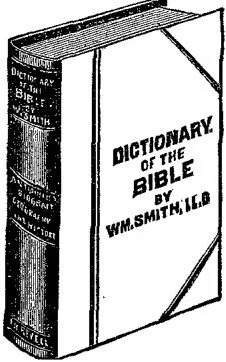
SMITH'S DICTIONARY of the BIBLE.

EDITED BY WM SMITH, L.L.D.
COMPRISING ITS ANTIQUITIES, BIOGRAPHY, GEOGRAPHY, AND NATURAL HISTORY.
PRICE, $2.00.
This work contains every name in the Bible respecting which anything can be said; over 400 engravings, and is a complete guide to the pronunciation and signification of scriptural names; the solution of difficulties of interpretation, authority, and harmony; also a history and description of Biblical customs, manners, events, places, persons, animals, plants, minerals, etc., and comprises a most complete encyclopedia of Biblical information.

—ADDRESS—

PACIFIC PRESS, 43 Bond Street, Oakland, Cal. New York City.

Papal Legation Secretary and American Protestant Alarm

WE are glad to see our contemporaries copying our original articles, even if they fail to give us credit. It is the dissemination of truth for which we aim, not popularity.
THE Evangelist, a leading Presbyterian paper published in this city, contained the following paragraph, under date of Dec. 27th:—
The new secretary of the Papal Legation in this country, Father Rooker, recently appointed by the pope to succeed Dr. Papi, appears to have been nominated in accordance with a recognition of this relative condition of things. Father Rooker is an American and of the liberal school represented by Cardinal Gibbons and Archbishop Ireland and the brilliant Paulist Father who recently lectured to the students in Union Seminary. His choice appears to be a good omen for America, and for the church of which he is a representative.
“A good omen for America!” Blind, indeed, must be the American Protestant who can see a good omen for America in the appointment of any Roman Catholic to secretaryship of the Papal Legation at Washington. The more he is like “Archbishop Ireland and the brilliant Paulist Father who recently lectured to the students in Union Seminary,” the sooner will the scheme of Rome be realized. Shades of Martin Luther! Are American Protestants drunk? Yes, drunk with the wine of Babylon.
THE real spirit of National Reform was well exemplified in the recent New Castle convention by the means used to counteract the influence of certain religious liberty publications, distributed there prior to the meeting. These publications were, “Limitations of Civil Authority from the Standpoint of Natural Right and Divine Obligation;” and, “Why Do Seventh-day Adventists Suffer Imprisonment Rather Than Keep Sunday?” Reference was made to these publications several times, and always in a way to prejudice the people against them. But the climax of misrepresentation was reached when Dr. D. McAllister exhibited a copy of the Truth Seeker to the audience, and calling attention to the cartoons on the first and last pages, said that such was secularism gone to seed; that such was the logical conclusion of opposition to their movement, etc.; and classed the AMERICAN SENTINEL with the paper he was exhibiting. This was grossly unfair, for the SENTINEL has nothing in common with the Truth Seeker, except opposition to National Reform, and even this is from so widely different a standpoint that it can scarcely be said to be in common.
But unfair and misleading as was Dr. McAllister’s statement, it was not sufficiently so to satisfy Dr. H. H. George, and he arose in the convention, and referring again to the religious liberty publications, said, “They all emanate from the same source and are of the same character.” Nothing could be more false, for while the Truth Seeker is intensely hostile to all revealed religion, the tracts to which reference has been made are consistently Christian, and breathe a spirit of genuine Christian piety; and this every honest man must admit, whether he agrees with the conclusions reached or not. The statements made were nothing short of palpable violations of the ninth commandment, and especially is this true of that made by Dr. George; indeed, it is hard to believe that his was not a deliberate purpose to deceive the audience as to the character of the tracts in question.
But is infidelity “opposition to National Reform gone to seed”? Is it the logical conclusion of opposition to the so-called “Christian theory of civil government”? By no means; for as we have repeatedly shown in these columns, National Reform is itself anti-Christian. Moreover, it is no more logical to class the Truth Seeker and the AMERICAN SENTINEL together because they both oppose National Reform, than it would be to class the Truth Seeker and the Christian Statesman together because they both oppose Romanism. The Roman Catholic can just as consistently argue that infidelity is simply opposition to Romanism gone to seed, as the National Reformers can argue that infidelity is simply opposition to National Reform gone to seed. Either is a begging of the question and is unworthy of honest men. Let the National Reformers meet and refute, if they can, from the Scriptures to which we constantly appeal, the arguments of the SENTINEL. Yea, let them clear themselves of the charge that their so-called reform is not subversive of the very foundation principles of the religion of the Lord Jesus Christ which they profess to serve.
IN a speech to the pontifical household, Dec. 24, as reported by the World, the pope said:—
The faith is reviving among the nations, which have come to recognize that civil virtues and laws are not sufficient to restrain the masses. It is of great importance, therefore, that all work together to make religion a force in public as well as in private life. It is the duty of rulers to lend their support to religious creeds.
The one great scheme which the pope is working to bring the governments of the world in submission at his feet is here briefly stated. “The masses cannot be controlled without religion. The Protestant religion commenced in anarchy and ends with anarchy. The only religion which can restrain the masses is the Roman Catholic religion.” Therefore, “it is the duty of rulers to lend their support to religious [Roman Catholic] creeds.” Rome breeds anarchy in her followers by telling them that the nation which does not recognize the Roman Catholic creed is a heretical nation, unstable, and must sooner or later come to ruin. When this teaching bears fruit in social unrest, riots and Coxeyism, she points to these social disturbances and charges it upon a failure to recognize the papal creed, and offers to calm the troubled waters in exchange for power. The Catholic World of August last, closed its observations on the Coxey movement which were similar to the statement of the pope here quoted, with the significant remark: “What possibilities there are in the old church!” This game of the pope will succeed and that soon, but this very success will preface the everlasting overthrow of this anti-Christian system. See Revelation, chaps. 17, 18, and 19.
EX-SENATOR TOLLEY, of Tennessee, who has been a careful reader of the AMERICAN SENTINEL for several years, writes thus complimentary of the paper: “There is not an abler, fairer, or more convincing advocacy of any cause by any organ in the whole country than that displayed by the SENTINEL for the cause it champions.”
And now, a word of encouragement to the State branches of the International Tract Society, which are sending the SENTINEL to the members of State legislatures. Mr. Tolley, who has labored and is laboring so earnestly and unselfishly for the relief of the persecuted seventh-day observers of his State, first became interested in the SENTINEL while a member of the Tennessee legislature. The paper was sent free to all the members of that body, and Mr. Tolley became interested in it and has been a regular subscriber ever since. It would pay to send the paper to every legislator in the United States, if perchance it would result in the discovery of another such a friend of liberty of conscience, and there certainly must be more of them.
THE valuable work, “The Marvel of Nations,” advertised for one dollar on the advertisement page, can be obtained with one year’s subscription to the SENTINEL for $1.25. This applies to renewals as well as new subscribers.

You have reached the end of this edition.

The American Sentinel · Jan 10, 1895