The Youth’s Instructor, Vol. 37, No. 7.

THE LITTLE BROWN BIRDS

The Youth’s Instructor

Feb 13, 1889

S. D. A. Publishing Association · Battle Creek, Mich. · Feb 13, 1889

THE LITTLE BROWN BIRDS.

CHICKADEE! chickadee! Under the cedars The little brown birdies are crowding together; The snow-drifts are heaping, the wild winds are raving. But the little brown birds do not ruffle a feather. O chickadee, chickadee, Like you I fain would be, Brave and undaunted, let happen what weather.
Chickadee! chickadee! Haste, little maiden— Haste the birds' breakfast to lovingly scatter. See how they wait for you, trust you, are glad of you! How the birds' faith should the little maid flatter! O chickadee, chickadee, Like you I fain would be, Cheery and trustful, let happen what matter.
Chickadee, chickadee, under the cedars Hopping so merrily! God keeps the tally, Knows every birdling, though cold be the winter, Fierce the rude blasts of the bitter storm's rally. O chickadee, chickadee, Like you I fain would be, Happy, though storms o'ersweep hill-side and valley.
—Harper's Young People.

THE USES OF COAL.

It has been estimated that the steam produced by one pound of good coal will, when applied to an engine, do as much work in a day as a man. Reckoning 300 working days in a year for a man, and thirty years for his working life, we see that he works only about 9,000 days in all his life-time. If it be true that one pound of coal represents one day's work, then it requires only 9,000 pounds, or four and a half tons, of coal to represent the entire life-work of a laboring man. This seems almost too wonderful to believe, and yet we know that coal is a great labor-saver when used in producing steam.
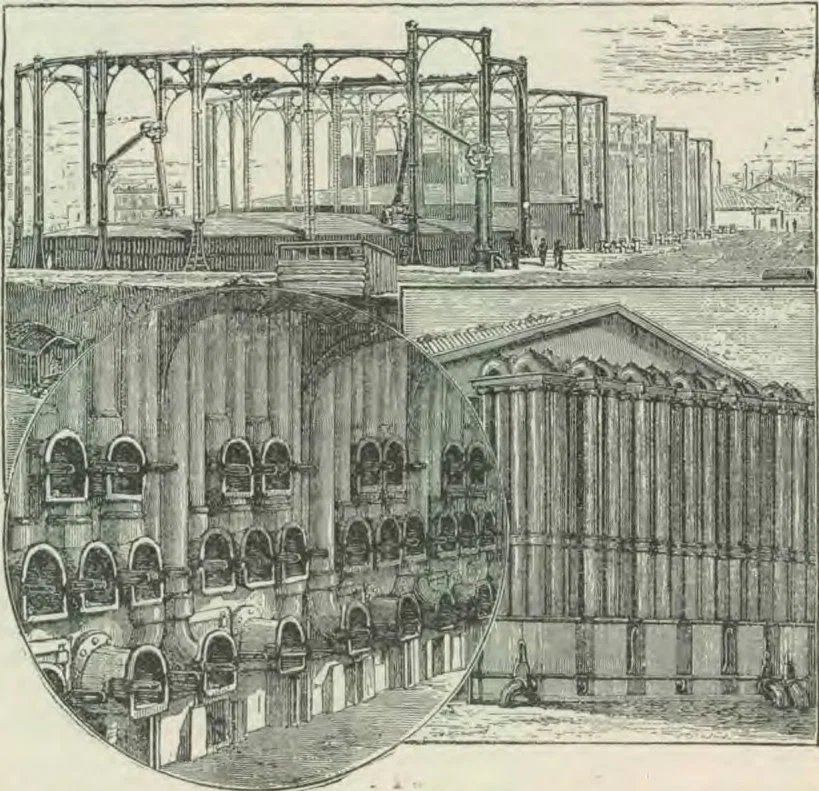
But coal is used for another purpose, which we will notice: that is, for making gas with which to light streets and houses in our cities. Gas is produced by what is called “distillation.” The coal used is first placed in “retorts,” or large ovens, strongly built, and lined with fire-clay. These ovens are built in rows, as shown in the lower left-hand corner of the picture on this page, and are heated from furnaces below, the flames surrounding them with an intense heat.
When the retorts are filled with coal, their projecting mouths are closed by iron covers screwed tight, and are plastered over with wet clay to make the ovens air-tight. At the end of every four hours, the retorts are opened, the old coal is raked out, and a supply of fresh coal is thrown in.
If we could look into one of these retorts when it is first opened, we would see that the coal put in four hours before is one fierce glowing mass, from which the gas has been extracted. The hot gas has passed off through iron tubes connected with the retorts into what is called the “condenser.”
The condenser may be seen in the picture at the right of the retorts. It consists of numerous upright pipes, joined at the top, and standing in pairs over a large cistern, into which the ends of the pipes are inserted. Connected with these upright pipes are others, which are kept cool by means of cold air or water. Through all these, from one to another, the gas is forced, until it becomes chilled, which separates from it all the liquid vapors it brought with it from the retorts. These, when separated from the gas, thicken and condense, and fall into the cistern below, from which they pass, through a pipe, into what is called the “tar-well.”
The gas must then pass through a purifying process to relieve it from the presence of a most nauseous and unwholesome part called “sulphuretted hydrogen,” before it is stored ready for use. The usual way of doing this is to conduct the gas through a pipe into a perforated iron cylinder, which is placed in water thickened with lime. The lime attracts to itself the obnoxious matter, while the purified gas rises to the top of the reservoir, and is passed into the gasometers, where it is stored until needed for lighting purposes. These are shown in the upper part of the cut.
All who have seen the large, boiler-shaped gasholders which are connected with all gas factories, know that they are made of iron plates, firmly riveted together. The lower ends of these tanks are not closed, as at the top, with iron, but the tanks are in the form of an inverted tumbler, whose mouths set down into the water, thus shutting off the escape of gas.
When the gasometer is dropped low down into the water pit, like the nearest one in the cut, it is because it is empty, or nearly so, of gas. But as it fills with gas, it rises in the iron frame which surrounds it, and when its top is nearly even with the frame, it is full of gas. As the tank empties of gas, it lowers into the water, which takes the place that was before occupied by the gas. Then of course when the tank fills again with gas, it lifts out of the water to make room for the gas.
About two hundred years ago, Robert Clayton, of Cork, by experimenting with coal, learned how to extract the gas from it. His experiment was then looked upon by most people only as a curiosity. Afterward, in writing about his discovery, the bishop said: “I kept the spirit [gas] in bladders, and when I had a mind to divert strangers or friends, I have frequently taken one of the these, picked a hole therein with a pin, and compressing gently the bladder near the flame of a candle till it once took fire, it would continue flaming until all the spirit was compressed out of the bladder, which was the more surprising because no one could discern any difference in appearance between these bladders and those filled with common air.
The bishop's experiment was much talked of by some, and was indeed brought to the notice of the Royal Society. But that body did not consider it of enough importance to warrant their taking any definite action toward making it a useful discovery. There were those who even thought it possible to manufacture gas from coal on a grand enough scale to light houses, and perhaps the streets of towns; but the theory was laughed at by others, while scientific men opposed it on the ground that its use would be very dangerous.

THE OLD-FASHIONED GIRL.

She flourished thirty or forty years ago. She was a little girl until she was fifteen. She used to help her mother wash the dishes and keep the kitchen tidy, and she had an ambition to make pies so nicely that papa could not tell the difference between them and mamma’s; and yet she could fry griddle cakes at ten years of age, and darn her own stockings before she was twelve, to say nothing of knitting them herself.
She had her hours of play, and enjoyed herself to the fullest extent. She had no very costly toys, to be sure, but her rag doll and little bureau and chair that Uncle Tom made were just as valuable to her as the $20 wax doll and elegant doll furniture the children have now-a-days.
She never said, “I can’t,” and, “I don’t want to,” to her mother, when asked to leave her play and run up stairs or down on an errand, because she had not been brought up in that way. Obedience was a cardinal virtue in the old-fashioned little girl.
She rose in the morning when she was called, and went out into the garden, and saw the dew on the grass, and if she lived in the country, she fed the chickens and hunted up the eggs for breakfast.
We do not suppose she had her hair in curl papers, crimping pins, or had it “banged” over her forehead; and her flounces were no trouble to her.
She learned to sew by making patchwork, and we dare say she could do an “over and over” seam as well as nine-tenths of the grown-up women do now-a-days.
She was not learned in French verbs or Latin declensions, and her near neighbors were spared the agony of hearing her pound out “The Maiden’s Prayer,” and “Silver Threads among the Gold,” twenty times a day on the piano; but we have no doubt she made her family quite as comfortable as the modern young lady does hers.
She learned the solid accomplishments as she grew up. She was taught the arts of cooking and housekeeping. We suppose that we are not exactly up with the times, but we honestly believe, and our opinion is based on considerable experience and no small opportunity for observation, that when it comes to keeping a family happy, a good cook and housekeeper is to be greatly preferred above an accomplished scholar. When both sets of qualities are found together, as they sometimes are, then is the household over which such a woman has control blessed.
The old-fashioned little girl was modest in her demeanor, and she never talked slang or used by-words. She did not laugh at old people or make fun of cripples, as we saw some modern little girls doing the other day. She had respect for elders, and was not above listening to words of counsel from those older than herself.
She did not think she knew as much as her mother, and that her judgment was as good as her grandmother’s.
She did not go to parties by the time she was ten, and stay till after midnight. She went to bed in season, and said her prayers before she went, and slept the sleep of innocence, and rose up in the morning happy and capable of giving happiness.
And if there be an old-fashioned little girl in the world to-day, may Heaven bless and keep her, and raise up others like her.—Selected.

BIT AND BRIDLE.

“Be ye not as the horse, or as the mule, which have no understanding; whose mouth must be held in with bit and bridle, lest they come near unto thee,” rapidly repeated Harry Vane, as he was brushing his hair, preparatory to going to Sabbath-school. “I don’t see why she gave us that verse to learn; surely I am not like a horse, or a mule either. I can understand what I am told to do.”
Mrs. Vane, who usually taught Harry his lessons carefully, had entirely neglected him this week. Baby Nell had been quite sick, and she felt weary after several nights of anxious watching.
“We have no time for a talk now, but your teacher will explain it to you,” said Mrs. Vane, as she gave Harry a good-by kiss.
He went away not a little puzzled, but he very soon overtook some other boys, and the text was dismissed from his mind.
There were bright, cheerful faces in the class that morning. But it was with some difficulty that the restless hands and active brains were kept quiet during opening exercises. Mrs. Rue loved the children under her care, and was patiently trying to lead them to follow the teachings of the Saviour. She absorbed their interest so completely during the time allotted to recitation that there was no time for mischief; but during the opening and closing exercises she had been frequently annoyed by misbehavior in these past few weeks, during which the class had been hers.
“How many can repeat the verse for to-day?” asked Mrs. Rue, with her usual smile. Every hand went up.
“Well, Harry, let us hear you say it, plainly, that all may understand.”
Then Harry repeated these words: “Be ye not as the horse, or as the mule, which have no understanding: whose mouth must be held in with bit and bridle, lest they come near unto thee.” Ps. 32:9.
“Very well done. What lesson did you draw from these words? You know that, ‘All Scripture is good for instruction.’”
“I didn’t get any lesson; for I am sure that I can understand, and do not need a bit or a bridle to guide me,” said Harry.
Roy Jones had been carefully taught, and at Harry’s reply he put up his hand, anxious to tell what he knew.
“What have you to say, Roy?” asked Mrs. Rue.
“Mamma said that horses and mules go only when they are driven, and without bit and bridle we would not be able to guide them; and that some children do not do right unless they are compelled to do so by their parents.”
“Yes, Roy, that is the thought exactly. Most children, if good, are so because from infancy they have had the watchful care of parents to keep them from the evils of the world. By nature you are no better than the bad street boys whom you do well to shun. How much you should love your kind parents, who are so zealous for your eternal interests!
“But when do we begin to break a horse? after it is old, and its habits are well fixed?”
“Papa said that we must break our colt next year, and she is only two years old,” said Harry.
“Do you know why he begins when the horse is so young?” asked the teacher.
“Because then it is easier to teach him new ways,” promptly replied Roy.
“Yes; and if you take a canary bird when it is young, you can teach it to hop out of the cage, and to sit on your finger, pick at your teeth, and to do many amusing things that an old bird never would learn. So also you may teach your dog and cat many tricks if you only begin when they are young.”
The children were now fully awake, ready to appreciate deeper thoughts, so Mrs. Rue continued questioning.
“Why teach children the Bible? Why not wait until they are old enough to read and understand it for themselves?”
“Because they would learn many wicked ways while they were growing up,” replied one of the class.
“Yes,” said Mrs. Rue; “and it is much easier for a child to change his ways than for a man to change who has been doing wrong for a long time.”
“How many of you love the Lord?”
Every hand went up.
“Now, children, if you love the Lord, you must obey him; for he says, ‘If ye love me, keep my commandments.’ Now if you do not steal because your parents and teachers watch you so closely that you have no chance, that is not keeping the eighth commandment. You are simply held in with bit and bridle lest you come near sin; you make no use of your understanding, and are thus like the horse and the mule, which have none. But if the opportunity presents itself, and you resist, then you are keeping the commandment in your heart. So, at home and at school, and wherever you are, you should do right because the eye of the Lord is upon you, and because you love him.
“You have no temptation to play when I am talking to you. You are interested, and love to hear me talk. My words are to you a bit and a bridle. But during general exercises the bit and the bridle are removed; and though you know what is right, you do not always do it. Now, may each one remember the lesson this verse contains. We have no time to talk longer on this text,” concluded Mrs. Rue, “for our lesson is full of good thoughts.”
That night, as Harry kneeled to say his prayers, he earnestly asked the Lord to help him to do right for Christ’s sake.
J. F. C.

BILLY BRAGGIE AND KING CANUTE.

Willy Reynolds had such a disagreeable habit of boasting that his schoolmates had nicknamed him “Billy Braggie.”
His grown-up sister Fanny once said she thought Willy must carry a pair of lenses over his eyes that magnified everything he did and owned; for he certainly thought his sled could outslide, and his skates outrace, and his kite outfly, and his feet outrun and outclimb, those of any playmate; and he was so disagreeably prompt and loud-voiced and long-tongued in claiming first preference and praise for his possessions and exploits, it was not a bit strange that he was not a favorite at school or on the playground; and “Billy Braggie” seemed liable to cling to him all his lifetime.
Perhaps you know a boy who wears just such lenses,—a queer kind of glasses they are, too; for while they puff out, and spread out, and stretch out, into wonderful proportions, or as having wonderful qualities, everything that that boy owns, from a lead-pencil to a new pair of boots, and put a blaze of smartness about everything he does, from climbing a tree to writing an exercise on the blackboard, they dwarf and shrivel into pitiful smallness everything others possess or do.
Willy’s mother did not wear any such glasses; so she could see very plainly this growing fault in her little boy, and it caused her many troubled thoughts. She talked with him very earnestly, telling him how foolish, and hateful, and sure to grow, was this habit of boasting.
“Great men and noble men are always humble, and do not claim the first places, or think themselves wiser and smarter than their companions,” she said one day, when Willy had come racing in, eager to show a pocketful of quartz crystals he had gathered on a school excursion to the tip-top of a ledge-covered mountain near their home.
“All the boys went, and a tough scramble we had climbing the steep sides of old Bannock, but I got there first, mother; I beat every one of them—the teacher and all—in getting to the top first. And just see these crystals, mother; aren’t they beauties! I found a splendid ledge way up on the north side of the mountain, where the other boys wouldn’t have thought of climbing, and we picked almost a bushel of crystals from it, but I got the biggest and best ones of all.”
And so proud and sure was he of his superior No. 1 abilities and possessions as seen through those deceitful magnifying glasses, that he swallowed, as a deserved, big, sweet crumb of praise, Fanny’s quiet remark, looking straight into the little braggart’s eyes:
“I am very glad my young brother is so much smarter and keener-witted than his mates and teachers!”
When Willy came from school the next day, he found a dozen pretty pink-bordered handkerchiefs lying on the table in his room. In a corner of each, his name was stamped with the dainty flowered letters and scroll that he knew came from Fanny’s new type-font; but in the opposite corner of each handkerchief was a bright pink picture, whose meaning he did not understand.
“George Washington,” he thought at first, seeing the face of a noble, kingly man printed on the white cambric. But no. Who ever saw George Washington represented as sitting by the sea-shore in a great carved chair, with a retinue of officers, in plumes and coats-of-mail, crowding around him?
“Mamma, what does it mean?” he asked, carrying her one of the queer-pictured handkerchiefs.
Willy’s mother stopped the click-clack of her sewing-machine to look at the gay pink figures indelibly stamped on the cambric.
“It must be a king, mamma. See! he wears a crown on his head, and a great fur-trimmed cloak, all beaded with pearls, and his chair is like a beautifully carved throne; but why does he sit in the edge of the ocean, with the great waves rolling up over his feet?”
“This is a picture of King Canute, Willy. He lived a long, long time ago, almost nine hundred years; for he died in 1035.
“He was king over England eighteen years, and his reign was the most peaceful and happy one that that country had seen, or again saw for many years. History tells us that he was not only a great and good and powerful king, loved by all his subjects, but that he was an exceedingly strong and large man, distinguished for uncommon beauty and talents.
“But, in spite of so much honor and flattery that he daily received, he did not become proud and boastful. One day his courtiers, excited and full of adoration over some new brilliant achievement or victory of their loved king, declared him the best and most powerful ruler on earth; that he was so wise and strong and god-like, that nothing could resist his commands.
“King Canute knew that such praise was all wrong. He knew that only one, God, was worthy of such worship; and to give his courtiers a lesson that they much needed, ‘to make them observe and acknowledge that God alone was omnipotent,’ he ordered his chair carried on to the sea-shore, while the tide was rising. As the waters approached, he commanded them to go back. Louder and louder he shouted to the creeping, lapping waves, telling them to obey the voice of him who was lord of the ocean, and then waited, pretending to expect the inrushing waters would obey him, while his courtiers crowded near, wondering what it all meant.
“Not until the tide threatened to wash away both chair and king, did Canute retire from the shore; and thus his courtiers were made to acknowledge that only God is truly powerful.”
Willy’s eyes were shining with eager interest as he carefully studied each figure in the gay picture, while his mother told this old story from history; but they grew very thoughtful and full of conscious shame, when his mother said, gently, smoothing the tangled brown locks: “And if this brave old king, brought up as a pagan, rich, powerful, honored, and with thousands ready to obey his slightest commands, could be so humble and zealously careful to give God all first honors and praises, ought not my little boy to overcome this fault of boasting and claiming for himself the first place and the first word in everything? Will you not let this picture of the great but modest and humble old king, on the handkerchiefs that Fanny has given you, help you to overcome this fault that is making you not only unlovable but untruthful?”
Willy carefully folded the pink-bordered square of cambric with the brave, calm face of old King Canute uppermost, and said, with a new light in his eyes, as though those deceitful glasses of his had at last been cleared away, “I will try, mamma.”—S. S. Times.

IF

“If you were me, and I were you, And all the world was twisted too, What do you think that you would do, If you were me, and I were you?”
“If I were you, and you were me, I’d be as good as good could be; I’d never fret nor tease, you see, If I were you, and you were me.”
“If you were me, and I were you, You think that you’d be good and true? Well, it’s as easy a thing to do When I am I, and you are you.”
“Since I’m not you, and you’re not me, Suppose we try, each day, to be So good that nobody can see Which I is you, and which is me.”
—The Pansy.

He Is Approved Whom God Commendeth

He is approved whom God commendeth.

LEARN TO SAY “NO.”

“No” is a very little word, In one short breath we say it. Sometimes ’tis wrong, but often right, So let me justly weigh it. “No,” I must say when asked to swear, And “No,” when asked to gamble; “No,” when strong drink I’m asked to share, “No,” to a Sabbath ramble. “No,” though I’m tempted sore to lie, Or steal, and then conceal it. And “No,” to sin when darkness hides, And I alone should feel it. Whenever sinners would entice My feet from paths of duty, “No,” I’ll unhesitating cry— “No, not for price or booty.” God watches how this little word By every one is spoken, And knows those children as his own By this one simple token. Who promptly utters “No” to wrong, Says “Yes” to right as surely, That child has entered Wisdom’s ways, And treads her paths securely. —Union Signal.

SUSIE'S BIRTHDAY.

SUSIE GRAHAM awoke very early one beautiful June morning, and she began thinking, and thinking; and she thought:—
“It is my eleventh birthday to-day, and papa has promised us all a nice, long ride in honor of it. But mamma has so much to do she says maybe she can't go. It will spoil all our pleasure to leave her at home to work while we are having nice times. Indeed, we should not have nice times at all without mamma, so I'll get right up, and see what I can do to help her get ready to go.”
Susie was a little Christian girl, and tried always to be helpful; but rather than have any member of the family deprived of pleasure when anything she could do would prevent it, she would make extra efforts to take the hinderance out of the way. So this morning she arose much earlier than usual, made her toilet, offered her prayer to God, and went at once to mamma's room.
“How is this,—that my little daughter is up before mamma this morning?” said Mrs. Graham as Susie entered the room just at daybreak.
“I think, mamma, I can help you so much that you can ride too. We can't think of going without you. It would be no fun at all.”
Seeing how earnest Susie was, Mrs. Graham arose at once, although it was much earlier than she was in the habit of getting up in the morning. She thought perhaps that by putting a little of Susie's zeal into her work, and with what help Susie and the other children would give, she could do all that it was strictly necessary should be done before Mr. Graham would be ready to go. She determined that, if possible, home cares should not bring disappointment upon her daughter's birthday, and so she hastened to the kitchen at that early hour.
Truly that was a busy morning at the Grahams,—breakfast to get and clear away, lunch-baskets to be provided for and packed (as they concluded to eat dinner in the woods), three children to dress, and the dozen and one little things that must always be looked after when one goes away.
But Susie flew around in her womanly way, making mamma's burdens light as possible, so she wouldn't be too tired to enjoy the occasion. Little hands did their part too, and it really proved true this time that “many hands make light work;” for they had everything done up half an hour before the time set for papa to call for them.
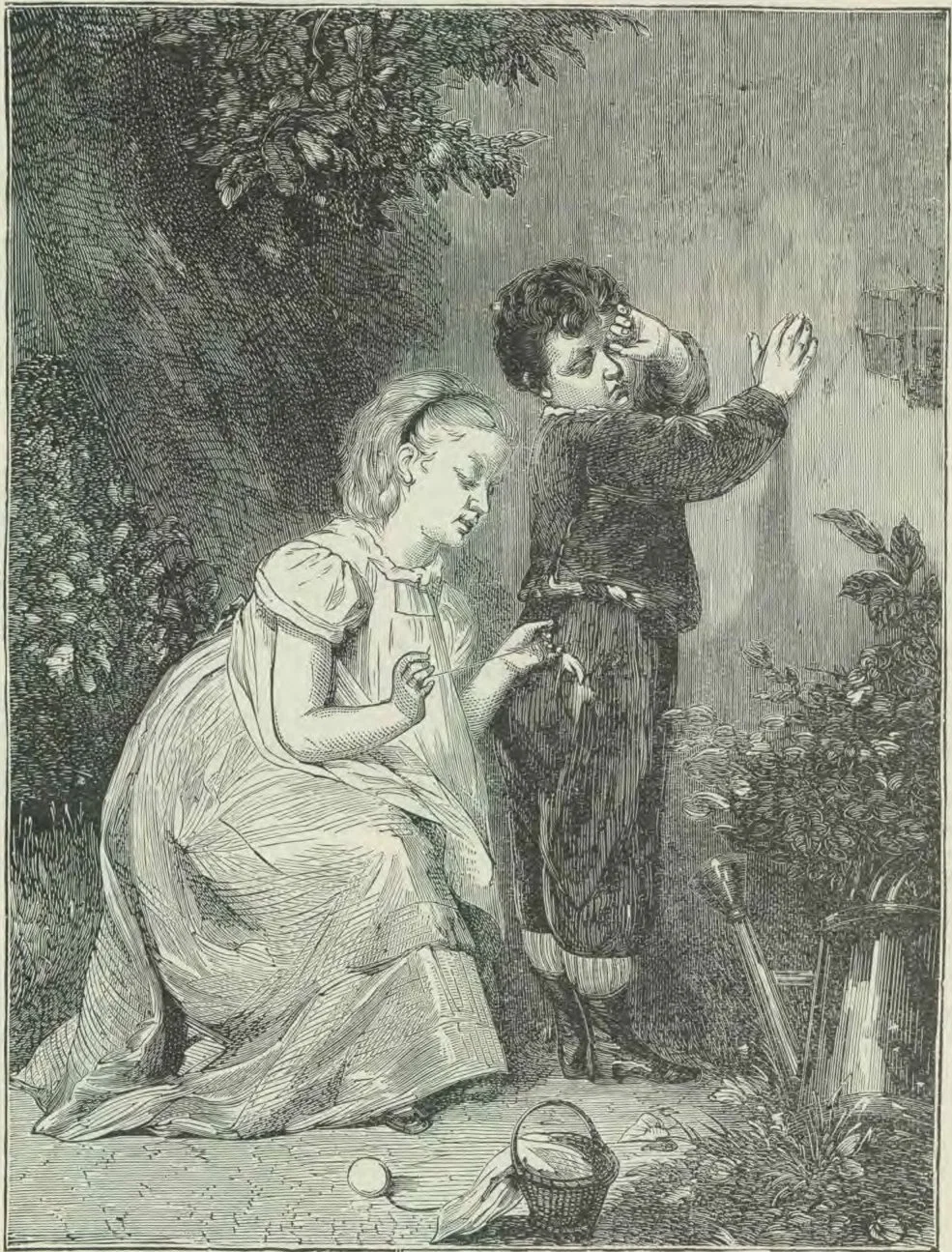
That no moments should go to waste, Susie caught up her work-basket to do a little mending while they were waiting. Before she had taken the first stitch, however, there was a cry of distress from one of the children. She ran, basket in hand, in the direction the sound came from, when, to her surprise, she found her little six-year-old brother grieving over a rent in his best suit.
While they were waiting for papa, Willie thought the flowers should be watered before they went away, and that he could sprinkle them faster by using the larger watering-pot; but it was so heavy, that in trying to lift it, he tumbled over it into a rose bush, and scratched his hands some, and tore his clothes more. When his sister reached him, he said very pitifully,—“O Susie, I had a big fall, and most made my hands bleed; but I don't care a bit only cause I've torn my new pants, and can't go riding, and 'll have to stay at home all alone, and not have any fun at all.”
“Never mind, brother,” said Susie; “I have a needle and thread right here, and can make that torn place look almost as well as new in just a few minutes.”
“Before papa comes, can you, Susie? and can I go riding, too?”
“Yes, dear, if you will stand perfectly still a little while.”
“You are a real nice sister, and I'll stand just as still; and I'll try not to bother you so much any more. See if I do.”
After a few moment's delay caused by Willie's mishap, the family were comfortably seated in the big carriage, and borne swiftly over the smooth roads of their beautiful country. The air, made vocal with the warblings of myriads of birds, was also laden with the perfume of thousands of June flowers. It was one of June's most delightful days; and you who have spent one such in the fields and woods know what was in store for the Graham family upon Susie's birthday. Mr. Graham said afterward, “It was one of the happiest days of our lives.”
But Mrs. Graham revealed what she thought was the principal secret of their happiness. This she did in conversation with Susie the evening after their ride. Susie was saying to her mamma that now she was eleven years old, she ought to be at work for the Lord. God's love had been made to look so precious to her that she wanted to be doing something to show her love in return, so she said she had asked the Lord to give her work to do for him every day. “And now, mamma,” said Susie, “do you suppose he will do it?”
“My precious child,” said Mrs. Graham, “the Lord is already giving you work every day, and in one of the best places in the world for little girls to work,—right in the home circle, with parents, brothers, and sisters. And he is helping you do the work, else you would not bear so cheerfully the duties which come along day by day. The Lord gives you a sweet, tender spirit, which is shining into other lives, and helps in making our home so pleasant.”
“You were at work for the Lord to-day, when you bore kindly and willingly so many family burdens that your parents were left almost wholly free from care, to rest and be refreshed. And although everything in nature was what any one could desire to make him happy, our greatest pleasure arose from the efforts of one of Christ's little servants to do faithfully what her hands found to do.”
“Your influence with the younger children is sweetening their lives, and they, too, are learning to love the dear Saviour. What a mission field for you right at home, Susie! And that is not all; for Christ's true followers will shine as lights to all who associate with them.”
“I begin to understand it now, mamma,” said Susie. “The Lord has work for us just where he puts us; and I shall be so happy now, because I know I am doing just what he wants me to do. And I know he will help me, because I shall be all the time trying to do my work to please him.” M. J. C.

HOW DOLL GOT THROUGH THE SNOW.

UNCLE FRANK had to go up to Bear Valley. He was building a dam there. This was to hold water for the farms in Redlands.
What I am going to tell happened in California. There is little rain in that country. Water is carried in ditches and pipes to the farms and gardens.
There was snow upon the mountains, but Uncle Frank thought that he and Doll could get through very nicely. Doll was the pony. She went like the wind when Uncle Frank sat in the saddle. She was very fond of him.
But the snow was deep, very deep, and soft. Doll pushed on with all her might, but it grew worse and worse. She began to puff and pant. Uncle Frank then threw away his saddle.
Doll struggled on bravely, but she was so tired that she would lean against the trees and pant. Uncle Frank had to walk and lead her. He threw away his coat and his overcoat. When Doll leaned against the trees, he lay down by her side to get his breath.
They reached Bear Valley at last, almost tired out. Uncle Frank had to return home in a day or two. He went down from the mountain on snow-shoes.
But poor Doll had to be left behind. How she whinnied when her master left her! She was very lonesome, and she was hungry too. There was nothing for her to eat except some poor straw and crumbs from the bread which the men ate who worked on the dam.
“I know what I will do,” cried one of the men, one day. “I will make Doll a pair of snow-shoes.”
Everybody laughed at this. But Doll was a wise pony. I believe she could have worn spectacles.
They made her a pair of shoes from round pieces of board. They were a foot across. How Doll did look at them, and pick up her feet, and straddle, when they were first tied on! But she practiced a little every day, and soon she could walk upon the snow as well as a man.
So one day Uncle Frank was astonished to see his pet, Doll, come back to Redlands. She had marched down the mountain on her snow-shoes. She was very proud of it, I think.
Should you not like to see a pony walking on snow-shoes? It is a funny sight, I can tell you. And Doll could not have done it if she had not tried.—Our Little Ones.
Continue reading: OLD TESTAMENT HISTORY