The Youth’s Instructor, Vol. 37, No. 52.

THE WITNESS OF ELSIE LYLE

The Youth’s Instructor

Dec 25, 1889

S. D. A. Publishing Association · Battle Creek, Mich. · Dec 25, 1889

THE WITNESS OF ELSIE LYLE.

ELSIE LYLE, an attractive girl of seventeen, sat between the red plush cushions of a railroad car at the beginning of a long day's journey. It was to be a pleasure trip, long planned and looked forward to; and the best of it had been that her father could go with her, and she need have no care for the changes of the way. The day before she was to start, however, her father had been summoned elsewhere, and she was obliged either to give up the journey, or to go alone.
“It is quite time that my girl learned to travel,” her father said as he kissed her good-by.
It was not a difficult journey from Quinsogue to Boston, except that it involved two changes. Elsie would not have dreaded it at all if her anxious mother had not overburdened her with directions and forebodings.
Just as the train started, Mr. Wardlaw, Elsie's pastor, took the seat by her side for a little while.
“I am glad, Elsie,” he said, as he rose to go at the next station, “that you are to have a holiday. I value opportunities of travel, because they are opportunities of witness-bearing.”
The words lingered in Elsie's memory, and gave a new turn to her thoughts. She had been thinking that she needed help, but Mr. Wardlaw thought she ought to offer help to others. She wondered if any opportunities of witness-bearing would come to meet her on her journey.
The seat in front of her was taken at the next station by a poorly-dressed woman with three children. The oldest was a boy about nine, clad in a worn jacket with embroidered collar, and sleeves much too short, over a wrinkled blue shirt-waist, spotted with yellow triangles; and all this faded splendor surmounted by a freckled face and a fringe of red hair under a straw hat. He was evidently a good-natured boy, with smile enough for two, and when his mouth was open wide, you could see little else but that—and freckles. The other children filled the mother's seat, and the freckles had drifted in with Elsie.
Now Elsie was fastidious, and she was not fond of boys. She had no younger brothers, and she felt, I think, that ragged, half-grown urchins were wild creatures, whom she did not know how to tame, and so avoided. It was not pleasant to have this boy's frayed garments and dusty boots so near her own dainty self, and the big warts on his hands made her shiver with disgust.
He, too, looked at her as if she had been some strange wild creature. What did he think of her? she wondered. She must persuade him to think kindly, if possible; for, when she considered, he had as much right to his place in the world, and to his half of the seat in the crowded car, as she. And then, she was Christ's disciple, and must be careful how she treated one of his little ones.
I do not say that it was easy for her; but obedience has its own reward, and soon she grew interested in the child. He was as restless as a sparrow. What would he do next? And all the time he did not speak a word. Elsie had no more idea how to talk to a boy than to a monkey, but she was saved the trouble of beginning.
Suddenly he pointed out of the window, and called out, “O, say! See that feller fishing!”
“Do you fish?” asked Elsie.
“Well, I guess!” was the answer. “I caught a string of trout down in Beelat that would make your eyes stick out!”
As it happened, Beelat was a town which Elsie knew by heart. Her grandmother lived there, and she had spent happy weeks in the old farm-house. She had herself caught trout in Beelat. There was no trouble about conversation after that.
Indeed, she soon found that the whole family had placed themselves under her protection. They, too, were going to Boston, and she became at once an authority upon the route and all its changes. It amused Elsie to find herself talking like an experienced traveler, as indeed she was, in comparison with this woman, who was making the first real journey of her life. She shared her lunch with Tommy and his sister, and drew pictures of horses and sheep and railroad trains. It was she who led the way when changes were to be made, and found seats for all on the shady side.
Altogether, Elsie was surprised when the journey came to an end. She was tired, but not half so tired as she had often been on a much shorter journey.
As she reviewed the day, however, after a pleasant evening with her friends, one cloud of trouble passed across her sky. “Mr. Wardlaw said that travel was an opportunity for witness-bearing, and I have not spoken a word for Christ all day.”
But the true story of the day was not yet ended. A fortnight later Elsie received a letter from Mr. Wardlaw.
“I have good news to tell you, Elsie,” he wrote.
“Do you remember Mr. Smith, the lawyer, who sat on the other side of the car that day you left home? I have often wondered why he was not a Christian. Yesterday he sent for me. I found him shut up in the house with a cold. He apologized for the trouble he had given me, and added, ‘I have sent for you to teach me how to be a Christian.’”
“You can imagine that I was glad, but I was happier yet when he told me how he had reached this decision. Can you imagine what you had to do with it, Elsie?”
“It seems he had been fighting with his conscience until that day when you set out for Boston. ‘I trav- eled half a day,’ he said, ‘with Elsie Lyle. I knew that she had just made a profession of faith, and I set myself to watch her. I know what young girls are like—I have had daughters of my own. “I will see,” I said, “if I can discover any sign of a changed life in this young girl.” “And if you do?” said conscience. “If I do,” I answered to myself, “I will believe in Christ.” I wanted her to fight my battle for me. It was cowardly and unfair, I admit, but I did it.
“Just then a whole platoon of disagreeable children pounced down upon her, and a boy—such a boy!—perched beside her on the seat, and overturned all her belongings. A shadow of ladylike disgust! This is your love for the brethren, I said; love at arms' length. I was hard upon her. I would have been disgusted if such a disagreeable child had crowded in upon me. And then I looked once more, and there was a new expression in her face. She had positively forgotten self, and was thinking of the boy; and presently she had won his heart, and for half a day she proved herself an angel of mercy to that worn-out mother and her three fretful children. I went a hundred miles out of my way to test and cross-examine her. And it was genuine. She did not do it as if it were a bore, as I have seen men handle duty. From the beginning to the end she was not thinking of herself at all. I had made my challenge, and was beaten. There was nothing left to do but to surrender. What the spirit of Christianity had done for Elsie Lyle, I wanted done for me.”
“And the best of it is, Elsie, that he is a Christian, and I want you to share the joy.”—Congregationalist.

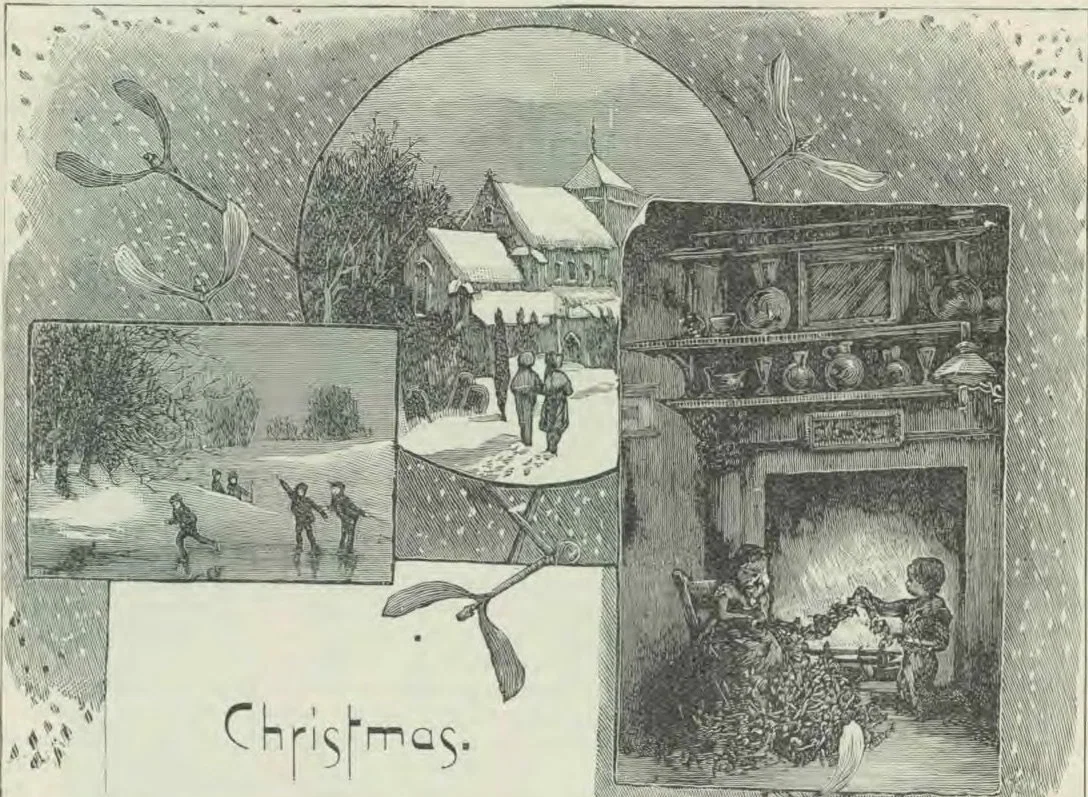
Christmas.

The bells ring clear as bugle note, Sweet song is thrilling every throat, 'Tis welcome Christmas morning. Oh, never yet was morn so fair, Such silent music in the air; 'Tis merry Christmas morning.
Dear day of all days in the year, Dear day of song, good will, and cheer; 'Tis golden Christmas morning. The hope, the faith, the love that is, The peace, the holy promises; 'Tis glorious Christmas morning.

LIFE-SAVING STATIONS.

Along the entire American coast, at necessary points, our government has established in convenient quarters, crews of men, with life-saving apparatus, to assist vessels in distress. These crews remain on the coast from September first until the last of April, eight months in each year. Hundreds of lives and many million dollars’ worth of property have been saved by these fearless men. A writer in the New York World states what he saw at a recent visit to one of these stations, where the captain in charge gave an exhibition to illustrate the methods adopted to assist a vessel in distress. He says:—
“To give a practical demonstration of the efficiency of his little command, the captain called his men into the drill-room, and informed them that he would show how lives are saved by means of the breeches buoy. Of course, as there was no wrecked ship to fasten the line to, the demonstration was made on land. The station flag-pole, which stands about one hundred yards from the station on a sand hill, was to be the ship in distress for the occasion.
“One of the crew was sent to the flag-pole, and from that point he shot off a small cannon as a signal of distress. A quick order from Capt. Van Wicklin, and the next moment the crew were hauling the carriage containing the appurtenances to the breeches buoy over the sand at a great rate. At the top of the knoll they stopped, and in accordance with orders, piled the ropes and Lyle gun on the sand in position ready for use. A charge of giant powder was hastily rammed into the gun, and on top of this was placed a heavy bar of steel, at one end of which was fastened a long piece of neatly-coiled rope.
“While the captain was preparing the charge and aiming the gun for the flag-pole, as the imaginary ship, the other members of the crew were burying in the sand two heavy cross-beams, to which the pulleys and heavy ropes were attached.
“‘Stand ready!’ cried the captain. The crew immediately took their positions at the ropes, and a second later off went the bar of steel through the air, like a rocket, taking with it the rapidly uncoiling line. The captain’s aim was a good one; for a second later the ‘shipwrecked sailor’ was hauling in the big rope, which had now been attached to the first line. When he took hold of the big rope, he found a black board tied to it, with the following instructions painted in white letters:—
“‘Make this hawser fast about two feet above the dart block. See that all is clear, and that the block runs free, and show signal to the shore.’
“The sailor fastened the rope as he was told, and showed the signal. The crew then hoisted a huge prop, like a tent-pole, under the rope about ten feet from where it was fastened in the sand. In the meantime the light line had been run out again by a series of pulleys, and when it had completed the circuit, the breeches buoy was attached, and quickly sent towards the sailor, over the imaginary waves. The sailor, who had fastened the rope about eight feet up the pole, climbed into the buoy, and with a rush and a hurrah, the crew brought him safe to shore.
“The life-car is another adjunct, and a valuable one, to the saving of life. It is an inclosed boat, built of thin sheet-iron about ten feet long, and pointed at both ends. At the top of the car is a small trap-door, which is just large enough to admit the passage of a medium-sized man. At each end are two iron rings, through which the ropes are run, and the rigging from the shore to the ship is the same as that used with the breeches buoy. The car is only used when the surf is too high for both the breeches buoy and the life-boat, and when the ship is liable to go to pieces at any moment. The car will accommodate six or eight persons, while the buoy only carries one at a time. It has been used with great success in a high sea, as the men at the oars are protected from the waves. The single passenger in the buoy often goes under a heavy wave, and in one case on the coast near Maine, a man being rescued in this way was drowned before he could be hauled ashore.
“After the ropes and the buoy were run back to the station, the order was given for practice with the life-boat. The men stood at the ropes, and, at the proper order, out of the station they rushed, with the boat on its carriage. A stiff pull of nearly two hundred yards brought them to the water’s edge, where the wheels were unlocked and taken apart, letting the boat fall gently on the sand with her nose pointing towards the sea.
“Each man then buckled round his waist a huge cork life-preserver, and laying his oar along the gunwale, took his stand near his seat. At another order the boat was pushed through the sand until her nose was just touched by a retreating wave.
“Each of the crew had on a suit of heavy oil clothes, and wore a big ‘sou’wester,’ which reached two feet down his back. There they stood, almost motionless at their positions, the captain at the stern, waiting for a favorable moment.
“‘Stand by!’ cried Capt. Van Wicklin, and in a second the boat was being shoved through the shallow water. When the crew were knee-deep in the bubbling surf, they were ordered aboard, and aboard they went in a hurry. Each man sprang to his seat, and it was but the work of an instant to grasp the oar and run it through the rowlock. The captain in the meantime had jumped to his seat at the stern, and had run out a big oar, which he used as a rudder. The boat was carried swiftly out by the receding wave, but not far enough for comfort, for the next wave broke over the bow, drenching every one of the crew. The oars were then plied with a will, and in a short time the gallant boat was riding the waves like a feather, half a mile from shore. After a twenty minutes’ drill in oarsmanship the order was given to put about for shore.
“When the crew were about one hundred yards from the beach, the captain, who had been keeping an eye out behind for some time, suddenly cried, ‘Lay to! double quick!’ as a huge roller struck the stern of the boat. The crew immediately bent over their oars at the top of their strength, and the speed, suddenly increased, had the desired effect. The boat rested easily on top of the wave, and went rushing towards shore like a race-horse. The oars were shipped, and every man was in readiness for a quick jump. Just before the shore was reached, the boat seemed to slide a little ahead of the breaker, and as the keel struck the sand, the wave broke with a roar over the stern, completely drenching the captain. In an instant the men were on their feet at each side of the boat, and up the beach she was dragged before the next wave could reach her. The life-belts, which had only been used for practice, were taken off, and the boat rolled back to her place in the station.”
W. S. C.

A SISTER'S INFLUENCE.

“I WONDER,” said Mrs. Eaton, “what makes Frank Sawyer so different from Tom Blake and Billy Harris? They’ve both got good homes and good parents, but Tom and Bill are as rough as young Indians, and never seem to know the difference between the inside of the house and outdoors.” Well, the fact was that Frank Sawyer had sisters, and it was impossible to feel that the “inside of the house” was the same as “outdoors,” where the presence and influence of either younger or older sisters were constantly felt.
Said a gentleman in our hearing not long since: “I can never tell what my older sister was to me all through my growing up. I knew nothing of her value to me as a boy, recognized comparatively little of it as a young man, but now I have reached years of maturity, I realize how much she did to make home attractive, and my childhood a pleasant one.”
And again, it was but a little while ago a lady was speaking of the gentle manner and unusual ability in entertaining shown by a young gentleman who had recently come into the community. “Oh, well,” said a friend, “I’ll tell you where he learned his ease and acquired such finished manners; he grew up with a lot of sisters, and they always depended on him to help them when they had company, and they consulted him about their fancy-work and the arrangement of a room or tea-table, just as if he were another girl.”
Commend us to those boys who have grown up with “a lot of sisters.” We have often heard a gentleman remark regretfully, “I never had a sister; that was something I missed.” We feel for such a genuine pity that they should have missed so much. But do the girls of the family realize even slightly the great influence they are exerting, or might exert, over their brothers?—Sel.

Trusting God's Appointed Work: A Reflection

I am glad to think I am not bound to make the world go right; But only to discover and to do. With cheerful heart, the work that God appoints. I will trust in him, That he can hold his own; and I will take His will, above the work he sendeth me, To be my chiefest good. —Jean Ingelow.

The Trial of Faith.

In one of our Western States there stood, nestled amid the trees of a small forest, an unpretentious dwelling-house, in which a widow and her three children lived. Mrs. Beal, with the help of her son, a lad of ten summers, cultivated an acre or two of land, from the products of which, together with the work she obtained in the neighboring village, she was enabled to gain a meager support.
Early were the little ones taught that He who notes the fall of a sparrow would have a care for them. Their childish faith was strong, and often the overburdened mother was strengthened anew to battle bravely against adverse circumstances, led by their cheerfulness and trust.
But a day came when scarcity of work brought want to this little household. The last morsel of bread had been eaten; the flour barrel was empty, and there was no means of replenishing it. The widow's heart sank as her little ones asked her for food.
Mindful, however, of her heavenly Father's admonition, “Cast thy burden on the Lord, and he shall sustain thee,” she called the children about her, and telling them how much more willing their Father in heaven was to give good gifts unto them than earthly parents are to give unto their children, she bade them kneel with her, and while she asked that their wants be supplied, to let their minds also be raised in prayer to the throne of grace, faithfully believing that what they asked for would be given them. A sense of calm trustfulness came into the widow's heart ere the plea was ended, and she resumed her household duties with the full assurance that her prayer was answered.
Not many hours elapsed before a dear friend who lived several miles distant drove to the door. After the usual greetings, kindly inquiries were made respecting the widow's needs, which brought forth the story I have given you. Then the friend said that on the previous night she dreamed the family were suffering for food, and the dream made such an impression on her that all the forenoon she could not dismiss it from her mind. When her husband came in to dinner, she was constrained to tell it to him. And he replied, “Never resist such impressions. I will harness the horse to the buggy, and put in a sack of flour, and you can contribute such other provisions as you wish. Drive over at once to Mrs. Beal's, and find out if this is their condition.”
Need I say the widow's heart overflowed with gratitude to her heavenly Father, and also to the kind friend who had so generously given of her means to supply their necessities?
I write this true story, dear reader, to show you that if your trust is stayed on God, and you seek his righteousness, you may freely ask him to care for you, and you will never ask in vain. His promises are sure and steadfast. He is able to help in every time of need.
E. C. A.

GET THE BAD OUT.

An Indian, away off in Alaska, had been trying for a long time, he said, to “get the bad out of himself.” At last he heard of “a Man who came down from heaven, named Jesus,” who could “get the bad out of any one;” and he went a long journey to learn more about Jesus—where he could find him, what he must do.
How glad he must have been when the missionary told him Jesus was always close beside him, ready to help and save him from sin!
Have you ever asked Jesus to take the bad out of your heart? Do you pray as King David did, “Create in me a clean heart, O God”?—Ex.

A CHRISTMAS SONG.

The Christmas bells in many a clime Their joyous peals are ringing, And sweet in cot and palace chime The children's voices singing.
To Christ we raise our thanks and praise For all the love he bore us; For his dear sake our hymn we make, And swell the Christmas chorus.
We bless his birth who came to earth, And in his cradle lowly Received the earliest Christmas gifts, The Christ-child pure and holy.
He gave our friends, our joy he sends, He ever watches o'er us; He bends his ear our song to hear, And loves our Christmas chorus.
Still, “Peace on earth, good-will to men,” The heav'nly choirs are singing; And, “Peace on earth, good-will to men,” Thro' earth to-night is ringing.
We catch the strain with sweet refrain That angels sung before us, And join the song with heart and tongue, The holy Christmas chorus.
—Adapted.

A PEEP AT THE MENAGERIE.

Of course you have seen a menagerie, where they have so many wild animals in cages.
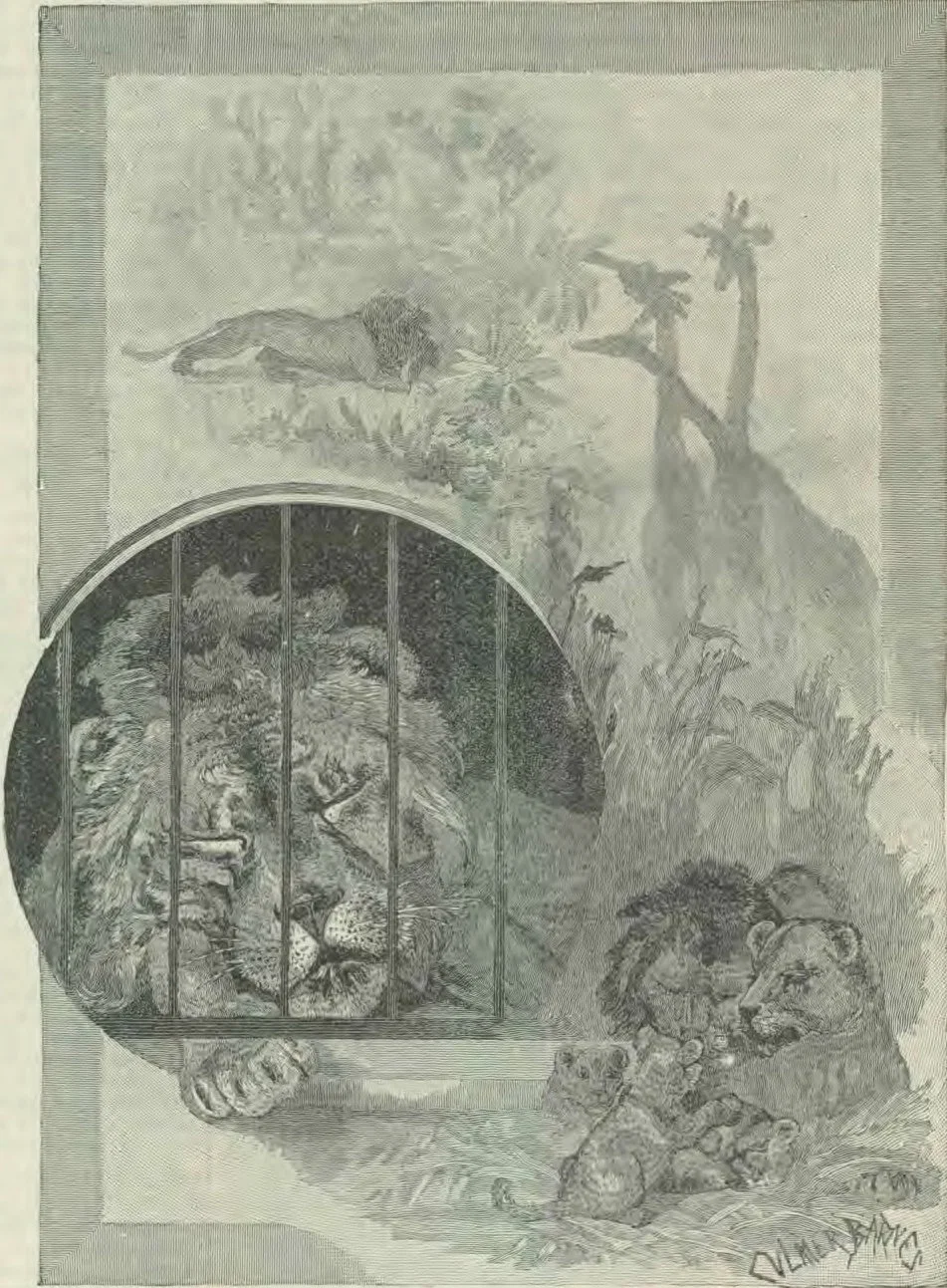
Did you ever think that the great shaggy lion, with his eyes shut, might be dreaming of the good old times when he and his mate and cunning little cubs were so happy, hidden snugly away in the tall grass? Or he may, perhaps, have been thinking how nice it was to eat those pretty giraffes, which he used to hunt, and suddenly spring upon from behind some bush or tree.
Now the old fellow does not have to find his own dinner, for it is brought to him every day. Twice a day he has all he wants to eat. When he is done eating, he licks his chops, yawns once or twice, and then lies down to sleep, perhaps to forget that he is shut up in a cage far away from his native land.
He sleeps a great deal of the time, and so I don't think he can be so very unhappy. Do you?
The lion in his own home does not often hurt any one unless he is hungry or hunted. When he is very hungry, he shakes his mane, and whips his sides with his tail. When he does this, it is very dangerous to be anywhere near him.
There are no lions in this country except those shut up in cages. They live wild only in Asia and Africa.
Most animals kept in cages are very fond of the men who feed and care for them.
One day a rough man quarrelled with one of the keepers in a menagerie. The lions and tigers tried to break out of their cages and help their keeper, they were so afraid he would get hurt. They made a great noise, and roared so loud that the people came from other parts of the menagerie, and helped put out the quarrelsome man.
The giraffe, the animal which the lion is fond of hunting, is the tallest animal in the world. Is it not strange that he is also one of the most gentle,—as gentle as a kitten?
He lives on grass and hay, and his neck is so long that when he is fed, his dinner is placed in a box or pail which has to be put much higher up in his cage or stall than a man's head, so that he can eat out of it easily.—Our Little Ones.

Bessie's Christmas

“Why are you so sober, Nell?” asked Mrs. Hurd of her little daughter, who wore an unusually thoughtful face.
“It’s Bessie Watkins, mamma,” said Nell. “She troubles me.”
“How, dear?”
“There’s something wrong, somehow, mamma; but I don’t quite know how to tell you. She has lots of things other girls don’t have, but they don’t make her happy. Her aunties give her beautiful things,—ever so many more than you give me, mamma,—but it don’t seem as though they do it because they love her as you do me, and sometimes I think that’s what’s the matter. She is one of the nicest girls I know, and just as good and generous as she can be, and I do wish she was sometimes as happy and full of life as other girls. This afternoon we were all at Mrs. Black’s, and she asked us each what we wanted Santa Claus to bring us. Of course we said all kinds of things, except Bessie. Mrs. Black asked her if there was not something she wanted, and she shook her head, and said, ‘No.’ Then Mrs. Black asked her to think again, and she looked up so sadly, and said, with a quivering voice,—
“I don’t want anything but my mamma, and then burst out crying, and we all cried a little too, because we know her mother is dead, and she has only her aunties to take care of her.
“Mrs. Black talked to her kindly; and Bessie said she knew she could not have her real mamma, like other girls, but she wanted something to make her feel that she did have one once, who would have loved her as other mothers do their little girls. She can’t remember hers, and no one ever tells her anything about her; so it just seems sometimes as though she never had one. It makes me feel sorry to think of it, and I just wish I could do something to make her look real glad and happy once. You make so many people glad, mamma, isn’t there just possibly something you could do to make her so?”
“I will try. Ask Bessie to come here Christmas day,” said Mrs. Hurd.
“Mamma, do you really think you can make her happy? It would be just too lovely for anything.”
Bessie Watkins had not lived long in the same town with Nell, and though Mrs. Hurd had seen her once or twice with Nell, and knew of her, she had never spoken to her; but when she came to the house Christmas morning, she was greeted pleasantly and questioned about her presents. In telling about them, she was not so enthusiastic as Nell would have been, and ended by saying, in sweet, lady-like tones,—
“My aunties are always so very, very kind, you know.”
“I am sure they are, dear,” said Mrs. Hurd, “and you are very fortunate in having such good aunties to take care of you; but what would you think if I were to tell you of a Christmas present here that has been waiting for you since before you were born?”
Bessie’s eyes opened wide, and so did Nell’s, as they both looked at Mrs. Hurd in surprise.
“Come and sit in my lap while I tell you about it,” said Mrs. Hurd. “That is the way Nell and I have our talks,” she added, smiling.
Bessie rose in a bewildered way, hesitating and looking from Nell to her mother, until Mrs. Hurd drew her to her tenderly, and resting the delicate little head on her shoulder, said,—
“This is the way Nell and I like to talk.”
Bessie burst into tears at this, and Mrs. Hurd did not try to stop her for a few moments, then said, quietly,—
“I want to tell you, Bessie, how dearly I loved your mamma.”
“You knew my mamma!” exclaimed Bessie, raising her head, and looking earnestly at Mrs. Hurd through her tears.
“Yes, dear; we were little girls together, just as you and Nell are.”
“O, tell me about her! please do.”
For some time Mrs. Hurd talked of their girlhood days, while the child listened eagerly to every word. At last she asked,—
“And did you know her always, as long as she lived?”
“Yes, dear; but when I married, I came here to live, and did not see her for several years. Then I had a dear little baby girl, just learning to walk and talk, and I sent for your mamma to come and visit me. When she came, she brought my little girl a beautiful doll, dressed by her own hands, and she had made it look just as much as she could like one we each had when we were little girls. She was very proud of it, and said, one day, that if she ever had a little girl herself, she was going to dress one just like it for her.”
“Did my mamma really say that?” asked Bessie, and Nell thought she had never seen her look so pretty; for a bright color had come into her face, and her eyes sparkled.
“Yes,” said Mrs. Hurd; and then she told how her own little girl had been taken sick and died in a little while, and the doll had been laid away with her other playthings, where it had been kept ever since.
“I think now, dear, that it would please both your mamma and my little girl if they could know you were to have it. Nell, dear, it is on the table. Will you bring it to Bessie, please?”
As Nell went for it, Bessie sprang up and met her, taking the doll from her, sat down and gazed at it as though she were almost afraid to touch it.
“Does it please you to have it?” asked Mrs. Hurd. Holding the doll close to her, she rose from the floor, and going to Mrs. Hurd, said,—
“I have never, never been so happy in all my life before. It is just like having a little bit of my own mamma, and I shall love it so very, very dearly that it will help me to know that my mamma would have loved me, too. O, I can’t tell you how happy you have made me by telling me what you did, and by giving me this!”
“Mamma,” said Nell that night when they were alone, “I am so glad you never let us play with that doll; but didn’t it hurt you to give it away?”
“Not under the circumstances, dear. Do you think I could have been so selfish as to keep it, when I have so much to remind me of my little girl, and she so little to remind her of her dear mother?”
“Mamma, I think if it had been all you had, you would have given it just the same. What a grand thing a good mother is, and how proud I am of mine!”—Children’s New Church Magazine.

FINDING TIME.

“Sixty seconds make one minute, sixty minutes make one hour, twenty-four hours make one day,” studied Johnnie. “Twenty-four hours make one day, seven days—”
“Third class in arithmetic,” called the teacher, and Johnnie’s mouth puckered into a whistle—almost an audible one. This was his class, and he had just begun studying the lesson. Of course he failed.
Miss Atwood looked grave—cross, Johnnie called it. “The third imperfect lesson this week! What is the matter?”
“Couldn’t find time for it,” pouted the boy. “Very well; you may search for time after school. The lost must be found.”
It was nearly dark when he reached home.
“Run right out and shut up the chickens, and chop the kindlings for morning,” his mother said.
“All right.” But Johnnie was spinning his top, and before he had finished, he forgot all about his chores.
“Everything done?” asked mamma, as he was going to bed.
“Oh, I forgot! And then, you see, it was so late when I got home, I couldn’t find time.”
There was no help for it; he must go out into the cold and dark to attend to his neglected duties.
“I don’t like these short days,” he grumbled, kicking the snow from his boots. “You can’t find time for anything.”
“How many hours in a day?” asked Mrs. Lane. Johnnie brightened up. He had learned that table only a few hours before. “Sixty seconds make one minute, sixty minutes one hour, twenty-four hours one day—”
“Did you say one summer day?”
“Why, no, it means a day and night both. It’s just the same all the year round.”
“Is that so? Then we have all the time there is, both in winter and summer. Let me tell you a secret,—Take care of the minutes, and the hours will not be lost. I have a little story for you before going to bed.”
Johnnie seated himself contentedly by the fire. “There was once a boy about your age and size, who had a very rich friend. This friend loved the boy, and wanted him to be useful and happy. So he said, ‘I have an important place for you to fill by and by. You are not ready for it yet, but I will give you every means of preparation. My gifts shall be sent continually and directly to you. They are to be used to fit you for the position, and if you improve them as you ought, the place will afford you great happiness, and you shall go to live in my beautiful home, where there are pleasures sweeter than you ever dreamed of.’
“The boy felt very grateful to his kind friend, and resolved to use the gifts carefully, and do all he could to show himself worthy. The next morning he awoke full of good resolutions. A messenger had already brought some of the gifts—only a few small coins as yet. But the boy meant to use every one as the giver had directed.”},{

“ROUND THE WORLD.”

We are happy to announce that, beginning with the January number, the forthcoming volume of the INSTRUCTOR will contain a series under the above heading, written by one who is at present making a voyage around the world. This series will to some degree form a substitute to the senior S. S. lessons, which will hereafter appear only in pamphlet form.
The majority of these articles will be illustrated by engravings made from photographs taken specially for this purpose. The writer of the “Round the World” series tells his experiences in a style not only instructive but entertaining; and our readers may feel assured that they will find his descriptions an attractive feature of the paper.

THE KANGAROO.

Until twenty years ago, the kangaroo was valued simply for its flesh. At that time an Englishman in Australia became aware of the superior strength and fine quality of the skins, and procured an immense quantity of them, which he shipped to novelty-loving America. But tanners had no proof of the value of this unknown leather, and declined to invest in it; and the speculator was finally obliged to sell his stock below cost, to a book-binder, who used it for corners of blank books, in which capacity its rare firmness was discovered.
Immediately a demand arose for the leather; but the supply was entirely inadequate, until, a few years ago, the proprietor of a large tannery in Newark, New Jersey, sent men to Australia to purchase; and now there are used in the manufacture of shoes, one thousand kangaroo skins per day. The trade of the world in this leather is supplied largely by our own country, some of the tanned skins being even reshipped to Australia.
An undesirable prelude to this profitable business is the danger incurred in hunting the kangaroo in the wild interior of torrid Australia and New Zealand. These animals are very fierce and agile, frequently springing several feet to deal a hunter a blow in the chest,—their usual method of attack. This makes it necessary for the hunters to stand erect on their horses as they ride into a herd, while they deal quick thrusts with their spears, or blows with the club-like handles.
MRS. ADA D. WELLMAN.

USES OF COTTON-SEED.

THE history of cotton-seed is in itself interesting, and marks an age of wonderful progress. For seventy years the seed was despised as a nuisance, and burned and dumped as garbage. Then it was discovered to be the very food for which the soil was hungering, and reluctantly admitted to the rank of utilities, and began to be treated with respect.
Cotton-seed was next found to be nutritious food for beasts; and then this formerly-despised product was discovered to hold thirty-five gallons of pure oil to the ton, worth, in its crude state, fourteen dollars a ton, which amounted to forty million dollars for the whole crop of seed. The refined oil is now worth one dollar a gallon.
But a new wonder was yet to come. Experience showed that the ton of cotton-seed was a better fertilizer and a better stock food after it had been robbed of its thirty-five gallons of oil than it was before; that the hulls of the seeds made the best of fuel for feeding the oil-mill engine; that the ashes of the hulls had the highest commercial value as potash, and that the “refuse” of the whole made the best and purest soap stock, to carry to the toilet the perfumes of the best manufacturers.
The history of cotton-seed has, perhaps, been paralleled by that of petroleum, which, in its crude state, ill-looking and bad-smelling, has proved a mine of wealth in the wonderful substances that have been produced from it.—Companion.
Continue reading: Letter Budget