The Youth’s Instructor, Vol. 65, No. 14.

Miscellaneous News Items From Around the World

The Youth’s Instructor

Apr 3, 1917

Review and Herald Publishing Assn. · Takoma Park Station, Washington, D. C. · Apr 3, 1917

Miscellaneous News Items From Around the World

The world’s richest county school is the Lincoln County School at Shamrock, Oklahoma. Some wise member of the school board found oil on the grounds, and an income of $72,000 a year resulted.
Two universities, Oxford and Cambridge, have already given more men for the European war than have been asked for from all Christendom for the evangelization of non-Christian lands.—John R. Mott.
Every available vacant lot and plot and field in Germany is utilized to raise something. Rye, grass, and potatoes are the main crops, with vegetables near the cities. The officials notify the owner what he should do with his land.
Secretary of the Navy Daniels requested the commander in chief of the Atlantic fleet to convey his appreciation to 15,988 sailors who remained sober while on shore leave at Port au Prince, January 25 and 26. Twelve others got drunk.
Scarcity of leather is forcing London to turn to clogs as a substitute for shoes. Already some of the city’s school children are clattering daily to their studies in clogs at seventy-five cents a pair, say dispatches to the commerce department.
If you desire to help make your town or city dry, follow the example of the Athol, Massachusetts, church, who placed a paper in the hands of every voter in the place. On soliciting assistance from their fellow townsmen, one business man gave them forty dollars.
An army of 20,000,000 children marches to school every day, and millions of newspapers are printed daily. Six ten-page newspapers weigh a pound, so that if each child contributed a paper a day there would be saved more than 3,000,000 pounds of paper a day, worth, at half a cent a pound, $15,000. Why not get your share of this money for some good cause?
The Senate on February 5 concurred in the previous action of the House and passed the immigration bill containing the literacy test, over the President’s veto by a vote of 62 to 19. The attempt to restrict immigration by means of a literacy test has been before the country since 1897, when a bill carrying this test was vetoed by President Cleveland. President Taft also vetoed a similar bill, and President Wilson has twice vetoed the Burnett bill. The law goes into effect May 1, and will exclude from the United States all aliens over sixteen years of age, physically capable of reading, who cannot read the English language or some other language or dialect. Any admissible alien or any citizen of the United States may bring into the country his father or grandfather over fifty-five years of age, or any female relative, regardless of their ability to read. The bill also provides for the admission of any person fleeing from religious persecution, this being the provision against which the President objected most strongly in his veto message. Only thirty Presidential vetoes have been overridden in the history of the United States, four of them in the last thirty-five years, the last previous case being the rejection of President Taft’s veto of the Webb-Kenyon interstate commerce liquor law, recently approved by the Supreme Court.
The United States Senate on February 20 passed measures creating a comprehensive body of statutes to punish espionage and spying of every description and to protect the neutrality of the country. The Senate also on the same day passed a bill providing a form of government for Porto Rico which makes Porto Ricans American citizens, and a bill providing for the payment to Denmark of the purchase price of the Danish Islands. This bill also provided a comprehensive form of government for the islands. The Senate Naval Committee on the same day completed the naval appropriation bill incorporating an additional appropriation of $71,000,000 for fifty submarines, fifteen to be built on the Pacific Coast.
The Senate on February 16 passed the post-office appropriation bill, defeating a last attempt to increase the rates on second-class matter. The bill carried an appropriation of $330,000,000. The Reed amendment prohibiting the taking or sending of intoxicating liquors into dry States and excluding liquor advertising and newspapers carrying such advertising from the mails was retained in the bill, and will, it is said, make fourteen States absolutely bone dry. The House on February 21 concurred in this amendment to the bill.

“Alone with God.”

This is a new book by Miss Matilda Erickson. It is a timely and stimulating call, first to prayer and then to service, which, of course, is the true order. It is a call to young and old to “live in the highlands with God,” and then go forth with his Spirit to battle for the souls of men in the lowlands of sin.
In her quiet and convincing manner, Miss Erickson reminds us, with well-chosen illustrations and intensely interesting bits of biography, that God’s mighty men in all ages were those who had been in “the school of God”—in the secret place alone with himself. And in that solitude, hallowed with the divine Presence, men were and are equipped for the battle.
The reader of this genuinely helpful little volume will surely be drawn into closer fellowship with the Son of God and have his faith in the power of prayer greatly enlarged.
ERNEST LLOYD.

New Use for the Nailbrush

BEFORE removing soiled wash gloves from the hands fill the wash bowl with cold water. Lather the gloves well with a good white soap, and brush lightly with the nailbrush. It will remove grime from finger tips and seams where no amount of rubbing on the washboard will do it. Slip the gloves from the hands, rinse them thoroughly, and hang them up to dry. The whole operation will not take five minutes, and one always has the satisfaction of a fresh pair of gloves when needed.—M. Pelton White.

In Harbor

THOUGH many a sea be charted And many a course be laid, There comes a night In the sweet starlight When the last still harbor is made.
When the last still harbor is made And the sails are lowered and furled, When the moon comes down Like a silver crown To rest on the weary world.
Then deep in the heart is quiet, And calm are the eyes that gaze Where the shadows glide On the outward tide To the breast of the vanished days.
— Scudder Middleton, in Ladies' Home Journal.

Having Our Way

T. E. BOWEN
THE difference between a child of God and a man of the world is that the former chooses to be a servant of the Lord; the latter proposes to have his own way. The Lord coerces no one. Every one is left perfectly free to do as he chooses,—serve God and be filled with the Lord’s way; or serve himself, and be filled with his own way. One way means joy, happiness, peace, usefulness, and eternal life, bestowed by God to keep one doing these same things with increasing capacity for enjoyment, happiness, peacefulness, and service. Eternal life simply means putting Heaven’s seal upon the choice we have made, by extending the life that shall never end in the doing of the things contained in the eternal purpose of the Father as revealed and wrought out for us through his Son. Eternal death is setting Heaven’s seal upon men’s choosing to have their own way. Unhappiness, unrest, wretchedness, and misery can only result from such a choice, and the only thing a merciful God can do is ultimately to cut off life from such. This means eternal death—eternally ceasing to exist.
Every day we make up our lives by either serving God or doing our own pleasure. Young people are doing this, older people as well.
Yielding our wills to Jesus does not mean bondage. Such one is a free man, a free woman. To choose to do as one pleases, regardless of the expressed will of Christ, means slavery; for that is exactly what Satan did when he rebelled in heaven. Although he professed freedom for himself and the angels who joined with him, he plunged himself and them into abject bondage, fettered hand and foot for the doom of eternal death.
“The angels which kept not their first estate, but left their own habitation, he hath reserved in everlasting chains under darkness unto the judgment of the great day.” Jude 6.
The most terrible fate that can befall a person is to be left by the Lord to have his own way. “Ephraim is joined to idols: let him alone.” Hosea 4:17. “Behold, your house is left unto you desolate,” were among the saddest words Jesus ever spoke. This was equal to saying, “You are now left to have your own way.” Swift destruction followed to the Jewish nation as the result.
“Not my will, but thine, be done,” was no mere sentiment of Jesus, expressed near the close of his life in Gethsemane. It was his working rule through life as he lived among men. And where did he learn that will?—By searching the scrolls of the prophets, studying, as must we, the very truths and words which away back there his Father had communicated to him. And he in turn had sent the message by his angel unto some servant (Rev. 1:1-3), a prophet,—David, Isaiah, Ezekiel, Daniel, or some other,—who in turn communicated it to the people by word of mouth, or wrote it out, or both, so all might know the mind of God. Coupled with this study of the Word, he prayed.
Thus Jesus set us the example of yielding himself—his mind, his life—to God for service. Christians must do this. The yielding of our ways to Christ, the blending of our life purposes with his, so that his thoughts become ours, is beautifully expressed in these words:—
“All true obedience comes from the heart. It was heart work with Christ. And if we consent, he will so identify himself with our thoughts and aims, so blend our hearts and minds into conformity to his will, that when obeying him we shall be but carrying out our own impulses. The will, refined and sanctified, will find its highest delight in doing his service.”—“The Desire of Ages,” p. 668.
The manifestation, therefore, of self-will, self-esteem, self-guidance, independent of the counsel given in the Word of God, at once betrays such a one as following in the footprints of the archrebel, rather than in the path traveled by the lowly Redeemer.
How appropriate to us down here at the end is the apostle’s counsel: “Let this mind be in you, which was also in Christ Jesus: who, being in the form of God, thought it not robbery to be equal with God: but made himself of no reputation, and took upon him the form of a servant. . . . Wherefore God also hath highly exalted him, and given him a name which is above every name.”
“Thy way, not mine, O Lord, However dark it be! Lead me by thine own hand, And choose the path for me. I dare not choose my lot; I would not if I might; Choose thou for me, my God, So shall I walk aright. “The kingdom that I seek Is thine; so let the way That leads to it be thine, Else I must surely stray. Hold thou my cup of life; With joy or sorrow fill As best to thee may seem: Choose thou my good and ill. “Choose thou for me my friends, My sickness, or my health; Choose thou my cares for me, My poverty or wealth. Not mine, not mine, the choice, In either great or small; Be thou my Guide, my Strength, My Wisdom, and my All.”

Listening More Than Speaking

“We were given one mouth and two ears for a purpose.”

Jottings by the Way

(Extracts from a personal letter from Mrs. A. G. Daniells)
HERE we are in Shanghai again, after nearly two years’ absence. We had a very pleasant voyage from Manila to this place, stopping four days in South China, while our ship was in dock in Hongkong. This gave us an opportunity to visit our mission in this city and also in Canton.
We found our missionaries of good courage, working industriously, and developing into strong, earnest workers. Some who were new when we came here before, now have the language well, and are preaching and working with the natives in their own language. I especially noticed how some of these young people had developed in the two years they have been here, and how well they are bearing heavy burdens. Our young people must carry this work in these countries; for they are able to learn the languages and stand the trying climate, as older persons are not.
We even found that nearly all of the forty missionaries who arrived here from America just a few months ago were chattering away to the Chinese in their own speech. It is interesting to hear these new ones singing in Chinese at the meetings,—makes one think of the gift of tongues. All these workers are of good courage and happy in their work. I was especially pleased to see how some of these young married women who have been in school for years and had very little training in housework, are adapting themselves to it, and how they are practicing economy and wisdom beyond their years.
It was well that we had a few days in the mild climate of South China before we plunged into actual winter of Shanghai. It seems very cold here,—not so freezing, but a strong north wind is blowing all the time. The people call it a lazy wind, because it goes right through a person instead of going around him. When we go out, we bundle up until I imagine we look like the Chinese in their padded garments. Our mission homes are comfortable, and we have a good coal fire in our room, so we are warm as long as we stay in the house; but when we go outside, it surely is cold.
On the “Empress of Asia,” from Vancouver, we made the acquaintance of a lady who was going to Canton to work for the house-boat people. There are thousands of these people, who live, raise their families, and die on these boats. I noticed that some of them are bright-looking people. They tie the little children with a rope, and if one falls into the water, they pull him out with it.
This lady missionary and her associate live on a house boat about a mile up the river. It is the only missionary house boat in those parts, and these two women are the only missionaries working for these people. When we reached Canton, we visited this boat, and found it a comfortable home, about fifty feet long or a little less, and wide accordingly. It had several rooms that looked homelike. The roof was flat, or nearly so. It was covered with an awning, and provided with seats. The missionaries hold their meetings there. The river was full of people, so they had plenty of company. As we sat in their living-room, the people who went by in their boats would stand up and look in at the window to see us. It seemed to me a great work and a needy field.
When we had been here in Shanghai a few days I went with one of our sisters and her little boy to a Chinese village farther out than our mission. We walked, and by the time we reached the place, I was too numb with the cold to enjoy the sights and odors, but I followed her around from store to store until she had finished her shopping, and saw enough to know that it is an interesting place. The streets are narrow and crooked, and the people are packed in like sheep in a pen. As there is no way to have any drainage and the ground is very flat, it looked to me as if in the hot weather the place must be very insanitary; but our sister said it is really a clean village compared with many she has seen.
By the time we were ready to go home, my feet were too numb to walk, so we took a wheelbarrow back. We three rode on one barrow, but that was not much of a load, as frequently a dozen women and children are pushed around on one barrow. There is a platform extending out on each side of the wheel, instead of a concave top like the barrows of America. Sister Shultz rode on the side of the barrow next to the canal. I told her I was glad I was not on that side, for fear I might be tipped off into the canal!
Yesterday we saw an idol procession. There is a woman idol in this village, and twice a year she is taken out for an airing. She was being carried in a very pretty gilt box, by four men. The procession was a long one, and the people carried rich flags and banners. They looked as if they were made of the finest silk, and were trimmed with real gold fringe. The richness of the procession contrasted widely with the poverty of the people. Some of them looked comfortably dressed, but they all walked, except those who could afford wheelbarrows; none of them were able to hire jinrikishas. I thought that if all our people would give for God’s work as liberally according to their means as these poor people do for their heathen goddess, we should have plenty of money to send to heathen lands all the missionaries who are ready to go.
As we were going to the city yesterday, we passed some men carrying on poles a big box containing wedding presents for a wedding they were on their way to attend. It looked as if they had been around among all the guests gathering the presents. In the middle of the box sat a goose, its white head rising above all the packages and bundles which were clustered around and over it. I could not see all, as we passed by quickly, but I saw many oranges and several large pieces of pork.
When we were in Japan, we went with Elder Hoffman to get a jinrikisha to go to the city. The woman who kept the stand said to Brother Hoffman, in Japanese, “Poison your honorable spirit, the jinrikishas are all out.” She meant that she was sorry they were all out. There was a funeral procession, and all were engaged for that, so we went around to another street and watched the procession.
First, there were eleven priests, all dressed in a most fantastic manner, and all riding. Next came fourteen wagons carrying flowers. These are two-wheeled wagons just large enough for one of the tall bouquets, which stand about six feet high, and are made of branches of evergreens and colored flowers made of shavings. There were a few natural flowers among the artificial ones. After these were twenty men carrying similar large bouquets. Then came a large number of men carrying baskets of fruit and cakes, and cages of sacred doves. At the last came the mourners, all dressed in white, which I think is a much prettier custom than dressing in black as Americans do. It looked as if there were about fifty mourners. These were walking. Brother Hoffman says that the wealthy Japanese hire a band to play in the procession, and he has heard them playing “Marching Through Georgia,” at a funeral.
I saw a funeral procession here in Shanghai the other day. First, I noticed four men staggering along under the weight of a large, heavy-looking coffin; and as I looked around for the mourners, I saw just one lone woman coming along on a wheelbarrow. She had mourned until she looked about exhausted; but when she saw us looking at her, she managed to make a few more wails to show us she was mourning.

Visiting Solusi Mission's Outschools: Henry's School

Visiting Solusi Mission’s Outschools — No. 3
After leaving Samuel’s, a five hours’ drive down the Gwaai River toward the Zambesi, brought us to Henry’s school, which is our farthest outschool. It is eighty miles from the main station, and one hundred miles from any center of civilization. We found this part of the country quite different from that through which we had been passing. Henry lives on the west bank of the river, on each side of which for many miles the country is covered with jungle and heavy timber.
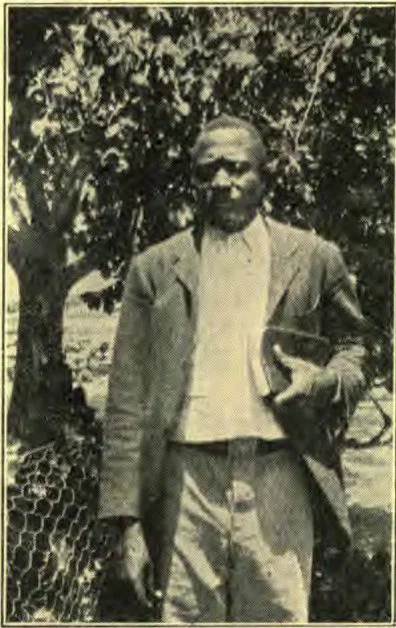
HENRY, AN EFFICIENT WORKER
In this timber live several different species of the African antelope. The little red stembuck, which is the smallest of the many antelopes, and the black sable, one of the largest, are found here. I saw many tracks of the sable and koodoo, and had the pleasure of seeing a large male sable. The koodoo has the long, beautiful spiral horns, while those of the sable are three feet in length and curve gracefully backward.
When we arrived at Henry’s, in the middle of the afternoon on Friday, we outspanned near his houses under two large nondo trees. By the time Sabbath was over I had become so interested in Henry’s work, his people, and the country, that I decided to stay over Sunday. This gave the mules that much more rest before starting on the hard three and one-half days’ trip home.
Like Samuel, Henry is one of the outschool teachers who had been longest connected with the mission. He speaks better English than any of the other teachers. I could sit down and talk with him on any common topic. He has a pleasant, jovial disposition, yet he is very earnest in his work and has a close walk with God. The people look to him as a father, though he is still a young man; and his home seemed to be the center of the community. Henry was a member of the Wesleyan Mission before coming to our mission. His wife was also a member of that mission, but since they were married, two years ago, Henry has taught her the Sabbath truth. She with another woman will be baptized with the candidates of our present baptismal class.
I found Henry doing as much work as any of the other teachers, if not more. At dark Friday evening he and his family came out to sit, and visit, as I supposed, with us around our big camp fire; but it was not long till I learned that there was to be a meeting. Soon people began to come, and in a short time we had a complete circle of more than twenty men, women, and children around our fire. Henry told me he always has a Friday evening prayer and social meeting. He has organized a Sabbath school of thirty members, and the most of these attend the Friday evening meeting. During the first part of this meeting they study the Sabbath school lesson.
What impressed me most was the testimony meeting; yes, a testimony meeting away down there in the edge of a great African jungle, a hundred miles from civilization, in the midst of African heathenism.
More than half of that company stood up and testified to the power in Jesus’ name. There was no hesitation, hardly a moment being lost between testimonies. Several of the mothers with babies on their backs stood up and spoke; and while I could not understand all that was said, yet I could understand enough to greatly interest me. One mother said she thanked God that he had kept her through another week. A herd boy said he praised God for sending a teacher so he could learn. Another mother thanked God for the many blessings she had received. The earnestness which gave expression to the thanks, indicated that the recipients of these blessings had a clear and true understanding of God.
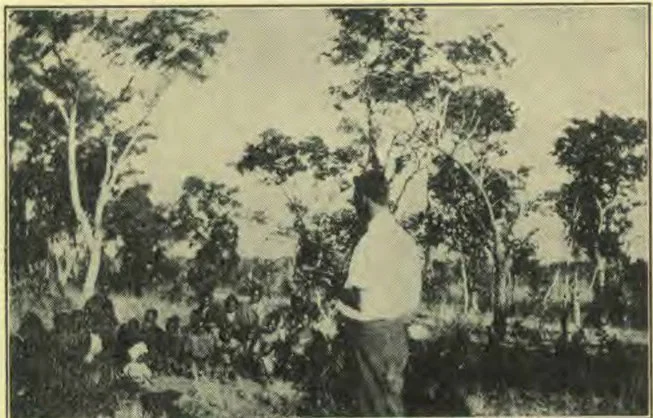
Sabbath morning Henry rang his plowshare bell for Sabbath school. In a little while the natives began to gather, but in a very different place from that in which the Sabbath keepers in the homeland meet. Their Sabbath school was conducted under the spreading branches of a great forest evergreen. There were about thirty present, and Henry conducted the one large class. It was indeed interesting to see and hear the members, the majority of whom could not read, answer the questions promptly. It is wonderful how readily the native learns the Word of God.
There were fifty of the jungle people present at the church service, which followed the Sabbath school, and they listened with the most careful attention during the entire forty-five minutes I spoke. At the close of the service I told Henry to announce that there would be meeting again in the afternoon. Henry’s regular company of twenty-five attended this meeting. I gave them a short, practical health talk. I had had an opportunity of seeing something of their physical needs, having attended to those needs as best I could after the morning service.
Most of Sunday was spent in a long tramp through the jungle looking for wild honey; but in the evening we had the fourth and last good meeting with Henry’s little company. We enjoyed much of the blessing of God during the two days spent with these people, and personally I shall never forget the pleasant visit.
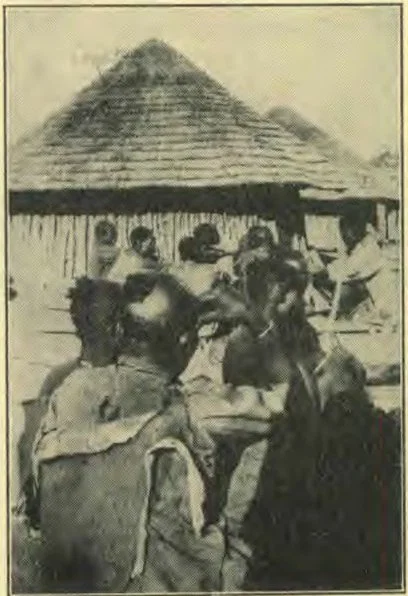
At break of day Monday morning we were on our way home, but we had to go off the road a few miles to get Ralph, another one of our outschool teachers, and move him and his family to a place near the main station. We reached his home in the middle of the afternoon, Monday. Hearing a noise in a near-by kraal , I asked Ralph what it was. He said the natives were having a beer drink there. Having never seen a native beer drink, I walked down to the kraal. An accompanying picture shows a portion of what I saw. The men were sitting around several earthen pots close to the huts, while the women were in the foreground. The picture shows how the Matabeles make their huts, also how the married women wear their hair. They keep it cut close except the tuft on top of the head.
THE SABBATH SCHOOL UNDER THE TREES, HENRY TEACHING
Ralph called the people together for a meeting that evening. Thirty-five gathered around the camp fire, and we had a service quite different from any other we had held. The people there were much opposed to schools, and when in my talk I said something about the need of schools, they immediately resented it. Some were still under the influence of the afternoon beer drink, and they were the ones who talked most. We could hardly close the meeting in order.
Tuesday morning we did not get started till eight o’clock, but reached the Zuzumba River that night, where we had outspanned for dinner on the trip out. From the time we left Ralph’s till we reached home, we had company, for in addition to myself and the two boys with me, were Ralph and his wife and baby, and two girls who live with them. This made an interesting company at camping times, especially in the evening. This close contact with the natives gave me a very good opportunity to learn more of their ways.
Wednesday night we reached the little Tjobusi River, where we made camp for the last time. We reached home Thursday forenoon, having traveled one hundred and sixty miles. It was indeed a welcome place after ten days and nights of camp life out in the wilds, with no companions but the natives. While the constant jabbering of their language was a help to me in learning it (for most of the time I heard nothing else), yet at times it would become tiresome. I saw only four white men on the whole trip.
In summing up the work of the trip I found that there were eighty children in the four schools visited; that I had spoken to two hundred and sixty-five persons in the eight meetings held; and that I had pulled fifteen teeth, besides doing what else I could to help the people physically as well as spiritually.
Four weeks later I made a similar trip of eight days, in another direction, visiting more of our outschools.
In our school here at the main station we have an attendance of one hundred and fifteen, requiring five teachers,— Mrs. Robinson, myself, and three natives. We have had many precious experiences since we took up the work two and a half years ago, but we need more help to do the work as it should be done.
Raleigh P. Robinson.

Youth Society Statistics for the North American Division

Figures
YES, a whole page of figures! But they are interesting. Why? [See page eleven.]
If the General Conference committee should vote for you to go to China as a missionary, your friends would be very much interested in the lists of outgoing missionaries to see if your name was among them.
Several years ago the Lord called the young people of this denomination to a great work. By and by the conferences began to act upon the advice given and to organize the young people for the work. Are the young people responding? Are they really about their Father's business? These figures tell. They tell how many societies in the North American Division report, the number of members, the number of isolated ones who belong to the conference societies, and the number of missionary visits made, the amount of literature distributed, the Christian help work done, and the money contributed by these members. Is it more or less than last quarter? Is the report more or less than one year ago? Yes, these questions are interesting to the interested.
Are you not glad to see that there is an increase over the third quarter of 1915 in most of the items? There are thirty-two more reporting societies, and over four hundred more members. The amount of literature distributed seems to be greater. Nearly twice as many tracts were sold as one year ago, but there were fewer given away. It would seem that our young people are learning to sell tracts. The Christian help work is about the same, but I am sure we are all sorry to see that fewer missionary visits were made and fewer cottage meetings held. Can it be that we are relaxing our efforts to reach souls in a time like this? There is an increase in foreign-mission offerings and a decrease in offerings for the home work. More conversions of our young people are reported, for which, I am sure, every true Missionary Volunteer is grateful.
In looking back over the reports, the third quarter seems to be the leanest one of all. But why should it be? Should we not work in the summer as well as at other seasons? The number of societies reporting for the different quarters of 1914, 1915, and 1916 are as follows:— 1914: 633, 499, 475, 667. 1915: 684, 525, 507, 966. 1916: 762, 543, 539.
A NATIVE BEER DRINK
A NATIVE BEER DRINK
Where are the 219 societies that reported for the first quarter of 1916 but not the second? And where are the 223 societies that did not report for the third quarter? Is yours among them? If so, will you not write and tell us why?
Are you interested in watching the progress of your conference? If you will get the INSTRUCTOR of Feb. 29, 1916, you will find the report for the third quarter of 1915, and can see how this year's report compares with it. I hope you will study these figures.
M. E. KERN.

Our Upstandings and Downsittings

To be caught seated at a social occasion when we should be on our feet makes us as uncomfortable as a stranger in an Episcopal church. Every one but our embarrassed selves seems to know when to get up and when to sit down, and we agree miserably with the prayer book that “we have done those things which we ought not to have done, and left undone those things which we ought to have done.”
Such discomfort is needless, for the rules about rising—which, after all, are no more than the custom of well-mannered people—are few, simple, and founded upon courtesy and common sense.
First, there is the question of introduction. A lady should always rise when presented to another lady, unless the latter is much younger, in which case it is quite permissible to keep one’s seat and simply bow one’s acknowledgment.
When a woman is seated and a man is introduced, she does not rise, unless he is a very distinguished person or a gentleman many years older than herself, to whom she wishes to show deference.
It is not usual to shake hands with a person whom one meets for the first time, except as a mark of unusual cordiality. A hostess, however, should always extend a welcoming hand to her guests, both to those with whom she is already acquainted and to any stranger brought to her home by a mutual friend.
In greeting, she holds the hand palm upward; in bidding farewell, she holds the palm down. On the face of it, this custom may seem an absurdity, but like all rules of good form, it is based upon common sense; for when a guest knows in just what position the hostess will extend her hand, there is no awkward fumbling about before the hands are clasped in greeting or farewell.
At an afternoon affair, when the hostess is pouring tea from behind her tea table, rising to greet each guest is too awkward to be in good form. In this case, she simply bows, giving her hand if she likes. She also bows her adieux, should a guest leave before the tea pouring is over.
A man caller should always rise when another guest enters, whether the second arrival be a man or a woman. He should remain standing until a lady has taken her seat, in observance of the rule that a man never remains seated when a woman is standing. This is a courtesy in which no man should grow careless; the act is slight enough in itself, but women appreciate and expect this deference.
A woman is not expected to rise when a later arrival enters, except in the case of a very young girl and a much older woman, when the former does it as a mark of respect. The hostess, however, should always rise to greet her guests, for it is her duty to make them feel welcome and at ease in her home.
When guests rise to go, the hostess rises also, and remains standing until they have taken their departure.
And here let me speak a word about prolonged good-bys.
To keep a hostess standing longer than the few minutes needed to say one’s good-by is one of the most thoughtless discourtesies a guest can commit. Yet how few of us could plead “not guilty” to the charge!
Time and again, guests will rise with an “I must go,” which brings the courteous hostess to her feet; then they proceed to pay a second call, while the other guests wait, and the hostess tries to conceal her discomfort.
Sometimes the hostess follows her guests to the door, and her courtesy is rewarded by ten minutes of shivering in the cold, while the warmly wrapped guests finish up their visit.
When we go, let us go, and have no more last-minute conversations, which leave our hostess with an aftertaste of weariness and boredom.
At a dinner party, the hostess, of course, leads the way to the dining-room immediately after dinner has been announced.
Each man assists his partner into her chair, then remains standing until all the ladies are seated. Should a guest arrive late (though this is considered almost inexcusable, at even a semiformal dinner), the men should rise until the guest is seated.
At the end of the dinner, after the hostess has given the signal to rise, the men remain standing until the ladies have passed out. Then they may either sit about the table with the host for a short time, or follow the ladies into the drawing-room.
Awkward situations sometimes arise when acquaintances meet in a restaurant or hotel dining-room. If a man is dining alone and a lady bows to him, he should bow and rise slightly in acknowledgment.
If he is with a party, and a lady and her escort stop to speak to him or to his friends, he rises and remains standing until she has passed on. He should also rise if a woman is introduced.
It is courteous for a man to acknowledge an introduction to another man by rising, but this rule is often waived by men, who are less formal in their relations with one another than women.
One last word about our children’s manners. Nothing so stamps a mother with good taste and refinement as a well-mannered child. Teach your child to rise when he is introduced to an older person, to extend his hand and say distinctly, “I am glad to meet you,” or some other polite formula, instead of hanging back and mumbling a few embarrassed words; and when he reaches the awkward age, the habit of years will save him many a painful moment.
Teach your boy to rise when ladies enter the room, to remain standing at the table until they are seated, and all the small courtesies which are only quaint and pleasing in a small boy, but by which his good breeding will be judged when he is a man.— Ruth Hamilton Ward, in the Woman’s Magazine.
Continue reading: A TALK WITH BROTHER HARRIS