The Youth’s Instructor, Vol. 43, No. 49.

From London to Calcutta

The Youth’s Instructor

Dec 5, 1895

S. D. A. Publishing Association · Battle Creek, Mich. · Dec 5, 1895

FROM LONDON TO CALCUTTA.

Bidding farewell to the friends who accompanied us to the boat, we stepped aboard the steamboat “Bengal” of the Peninsular and Oriental line, at London, on Jan. 22, 1895, en route for Calcutta. Sailing down the Thames, we soon entered the English channel. On account of a heavy storm, we were obliged to cast anchor for about twenty-four hours alongside the Isle of Wight; but this delay was afterward made up, so that we reached our destination at the appointed time.
Our vessel touched at Gibraltar; Naples; Port Said, at the entrance to the Suez canal; Aden, the southern point of Arabia; Colombo, the principal city of the island of Ceylon; and at Madras. At each of these stopping-points, the vessel was thronged with dark-skinned natives of these various countries; and as I thought of the thousands and millions, of whom these are the representatives, who have never heard the first sound of the message for this time, I realized as never before the vastness of the work to be done in carrying the truth to every nation, kindred, tongue, and people.
THE SUEZ CANAL.
THE SUEZ CANAL.
The passage through the Suez canal was made on the Sabbath-day; and as we sailed down the arm of the Red Sea, with the land of Goshen on one side and the Wilderness of Wandering on the other, it added much to the interest of the scene to take the Bible, and read again the story of God’s wonderful dealings with his people in connection with these places. The peninsula of Sinai, as seen from the vessel, presented a very dreary, desolate appearance, and well merits the description given by the inspired writer, as “that great and terrible wilderness,” “a desert land,” and “the vast, howling wilderness.”
At Colombo we went ashore, and spent a pleasant afternoon in conversation with some of the English missionaries stationed there. The natives of this island, called Cingalese, are a very interesting people. They are quiet and peace-loving, gentle and hospitable, with intelligent, and, in the educated classes, intellectual countenances.
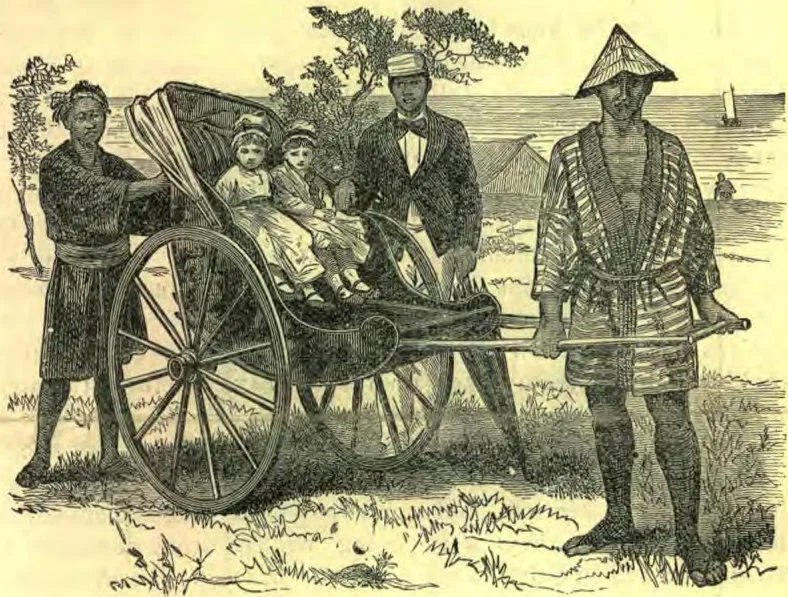
The dress of the men is very similar to that of the women, so that in the distance it is impossible to tell to which sex they belong. They also have a peculiar way of dressing the hair, combing it straight back from the face, and doing it up in a coil at the back of the neck. On the top of the head they wear a round comb inverted, with the teeth projecting into the air. Here we had our first ride in a jinrikisha. The jinrikisha came from Japan, and has found great favor on this island. It is something like a big baby-cab, with shafts, and is drawn by a man. The carriers seem to find the work both easy and profitable.
Having reached the ferry, we embarked in a frail-looking canoe, made from the hollow trunk of a tree, so narrow that I had difficulty in getting into it, and returned to the ship, which was anchored some distance out in the bay.
A JINRIKISHA.
A JINRIKISHA.
Another week’s sailing brought us to the mouth of the Hugli River, a branch of the Ganges, on which the city of Calcutta is situated. As we came nearer and nearer land, the water became more and more muddy. It is estimated that it would require fifteen hundred large ships sailing down the Ganges every day, to carry the amount of earth and sand the river daily bears to the sea. In this way thousands of acres are thrown up each year; but while new land is thus constantly forming, large portions of cultivated land are swept away from time to time, so that the poor native does not notice that the river makes much amends for the loss it often causes him. Nevertheless, the land is steadily gaining on the ocean, and those who cultivate near the river often have new fields thrown up in the course of a few weeks. Bishop Thoburn, in his book on India, says: “I have myself seen wheat growing rich and green in the month of December, in fields where I had seen the water flowing fifty feet deep six months before.”
The mouth of the Hugli is so wide that one cannot see across it, but it gradually narrows. On account of the shifting sand beds, navigation is very dangerous. Not far above the mouth of the river is an uncommonly treacherous shoal called the “James and Mary.” If a ship strikes the bottom here, she is immediately pushed over by the strong current. In a few minutes even large vessels disappear. Numbers of ships have been lost at this point. When our vessel reached this place, passengers were called on deck, the life-boats were lowered, and every man stationed in his place, ready to get the passengers into the boats at a moment’s notice; but our brave vessel passed this dangerous shoal without accident, and a few hours later we were safely lying at anchor in the harbor at Calcutta, after a voyage of thirty-three days out from London.
GEORGIA A. BURRUS.

THE HEATHEN.

I PRAYED for the heathen in foreign lands, But when they came nigh to my door, I spurned them aside with a gesture of pride, And bade them return nevermore.
The heathen of Africa's tropical clime Were mentioned by me when I prayed, But when one of her band wished to clasp my white hand, I turned in contempt on the maid.
It is safe at a distance to pray for their souls, One feels so much sympathy then; But when they are near and their wants are so clear, We shun them again and again.
Our Father in heaven, who hears when we pray, Help us to remember thine own; Although black or white, they're the same in thy sight; For them also did Jesus atone.
— Lottie Hay Meredith, in Northwestern Christian Advocate.

MRS. E. G. WHITE

CHILD LIFE OF JESUS.—NO. 3.

Even in his childhood Jesus saw that the people did not live in the way that the Bible pointed out as the way for them to live. He studied the Bible, and followed the simple habits and ways that the word of God directs; and when people found fault with him because he was so lowly and simple, he pointed them to the word of God. His brothers told him that he thought himself much better than they were, and reproved him for setting himself up above the priests and rulers of the people. Jesus knew that if he obeyed the word of God, he would not find rest and peace in the home circle.
As he grew in knowledge, he knew that great errors were increasing among men, and that because the people followed the commands of men instead of obeying the commands of God, simplicity and truth and true piety were becoming lost in the earth. He saw the people going through forms and ceremonies in their worship of God, and passing by the sacred truths that made their service of value. He knew that their faithless services could not do them any good, and would not bring them peace or rest. They could not know what it was to have freedom of spirit when they did not serve God in truth.
Jesus did not always silently look upon these worthless services, but sometimes told the people where they were going wrong. Because he was so quick to see what was false and what was true, his brethren were greatly annoyed at him; for they said that whatever the priest taught ought to be considered as sacred as a command of God. But Jesus taught both by his words and by his example that men ought to worship God just as he has directed them to worship him, and not follow the ceremonies that men have said ought to be followed. His brethren were greatly put out because Jesus would not do as the priests directed, but followed the word of God rather than the traditions of men.
The priests and the Pharisees also were annoyed because this child would not accept their human inventions, maxims, and traditions. They thought that he showed great disrespect to their religion, and to the rabbis who had commanded these services. He told them that he would heed every word that came from the mouth of God, and that they must show him from the Bible where he was in error. He pointed out to them the fact that they were placing the word of men above the word of God, and causing men to show disrespect to God through obeying the commands of men. The rabbis knew that there was nothing in the Scriptures that would uphold them in forcing him to obey their traditions. They knew that he was far in advance of them in spiritual understanding, and that he lived a blameless life; yet they were angry with him because he would not violate his conscience by obeying their dictates. Failing to convince him that he ought to look upon human tradition as sacred, they came to Joseph and Mary, and complained that Jesus was taking a wrong course in regard to their customs and traditions. Jesus knew what it was to have his family divided against him on account of his religious faith. He loved peace; he craved the love and confidence of the members of his family; but he knew what it was to have them withdraw their affection from him. He suffered rebuke and censure because he took a straightforward course, and would not do evil because others did evil, but was true to the commandments of Jehovah. His brethren rebuked him because he stood aloof from the ceremonies that were taught by the rabbis; for they regarded the word of man more highly than the word of God, because they loved the praise of men more than the praise of God.
Jesus made the Scriptures his constant study; and when the scribes and Pharisees tried to make him do as they did, and accept their doctrines, they found him ready to meet them with the word of God, and they could do nothing to convince him that they were right. He seemed to know the Scriptures from beginning to end, and repeated them in such a way that their true meaning shone out. They were ashamed because this little child knew more than they did. They claimed that he ought to obey them, and not go contrary to the teachings of the church. They said it was their business to explain the Scriptures, and that it was his place to accept what they said. They were angry that this child should dare to question their word, when it was their calling to study and explain the Scriptures.
The scribes, rabbis, and Pharisees could not force Jesus to turn from the word of God, and follow the traditions of men; but they could influence his brethren in such a way that his life might become a very bitter one. His brethren threatened him, and sought to compel him to take a wrong course; but he passed on, making the Scriptures his guide. From the time his parents found him in the temple, asking and answering questions among the doctors, they could not understand his course of action. Quiet and gentle, he seemed as one who was set apart. Whenever he could, he went out alone into the fields and on the mountain sides to commune with the God of nature. When his work was done, he wandered by the lakeside, among the trees of the forest, and in the green valleys where he could think about God, and lift his soul to heaven in prayer. After a season thus spent, he would return to his home to take up again the humble duties of his life, and to give to all an example of patient labor.

MRS. E. G. WHITE

THE MOTIVE OF LOVE.

THEY but half understand the gospel who dwell upon its sanctions of reward and punishment, and would seek to frighten men into goodness by brandishing the whip of law before them, and uncovering the lid that shuts in the smoke of a hell. And they misinterpret it almost as much, if there be any such, who find the chief motive for Christian obedience in the glories of the heavenly state. These are subordinate, and legitimate in their secondary place; but the gospel appeals to men, not merely nor chiefly on the ground of self-interest, but it comes to them with the one appeal, “If ye love me, keep my commandments.” That is how the law is written on the heart. Wherever there is love, there is a supreme delight in divining and in satisfying the wish and will of the beloved. His lightest word is law to the loving heart; his looks are spells and commandments. The secret of Christian morality is that duty is changed into choice, because love is made the motive for obedience. — Dr. Maclaren.

Books of the New Testament.

Their Names and Order.

We trust that the readers of the Instructor have now learned the names of the books of the Old Testament so they can readily recite them in their exact order. Having proceeded thus far, it will now be a delightful task to commit to memory the names of the books of the New Testament. There are twenty-seven books in the New Testament. These might be grouped together in distinct divisions somewhat after the order of the books of the Old Testament, although the lines of distinction between the various divisions do not appear as plainly as in the Old Testament.
First, we have the Gospels,—Matthew, Mark, Luke, and John. These books are very much alike in character, since their authors wrote upon the same subject—the life and works of our Saviour, Jesus Christ. It will be noticed that two of these writers were of the number of the twelve apostles. These were Matthew and John. Two, Mark and Luke, were not chosen to take a place with the twelve apostles, but they were disciples of Christ, and well knew the history of the life of our Lord while he was here on earth.
The dates of the writing of these books are variously given. The following dates are doubtless about correct: Matthew, A. D. 55; Mark, A. D. 65; Luke, A. D. 60; John, A. D. 97.
The next book, the Acts, may be called the historical book of the New Testament. It gives the history of the early church during the first few decades after Christ. This book was written by Luke. It is a very significant fact that the first thing to record concerning the church of the new dispensation was its “acts”—the doings of the disciples of Christ. It has been aptly said that what is needed now in the church is a book of acts performed in this generation. Would that the church to-day might be noted for its gospel work, that we might have written anew, for our own time, the book of Acts.
With the sixth book of the New Testament begin the writings of the eminent apostle, Paul. Of the twenty-seven books of the New Testament, Paul wrote fourteen, or just one hundred of the two hundred and sixty chapters of which the New Testament is composed. It will be interesting for the Bible student to notice the location of the churches addressed in the epistles of Paul. You will notice that this first epistle in order was addressed to the church at Rome, the proud capital of the Roman empire. This city was far distant from the mother church at Jerusalem,—more than fifteen hundred miles away,—and that was a long distance in those times. The epistle to the Romans was doubtless written in A. D. 58, or four years before Paul went to Rome as a prisoner. It is thought to have been sent by Phebe, a servant of the church. It is evident from Rom. 16:1, 2 that this sister went to Rome, and doubtless she carried this epistle with her. Consider how different were the means of carrying letters then from what they are now. There was then no general postal system for the use of the people. Letters had to be carried by special messengers, as opportunity might offer; but the message for that time found its way into the imperial city itself, and into king’s courts even. Phil. 4:22. If this could be done then, how much more readily now! And the Lord has assured us that the message for the present time, also, shall be proclaimed to kings as well as people. Rev. 10:11. F. D. Starr.

NOT ON SUNDAY.

For some weeks the papers have contained many reports of one Schlatter, who is healing people by the laying on of hands. At Denver, Colo., thousands gathered to see him, and it would seem that if he would only remain in one place, we would soon have a place in this country that would rival Lourdes, in France. His history has been looked up, and it is learned that he went into the mines several years ago, hoping to get rich, but failing, he turned his attention to religion. The man undoubtedly has a mild form of insanity. Popular credulity and superstition will do the rest. When a morbid and nervous woman has faith enough to stand five hours in a crowd waiting for a chance to speak to the “healer,” it is not at all surprising if she has “thrills” when he takes her hand. Schlatter has now disappeared, and no one knows where he is, but his place in the public mind is supplied by a negro at Terrell, Texas, who is drawing a great crowd, and rivaling Schlatter himself in the power to work miracles. Perhaps this is the beginning of a whole brood of healers!
It is remarkable that both of these healers will not heal any one on Sunday. When Christ was on earth, his greatest miracles, and the most of them, were wrought on the Sabbath, and he often justified himself for so doing; but these last-day healers, who tread under foot the Sabbath of Jehovah, honored by Christ, have such sensitive consciences in regard to the papal holiday of Sunday that they will not heal on that day! To refuse to heal on the Sabbath would be unchristian; to refuse to heal on Sunday is devilish. There is nothing of the tender love of Christ in it; but it seems to captivate many people, who are ready to cry, as the people of old did of Simon the Sorcerer, “This man is the great power of God.”

A JUST VERDICT.

The foreign rioters of Spring Valley, Ill., who last August attacked colored laborers and drove them from their homes, have just received their sentences. They will now have an opportunity to work for the State of Illinois in the Joliet penitentiary for five years, where there will be little danger of so much competition from colored, or other, laborers, but they will be fully employed all the time! The best that can be said of these men is that they are ignorant foreigners, unable to speak the English language, and with very dubious ideas of the difference between freedom and license. A vigorous application of law appears to be the only way to teach them that other men, black as well as white, have equal rights with themselves in the United States. They had an undoubted right to cease work when they pleased; they had no right to prevent others from working in their places. By their attack on the colored laborers who desired to work, they showed what has been seen hundreds of times in this country, that strikers can manifest as much tyranny, and exercise it in as brutal a way, as any firm, trust, or corporation that ever existed. A few more such experiences as justice has meted out at Spring Valley, and these toughs from foreign lands, who so often presume on immunity from punishment for their evil deeds in this land of the free, will have learned a lesson that will be of immense benefit to them the remainder of their days. Five years of schooling in the penitentiary, during which time it is to be hoped they will learn the English language, will give them a better idea of the rights and limitations of action allowed in this country than they possessed when they first landed on our shores; and it is to be hoped that others who sympathized with them will also be benefited by what has befallen them. Their sentence was just; though, of course, it will fall heavily upon their families, who are dependent upon them for support.

AUTHOR OF “AMERICA” DEAD.

Dr. Samuel F. Smith, of Boston, Mass., author of the national hymn “America,” died November 16. He was taken suddenly ill while riding in a car, and was immediately taken to the hospital, where he soon expired. If our readers will look up the INSTRUCTOR of April 25, of the present year, they will find a picture of this venerable man, and an article descriptive of him. He was also the author of the well-known missionary hymn beginning, “The morning light is breaking.” Dr. Smith was eighty-seven years old, and has spent all his long and useful life in Boston and its vicinity, where he was loved and revered by all who knew him.

INTOLERANCE IN FLORIDA.

Two Mormon preachers were lately arrested in Florida charged with being a public nuisance and with corrupting the morals of the people; and they only escaped imprisonment by consenting to leave the State. If two Presbyterian or Methodist ministers should be treated in a similar way in Utah, it would be denounced by the press of the country as an outrageous invasion of their rights. It is no less so because it took place in Florida, and was practised upon two Mormons. Now that the Mormons do not preach or practise polygamy, there is no excuse for such cruel treatment of them. “But,” says one, “they used to preach and practise polygamy.” True; but only a few years ago Methodists, Presbyterians, and Baptists preached and practised slavery! Even now, in some parts of our country, they find excuses for their former conduct. Slavery affected a much greater number of people in this country than did polygamy; it was a greater evil than polygamy; and it had in its train, as an attendant evil, all the evils of polygamy, without even the pretense of marriage. Slavery and polygamy have been aptly called “the twin relics of barbarism.” Now, why are those who once loved one of these twins, so much better than those who once loved the other? When Utah becomes a State, she may insist upon better treatment of her citizens, by the authorities of other States, with the threat of retaliation.

AN AFRICAN WAR.

GREAT BRITAIN is now preparing for an expedition and war upon the king of Ashanti, one of the native kings of the West Coast of Africa. This king has had a treaty with Great Britain, in which he agreed that no more human sacrifices should be made. He does not keep his word, and treats his people after the usual manner of the native African despot. He was then asked to receive a British resident, and to place his kingdom under the protection of Great Britain. This he now refuses to do, and says that he will go to war rather than yield. He will undoubtedly have the opportunity to do both. The king has a large army, but it will avail little against the force which will be sent against him. The conquest of Dahomey by France has been a benefit to that country, and if the British expedition shall result in freeing Ashanti from the rule of a bloody tyrant, and introduce a more gentle reign, as it probably will, the result will be equally good.

INCREASED SUPPLY OF GOLD.

Reports from various countries where gold is found indicate that more of this precious metal is now taken from the earth than in any previous time known to history. Not even in the best years of Californian and Australian gold-mining did the output of gold equal the estimate for the last few years. It is now believed that the world’s product of gold for the five years ending with the present year will be about $815,688,000. This is twenty-two per cent better than during the years when both California and Australia were producing the largest amount in their history, and eighty-one per cent more than was produced in the five years ending with 1870.
The principal cause of this augmented yield of gold is the great South African gold field, which is now excelling all others. While the gold mines in South Africa are regarded as new discoveries, there are evidences that some of them, at least, were worked centuries ago. Old smelting works have been found where the ore was melted and the gold extracted in a crude way ages ago; and it is thought by some that that country is the “Ophir” where Solomon obtained his gold for the temple.
If the men of our times have really struck the source of Solomon’s wealth, we may expect that with the greater knowledge of mining and the machinery now in use, a vast amount of gold will be secured. As the white men penetrate farther into the country, new mines are constantly discovered. Some of these can be worked to a great depth. Unlike the gold fields in California, which at the first were worked by individual, independent miners with pickax and shovel, the African mines require costly machinery and much expense to get at the precious metal. For this reason the gold is nearly all secured by rich companies; but this will not prevent its being put to use in some way. A large amount of gold is now put to other uses than money; at the same time it is very probable that there will be many millions of dollars in gold money added to the world’s currency by reason of these mines. This will have the effect to stimulate trade. Plenty of money is necessary for business prosperity. At the present time the aggregate of the commodities bought and sold is simply immense; and when there is not enough of the circulating medium to meet the proper demands of trade, there is an unseen, but nevertheless felt and recognized, restriction, binding trade and lowering prices. The business of the world is now so closely connected that what affects it in one quarter is soon felt in another, and often clear around the world. The need of silver by China to pay the Japanese indemnity was distinctly felt in America. The increase in the output of gold must also be felt. If gold is to be our only standard money, we ought to have enough of it so that it will circulate among the people, and not all be held by the government and the banks. No one can dispute that coined gold is money, and good money, too. The increase in its production is therefore a good omen to the commercial world.
M. E. K.

The Man in the Moon.

The irregular markings on the face of the moon attracted attention long before the telescope was invented, and from a very early date have been regarded as forming the features of an imaginary face. Some have recognized in these markings the features of a man, while others have thought them the features of a woman.
The “man in the moon” of later days has been pictured by some as a man bearing a large bundle of sticks on his shoulders, and accompanied by a dog. Those who have not heard of the sticks and the dog, usually imagine a face only, in the full moon. If the reader will take a look at the moon when it is in the full, he may be able by the following directions to see what is generally imagined to be the man with his bundle of sticks and his dog as his heels: First, the dark markings at the right, which extend to a very low point, are imagined to be the outlines of the man. Secondly, the large dark spots at the left of the ones already mentioned, and opposite what would be called the man’s head, are called the bundle of sticks. Lower down are two spots that represent the dog following the man. It will perhaps require a strong imagination to see any distinct outline of the man or his dog. But suffice it to say that many people who lived centuries in the past were sure they could see all these things.
Disregarding all the superstitious ideas of the past, there is one fact that has always stood the same: from the earliest times men have always recognized the same features in the full moon. They have also observed that as the moon waxes and wanes, the same features are still seen as far as the illumination extends. In other words, men have known from time immemorial that the moon in her circuit around the earth turns always the same face toward us. This is in reality one of the most remarkable circumstances known about the moon, though its significance has not been recognized until recent times.
With the naked eye man has not been able to study the moon’s disc so as to reveal any facts as to its physical condition. The views held by Anaxagoras five hundred years before Christ were practically the same as those held by Copernicus and Galileo until the eventful year 1609, when Galileo first turned a telescope upon the moon. Previous to this date it was supposed that the dark spots represented land, while the light part represented seas, and that the moon was a globe in many respects like the earth, and probably inhabited by living creatures.
The earliest observers noted that when the moon is opposite the sun, it shines with a full disc; that when near this great luminary, it shows only a fine crescent of light, with the points turned from the sun; and that its disc gradually fills as it recedes from the sun’s place in the heavens, and gradually becomes less and less fully illuminated as it approaches the sun. From these observations they quite readily inferred that the moon must be a globe illuminated by the sun, and very much nearer the earth than is the sun. This led to the conclusion that the moon is an opaque globe circling round the earth, and that it is illuminated by the sun. It is much nearer the earth than the sun, and therefore, since it looks no larger, it is a much smaller globe.
One of the first discoveries made when the moon was examined with a telescope, was that the dark markings, which are called the “man in the moon,” are great plains, lying at lower levels than the bright parts. They correspond with our ocean beds, if the waters were removed. These enormous plains are not all at the same level. Each has its own peculiar character or tint. When we speak of them as plains, it is not to be understood that they are perfectly level. As revealed under the telescope, they are old sea bottoms, some of which have undergone upheavals and other changes since the water retreated from them; while others present the appearance of being unchanged since the time the waters dried up, or were in some other way removed.
Thus we see that there is no “man in the moon,” as was imagined in the past. It would be impossible for human beings to live on this earth if all the water were removed from it; therefore we must conclude that the moon is uninhabited. According to the investigations of astronomers, it is thought once to have been in a condition for habitation, but at some time, and in some way, it has undergone such a change that it is used only as a reflector of the sun’s light to this earth, while the sun is shining directly on the opposite side of our planet.
As the moon reflects the light of the sun to the inhabitants of this earth, so Christ has commanded those that follow him to reflect him to a world darkened by sin. “I am the light of the world: he that followeth me shall not walk in darkness, but shall have the light of life.” The moon constantly follows the sun’s rays in its journey around the earth, and reflects its light to the living creatures of the earth. Jesus says, “Let your light so shine before men, that they may see your good works, and glorify your Father which is in heaven.” As the moon’s light is of the sun, so our light is of Christ. Like the moon, we show the effects of the curse; yet God is willing to use us in his plan of salvation to save fallen humanity. Are we as obedient in following the Sun of righteousness as the moon is in following the light of the sun? We ought to be more faithful. There should be no waning with us; neither should there be any eclipses.
J. H. D.

THE PEACEMAKERS.

“BLESSED are the peacemakers: for they shall be called the children of God.” Matt. 5 : 9.
There are many people who seem to give their whole attention to the problem of how to make trouble, and how to keep it up when it is once started. About every community has one or more persons of this character. They often do this work very quietly and slyly, so that it cannot be known what they are doing; but the fruit of their work is very apparent. One person often succeeds in keeping a neighborhood in a perpetual ferment. There is no blessing for such people; their work is satanic. Such people often get into the church, and since joining the church does not change their natures, they simply have a new field of operations in which to make trouble. A brother or a sister is made an offender for a word; little things are made to appear great; and everything that is liable to cause trouble is kept to the front. Should there arise a disagreement between the brethren in regard to anything, the peace-killer is ever ready to take sides and blow the coals of strife, until from a few smoldering sparks there will arise a big blaze. We once knew a promising church which went to pieces over a contention between two sisters in regard to the distribution of some Sabbath-school lesson sheets! We can almost imagine that there might be a text which would say: “Cursed are the peace-killers: for they shall be called the children of Satan!”
The peacemakers referred to in the text are those who have made their peace with God by accepting his terms of peace; they have received the peace of Christ, and the contentious, jarring elements of strife are exceedingly distasteful to them. They will say or do nothing to cause strife or contention, or to promote it if it has been started. Experiences that would greatly ruffle and excite the natural man, do not disturb the quiet serenity of the one at peace with God. He can be ill-treated, misapprehended, the sincerity and purity of his motives be questioned; but he will not retaliate, will not be thrown out of his peace.
But the best part of the work of the peacemaker is that he assists others to come into the same relation of peace toward God which he himself enjoys. He has had the experience of both war and peace,—the first by nature, the second by the reception of grace and divine favor. He knows that the last is best; that the final happiness of every soul depends upon his acceptance of the peace upon the terms offered in the gospel; that a failure to make peace means death, while acceptance means everlasting life; and that all peace between human beings is illusory and shallow unless the peace of God rules in their hearts. So he becomes an ambassador of peace, making known to all the blessings and advantages of being in harmony with God. The terms of peace,—repentance toward God, and faith toward our Lord Jesus Christ,—are well known by the peacemaker in all their bearings, and nothing gives him such great joy as to be successful in inducing a rebel against the government of God to surrender his weapons of warfare, cease the useless battle, accept pardon, and receive the peace of God. The peacemaker has lived through the experiences suggested in Matt. 5 : 3-8, and he knows how to direct others in the pathway he has trodden. Poverty of spirit, sorrow for sin, meekness, hungering and thirsting for righteousness, receiving the mercy of God to manifest again to others, purity of life,—these are the preparatory lessons which must be learned before one can be an ambassador of peace, beseeching men to be reconciled to God.
Those who do this are called the children of God. They are God’s children, because they are doing the same work that God is doing; or rather, they are co-workers with God. As good, obedient children assist their father in his work, so those who accept and proclaim the gospel of peace are the children of God, working in harmony with him for the accomplishment of his purposes. The text says that they “shall be called the children of God,” and they are thus called while they are doing this work. “Beloved, now are we the sons of God.” What honor can be higher? The peace-destroyers have had their way a long time, and the world has been filled with their evil doings. They have had their way, and nearly their day. The peacemakers,—the children of God,—will, ere long, inherit the earth. Peace will reign here as in heaven, and all will “delight themselves in the abundance of peace.” M. E. K.
Continue reading: LESSON 12.—SUNDAY LAWS