Your ShelfYour Projects

Signs of the Times, Vol. 32, No. 9.

FUNDAMENTAL PRINCIPLES. No 3
Earlier text: WHAT DOES IT MEAN TO WIN A SOUL?

EXCURSIONS

Low Rates to California

On sale every day, from February 15 to April 7, from all eastern points. Following are a few: Chicago, $33.00 Bloomington, $32.00 Peoria, $31.00 St. Louis, $30.00 Cairo, Memphis, and New Orleans, $31.65 Kansas City and Leavenworth, $25.00 St. Joseph, Atchison, Council Bluffs, $25.00 Omaha, Dallas, Fort Worth, Houston, $25.00 Nearly all points in Kansas, $25.00 Oklahoma and Indian Territory, $25.00 Denver, Colorado Springs, Pueblo, $20.00 New York, $50.00
Santa Fe Agents will take deposits of money to cover price of tickets, which will be promptly furnished to passengers at any point.
TICKET OFFICES 653 Market St., San Francisco 1112 Broadway, Oakland Also any Santa Fe Agent.

OUR WORK AND WORKERS.

THE last quarterly report of the church at Marion, Ind., noted the addition of six to the membership.
JANUARY 21, Brother M. N. Campbell, now vice-president of West Michigan Conference, was ordained to the Gospel ministry.
MRS. P. E. BOHUA, Woody, Kern County, Cal., says that the section where she resides is an excellent locality for those who wish to move out of the cities, and settle in a country district. She would like to correspond with any who would like to make such change.
IT was Brother C. W. Hollingsworth who visited every home in a country district in Iowa as a book agent, selling "Ministry of Healing," and then announced meetings in the district schoolhouse. Reporting to the Bulletin, he says: "At first it seemed that some came through curiosity to hear the book agent, but I notice that they have been present every evening since."
MOUNTAIN VIEW, Cal., the home of this paper, is well represented at the Pacific Union Conference, now in session at Portland, Ore. There are Brethren W. T. Knox, president of California Conference; J. O. Corliss, of the conference committee; J. N. Loughborough, of the General Conference; M. C. Wilcox and A. O. Tait, of the SIGNS editorial staff; H. H. Hall, of the Pacific Press book department, and A. J. S. Bourdeau, missionary secretary California Conference.

SUNSET MAGAZINE

DESCRIBES

California

Not only California, but all the great West, is truthfully described in the beautifully illustrated pages of this virile Western monthly. Its fine half-tones make you SEE the country, while its descriptive and industrial articles TELL YOU EXACTLY what is to be found there. It is

"Opportunity"

in visible form, for it shows the wonderful chances for success now open in the new West for wide-awake people.
If your news dealer doesn't carry SUNSET, send us his name and address and write for sample copy.
HOME OFFICE: 431 California St.
San Francisco, California.

IMPORTANT TO TRAVELERS

The SUNSET-PIEDMONT AIR LINE announce the opening of their through line via New Orleans. Personally conducted cars, San Francisco to Washington, D. C., via Coast Line and Los Angeles, tri-weekly. Tickets at lowest rates to Washington, Baltimore, Philadelphia, New York, New England, and all Eastern points. Through the Old South. Quick time. Best service. Write Phil K. Gordon, 633 Market St., San Francisco, for full information.

A TEXAN'S STRUGGLE WITH THE TOBACCO HABIT.

[E. L. Hutchison, in Weekly Witness.]
WHEN I was a young boy, about 12 years old (I am now sixty-seven), I thought I could not be a man until I could smoke. Many a time I took my father's pipe and went in some secret place to learn. Many a drunk and vomit from it I experienced, but by persisting I conquered. Finally I got to love it. I became a slave to both chewing and smoking. I would chew and smoke together all day, and often got up at night to smoke.
After several years it commenced to tell on my system. From the use of it, I got sick. I managed by a great effort to quit chewing, but smoking held me fast in its chain. I still persisted in smoking; I knew it was killing me, but I could not quit.
Some time after, during the Civil War between the North and South, being a soldier in the Southern army, I was made a prisoner and sent to Johnson Island, Lake Erie.
A revival was in progress at the time. Through the prayers of my mother I was enabled to see the sinfulness of continuing to smoke. I knew it was on my part a sin, as it was killing me fast. I had to come to some decision. With a determined effort I gave my pipe and tobacco away. I then found my Saviour; but O, the struggle I had afterward! My system was used to it, my craving to take it up again seemed almost unbearable. For ten years I had been an excessive smoker. It took about the same length of time (ten years) before the craving was overcome.
I am sorry to say, occasionally during that time I had to smoke a little to satisfy my craving. Thank God, for the last twenty years I have not used it, and I have no desire for it.
This is not the experience of all users of tobacco. Some have been enabled to quit without a struggle, while others have had to fight to conquer.
I believe it to be the same in the drinking struggle with some, and would be in my case, I know. About the same time I was enticed to drink whisky by my companions. At first I could not see how any one could like the taste for it. I got drunk twice from its effects.
I saw it was conquering me fast. In God's strength I was enabled to give it up, too. To-day I thank God for keeping me and enabling me to set an example to my children, which I believe they are following.

THE ONLY REMEDY.

PROHIBITION is the only effective weapon against the liquor traffic. It took the majority of "temperance" men a long time to find this out. All other schemes have proved to be only compromises that fell by the weight of their own inconsistency. Prohibition, even by the apparently slow, plodding process of local option, is winning great victories.
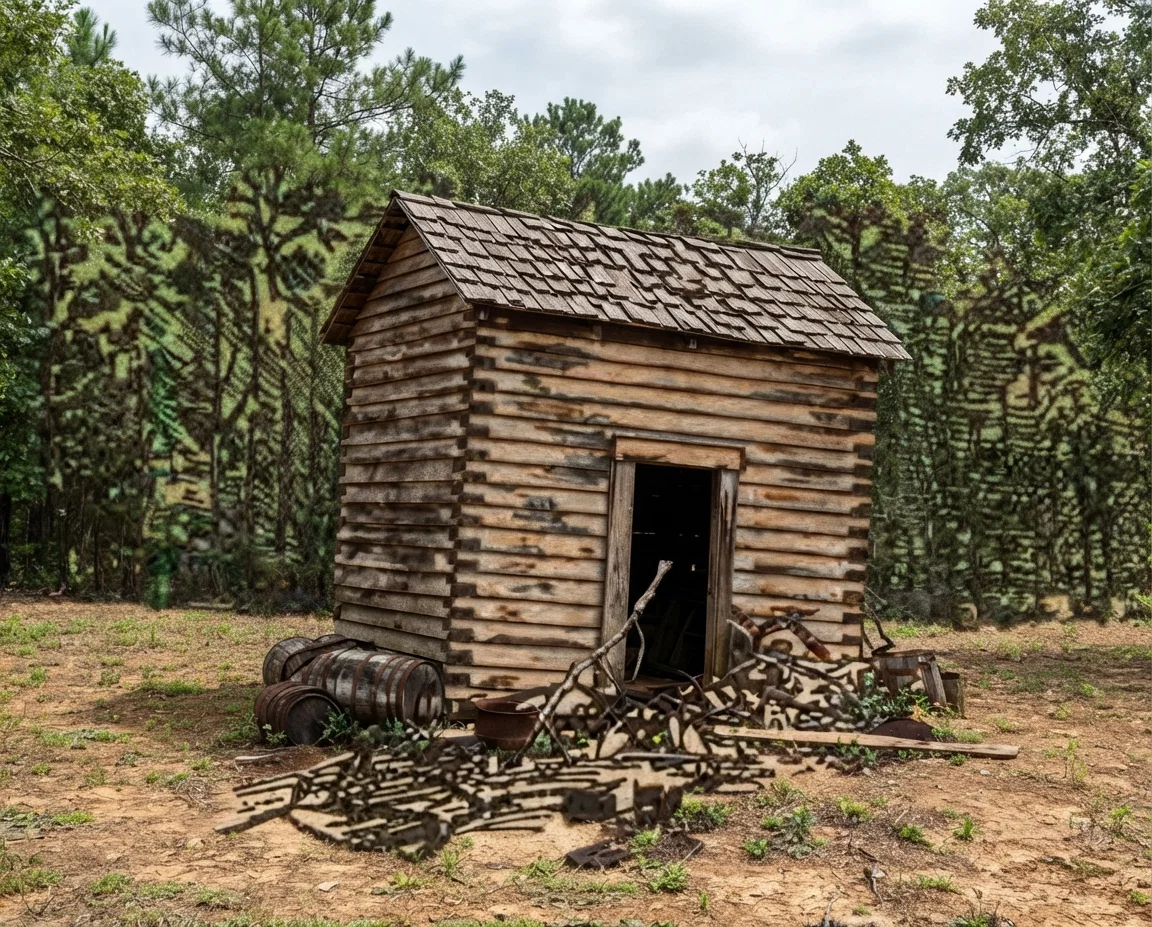
CLARKSVILLE ARK. CALABOOSE
AFTER 10 YEARS OF PROHIBITION
CLARKSVILLE ARK. CALABOOSE AFTER 10 YEARS OF PROHIBITION
In Arkansas, after long and arduous work, a law was secured under which a majority of the adults of any community can get rid of the saloon at any time by petition signed by such majority. In 1896 there were forty-two saloon counties to thirty-three prohibition. In 1905 the situation has been changed to nineteen saloon counties and fifty-six prohibition. A like progress is being made in several other Southern states, notably Texas, Tennessee, and Georgia.
Local option has had some marked victories in Oregon. It won at the polls in 1904. It won in the Legislature in February, 1905, and again in the Supreme Court in July of last year.
The liquor traffic is like a cancer; leave a root and it will grow again. It is like a tapeworm; leave the head and it will grow again. The only remedy is annihilation—persistent prohibition. That this fact is realized by those engaged in the liquor business, is shown by the fact that prohibition is the one temperance measure that they really fear and seriously combat. The brewers of Texas have assessed themselves thirty cents on the barrel of beer, amounting to over ninety-nine thousand dollars, to push the campaign against local option in that state. Texas is now three-fourths prohibition, and the other portion is considerably agitated.

FLESH DIET NOT NECESSARY FOR ATHLETES.

MR. CARL MANN, of Germany, excludes flesh, fowl, alcohol, tea, coffee, and coco from his diet. In 1902 he beat the world's record in long-distance walking, covering a distance of 127 1/2 miles in twenty-six hours, fifty-two minutes. Mr. George Allen, of England, a year later beat Carl Mann's record. This was said to have been the greatest walking feat ever performed. Mr. Allen is also a strict vegetarian. On his journey, his diet was breads and fresh fruits. Mr. Eustace Miles, England's champion amateur lawn tennis and racquet player, is a food reformer and a non-flesh eater. The Japanese wrestlers, who are almost gigantic in size, possess marvelous strength, and have for ages subsisted upon a non-flesh dietary. Cases might be multiplied proving beyond dispute that flesh is not essential for athletes, but that, other things being equal, the athlete who keeps his blood the most free from uric acid and other wastes, must excel.

FIFTEEN YEARS AGO.

I WANDERED to the grogshop, Tom, I stood beside the bar, And drank a bowl of lemonade and smoked a bad cigar; The same old kegs and jugs were there, the ones we used to know When we were on the round top, Tom, some fifteen years ago.
I asked about our old-time friends, those cherished, sporty men, And some were in the poorhouse, Tom, and some were in the pen; And one, the one we liked the best, the hangman laid him low. The world is much the same, dear Tom, as fifteen years ago.
New crowds line up against the bar, and call for crimson ink; New hands are trembling as they pour the stuff they shouldn't drink; But still the same old watchword rings, "This round on me, you know!" The same old cry of doom we heard some fifteen years ago.
I wandered to the churchyard, Tom, and there I saw the graves Of those who used to drown themselves in red, fermented waves; And there were women sleeping there where grass and daisies grow, Who wept and died of broken hearts some fifteen years ago.
And there were graves where children slept, have slept for many a year, Forgetful of the woes that marked their sojourn here; And 'neath a tall, white monument, in death there lieth low The man who used to sell the booze some fifteen years ago. —Anon.

TRAPS BY THE WAY.

THE poor victim of rum has just emerged from a drunken debauch. He is downcast and ashamed. He sees the want and squalor in his home, because of his neglect. He has spent the money needed by his family for food and clothing. He sees sorrow and discouragement and want on the faces of wife and children. He resolves to quit the drink habit; he promises his companion, as he has done a score of times before, that he will drink no more. And he means to keep his promise. He starts to his business or employment, if he has any; if not, he goes out to find employment. He feels keenly the effects of his past experience. He passes saloon after saloon. His appetite craves just one drink. Just one drink would revive his drooping spirits, and "set him on his feet." The more he thinks about it, the more he is tempted to take just one drink. But he has no money; so he goes to the place where he spent his money. Of course he is given a drink; men can get drink when they can not get bread. It is business to give men drinks at such times; they feel grateful for it, and when they get money they feel under obligation to return and spend a little. The saloon-keeper plays the rôle of a good, liberal friend in need. The trap by the way seems to be a place of good cheer. His spirits are aroused, and he forgets his sorrow for the past; he forgets, too, that his neglected family have not had their spirits brightened up, and this again encourages the demon that is lurking in his own breast.
You who have had experience know the story and its results better than it can be told. You know it was the saloon that brought you down, and you know it is the saloon trap by the way that catches you and keeps you down when you would fain break away from the demon of drink. Then, when you have opportunity, go to the polls and tell the authorities by your vote that you must have relief. Were it not for the ever-open and handy saloons, many a poor victim of alcohol would be free, and many a suffering family would be made to rejoice.

TOBACCO AND CHRISTIANITY.

THE following conversation took place between a physician and a professor of Christianity who was unconsciously more devoted to pipe worship than to the worship of God, and as a result was in ill health, and in need of medical advice:
"Do you use tobacco?"—"Yes."
"Are you a Christian?"—"Yes, I am a Christian."
"Christ did not use tobacco."—"O no."
"You say you use tobacco?"—"Yes, I use tobacco."
"Ah, but 'I am dead,' 'Christ liveth in me,' and Christ in you uses no tobacco."
The tobacco devotee bears evidence to the world that Christ is not within him, for, "He that saith he abideth in Him ought himself also so to walk even as He walked." I imagine if Christ should appear to-day among men, He would drive from the temple the worshipers who dared to appear before Him and defile the place with their whisky-soaked bodies, and tobacconized breaths, saying, "Take these things hence," your worship is not accepted. What an offering to present, a defiled body! Such offensive odors can never arise as sweet incense before the Lord.—Australasian Good Health.

Wine Is a Mocker

"Wine is a mocker; strong drink is raging."

LOOK OUT FOR THE BOYS.

GET the boys to sign the total abstinence pledge. The saloon can no more run without boys and girls than a sawmill can run without logs. Its life depends upon the boys. It may be your boys, if you have any. How are you going to secure your boys against its allurements? Many boys just as good and just as well reared as yours, have fallen victims to its enticements. There is but one sure means of protecting the boy, and that is to abolish the saloon. Will you help to do it? The saloon-keepers say:
“We must have more boys, at least twelve each hour, We must win by cunning devices. To gather the brightest of youth’s flower From the garden of home, its peaceful bower, We must use every art that entices.”
250,000 saloon-keepers are after your boy, and their wine rooms are open to your girl. For every drunkard that drops down, a boy starts in to fill the gap. Whose boy will come next?
Saloon kindergartens have been discovered in some of our large cities. They are rooms back of the saloons, fitted up with small furniture, toys, and picture-books, such as would delight children. Here wine is served in tiny glasses at the hands of some little boy or girl who receives a small recompense for services. Who can conceive of a more fiendish scheme to perpetuate the saloon?
In one year nearly four thousand children under ten years of age were picked up on the streets of New York as common drunkards, and their acts made a matter of police record. In one hour in New York, recently, 120 children entered one saloon.

IS THE MODERATE USE OF TOBACCO INJURIOUS?

THE tobacco-user may insist for years that the drug does him no harm, and wonders why he should at last find himself suffering from tobacco heart, or tobacco blindness, or other grave disease due to the long-continued action of this poisonous drug. He does not comprehend the fact that nature has been all these years battling in his behalf, and has only yielded when unable longer to maintain the struggle. The final collapse comes, not because of nature’s unwillingness or neglect, but because her resources are exhausted. Let the man who suffers from tobacco heart or tobacco blindness cease the use of the drug, and if irreparable damage has not been done, the disturbing symptoms will rapidly disappear; not because nature good-naturedly cooperates with the man when he undertakes to help himself, but because nature, by simply continuing the efforts which she has been making all the time in the man’s behalf, attains success because the man himself has ceased to thwart her efforts by his own wrong-doing.—Selected.

A QUESTION OF DAMAGE.

If three saloon-keepers of this city [Chicago] have to pay $5,000 damages apiece to the family of a man whom they have ruined and debauched, how much would the 240,000 saloons of America have to pay on the same basis for all the homes they have wrecked and are now wrecking, provided simple justice in the premises were required at their hands at the present time? That is the startling question suggested by a remarkable decision in Judge Tuthill's court, in which a jury assessed three saloon-keepers $17,500 damages (under the civil damage act) for debauching John Hedlund, a skilled carpenter, and, despite the repeated protests and warnings of his wife and friends, persisting in selling him liquor after his will-power was gone and his body a prey to alcoholic poison.
Five years ago Hedlund was a successful workman, earning $4.00 a day at his trade. To-day he is a drunkard, made so by virtue of the license law, and his wife and five little children, the youngest two years old, are in desperate circumstances. The testimony developed the fact that the defendant saloon-keepers had put Hedlund under considerable financial obligation and had exhausted their wiles to bind him fast as a patron even after he had become a confirmed drunkard.—Press Despatch.

THINK OF IT!

THE liquor traffic, to-day a thoroughly-organized business, represented in 1,741 breweries, 2,267 distilleries, and over 240,000 retail liquor saloons throughout the country, now contributes to the support of the national government about $185,000,000 annually, and, according to the most conservative and unbiased estimate by eminent authorities, receives from the people over $1,200,000,000 annually. That one-half of this is paid by the wage-earners in shop and mine and country is not at all unreasonable. This money is taken directly out of the channels of legitimate trade—that is, turned aside from the market for bread and meat and fuel and clothing and other necessities and helpful luxuries, essential to create and maintain in the consumer wealth-producing power. A dollar spent in the corner saloon is lost to the grocer and the merchant, and gives the consumer nothing in return, save an increased appetite for liquor, and a decreased capacity for effective labor. And $1,200,000,000 spent in the saloons of the whole country means not only the same results multiplied a billion times, a consequence beyond the farthest reach of any mind to conceive, but in addition, the added perils to the entire citizenship which invariably breed in the contagious masses of such undisturbed social vice and degeneration.—Selected.

AN EFFECTIVE METHOD OF ENCOURAGING TEMPERANCE.

THE question of intemperance is one which is largely in the hands of the employers of labor. When the employer understands, and announces that he can hire a man with a clear head for the same compensation for which he can get one with a muddled brain, the temperance movement is subjected to a force not known by any other method. It may well be called the dynamics of the temperance movement, and began on the railroads a generation ago, first, in orders that men who drank while on duty should not be employed. It was soon seen that this meant nothing whatever, and so the next movement was to prohibit the employment of men who were habitual drinkers, even in slight degree.
This movement has spread over the country. The public is interested as much as the railroads themselves. The safety of travel and the avoidance of disaster concern the whole people, and thus the economic value of the prohibition has been felt in every direction. It now extends to private and corporate concerns which desire to run their establishments with as little friction and as little loss as possible. The common and the statutory laws which make employers liable, in some degree and under certain circumstances, for the carelessness of their employees, are a most powerful incentive to the employment of men with clear heads. Thus economically again the movement acquires strength. —Carrol D. Wright, Commissioner of Labor.

LIQUOR TRAFFIC’S “LIBERALITY.”

THE people who use “strong drink” unwittingly assist in many foolish extravagances. That they pay enormous prices for the stuff they use, is shown in the manner of life the manufacturers are able to lead, and the appalling prices they are able to pay for advertising. It is said that the entire expense account of the Japanese and Russian peace envoys at Portsmouth, N. H., were paid by the Portsmouth Brewing Company, the property of the Frank Jones estate. The following facts, taken from an exchange, are significant:
Judge Calvin Page, trustee of the Frank Jones estate, frankly admitted that the big brewing company and the Hotel Wentworth entertained the envoys as an advertisement.
Hotel expenses, bills for wines and cigars, all were O. K.’d by the estate of the late Frank Jones, millionaire beer brewer, and once president of the Boston and Maine Railroad.
The State of New Hampshire had no fund to spend on the envoys, and so the Jones estate assumed the burden.
Judge Page thinks that the advertisement ought to be worth a million or more for Jones’ ale and the Hotel Wentworth, which the estate also owns.”

Prohibition Does Not Destroy Towns

The friends of the liquor traffic talk glibly about saloons and breweries and distilleries building up towns. On this proposition the North Carolina Baptist says: "That which destroys human flesh and blood and increases crime and causes sorrow can not make a town." As illustration that prohibition does not kill a town, the same paper cites the case of Greensboro, in that state, a prohibition city, where 1,200 houses were built last year. But we have older testimony than that on this subject. The Lord says, "Wo to him that buildeth a town with blood, and establisheth a city by iniquity! . . . Wo unto him that giveth his neighbor drink, that puttest thy bottle to him, and makest him drunken also, that thou mayest look on their nakedness!" Hab. 2:12-15.

Prohibition Prosperity in Sutter County

The first day of October was announced as "a gala day" for Sutter County, Cal., the occasion being the celebration of the anniversary of the taking effect of the prohibition ordinance. An elaborate free dinner was spread, and an excellent literary program rendered. A large crowd was present. There is not a saloon in the county. During last year the taxable property in Sutter County increased a quarter of a million dollars and the tax rate has been decreased. The county jail has been empty for some time, and the hospital contains but three patients.
FERRY'S SEEDS
Represent the survival of the fittest. We have become the largest seed house in the world because our seeds are better than others. Do you wish to grow the most beautiful flowers and the finest vegetables? Plant the best seeds--Ferry's.
1906 Seed Annual free to all applicants.
D. M. FERRY & CO.,
Detroit, Mich.
FERRY'S SEEDS Represent the survival of the fittest. We have become the largest seed house in the world because our seeds are better than others. Do you wish to grow the most beautiful flowers and the finest vegetables? Plant the best seeds--Ferry's. 1906 Seed Annual free to all applicants. D. M. FERRY & CO., Detroit, Mich.

Devotional Songs

One-half new songs that will never grow old One-half old songs that will always be new

Devotional Songs

250 pages, cloth, $25.00 per 100; 30 cents each by mail. A copy for examination will be mailed on request. Returnable. Published by the publishers of the famous “Gospel Hymns.” THE BIGLOW & MAIN Co., New York and Chicago

FOR SALE

I have a number of Buggies, Carriages, Spring Wagons, Fruit Trucks, etc., for sale at prices that will make it to your interest to investigate when you are in need of a rig of any kind.
GEO. E. HENTON, Wagon and Carriage Maker, Mountain View, Cal.

WANTED

Conscientious Sabbath-keepers to work in Colorado gold mines. The Colorado Big Bore Mining, Milling and Tunnel Company (Incorporated, capital stock, $5,000,000). Suite 550 Watson Building, 123 and 125 Lasalle St., Chicago, Ill.

Notice

NOTICE.—If you are thinking of buying a watch now or at some future time, write for my Price-list of American Watches. I can save you money on watches. Address, Epharim K. Skedgell, Portsmouth, N. H.

Inter-church Federation

"Inter-church Federation."—The series of articles on this significant movement closes with this issue. This is not to say that all has been said; the issue is still before us, and will not be ignored or allowed to go by default. But surely the articles that have been presented have been eye-openers to those who are disposed to view the matter in the light of prophecy, of history, and of the fundamental principles of this Republic. Enough has been given to leave any reader without excuse for ignorance of the sure outcome of a movement conducted to a conclusion on the lines laid out by the Federation.
The "Christian Advocate" of New York, while admitting that Utah has a right to send any senator they choose to the United States Congress, still feels that Reed Smoot ought to be rejected, because "he belongs to the hierarchy of the Mormon Church, and therefore that his relations to that church are such that he can not safely be trusted with this exalted and responsible position," because "to a great extent" the church exercises autocratic power over the votes of its members, and wields them as so many puppets to work its will; and because, as a fundamental principle of Mormonism is that its government is theocratic, his religion will always control his politics. Now all this may be true, but they apply with equal force against every Roman Catholic who is loyal to his church. There may be times, and in most matters, when the Catholics act absolutely independent, but wherever the safety or interests or welfare of the church is concerned, the political influence is sure to be thrown on that side, whatever the result to the nation.

Protestants on Romanism

The difficulty with much of the opposition of professed Protestants to Romanism is, that the opposers do not know what Romanism stands for. Many of these opposers are doing the same things themselves, but under other pretexts. When Protestants, so called, urge religious legislation in the name of Christ, the principle is just the same, and the effect must be the same, as when Rome urges the same thing in the name of "the church." Rome always maintained that the prime object of the state is to enforce the interests of "the church;" and when other churches call for state aid and state-enforced religious institutions, they take their stand on Roman ground. When they ask the state to enforce the observance of Sunday they ask the support of that which is distinctly Roman. Rome maintains, and logically, too, that when Protestants acknowledge her authority to ordain a sabbath institution contrary to the law of God, they have no excuse for not accepting her authority in all doctrine.

CONTAINED IN THIS NUMBER.

Poetry. God's Word and Plan .................................................... 10 Labor Song, L. D. SANTEE .............................................. 12 Fifteen Years Ago ........................................................... 15
Editorial.—"It Is Written"—The Key That Unlocks Heaven—"New Light"—In Harmony with God's Purpose 3-5
Question Corner.—No. 1780 ......................................... 5
Outlook.—"The Pernicious Effects of State License"—The Patent Medicine Curse—The Beer Delusion—Liquor Manufacture on the Increase—Merely for Revenue—Futile Attacks .......................................................................... 6, 7
General. Fundamental Principles No. 3 ........................................ 4 The Will of God, W. A. SWEANY ..................................... 8 Trusting Christ, MRS. E. G. WHITE ................................. 8 The Federation of Churches, ALONZO T. JONES .......... 9 Jeremiah 17:11, ROSALIND A. YOUNG ........................ 10 Ambassadors for Christ, A. C. ANDERSON .................. 10 False "Reform" on the Sabbath, W. N. GLENN ............. 11 The Law of God (Bible-Reading) ................................. 11
Missions.—A Fiesta in Porto Rico, IDA M. FISHER ........................................................................ 12
The Home.—A Texan's Struggle with the Tobacco Habit—The Only Remedy—Traps by the Way—Tobacco and Christianity—A Question of Damage—Think of It!—Look Out for the Boys—An Effective Method of Encouraging Temperance ........................................................ 14, 15
Our Experience Meeting .......................................... 13
Publishers ................................................................ 2

Who Is J. S. L.?

Who is J. S. L.?—We have received an article from a town in Illinois, bearing the signature, "J. S. L." If J. S. L. will inform us as to who he is, we will examine his manuscript. We have no time to spend on communications so sent. We do not ask the name for publication.

A Coming Panic Predicted

A Coming Panic Predicted.—Jacob H. Schiff, a financier of New York, declares that until some plan is devised by which the currency of this country shall be made more elastic, a panic will follow in this country in comparison with which all preceding panics will seem like child's play.

A Good King

A Good King.—No death of recent years has probably caused more wide-spread mourning among the great people of earth than that of Christian IX., king of Denmark, who died of heart failure January 20, at the age of nearly 88 years. He was known as the father-in-law of Europe on account of the numerous family connections with reigning houses. He was not a great man, but evidently a very kind, genial man, very democratic, and unostentatious in manner, living a quiet and moral family life.

TEMPERANCE.

THIS week we give our "Outlook" and "Home" departments mainly to the subject of temperance, as the subject is popularly treated. But this is not to say that from this view-point all there is of this question, or even the fundamental principles, are to be seen. The inspired Word enjoins us to "be temperate in all things," and this includes much more than abstinence from the ordinary stimulants and narcotics. The seeker after temperance matter in this paper will not by any means get it all without a careful reading of the article beginning on page 3, entitled, "It Is Written." Satan injected sin and death into this world by a play on the appetite of our first parents, and through perverted appetite ruin has run riot in the human family ever since. So Christ began at the point of appetite to overcome sin in the flesh. Thus the overcoming of the natural, physical tendencies by the power of the Spirit is the root of the temperance question. From this standpoint every issue of the Signs of the Times is designed to be a temperance number. When men, through faith in Christ, have "condemned sin in the flesh," by having fulfilled in them "the righteousness of the law" of God, the temperance question will be forever settled; and not till then. Any temperance effort not based on this Gospel principle can only be superficial and limited in its results.

The Deadly Sport of Prize-Fighting

A man was killed in a prize-fight at Colma, near San Francisco, Cal., on the 5th inst. It is not surprising that a man should be killed in this kind of sport, but there is a bad feature of the affair that is said to 'startle' the board of supervisors of San Mateo County, and that is the fact that a number of recent 'boxing contests' have been exhibited without license. This seems to be the horrible criminality of the business. To hammer men to death, or until they are unable to respond to call for a prescribed time, is deemed 'legitimate' if only the parties have paid the required license. It is feared in sporting circles that 'legitimate' prize-fighting has received a discouraging blow through the illegitimate affair that resulted in what can be expected in any 'bout' of that kind.

The Fear of Man

The Fear of Man.—At a ministers' meeting in Providence, R. I., where about forty were present, a few years ago, one of the number presented the subject of "The Biblical Sabbath." At the close a tall, dignified minister, with a scholarly appearance, arose and said:
"Why do we ministers not tell the truth we know about this Sabbath question? We know there is not one particle of evidence in the New Testament that the Sabbath ever was changed to the first day of the week by Christ or His apostles. We know this, and yet we are afraid to admit it even to ourselves; far less would we tell it to our congregations. What are we afraid of?"
Then the speaker sat down, and not one of his brethren, either by look or word, expressed dissent from what he had said. They knew that he had spoken the truth.—I. J. Hankins, Missionary in South Africa.

Peanuts

Peanuts.—According to the American Nut Journal there are three hundred million pounds of peanuts grown annually in the United States, yet how few there are who know this. Three hundred fifty thousand acres of land are used and 170,000 persons employed in the industry. The yearly value of the crop is about eleven million dollars. Fifty years ago a few were grown in gardens; now it is cultivated very profitably in all the Southern States, California, Oklahoma, and Missouri, and to some extent in the Northern and Western states. It is said to be one of the very best of foods for cattle, and splendid for the land. What a blessing it would be if it would take the place of the tobacco crop that impoverishes the land more than almost all other crops.

The Doctrine of Intolerance

A President of the United States, now deceased, once said that the best thing to do with a bad law was to rigidly enforce it until the people should demand its repeal. This was deemed a wise saying, by some people, especially by those who desired to see certain laws enforced that others deemed bad. The practice is based on the theory of doing evil that good may come. It is the doctrine of intolerance, the doctrine on which the Inquisition was built. Any law that infringes the natural rights of any individual ought to be repealed without appeal from the people. Law that does not protect the rights of the minority is unjust law.

Destruction of Missions at Changpu

A despatch from Amoy, China, February 9, confirms the report of the destruction of the English Presbyterian and Roman Catholic missions at Changpu, thirty miles from Amoy, by a mob described as having been composed of Boxers. The damage amounts to $50,000. The American missions were uninjured. Details are lacking. The sentiment in the neighborhood of Changpu is hostile to foreigners, and it is considered strange that the American missions were not molested, as the boycott of American goods is strong there.

True Christianity Never Persecuted

Christianity, true Christianity, never persecuted the Jews. True Christianity never persecuted anything. All the so-called Christianity which ever persecuted was its dead or dying form, barren of the power of God and seeking to civil power to support its lack. But civil power can never do it; let the state attend to its own business. Each has proved a curse to the other wherever they have been united. True Christianity can rely on her Lord alone. She knows that He is all-sufficient.

The Youth's Instructor

The Youth's Instructor opens the year in splendid shape, and we should like to appeal to the young readers of this paper to send for a sample copy if you are not already taking it. Our monthly department barely touches questions which the Instructor will deal with fully. The address is Youth's Instructor, Takoma Park, Washington, D. C.

You have reached the end of this edition.

Signs of the Times · Feb 28, 1906