The Youth’s Instructor, Vol. 38, No. 49.

THE LESSON OF THE BIRDS

The Youth’s Instructor

Dec 3, 1890

S. D. A. Publishing Association · Battle Creek, Mich. · Dec 3, 1890

THE LESSON OF THE BIRDS.

WHAT do the birds do when the winter neareth, And dead leaves drop downward, and every bough is bare, And the pools are ice-crusted, and he who listens heareth The rustle of the snow-wings in the upper air?
O, the birds they are brave; their fine pervasive senses Discern the distant warmth and balm beyond the frost and sting; The old ones tell the young ones in secret conferences, And the young ones learn the lesson, and trust in the spring.
In the close pine coverts they crowd for protection— The left-behind who cling to home and will not southward go. They know the hardy berry-beds, and need no direction To seek out drinking-basins in the half-melted snow.
When the sunshine warms the world, the birds rehearse their singing: Low trills and twitters break the quiet of the woods. And while spring is yet a long way off, they see her, and come winging. Blue-bird and thrush and robin, in joyous brotherhoods.
Teach us your lesson, dear birds, Of bright endurance. To face the cold and face the gloom, and bravely wait and sing. And trust the Love that never fails, in confident assurance That out of winter's deepest drifts shall bloom the spring!
—Susan Coolidge.

THE PICTURE WHICH WAS “DEVELOPED.”

I KNOW a boy who has a camera and takes pictures. He took me into his dark room the other day to show me how to develop a plate. He had been down to the Battery, in New York, that afternoon,—it is not a battery at all now, being a little park on the tip end of Manhattan Island,—and had “snapped” a picture. He did not tell me what it was going to be, and all I had to do was to watch him.
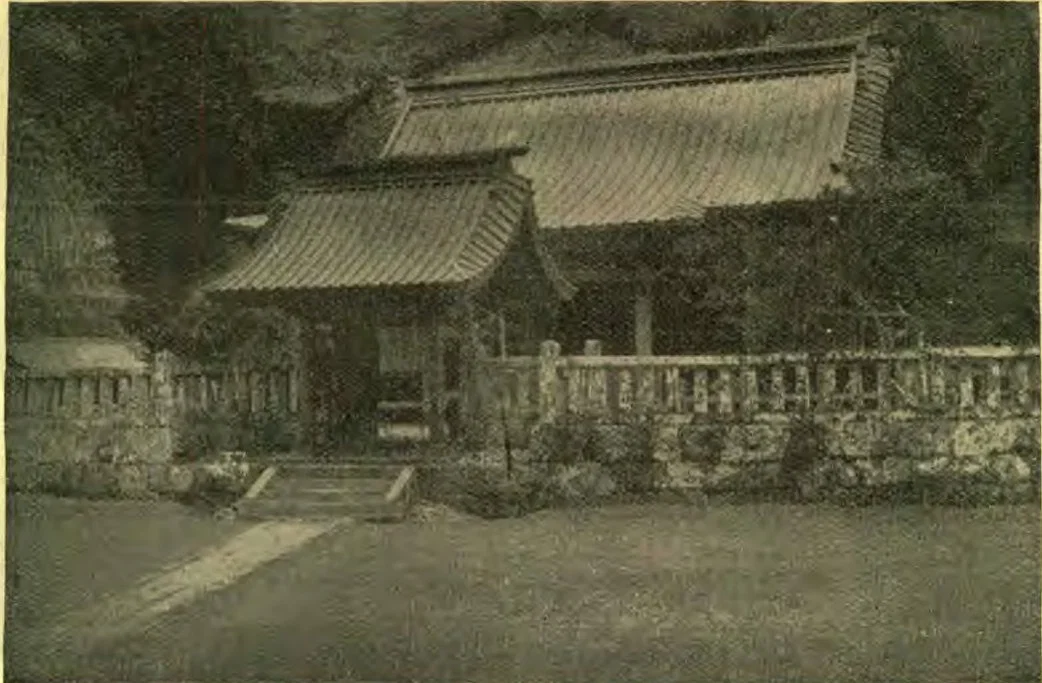
A JAPANESE HOUSE.
A JAPANESE HOUSE.
First he poured clean water into a tray, and then by the dim light of a red lantern took a glass plate out of his camera. “The picture’s on that,” he said, as he slid it into the water-tray. May be the picture was there, but what I saw was a pane of glass coated on one side with some stuff that looked like cream. While the plate soaked, my little photographer was busy with his bottle and measures, mixing a glassful of clear liquid that he called his “developer.” “Now, watch,” he warned me, as he lifted the plate from its bath, and, placing it in an empty tray, poured the developer upon its blank, creamy surface. I watched—no change yet; he was watching intently, rocking the tray gently. “Look, there are spots in the cream; the upper part of the plate is darkening.” “Sky,” says the operator. The shade creeps over the lower corners. “Water,” he murmurs. What is this? The creamy remnant in the central field is taking form; slender lines of white transverse the dark sky; a mass of white becomes a vessel with spurs and rigging, two massive stacks, four towering masts, the smoke pours from her chimneys, a torrent of foam leaps from her prow, and sweeps behind her in a majestic avenue. The blank cream plate has developed into a perfect picture of an Atlantic steamship.
The picture was all on the plate when we went into the dark room, but it took the developer to bring it out.
I knew a young man who was remarkable for his good looks and genial manners. He was one of those fellows whom every one likes. So far as his friends could see, his life was as clear as that creamy plate of my friend, the picture man. But the young man is in Canada now, and it is said that he wakes up in the middle of the night shivering with fear that the police have caught him at last. “That can’t be the same young man,” you say. Ah, but it is the very same, only he has been in the “developer.” Smooth as he seemed, he had been exposed to temptation in his boyhood, and got in the habit of being not quite honest. Nobody knew it; I don’t suppose he realized its wickedness. But one day he was in a “dark room,” with a terrible temptation, and the character which he had been forming flashed out. He stole one hundred thousand dollars, and fled. At some time or other, circumstances will bring to light the principles you now live by. Be sure that the picture of your own character comes out well.—Dr. Hurlburt, in Classmate.

ROUND THE WORLD.—38.

THINGS JAPANESE.

There are so many curious things in Japan that we know not how else to classify them. Everything is so different from what we see at home that at first we find ourselves as animated as “Alice in Wonderland.” But we are soon sadly conscious of losing these vivid impressions, which at first rendered every moment interesting and every scene picturesque. We gradually accept the ways of the people, melt into their simple ideas, and become, as it were, “japanned.”
We have talked of the people and their dress, now to their homes. The first sight of a Japanese house, that is, a house of the people, is certainly disappointing. From the infinite variety and charming character of their works of art, as we had seen them at home, we were anticipating new delights and surprises in the character of the architecture. The houses are unsubstantial in appearance and meager in color. Their unpainted condition suggests poverty. This absence of paint, with the gray and often rain-stained color of the boards, leads one to compare it with similar unpainted buildings at home, usually unpainted barns and sheds in the country and the homes of the poorer classes in the cities. With one’s eye accustomed to the bright contrasts of American houses, with their white or light-painted surfaces, their rectangular windows, black from the shadows within, and glints of light reflected from the glass, the front door with its pretentious steps and portico, the warm red chimneys surrounding all, and a general trimness of appearance outside, which is by no means always correlated with like conditions within, one is apt at the outset to form a low estimate of a Japanese house. We find it indeed difficult to consider such a structure a dwelling, when so many features are absent which go to make up a dwelling at home. There are no doors or windows such as we have been familiar with, no attic or cellar, no chimneys, and within no fire-place, and of course no customary mantel; no permanently inclosed rooms; and as for furniture, no beds or tables, chairs, or similar articles, at least so it appears to us.
One of the chief points of difference in a Japanese house as compared with ours lies in the treatment of partitions and outside walls. In our houses these are solid and permanent, and when the frame is built, the partitions form part of the framework. In the Japanese house, on the contrary, there are two or more sides that have no permanent walls. Within, also, there are but few partitions which have similar stability; in their stead are slight sliding screens, which run in appropriate grooves in the floor and overhead. These grooves mark the limit of each room.
The screens may be opened by sliding them back, or they may be entirely removed, thus throwing a number of rooms into one great apartment. In the same way the whole side of a house may be flung open to sunlight and air. For communication, therefore, between the rooms, swinging doors are not necessary. As a substitute for windows, the outside screens, or shoji, are covered with white paper, allowing the light to be diffused through the house.
Where the external walls appear, they are of wood, unpainted, or painted black; and if of plaster, white or dark slate-colored. In certain classes of houses, the outside walls, to a height of several feet from the ground, and sometimes even the entire wall, may be tiled, the interspaces being pointed with white plaster. The roof may be lightly shingled, heavily tiled, or thickly thatched. Nearly all the houses have a veranda, which is protected by the widely overhanging eaves of the roof.
While most of the houses of the better class have a definite porch and veranda, or genka, in houses of the poorer class this entrance is not separate from the living room; and since the interior of the house is accessible from two or three sides, one may enter it from any point. The floor is raised a foot and a half or more from the ground, and is covered with thick straw mats, rectangular in shape, uniform in size, with sharp, square edges, and so closely fitted that the floor upon which they rest is completely hidden.
The rooms are either square or rectangular, and are made with absolute reference to the number of mats they are to contain. With the exception of the guest-room, few rooms have projections or bays. In the guest-room there is at one side a more or less deep recess divided into two bays by a slight partition. The one nearest the veranda is called the tokonoma. In this place hang one or more pictures, and upon its floor, which is slightly raised above the mats, rests a flower vase, incense burner, or some other object. The companion bay has shelves and a low closet. Other rooms may have a recess to accommodate a case of drawers or shelves. Where closets and cupboards occur, they are furnished with sliding screens instead of swinging doors.
In city houses the kitchen is at one side or corner of the house, generally in an L covered with a pent roof. Curious to say, the rooms which we generally place at the back of our houses are nearly always in front of a Japanese dwelling. Thus the parlor is at the back, and the kitchen facing at the front. In the country the kitchen is nearly always under the main roof.
Accompanying the houses of the better class are solid, thick-walled, one or two-storied, fire-proof buildings called kura. In these the goods and chattels are stored away in time of a conflagration. They are known to foreigners as godowns, and have one or two small windows and a door, closed by thick and ponderous shutters. When these are flung back, they look very like the doors of an iron safe. They are painted black and are very finely polished, so that they have the appearance of iron.
In the gardens of the better class, summer-houses of rustic appearance and diminutive proportions are often seen. Specially constructed houses of quaint design are not uncommon. In these the ceremonial tea-parties take place. High fences of bamboo usually surround the house to inclose it from the street. But whatever is commonplace in the appearance of the house is always toward the street. Within these plain and unpretentious houses are often to be seen marvels of carving, and the perfection of cabinet work, while their porcelain and lacquer work has been and is the wonder of the world.
The first thing that impresses one on entering a Japanese house is the low studding and small size of the rooms. The ceilings are so low that in many cases they can be easily touched. The mats which cover the floor are always beautifully clean, and are from two to three inches thick.
No room contains any article of furniture like a bedstead. The bed consists of wadded comforters, which are made up temporarily on the soft mats. A Japanese pillow is called a makura, and consists of a closed wooden box, with the bottom either flat or slightly convex. On the top of this box is secured a small, cylindrically-shaped cushion, stuffed with buckwheat hulls. The same string that holds it in place also secures the pillow-slip, which is simply a sheet of soft paper folded several times. The Japs place their necks, not their heads, on this pillow, so that the hair may not be disarranged while sleeping. Once they lie down, they as a rule do not move during the remainder of the night. If they desire to turn over from one side to the other, instead of going through the performance as we would, they sit bolt upright, change their position, and then lie down again. Some of these pillows open, and inside their owners stow a paper lantern, matches, a comb, a mirror, and various other toilet requisites. A Jap will never sleep unless he has a large paper lantern lighted by his side; it looks to a stranger as if one movement of the body might upset it, and the place get afire, but as a Jap never moves in his bed, I suppose there is not so much danger. A Jap with his pillow and bed of this kind can literally take up his bed and walk.
When on a visit into the interior of the country, we stopped at one time at a Japanese inn. Being very tired, we asked to be given a room where we could go to bed and sleep awhile. But the hostess could not speak a word of English, and we were ignorant of her tongue, so that it was with great difficulty that I made her understand what I wanted. Finally, I lay down on the floor, and placing my hand under my head, snored loudly, pretending to be asleep. She took in the situation in a moment, and, laughing as all Japs must, ran off, and brought a comforter and pillow, as described above. I was allowed a room to myself, but I noticed that the Japanese guests were permitted to occupy only the dimensions of one mat. In this way the entire floor is covered.
We have already mentioned that in Japanese houses there are no stoves such as we have at home. Many of the bedrooms have a square hole in the floor, in which, when needed, a fire of charcoal may be kindled. This is called a ro. Above the ro a square frame of wood is adjusted, and the bed-clothes being placed over this are thoroughly heated, so that one may go to bed in the warmest of nests. A little wooden box is used for holding an earthen receptacle for coals, and this is taken to bed, as a substitute for the hot stone or brick, which is often used at home for a similar purpose.
In this connection it may be well to add that oftentimes little square cushions are provided for guests to sit on, and one often sees a light, round cushion, which is provided for an elbow rest for reclining. Beyond these things there is little or no more furniture in a Japanese house. Occasionally there are little cabinets in which articles of value are bestowed, but many houses are devoid of even these.
P. T. M.

ABOUT DOLLS.

DOLLS have amused the world for ages, and seem to have been well known in the days of the Pharaohs; for in the tombs of ancient Egypt, figures of painted wood, of terra-cotta, of ivory, and of rags have been found, whose limbs were made movable for the delight of children. Similar toys have been discovered in tombs; they were spread in the East and in China, as well as in India. Movable figures were made to act, from time immemorial, by hand, and on strings, or as shadows behind a curtain. The ancient Greeks were experts in the manufacture of puppets, including wax dolls. They show that little girls have always had the same girl-nature they now have, and that older people have always tried to please and satisfy it in the same way.
The puppets, originally intended to gratify children, ended in being a diversion for adults, and puppet shows attracted a due amount of attention in the Middle Ages, arriving at such perfection in the sixteenth century that their performances rivaled in attraction those of living actors. Puppet shows became exceedingly popular in England in the early part of the last century.
There was a time when there were no fashion journals, just as there was a time when there were no newspapers or magazines of any sort. The French people then, as now, originated most of the ladies' fashions for all the world; and, as they had no way of making pictures of their new styles, or papers to describe them in, they made up dolls in the latest French fashions, and sent them all over the world. These poupées, as the French called them, were thought of so much importance in England that they were allowed to be imported without hindrance, even in time of war. These dolls not only showed the cut of the costumes, but also reproduced faithfully the materials and trimmings. Some of them were carried into Pennsylvania and Virginia in early times, and set the fashions for our great-grandmothers' styles in dress.
The French poupée still maintains its superiority in the doll world. Not even the most fashionable American emporium can display dolls of home manufacture equaling in pinkness of complexion, in wealth of lace, flounces, and frilleries, the dolls exhibited in Paris. In the manufacture of small porcelain dolls, arrayed as brides, babies, shepherdesses, beadles, and gendarmes, the French are also wonderfully skillful. The more expensive dolls, arrayed in the latest fashions, come, in many instances, from Paris; but there are professional and amateur doll-dressers enough in England who can successfully compete with the French. Most of the best dolls in this country, however, do not come from England (for we hardly look to the English for our styles), but from France and Germany.
The latter country is famous for the manufacture of toys and dolls; and the small town of Sonneberg, in the Thuringian Forest, alone produces articles for the amusement of children to the value of $150,000 yearly. The different processes in the manufacture of wax dolls can there be seen from beginning to end. German ladies are expert doll-dressers, and there is a yearly Christmas exhibition of dolls at Berlin. A great deal is made of this Berlin doll exhibition, and society turns out in large numbers to patronize it.
There are whole towns in Germany that do little else but make dolls for American children. They are mostly simple country folk. They get small pay for making even an excellent doll; but it must be remembered that their wants are few. German people do not stir about as much as Americans, and it is the traveling and the dresses to travel in and appear in “style” before the world that cost. English children buy almost $1,000,000 worth of dolls from French and German doll-makers; while the American children buy (not quite all in dolls, however,) double that many dollars' worth every year. American money paid out for dolls makes happy homes among the poor people of France and Germany at Christmas time.—Selected.

THANKSGIVING

“In everything give thanks.” —1 Thess. 5:18.
WHAT wondrous counsel here In words so brief: “In everything give thanks.”— In joy, in grief. This is the “will of God” Concerning me. The great and mighty God, O! can it be? “The will of God in Christ,” His own loved Son, Concerning thee, my soul, His “will be done.” Spirit divine, now aid That thus I may “In everything give thanks;” Thro’ all life’s way, Give thanks “in everything.” In weal, in woe; For “in Christ Jesus” God Hath willed it so.
—The Pansy.

A WORKING STEWARD.

John Ericsson will always be a boy’s hero. To read of his inventions is to believe almost in magic, so wonderful is it that one man should have done so much to revolutionize methods of travel and warfare, as well as to have enlarged the field of mechanics until the possibilities are boundless; for the little solar engine which Ericsson left as a legacy may work as great wonders, when understood and applied, as steam has worked. Great engines may yet be worked by the heat of the sun, as they are now by steam and electricity. Think of the great economy in coal and labor when the sun becomes the generating force in moving machinery. Every boy cannot be a John Ericsson, but every boy can hold as a principle in his life the principle that controlled him. “Providence has given me greater abilities for use, within certain limits, than to any other mortal. I will be a faithful steward,” he said to a friend; and it was this thought that controlled his life. To every boy is given some gift not held by any other boy. It may not be one that will make him marked before the world, but it is this gift that distinguishes him from the rest of the world. What he becomes depends on the use he makes of this gift.
If you read the life of Ericsson, doubtless you will be impressed with one thing—his devotion to study, his determination to understand whatever subject he undertook. He understood the principles of geometry so perfectly, and applied them so thoroughly to mechanical drawings that he found models unnecessary. It was this knowledge that enabled the young Swedish engineer to enter a contest and complete a locomotive in seven weeks and a “monitor” in one hundred days. Some one gave the definition of genius as the ability to do hard work; and when we read the life of this Swedish boy, who had but slight school advantages, it seems to have been his greatest genius in spite of the monuments of skill which he left.
Every opportunity to gain knowledge was used, and he studied especially those lines which he felt would help him to lead in his chosen field.
Boys can do that now. There is hardly a city of any size in which a training of any special line cannot be followed—art, chemistry, mechanics, electrical engineering, as well as the trades. Never did boys at school have the opportunities they have now, and he who feels himself a steward will work for the stewardship.—Selected.

HIDDEN CARVING.

That is an old story of the Grecian sculptor who, charged with adorning a lofty temple, was chided by his employers because he fashioned the upper surface of the capitals which surmounted his pillars with the same exquisite handiwork and elaborate care which he bestowed on the carvings within reach of every visitor who might stand on the pavement.
They said to him, “Why do you waste your skill where no human eye can ever behold it? Only the birds of the air can perch in such a place.”
The sculptor raised his eyes, lifted for a moment his chisel from the stone, and replied, “The gods will see it,” and resumed his task.
Old story as it is, it carries a lesson to those who are beginning their life-work. Not only is God’s eye watching your hidden carving; some day it may—yes, it will,—stand forth in full light to your honor or confusion.—Selected.

SOME ONE WATCHING.

Rika’s cousin Anna was sick, and Anna’s mother was tired out taking care of her and doing the housework; so Rika’s mamma thought she ought to go and help care for the sick child.
But what was to become of Rika? It would not be safe to take her along, because then she might get sick, too, like Anna; and, besides, such a little girl would be pretty sure to make some noise, which would make her little cousin’s head ache still worse, and keep her awake when she needed to sleep.
Finally Rika’s mamma decided to watch till the teacher came along on the way home from school, and then ask her to stay with Rika.
When the teacher heard about the sick girl and her tired mamma, she was very glad to do something that would help them, and she promised to stay not only the rest of that day, but also the next day, as there would be no school then.
Rika was not used to being away from her mamma; but the teacher thought of so many things for her to do, and so many things to tell her about, that the little girl got along very well, until it began to grow dark; then she felt lonely and afraid. So the teacher took her onto her lap, and told her how God watches his children, and takes care of them; and that he can see just as well in the dark as in the light, and will not let anything happen to us that is not best, if we are trying to do right, and be God’s own little children.
After awhile, when Rika became sleepy, the teacher said she might go to bed then, and not wait for her mamma; and when she was ready for bed, the teacher asked if she wanted to pray before she went to sleep. The little girl looked surprised, and said she wasn’t big enough, and hadn’t learned any prayers to say.
Then the teacher told her that she did not need to learn anything to say, but that she could simply ask the Lord to take care of them all, and to help them to be his own true children; and she could thank him for taking care of them before, and giving them so many things.
Rika thought about it for a long time. When her mamma came home, she was still awake, and said to her, “Mamma, I don’t need to say any prayers; I can just talk to the Lord!”
This little girl was right; for praying is simply talking to God.
Next day Rika’s mamma went again to Cousin Anna’s; and Anna’s mamma was very glad of a chance to rest and sleep some.
Rika liked the teacher very much, and was pleased to have her at their house, though she felt a little strange with mamma away.
Before noon, the little girl wanted something to eat. The teacher did not think it best for children to eat between meals unless they were really hungry; but she gave Rika a piece of bread, knowing that if she were hungry enough to need anything, she would be glad to eat that.
The bread did not suit, and the little girl began to sulk, and to think to herself like this: Those things in the pantry don’t belong to her! What right has she to say I can’t have them? Didn’t mamma get them partly for me? I don’t like this dry bread at all!
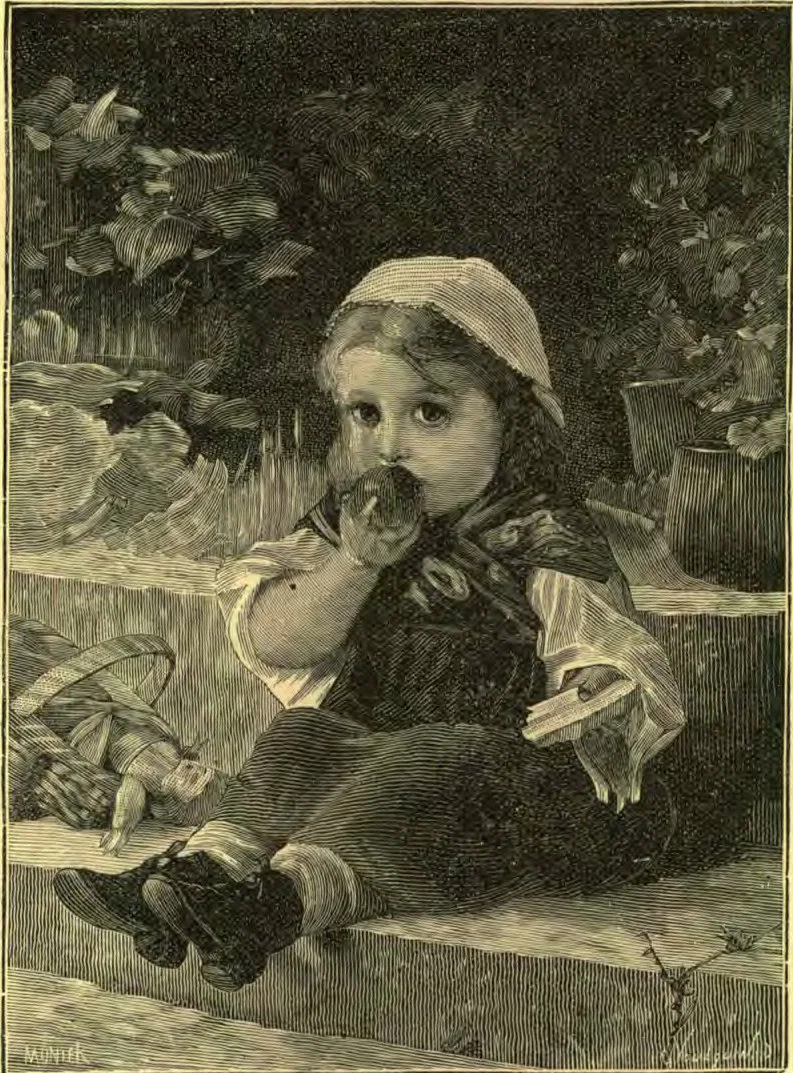
Then she started toward the pantry. I do not think she really knew herself what she was going there for; but on entering, she espied a basket of apples, and immediately trouble followed.
What a pity she had not stayed away from the pantry! Then she would not have gotten into temptation; but when she saw the handsome red apples, she wanted one very much, and said to herself, “Mamma didn’t say I couldn’t have one.”
She knew that children ought to obey whoever is taking care of them, the same as they would their mamma; and she knew, too, that her mamma would not be willing she should take anything to eat without asking; but she tried to satisfy herself by saying, “I can’t ask mamma, because she isn’t here; and if she were here, I am sure she would let me have it.”
Then she touched one of the apples, but drew her hand away again; then she again reached out, and this time picked up one.
Oh, how her heart pounded! and how the blood rushed into her face! She did not feel at all good. Surely she would have felt much better had she been in the sitting-room with the teacher, with only the piece of bread to eat. Now she did not dare let the teacher see her, but went out onto the porch, and sat down to eat the apple.
Do you suppose she was glad she had it? No, indeed, she was not! However, she set two tiny teeth into the peel—but she stopped, and looked frightened, and then hurried into the house. She ran to the pantry, and dropped the apple into the box, then rushed to the sitting-room, put her face right down in the teacher’s lap, and sobbed, and sobbed, and sobbed.
The teacher did not know anything about what was the matter, and it was quite awhile before Rika could tell her; but finally the little girl said, with many sobs, “He was watching so as to take care of me, and He saw me being wicked!”
Poor little girl! Just as she was about to bite the apple, she remembered what the teacher had told her, the evening before, about God’s taking care of the children who try to do right, and about his watching them, so that no harm can come to them. That is why she did not bite the apple.
She wept for a long time, because God had seen her doing something wicked; but the teacher told her that God would forgive her, and help her to be a good girl, if she asked him to do so; and then she kneeled down beside the teacher, and told the Lord what she wanted.
She was very glad that she could talk to the Lord, and that he could always hear her; and she was sure she would be very careful, after that, never to do anything she would not want him to see, when he was watching her, to take care of her.
MRS. ADA D. WELLMAN.

HOW JOHN GOT AN IDEA.

“Mamma, mamma,” cried Johnny, “do you know where my cap is? I can't find it anywhere, and papa wants me to go to the post-office for him right away.”
Mamma was busy sewing, but she laid down her work to look for the missing cap. As Johnnie had said, it was nowhere to be seen.
“Where did you put it when you came home from school not half an hour ago?”
“On the hat-rack, I know, and now it isn't anywhere. O dear, how provoking!”
After fifteen minutes' diligent search, shared by all the members of the family, the cap was found tucked away in the owner's coat-pocket, and Johnnie ran off to do his father's errand, while the others returned to their interrupted work, and tried to make up for lost time.
“Johnnie is growing more careless every day,” said his mother. “I don't know what to do with him. It isn't always possible to make him look for his own things, and I am afraid nothing else will cure him.”
“Suppose we try setting a frightful example?” suggested his oldest sister.
“Perhaps that would do,” replied her mother, as the details of the plan presented themselves.
The next afternoon Johnnie rushed in from school, crying,— “Mamma, Mr. Harris says the ice is strong enough to bear us, and we are all going skating, but I've just torn my coat. Can you please mend it right away?”
“Yes, if you can find my thimble. See if it is in the basket.”
“Why, I don't see where it can be,” said Mrs. Blake, feeling in her pocket, and not finding it. “Look all around the room.”
Johnnie, in too much haste to think how strange it was for his orderly mother to mislay anything, hunted diligently, but no thimble came to light.
“Go ask Jennie for hers.” Jennie's was missing also. “I think you will have to stay at home; you certainly cannot wear that coat as it is.”
Sore as the disappointment was, Johnnie was obliged to submit. For a week the very spirit of disorder seemed to rule the house. Every article was left where it was last used, until the once tidy rooms looked fairly cheerless with the accumulated litter. There was one exception.
While Johnnie was constantly called upon to look for Jennie's gloves, mamma's scissors, or papa's umbrella, his own hat was more frequently upon the rack, his skates on their hook, his slate and books strapped together. Finally after an unusually trying experience, he exclaimed one day:—
“I never saw such a house as this is getting to be. I seem to be the only one who ever puts things where they belong.”
The shout of laughter that went up at this extraordinary statement somewhat abashed the speaker, but he sturdily maintained his point; whereupon the others promised that if he would continue to set such a good example, they would certainly follow it. That week taught Johnnie a lesson that he never forgot.—Morning Star.

THE SONG OF THE TEA-KETTLE.

Oh, I am a tea-kettle fat; And, merrily singing away, A song that is full of contentment and mirth, I sit on the hob all day. My sides, they are jolly and round, And never there could, I'll be bound, Such a happy old fellow be found, As I sit on the hob all day, Singing, singing, Merrily singing, Oh, merrily singing away!
Dear grandmother loves me well, And oft by the fire will sit, While many a stocking long and round, Her aged fingers knit; And she joins her voice into mine In accents quavering and fine; A ditty of Auld Lang Syne She croons as her fingers knit, Knitting, knitting, Busily knitting,— We sing as her fingers knit.
I'm only a tea-kettle fat; But under my boiling lid, 'Twas discovered long years ago by a lad, A famous old giant had hid. Though fragile and fair to the sight, Yet a giant of wonderful might; And when men learned to use him aright, Ho, ho, what wonders he did,— Flashing, dashing, Around the world flashing,— Ho, ho, what wonders he did!
The steamer that ploughs the deep, The train with its iron steed, The whirling looms and busy mills All moving with lightning speed,— These all are the wonders of steam, Who, awakened by Watts from his dream, Rushed forth with a whistle and scream To work with lightning speed,— Working, working, His duty ne'er shirking,— A famous old giant indeed!
—Nellie M. Garabank.
Continue reading: HOW AUNT JANE WORRIED