The Youth’s Instructor, Vol. 28, No. 43.

The Old School-Days

The Youth’s Instructor

Oct 20, 1880

S. D. A. Publishing Association · Battle Creek, Mich. · Oct 20, 1880

The Old School-Days.

Not long ago it chanced that I went by the old school-house, where, a long time before my life had ripened into its teens, I used to go to school.
It was a dreamy autumn day. The pulse of the earth was throbbing quietly, as though she had fallen into a pleasant sleep. Gray, low clouds muffled the sky. The cool, delicious, dreamy quiet rested on everything. There stood the old brown school-house, and the window was open, and there sat the teacher—the very same teacher—with a little girl standing by her side, saying her lesson just as I used to say it, in the days that will never, never come back!
And at that sight, how the old, childish days rode up the waves of the years and stood before me, flushed as thick with memories as a little while ago the cherry-trees outside were white with blossoms. How often I have opened the high gate, and gone up the narrow path laid with boards, and walked over the low door-sill, and taken my seat on the small bench!
One could see the pleasant, kindly face of the teacher, faded with the years now—and yet I have heard people tell of its wonderful beauty in her youth—and in imagination I was a little girl again, reciting once more out of my well-thumbed geography.
There was the yellow-covered copy book, which was my special pride; there was the girl who sat on my right hand, and always had permission to leave half an hour before school closed, and was, on that account, an object of special envy to us; for I here make candid and humiliating confession that I was not particularly fond of going to school. Those six hours seemed almost interminable. I grew restless and weary of the confinement, and longed to get out into the sunshine, and under the trees, where the winds made their sweet, solemn music all the day; and for this very reason I have always had a secret intelligent sympathy with the little boys and girls who are not particularly eager about getting off to school. There was the sampler, worked in black, and red, and green, in great capitals and tiny letters, in cross stitch and square; and the wreath, begun and never finished, that I held a marvelous achievement of feminine needle-craft.
How the old scenes swarmed back, as the voice of the teacher, and the slender sound of the child’s as she followed, repeating her lesson, floated out to us! And how, in the foreground, comes back that special afternoon when I endured a slow torture of thirst for three hours, because I hadn’t the courage to ask for a glass of water.
Little children have their trials as well as grown people; and I can feel for wrecked sailors far off at sea, and wounded soldiers on burning battle-fields, when I remember those three long hours of terrible thirst; oh, that small parched throat! oh, that haunting, agonizing vision of cool, fresh, gurgling waters, which were leaping in a thousand silvery springs among cool mountains and dark rocks, for the little birds to flash their bright wings and dainty bills in.
But at last the three hours had an end, and I hurried home. How I dashed toward the old kitchen water pail, and the tin dipper that hung there! No matter if it was old and rusty; it held for me then a draught of sweetest nectar.
Oh, no amber and purple wine, wrung from the hearts of clusters which had ripened in the fair vintage of foreign lands, and grown fragrant and mellow with the years, ever cooled lips and throat just as that water did! How the cool tide flowed through my small lips and healed the thirst that parched my tongue.
But the yellow writing-book, and the marvelous sampler, and the old thumbed geography, are all gone; and so is the little girl whose small feet used to go pattering along the curbstones in the summer mornings to the old brown school-house. That is standing still, and the teacher is there in her old place, and the sweet faces of little children gather about her as before; but that little girl of whom I write will never more be found among them,—will never more go back and stand in those old days,—she would not, on the whole, if she could; but they have shone down tenderly, as, sitting here, I have written for other children,—children under the cool shadows of Eastern hills, children away off among the dark velvet of Western prairies, children still farther away by the golden shores of the Pacific,—God bless them all!—the memories as they have swarmed back to us of our old school-days.—Virginia F. Townsend.

THE OTHER SIDE.

THE words are good,” I said, “I cannot doubt;” I took my scissors then to cut them out; My darling seized my hand. “Take care,” she cried, “There is a picture on the other side.”
I fell to musing. We are too intent On gaining that on which our minds are bent; We choose, then fling the fragments far and wide, But spoil the picture on the other side!
A prize is offered; others seek it too, But on we press, with only self in view; We gain our point, and pause well satisfied,— But ah! the picture on the other side!
On this, a sound of revelry we hear; On that, a wail of mourning strikes the ear: On this, a carriage stands with groom and bride; A hearse is waiting on the other side.
We call it trash,—we tread it roughly down, The thing which others might have deemed a crown; An infant’s eye, anointed, sees the gold, Where we, world-blinded, only brass behold.
We pluck a weed, and fling it to the breeze; A flower of fairest hue another sees: We strike a chord with careless smile and jest, And break a heart-string in another’s breast.
Tread soft and softer still as on you go, With eyes washed clear in Love’s anointing glow; Life’s page well finished, turn it, satisfied, And lo! Heaven’s picture on the other side.—Sel.

Peace in Death: An Aged Christian's Testimony

Dr. Cullis tells, in one of his reports, of an aged Christian, who, lying on his death-bed in the Consumptives’ Home, was asked the cause of his perfect peace, in a state of such extreme weakness that he was often entirely unconscious of all around him. He replied, “When I am able to think, I think of Jesus; and when I am unable to think of him, I know he is thinking of me.”

ICEBERGS

The New Foundland Banks are situated just where the cold winds of the North meet the warm breezes from the Gulf Stream, which generally causes a heavy fog. This fog is so thick as to hide objects from view, and ships often come in collision, or lose their course and drift on to projecting rocks. Thanks to our merciful heavenly Father, we have had a passage over the Banks entirely free from these unpleasant chilling fogs.
As we leave the Banks, the wind shifts from behind us to the north, blowing a chilling blast. On the morning of the fifth day of our voyage, it clears off pleasantly over head, but we have much pitching of the ship, for the sea “boils like a pot of ointment.” The noon observation to-day shows a “sail” of two hundred and ninety miles, making us fourteen hundred and thirty-six miles from New York.
As we are now in the channel where icebergs make their passage from the polar to warmer seas, timid passengers, of course, have their fears aroused, and imagine that every peculiar cloud in the northern horizon is an iceberg. As in the case of the whales, it is not the right season of the year; so we shall have no romantic encounter with icebergs this trip.
During the winter months is the time when the glaciers of polar ice are greatly increased. These are formed from fresh water on the mountain coast of Greenland. They protrude out over the sea on cliffs, and in the summer months, as the ice becomes brittle, great masses break off, by their weight, and come down with a dreadful crash. Thus an iceberg, or mountain of ice, as the word means, is formed. By the force of the polar current passing through the narrow sea that separates Greenland from Iceland, these mountains of ice are carried down to Labrador, and from thence to the south-east Atlantic, where the warm temperature dissolves them.
Sometimes the ice takes the form of a mountain, and sometimes it is a vast sheet of salt-water ice. It is from the latter, while they are floating over the Banks, that the fishermen of New Foundland catch seals. The bergs appear like great mountains of chalk, and are a terror to sailors. They have been seen nearly two hundred feet high, and it is calculated that only one-seventh of the entire height is above the surface of the water. They are sometimes two or three miles in circumference. Captain Ross saw one in Baffin’s Bay that was estimated to weigh over one and one-fourth billion tons. Dr. Scoresby counted, one season, five hundred icebergs between 69° and 70° of north latitude. These bergs are described as very beautiful, with their varied fantastic peaks shining in the sun’s rays.
As night comes on, the wind shifts to the south, blowing a strong breeze, and another sea-sick night is the result of these “chop seas.” The sixth day opens with warmer weather, and a rain that smooths down the sea. Again we have the pleasure of seeing two sailing vessels, bound from Liverpool to New York.
The noon observation to-day proved what we had feared,—the least progress made in any one day. In consequence of shifting winds, we have made only one hundred and eighty-eight miles to-day. But we are over half-way across the Atlantic, being sixteen hundred and twenty-four miles from New York. J. N. L.

THE JOY OF DOING GOOD.

WOULD'ST thou from sorrow find some sweet relief? And is thy heart oppressed with woes untold? Balm would'st thou gather for corroding grief? Pour blessings round thee like a shower of gold. — Wilcox.

CLEOPATRA'S NEEDLES.

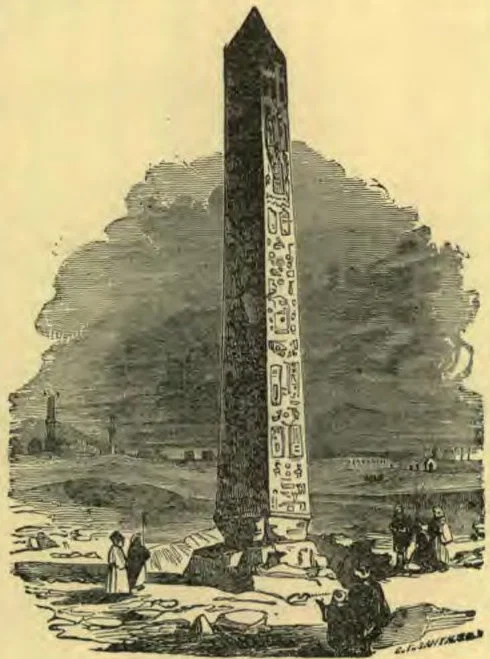
The obelisk that lately safely reached this country is a single stone, seventy feet in length, eight feet square at the base, five feet three inches square at the top, and weighs one hundred and ninety-six tons. Its companion that was taken to England in 1878 is sixty-eight feet five inches in height. Both were taken from the celebrated quarries of Syene.
Our engraving represents one of these two giant pillars. The figures upon it are a kind of hieroglyphics, or word-writing.
“At first they stood sentinel for centuries before the doors of the temple of the Sun at Heliopolis, but were taken from thence, and for hundreds of years remained upon the shores of the Levant, near Alexandria.”
The term Cleopatra’s Needle has been applied alike to both obelisks, as it has long been a disputed question to which it rightfully belongs.
What special good is to be accomplished by transferring this mammoth stone to our shores is a problem that no one seems to be able to solve. Gardner Wilkinson about expressed the truth when he said, “Few motives can be assigned for their removal to Europe and America beyond desire of possessing what requires great difficulty to obtain.”

PRACTICAL TEACHINGS.—

1. Not theories, nor professions, nor isolated great deeds, but the fruits of living are taken account of by God.
2. Christ’s teachings have stood the test of nineteen centuries. Let Christianity be judged by its fruits.
3. If God were now to judge you, would he “know” you as his own?
4. It is a bad sign to have to tell people that you are a Christian; make them see and feel it.

MISTAKES

We remember an old song, one line of which was, “The mistakes of my life are many,” and we have thought of these mistakes much of late. To be sure, it is not self-flattering to do so, but sometimes it is necessary. There is no use in trying to get rid of, or around them. They stare us in the face, and we must look straight at them, just as we would at sorrow or misfortune. They are facts.
That every one is liable to make mistakes, and does make them, is patent to all. “If I could only live my life over again,” we sometimes hear people say, and always in a low, sad tone, perhaps accompanied with a sigh. This implies that in looking back and viewing their life-path, they see mistakes, perhaps scattered all along it,—mistakes that were the result of a wrong heart, many times; mistakes whose influence and results can never be undone, no matter how deep the repentance.
The mistakes of the past may be beneficial, if they teach a lesson for the future. But it is not best to clothe ourselves in sackcloth, and sit in the ashes and mourn over them. There are two ways of looking at our mistakes, as at everything else in life; and who shall say that we haven’t a right to look on the bright side of these mistakes, as of every other dark and painful thing?
We should never be afraid to own our mistakes, to change our opinions. Of course, to change our opinion implies that we have made a mistake; but we should never stick to an idea when we have proved it wrong, no matter how firmly we have held it, or how humiliating it may be to own ourselves mistaken. Some people will never change their opinions, will never own that they make mistakes. Oh, what if at last they find that they have made one grand mistake of life!
The evils of life are heavy and hard to bear, and wash out all the gladness from the years. But in the sweet by-and-by will come a time when all the mistakes and follies of life will be left behind. By-and-by will come the perfect day. By-and-by, good will triumph over evil, love over hate, and light over darkness. Therefore, O reader, take heart. V. A. M.

LESSONS FOR CHILDREN.

LESSON XCV.—THE RETURN OF THE JEWS TO JERUSALEM.

It was about fourteen or fifteen years after Daniel had the vision last noticed that Babylon was taken by the Medes and Persians. We have learned in another lesson how Cyrus entered the city of Babylon, and how Darius the Median took the kingdom. In the first year of this King Darius, Daniel, by studying the prophecies of Jeremiah, knew that the time had nearly come for the Jews to return to their own country. If you will turn to the twenty-ninth chapter of Jeremiah, and read the tenth verse, you will see that this was made very plain. But Daniel knew that his people had been very stubborn and disobedient, and feared that the Lord would, on that account, keep them in captivity much longer. So he prayed very earnestly, confessing his sins and the sins of his people, and begging that the Lord would fulfill his promise, and not put off the time of their return to Jerusalem.
While Daniel was yet praying, the Lord sent the angel Gabriel to comfort him, and to tell him the meaning of that part of the vision which was left unexplained when Daniel fainted. He said, “O Daniel, I am now come forth to give thee skill and understanding. At the beginning of thy supplications the commandment came forth, and I am come to show thee; for thou art greatly beloved: therefore understand the matter, and consider the vision.” He also told him just how many years it would take to restore and rebuild Jerusalem; when the Saviour would come, how long he would preach, and when he would be cut off: and all these things came to pass just as the angel had said.
Just about seventy years from the time when the first company of captives were taken from Jerusalem, Cyrus returned from his wars with other nations, and began to reign in Babylon.
In the first year of his reign he issued a decree that all the Jews who had a mind to do so should be permitted to return to Jerusalem, and rebuild the temple. He also brought out the gold and silver vessels which Nebuchadnezzar had taken from the temple at Jerusalem, five thousand four hundred in all, and gave them to the Jews to take back with them. As soon as they could get ready, nearly fifty thousand of them went up to Jerusalem under Zerubbabel [Ze-rub'-ba-bel] as a leader. The next year they began to build the temple, but as soon as the Samaritans found out what the Jews were doing, they wanted to join with them in building. When they were not allowed to do so, they were very angry, and tried to hinder the work in every way they could. Daniel still remained with the king of Persia, and when he heard of this, he felt very sad. He fasted and prayed for three whole weeks, and at the end of that time, he had a wonderful vision. In this vision the Saviour himself seems to have appeared to him, and Gabriel talked with him a long time, telling him what should come to pass for many hundred years to come. Daniel was now an old man, and it is supposed that he remained in the East till he died.
How many useful lessons may be learned from the life of this good man? He must have been studious and thoughtful in his youth; for even then he was skillful in wisdom, cunning in knowledge, and understood science, as will be seen from reading the fourth verse of the first chapter of the book of Daniel. He was temperate in his habits, and faithful to his God; for he refused the wine from the king’s table, and all food that was forbidden by the Jewish law. He was faithful in telling all that the Lord showed him, and would not neglect the worship of his God even when threatened with death in a den of lions.

QUESTIONS.

  1. How long was it from the time of the vision last noticed to the taking of Babylon by the Medes and Persians?
  2. What have we learned in another lesson about the taking of Babylon?
  3. During the first year that Darius reigned in Babylon, what did Daniel learn by studying the prophecies of Jeremiah? Dan. 9:1, 2.
  4. Where is this made very plain?
  5. What does this scripture say about it?
  6. What did Daniel fear?
  7. Why did he think there was danger of this?
  8. What did Daniel do?
  9. What did he confess?
  10. What did he beseech the Lord to do?
  11. Who was sent to Daniel while he was praying?
  12. For what purpose was the angel sent to him?
  13. For what did Gabriel say he had come?
  14. When did he say the commandment went forth for him to come to Daniel’s relief?
  15. Why was Daniel’s prayer so promptly noticed?
  16. What other things did Gabriel tell Daniel in this vision?
  17. What happened just about seventy years after the first company of captives were taken from Jerusalem?
  18. What decree did Cyrus issue in the first year of his reign in Babylon? Ezra 1:1–3.
  19. What did he give them to put in the temple which they were to build at Jerusalem?
  20. How many of these vessels were there?
  21. How many of the Jews went up to Jerusalem at this time?
  22. Who was their leader?
  23. When did they begin to build the temple?
  24. What did the Samaritans want when they found out what the Jews were doing?
  25. How did they feel when the Jews refused to let them help in building the temple?
  26. How did they act?
  27. Where was Daniel at this time?
  28. How did he feel when he heard what the Samaritans were doing?
  29. How did he try to help his people?
  30. How did the Lord favor Daniel after he had fasted and prayed three whole weeks? Dan. 10.
  31. Who besides Gabriel appeared to Daniel in this vision?
  32. What did Gabriel tell the aged prophet in the long talk which he had with him at this time?
  33. Where did Daniel die?
  34. What may we learn from the life of this good man?
  35. What reasons have we for thinking that he must have been studious and thoughtful in his youth?
  36. Where do we find proof that he was so wise and scholarly?
  37. How may we know that he was temperate in his habits, and faithful to his God?
  38. In what other things did he set a noble example?

BIBLE LESSONS FOR YOUTH.

LESSON CXXI.—CHRIST'S TALK WITH NICODEMUS.

AMONG those who witnessed with deep interest the miracles of Christ at the passover was a wealthy Pharisee, named Nicodemus. This man was a ruler of the Jews, and undoubtedly a member of the national council called the Sanhedrim. The people so thronged about the Saviour that a private interview by day was impossible. So Nicodemus came by night to converse with him. He was a man of great learning and influence, yet he addressed the Saviour in terms of the highest respect, saying, “Rabbi, we know that thou art a teacher come from God; for no man can do these miracles that thou doest, except God be with him.” The use of the term we seems to imply that other members of the Sanhedrim, as well as Nicodemus, knew Christ to be a divine teacher, but would not own it. The answer which Jesus gave him was at once prompt and searching,—“Verily, verily I say unto thee, Except a man be born again, he cannot see the kingdom of God.” Apparently not wishing the Saviour to know that he comprehended his meaning, Nicodemus gave a literal interpretation to his words, and then expressed his astonishment at what would thus be impossible.
Jesus then presented the thought in words which could not be misunderstood,—“Except a man be born of water and of the Spirit, he cannot enter into the kingdom of God.” Being born of water could mean nothing else than water baptism, and being born of the Spirit must refer to those operations of the Holy Spirit by which man is brought back to the image of his Creator. To use the excellent words of another: “The power of the Holy Spirit transforms the entire man. This change constitutes the new birth. . . . The regenerating Spirit of God, taking possession of the mind, transforms the life; wicked thoughts are put away, evil deeds are renounced, love, peace, and humility take the place of anger, envy, and strife. That power which no human eye can see, has created a new being in the image of God.”
Jesus then refers to the wind to show that the influences of the Spirit are none the less real and powerful because mysterious and unseen. We cannot see the wind, we cannot tell whence it comes or whither it goes; yet it is powerful in its effects. Just so it is with the Spirit. Its operations are mysterious, yet we know them to be real from the effects produced.
But Nicodemus still marveled, and said, “How can these things be? Jesus answered and said unto him, Art thou a master of Israel, and knowest not these things? Verily, verily I say unto thee, We speak that we do know, and testify that we have seen; and ye receive not our witness.” This seems to imply that Nicodemus and others had very little practical knowledge of what they taught.
It appears probable that Nicodemus wanted to know about the mysteries of Heaven; but the Saviour persisted in telling him only what he most needed to know. He says, “If I have told you earthly things, and ye believe not, how shall ye believe, if I tell you of heavenly things?” He then goes on to show him the only way of salvation. “As Moses lifted up the serpent in the wilderness, even so must the Son of man be lifted up, that whosoever believeth in him should not perish, but have eternal life. For God so loved the world, that he gave his only begotten Son, that whosoever believeth in him should not perish, but have everlasting life. For God sent not his Son into the world to condemn the world; but that the world through him might be saved. He that believeth on him is not condemned; but he that believeth not is condemned already, because he hath not believed in the name of the only begotten Son of God. And this is the condemnation, that light is come into the world, and men loved darkness rather than light, because their deeds were evil. For every one that doeth evil hateth the light, neither cometh to the light, lest his deeds should be reproved. But he that doeth truth cometh to the light, that his deeds may be made manifest, that they are wrought in God.”

QUESTIONS.

  1. What noted man among the Jews witnessed the miracles of Christ with deep interest? John 3:1.
  2. To what sect did he belong?
  3. What position of honor and influence did he hold?
  4. What opportunity did he take to converse with Jesus?
  5. Why did he come by night?
  6. How did he address the Saviour?
  7. What did he say?
  8. What seems to be implied by the use of the term we?
  9. What was the nature of the answer which Jesus gave him?
  10. What were his words?
  11. What kind of interpretation did Nicodemus give to these words?
  12. Why did he thus interpret them?
  13. At what did he then express his astonishment?
  14. How did Jesus then present the thought?
  15. Give his words.
  16. What must be meant by being “born of water”?
  17. What by being “born of the Spirit”?
  18. What does the Holy Spirit accomplish for those who cherish its influence and follow its leadings?
  19. What does this transformation constitute?
  20. How is it manifested?—“Wicked thoughts are put away,” &c.
  21. What is thus created by that power which no human eye can see?
  22. How did Jesus show that the operations of the Spirit are none the less real because unseen?
  23. What is there mysterious about the wind?
  24. How do we know that it exists?
  25. How do we know the operations of the Spirit to be real?
  26. Did this illustration seem to satisfy Nicodemus?
  27. How did Jesus reprove him for his want of discernment?
  28. What does he seem to imply by saying, “We speak that [what] we do know”?
  29. About what did Nicodemus probably want to inquire?
  30. What did the Saviour persist in telling him?
  31. What did he say about telling him of heavenly things?
  32. What did Jesus then go on to show?
  33. By what figure did he present himself as the one to whom all must look for salvation?
  34. How did he show that salvation comes through the love of God rather than through the merits of those who are saved?
  35. How may all men escape condemnation?
  36. How do those who will not accept Christ bring condemnation upon themselves?
  37. Why do so many men love darkness rather than light?
  38. What feelings and actions characterize evil-doers?
  39. What characterizes those that love the truth and obey it?

HOW INDIAN BABIES RIDE.
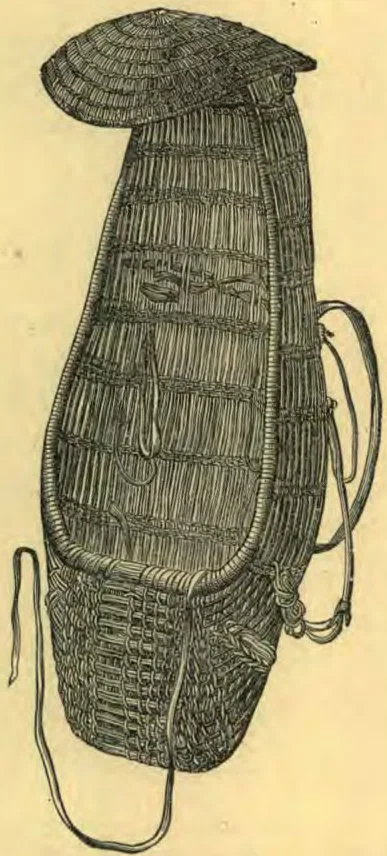
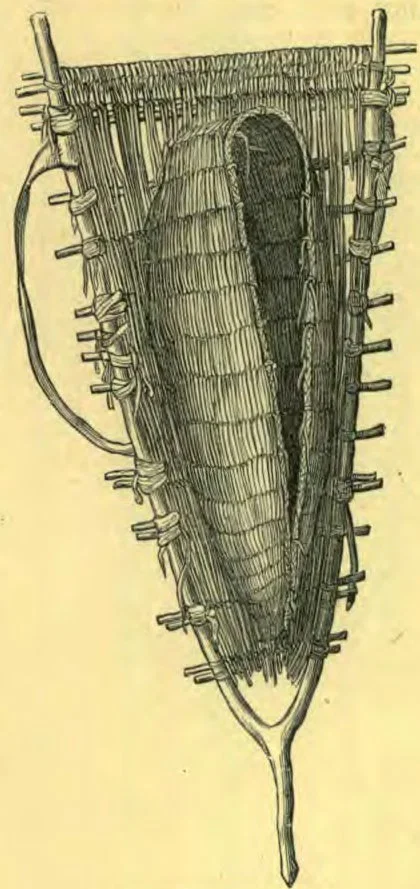
ON this page are pictures of two Indian baby-carriages. “But,” says one little reader, “these baby-carriages have no wheels. Are they drawn like a little boy’s sled by the strap that hangs from the end?” Oh, no, indeed! The little babies are tucked into these bird’s-nest carriages as if they were only a sparrow or an oriole, and the mother puts the strap around her shoulders, the carriage hanging down her back, and off she goes to the woods for berries, or bark to make pretty baskets and birch-bark ornaments or toys, perhaps little canoes for the older children to learn how to “paddle their own canoe.”
When the Indian mothers made these baby-carriages of twigs, and wove the sides so neatly, they covered the tops close, like a little roof, to protect the baby’s head from sunshine and shower. The pointed stick on the end of one of them is to stand it up in the ground when the mother takes it off her shoulders. She says to the baby, “Now keep quiet, Wakanhdikokipapi,” if it is a Dakota baby; and then little Fearful Thunder—as the baby’s name means in English—keeps quiet until, like all other little people with long or short names, he wants to be taken care of by his mother, and have milk and hominy that he can see the other children eating when he looks out of his carriage door. Then, too, he spies his sisters, “Blue Star” and “Jingling Foot Bells,” having their supper around the door of the wigwam.
The Indians are very anxious that their children should be educated, and several schools have been opened for them. If you could visit these schools, you would see that many bright scholars and smart boys have grown up out of these baby-carriages. One boy walked a hundred and thirty miles to reach a school, so eager was he to learn.—Missionary Echoes.

LETTER BUDGET.

WE know that many bright eyes will eagerly scan the letters in the “Budget” to see if their owner’s name is here; but some will be disappointed, for there is not room for all the letters we have received this week.
Edith Henton, of Parker, Dakota, tells us in a nice little letter how much she likes to read the INSTRUCTOR, especially the “Budget.” She is a little Sabbath-keeper.
We are very glad to hear that you like the INSTRUCTOR, Edith, and we agree with you in thinking that the “Budget” is especially nice.
Louise McDonald, of Standish, Maine, writes: “I am nine years of age. A good friend has sent the INSTRUCTOR to me, and the Review and Reformer to mamma. We like them very much. Mother does not profess religion, but she believes in the commandments. I wish that she would bear her cross and pray, so I could hear her. I have heard of the Tabernacle, and thought I would send ten cents for it. This is nearly all the money I have got. I hope that I shall some day see the Tabernacle, and go to school at the college. I want to be a good girl, and meet the INSTRUCTOR family in the kingdom.”

MAKING THE APPLICATION.

The duty of making the application of the lesson should not be omitted by the teacher, on the plea that the superintendent will make some impressive remarks at the close of the session or in the review. What the superintendent says is, after all, an arm's-length business. If the teacher knows the spiritual state of the pupil, the teacher can best make the appropriate application. There is an effect produced by the nearness of the teacher, by the kind tone and earnest manner, by the look of the eye and the touch of the hand, which no appeal from the desk can make. Rev. Wm. Jay, of Bath, Eng., was once invited to preach in another pulpit. His brother minister asked him before they entered the pulpit, whether he should not relieve him by taking the preliminary part of the service,—the prayer, the giving out of the hymns, and Scripture reading before the preaching. Mr. Jay answered, “No, I thank you, I like to whet my own scythe.”

Teachers' Regular Attendance at Sabbath-School

I THINK that the teacher who goes to Sabbath-school when he feels like it, and stays at home when he feels like it, ought to have the spirit of “resignation” come upon him. What would you think of a minister who came to his pulpit when he pleased, and stayed away from it when he pleased? I think that you would call another minister before long. A Sabbath-school teacher who consents to teach a class, is as much bound to be present regularly as the minister.—Vincent.

You have reached the end of this edition.

The Youth’s Instructor · Oct 20, 1880