Your ShelfYour Projects

Review and Herald, Vol. 76, No. 6.

JUDGE NOT

Review and Herald

Feb 7, 1899

Seventh-day Adventist Publishing Association · Battle Creek, Mich. · Feb 7, 1899

JUDGE NOT.

MRS. E. G. WHITE.
“And it came to pass, when the time was come that he should be received up, he steadfastly set his face to go to Jerusalem, and sent messengers before his face: and they went, and entered into a village of the Samaritans, to make ready for him. And they did not receive him, because his face was as though he would go to Jerusalem. And when his disciples James and John saw this, they said, Lord, wilt thou that we command fire to come down from heaven, and consume them, even as Elias did? But he turned, and rebuked them, and said, Ye know not what manner of spirit ye are of. For the Son of man is not come to destroy men’s lives, but to save them.”
After Christ had fed the five thousand, the people determined to make him king. Hundreds were ready to rally round his standard; and the enthusiasm ran so high that a purpose was formed to take him by force, and place him on the throne. But with an authority they dared not resist, Jesus dismissed the multitude.
From this time his popularity appeared to wane, and the disciples began to have a clearer conception of his mysterious character. He had given them many lessons showing the relation in which he stood to his Father; and apparently they were overcoming the hope they had so firmly entertained,—that he would reign as a temporal prince in Jerusalem. Christ told them of the trials he must endure, of the final rejection of his work, and of his betrayal, crucifixion, and resurrection. He told them that events were fast ripening for the closing scenes of his life, and declared that he must go again to Jerusalem, to be present at the Passover feast.
He sent messengers before him, to prepare for his coming. But the people refused to receive him, because he was on his way to Jerusalem. This they interpreted as meaning that Christ showed a preference for the Jews, whom they hated with an intense bitterness. They had hoped that Christ would acknowledge their temple and worship; and when they saw him going to Jerusalem, they broke forth into bitter accusations against him. Their insulting words showed open contempt for the Son of God.
James and John, Christ’s messengers, were greatly annoyed at this insult. They loved their Lord, and were filled with indignation because he had been so rudely treated by the Samaritans, whom he was honoring by his presence. They had recently been with him in the mount of transfiguration, and had seen him glorified by God, and honored by Moses and Elijah. This manifest dishonor on the part of the Samaritans should not, they thought, be passed over without marked punishment.
Coming to Christ, they reported to him the words of the people, telling him that they had even refused to give him a night’s lodging. They thought that a grievous wrong had been done him; and seeing Carmel in the distance, where Elijah slew the false prophets, they said, “Wilt thou that we command fire to come down from heaven, and consume them, even as Elias did?” They were surprised to see that Christ was pained by their words, and still more surprised as his rebuke fell upon their ears: “Ye know not what manner of spirit ye are of. For the Son of man is not come to destroy men’s lives, but to save them.”
What a lesson this is to those who are fired with religious zeal, and who would cause to suffer those whose belief is not in accord with their own! What a rebuke to those who are quick to speak harshly, and who manifest an overbearing, condemnatory spirit toward those who entertain ideas out of harmony with their theories!
The rebuke given to James and John sounds down along the line to our time. Many reveal the attributes of Satan by trying to compel their fellow men to believe as they believe. They desire to punish those who, they think, dishonor Christ. They may say that they are working for truth and liberty, they may claim to be doing honor to God; but if they exercise a zeal that brings pain to the bodies and spirits of those who dare to differ with them, they are controlled by the enemy of God. Such may think themselves righteous; but Christ says to them, as to the disciples: “Ye know not what manner of spirit ye are of. For the Son of man is not come to destroy men’s lives, but to save them.” By his dealing with the Samaritans, Christ has shown us that although men manifest unmistakable contempt for him, his followers are not to harbor thoughts of hatred and revenge.
Many choose the world before Christ. Paul wrote to Timothy, “Do thy diligence to come shortly unto me: for Demas hath forsaken me, having loved this present world.” This we shall meet. Those whom we have loved and trusted will leave the faith, and by their falsehoods do us harm. But we are to work on, lifting up Christ, the sin-pardoner, higher and still higher. We must not be overwhelmed because good and bad are gathered into the church. Judas was numbered among the disciples. He had every advantage a man could have; but although he heard the truth, and listened to the principles so plainly laid down, Christ knew that he did not receive the truth. He did not eat the truth. It did not become part of himself. His old habits constantly asserted themselves. But Christ did not take forcible means to cut Judas away from the disciples.
There is a time coming when those who have joined the church, but have not joined Christ, will be manifest. Their corrupt principles can not blend with Christ. The heart must be made new before it can receive the truth that sanctifies the receiver. But to sit in judgment on those who, we think, are wrong—to condemn them and cast them out—is not for mortals to do. God has not given this work to any human being. “Let both grow together until the harvest,” Christ says. He has bought men with a price, even his precious blood; and he would not lose one soul. His experience with Judas is recorded to show his long patience with perverse human nature. He came not to “destroy men’s lives, but to save them.” He will decide who are worthy to dwell in perfect unity with the saints in the family of heaven.
God can not reveal himself through some who have been entrusted with work for him. He can not make them channels through which his compassion and love can flow; for they insult his goodness by exhibiting a masterful spirit toward those whom they regard as being in error and needing reproof. By their own unsanctified passions they eclipse Christ’s love and mercy. The enemy of all good is allowed to rule in their hearts, and their lives reveal his attributes. They claim that the word of God directs them; but by their actions they say, We want not thy way, O Lord, but our own way.
By their words, their works, and their spirit, those who pursue such a course are making a record in the books of heaven that they will not care to meet; for God does not value them as they value themselves. Men are abusing their probationary opportunities, and are grievously neglecting the high privileges conferred upon them. Though finding nothing in the word of God to vindicate their actions or countenance their opinions, they persist in having their own way. In the day when judgment is passed upon all, the sentence will be pronounced against them, “Thou art weighed in the balances, and art found wanting.”
Let those who desire to control their fellow men read God’s declaration on this subject. He says: “Judge not, that ye be not judged. For with what judgment ye judge, ye shall be judged: and with what measure ye mete, it shall be measured to you again. And why beholdest thou the mote that is in thy brother’s eye, but considerest not the beam that is in thine own eye? Or how wilt thou say to thy brother, Let me pull out the mote out of thine eye; and, behold, a beam is in thine own eye? Thou hypocrite, first cast out the beam out of thine own eye; and then shalt thou see clearly to cast out the mote out of thy brother’s eye.”
The work of saving souls is to be carried forward amid opposition, peril, loss, and suffering. Christianity is to be wrought out by self-denial and cross-bearing. Christ did not mark out an easy path to heaven. He declares to his followers: “If the world hate you, ye know that it hated me before it hated you. If ye were of the world, the world would love his own: but because ye are not of the world, but I have chosen you out of the world, therefore the world hateth you.” Christ is our example. When he was reviled, he reviled not again. When the cruelty of men caused him to suffer painful stripes and wounds, he threatened not, but committed himself to God who judges righteously. “Let this mind be in you,” writes Paul, “which was also in Christ Jesus.” Our interests must be submerged in Christ, that we may be able to say, “I live; yet not I, but Christ liveth in me.”
Christ came from his heavenly home to raise up workers to be his messengers, to co-operate with him in presenting his message of mercy to the world. They are to be the ministers of his grace, and their hearts should throb in unison with the heart of Christ. It should be their meat and drink to do the will of him who has called them to his service. If Christ abides in them, they will be brought into captivity to him. They will no longer live the common life of selfishness; for Christ will live in them. His character will be produced in them. Then the bitter, poisonous root of selfishness will be uprooted. Tender feelings, full of sympathy for the erring, take possession of the man or woman who has fallen on the Rock, and been broken.

CALVARY

MRS. ELIZABETH ROSSER.
(Chandler, Ore.)
Weak and weary, horror-shaken, See the man of Calvary, From the hall of judgment taken To the mount of Calvary! There the blessed Saviour, dying, “Father, Abba, Father!” crying, Bought us all, the price supplying On the cross of Calvary.
O, there is one Voice that calls me— ’Tis the Voice from Calvary! O, there's but one scene enthralls me— ’Tis the scene on Calvary! From the courts of glory riven, All the wealth of highest heaven But to rescue man was given On the cross of Calvary.
Once again shall we behold Him, Not, as then, on Calvary: Clouds of glory shall enfold him— Him who died on Calvary! While the earth with fear is rending, We shall see the just ascending, There to meet their Lord descending, Whom they loved on Calvary.

J. N. LOUGHBOROUGH

MIND OF THE SPIRIT.—NO. 1.

J. N. LOUGHBOROUGH

Those who are led by the Spirit of God, having the mind of the Spirit, will be in harmony and union with one another. They are exhorted thus to be. Said Paul, when writing to the Corinthians: “Now I beseech you, brethren, by the name of our Lord Jesus Christ, that ye all speak the same thing, and that there be no divisions among you; but that ye be perfectly joined together in the same mind and in the same judgment.” 1 Cor. 1:10. Writing to the Philippians, he said: “If there be therefore any consolation in Christ, if any comfort of love, if any fellowship of the Spirit, if any bowels and mercies, fulfil ye my joy, that ye be like-minded, having the same love, being of one accord, of one mind. Let nothing be done through strife or vainglory; but in lowliness of mind let each esteem other better than themselves. Look not every man on his own things, but every man also on the things of others. Let this mind be in you, which was also in Christ Jesus.” Phil. 2:1–5.
To preserve such harmony the Scriptures plainly teach that there must be free counsel with one another. The wise man said: “Where no counsel is, the people fall: but in the multitude of counselors there is safety.” Prov. 11:14. Again: “For by wise counsel thou shalt make thy war: and in multitude of counselors there is safety.” Prov. 24:6. Also: “Without counsel purposes are disappointed: but in the multitude of counselors they are established.” Prov. 15:22. In the work of the Lord we are directed for help to One who is “the Great, the Mighty God, the Lord of hosts is his name, great in counsel, and mighty in work: for thine eyes are open upon all the ways of the sons of men.” Jer. 32:18, 19.
To the Ephesians, Paul said: “I therefore, the prisoner of the Lord, beseech you that ye walk worthy of the vocation wherewith ye are called, with all lowliness and meekness, with long-suffering, forbearing one another in love; endeavoring to keep the unity of the Spirit in the bond of peace.” Eph. 4:1–3. To the Roman brethren he said: “Now the God of patience and consolation grant you to be like-minded one toward another according to Christ Jesus: that ye may with one mind and one mouth glorify God, even the Father of our Lord Jesus Christ. Wherefore receive ye one another, as Christ also received us to the glory of God.” Rom. 15:5–7.
From the beginning of the third angel’s message, the Lord, through the Testimonies, has given counsel in harmony with these scriptures. The following quotations are from some of these. One given in 1851 reads:—
I saw that the shepherds should consult those in whom they have reason to have confidence,—those who have been in all the messages, and are firm in all the present truth. . . . Then the shepherds will be perfectly united, and the union of the shepherds will be felt by the church.—“Early Writings,” Experience and Views, page 52.
Another, published in 1853, says:—
The Lord has shown that gospel order has been too much feared and neglected. Formality should be shunned; but in so doing, order should not be neglected. There is order in heaven. There was order in the church when Christ was upon earth. And after his departure, order was strictly observed among his apostles. And now in these last days, while God is bringing his children into the unity of the faith, there is more real need of order than ever before; for, as God unites his children, Satan and his evil angels are very busy to prevent this unity and to destroy it.—Id., Supplement to Experience and Views, page 12.
Again, we read:—
Said he [the angel], “The church must flee to God’s word, and become established upon gospel order, which has been overlooked and neglected.” This is indispensably necessary to bring the church into the unity of the faith. I saw that the church was in danger in the apostles’ day of being imposed upon and deceived by false teachers. . . . I saw that we are no more secure from false teachers now than they were in the apostles’ days; and, if we do no more, we should take as special measures as they did to secure the peace, harmony, and union of the flock.—Id., pages 15, 16.

WALKING IN THE SPIRIT.

The King's Messenger.
WALKING in the Spirit must ever be walking with the Spirit. For while he is atmospheric in his all-pervading presence, he is also intensely and intelligently individual. Hence if we would live in the delightful atmosphere of his presence, we must recognize his personality, and honor him by obedience to his commands. In other words, “If we live in the Spirit, let us also walk in the Spirit.”
It is utterly useless to seek the continued delights of his atmosphere without knowing and obeying him. And we can not know him intimately and well unless we walk with him; for he is always moving on. He has not come to stay with us, but the rather to take us on with him. He must ever be unfolding truth, perfecting faith, increasing and adding all his blessed virtues to the one with whom he dwells; for he will not rest nor be satisfied until he has wrought out in us, in measure at least, the exact counterpart of everything that is in himself. So as he abides within, the atmosphere of our minds and hearts grows increasingly clear, while our thoughts give place to his, and our lives are lost in his living in us.
But walking necessitates moving, and it is accomplished a step at a time. I must be ever moving out of myself into him. I must ever be letting go the old life, and entering into the new. I can not become fixed and stereotyped, even in goodness, and still walk with him. I must increase in the knowledge of God and in godlikeness.

PAY YOUR DEBTS.

B. G. WILKINSON.
(Winnipeg, Manitoba.)
It is impossible for any man to succeed in the temporal affairs of this life who neglects business principles. Those principles are the wedges which stop the leakage of the vats. The wine-presses overflow at vintage only when, in summer, care has been taken to seam the cracks. So no man need expect to be crowned with the golden reward at last who, in this life, has adhered to leaky principles.
There is a contract made with heaven which, I fear, we have greatly violated. When Christ offered us the life to come, we accepted it, and agreed to give him, in return, the present life. The contract was made, not to be confined to paper alone, as when we put our names on the church list. But inasmuch as, before the contract, we had abused, not used, our present life, after it our life became Christ’s to be used.
Now the apostle says, “Owe no man anything.” That is a sound principle. But what would you think of a man who had borrowed heavily from a friend, and when it became possible to begin repayment, should so enlarge his plans as to consume future proceeds?
Yet God says this is the present condition of his people. The life which he freely gave us when our eyes first saw the light of day, we forfeited by sinning. And when, at great sacrifice, he generously prolonged it, he gave it back to us with a condition. What is this condition? Here it is: “I am debtor both to the Greeks, and to the barbarians; both to the wise, and to the unwise.” This condition we have failed to recognize.
We were in debt to God. He, however, transferred the obligation, and said: What you owe to me, pay to the Greeks and barbarians, to the wise and to the unwise. The payment due to God was the present life, purchased by him, and lent to us,—lent that to Greeks and barbarians, wise and unwise, we might carry the news of eternal life. Wherein do we differ from these classes, that God should place us in debt to them?—Only in this: upon us has he shined the light of life, while darkness overshadows them. And he who is no respecter of persons bids us discharge our debt by bringing to them the truth which drives back the shadow of death.
Brother, sister, how many of you realize this debt? The books of heaven are rolling up an account against us, which we can never meet unless we speedily begin payment. I quote the following: “Workers are needed all over the world. The truth of God is to be carried to foreign lands, that those in darkness may be enlightened by it. God requires that a zeal be shown in this direction infinitely greater than has hitherto been manifested. As a people we are almost paralyzed. We are not doing one-twentieth part of the good we might, because selfishness prevails to a large extent among us.” — “Testimonies for the Church,” Vol. IV, page 426. Consider this: of your debt you have discharged only one twentieth. Nineteen twentieths remain unpaid—a heavy mortgage upon your existence.
But the mercy of God has withheld foreclosure. By earnest efforts we may yet redeem our past obligations. This means much. If we had faithfully and uncomplainingly used our past opportunities, we should by this time have been in the promised land. Now, as it is, we must carry both past and present. Still it is not too great a task. When the children of Israel refused to take the land of Canaan at God’s command, they were ordered back into the wilderness. This seemed a hard sentence. It may not be as pleasant to work with great arrears against us as in prosperous times; but if we take up the task cheerfully, and with faith in God, he will surely make unfavorable conditions favorable.
How shall we begin to pay this debt? First, let us pray. Pray for what? Christ once taught his disciples how to pray. He also taught them for what to pray. Matt. 9:38: “Pray ye therefore the Lord of the harvest, that he will send forth laborers into his harvest.” This is part of the debt. How many of God’s saints are there who, when they pray, plead that he will send forth laborers into his harvest? who not only mention this petition when they pray, but are so exceedingly burdened that they make a special season to offer this special prayer? O that prayers might go up all over the land! Then Jesus would greatly bless the petition he especially indorsed.
But notice: the prayer calls for harvest laborers. We are now in the time of harvest. This prayer, then, belongs especially to this time and to this people. Are you praying? If so, then you are paying. Be sure, however, to mix faith with your prayers.
How shall we pay this debt?—By answering our prayers. The Lord of harvest may call the laborer, and endow him with the missionary spirit necessary to send him forth. But God has been unable to endow you with the missionary spirit necessary to furnish means upon which the laborer may go. How can you enlarge your business when you are in debt? or think of better homes, more food, or choicer raiment, when your creditors perish? Your woes, rising up to the ears of God, so greatly touched his heart that he gave. Is it possible that you can remain untouched by the terrible woes of those in darkness?
You say you are touched. Then show it as God did, by giving. You will gain nothing by withholding; for there is that withholding that impoverisheth . You will lose nothing by giving; for there is that giving which increaseth. Have you given in the past? In the future give more. Recurrent benevolence keeps the heart open. The year 1899 will greatly need funds for the foreign mission work. Who will give, and discharge their debt to the barbarian and the unwise?
“Years have been lost to us in our foreign missions.”—Review and Herald, Dec. 15, 1885.

THE WAR EQUIPMENT OF EUROPE.

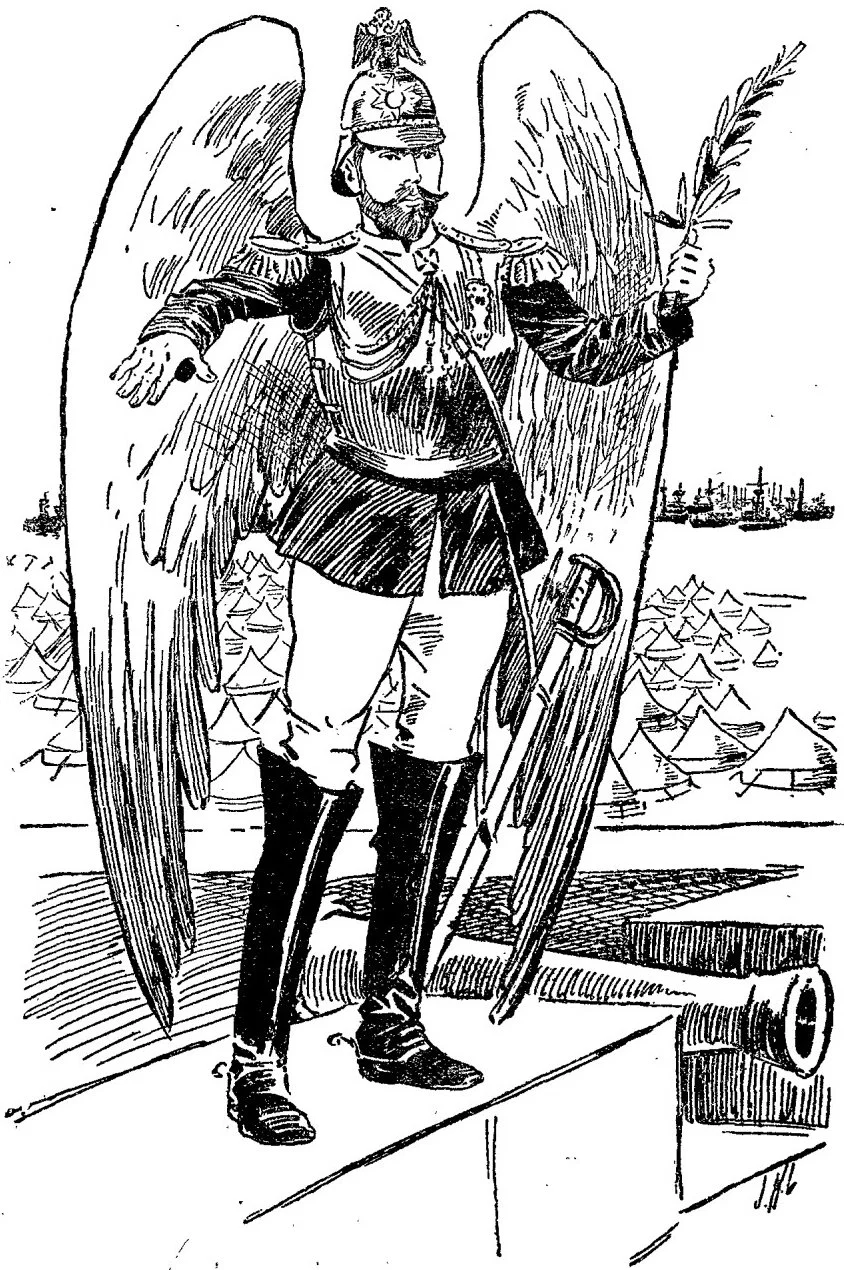
A STRIKING cartoon, called “Peace on Earth,” is here reproduced, which appeared in a recent issue of the Belfast Weekly Telegraph. It not only shows how the czar’s proposal is looked upon by the nations; but also, to an extent not possible in words, impresses the mind with the incongruity of his peace proposal, in the face of the present preparations for war in all the world. The naval demonstration seen in the distance, the populous camp nearer by, the guns of the fort, the war-like outfit of the stalwart soldier, make ridiculous the emblems of peace shown by his hands, and the dove-like wings with which he is overshadowed.
But there can be nothing more absurd in the picture than the thing it is evidently designed to represent,—the proposal by the crowned head of the greatest nation in Europe for an international peace conference, immediately followed by a decree for a material enlargement of his navy. Equally illogical is the relation of the nations to this peace proposal; for while they all received it with words of favor, nearly all began to plan for extensive additions to their fighting forces, the only exceptions being those nations that are unable to do this because of financial embarrassment.
On the same page of the paper from which this cartoon is taken is an article entitled “The Armies of the world.” The writer enumerates the number of soldiers in the standing armies of the six greatest countries of Europe, with the number of trained men who could be called out at once in case of war, and the reserve men, who are more or less untrained. After naming figures that aggregate twenty-three million six hundred thousand, he notices, in the following language, the inability of the mind to grasp the facts stated: “But arrays of figures like the foregoing are confusing, and merely serve to stir up the waters of ignorance into a bubbling flood. No one can understand what these figures really mean; for beyond a certain point, it is impossible to realize the immensity of numbers, not to speak of the facts that lie beneath them.
To assist the mind to a better understanding of the relative sizes of the standing armies only, a picture is given containing eight soldiers, attired in the uniforms of their several governments. The Russian is first, standing at a height of about four and one-half inches. Next to him stand French, German, and Austrian representatives, each about two inches in height. Following these are the Italian, Spanish, and British soldiers, standing respectively, one inch, half an inch, and one fourth of an inch high. The representative of the United States is only an exclamation point, so small is the regular standing army of this country, as compared with those of the nations of the Old World. Another series of drawings equally impressive is given, showing the relative number of soldiers to citizens in the larger countries. The soldier of the United States is shown having five hundred civilians under his care; the Briton has fifty-five; the Russian has thirteen; the German, twelve; while each French military representative has to guard only nine citizens, in order that the whole nation may be protected by arms. From this we see that one man out of every five in France is a soldier! It is no wonder that militarism and the civil powers conflict.
These statements and figures apply only to the nations named. The smaller countries of Europe add to the number given five million four hundred and seventy thousand more soldiers, while the total number for the world is estimated at forty-four million five hundred thousand men. “When one looks around, and sees all the nations of the earth arming themselves for war, and subscribing to the principle that might is right, one can not but be struck with the irony of it, as one remembers the civilization, and the superiority of mind over matter, of which this nineteenth century boasts.” The time when nations shall learn war no more seems a long way off, judging from the world’s point of view at the present day.
H. E. S.

Samson and Delilah: A Warning Against Worldly Slumber

“Samson, rocked to sleep on the lap of the crafty Delilah, when he ‘wist not that the Lord was departed from him,’ is but a picture of the child of God rocked into fatal slumber in the lap of the world.”

Righteousness Defined as Moral Rectitude

RIGHTEOUSNESS is moral rightness, moral rectitude, moral uprightness, conformity to moral law.—Finney.

Russia's Relentless Drive for Dominance in Europe and Asia

No NATION in the Old World is so near to being an undying, persistent, determined, intelligent, unwavering, unified force, as is Russia. Dynasties may change; but Russia neither wavers nor changes. She has set out to win the mastery of the Orient, and nothing but superior force can arrest her course. There is intimation that her aims—which she solemnly interprets as divine predestination—include her paramount rule in Europe also; and that her combinations with conscienceless France already have given her a portentous base in Western Europe, whereby her line of battle already stretches from the English Channel to the Pacific Ocean in the far East. It is superb generalship! What nation has better? Yet the final test will come only when the myriads of armed men meet in the shock of actual battle, which sometimes reverses the fortunes, and consumes the fruits, of the most appalling human generalship, as in Napoleon’s history.—Selected.

OUR GOD IS A CONSUMING FIRE.*

A. T. JONES.
(Concluded.)
“Who may abide the day of his coming? Who shall stand when he appeareth? for he is like a refiner’s FIRE.” Good. Then when I meet him now, in the consuming fire that he is, I meet him in a fire that is refining, that purifies. “And he shall sit as a refiner and purifier of silver: and he shall purify the sons of Levi, and purge them as gold and silver, that they may offer unto the Lord an offering in righteousness.” That is separation from sin; that is purification from sin. And that sets us where we offer an offering unto the Lord in righteousness: we become the servants of righteousness unto holiness, that we may meet the Lord. So, then, bless the Lord that he is a consuming fire,—that he is as a refiner’s fire.
Look again at that expression in Revelation: “His eyes were as a flame of fire.” In that day his eyes will rest upon each one of us, and he will look clear through us. When his eyes are as a flame of fire, and those eyes in that great day rest upon every one of us, and look clear through us, what will that look do for every one who is wrapped up, body and soul, in sin?—It will consume the sin, and the sinner with it; because he would not be separated from the sin. And to-day, just now, those eyes are the same that they will be in that day. To-day his eyes are as a flame of fire; and “all things are naked and opened unto the eyes of him with whom we have to do.” Very good, then. As all things are naked and opened unto the eyes of him with whom we have to do, whether we will have to do with him or not, why not accept the fact, choose to have it so, and on our part open up everything to the eyes of him with whom we have to do? And having opened up the life thus to him, to the flaming fire of the glory of his shining eyes, what will that do?—Those eyes of living flame will look clear through us, and will consume away all the sin, and all the dross; and will refine us so that he shall see in us the image of himself.
It is written that we are to serve the Lord “as of sincerity.” Sincere is genuine; it is true; it is as strained honey. Originally, it is honey strained, and strained again, over and over, until, holding up the honey to the light, it is found to be sine-cera,—“without wax,” no trace of cera to be seen floating in it. That is what he says you and I are to be as certainly as we are Christians. God cleanses us in the blood of Christ, and holds us up in the light of the Lord, and the world can see only the light. And so, “ye are the light of the world.”
Here, again, is the word of the Lord: “Search me, O God, and know my heart: try me, and know my thoughts: and see if there be any wicked way in me.” Ps. 139: 23, 24. That is the word given to us for to-day and for all time. Another word goes right along with it: “O Lord, thou hast searched me, and known me. Thou knowest my downsitting and mine uprising, . . . and art acquainted with all my ways. For there is not a word in my tongue, but, lo, O Lord, thou knowest it altogether. Thou hast beset me behind and before, and laid thine hand upon me.” Another translation has it: “Thou hast compassed me all around; and holdest thine hand over me.” Verses 1–5. That is a fact. He has compassed us all around, and his hand is over us. Whether we accept it or not, is another matter; but that is the fact with every man in all this wide world. That is how it is that all things are naked and opened unto the eyes of him with whom we have to do.
Then when it is a fact that he has searched us, and known us, and does search out and know us all the time, why not accept it as a fact, and have the benefit of it? Why not present to him the word, “Search me, O God, and know my heart: try me, and know my thoughts”? What for?—“And see if there be any wicked way in me.” O, that sets me before his face; for his glorious eyes of light to look upon me, and to shine through me, as the fire, searching out if there be any wicked way in me! And having searched it out, and being a consuming fire, he consumes it all away, and leads me in the way everlasting.
So, then, the sure way to escape the flaming fire of that great day is to welcome that flaming fire this day. Therefore, I say again, Let it never escape from your thought that “our God is a consuming fire;” and that the sure way to escape from that consuming fire in that great day when there will be no chance to change, and no time to choose, is to choose to-day the blessed change that is wrought, by welcoming freely, gladly, into the life, our God, who is a consuming fire.
I remember the word that was spoken to Moses. As Moses had come nearer and nearer to God, he said at last: “I beseech thee, show me thy glory.” That is exactly what appears in the coming great day that is at hand: he comes “in the clouds of heaven with power and great glory.” His glory covers the heavens in that day, and the earth is filled with his praise. In that day he is “wrapped in a blaze of boundless glory,” “and every eye shall see him.” But who shall endure it? That is the question; and the answer is: Only those who have prayed, and now pray, that Christian prayer, “I beseech thee, show me thy glory.”
When Moses prayed that blessed Christian prayer, the Lord said: “There is a place by me, . . . and I will put thee in a cleft of the rock,” “and I will make all my goodness pass before thee.” “And it shall come to pass, while my glory passeth by,” I “will cover thee with my hand. And I will take away my hand,” and you shall see me. Ex. 33: 21–23. So, though every man should dread the terror of the consuming glory of the Lord in that great day, there is to-day a place by him. So we are to bid all souls; and from him I bid you, to-day, Come, and stand in this place by him, in the very presence of the flaming glory. Do not be afraid. Moses was not able to bear the fulness of that consuming glory that day; but the Lord, in his love, covered him with his hand, and protected him from the effects of that glory, which he was unable to bear.
The great trouble in that great day is that the people are not able to bear the glory. The kings of the earth, and the great men, and the rich men, the chief men and the captains, and every bondman, and every freeman flee to the rocks and mountains to hide themselves, and say to the rocks and mountains, “Fall on us, and hide us from the face of him that sitteth on the throne, and from the wrath of the Lamb; for the great day of his wrath is come; and who shall be able to stand?” The blazing glory of God will shine upon the earth, and these people can not bear it.
But to-day do not be afraid. He says: “There is a place by me;” there is a place “in a cleft of the rock,” and “I will put thee in a cleft of the rock,” and I “will cover thee with my hand,” so that you can bear the blaze, and the purifying power, of my glory. And that consuming fire of my presence shall consume away all the sin. I “will cover thee with my hand,”—I will protect you even from that weakness which, in you, makes you unable to bear the fulness of my glory. And when he takes away his hand in that great day, those who have dwelt by his side, and been purified by living in this consuming fire until they are made white and tried, can look upon his unveiled face. In the full brightness of his glory, we shall look upon him, and see him as he is.
And that is where we are now to look. With open face we can look, even now, into his face. For, in the flesh of Jesus Christ, God has veiled the annihilating power of the glory of his face; for, having shined into our hearts, he gives the light of the knowledge of the glory of God in the face of Jesus Christ. In looking into the face of Jesus Christ, we see the face of God, and “we all, with open face beholding as in a glass the glory of the Lord, are changed into the same image from glory to glory, even as by the Spirit of the Lord.”
Then let every soul welcome the glorious message that God sends to the world, “Receive ye the Holy Ghost;” welcome that blessed Spirit that works this change by which we are changed from glory to glory, and made ready to meet him in that great day of glory; and welcome not only the Holy Spirit, but covet earnestly the best gifts, which the Holy Spirit brings when he comes. Desire spiritual gifts; for these are to bring us to perfection in Christ Jesus. Only in this way shall we be made perfect in Christ Jesus; and in Christ be made ready to meet him as he is.
God is a consuming fire; and I am glad of it. Our God is coming; and I am glad of it. He is coming in flaming fire; and I am glad of it. He is coming in all his glory; and I am glad of it. I am sorry that there will be anybody upon whom he will have to take vengeance; but I am glad that the day is coming when all sin will be swept away by our God, who is a consuming fire.
Come, brethren. Are you ready? Are you ready to meet him in that day? If not, he says to you to-day, “There is a place by me.” Come to-day, and stand in this place by me. I will reveal to you all my glory; “I will make all my goodness pass before thee.” And where there is any defect in you that can not just now bear the deeply consuming fire of this glory, I “will cover thee with my hand” until it is all over; so that I may separate you from all sin, and save you in that day of glory.
O, then, welcome him who is a consuming fire! Dwell in his presence. Open up the life. Recognize the fact that he is a consuming fire—that he is never anything else. Then rejoice in that to-day. Dwell in that consuming fire to-day. And when that great day breaks upon the earth, in all his glory, we shall also rejoice in that day. Then we shall stand and say, “Lo, this is our God.” But what! with the mountains hurling through the air; every island fleeing out of its place; the earth coming up from beneath; the heavens departing as a scroll, with a noise that is more than deafening; and flaming fire all around, his face as the sun, his eyes as a flame of fire,—in all this shall we rejoice?—Yes, bless the Lord! We shall rejoice, because “this is our God.” We have seen him before; we have lived with him; we have welcomed his consuming presence; we have welcomed the living flame of which his eyes are as a flaming fire, that they should pierce us through, and search out any wicked way in us. We know what blessing and joy were brought into our lives when his consuming glory purified us from sin and from sinning, and made us the servants of righteousness unto holiness. And knowing what blessedness that was, we exclaim, in the fulness of perfect joy, “Lo, this is our God” indeed. We see him now, more fully than before. That means more blessing still. “Lo, this is our God; we have waited for him, and he will save us: this is the Lord; we have waited for him, we will be glad and rejoice in his salvation.” Isa. 25: 9.
Continue reading: FAITH