The Youth’s Instructor, Vol. 31, No. 4.

PEARLS

The Youth’s Instructor

Jan 24, 1883

S. D. A. Publishing Association · Battle Creek, Mich. · Jan 24, 1883

PEARLS
PEARLS are valued for their beauty; and some of them are so costly that none but princes, or people of great wealth, can afford to possess them. Yet to-day, as I was riding near Gardner, in northern Massachusetts, I saw millions of them as bright and beautiful as ever decked the brow of an empress. Here, as in many parts of New England, a fresh growth of shrubs and young trees covers hill-side and valley in every direction. The boughs of these were ornamented in the most gorgeous manner. A recent rain had loaded them with ice-crystals, which, when shone across by the sun, glistened and sparkled like the most brilliant diamonds. The light graceful forms of the gray birches, with their long delicate sprays, drooping low under their glittering treasures, presented the appearance of a shower of silver rain, glowing with a phosphorescent light, or mingled with liquid fire.
As the train whirled along, the ever-varying undulations of the landscape continually presented new forms and new groupings. In a rapture of surprise and admiration I gazed upon the glittering panorama, and I thought, “What could be more beautiful!” I could hardly see how the pearly gates themselves could surpass in loveliness the resplendent view so freely spread out here upon this “dull cold earth” for the admiration of all who had the taste to appreciate it, or the inclination to behold.
Yet, among the numerous passengers on board the train, there were but few who seemed to take any special interest in this rare exhibition of exquisite beauty. Alas, how much of the best enjoyment of life is lost, for want of appreciation on our part! Daily and hourly, our heavenly Father is endeavoring to draw us toward himself, not only by his word, but also by the wonderful display of wisdom, power, and goodness, with which he surrounds us in all seasons, and under all circumstances.
Furthermore, our great Teacher is continually trying, by exhibitions of beauty, grandeur, and loveliness, to cultivate in us such tastes as will fit us to enjoy the beauties of heaven, and thus make us happier both here and hereafter. If we should heed these lessons better, it would not retard our true prosperity in the ordinary affairs of life, while it would greatly favor our advancement in learning, and afford us a most valuable source of enjoyment. He who has learned to hold sweet communion with nature, has the best antidote against loneliness; for since the works of God are always before him, he always has an interesting theme of meditation.
Such a habit is not only conducive to enjoyment, but it leads the mind to the Creator, who originates all these beautiful forms. Thus it works upon our devotional feelings, and promotes spiritual growth. When Balboa discovered the Pacific Ocean, he dropped upon his knees, and praised God. Just so the lover of nature feels his heart swell with rapture and devotion, as he admires the handiwork of its great Author. On a clear night, the innumerable stars remind us of the immensity of God’s works; if it be dark, the certainty of coming day suggests the constancy of that Being who holds the worlds in his hand; the rosy light of morning proves the faithfulness of him who has promised that seed-time and harvest, day and night, shall not cease; as the sunlight quickens all nature, so the Holy Spirit warms into life and activity the Christian graces. When the day is cloudy, we know that the sun is still shining on the other side of the cloud, and is just as near as ever; just so we may know in times of sorrow and adversity that God’s watchful care is still over us, and that his love is not withdrawn from us. The raging storm purifies the atmosphere; and so, deep afflictions and fierce temptations may purify the heart by driving us near to God.
The chief beauties and choicest blessings that this world can afford, are free to all. The beauties of the landscape, the loveliness of flowers, the azure sky, the fleecy clouds, the gorgeous sunset, the glittering snow, the brilliant stars, the soft light of the moon, are denied to none. Air and water, food and friends, the promises of God’s word, salvation through Christ,—all these are ours to enjoy. Why, then, should we envy those who have hoarded gold and silver, or who can wear costly pearls, since so many richer blessings are showered upon God’s creatures everywhere. When we come to appreciate these things as we should, we shall find a source of much pure happiness, and a means of avoiding many temptations.
G. H. BELL.

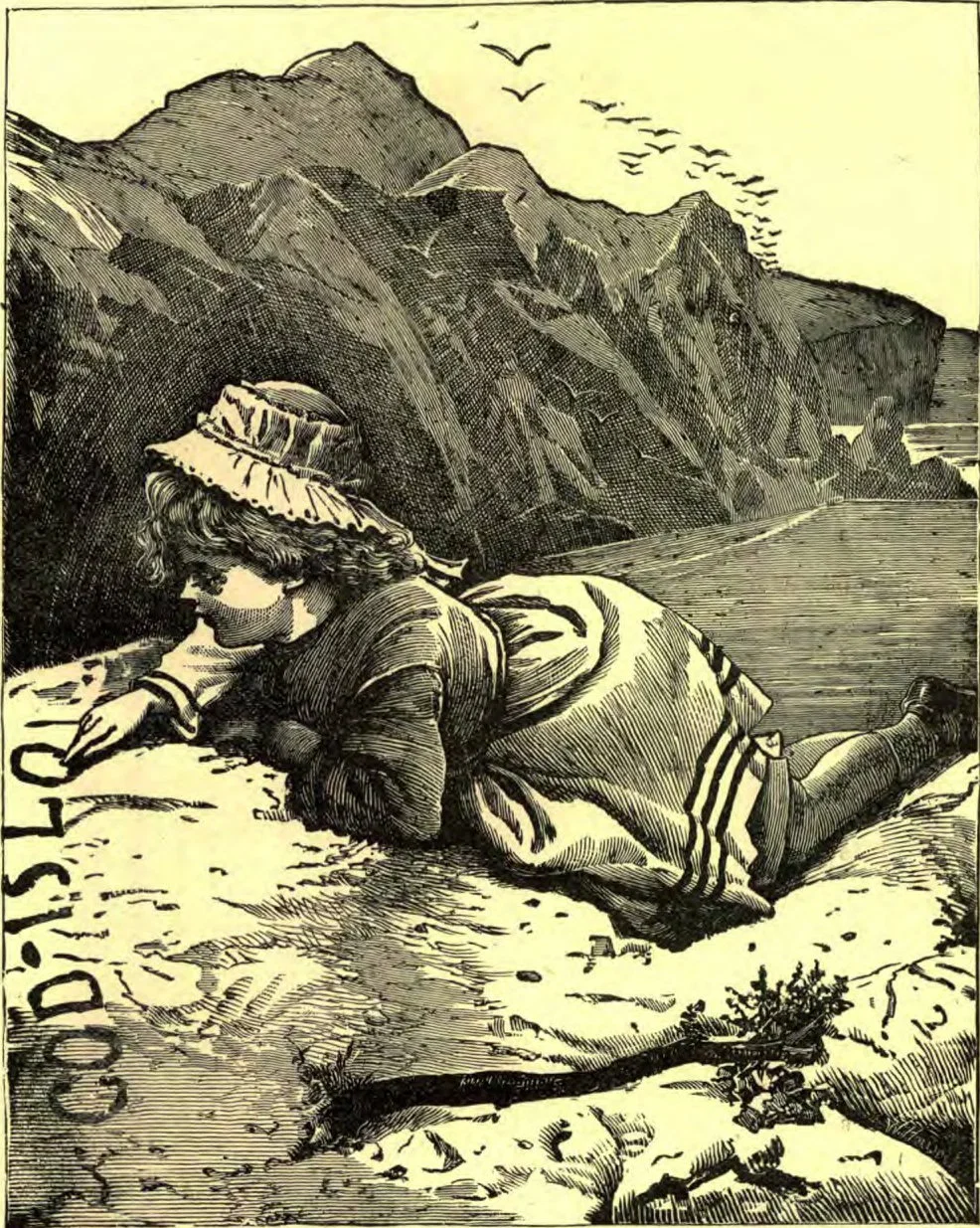
THE WRITING ON THE SHORE.

I READ one morning on the sand, And written by a childish hand, A truth the billows cannot teach— A truth past human wisdom’s reach— God is Love.
It seemed a very angel’s trace, God’s footprint in that lonely place; It brightened up the sea and sky, And glad I was I could reply, God is Love.
And much I thanked my little friend, Who thus her joyous creed had penned; And may she know for evermore The truth she wrote upon the shore— God is Love.
The tide will come again to-day, And wash that lovely print away, But death and hell cannot erase The charter of the child of grace— God is Love.
—George S. Outram.

GRETCHEN'S WONDERFUL DAY.

She never knew that it was wonderful. She thought it exactly like other days. It began by her getting up even a little earlier than usual, so that she had time to arrange her hair neatly; and Mrs. Dunlap, the American lady, meeting her on the stairs, said to herself, “The child has very pretty hair.”
But of course Gretchen did not hear that.
Gertrude was up early too, and out of the house, with bare feet, and into mischief; that little Gertrude was really the most mischievous four-year-old who was ever born, I do think!
Gretchen was sent for her in haste, and coaxed her in. What do you suppose she had in her hand? A half frozen bird!
“Poor little thing!” said Gretchen, meaning the bird, and she took it tenderly in her hands, and fed it, and petted it back into life, and bore silently the rather sharp scolding of the house-mother for letting the naughty little four-year-old out in the cold. She did not even explain that she was in the outer kitchen, at work on something which the house-mother had sent her to do, and knew nothing of Miss Gertrude's movements.
“It is a wonder she doesn't explain,” said Mrs. Dunlap, the American lady, who had been looking on, and knew all about it. This thought interested her so much that, later in the day, she asked Gretchen about it.
“What use?” said Gretchen, smiling. “She knew she sent me to another place to work; when she thought it over, she knew all about it; but just then she was tried; and what use for me to try her some more?”
“She is a thoughtful little girl, and good-tempered withal,” said Mrs. Dunlap. But this she said to herself. That half frozen little bird received much care that day; yet I have never heard that Gretchen neglected any of her work; and she had much to do. Up-stairs and down, chambermaid, housemaid, errandmaid, where did not her busy feet have to run? She sang much of the time, bursting into little snatches of happy song when she thought she was out of hearing, keeping quiet as a mouse when anybody was near. “She has a wonderful voice,” said Mrs. Dunlap, but nobody told Gretchen that.
A good deal of Gretchen's time was spent in the kitchen. Not a pleasant place for a little girl to stay. At least Mrs. Dunlap thought so. The house-mother had different ideas about kitchens from American mothers. To be sure, everything was neat and clean; but it was in what Minnie Dunlap called “a huddle.” Kettles and pans and pails and dippers, almost without number, hanging on the walls, and a smell of something boiling or sizzling on the great stove all the time. Out of doors the day was bright, and half the children of the town were out enjoying the flurry of snow. They had come for Gretchen, but the house-mother said, “No, Gretchen has work to do.” She seemed always to have work to do. Mrs. Dunlap, watching her, wondered if she would cry, or look gloomy and pout. She did neither. She was still for a few minutes, and then as she seated herself to grind the black coffee for supper, she kept time to the grinding with a queer little German air, that was half sad, half merry. Mrs. Dunlap had come to the kitchen on an errand, and saw her.
“Gretchen is a cheerful little thing;” she said this to the house-mother, after they had left the kitchen.
“Yau,” the woman answered; she was good-natured always; and why shouldn't she be? She had plenty to eat and good clothes to wear, while many another, whose father and mother were dead, went hungry to bed. All this she said in queer-sounding German words, but Mrs. Dunlap understood. The honest-faced German woman, seeing that she had a good listener, explained that while she had only taken in Gretchen out of charity, she meant to do well by her, and teach her to work, and earn her own living. By-and-by she could go across seas, maybe, and get good wages, doing housework.
“I don't believe she will,” said Mrs. Dunlap with a smile; but this she said to herself. And Gretchen, thinking everybody was out of hearing, sang on, a gay, cheery song.
Putting all the little bits of that day together, watching Gretchen, tender to the little bird, tender to the mischievous little girl, respectful to the house-mother, who wasted no tender words on her, industrious, patient, faithful all that busy day, Mrs. Dunlap settled something in her own mind.
It was when Gretchen came to bring her candles, and answered her cheery German “yes ma'am,” to a loud call, and hastened away with as quick a step and as pleasant a face as though she had not been called a hundred times before that day, that Mrs. Dunlap said to Minnie,—
“I mean to do it.”
And Minnie said,—
“Aunt Katie, I'm so glad!”
The next morning the story came out. Mrs. Dunlap, the rich American lady, wanted to take Gretchen, the orphan girl, “across seas” with her, this very fall. She liked her face, liked her voice, liked her gentleness, liked her ways with little children, liked everything about her, and would send her to school, and teach her to sing, and to play the piano, and be a friend and companion to her always. Would Gretchen like to go?
Ah, wouldn't she! I cannot begin to tell you how dearly she loved the American lady.
“Gretchen,” she said to her one day when they were on the great ship, “do you know it was that Thursday, when the first snow came, and the little bird was almost frozen, and Gertrude ran away barefoot and found it, that I, watching you, made up my mind fully to take you home with me? You decided it, my dear.”
“Me, ma'am?” said Gretchen with sweet, wide-open eyes. “I did not do anything that day, only just my bits of duties.”
Ah! If each day, we only did our bits of duties.
—The Pansy.

Oh, What Is Life? Drops Make the Sea

Oh, what is life? Drops make the sea; And petty cares and small events, Small causes and small conquests, Make up the sum for you and me; Then, oh, for strength to meet the stings That arm the points of little things!

PETER H. CLARK

FROM THE SUNNY SOUTH.

[Here is a letter from “Uncle Peter,” who wrote quite frequently for the paper several years ago. The readers of the INSTRUCTOR will no doubt be glad to hear once more from their old friend.—ED.]
It has been a long time since I wrote to the INSTRUCTOR family. I would like to see you all, but you are scattered in every State, I understand. I have been thinking lately that you might like to read a letter from this part of the sunny South,—my native clime. Down here the orange grows, though the crop was very short this year; figs are abundant; bananas grow, but they seldom mature. The magnolia, a beautiful evergreen tree, is also found here. Its flowers are snowy white and nearly a foot in diameter, and are very fragrant. The tree begins blooming early in April, and continues in blossom for several months. The orange-blossoms are small, white, and exceedingly fragrant.
There are many evergreens here, as the cedar, live-oak, gall-berry, and the vast forests of pine stretching away in all directions, except toward the gulf. This makes it a very pretty place to live, at least it seemed so to me five years ago when I returned home in mid-winter, after spending four years on the prairies of Texas. Maybe I was homesick. I suppose some of you have been homesick; it is a lonesome, hungry sort of feeling, isn’t it? Well, I wish every one of us would get real homesick, longing for the home that the Saviour has gone to prepare for us; that when he shall come to take us there to see our dear heavenly Father, we shall hail him with joy, because we have become real homesick waiting for him.
Christmas has come and gone. I hope you all had a happy time. Two wild red-birds came Christmas morning and sang some carols for their Creator and for us, although it was cold and the white frost was over everything. It is seldom they do so on frosty mornings.
We are having such good Sabbath-school lessons now. I love to study them, though I do not attend Sabbath-school, as there is none in my neighborhood. I love the INSTRUCTOR; and during the past few years, I have obtained 135 subscribers for it. These have gone to twenty-five post-offices, nine counties, three States, and one island in the Gulf of Mexico. In another letter I will tell you about the queer home on this island. I must close for this time. Your friend,

PETER H. CLARK

Moss Point, Jackson Co., Miss.

Who Fastest Walks Astray: An Adventist Verse Reflection

WHEN people once are in the wrong, Each line they add is much too long; Who fastest walks that walks astray, Is only fartherest from the way. —Matthew Prior.

HABIT

“I trust everything under God,” said Lord Brougham, “to habit, upon which, in all ages, the lawgiver, as well as the school-master, has mainly placed his reliance,—habit, which makes everything easy, and casts all difficulties upon the deviation from the wonted course. Make sobriety a habit, and intemperance will be hateful; make prudence a habit, and reckless profligacy will be as contrary to the nature of a child, grown or adult, as the most atrocious crimes are to any of our lordships. Give a child the habit of sacredly regarding the truth; of carefully respecting the property of others; of scrupulously abstaining from all acts of improvidence which can involve him in distress, and he will just as likely think of rushing into an element in which he cannot breathe, as of lying, stealing, or swearing.”

SCENES IN THE LIFE OF CHRIST.

LESSON 105.—JESUS TAKEN BEFORE PILATE.

As soon as morning had come, the chief priests, and the elders, and the scribes, and all that belonged to the council of the seventy, called the Sanhedrim, met together, and condemned Jesus to death. Then they led him away bound, to Pilate the Roman governor, that he might order his soldiers to execute him.
When Judas saw that his Lord was condemned to die, he was sorry that he had betrayed him, and brought the thirty pieces of silver to the chief priests and the elders, saying, “I have sinned, in that I have betrayed the innocent blood.” But these cruel men were unmoved by the penitence of Judas, and said, “What is that to us, see thou to that.” Then Judas threw down the pieces of silver in the temple, and went away, and hung himself. The chief priests were troubled to know what to do with the money, but after counseling together, they decided to buy with it the potter’s field, to bury strangers in.
When those who led Jesus to Pilate, came to the Judgment Hall, they called Pilate out; and when he had come forth, he said, “What accusation bring you against this man?” They answered, “If he were not a malefactor, we would not have delivered him up unto thee.” Pilate then told them to judge him according to their own law. But said they, “It is not lawful for us to put any man to death.”
Then they began to accuse Jesus, saying, “We found this fellow perverting our nation, and forbidding to give tribute to Cæsar, and saying that himself is Christ, a King.”
Then Pilate called Jesus into the Judgment Hall with him, and questioned him, saying, “Art thou the King of the Jews?” Jesus said, “My kingdom is not of this world. If my kingdom were of this world, then would my servants fight.” This made Pilate all the more interested, and he questioned Jesus still farther, saying, “Art thou a king then?” Jesus said, “For this cause came I into the world, that I should bear witness unto the truth. Every one that is of the truth heareth my voice.” Then Pilate said, “What is truth?”
Then he took Jesus out again to the chief priests, who kept on accusing him; but Jesus gave them no answer, and Pilate marveled. Turning to the chief priests and the people, Pilate said, “I find no fault in this man.” This made the Jews the more fierce, and they said, “He stirreth up the people, teaching throughout all Jewry, beginning from Galilee to this place.”
As soon as Pilate heard them speak of Galilee, he inquired if Jesus were a Galilean, and on finding that he was from that province, he sent him to Herod, who was ruler over Galilee, but happened at this time to be in Jerusalem. Herod was very glad to have Jesus sent to him; for he had been anxious for a long time to have the opportunity of seeing some of his miracles. But when he questioned Jesus in a lordly, overbearing manner, Jesus answered him nothing. The chief priests and scribes were also present, and accused him vehemently. Herod felt indignant because Jesus would not answer his questions, and he, with his men of war, treated Jesus with scorn, and mocked him, and put on him a gorgeous robe, and sent him again to Pilate.
When Pilate had called together the chief priests and the rulers, and many of the people, he said unto them, “Ye have brought this man unto me, as one that perverteth the people; I, having examined him before you, have found no fault in this man touching those things whereof ye accuse him; no, nor yet Herod; for I sent you to him; and, lo, nothing worthy of death is done unto him. I will therefore chastise him, and release him.”

QUESTIONS.

1. What was done as soon as the morning broke? Matt. 27 : 1; Mark 15 : 1; Luke 22 : 66.
2. What was done with Jesus after the Sanhedrim had condemned him?
3. Why did they do this?
4. How did Judas feel when he saw that his Lord was condemned to die? Matt. 27 : 3.
5. What did he do with the money that had been given him?
6. What did he say to them?
7. What effect had this upon the men that had hired him to betray his Lord?
8. What did they say to him?
9. What did Judas then do?
10. What troubled the chief priests?
11. After counseling together, what did they decide to do?
12. What did Pilate say to the men who brought Jesus before him? John 18 : 29.
13. What reply did they make?
14. What did Pilate tell them to do?
15. Why were they not satisfied with this permission?
16. What did they begin to do?
17. What accusations did they bring against him?
18. After having called Jesus into the Judgment Hall, what question did Pilate ask him?
19. What did Jesus say about his kingdom?
20. How did this answer effect Pilate’s mind?
21. What further questions did he ask?
22. For what purpose did Jesus say he came into the world?
23. Who did he say would hear his voice?
24. What did Pilate then say?
25. What caused Pilate to marvel when he had taken Jesus out again to the priests and scribes? Mark 15 : 3–5.
26. As Pilate turned to the chief priests and the people, what did he say to them? Luke 23 : 4.
27. What was the effect of his words?
28. What did they say?
29. What inquiry did Pilate make when he heard the people speak of Galilee?
30. Who ruled over Galilee at this time?
31. Where was he at this time?
32. What did Pilate do when he heard that Jesus was from the province of Galilee?
33. How did Herod feel about having Jesus sent to him?
34. Why had he been anxious to see Jesus?
35. How was Herod pleased with the interview?
36. What part did the priests and scribes take in this interview?
37. How did he and his men of war treat our Saviour?
38. What did he finally do with him?
39. What course did Pilate take when he found that Jesus was again brought back to him?
40. Repeat the words of his decision as he gave it to the priests, rulers, and people, thus assembled? Verses 14–16.

NEW-TESTAMENT HISTORY.

LESSON 119.—REVIEW; THE KINGS OF ISRAEL.

  1. Tell how the kingdom of Israel was divided after the death of Solomon?
  2. Who was the first king over each part after the division was made?
  3. How many years did the kingdom of Israel continue as a separate kingdom?—254.
  4. How much longer did the kingdom of Judah continue?—183 years.
  5. How did the kingdom of Israel come to an end?
  6. Give the closing history of the kingdom of Judah. 2 Chron. 36.
  7. Name some of the leading kings of Israel.
  8. What was their general character?
  9. Tell some of the acts of Jeroboam.
  10. Give some events in the life of Ahab.
  11. Who was the most successful ruler over this kingdom?
  12. Who was the most noted prophet during Ahab’s reign?
  13. Give some of the most remarkable events of his life?
  14. Who reigned in Israel when the prophet Elisha flourished?
  15. Who reigned in Judah at this time?
  16. Describe Elisha’s most important miracles.
  17. Who were the most noted kings of Judah?
  18. Which of them were good?
  19. Which of them began well, but ended badly?
  20. Which of them began badly, but afterward repented and lived a good life?
  21. Give some of the most important events in the life of King Asa.
  22. What did Jehoshaphat do for the improvement of the people, and the benefit of his country?
  23. What foolish thing did he do?
  24. What king lost his life in trying to hinder an army from invading Babylonia?
  25. Give a brief account of Hezekiah’s reign.
  26. Tell some of the acts and experiences of Josiah.
  27. When were the first company of captives taken from Jerusalem to Babylon? About 606 B. C.
  28. What distinguished persons were among them?
  29. When, and under what circumstances, were the second company taken?
  30. Tell how Jerusalem and the temple were finally destroyed.
  31. How had the last kings of Judah treated the prophets of God?
  32. How long was it from the time Daniel was taken to Babylon to the time when the last company were taken?

HOW SHE MANAGED IT.

In a certain Sabbath-school, no matter where, there was a class which had been the despair of successive teachers. One after another was frozen out by the elegance, or was it the stiffness, of the half-dozen beautiful young girls who composed the exclusive circle. Bound together by congenial social relations, the young ladies remained apparently indifferent as to whether they had a teacher or not, and equally polite and uninterested with the new teachers who came from time to time, as they had been with the old.
The superintendent grieved over their lack of class feeling. They were in the school, and not of it. It was suggested to him to press them into the service as teachers. They, one and all, declined the office. During the opening and closing exercises, they behaved with propriety, as grown-up girls should, and, when they had no one to teach them, they spent the time appointed for study in talking to each other, with evident enjoyment, but as evidently about anything else rather than the lesson.
One day, a little, dark-eyed woman entered the school, and offered her services as a teacher. She stated that she had recently come to live in the neighborhood, and wanted to work for Christ.
“We have a young ladies’ class,” said the superintendent, with some hesitation,—thinking, good man, of the fine clothes worn by the class in question, and of the plain attire of the woman before him. “It is an unpopular class,” he continued; “nobody succeeds in it; but you might try it for to-day.”
Looking in her direction a little later, he could hardly believe his eyes. The ice had melted. The class had forgotten itself over the Bible, and was a unit in its eager attention to the lady, who was speaking to them in a low, soft voice, and as if what she had to say was worth their hearing. And, yes indeed, he could see that they were asking questions as well as answering them.
Sabbath after Sabbath, the stranger, who soon grew to be a friend, was in her place; but ere long the six had grown to twelve, and then to twenty; and in three months the number had increased to thirty-five.
A more miscellaneous set could not have been imagined. Yet they did not seem ill-assorted. There was no patronage in the manner of Floribel N., the judge’s daughter, nor the least servility in the air of Dulcie W., who was folding sheets for books daily from eight until five.
“Tell us your secret,” said some of the teachers one day, to Miss——. It was at a little afternoon meeting of the lady teachers, informally assembled to talk over methods.
“How do you contrive to hold those girls?”
“I have no secret,” was the reply, “I pray for my girls daily. I name each individual at some time every week, to my Master, and I study the lesson with my whole heart and soul. I try to make it a living lesson; not a story of the past, but a vivid, stirring story for to-day. I try to find out what is back of each girl,—what home influences she has, what are her surroundings, and to what key her life is set. Then I seek to discover whether she is happy or discontented, whether she feels herself of use, and what work she can do, and my constant refuge in every doubt and perplexity is my Saviour. I know these young lives are very precious to him, and I cannot be satisfied to let them slip into worldliness, when they ought to be consecrated to him.”
“But how did you conquer the caste feeling so completely?”
A light came into the dark eyes, kindling the expressive face almost into beauty.
“I think nothing about it. Caste must go down when the cross is the central thought. The only secret,” said the little woman, smiling, “is that I bear my scholars on my heart night and day, that I set them at work, and that I get them to be wide awake with interest in the Bible, which is the most interesting book in the world. And then I trust in One who never breaks his word. He is with us always.”— Margaret E. Sangster, in S. S. Times.

WINTER

ALL the little birds are frightened, Chirping very sweet and loud; “What shall we do, both I and you, Since winter is so proud?”
“With his snow he hides the grasses, With his breath he nips the trees; What use to seek, with claw and beak, For food ’mid things like these?”
Winter smil’d a very little, Said, “You discontented things, Why, don’t you know that from my snow Arise your lovely springs?”
“Here are haws and holly-berries, Eat them as good birds should do; And be content that I am sent To keep earth warm for you.”
—Selected.

STORIES ABOUT WOLVES.

WOLVES are of many different kinds, but the most common is gray, with many long black hairs in its fur. There is also in our country, a black wolf, and a prairie wolf, which is not large.
The black wolf and some others are very bold and brave when at liberty; but when they are once caught, their courage seems to fail them, and they act like whipped dogs.
One wolf alone will not often attack or harm a man, but a drove of them together is not a pleasant thing to meet, especially in the winter, when they are apt to be hungry. They are very swift on foot, and will overtake the fastest team, and drag the people from the sleigh and devour them. Many stories are told of people being chased and devoured by these fierce animals. In many places where the country is new, it is not safe for people to travel after dark in the winter, on account of them. It is said that they are not apt to disturb any one by daylight, unless very hungry. They will often follow the traveler by his scent for many miles till it becomes dark; and when he hears their faint howl in the distance, he knows that unless he can reach some house before they overtake him, he is sure to be killed and eaten by them.
One time a boy about ten years old was on his way home with a pair of oxen, with which he had been helping a neighbor about six miles away. He was trudging along, singing as he went, when a sound came on the night air that sent a shiver to his heart. It was the cry of the wolves. At first he hoped they were not on his track, but the uproar came nearer and nearer, and he knew his chance of escape was small. But he got onto one of the oxen, making use of his goad, and shouting at the top of his voice to hurry the beast on. The ox set off at full speed, and his mate kept up with him. The boy, whose name was James, shouted, the oxen almost flew, and the chain rattled loudly. Fast as they went, however, the wolves gained on them, but when the fierce animals came near enough to hear the terrible rattling of the chain, they did not know what it was, and kept stopping a little to listen. This gave the oxen a chance to gain on them; and just as the wolves were almost at their heels, they landed the brave little boy safe at his own door, where his parents and brothers were beginning to look anxiously for him.
A story is told of a gentleman, who with his daughter, was thus chased by wolves over a lonely road through the woods. For a while they threw out provisions which they had in the sleigh, and tried in other ways to keep off the hungry beasts, hoping, since they had a fleet team, to reach a place of safety. But when the driver, a faithful servant, saw that they all must perish unless something more could be thrown out to stop the wolves awhile, he quickly put the reins in the hands of the gentleman, and sprang out of the sleigh. While the wolves were devouring him, the father and daughter reached a place of safety.
The Bible says: “Greater love hath no man than this, that a man lay down his life for his friends.” This faithful driver gave his life for his friends; but our Saviour gave his life for us when we were yet enemies to him. E. B. G.

HE KNOWETH.

What a world of comfort there is in those words! He, the great Father, knoweth. We are trying to do right. We are seeking the way. But discouragements come. In an evil hour we yield to temptation. Can he ever forgive? Yes, for He knoweth. He knows just how weak are our natures, how strong our wicked passions; he knows how hard we try; how sorry we are when we fail, and because he knows, he can forgive.
Our friends condemn us. They wonder that we do no better. They are out of patience with our constant failures. They reproach us, and are ready to give us up. They do not know; they cannot look into our hearts and see the desires, the determinations, the repentance, that can find no words for expression in human speech. Only the good Creator can understand his own creation. We do not know each other, but what a blessed thought that God knows!
And yet what a world of woe may be in those words: He knoweth! If in the heart there is sin, hatred of our neighbor, envy of our associates, we may keep it concealed from those who meet us every day, and yet, He knoweth. If we have even wicked desires, complainings, thoughts for which we would blush if our friends should guess them, however carefully we try to keep them away from sight, still, He knoweth.
Let us try to live so that these words may be a comfort instead of a trouble to us. Let us trust the One who knoweth all, and he will guide and forgive, till we come to the land where none of the ways lead into temptation.—Little Star.

The Heart Gives Life Its Beauty

THE heart gives life its beauty, Its glory and its power,— ’Tis sunlight to its rippling stream, And soft dew to its flower.

GOD'S CARE OVER US.

Two little girls were walking homeward on a moonlight evening. I overheard one of them say, “Sister Annie, It don’t make any difference how fast we walk, the moon keeps up with us every step of the way; it don’t move at all, and yet it is always going along with us.” So it is with the dear God in heaven; though he seems far away, he is keeping step with us always in the march of life.

TRUE WORTH.

TRUE worth is in being, not seeming— In doing each day that goes by Some little good, not in dreaming Of great things to do by-and-by; For whatever men say in their blindness, And spite of the fancies of youth, There is nothing so kingly as kindness, And nothing so royal as truth. —Alice Cary.

LETTER BUDGET.

BERTIE QUICK writes from Denver, Miami Co., Indiana. He is eight years old. He does not have a chance to go to Sabbath school, but he learns a lesson at home every Sabbath. This is the first letter he ever tried to write.
HARDIN R. JAMES writes us a very neat letter from Shepherdsville, Kentucky. He says: “I take the INSTRUCTOR, and like it very much; I also take the S. S. Visitor. My pa and ma are Seventh-day Baptists. I have no brothers or sisters to play with me, but I have a little squirrel. Her name is Effie, and she is so tame that she will sit on my knee and eat walnuts and fruit. I hope you will think this good enough to print.”
EUGENE LAWRENCE PAGE, of Marksville, Page Co., Va., says: “I thought I would like to have my ma write a letter for me to the INSTRUCTOR. I am a little boy seven years old. I have a baby brother; he is one year old. I have been trying to get him to say his A B C’s. His name is Arthur. I like the INSTRUCTOR very much. I always go to Sabbath-school with ma when I can. We do not have far to go. We all learn a lesson, and then after we have said it, every scholar repeats a verse from the Bible. I go to school through the week close by our house. I am trying to be a good boy, so I can meet the Lord when he comes in the clouds.”

“NOT WORTH A STRAW.”

PERHAPS a straw is not so worthless as you think. Let us see. Straws are the stems of wheat, rye, oats, and barley. In order to wave to and fro in the wind, and yet bear up the heads of grain, they must be both light and strong. Let us see how lightness is secured.
They are made hollow, you see, like quills; and yet not hollow through the whole length, for every now and then we find a knob or joint, which helps to brace up the sides, and make them strong.
The straw on the outside is hard, and looks shiny, as if it had been polished. It is polished, and that keeps the insects from damaging it, besides adding to its strength. Polish! but where does it get polish?
God gave these plants the power of drawing up this gummy sort of varnish from the earth. It is flint. There is nothing like it on the stem of the sweet-pea or the currant-bush, because they do not need it. But does it not show God's wisdom and knowledge in giving this power to one plant where it is needed, and withholding it from others where it is not?
So you see that even a straw can show the wonderful power of our Creator, and speak his praise.

You have reached the end of this edition.

The Youth’s Instructor · Jan 24, 1883