The Youth’s Instructor, Vol. 29, No. 4.

DOWN THE RAPIDS

The Youth’s Instructor

Jan 26, 1881

S. D. A. Publishing Association · Battle Creek, Mich. · Jan 26, 1881

DOWN THE RAPIDS.

About eight miles above Montreal, on the River St. Lawrence, are the Lachine Rapids, which render the navigation of the river difficult and even dangerous. From this point to Montreal a ship canal has been constructed, which allows the largest craft to pass in safety around this perilous channel. Small craft, however, if skillfully piloted, “run the rapids” and avoid the necessity of going through the canal.
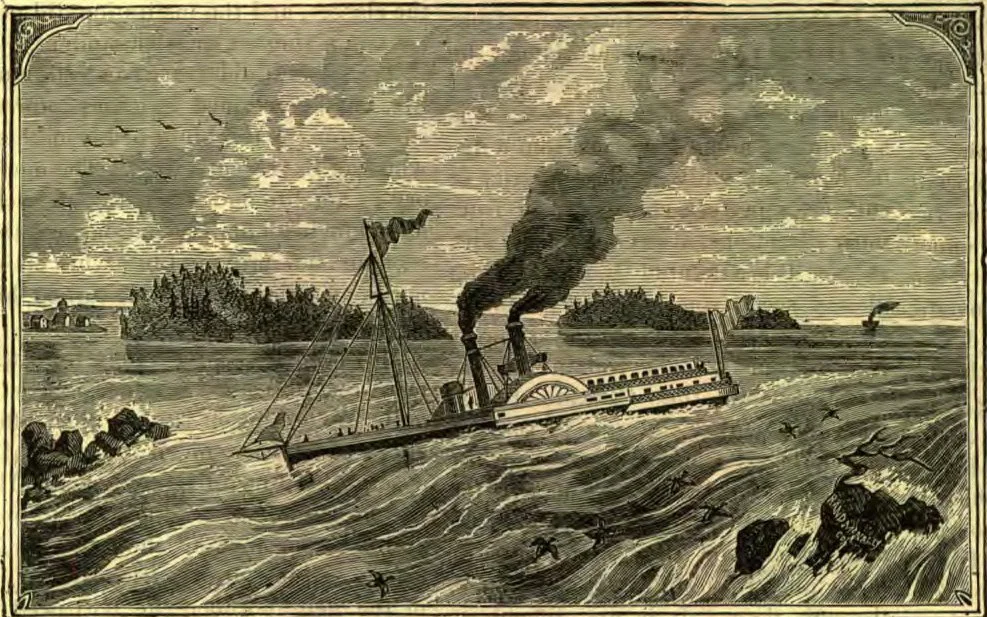
During the summer season, the market steamer, which brings fresh produce to Montreal every morning from the farms up the river, makes the trip and “shoots the rapids,” as shown in the engraving. Many tourists avail themselves of the opportunity of sharing in the excitement of the journey, there being now but little risk in it, as long practice enables the pilot to safely guide the boat to the quiet waters below.
After an early breakfast in Montreal, the tourist takes the morning train to Lachine, and enjoys a pleasant ride up the banks of the beautiful St. Lawrence. The steamer is found above the rapids, ready to receive its passengers. An experienced Indian pilot here takes the wheel, and the journey commences. In a few moments the passenger becomes conscious of an unusual motion, and the boat pitches and tosses in the agitated waters. Right ahead is a ragged rock, upon which the little craft seems to be rushing; but a turn of the wheel at just the right moment sends the boat to the left, and the danger is past. Steam is shut off from the engine, and the boat is now tossing, apparently at the mercy of the current. All eyes are turned upon the pilot, who seems as cool as though sailing “through unruffled seas.” The words of the poet come to mind,— “Steady, O pilot, stand firm at the wheel;” and with bated breath the passengers watch for the next peril that looms up ahead. The “dangers unseen,” however, are the worst, as just below the surface of the water lie rocks which would be certain destruction if the pilot were ignorant of their locality and should allow the boat to run upon them. But with every inch of the channel as familiar to him as a beaten path, he skillfully guides the steamer through, and all breathe easier when the placid waters are reached, and the steady puff of the engine shows that the paddle-wheels are again at work.
The remainder of the trip is full of enjoyment, and the boat passes under the famous Victoria Bridge and reaches her dock in the city while the morning is yet fresh with dew.
How many of our readers are going “down the rapids” of life toward destruction? The way may seem pleasant, but there are hidden dangers all along the channel, and the only safety is to turn square about and journey up the stream, even though you may have to contend with the current every inch of the way. Do not float with the current. There are breakers ahead. Stem the tide, and at last you may anchor in the haven of rest. W. C. G.
LACHINE RAPIDS, ST. LAWRENCE RIVER.

COLUMBIA RIVER.

[The following, which was published in the INSTRUCTOR about four years ago, is by request again offered for perusal.—Ed.]
THERE is probably no large river in North America of which the readers of the INSTRUCTOR know so little as the Columbia. If you will take a map of North America, or of the United States, it will aid you in considering what I now write to you.
Comparing the American coasts of the Atlantic and the Pacific you will notice a great difference of outline. The Atlantic coast is fringed with inlets, river-mouths, bays, and gulfs, while the Pacific coast is regularly and smoothly outlined. From the San Diego (Dee-a'-go), in the extreme south of California, to Vancouver's Island, in British Columbia, there is scarcely a good harbor or safe refuge from storm except that of San Francisco through the “Golden Gate.” And even that is often difficult to enter in a storm on account of the frequency of heavy fogs.
Looking at the map you may think the mouth of the Columbia River is a good refuge from storm, but there is a heavy “bar” at the mouth which makes an entrance difficult, and sometimes impossible, to sail vessels, in stormy weather.
When I was a boy and studied geography, I was told that the name Pacific was given to this ocean because it was so quiet and free from storms. The number of vessels and lives lost along this coast during the last two years make me doubt the propriety of so naming it; but that may be owing in part to the lack of good, safe harbors, for I believe it is not subject to such terrific storms as is the Atlantic, unless it is far to the south.
“Crossing the bar” at the mouth of the Columbia is quite an event to weak-nerved and seasick passengers, with whom, however, I could not sympathize. We crossed at early dawn, and I was on the upper deck to enjoy the scene. On the northern point, on the Washington side, is Cape Disappointment, or used to be, and I felt considerable disappointment to learn that our government has changed its name to Cape Hancock, as it was a geographical landmark of my school days.
Our vessel was a propeller, that is, it had no wheels on its sides, but a large iron screw at the stern by which it was propelled or pushed ahead. These vessels are narrower than others, and when in the trough of the tide they rock constantly even when there is no wind. We had rocked all the way from San Francisco, and in crossing the bar we had its last desperate struggle, as if the vessel wished to have one hearty shake before entering the quiet waters of the river. Everything movable had to move, and some of the seasick ones took the first exercise they had had for several days.
But this over we were in smooth water, and the sick began to come on deck. We soon landed at Astoria, an old village founded by Astor for the Fur Company. There are some new buildings, yet the town is very small for its age. It is surrounded, except on the river side, with high sand-hills which are covered with small fir-trees. Canning salmon appears to be the principal business of the place. While we were at the wharf, a tug-boat steamed up with twelve fishing-boats which it had gathered on the river, each having a quantity of large salmon. Hundreds of Chinamen are employed in these canneries.
From the mouth of the Columbia to the mouth of the Willamette (accent on second syllable), the scenery is varied and pleasing. Perhaps the effect is heightened to the traveler by the sudden change from the ocean voyage. The banks are mostly high and precipitous, often quite rocky, with frequent mountain streams forming beautiful cascades as they dash on to the river. Except on the bottom-lands, which are nowhere extensive, there is no variety of timber, as there is on our Eastern rivers. The continuous fringe of fir becomes monotonous, and detracts from the interest of the view.
When I ascended the river, the bottom-lands were all overflowed, many houses being carried away. At Kalama (Ka-lam'-a), the southern terminus of the railroad to Puget Sound, the water was over the floors of cars on the highly elevated track. But the height of the flood was unusual.
All vessels which make into the Columbia River go to Portland, which is the largest city in Oregon, about one hundred miles above Astoria, and twelve or fourteen up the Willamette. The latter stream is rather narrow, but deep as far up as to Portland. The vessels which run on the upper Columbia, to the Cascades, start from Portland.
Leaving Portland we find fifty miles of river similar to that which we have already passed, except that there is rather more bottom-land, and therefore a little more variety of trees. Not far above the mouth of the Willamette, on the north side of the Columbia, is Vancouver, the pleasantest-looking place on the river. Fort Vancouver, just above the village, lies on a beautiful plat sloping south toward the river.
The hills gradually increase in height, until we reach the Cascades. This is the name both of the mountain range and of the rapids of the river.
The Cascade Mountains rise abruptly from the river's bank on the south, or Oregon side, to a height of 3000 feet. On the north side there is a valley several miles in width in some places. At the foot of the Cascades on the north side is Castle Rock, an isolated rock which towers up 800 feet. It was the intention of Jay Cooke, in the days of his prosperity, to place on its top a sheet of iron painted to represent the American flag. In a more open country it would be a splendid landmark. Viewing it, I thought no ambition nor curiosity could induce me to scale its steep sides to its dizzy height. I did not learn that anybody has ever ascended it. The Cascades (rapids) are six miles in length. A narrow-gauge railroad conveys passengers and freight this distance. The river is very narrow, sometimes looking like a small stream as we almost hang over its waters in rounding a rocky point. It is also very crooked, rushing through its rugged confines, and foaming over its rocky bed.
In this range, about forty miles from the river, in Oregon, is Mt. Hood, the highest of all the peaks in that part of the country; about 15,000 feet. It is a beautiful mount, as seen from a distance, rising with great regularity of surface, a perfect cone as seen from most directions, always covered with snow. It is a notable landmark, being plainly seen from a great distance. On the north side of the river is Mt. St. Helens. The Indians have a tradition that the Cascade Range was once entire, shutting in the waters into a large lake or sea to the east, and that Mt. Hood and St. Helens got mad and threw stones at each other, and thus broke up the mountains, forming the river channel through them. It is not difficult to imagine that great convulsions of nature have wrought such changes. A company who ascended Mt. Hood in July, 1876, reported that a crater is found at the top from which smoke still issues.
J. H. WAGGONER.
(Concluded next week.)

Good Advice

If children at school can be made to understand that it is just and noble to be humane even to what we term inferior animals, it will do much to give them a higher character and tone through life. There is nothing meaner than barbarous and cruel treatment of the dumb creatures, who cannot answer us or resent the misery which is so often needlessly inflicted upon them.—John Bright.

UPS AND DOWNS.

One day, as I have heard it said, It chanced a rag and bit of lead Lay in the kennel snug together In very wet and muddy weather. The rag was soiled and old and torn; The bit of lead was bruised and worn,— Two waifs, whose worth, at full account, Was of such very small amount They well together might remain To hide the pelting of the rain.
Yet low'as was their present state, They both had known a better fate. The rag had once been whole and white, In every way had pleased the sight; And, in its time, had helped adorn A bride upon her wedding-morn; Lent to her figure and her face An added though unneeded grace, Nor thought such parting and distress Could e'er befall a wedding-dress. The piece of lead could not forget Its fortunes had been nobler yet; For, molded well for use of one Who was his country's faithful son, It had—though that was long ago— Been sped against his country's foe, And, guided by unerring hand, Had stretched him lifeless on the sand.
There came a man with hook and bag, And took away the lead and rag; And both were to a shop consigned, With many others of their kind. When winter passed, and summer came, The former rag had changed its name To paper, and it might avow It ne'er had been so white as now. Meanwhile, the lead, so long despised, Was altered so 'twas highly prized; For, melted, purified, and cast, It was a printer's type at last. They now, in this, their new condition, Were put into their old position; Drawn closer than before, to kiss, And find their apotheosis.
What greater immortality Than helping Genius not to die? —Scribner's Magazine.

FROST-WORK

For several days in the past, the frost has been gathering and clinging to everything within its reach, presenting the most beautiful work of nature we ever witnessed. Perhaps it has pervaded the country extensively, and adorned the towns, villages and country in other States; but we think no place can look so beautiful as our own little valley among the Adirondack Mountains.
High mountain ranges surround us on every side; the river and brooks are frozen, excepting in places where the rapids are, and the snow lies upon the ground a foot deep. The frost clings to the highest peaks, where it is too cold and windy for the snow to lie, and has made its way down, enwrapping the valley below with its snowy drapery. The alders on the banks of the river; the willows and ferns by the brook; every bush and stalk lifting its head above the snow; every leaf of the evergreen, and tiny twig of the tall, stately trees, is completely covered with the sparkling frost, so thick that only the trunks of the large trees can be seen.
As we look out upon the mountains, hills, valleys, lakes, rivers, brooks, and waterfalls, so beautifully dressed in white, and glittering in the sunlight, what feelings of sublimity it awakens! How we love the beautiful and pure! How it raises our thoughts and desires above to the Author of all purity!
NETTIE HOLT.

A SECRET MEETING.

SOME time ago, the Rev. Dr. Hill, of Virginia, related the following story:—
In his youth he entered Hampden Sidney College, where, at the time, Christianity was little respected among the classes, and the institution did not contain a single Christian student.
Young Hill did not live a religious life, but he retained religious impressions from the teachings of his mother, who had but recently died. The memory of her life and words thrust itself upon him in all his associations, and the scoffing and profane fun of his classmates at serious things disturbed his conscience.
He endured this for a long time, till it became a question whether he would quite give himself up to the influences which surrounded him, or make a serious effort to resist them. He had no Bible. He did not like to procure one for fear he should be ridiculed. At last, from a friendly family in the neighborhood, he borrowed a religious book. It was the work of a Scottish minister, and full of plain and holy truths.
Young Hill took his first opportunity to read it, locking his door, and hoping he should not be disturbed. Before long a student clamored so boisterously for admission that he was obliged to let him in. The book lay on the bed, and the visitor took it up and looked at it in surprise.
“Hill, do you read such books?”
Momentary cowardice made the young man hesitate, but he mastered himself, and replied, “Yes, I do.”
“Well,” said the fellow-student, with unexpected emotion, “you may be a Christian, but I can’t. I came here a professor of religion, but I struck my colors, and went over to the enemy.”
They had some further conversation, and Hill learned that there were two other well-disposed fellows in the college who might welcome his confidence, and finally it was decided to invite them to his room.
The four young men met and tried to hold a religious meeting. It was a new thing to them all. Their efforts were crude and incoherent enough, but they were sincere.
Their attempt to sing attracted listeners, and then the storm burst. A mob of students crowded the hall, and the uproar was such that the college officers had to come and disperse them.
That evening at chapel prayers the President inquired the cause of the disturbance, and learned the truth. He assured young Hill and his three friends that they should be protected.
“You shall hold your next meeting in my parlor,” said he, “and I will be one of your number.”
Saturday came again, and the meeting at the president’s house was attended not only by the four students, but by half the college. That was the beginning of a work that swept through the institution. Ridicule and reckless impiety were silenced, and scorners became worshipers.
The influence of the new religious life in the college spread through all the town and into the surrounding country; but its most interesting results were in the young men who first felt its power, and who had their long future before them. Some of these, like Dr. Hill himself, became clergymen, and the student who interrupted Hill in his reading, became president of a college in the West.
So did one good old book, cherished in secret by a single hungry heart—a little good amidst a great deal of evil—make itself felt and prove a seed of large blessing.—Youth’s Companion.

Hedge Thy Life With Prayer

Hedge round thy life with prayer, Knowing this truth, That sin in youth Is seed which, sown in unknown fields, A crown of thorns in manhood yields, Which he who sows must wear.

A NOVEL PUNISHMENT.

LITTLE Johnnie came home from school and told us how his teacher dealt with little boys that swore or told lies. He said that the teacher took a small swab, with water, soap, and ashes, and thoroughly swabbed out the bad boy's mouth. Quite severe, I thought, and yet it will take more than soap and ashes in the mouth, to remove the wrong.
To swear, and to lie, is to break the third and ninth commandments. These great sins go deeper down than the mouth, even to the heart. They go higher up, too, for they are put down in a book by an angel in Heaven. Are you anxious to know how they can be taken away? Then I will tell you. If they are sincerely confessed and forsaken, Jesus will cleanse the heart; and as he is in Heaven, he will have them all blotted out of the book up there.
Now, children, strive to keep a clean person, a clean mouth, a clean heart, and a clean record up in Heaven.
H. A. St. John.

Paper Goods Shown at the Berlin Exposition

A LIST of articles made of paper would be a very curious one; and almost every day it becomes more so, not only in this country, but also in Europe. Among the things exhibited at the Berlin Exposition, were paper buckets, “bronzes,” urns, asphalt roofing, water-cans, carpets, shirts, whole suits of clothes, jewelry, materials for garden walks, window-curtains, lanterns, pocket-handkerchiefs, and a fire-stove with a cheerful fire burning in it.

SCENES IN THE LIFE OF CHRIST.

LESSON 1.—INTRODUCTORY.

IN our course of Bible study we first learned about the creation of the world, and its history before the flood. Although this history is so brief, it covers a period of 1656 years. Of what happened for 352 years after the flood, we are told but little, except of the building of the tower of Babel, and the confusion of tongues. Then follow the lives of the patriarchs; Abraham, Isaac, Jacob, and Joseph, till the time when Jacob and his family went down into Egypt, covering a period of 290 years. The sojourn of the children of Israel in Egypt lasted 215 years; and the wanderings in the wilderness, the conquest of Canaan, and the rule of the elders and judges down to the time of Saul, about 396 years, according to the common reckoning.
Saul, David, and Solomon each reigned 40 years. Then the country was divided into the two kingdoms of Israel and Judah. At the end of 254 years the kingdom of Israel was completely subdued, and its people carried away captives, by the Assyrians. The kingdom of Judah continued 133 years longer, when Jerusalem was destroyed, and the people carried into captivity by Nebuchadnezzar, king of Babylon. After remaining in captivity 70 years, they were permitted to return to Jerusalem, and rebuild the temple.
The end of the captivity was only 52 years after Jerusalem was destroyed; for the first company of captives, with Daniel among them, was taken away 18 years before the destruction of the city.
In building the temple the people were so hindered by the Samaritans and other enemies that they gave up the work, but the Lord sent prophets to encourage them. Then they took hold again, and at the end of twenty years the house of God was completed.
This temple stood about 500 years,—almost to the time of Christ, when it was rebuilt by a very cruel king, called Herod the Great.

QUESTIONS.

  1. Where did we begin in our course of Bible study?
  2. How long was it from the creation to the flood?
  3. How much are we told of what happened during the next 352 years after the flood?
  4. Whose lives occupy the history of the next 290 years?
  5. How long was it after the flood to the going down into Egypt?
  6. How long was it after the creation?
  7. How long were the children of Israel in Egypt?
  8. What events followed during the next 396 years after their deliverance from bondage?
  9. How long was it from the time of leaving Egypt to the anointing of Saul?
  10. How many kings reigned over Israel before the kingdom was divided?
  11. How long did each of them reign?
  12. After the division what were the two kingdoms called?
  13. How many tribes constituted each?
  14. What became of the kingdom of Israel, after it had continued 254 years?
  15. What happened to the kingdom of Judah when it had continued 133 years longer?
  16. What then followed?
  17. How long before the destruction of Jerusalem was the first company of captives taken to Babylon?
  18. How long after the city was destroyed before the 70 years' captivity came to an end?
  19. After their return to Jerusalem how were the people hindered in the work of rebuilding the temple?
  20. How were they encouraged?
  21. When did they finish it?
  22. How long did this building stand?
  23. Who then rebuilt it?

LESSONS ON NEW-TESTAMENT HISTORY.

LESSON 14.—CHRIST HEALS THE NOBLEMAN'S SON.

On leaving Sychar our Lord went throughout Galilee, preaching in the synagogues, saying, “The time is fulfilled, and the kingdom of God is at hand! repent ye, and believe the gospel.” The time here referred to is probably the sixty-nine weeks of Dan. 9:25. This period was to reach to Messiah the Prince. Messiah means the Anointed, and it is an interesting fact that the sixty-nine weeks expired at the baptism of Christ,—the time when he was anointed by the Holy Ghost. Up to this point he had lived in retirement, but now he was to enter upon his public ministry, and as he went forth preaching, he said, “The time is fulfilled.” The kingdom of God here referred to cannot be the kingdom of glory; for that is not to be set up until all earthly kingdoms are destroyed. It must have reference to the kingdom of grace, and the wonderful manifestations soon to be presented in that kingdom. The Prince of that kingdom was then upon the earth, teaching and working miracles. He was soon to offer himself as a sin-offering for all mankind. To this great event all Christians of past ages had looked forward, and to it all Christians this side the cross have looked back, as the central point of their faith. The pure Son of God was about to give his life for the wicked sons of men; and through his preaching and that of his apostles the gospel light was to be shed with a fullness and radiance never known before.
The gospel which the people were exhorted to believe is the glad news of salvation through Christ.
As Jesus was going from place to place, teaching the people, he came to Cana of Galilee, where he had performed the miracle of making the water wine. “And there was a certain nobleman whose son was sick at Capernaum. When he heard that Jesus was come out of Judea into Galilee, he went unto him and besought him that he would come down, and heal his son; for he was at the point of death. Then said Jesus unto him, Except ye see signs and wonders, ye will not believe. The nobleman saith unto him, Sir, come down ere my child die. Jesus saith unto him, Go thy way; thy son liveth. And the man believed the word that Jesus had spoken unto him, and he went his way. And as he was now going down, his servants met him, and told him, saying, Thy son liveth. Then inquired he of them the hour when he began to amend. And they said unto him, Yesterday at the seventh hour the fever left him. So the father knew that it was at the same hour in the which Jesus said unto him, Thy son liveth; and himself believed, and his whole house. This is again the second miracle that Jesus did, when he was come out of Judea into Galilee.”
This simple narrative relates an astonishing miracle; but in addition to this, it teaches a lesson of simple faith which it would be well for all to heed. When Christ tells the nobleman that he will not believe without seeing signs and wonders, the afflicted man does not stop to make professions of faith, or to utter complimentary words, but in the earnestness of his soul, cries out, “Sir, come down ere my child die.” At first this might seem like an imperative command; but when Christ says, “Go thy way; thy son liveth,” the agonized father, like a true nobleman, accepts the statement without a question. He was satisfied with the Master’s word. It was now only about an hour past noon, and as the distance to Capernaum could not have been much over twenty miles, it would seem that he might have reached home that night; but so great was his confidence in the Saviour’s words, that, since the way was dangerous by night, he seems to have stopped, as darkness drew on, and rested till morning; for it was the next day when his servants met him on his way home.
How well it would be for us, if we could always accept the Saviour’s promises as unhesitatingly as did this man of Capernaum, and walk out upon them by faith, as he did!

QUESTIONS.

  1. On leaving Sychar, what did our Lord do? John 4:43-45.
  2. What did he proclaim? Mark 1:14, 15.
  3. What time is here referred to?
  4. How far was this period to reach?
  5. What does Messiah mean?
  6. What interesting fact may be noticed in connection with the sixty-nine weeks?
  7. How had our Saviour lived, up to the time of his baptism?
  8. Upon what did he then enter?
  9. What may be said in regard to the kingdom of God mentioned in Christ’s preaching?
  10. Mention some of the manifestations that were about to be displayed in the kingdom of grace.
  11. How have Christians of all ages regarded the crucifixion of Christ?
  12. What was to be accomplished through the preaching of Christ and his apostles?
  13. What is the gospel that the people were exhorted to believe?
  14. When Jesus in his journeyings had reached Cana, who came to him?
  15. What did the nobleman desire?
  16. How did Jesus question his faith?
  17. What reply did the nobleman make?
  18. What did the Lord then say to him?
  19. As he was returning home, what did he learn from his servants, who came out to meet him?
  20. What was the result of this miracle?
  21. What does this narrative teach?
  22. What was there remarkable in the man’s course when the Lord told him that he would not believe without seeing signs and wonders?
  23. What might his words at first appear to be?
  24. With what degree of faith did he receive the assurance that his child should live?
  25. With what did he feel entirely satisfied?
  26. At what time of day did he hold this interview with the Saviour?
  27. What was the distance from Cana to Capernaum?
  28. When did he arrive at home?
  29. What must have occasioned this delay?
  30. What cause was there for his not traveling by night?
  31. What did he show by thus journeying homeward so deliberately?
  32. What would it be well for us to do?

SAMARIA

SAMARIA is generally defined as the country lying between Galilee and Judea, though at one time it included all that portion of the Holy Land embraced by the tribes over which Jeroboam made himself king, whether east or west of the river Jordan. The country is described as more beautiful than Judea. The soft lime-stone or chalky hills, of which it is largely made up, unlike those farther south, abound in springs and mountain brooks. Fertile bottoms of black earth are not infrequent; rich fields, gardens, and orchards once decorated the valleys, while vineyards and trees of different kinds spread up the slopes; and woods of olives and walnuts still crown the soft outlines of many of the hills. The meadows and pasture lands of Samaria were famous in Israel. The landscape, however, with its flat valleys, and straight lines of rounded hills, all nearly of a height, is tame when compared with the bold scenery of the highlands of Galilee, among which was the home of Jesus.
Through the pleasantest part of Samaria runs the valley of Shechem, on opposite sides of which are the two most important mountains of Samaria, “the giants of the mountains of Ephraim,” mounts Ebal and Gerizim, on which the blessings and curses were pronounced when the children of Israel first came into the land of Canaan. In the valley between these mountains is the city of Nablous, as described in a former article. Still following down this valley, we come to the city of Samaria, the capital of the kingdom, some six miles northwest from Shechem, or Nablous.
The present city of Samaria is small and poor, consisting of only a few cottages built of stone from the ancient ruins. Its situation is exceedingly beautiful, and strong by nature. It stands on a fine large hill, compassed all around by a broad deep valley. The valley is surrounded by four hills, one on each side, which are cultivated in terraces to the top, and sown with grain, or planted with fig and olive trees, as are also the valleys. The hill of Samaria rises in terraces to a height equal to any of the adjoining mountains.
This is a very ancient city, having first been built by Omri, king of Israel, about 920 years before Christ. It became the favorite residence of the kings of Israel, and was highly adorned with public buildings. Ahab built there a palace of ivory. It was finally destroyed by the Assyrians at the time the Israelites were carried into captivity. It was partly rebuilt by the Samaritans; but a little before the birth of Christ, Herod the Great enlarged and adorned it, surrounded it with a strong wall, and gave to it the name of Sebaste, the Greek word for Augustus, in honor of the Roman emperor.
The eastern part of the country of Samaria is occupied by the plain of Sharon, justly celebrated for its beauty and fertility. Sharon, even at the present day, contains some of the finest pasture land in Palestine. In spring it is all spangled with flowers of the brightest colors. But owing to the wretched government that prevails, this region has become to a great extent a solitude, and indicates its fertility only by the enormous growth of weeds and the forests of thistles which cover it. The fear of the Bedouins, a wild people who roam over the country, plundering and even murdering, at will, has driven the inhabitants to the mountains; and here, as in other parts of the Holy Land, the oppression of Turkish rulers is an effectual discouragement to agriculture. The ruins of many cities and villages are found on this plain. Joppa, or Jaffa, as it is now called, situated on the sea-coast, is one of the most ancient sea-ports in the world, and is sometimes called the gate of the Holy Land. E. B.

Qualifications and Motives of a True Teacher

A true teacher must first be a sincere and humble learner, and being taught of God, he will be wise to win souls. This is a vital point. The office of the teacher must not be lightly assumed or inconsiderately cast aside; we are all trust-bearers, and this is one of the highest trusts of life. I would not discourage one earnest worker, but I would press home the question, “What doest thou here?” and doing what we may, we shall none of us be the worse for a little self-scrutiny as to our motives and qualifications. The young ruler was gentle and amiable, but no stone in nature was harder or colder than was his unrenewed heart toward the things of God and of eternity. Let us see to it that we are not of those who, “desiring to be teachers of the law,” understand “neither what they say nor whereof they affirm.”—Sel.

The Sabbath School Teacher Must Believe

The successful Sabbath-school teacher must be a sincere believer in the truth of the Bible. It is impossible to impress upon any one a truth which you do not firmly believe. Young minds are quick to perceive a doubt in the mind of their teacher, and that doubt once perceived, words are of no avail.

HERBERT’S WISH.

“I wish I could be a man to-morrow,” said Herbert Grant. His sisters, Nell and May, laughed, but his mother looked sad, and this is what she said:— “It is a great thing to be a man, but a man has to grow up into manhood from boyhood. It cannot be done in a day, any more than a tree can grow up tall and strong in a short time. It is little by little, and the true man keeps on growing all the time, as long as he lives.
“Every time you conquer the wrong, you are so much nearer manhood. Every time you forget self, and do, or say, or think, a noble thing, you are growing. So if you are in a hurry to be a man, remember that this is the only way you can help it along, by trying to be manly every day and all the day.”

SOLOMON AND THE BLACKSMITH.

THE blacksmith has sometimes been called the king of mechanics, and this is the way he is said to have earned the distinction:—
The story goes, that, during the building of Solomon’s Temple, that wise ruler decided to treat the artisans employed on his famous edifice to a banquet. While the men were enjoying the good things his bounty had provided, King Solomon moved about from table to table, endeavoring to become better acquainted with his workmen. To one he said,—
“My friend, what is your trade?”
“A carpenter.”
“And who makes your tools?”
“The blacksmith,” replied the carpenter.
To another, Solomon said,—
“What is your trade?” and the reply was,—
“A mason.”
“And who makes your tools?”
“The blacksmith,” replied the mason.
A third stated that he was a stone-cutter, and that the blacksmith also made his tools. The fourth man that King Solomon addressed was the blacksmith himself. He was a powerful man with bared arms, on which the muscles stood out with bold relief, and seemingly almost as hard as the metal he worked.
“And what is your trade, my good man?” said the king.
“Blacksmith,” replied the man of the anvil and sledge.
“And who makes your tools?”
“Make ’em myself,” said the blacksmith.
Whereupon King Solomon immediately proclaimed him the king of mechanics, because he could not only make his own tools, but all other artisans were forced to go to him to have their tools made.—Blacksmith and Wheelwright.

KEEP TO THE HABIT.

A WRITER in the National Baptist tells, in order to illustrate the necessity of keeping a good habit inviolate, the following anecdote:—
Prof. Stuart, during the latter part of his life, was able to study only two hours and a half a day. He set apart the time from nine to half-past eleven each morning; and this habit, once formed, he steadily and consecutively maintained.
A personal friend, who was about to be married, asked Dr. Stuart to perform the service. He consented. Presently it appeared that the wedding was fixed at eleven o’clock. Dr. Stuart said, “I cannot marry you,” giving the reason. “But can you not forego the rule for once?” “No, not for once.” So another minister officiated.
Dr. Stuart realized that, though one hour or another might be in itself indifferent, yet to break in upon a habit was not a matter of indifference, was not a trifle.

Basle Leads the World in Ribbon Manufacture

BASLE, Switzerland, leads the world in the manufacture of ribbons. It has 6,000 men employed in its factories, who make 130,000,000 yards a year, worth $15,000,000.

CHICKADEE

HIGH in the bare brown elm he swings, And twitters low and sweet; What cares he that the winter snow Lies white beneath his feet! December is better than Mays and Junes For singing the sweetest of sweet tunes,— Chickadee dee dee dee.
Where are the wife and babies brown? Where does the wee nest hide? For trees are bare and leaves are down, And all the country-side Lies shrouded in the drifting snow; But he sings though bitter north winds blow, Chickadee dee dee dee.
The night shuts down with bitter cold; Men shiver, hurrying by; But when morning breaks in purple and gold, Clear ’gainst the eastern sky, We see the dainty figure swing, And hear again the sweet notes sing, Chickadee dee dee dee.
—Annie M. Libby.
Continue reading: OUR BIRDS