The Youth’s Instructor, Vol. 47, No. 24.

VOICE OF THE MOUNTAINS

The Youth’s Instructor

Jun 15, 1899

Review and Herald Publishing Company · Battle Creek, Mich. · Jun 15, 1899

VOICE OF THE MOUNTAINS.
I SAW the mountains stand, Silent, wonderful, and grand, Looking out across the land When the golden light was falling On distant dome and spire; And I heard a low voice calling,— “Come up higher, come up higher, From the lowlands and the mire, From the mist of earth-desire, From the vain pursuit of pelf, From the altitude of self,— Come up higher, come up higher.
“Think not that we are cold, Though eternal snows have crowned us; Think not that we are old, Though the ages die around us. Underneath our breasts of snow, Silver fountains sing and flow; We reflect the young day’s bloom While the valleys sleep in gloom; We receive the new-born storms On our rugged, rock-mailed forms, And restore the hungry lands With our rivers and our sands. He who conquers inward foes All the pain of battle knows, And has earned his calm repose.
— James G. Clark.
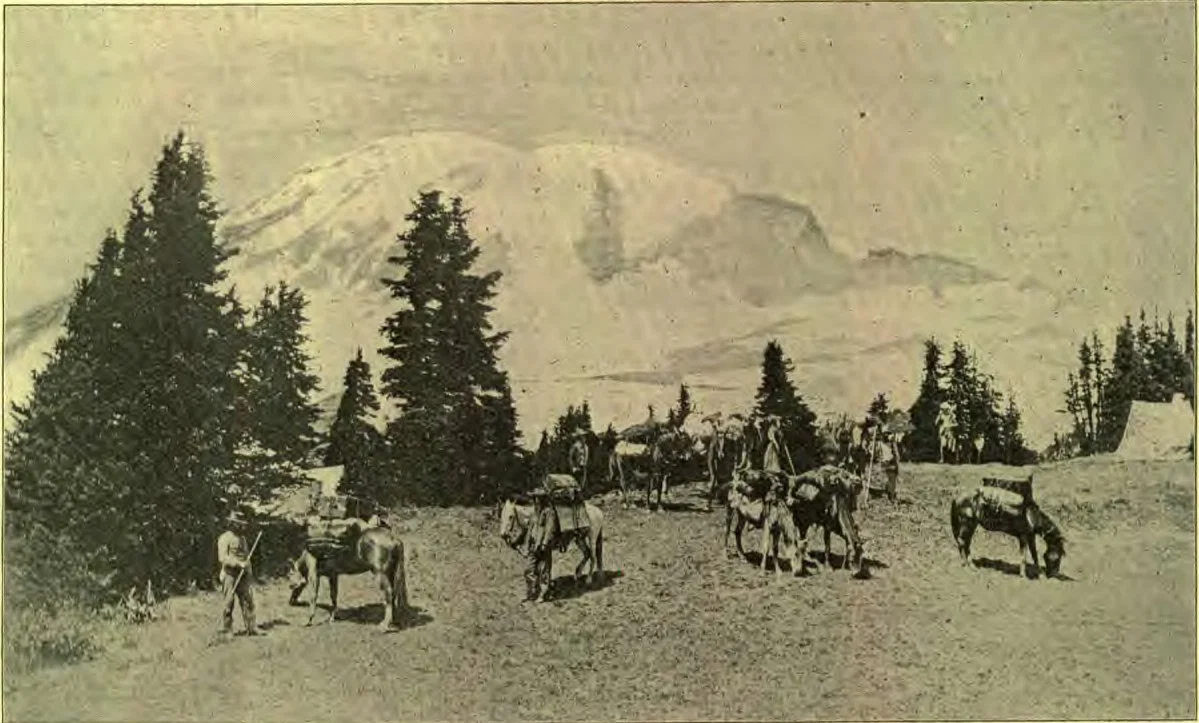
AT TIMBER-LINE ON MT. RAINIER.

BEAUTIES OF OUR OWN LAND.

It has been the writer’s privilege to travel extensively in the Rocky Mountains of Colorado, the Sierras of California, and the Cascades of Oregon and Washington. In almost every part of these mountains, one will see something beautiful, grand, and awe-inspiring. Wild flowers rivaling in beauty and fragrance the most successful product of the florist’s care and skill, can be found growing within arm’s length of the snow. Precipices are often seen where a pebble, lightly tossed outward, will go whirling down more than a mile. Here, you see the marks of the earth’s struggles in the long ago,—a mountain thrown up at a single upheaval, or built more gradually by volcanic action; or a lake where once stood a mountain that the earth has swallowed up; there, some cañon, perhaps thousands of feet in depth, the work of a turbid stream that has been cutting away the solid rock ever since the flood. Or perhaps you may stand looking down into a deep ravine, whose sides are made up of loose rocks, lightly embedded in sand or gravel. It may not look steep, and you may be tempted to descend; but before doing so, kick one of the smaller rocks from its substantial foundation, and watch the result. The rock you have loosened may be no larger than your two fists; and at first it will move so slowly that you could easily overtake it, and without danger stop it with your hand or foot. But its speed increases as it goes, until it strikes a larger rock with sufficient force to start it downward. This, in turn, starts another, until from that small beginning, a great avalanche of rocks, some weighing hundreds of tons, is rushing down the sides of the ravine with an irresistible force. Watch some of the larger boulders. They will at first roll slowly, then move in short leaps, which gradually lengthen until they go whirling through the air hundreds of feet at a bound. Now they strike the bottom of the ravine; and you see a cloud of dust, from which fragments of rock fly in all directions, and presently you hear a report like the booming of a distant cannon.
Most people have heard of the famous peaks and glaciers of the Alps; but many are not aware that in the extensive mountain ranges of our own country are peaks and glaciers that outrank in height, and rival in grandeur, the most famous of the Alps.
In the Cascades there are nearly a dozen peaks that have an altitude of from nine thousand five hundred to fourteen thousand five hundred feet. Most of these mountains support several glaciers. In the Alps, glaciers are usually formed between two mountain peaks, and many of them are of great size. Those of the Cascades, however, are always found between two ridges of one peak, and are consequently smaller, although one of the nine supported by Mt. Rainier is nearly ten miles long, and at some points more than half a mile wide.
A glacier is simply a river of ice. In winter, and often in summer, more snow falls upon the mountain-top than can be melted by the sun. As it accumulates, the pressure of the snow above solidifies that lower down, until it becomes a solid mass of ice. When the weight becomes too great, it begins to creep down toward the valleys. Often where the incline is very great, a part of the ice becomes detached from the main body, and goes rushing down the mountainside in an avalanche, tearing up huge boulders, uprooting trees, and sweeping everything before it. As time goes on, the slow-moving ice forms beds for itself along the course of the least resistance, just as riverbeds are formed. Year after year the glacier tears up the bosom of the mountain that gave it birth, grinding the great boulders or blocks of lava into powder to be carried away by the stream that begins where the glacier ends.
About seventy-five miles east of Tacoma, in the heart of the Cascade Range, Mt. Rainier, or Mt. Tacoma, as it is sometimes called, towers high above the surrounding peaks, and stands the king of American mountains. Its altitude is fourteen thousand five hundred and thirty-two feet. The altitude of its timber-line is between seven and eight thousand feet; while the line of eternal snow is about one thousand feet higher.
Two of the principal glaciers of this mountain begin at about the same altitude, and are separated by only a high ridge of loose rocks. From this point they flow in slightly different directions, forming two sides of an irregular triangle. From each springs a river that bears the name of the glacier that gave it birth,—the Cowlitz and the Nisqualli. The Cowlitz River flows past the east end of the Tatoosh Mountains, while the Nisqualli passes to the west, completing the triangle. The Tatoosh Range, the third side of this triangle, is quite unique in formation. The peaks are nearly equal in height,—between eight and nine thousand feet,—and the range follows the points of the compass east and west almost as straight as a crow would fly.
Within this triangle, nature has spread beauty and grandeur with a lavish hand. Paradise Park, it is called; and certainly no name could be more fitting. The soil is very rich, and the lower altitudes are covered with dense forests of cedar, fir, and mountain hemlock. Higher up, where the winters are more severe, the trees are dwarfed and ill proportioned. But the beauty of the wild flowers more than makes up for the plainness of the trees. More than four hundred varieties were gathered and classified by one man during a summer’s botanizing in Paradise Park. They grow wherever they find soil in which to take root. The most common flower is a pure white lily, called adder’s tongue. In some parts of the park these lilies grow so close together that they form a great carpet of delicate white and green.
Were Paradise Park divided into five-acre tracts, each would contain some charm peculiar to itself. There are cataracts from one hundred to one thousand feet in height, and lakes from a few rods to half a mile in diameter. There are deep cañons and high mountains, bare rocks and green meadows. Everywhere there is something new, something beautiful. Volumes might be written in description, and the reader would still have but a faint idea of what Paradise Park really is.
J. EDGAR ROSS.

DOERS OF THE WORD.

II.

The sayings of Christ are truth, eternal truth. He has sent his message, and we must hear with ears of faith. All who hear the word are to be doers of the word. The Saviour seeks to impress our minds with the necessity of charity, love, that earnest prayer that will ascend to God from hearts that are sincere in their religious duties. “Seek ye first the kingdom of God, and his righteousness, and all these things shall be added unto you.”
When Christ asked his disciples, “Whom say ye that I am?” Peter answered: “Thou art the Christ, the Son of the living God. And Jesus answered and said unto him, Blessed art thou, Simon Bar-jona: for flesh and blood hath not revealed it unto thee, but my Father which is in heaven. And I say also unto thee, That thou art Peter [which by interpretation means a stone], and upon this rock I will build my church; and the gates of hell shall not prevail against it.”
The name Peter means a stone, but Christ did not refer to Peter as the rock. He spoke of a rock altogether stable and immovable. He referred to the words Peter had spoken: “Thou art the Christ, the Son of the living God;” and he said, “I say unto thee, . . . upon this rock I will build my church; and the gates of hell shall not prevail against it.” The Truth, the Life, the Light of the world, was to be the foundation of the Christian church.
In plain language Isaiah tells who is the stone upon which the church is built: “Thus saith the Lord God, Behold, I lay in Zion for a foundation a stone, a tried stone, a precious corner-stone, a sure foundation: he that believeth shall not make haste. Judgment also will I lay to the line, and righteousness to the plummet: and the hail shall sweep away the refuge of lies, and the waters shall overflow the hiding-place.”
Peter afterward wrote: “To whom coming, as unto a living stone, disallowed indeed of men, but chosen of God, and precious, ye also, as lively stones, are built up a spiritual house, an holy priesthood, to offer up spiritual sacrifices, acceptable to God by Jesus Christ. Wherefore also it is contained in the scripture, Behold, I lay in Zion a chief corner-stone, elect, precious: and he that believeth on him shall not be confounded. Unto you therefore which believe he is precious: but unto them which be disobedient, the stone which the builders disallowed, the same is made the head of the corner, and a stone of stumbling, and a rock of offense, even to them which stumble at the word, being disobedient: whereunto also they were appointed.”
Those who build upon Christ Jesus will be safe; but those who build according to the wisdom of worldly-wise men, will find their wisdom foolishness. The great questions for us to settle are, How are we building? What characters are we forming in this our probationary time? The corner-stone of right character is Jesus Christ. His word, if practised, is sufficient to develop harmonious characters in all who believe, and who fashion their lives in accordance with it. The life that is given to God will become most valuable. He says, “I will make a man more precious than gold; even a man than the golden wedge of Ophir.”
“Ye are God’s husbandry, ye are God’s building,” and you are under obligation to God to render him perfect service. You are in Christ’s training-school. What do you propose to do with yourselves,—to be taught of God, or to take yourselves into your own keeping, and live in opposition to the plans of your Redeemer? Do you purpose to lay up treasure in this world, simply to expend upon your desires, and thus become unblessed of God in this life, and bankrupt for eternity?
“Ye are not your own; for ye are bought with a price.” All the physical strength you have is Christ’s. You live because he keeps you by his power. He made you for himself. He has a right to you, soul, body, and spirit. He has given you his plan for your life. It is to meet his requirements, that he may endow you with the gift of everlasting life. In order to become a member of the royal family, you must receive Christ by faith, believe in him as your personal Saviour, and take your place in his service. All your possessions are God’s, not to be trifled away, not to be used to gratify yourselves. You are to remember that the gold and silver, the houses and lands, bear the royal stamp, the signature of God. All are his property, to be used to glorify his name. You are to be his representatives, his faithful stewards, using his means to advance his work. God is greatly dishonored when his entrusted goods are used unfaithfully, and diverted to please the selfish heart.
God would have you draw wisdom from him; then you will be all-round Christians, reaching the highest perfection of usefulness in this life. By bringing every advantage God has given you into this work, your consecrated efforts will win souls for Christ. Set Christ ever before you. Recognize him as the first, the last, the best, in everything. Lay all the plans of your life before the One who died for you, that he might bring to you life and immortality. Remember that just the character-building you now make will determine your eternal salvation or your eternal ruin.
MRS. E. G. WHITE.

REDEEMING THE TIME.

Up, up, my soul! the long-spent time redeeming; Sow thou the seeds of better deed and thought; Light other lamps while yet thy light is beaming: The time, the time is short.
The time is short. Then be thy heart a brother's To every heart that needs thy help in aught; Soon thou mayest need the sympathy of others: The time, the time is short.
If thou hast friends, give them thy best endeavor, Thy warmest impulse and thy purest thought, Keeping in mind, in word, and action ever, The time, the time is short.
Each thought resentful from thy mind be driven, And cherish love by sweet forgiveness bought; Thou soon wilt need the pitying love of heaven: The time, the time is short.
By all the lapses thou hast been forgiven, By all the lessons prayer to thee hath taught, To others teach the sympathies of heaven: The time, the time is short.
— Hezekiah Butterworth.

Refraining from Making Excuses

“ONLY a strong soul can refrain from making excuses.”

ELIOT'S INDIAN BIBLE.

In a few of the great libraries of this country and England are preserved copies of the quaint old book, “Up Biblum God,” Eliot's Indian Bible. The Indians for whom it was written are gone, and no one living can speak their language or read their Bible; yet large sums are frequently paid for the scattered copies that remain.
Though the language in which it is written is dead, the book itself is a fitting memorial of its author. John Eliot came to this country just two hundred and sixty-eight years ago, and settled in the little town of Roxbury, Mass., as a religious teacher. He was much interested in the Indians. Acquiring their language, he labored successfully among them, bringing many to a knowledge of Christ, and thus gaining the title of “Apostle to the Indians of North America.”
Aided by a society for the propagation of the gospel, arrangements were made for preparing young Indian converts to go as missionaries to their own people. That this might be properly done, Eliot translated the Bible into the Mohican dialect, and had it printed at Cambridge in 1663. Materials were imported especially for the work, and eight years elapsed before the first edition of one thousand copies was announced. A second edition of two thousand copies was ready in 1686. This was, by many years, the first Bible published in any language in America.
While Eliot was translating the book of Judges, he came to the verse, “The mother of Sisera looked out at a window, and cried through the lattice.” Not knowing the Indian equivalent for “lattice,” he applied to the Indians, describing to them, as well as he could, what a lattice is. They gave him a long, barbarous, unpronounceable word; and he went on with his work, soon forgetting the incident. Imagine his astonishment some years later, when he knew more of the language, to read, “The mother of Sisera looked out at a window, and cried through the eel-pot.”
EDISON J. DRIVER.

INDIA INK.

India ink, so largely used by artists all the world over, forms the subject of a recent trade report by Mr. Fisher, British consul at Wuku, on the Yangtse. The ink, which is more correctly described as Chinese ink, is made only in the Anhwei province, and from Anhwei is exported to all lands. The material of the ink is lampblack of particular preparation, and the ink doubtless owes its beautiful quality to careful choice of its constituent parts. A vegetable oil, either colza or the oil expressed from the poisonous seed of a tree extensively cultivated for the purpose, and also well-known in Japan, forms the basis of the product; and to this, varnish and pork fat are added. This does not seem a promising beginning for an ink used for fine drawing; but it must be remembered that the mixture is burned, and its smoke collected to produce the actual material, the lampblack, of which the ink is made. This lampblack has a small quantity of glue and water added to it, and is then beaten with steel hammers on wooden anvils, scented with musk, and forced into wooden molds. In fine weather the contents of the molds will become dry in twenty days, when the sticks of ink are gilded with leaf gold, and are ready for market. There are about a dozen different grades of ink, varying from two shillings to seven sovereigns a pound. This ink is sold not only for drawing but also for writing purposes; for throughout China, Japan, Korea, and some adjacent countries, the natives use ink in this form only, rubbing the stick down with water, and using a brush set in a bamboo holder.— Selected.

Chapter I

From Sinai to Olivet

Chapter I.

“So that is it, mother!”
“That is it, dear, and I think it can be made to do rather nicely.”
“O mother! don’t! I know you feel just as I do; don’t let’s ‘put on’ with each other; neither of us would ever have picked out that horrid green, you know it.”
“Yes, I know, dear, but ——”
“And I just won’t wear it, so there now! make me look like a perfect fright.”
“O Shirley! don’t! you know we can’t fight father! and I ——”
“Well, yes, you, mother,—for your sake I’ve done lots of things that made me the laughing-stock of the other girls. There, I didn’t mean to say that exactly; yet I did, too. I wish I could say what I must say, without making you feel bad, mother.”
“I know, dear child,—I know it all. Of course we must respect father, and let him have his way; and you know he is a good man, Shirley. It is not as if he drank, like Mr. McCarthy.”
“Mother, drink is awful, but it isn’t the only vice: I don’t know what name to call father’s by, but I believe his chewing so much has something to do with it. However, it’s his determination to handle every single penny himself, that I just cannot stand any longer. Do you know, I never bought a thing in my life! If he had good taste, it would be bad enough never to pick out a thing for one’s self, but his taste is awful; I never had a becoming thing yet, no more have you, since I’ve known you; and I just will not stand it. I won’t wear that dress; I won’t go to the exercises; I won’t sing in that cheap, sleazy, horrid green rag.”
“I am eighteen years old; I work, and save a girl’s wages for father. I am willing to work,—I like to,—and I want to do everything a daughter can for him; and—and—you know, mother, dear, what I want to do for you, and will do always; but he has got to find out, one of these days, that I am a woman.”
“Well, you see that’s it, dear; he has queer ideas about women, you know.”
“Yes, I know, and he’s got to change them. I can do things, if I am a girl. You are as smart as he is, if you are a woman; and we ought at least to be allowed the privilege of picking out our own hats and dresses. I never looked fit to be seen in my life unless I tried on something of Aunt Nell’s.”
“Shirley!”
It was an impatient man’s voice from the kitchen. The girl’s face grew more contemptuous as she answered her father’s call by continuing to her mother: “And there’s another thing—as if we couldn’t run the house. It’s the dishes—I left ’em a minute, you see.”
“Shirley!” came the call, louder and harsher.
“Run, dear, do; don’t clash with father, please.”
“All right, for your sake—yes, father.”
“Are you going to let these dishes stand all day?” asked Mr. Goss, coming toward the bedroom where the two women had been. Shirley did not reply, but went slowly, doggedly, toward the sink, and began to drain off the cold suds, preparatory to replenishing with hot.
“There, you are wasting that soap!” growled her father, who had turned and followed, and stood watching her angrily.
Shirley answered only with darkly lowering brows, which hung like a cloud over a face that should always have been more than pretty.
Her father recognized the sullen sign. It had come in these days to be almost the only look he ever saw on his daughter’s face. At sight of him the light which greeted everybody else, the gaiety which her girl friends evoked, and the tenderness that answered her mother’s pleading eyes, all vanished; and in their place came this ill-tempered, morose scowl.
“Shirley, what is the matter?” at last asked Mr. Goss, sternly.
“Nothing.”
“Well, then, see here; you have been asked that question a dozen times in the last six months, and have always given the same answer, and if that’s true,—if there isn’t anything the matter,—you have simply got to put off that glum, discontented face, and stop your moping about the house, and act like somebody. Do you hear?”
“Yes, sir.”
For her mother’s sake she still answered her father when he required it; for her sake she had never yet come to the actual clash which her mother, timid and gentle as she was, dreaded.
“Well, then, are you going to chirk up?”
What could she answer to that? She knew she was not going to chirk up just yet, but it would scarcely do to say so. She stood still with her hands down in the sudsy dish-water, and was silent.
“Look at me.”
She scarcely dared defy that tone, so she glanced up at him with burning eyes, and then turned and gazed at the fair sky and fields, and the teams, and the men who were busy putting in the crops of a large farm. Why did not her father go to the field, and let her alone with her work?
“Shirley, do you understand? I will have no more of this. I will not have the house clouded all day with such a face as you carry. You have no reason. What more do you want, I should like to know? Don’t I get everything for you that you can use? You have too much done for you, that’s the trouble. It would do you good to have to go out and earn your own living somewhere.”
Shirley let her eyes come back slowly to meet her father’s; and for the first time in her life asserted herself before him, and said: “I do earn my living.”
Mr. Goss was surprised; but he was a fair-minded man, as far as he recognized another’s right; so he replied, justly, as he thought: “Yes, I am not complaining as to that; you do your work, after a fashion,—pretty well, in fact, as a rule, unless you get a dawdling, sulking fit on; ’t is n’t that I mean. You ought to have to go off, and look after yourself, that’s what.”
Shirley’s heart gave a great jump, the color mounted to her cheeks, her eyes sparkled; she did not, however, look up, and probably the angry man before her would not have understood if she had.
“If I could!” was the cry of her heart; “if I could be free; if I could have just one dollar of my own, to do just as I want to with; if I could ever move the things in my own room to suit myself once, without having to ‘put them right,’ if I could do anything my own way, just once,—if I could be just my own self one little hour, so I could get an idea of what I am like!”
She did not speak, or even look, aught of all this. It was buried too deeply to be easily upturned to the light. Besides, what would have been the use of speaking? It would have done her no good, and only hurt mother.
She stood quite still, leaning over the sink, bearing her weight on her two hands, which were soaking in the dish-water.
Benjamin Goss was at his wit’s end. He did not want to go any further in this matter now; for he was a little afraid of himself, if not of the girl, who was so much like him.
If he should really “set out” to make Shirley shine out of this cloud, he would be pretty sure to go on to extreme measures before he gave up. In fact, he never gave up; and he was afraid Shirley would be slow to shine unless she chose to do so; hence he hesitated to take a step that might precipitate a conflict such as he did not care to think about. He was not a fighter, only autocratic. He began to fear that a standing army would become necessary to support his form of government; but he was not quite ready to make a declaration of war against his one child, who had been as the light of his eyes, and who was still his pride, as all his neighbors knew. Yet something must be done. He would not, could not, have this moody, discontented face like a nightmare in his home.
And what did it mean? If she would only speak, and give a reason for growing into this sullen temper. The time was when she filled the house with sunshine, flitting here and there with daisies in her belt or hair, dimpling, laughing, singing, just as she always ought to. And who ever sang as she did?
Seeding, haying, and harvest always used to bring added merriment with the extra work; for the young fellows who came to help were neighbors and friends, and Shirley was a favorite with them all, and unkind to none. But now she manifested no pleasure in any of it; nothing brought out a dimple, smile, or sparkle. She went slowly about her work as her mother’s sole assistant, sometimes really hindering more than helping. Not even Seth Addams, who had been almost recognized as her one especial friend, could win more than the shortest replies from her.
Mrs. S. M. I. HENRY.
(To be continued.)

FURTHER BREATHING-EXERCISES.

After mastering the physiology of breathing, it is profitable to continue breathing-exercises with other movements. Stand erect, the right foot slightly in advance of the left (about the distance of one foot-length), toe pointing out to the right, and rise on toes slowly; at the same time raise the arms even with the shoulders, and breathe deep. Inhale as the arms rise, and the body rises on toes; exhale as body and arms slowly sink to position. This movement should be taken six times with the right foot in advance; then six times with the left foot forward.
These exercises may be varied by combining all the previous arm-movements (breathing) with the foot-movements. For instance, place the right foot in advance, arms extended in front, palms together; slowly rise, inhale, putting the arms back as far as possible, and allowing the chest to expand fully. Bring the arms together in front, slowly sinking on the heels as the hands meet. Repeat the exercise, placing the backs of the hands together. A third variation is to place the hands together in front, bringing them out to the sides even with the shoulders, rise on toes, and inhale; then slowly sink on heels, exhale, and let hands sink to sides.
Again: hands at side, rise on toes, inhale, draw arms up straight over the head, backs of hands together. Slowly sink, exhale, lower arms to side. This exercise should be taken slowly, and with deep, lateral breathing. Practise breathing with arms folded behind the back at waist-line, and also with hands clasped at back of neck, taking care to keep the elbows far apart. Another excellent “all-around” exercise is to raise the hands high over head, inhale, and bend at hip-joints to touch the floor if possible. Begin to exhale as the body rises to position. Fill the lungs full, inhaling slowly through the nostrils. This exercise is said to be a sure preventive of the stiffness of old age, and should be taken every day, morning and evening, four or five times.
The importance of intelligent breathing can not be overestimated; and when we remember that God breathed into man the “breath of life,” we who prize “life,” will value the ability to drink deep drafts of this, which is the life of God. He has the power to withdraw it from us; but as long as he allows us access to the vital breath, let us prize it, appropriate it as his gift, and use it to his glory.
I can not close this article without a word concerning the wrong use of our breath. Let us be careful not to pervert this priceless gift of God to Satan’s service. “Kept for the Master’s Use,” by Frances Ridley Havergal, is a happy expression of the use that should be made of our bodies. May God grant that we all may be “meet for the Master’s use.”
MRS. M. D. McKEE.

SETTING AND FILING SAWS.

SOMETIME ago I promised that in a future article I would tell you how to sharpen saws. To do first-class work, it is important to have one’s saws in order. Many can work well when their tools are in good shape, but do not know how to keep the saw in the best condition.
I do not like a saw that is too hard,—that is, too highly tempered,—as it is much harder to file, and the teeth are more liable to break out in setting it. I think the saws now made, of rolled steel, are not tempered so highly as formerly, when the plates were hammered out.
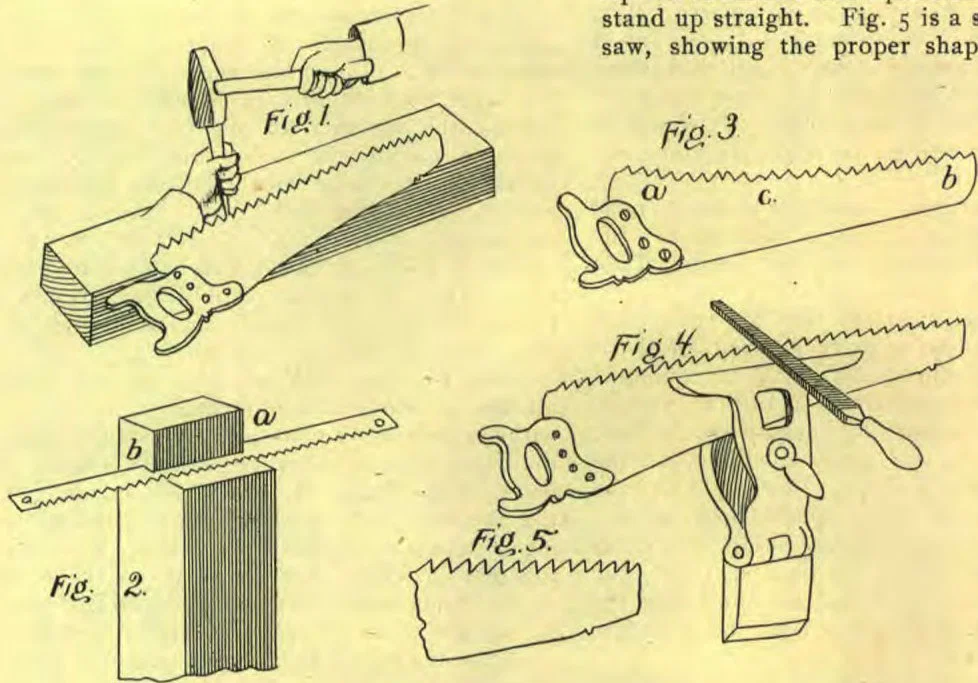
First, you must learn how to set a saw. There are many kinds of saw-sets manufactured; and some carpenters think that in order to set a saw, they must have one; but for my own use I would not give twenty-five cents for all I have ever seen. Take, as shown in Fig. 1, a piece of maple or apple-tree scantling about two and one-half feet long, and four by five inches square, plane it smooth on one side, and lay on your saw. Then take a hard nail-set, put one corner on a tooth, and with a light hammer strike a blow on every other tooth. Then turn the saw over, and go through the same process again. With a little practise, you will be able to strike blows of a uniform weight.
Fig. 3 shows a saw that was brought to me last week to be put in order. I wore out two files on it. You will notice that this saw is very concave, and therefore not straight on the teeth; also that the teeth are not of a size, or of the same shape. At a and b I filed the teeth off twice, and then filed them in again, to make the saw straight. Where this has to be done, it is better not to set the saw until after it is filed.
To run easy, a saw should be about one fourth of an inch crowning, or convex, on the cutting edge, as shown in Fig. 4. Were you sawing off a board with a saw shaped like Fig. 3, when the saw had cut to c, it would strike solid, with a “chug.” A saw gets in this condition by being filed only when dull; for instance, if you strike a nail or other hard substance, and sharpen only the dulled teeth, and follow up this practise, your saw will soon be all out of order. When such an accident happens to your saw, take a flat mill-saw file, and joint off all the teeth by lightly running the file lengthwise over them, always keeping the cutting edge rounding, as shown in Fig. 4.
Fig. 2 represents a piece of lumber in which is inserted a whip-saw. Cut out a notch, as seen at a. At b saw in a little way; and into this slit put the back of the saw. The saw being narrow, it is thus held while you set the teeth. Shove it along as you set it.
In Fig. 4 you will see a saw-clamp. Screw this into your bench vise, and place your saw in the clamp. If the teeth are uneven, run your flat file over them lightly until they are even; then, beginning at the small end, file against the front edge of the tooth. Hold the file nearly level. File off the back edge of the tooth near where you jointed it. In this way go the whole length of the saw, taking every other tooth. Then turn your saw around, and file the other side, always being careful to hold your file at the same angle with the saw, and to have the same bevel for the pitch of the teeth.
The teeth of a crosscut-saw, or cutoff-saw, should be filed “flemming;” but the teeth of a rip-saw should be filed square across, and should stand up straight. Fig. 5 is a section of a rip-saw, showing the proper shape of the teeth.
The least set you can have in a slitting-saw, the more easily it will work.
After filing your cutoff-saw, lay it down on a board or bench, and rub the sides of the teeth lightly with a whetstone. This takes off the burr that the file makes.
In filing do not bear down on your file when drawing back, but bring it back lightly. The file cuts when you shove it from you.
W. K. LOUGHBOROUGH.

A CURIOUS TREE.

The whistling-tree is found in the West India Islands, in Nubia, and in the Sudan. It has a peculiarly shaped leaf, and pods with a split, or open, edge. The wind passing through these sends out the sound which gives the tree its peculiar name. In Barbados there is a valley filled with these trees; and when the trade-winds blow across the island, a constant moaning, deep-toned whistle is heard from it, which, in the still hours of the night, has a weird, unpleasant effect. A species of acacia, which grows abundantly in the Sudan, is also called the whistling-tree by the natives. Its shoots are frequently, by the agency of the larvae of insects, distorted in shape, and swollen into globular bladders, from one to two inches in diameter. After the insect has emerged from a circular hole in the side of the swelling, the opening, played upon by the wind, becomes a musical instrument, resembling in sound a sweet-toned flute.—Tid-Bits.

Luck Versus Labor: Turning Something Up

“Luck is waiting for something to turn up; Labor, with keen eyes and strong will, turns something up. Luck lies in bed, and wishes the postman would bring him news of a legacy; Labor turns out at six in the morning, and with busy pen or ringing hammer lays the foundation for a competence. Luck slips down to indigence, while Labor strides upward to independence.”

Every Child Has a Place in God's Work

“Oh, I’m only a little child; I can’t do anything in the Lord’s work”—did any of you ever have such a thought? Do not cherish it for a moment. There is a place for every one, even the smallest, in his great harvest-field, just as there will be, by and by, a place in the beautiful new earth for all who love him, and follow in his steps.

Glass Cloth and Its Practical Uses

“Glass cloth seems a difficult thing to make, yet it was brought into practical use as long as half a century ago. Being spun into threads of exceeding fineness, glass can be woven like cotton or silk. One of the most common uses for glass cloth to-day is in the making of filters for laboratories. There is one advantage, at least, that we should enjoy if glass garments ever came into use, and that is that the great grease-spot evil would be abolished forever.”

PLANT TREES.

WHAT do we plant when we plant the tree? We plant the ship which will cross the sea; We plant the masts to carry the sails; We plant the plank to withstand the gales; The keel, the keelson, and beam and knee,— We plant the ship when we plant the tree.
What do we plant when we plant the tree? We plant the houses for you and me; We plant the rafters, the shingles, the floors; We plant the studding, the laths, the doors, The beams and siding, all parts that be,— We plant the house when we plant the tree. — Selected.

Like Warp and Woof: A Poem on Destiny

“LIKE warp and woof all destinies Are woven fast, Linked in sympathy, like the keys Of an organ vast. Pluck one thread, and the web ye mar; Break but one Of a thousand keys, and the paining jar Through all will run.”
Continue reading: WEAVING