The American Sentinel, Vol. 9, No. 17.

Church and State Union as a Papal Danger
Earlier text: Toleration Versus Rights

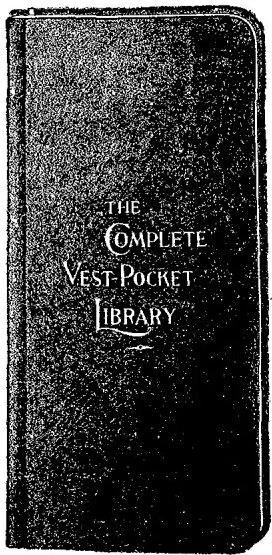
THE COMPLETE VEST-POCKET LIBRARY

STANDS PRE-EMINENT,

In that while it is no larger than the average of such books, and of convenient size to carry in the vest-pocket, it gives, besides other useful information, THE CORRECT SPELLING AND PRONUNCIATION OF 45,863 WORDS, OR ABOUT TWICE AS MANY AS ANY SIMILAR WORK.
As its name indicates, it is much more than a dictionary. It contains:—
1. THE COLUMBIAN WORD BUILDER, a very simple and yet exceedingly useful device which more than doubles the capacity of the dictionary.
2. GUIDE TO PRONUNCIATION.
3. A VERY FULL LIST OF ABBREVIATIONS.
4. THE COLUMBIAN PRONOUNCING DICTIONARY AND SPELLER (135 pages).
5. THE COLUMBIAN PRONOUNCING AND STATISTICAL GAZETTEER OF THE WORLD.
6. THE COLUMBIAN DIGEST OF PARLIAMENTARY PRACTICE.
7. THE COLUMBIAN RAPID CALCULATOR, AND COMPEND OF BUSINESS AND SOCIAL FORMS.
8. THE COLUMBIAN PERPETUAL MEMORANDUM, STAMP BOOK AND THREE YEARS' Calendar.
9. TABLES OF WEIGHTS AND MEASURES.
The whole forms a book only 5⅝ by 2¾ inches and only three-eighths of an inch thick.
In Leather, 50c; Cloth, 25c.
Address Pacific Press, 43 Bond Street, New York City.

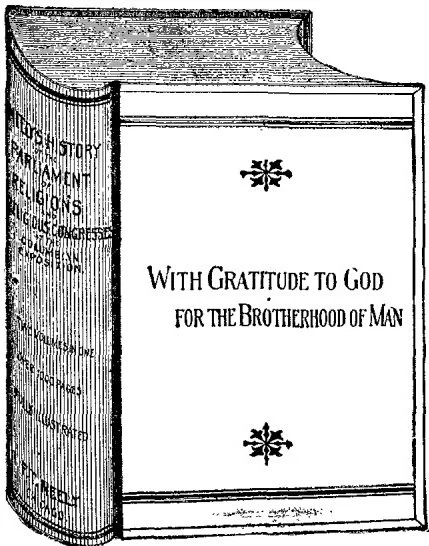
THE PARLIAMENT OF RELIGIONS.

This work is complete in one large octavo volume, and is a careful compilation of all of the proceedings—at once a fascinating story and a book of universal value. The book gives the origin of the Parliament of Religions; proceedings of every meeting of the Parliament; speeches delivered and papers read at every session of the noted gathering; the beliefs of the various religious denominations; opinions of eminent divines in regard to the Parliament; influence of the Parliament upon the religious thought of the world. Published by F. T. Neely, Chicago.
1000 pages. Price: Cloth, $2.50.
We have made arrangements with the publisher so that we can offer this book to our subscribers, together

WITH THE AMERICAN SENTINEL FOR $2.75,

only 25 cents more than the price of the book alone. This offer applies to either new subscriptions or to renewals. We will supply this book alone at the regular price, $2.50.
This book is not offered because we approve the Parliament of Religions, but because it is a history of one of the most remarkable and significant religious gatherings ever held.
Address, AMERICAN SENTINEL, 43 Bond Street, New York City.

Postal Regulation.

UNDER the head, “General Rules for Postmasters in the Conduct of Their Offices,—Days and Hours of Business,” speaking of when the mail arrives on Sunday, the Postal Department directs:—
If it be received during the time of public worship, the opening of the office should be delayed until services have closed. . . . Sunday-school services are not to be regarded as “public worship,” within the contemplation of the regulations.
So we see that the United States Government, in this respect, takes it upon itself to determine what is public worship and what is not. S. H. CARNAHAN.

Christianity and Patriotism.

THE man who is a Christian will be a good citizen and the best of patriots. That is, he will have a love for his country which will lead him to do nothing to her injury, but all for her good. He will give his life, if need be, to save the souls of those who dwell therein. But, as a Christian, he cannot give his allegiance to principles of injustice, intolerance, or iniquity in any form. And if the government under which he is a citizen becomes a party to intolerance, his higher allegiance to Christ will demand that he shall protest against it. Love of country and people will demand it. And yet this very stand for righteousness and truth is ever in great crises misunderstood, and the hero is condemned. Jesus Christ loved Judea and Jerusalem, as none other ever did, but he was condemned as her enemy. Elijah was the truest patriot in Israel, but he was called a troubler. Roger Williams breathed the pure principles of the liberty of the gospel, and would have made a most earnest patriot had he been permitted a home in Massachusetts, but he was driven hence by that people, who considered themselves to be the only patriots and only Christians, but who knew neither patriotism nor Christianity as taught in the religion of Christ.
Do not be deceived. The patriotism of the world is not Christianity, nor will it save a soul. Christianity is not the patriotism of the world; it is much more. It places Christ first, and all things earthly secondary and subsidiary; but it will labor more earnestly, and make greater sacrifices for mankind, yea, even its own enemies, than the most ardent patriotism ever knew. It is not patriotism, Protestantism, Christianity, nor is it Protestantism, patriotism, Christianity, but it is Christianity, Protestantism, patriotism; and both of the latter, in the truest sense, are found in the former.—Signs of the Times.

A NEW DEPARTURE.

Through Palace Cars to the Pacific Coast.

The West Shore Railroad in connection with the Nickel Plate and Rock Island routes have established a through Tourist Car Line, making weekly trips to California at extraordinary low rates.
These excursions are under the personal supervision of Mr. A. Phillips, who has had several years' experience in the tourist business, and he or his representative accompanies each excursion en route.
For detailed information apply to any ticket agent of the West Shore Railroad.

Religious Liberty News Items from Several States

The Farmer’s Voice, of Chicago, is asking in behalf of the clerks in that city, that the city council of Chicago enforce the Sunday closing laws against the stores and other places of business.
The case of Edgar Price, of Millington, Md., Seventh-day Adventist, under arrest for Sunday labor, has been tried at Chestertown. No information as to the result of the trial has reached the SENTINEL before the hour of going to press.
A large number of Evangelical Lutheran churches throughout the country have petitioned Congress in opposition to the proposed “Christian amendment to the Constitution of the United States,” which the House judiciary committee has tabled.
C. E. Moore, the editor of the Blue Grass Blade, of Lexington, Ky., has been indicted for blasphemy. Mr. Moore’s offending seems to have been in stating the Unitarian views of the human origin of Christ in such positive terms as to have aroused the religious feeling of Congressman Breckinridge’s town, which is at this time, no doubt, particularly tender. This is said to be the first case brought under the ancient statute which Kentucky inherits, through the Carolina laws, from Church and State, England.
Senator Kyle has introduced in the Senate a national bill for Sunday rest, and the measure has been referred again to Ex-Senator Blair’s old committee,—the Committee on Education and Labor. This bill appears to be identical with that introduced by Mr. Blair in the Fiftieth Congress, with the exception of the title, which is simplified to read merely, “A Bill For Sunday Rest.” A thorough discussion of this bill, in all its different phases and applications, can be found in No. 27 of the Sentinel Library—“The National Sunday Law,” also in the files of the SENTINEL.
In the Iowa legislature not long ago a resolution was offered prohibiting the sale of intoxicating liquors on the “Sabbath.” Immediately a member offered as an amendment that the word “Sunday” be inserted instead of the “Sabbath,” saying that Sunday was not the Sabbath, but Saturday, the seventh day, was the Sabbath, and consequently if the original resolution should prevail it would, if subjected to accurate interpretation, fail of its intended purpose, and involve a troublesome controversy. The amendment was adopted, and thus the members of the legislature of Iowa showed their knowledge and recognition of the fact that the seventh day of the week is the Sabbath and the first day is not.
The New England Methodist Conference, in session on April 16, after a warm discussion adopted resolutions “viewing with alarm the oft-repeated attempts of the Roman Catholic priesthood to make our public schools sectarian,” declaring also that “the members of the New England Conference will by voice, pen, and ballot, in private and public, in press, pulpit, and on the platform, utter no uncertain sound on the subject of these aggressions.” Having adopted these resolutions the conference proceeded with all seriousness and gravity to adopt another set condemning Sunday newspapers, etc.—What a genius for blowing both hot and cold in the same breath, those who imagine themselves Protestants have developed in these last days.
A missionary of the American Board, writing on the progress of the gospel in Spain, says:—
During the year the editor of a Protestant periodical in Malaga, replying in moderate terms to a violent attack in the public press by a priest, on evangelicals and evangelical doctrine, was summoned by the State’s attorney to answer to the charge of holding up to contempt the religion of the State. He asked for the editor a fine of fifty dollars and costs, and imprisonment for “two years, four months and one day.” Bail was set at $600. The case was ably and eloquently defended by one of the most prominent lawyers of the district. The judge charged the jury with evident sympathy for the accused, and in a few minutes the jury brought in a verdict of acquittal. The agitation of the case did the cause of the gospel unquestionable good.
If it is God’s truth that is at stake it is always certain that nothing can ever be done against it, but for it; and that, invariably, the wrath of man will be made to praise Him. The prosecution of the Seventh-day Adventist publishing house in Basle, Switzerland, is a case in point; that also will do “the cause of the gospel unquestionable good.” All who know the circumstances will look to see the Lord work in this.
The District of Columbia Sunday bill, which the House Committee on the District referred to the District Commissioners, has been by them sent to the attorney for the District, and he has reported upon it at some length. The attorney reviews the origin of Sunday laws and says that the Sunday legislation of this country, in most of the States, has followed generally the model of the English act of 29 Chas. II. The opinion appended to the historical effort of the attorney is as follows:—
Sunday laws are not based on the idea that it is immoral or irreligious to labor on the Sabbath day, but on grounds of public charity, in order to protect all persons from the physical and moral debasement which comes from uninterrupted labor. Such laws are merciful and beneficial, especially to the poor and dependent, to laborers and mechanics in factories, workshops and the heated rooms and close quarters of great cities. The keeping one day in seven as a time of relaxation and reflection, as well as for public worship, is deemed to be of admirable service to the State. It enables the industrious workman to pursue his occupation in the ensuing week with renewed vigor and cheerfulness. From the examination I have been able to give the subject, I do not conceive the necessity for the enactment of the bill in question. All laws should be founded on necessity. If, however, the commissioners on mature reflection should be of opinion that this District stands in need of further moral legislation, the present bill appears to be in good form and they might favorably recommend it to Congress for enactment.
From this it does not positively appear that the attorney for the District is earnestly desirous that the commissioners should recommend to the committee that they ask Congress to pass this unconstitutional measure, neither does he openly oppose the bill on its demerits. Why does he not?
The May Arena closes the ninth volume of this leader among the progressive and reformative reviews of the English-speaking world. The table of contents is very strong and inviting to those interested in live questions and advanced thought. Among the important social and economic problems discussed and ably handled in a brave and fundamental manner, characteristic of this review, are, “The First Steps in the Land Question,” by Louis F. Post, the eminent single-tax leader; “The Philosophy of Mutualism,” by Professor Frank Parsons of the Boston University Law School; “Emergency Measures for Maintaining Self-respected Manhood,” by the editor of the Arena. The saloon evil is also discussed in a symposium. One of the strongest papers on heredity that has appeared in recent years is found in this issue from the pen of Helen H. Gardener. Rev. M. J. Savage appears in a very thoughtful paper on “The Religion of Lowell’s Poems;” a fine portrait of Lowell appears as a frontispiece. Dr. James R. Cocke contributes a striking paper on “The Power of the Mind in the Cure of Diseases.” A strong feature of this number is a brief character sketch by Stephen Crane, entitled, “An Ominous Baby.” Stinson Jarvis’ series of brilliant papers on “The Ascent of Life” closes with this issue.
The Arena has made steady progress; its circulation having increased during the panic, and it has necessarily been enlarged to one hundred and forty-four pages. There is, also, in addition to this, the book reviews, which covers over twenty pages, making in all a magazine of over one hundred and sixty pages. The steady increase in circulation of this $5 magazine during a period of unprecedented financial depression shows how deep rooted and far reaching is the unrest and social discontent; for this review has steadfastly given audience to the views of the social reformers of the various schools of thought.

You have reached the end of this edition.

The American Sentinel · Apr 26, 1894