The Youth’s Instructor, Vol. 38, No. 51.

A CHRISTMAS HYMN

The Youth’s Instructor

Dec 17, 1890

S. D. A. Publishing Association · Battle Creek, Mich. · Dec 17, 1890

A CHRISTMAS HYMN.

WHAT shall I give to thee, O Lord? The seers that came of old Laid softly on thy cradle rude Their myrrh, and gems, and gold.
The martyrs gave their hearts' warm blood; Their ashes strewed thy way; They spurned their lives as dreams and dust, To speed thy coming day.
We offer thee nor life nor death, Our gifts to man we give; Great Lord, upon thy day of birth, Oh, what dost thou receive?
Thou knowest of sweet, precious things, My store is scant and small; Yet wert thou here in want and woe, Lord, I would give thee all!
Show me thyself in flesh once more; Thy feast I long to spread: To bring the water for thy feet, The ointment for thy head.
There came a voice from heavenly heights, “Unclose thine eyes and see, Gifts to the least of those I love Thou givest unto Me.”
—Rose Terry Cooke.

CONFESSING A FRIEND.

“Oh, yes; of course! I’m not a heathen. I expect to live a Christian life and to do right, but then, I don’t see any use in making all this public show about it. It is so much like saying, ‘Behold, was ever righteousness like unto my righteousness?’ I don’t like any of those I-am-holier-than-thou professions.”
That was what Florence George said, with a toss of her pretty head, when her Sabbath-school teacher referred to the recent baptism of one of the scholars in her class, and expressed the wish that Florence might also become a Christian.
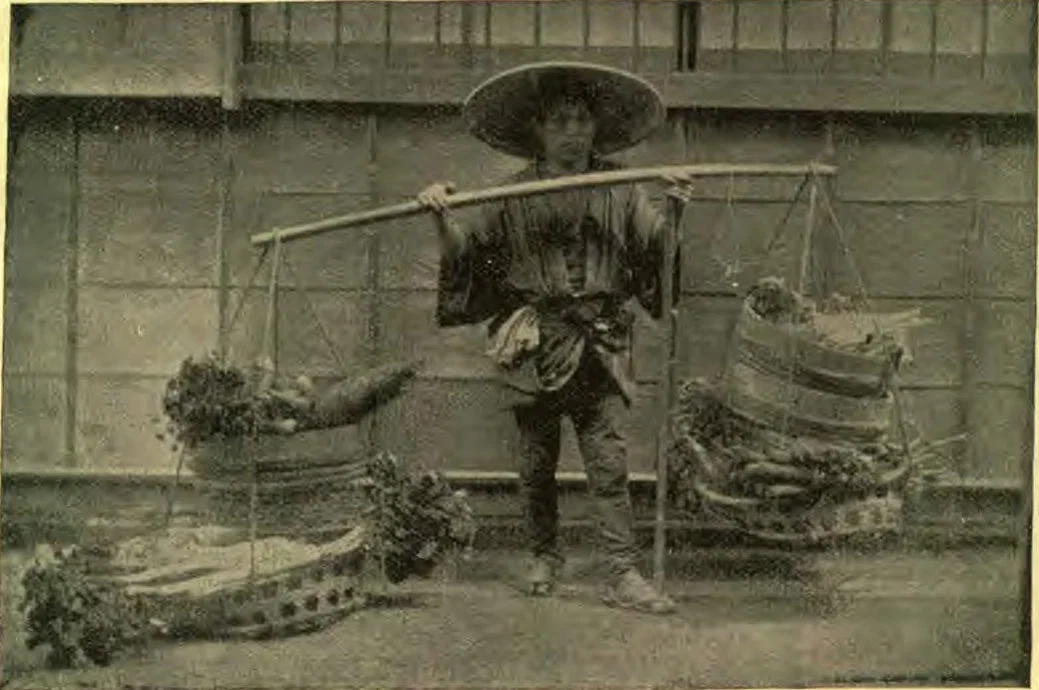
A JAPANESE STREET VENDER.
The teacher looked deeply grieved, but she answered, very quietly, “I don’t like such professions as that, either.”
Florence had not expected so ready an assent to what she knew to be false reasoning (though she felt the difference implied in Miss White’s accent), and felt called upon to justify her weak position.
“Well, Miss White, it does seem just like that,” she said, with flushing face; “and I can be just as good a Christian outside the church as in it.”
“Were you with the girls when they passed Dr. Hall on Broad Street, yesterday? I heard several of them talking of it to-day,” was the unexpected question by which Florence thought her teacher changed the subject to those which she considered more congenial if not more urgent.
“Yes, ma’am, I was.” And there came a swift look of defiance into the young face. “And he didn’t recognize one of us. He was with a lady who would have answered for a walking fashion-plate, and I suppose didn’t care to have her see him speaking to us, who dressed so much more plainly. But we’ll all of us be even with him yet. He isn’t so much better than we are, if he does happen to have a title to his name, and I declare, if the next time he speaks to me, I don’t stare at him, and pretend I never saw him before. We’re all going to do it, and it will serve him exactly right. Don’t you really think so, Miss White?”
“I would probably agree with you if I did not know that Dr. Hall is near-sighted, and really did not see one of you; he would not have been guilty of an actual slight from any such motive, to any lady friend; and, dear, your vindictiveness will hurt yourself much more than any one else, but your strong emotion on the subject will help you to understand a verse I would like to read here,” replied Miss White, as she opened the Bible, and turned its pages rapidly. When she had found the place, Florence read, with burning cheeks:—
“Whosoever shall confess Me before men, him will I confess before my Father which is in heaven. But whosoever shall deny Me before men, him will I deny before my Father which is in heaven.”
“It is not that Christ has any of that vindictive spirit which has made you so unhappy, but he cannot confess as his children those who have never confessed themselves to be his children. Think how it would be if one whom you loved very much indeed—loved so much that you were willing to sacrifice the dearest thing in life for him—were to pass you, knowingly, on the street, and refuse to claim your friendship. Wouldn’t it hurt you—grieve you to the very heart?” she asked, very seriously.
“O Miss White! Do you suppose Christ really cares anything about it?” asked Florence.
“I don’t suppose anything about it; I know. Unless we can be a true friend of another, and still refuse to acknowledge his friendship before others, we cannot be as good a Christian without confessing Christ as by doing so.”
Florence looked troubled. “Indeed, Miss White, I always intended to do right, and, in a way, I thought I was a Christian; but now I see that I was all wrong. I will think it all over again.”
“And I will pray for you, dear, while you are thinking,” her teacher added.
Three weeks from that day, Florence followed her Lord’s command of baptism, and on the day of this dedication and public confession, she said: “This is one command; I will follow all the others as well.”
—Young Reaper.

ROUND THE WORLD.—40.

THINGS JAPANESE.

Still, it is “Things Japanese,” and if our readers are not weary, we will tell about salutations. They are novel, like everything else in Japan. Here we meet with the bow par excellence. Not the airy oscillation of the ultra-polite Frenchman, not the sweeping, graceful reverence of the Elizabethan period, but a unique conception of a bow. The Japs never shake hands, consequently this clue by which in the West we gain access to our neighbor’s character is foreclosed. But they bow to the ground, sometimes two or three times, and it is not an unfrequent occurrence to see the host, when coming to admit a guest to his mansion, advancing on all fours. When two women meet each other on the street, they salute something like this: When they are about ten yards apart, they stop and bow, each toward the other, keeping this up at every step. At length they meet, and their heads are almost touching, and descending and ascending with extraordinary unanimity. The two curves described seem perfectly symmetrical and simultaneous. The rule seems to be to bow for every complimentary remark. Then down go their heads, and there is a pause, neither being so impolite as to resume position first. Then come one or two sidelong glances to see if each is ready, the heads curve back together, and the ceremony is over.
A common sight in a Japanese street is the traveling restaurant. It is a curious concern, and rather difficult to describe. First of all there are two things like bureaus. These stand about five feet high, and are perhaps two feet square. The lower part of both of them contains many drawers and little shelves, in which are stored tea, flour, candies, and Japanese delicacies for which we know no name. About half way up one of them is a flat shelf, with a sunken hole in the middle about one foot square. In this are a few charcoal ashes. Here the owner stands, and with a little griddle makes waffle cakes for his customers, for the modest sum of a cent apiece. Crowds of hungry men and women gather round him, and have their appetites appeased in this manner. He serves tea without milk or sugar for a cash per cup. A cash is about a thousandth part of a dollar. The two bureaus, as we have designated them, are slung on a bamboo pole, and the owner walks along between them, carrying his all on his shoulder. These vendors are adorned with little bells, so as to let people know when they are coming.
Earthquakes are common in Japan. We were told that there were several one week during our stay at Yokohama, but I cannot say that my nerves were sensitive enough to feel any of them. There are frequently violent shocks, and great damage has been done from time to time. But latterly there has been nothing of a serious nature. Another dreaded agent of death, as feared by the Japanese, is fire. These are of frequent occurrence. They have fire-brigades and fire-engines; but as they are drawn by coolies, it takes much time to get them to the scene of action, and the houses, thin as match-boxes, burn like touch-wood. But despite the modern instruments used to extinguish the flames, the Japs still cling tenaciously to the belief in a “fire god.” They have a small image which is supposed to have control of the flames, and as soon as a fire breaks out, they rush to the top of the house with it, and stand holding it aloft on the shingles. But still the flames will come, and when the one holding the deity finds things too warm for him, he drops the god, leaves him to his fate, and runs to save, if possible, his own skin.
Three sounds in a Japanese city break the stillness of the night—the amma, or blind doctor, the thief-watch, and the fire-watch.
Blindness seems to be a calamity inflicted by the good Creator on many in Japan. The members of the first-named class are very numerous. They are usually doctors practicing the Chinese system. They are known as “shampoo doctors.” They carry, men and women alike, a piece of bamboo made into a rude, shrill whistle, which they blow at intervals of a few minutes, so as to warn the vehicles to move out of their way, and not run over them. They give a rude kind of massage to those desiring it, for which they receive remuneration to the amount of half a sen (cent). And this is considered good pay.
The thief-watch is supposed to be some protection against house-breakers, but we would lay him down as of great assistance to them. He parades the streets and alleys during the night, and carries in his hands two pieces of wood, which are hollowed in the middle. These he raps together, and being hollow, they make a loud noise, so that the thieves, hearing it, can make good their escape.
The fire-watch is on the lookout for flames. He carries a lantern, and a stick on which are fastened several pieces of iron, which clash at every step he takes.
P. T. M.

Whatsoever a Man Soweth, That Shall He Also Reap

WHATSOEVER a man soweth, that shall he also reap.

THE STORY OF A CARPET.

[The following story, published in tract form by the American Board of Commissioners for Foreign Missions, contains suggestions well worth consideration at this season of gift-giving. When we think of the millions on whom light from the Holy Word has not yet shone, and upon whom it will never shine unless we send it to them, how necessary it seems that each one should do what he can to send the gospel rays into the darkness. Almost nineteen hundred years ago, a Friend came to give us an unspeakably precious gift, even eternal life. He taught right-doing, he relieved suffering, he shed blessings wherever he went; and he left word, when he went away, that those who loved him should follow his example, and do works like his. How small any gifts we may make look beside sacrifice like this! Yet we call it liberality when out of our abundance we give that which we can spare as well as not. At this season of gift-giving we love to show our friends, in some tangible way, our appreciation of them. In what way shall we show our Best Friend our love for him? Is there not some self-denial we can make? Can we not sacrifice our desire to give fine gifts to our friends, in order that those who toil in hardship and loneliness in foreign fields may have means to carry on the work? Let us think about it; let us pray over it; and let us give in accordance with the blessings Heaven gives us daily.—Ed.]
I used to read to my children from that most delightful of children's books, Hans Andersen, the story of the Magic Carpet, which would carry its owner anywhere in the world. I want to tell you now of a carpet just as wonderful. An old, old carpet, which has been transformed by some magic into one bright and beautiful. This is how it came about:—
I am a housewife, and enjoy having things as pretty and fresh and suitable as most housewives do. On the stairs, first floor stairs, too, was a carpet, once good as well as beautiful, but now shabby, worn, yes, I have to confess it, fearfully old.
For a year or more it had been an annoyance and mortification, but the time never seemed to come when something else was more necessary, and it was made to “do.” At last it was pronounced as past that period. It could not be made to “do” any longer, and money was appropriated for a new one.
Just then the appeals for foreign mission work came home with more and more force, and there was a mental struggle. “The carpet was a necessity.” “It was no longer respectable,” etc., etc.
Well! the Board got the money, and I really thought I had made a sacrifice.
Not so! the fairies have been at work, and my carpet is embroidered all over with beauty. As I go up, step by step, it speaks to me. Here is a worn spot where the pattern is almost invisible, but it says, “Precious truths have been woven into the heart of some girl in Japan which will make her life a perfect pattern to be followed by the women of that nation, so earnestly, so enthusiastically striving for a higher life, and your little self-denial has done this.”
Here are other bare places, which look as though a troop of rosy, rollicking children had been rushing up and down, with feet none too daintily shod for out-door play. These say, “Think of your children now, just entering on Christian manhood and womanhood, and then of the little ones of China, unwelcome at birth, with feet tortured and bound in youth, and of the aimless, ignorant, hopeless lives of maturer years. The day is coming, and perhaps a little more speedily through your sacrifice when ‘these from the land of Sinim’ shall be the free and merry children of a Christian land.”
I step on—here are long, bare places, worn by the ceaseless tread on the edge of the steps, and another voice, a grateful voice, reminds me of “the little child widows of India, ceaselessly trodden under the iron foot of custom, until all the bloom and beauty and freshness of young lives is crushed and worn into one long, weary, dull round of suffering, and perhaps, by your small sacrifice, relief is one step nearer the poor little child-widows of India.”
And so my old, worn carpet has become bright with beautiful lessons. Fair flowers of Christian hope and life and light blossom all over it, and the unintelligible language of these Eastern sisters is translated to me by my own heart’s need.
When traveling in those Eastern lands by caravan, years ago, we would arise in the early morning, long before dawn, to prepare for our day’s journey. We would be aroused by the jangle of the bells as the mules and horses were being made ready for their loads. Of all kinds and sizes and sounds, from the large iron bell, with deep, discordant tone, to the silvery chain hung on the neck of the leading horse of the caravan. Jingle! jangle! jingle! jangle! each of different note or key; each discordant with the other, but all, when united, producing most delightful harmony, which I often recall to this day with exquisite pleasure.
So with the voices which speak as I ascend my stair: the deep guttural of Chinese women, the softer tones of fair Japan, and the musical flowing ripple of India’s dusky daughters as they sing:—
“Ni ehara na mute, nam mitte, nam mitte, Ni pada mule, battiti battiti.”
“Thy refuge would I seek, Blessed Jesus, blessed Jesus. Thy mercy-giving feet would I clasp, Blessed Jesus.”
These all unite in a sweet strain as I pass upward. Mingling with them I hear a silvery voice, which, like a theme in music, now louder, now soft and low, but ever sustained, ever recurring, until, as I reach the last step, it sings: “Inasmuch as ye have done it unto the least of these, ye have done it unto Me.”
This is the magic which has wrought this transformation. This has filled the poor, worn covering with music and beauty.
“Ye have done it unto Me, Ye have done it—unto Me.”
—Mrs. Henry N. Cobb.

THE LAST WILL OF OUR LORD.

The New Testament is the last will of our Lord Jesus Christ. He has died to make it valid, so that now it is in force, and he is now fulfilling its bequest.
How sad it is that many of those who are by bequest heirs of this glorious inheritance, live and die unconscious of it!
Let us look into “THE WILL” of Jesus, and see what are the legacies, and who are the legatees.
1. I will that all the debts of those who trust in me be transferred to my account. To this end I establish a bank of redemption, where all who will present their accounts, even though they are over ten thousand talents, shall be freely discharged on my account.
2. For present support I give to all the weary and heavy laden, rest.
To the thirsty I give the water of life; and the water that I give shall be in them a well of water, and he that drinketh it shall never thirst.
To those who have left houses or lands or kindred for my sake, I give in this life a hundred-fold, and in the world to come, life everlasting.
3. For final inheritance, I will that all who have been given me, be with me where I am, that they may behold my glory. I go to prepare a place for them.
To my sheep that hear my voice and follow me, I give eternal life, and no man shall pluck them out of my hand.
To him that overcometh will I give to eat of the tree of life, to sit with me on my throne; even as I overcame, and am set down with my Father in his throne.
He shall be clothed in white raiment, and I will not blot out his name out of the book of life.
To him that is faithful unto death I give a crown of life.
To them that endure with me my temptations I appoint a kingdom; and they shall be kings and priests unto God.
Now are you remembered in this will? Have you laid your sins on Jesus as your Mediator? Do you trust him, follow him, wear his yoke, overcome, bear reproach for him? Then shall those blessed legacies be yours.
Spread the information! Poor, benighted sinner, come and inherit all things. “Whosoever will, let him take of the water of life freely.”—Good Words.

MY HOUNDS ARE ALL PUPS!

Can children understand deep truths? The following true incident may answer the query.
Fred and Rom, two hearty, mischievous boys of ten and eight years, had seated themselves by mother's knee for “their hour” before retiring.
To-night it was spent in listening to a story of some wolves—their character, tricks, habits, and homes; the moral suggested the wolves of sin,—as profanity, quarreling, disobedience, selfishness, Sabbath-breaking,—till quite a pack was set in array.
No remedy for these wolves was intimated, so with quick insight the mother asked, “Boys, what do they hunt wolves with?”
“Hounds,—they’ll catch ’em!” shouted Fred.
“Yes, and what hounds shall we have to hunt these wolves of disobedience, selfishness, and the like?”
Fred thought a moment, then said soberly, “The hound of prayer would be a good one.” “And the hound of faith is another,” added Rom. “Yes, and watchfulness and forgiveness are two more capital ones,” said Fred.
Each lad added others, till there was a fine pack ready for the chase; and the boys hunted each other off to bed as hound and wolf.
Next morning, nothing was to Fred’s liking; his clothes, his hair, his breakfast, everything seemed askew.
“What about the hounds this morning?” said the father, who had quietly overheard the animated discussion of the previous evening.
“Yes,” chimed in Rom, “Trot ’em out!”
“Bring them on, Fred,” added the father.
But Fred sat glum and stiff.
At length, not a smile suggesting itself on his usually radiant face, he said, “My hounds are all pups! They aren’t good for anything,” and, bursting into tears, rushed to his room, overcome with the truth that his good resolutions were only “pups,”—good in promise, but of themselves useless when most needed.

DON'T

A TRUE Christian never snubs anybody; yet the habit of slighting, snubbing, or looking down upon less fortunate acquaintances is common enough to make the following advice very timely:—
Don't snub a boy because he wears shabby clothes. When Edison, the inventor of the telephone, first entered Boston, he wore a pair of yellow linen breeches in the depth of winter.
Don't snub a boy because his home is plain and unpretending. Abraham Lincoln's early home was a log cabin.
Don't snub a boy because of the ignorance of his parents. Shakespeare, the world's poet, was the son of a man who was unable to write his own name.
Don't snub a boy because he chooses a humble trade. The author of "Pilgrim's Progress" was a tinker.
“Don't snub a boy because of physical disability. Milton was blind.
Don't snub a boy because of dullness in his lessons. Hogarth, the celebrated painter and engraver, was a stupid boy at his books.
Don't snub a boy because he stutters. Demosthenes, the great orator of Greece, overcame a harsh and stammering voice.
Don't snub any one—not alone because some day they may outstrip you in the race of life, but because it is neither kind, nor right, nor Christian.—Selected.

The Fountain by the Sea: An Emblem of Life

THERE is a fountain within high-water mark on the sea-shore. The tide spreads over it. The sweet water is spoiled by the salt wave. But the tide goes down, and the fountain washes itself free from defilement. As that troubled sea goes down once more, the fountain gushes still pure and sweet. This is the emblem of a life in daily conflict with adverse circumstances. Overrun, and yet bubbling up ever, pure, fresh, continuous.

KNITTING

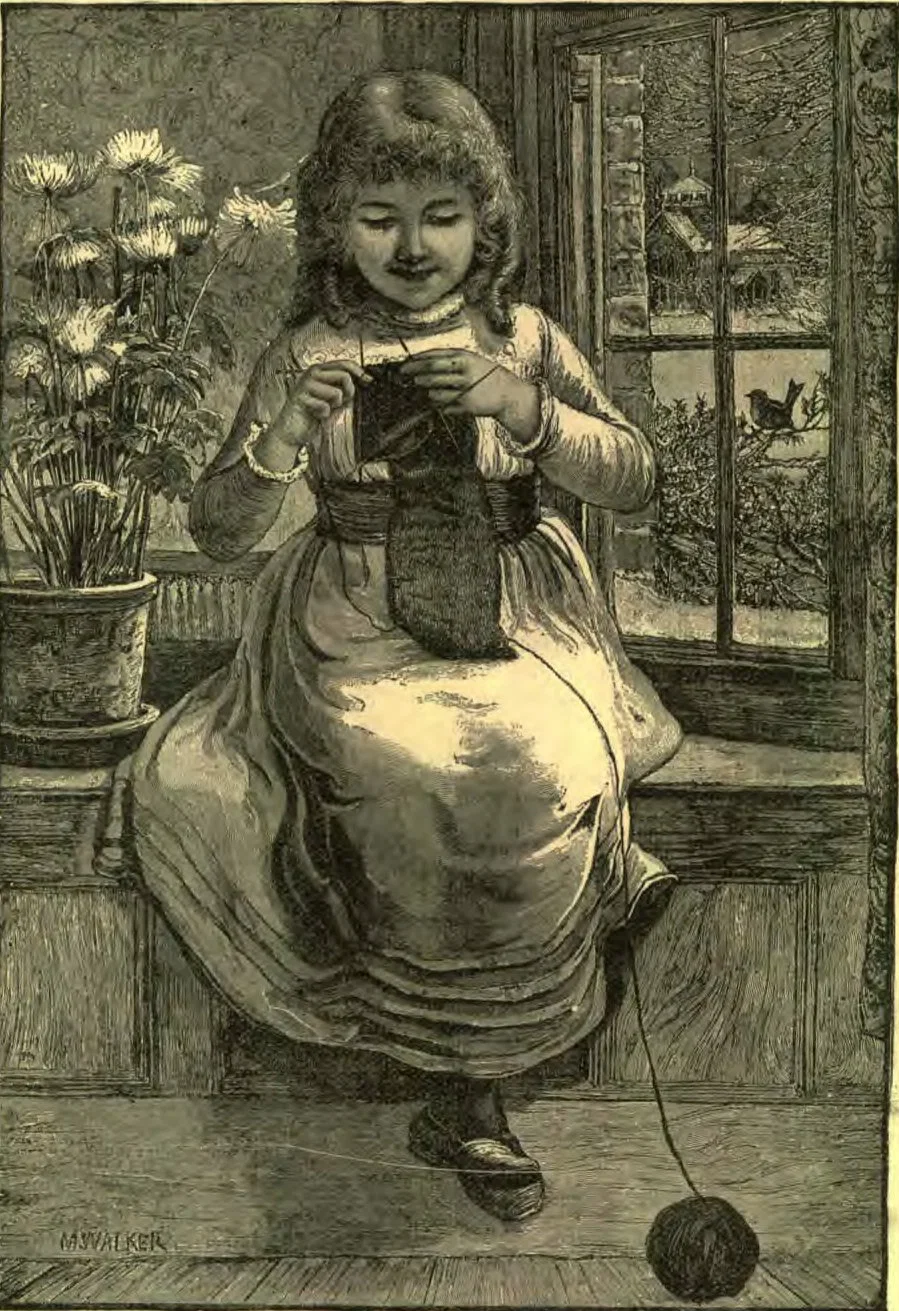
SHE had a look both sweet and wise, A smile was hiding in her eyes, As, in the window sitting, She took up grandma's knitting, And clicked the needles to and fro, Just as she'd seen dear grandma do.
A bird was singing in the snow, That she'd no care to listen to, As, in the window sitting, She gravely kept on knitting, And made her little fingers go, Just as she'd seen dear grandma's do.
The flowers were blooming near her face, But she'd no time to note their grace. She did not think of quitting Her most delightful knitting, But clicked and clicked her needles bright, And knit away with all her might.
And by and by her head dropped low, Just as dear grandma's used to do, As, in her rocker sitting, She fell asleep while knitting. And grandma came to find her stocking, And said, "Dear! dear! this knitting's shocking!"
She had to take the needles out, And ravel all the top about, It made her work just double For all the darling's trouble. But grandma stooped and kissed her brow, And said, "I'll teach the dear child how."
And when Miss Lillie's sleep was done, Dear grandma took the little one, And by her rocker sitting, She taught her about knitting, And oh, it gave the child delight To set the stitches in just right.
And grandma told her something queer, And yet it's very true, my dear, That every one is knitting, Stitch dropping or stitch setting, Knitting with deeds of love or strife, Making a garment out of life.
And grandma said that doubts Would come in care or trouble, If we should try life's knitting Without first lowly sitting Close to the feet of Christ, who could Teach us the way to make it good.
FANNIE BOLTON.

BILLY

JOHN and Fred Evans were very much troubled. They had attended a missionary meeting the day before, which had deeply stirred their young hearts.
Both boys had recently given their hearts to the Saviour. In the first glow of their early love, they were eager to show their gratitude to Jesus, who had loved them and died for them that they might have eternal life. Here was their first opportunity for doing something for Jesus; but what could they do?
It was the evening of the second day after they had heard the missionary tell of the needs of the poor heathen. There was to be another meeting the next night, when the people were going to bring him their offerings, and then he was going away.
The boys had discussed and dismissed plan after plan for raising or earning money; and it was not until they had gone to bed, that John told Fred the project that caused such trouble in both little hearts.
Fred called over to John, and said,—
“I say, John, I wish we hadn’t spent all our allowance on that foot-ball. They wouldn’t take it back, either, ’cause we’ve kicked it. Oh, dear! I wish you could think of something.”
“Fred,” said John, hesitatingly, “there is something; I thought of it the first thing.”
“You did? Why didn’t you tell me?”
“’Cause it’s—it’s—Billy.” And John pulled the blanket over his head to hide the springing tears, forgetting that it was “pitch dark.”
“John Evans! Are you crazy? I’d most as soon think of selling Ethel.”
John said nothing for some time. At last he pulled down the blanket, steadied his voice, and said,—
“It would be wicked to sell our sister, if we could; but Billy is only a goat, and even if we do love him, it wouldn’t be wrong to sell him.”
“That’s it,” replied Fred. “We do love him—at least, I do—as much as if he was a—a person.”
John made no reply. At last he said,—
“Of course you’re thinking of that fifteen dollars Mr. Jones said he’d give for Billy, if we ever wanted to sell him, ’cause some gentleman in the city wanted a trained goat for his little lame boy.”
“Yes; and how long fifteen dollars would keep a little Karen chap in Mr. Dalton’s school.”
Fred turned his face to the wall, and tried to go to sleep, but he could not. He tossed and tumbled, rolled and kicked.
At last he got up, and went over to John’s bed. John was fast asleep.
“Humph! he don’t care,” muttered Fred, but he touched the pillow, and found it wet with tears.
Back he went to his own bed without waking his brother, but not to sleep. After another hour he slipped out of bed again, and knelt beside it.
The heaving shoulders and wet spot on the spread where his head rested told of the struggle he was passing through.
Once more he crept into bed, and fell asleep at once. When he wakened in the morning, John was gone. He thought he knew where to find him. Dressing quickly, he ran to the barn, and there was John, with his arm around Billy’s neck, crying.
“John!” said Fred.
“Well?”
“I—I—do love Billy; but I—I—do love Jesus. Let’s take Billy over before breakfast.”
“I knew you would do it, Freddie boy,” said John, gently.
It was not far to Mr. Jones’s, and the boys had finished their tearful explanation of the reason why they were going to sell Billy. There were tears in his eyes, too, though a smile brightened his face, and he insisted upon giving twenty dollars instead of the fifteen offered.
Two happy boys laid ten dollars apiece in Mr. Dalton’s hand that evening, and when he so beautifully invoked God’s blessing upon the boys, they felt sure they would never regret their sacrifice; and they never did.—Selected.

MAKING ROOM.

Jack and Charley sat on the kitchen door-step, in the shade of the big willow-tree, eating their morning lunch of crisp soda-crackers. Jack’s pet bantams, forgetting for the time their important little strut, scrambled so eagerly after the crumbs that every now and then the boys’ bare toes got a vigorous peck from their greedy little bills.
Little four-year-old Matty, hearing the boys laugh, wanted her share of the fun. She ran to the door, cracker in hand, and said, eagerly,—
“Let me sit there too!”
But Charley’s blue flannel knees were so wide apart that one of them touched Jack’s gray jeans, and the other lay against the door casing.
Against the opposite casing leaned Jack’s head and shoulder. So it happened that Charley said hastily,—
“There isn’t any room.”
And in the same breath Jack said crossly,—
“Oh, go ’way, Matty, and find some other place. It’s too crowded with you.”
Matty put her little blue gingham sleeve up to her eyes, and left a trail of cracker crumbs across the kitchen floor, as she ran to lay her curly head on mamma’s lap, and sob out that the boys hadn’t any room for her to help feed the chickies. But in a minute Charley’s voice rang out in the kindest of tones:—
“Come on, Matty; here’s room for you.”
And Jack called also:—
“Yes, plenty of room, right between us.”
Matty brushed away her tears, and ran back to the kitchen door. Sure enough, between the blue flannel and the gray jeans was room enough for two such little mites of girls as she was.
“How did you happen to find room so quickly?” asked mamma, smiling.
“We made it,” said Charley, putting his arm lovingly about Matty’s shoulders, and throwing out a big crumb for Mr. and Mrs. Bantam to scramble after.
“Remember, dearies,” said grandma from her corner, “there’s plenty of room in the world for every kindly deed, if we only choose to make it.”
—Selected.
Continue reading: THE CANDLE FISH