The Youth’s Instructor, Vol. 28, No. 40.

Wycliffe and His Church at Lutterworth

The Youth’s Instructor

Sep 29, 1880

S. D. A. Publishing Association · Battle Creek, Mich. · Sep 29, 1880

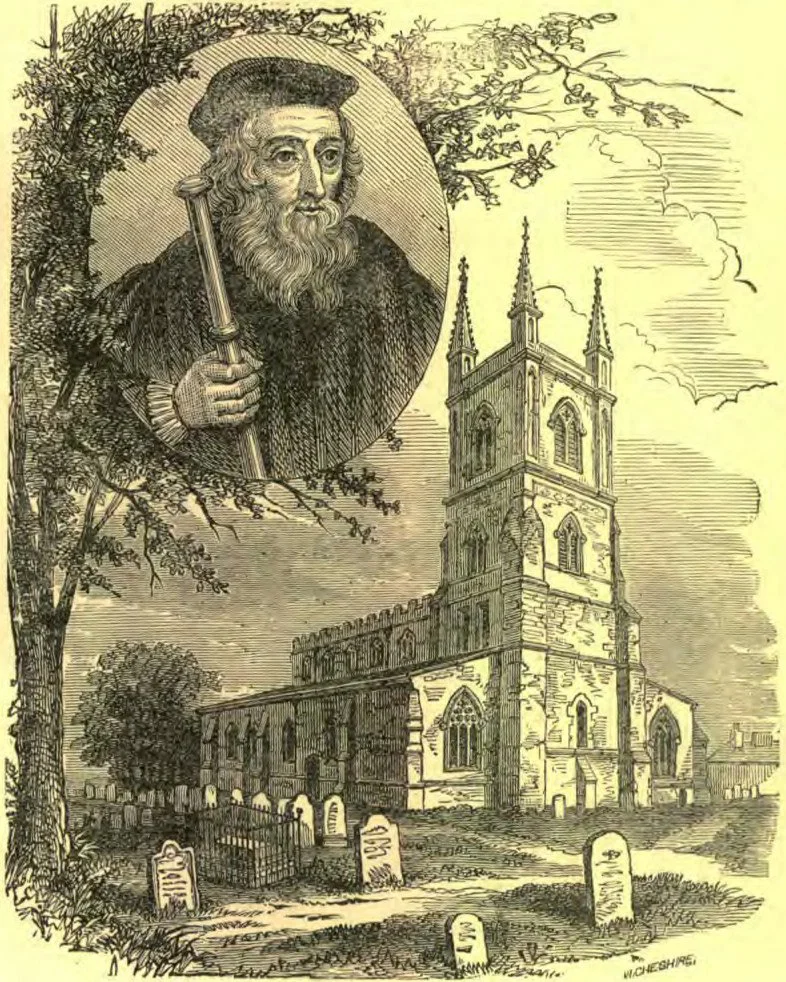
Wycliffe and His Church at Lutterworth.

John Wycliffe was born in 1324, in Yorkshire, England. He has been well called the “Rising Sun of the Reformation,” for certainly he was the greatest of all the reformers before Luther. He became a student at Queen’s college, Oxford, in the year 1340, being about sixteen years of age. Very early in his ministry he became famous for his learning, piety, and zeal.
In 1348, a terrible pestilence, called the “black death,” appeared, which greatly stirred the heart of young Wycliffe with thoughts of death and judgment, and it is said that he spent days and nights calling upon God to show him the path he ought to follow. He studied the Bible, and found his way marked out in it. But the word of God was kept from the people by the church, and Wycliffe now began to demand that it should be given them. This caused trouble at once, for the Romish church requires unquestioning obedience, and will not allow her children to read the Bible. But Wycliffe was not terrified, he had found the truth, and he was not afraid to make it known. From this time on, he was not allowed to speak in peace.
In 1374 he was presented by the king with the rectory of Lutterworth, in Leicestershire. About this time, he began to speak out his mind boldly against papal doctrines and doings, and he styled the pope “Antichrist.” This enraged the pope, who issued several bulls against him, summoning him to London; but being acquitted, he returned to Lutterworth.
He now labored earnestly to get the word of God before the people; and in 1380, just five hundred years ago, his translation of the New Testament was completed, the Old Testament being finished two years later. This was a great event. All classes were eager to see and read this new book, and Wycliffe had a great number of persons who went from village to village, and from town to town, bearing copies of part of them. He also labored with great zeal in the pulpit, preaching not only on Sundays, but on week-days.
He had a paralytic stroke, which left him in ill-health, yet still he worked on; but on the 29th of December, 1384, as he was in his church at Lutterworth, in the midst of his flock, he fell down, again stricken by paralysis. He was carried home by loving friends, and, after lingering two days, died. After his death, so great was the hate of the Romanists, the council of Constance condemned all his writings, and decreed that his body should be exhumed and burned, which sentence was carried into effect. Wycliffe was a great man, and who will say that he did not accomplish a great work. V. A. M.

Golden Autumn.

Golden autumn comes again, With its sunshine dashed with rain, With its fields of yellow grain.
Trees bend down with plum and pear, Rosy apples scent the air, Nuts are ripening everywhere.
Through the lane where bindweed weaves Graceful wreaths of clustering leaves, Home the reapers bear the sheaves,
Singing loud their harvest song, In their hearty rustic tongue, Singing gayly, old and young.
Mice, and ants, and squirrels fill Now their garners at their will; Only drones need hunger still.
Purple sunsets, crimson leaves, Fruit, and flowers, and golden sheaves Autumn gives us ere she leaves.
—Mrs. Hawley.

A RIDE THROUGH KENT IN HOP-TIME.

In September and early October, when thousands of men and women and boys and girls are busy gathering the ripened clusters of flowers, nothing can be more beautiful than a Kentish hop-ground.
The hop-vine has a great many enemies. There is the “hop fly,” and the “hop flea,” “and the “red spider,” and the “otter moth,” and great green long-winged flies, and the “honey dew,” and the “mold;” and any of these uninvited guests may any day sit down and make a feast on these delicate plants that will cost the Kentish hop-growers more than a million of pounds sterling!
From the first planting to the gathering in of this beautiful and valuable crop, it needs a constant watch-care.
Hops are trained on ash poles, which stand in groups of three or four about six or seven feet apart; but the young stems, or bines, as they are called, do not take at first very readily to the poles; so they have to be tied to them with dried rushes until they are four or five feet in height; then they cling to the tall poles and curl around them and run up so rapidly that they sometimes grow an inch in less than an hour!
Soon the lovely leaves and bines and tendrils are at the top of the twenty-foot poles, and looping and festooning themselves from pole to pole until acres and acres of these luxuriant hop-gardens are a perfect bower of beauty.
When September comes, it is a pretty sight to see the men and women, boys and girls, of all ages, factory girls and fishermen’s boys, everybody out of employment, thronging the roads to the hop-gardens.
These merry pickers may be heard laughing, singing, and chatting, in the green arbors and narrow lanes of the gardens, while their fingers are busy picking the flowers from the bines which the hop-cutter with his “hop-dog” (an instrument with a knife on one side and a hook on the other) has cut down and hooked up—pole and all—and laid across the canvas bin, holding many bushels, stretched upon a wooden frame, into which the flowers are dropped.
After picking, the hops are taken to the “oast-houses” to be dried. These drying places are generally built of brick, fourteen or fifteen feet high, perfectly circular in form, looking like a little round tower; on the top of this is a cone, and on top of that a cowled chimney, which people who have been to Egypt say looks just like the “air-fans” that they have on their houses in that far-off country.
In the lower part of the oast-house, in the middle of the small round chamber, is the furnace, in which burns a bright fire of coke and charcoal; and into this, every little while, rolls of brimstone are thrown; this is to give a livelier color to the hops.
Over the furnace, on a circular floor of strong wire netting, and covered with coarse hair-cloth, through which the warm air comes up, the hop flowers lie two or three feet in depth; and here a man watches them day and night, turning them over and burying his arms in them every now and then, and when he feels them to be just dry enough, and not too dry, they are shoveled on to the cooling floor close by, and here the hops are tightly pressed into “pockets,” coarse or fine, according to their quality.
Then the excise officer comes and weighs and numbers and marks each pocket, and last of all makes a black cross upon the seam at the mouth of the pocket.
This is called “sealing” the pocket; and then comes the “duty” to be paid on this precious crop, which has had constant care and watching from February till October.
Near Maidstone is the pretty little village of East Farleigh, where many years ago lived James Ellis, who, I think, might be called the “King of Hop Growers,” for his hop-poles alone were worth £70,000!—Youth’s Companion.

AN INTERESTING TRAVELING COMPANION.

While passing from San Francisco to San Diego on a boat, a short time since, I became interested in an old gentleman who was on his way to Santa Barbara. Although he had reached the age of one hundred and four years, and was in feeble health, his mind was very clear.
He said that his father was an officer in the American army in the Revolutionary War, and an intimate friend of George Washington. He very minutely related the circumstances of the deliverance of Washington’s army when surrounded by the English on the Delaware River. A lady who was stopping with his mother in Philadelphia, in order to learn of the plans which the English had laid to destroy General Washington and his men, at the risk of her life, went among the English, and, having accomplished her object, walked ten miles in one night to inform the general of his danger. The successful accomplishment of her work proved the salvation of the American army, and was the turning point in the Revolutionary War.
I was curious to learn something of the early habits and religious sentiments of this remarkable man. I found, on introducing these subjects, that I had touched something that lay very near his heart, for while conversing, his face was all aglow with animation. He stated that he had always been a temperance man, discarding all alcoholic drinks. He also stated that he had ever taken an active part in matters pertaining to religion and the Sabbath (Sunday) school. He had always attended the latter, and been a worker in it, until prevented from doing so by feebleness. He had now settled up his business, and was going to spend the few remaining days of his life with his daughter. He did not expect to live long, and felt ready to lay off his armor,—ready to meet his God.
Since meeting this old gentleman, I have thought of the INSTRUCTOR family, and wondered how many of them were taking that interest in the study of God’s word that they should take, that if their bodies were wasted away by disease, their minds would still dwell upon those things which pertain to God and eternal life. My mind reverted to a little Sabbath-school scholar of my acquaintance, who, having become unable to raise his hands, used to have the INSTRUCTOR placed before him so that he could read it. After he had read one side, it was turned for him so that he could read the other side. After having read it all he desired to, he would have it sent South for other children to read. This he called his missionary work. His interest in these things ceased only with his life.
It is by our thoughts and affections that we connect with God, and it is because of this connection, through Christ, that we shall finally be translated and taken home to Heaven.
S. N. HASKELL.

Wasting Time, Money, and Happiness

WE waste our time in moments, our money in dimes, and our happiness in trifles.

A LAMP TO MY FEET.

A FRIEND of mine, who had traveled in the Holy Land, told me that on the first evening he spent in Jerusalem he threw open his lattice, and, looking down the street, saw what seemed to be little stars twinkling on the pavement. As the clattering sandals of the travelers came nearer, he could see that each one had a little lamp fastened to his foot, so that every step along the narrow street might be safe. He said it brought to his memory in a moment the passage of Scripture, “Thy word is a lamp to my feet, and a light to my path.”
So it was, he remarked, that almost everything in the Holy Land illustrated the word of the Lord. The text quoted above was written in that same city where the little twinkling stars upon the sidewalk brought it to his memory. And it was written more than three thousand years ago.—Lutheran Evangelist.

Doing Your Part to Make the World Better

Make the world as good as you can. Do your part, whether other people do theirs or not.

GOD RULES.

A WILD rose wooded by sunbeams, Was sinking back from sight, And tremblingly unfolding Its petals to the light. O rose, why do thine odors The glad air round me thrill? The rose looked up and answered, “’T is my Creator’s will.”
I asked a kingly eagle, With lightning in his eye, Why upward, ever upward, He soaring sought the sky. With royal pinions tossing And spurning earth’s vile dust, He said, as heaven received him, “God wills it, and I must.”
I asked Niagara’s torrent, “Why do thy waters sweep With their eternal surges Down, down yon dizzy steep?” A voice replied in thunder That shook the solid land, “Omnipotence impels me, I roll at his command.”

BIBLE LESSONS FOR YOUTH.

LESSON CXVIII.—THE BAPTISM AND TEMPTATIONS OF CHRIST.

While John was baptizing in the river Jordan, Jesus came from Nazareth in Galilee, and asked to be baptized. “But John forbade him, saying, I have need to be baptized of thee, and comest thou to me?” But Jesus said, “Suffer it to be so now, for thus it becometh us to fulfill all righteousness. Then he suffered him. And Jesus, when he was baptized, went up straightway out of the water; and, lo, the heavens were opened unto him, and he saw the Spirit of God descending like a dove, and lighting upon him. And, lo, a voice from Heaven, saying, This is my beloved Son, in whom I am well pleased.”
It seems that the Lord had told John beforehand that he might know the Messiah by this sign, for John says, “He that sent me to baptize with water, the same said unto me, Upon whom thou shalt see the Spirit descending, and remaining on him, the same is he which baptizeth with the Holy Ghost.” Of the fulfillment of this sign he says, “I saw the Spirit descending from heaven like a dove, and it abode upon him. And I saw and bare record that this is the Son of God.”
Thus Jesus received not only the baptism of water, but the baptism of the Holy Ghost,—the anointing which marked him as the Messiah, the anointed one. But the vast multitude of people gathered at the Jordan were allowed not only to see this unmistakable token, but to hear a voice from Heaven declaring Jesus to be the Son of God.
“And Jesus, being full of the Holy Ghost, returned from Jordan, and was led by the Spirit into the wilderness, being forty days tempted of the devil. And in those days he did eat nothing; and when they were ended, he afterward hungered. And the devil said unto him, If thou be the Son of God, command this stone that it be made bread. And Jesus answered him, saying, It is written, That man shall not live by bread alone, but by every word of God. And the devil, taking him up into a high mountain, showed unto him all the kingdoms of the world in a moment of time. And the devil said unto him, All this power will I give thee, and the glory of them; for that is delivered unto me, and to whomsoever I will, I give it. If thou, therefore, wilt worship me, all shall be thine. And Jesus answered and said unto him, Get thee behind me, Satan; for it is written, Thou shalt worship the Lord thy God, and him only shalt thou serve. And he brought him to Jerusalem, and set him on a pinnacle of the temple, and said unto him, If thou be the Son of God, cast thyself down from hence; for it is written, He shall give his angels charge over thee, to keep thee; and in their hands they shall bear thee up, lest at any time thou dash thy foot against a stone. And Jesus answering, said unto him, It is said, Thou shalt not tempt the Lord thy God.”
It seems that the Saviour was tempted on those points where men are most frequently overcome,—appetite, love of dominion, and presumption. If he had used miraculous power for his own relief or protection, there could have been left on record no perfect example, showing how man may resist the temptations of the evil one under the most trying circumstances; and if he had in any way yielded to Satan, the plan of salvation would have been frustrated. But he stood the test just as men may do, by faith and prayer; and when he had been sufficiently tried, we read that the devil departed, and “angels ministered unto him.”
It appears that Jesus, after his temptation, returned to the Jordan where John was still baptizing; and when John saw him coming, he said, “Behold the Lamb of God, which taketh away the sin of the world!” The next day while standing with two of his disciples he repeated the same words; whereupon the two disciples that were with him followed Jesus. When Jesus saw them following, he said, “What seek ye? They said unto him, Rabbi, where dwellest thou? He saith unto them, Come and see. . . . One of the two which heard John speak, and followed him, was Andrew, Simon Peter’s brother. He first findeth his own brother Simon, and saith unto him, We have found the Messias, which is, being interpreted, the Christ. And he brought him to Jesus. And when Jesus beheld him, he said, Thou art Simon, the son of Jona; thou shalt be called Cephas, which is by interpretation, A stone.”

QUESTIONS.

  1. Who came from Nazareth to be baptized of John? Mark 1:9.
  2. Was John willing, at first, to baptize him? Matt. 3:14.
  3. What did he say?
  4. What reply did Jesus make?
  5. What was seen as Jesus came up out of the water?
  6. What voice was heard?
  7. What did the voice say?
  8. How does it appear that John had been told that he might know the Saviour by this sign? John 1:33.
  9. What did John testify that he had seen? Verse 32.
  10. To what did he bear record? Verse 34.
  11. What double baptism did Jesus receive?
  12. What may this baptism of the Holy Ghost be termed? John 1:41, margin; Acts 10:37, 38; Luke 4:18.
  13. How did this anointing mark him as the Messiah? John 1:41.
  14. What evidences were given to the multitudes that were probably assembled at the baptism of Jesus?
  15. When Jesus returned from Jordan, where did the Spirit lead him? Luke 4:1.
  16. What did he suffer there?
  17. What did Satan say to Jesus about providing himself with food?
  18. What answer did Jesus give him?
  19. Where is this written? Deut. 8:3.
  20. Where did the devil then take the Saviour?
  21. What did he show him?
  22. What power did he claim to have?
  23. Under what conditions did he promise to give Jesus all earthly dominion and glory?
  24. What did Jesus say to him?
  25. Where was the third scene of temptation?
  26. What did the tempter say?
  27. What reply was given him?
  28. What is noticeable in regard to the points on which the Saviour was tempted?
  29. On what points are men most easily overcome?
  30. What would have been the consequence if Christ had used miraculous power for his own relief or protection?
  31. What would have been the consequence if he had in any way yielded to Satan?
  32. How may men stand the test just as Christ did?
  33. When he had been sufficiently tried, how did relief come? Matt. 4:11.
  34. Where did Jesus go when his temptations were past? John 1:28, 29.
  35. When John saw him, what testimony did he bear in regard to the Messiahship of Jesus?
  36. Relate the conversation between Jesus and the two disciples.
  37. What did Andrew say to Peter, when he had found him?
  38. What did Jesus say to him about his name?

LESSONS FOR CHILDREN.

LESSON XCII.—REVIEW OF LESSONS LXXXIX-XCI.

  1. Who is represented as talking in the first part of the fourth chapter of Daniel?
  2. What does he relate?
  3. To whom did he tell the dream?
  4. What reason does he give for telling it?
  5. What did he see in his dream?
  6. Describe the tree.
  7. Who talked with him in the dream?
  8. What did the Holy One say to him?
  9. What made Daniel hesitate in giving the meaning of the dream?
  10. What interpretation did he finally give?
  11. What counsel did the prophet give the king after having interpreted his dream?
  12. How long was the fulfillment of the dream delayed?
  13. What did Nebuchadnezzar finally do to bring upon himself the evils foretold in the dream?
  14. What voice did he hear while the proud words were yet in his mouth?
  15. What did the voice say to him?
  16. How long did Nebuchadnezzar remain in this condition of insanity?
  17. How did he show his thankfulness for the return of his reason?
  18. What other blessings were bestowed upon him?
  19. How did he then feel toward the God of Heaven?
  20. What great feast is described in the fifth chapter?
  21. What did Belshazzar do at this feast?
  22. What use did they make of these sacred vessels?
  23. What did they say while drinking from them?
  24. How was this wicked feast suddenly stopped?
  25. How was Belshazzar affected at the sight of a hand tracing letters upon the wall?
  26. What did he immediately do?
  27. How was he disappointed?
  28. Who advised him what to do?
  29. What did Daniel say to him about Nebuchadnezzar?
  30. How did the prophet reprove Belshazzar?
  31. What interpretation did he give of the writing on the wall?
  32. What took place that night?

NOTES ON BIBLE LESSONS FOR YOUTH.

BETHABARA.

The place where the Saviour was baptized is not certainly known. The word Bethabara means the house or place of passage; a crossing place; but which of the fording places it was, cannot now be determined. It is probable, however, that it was not far north of Jericho, since John preached in the wilderness of Judea, and baptized in the Jordan.

THE MOUNT OF TEMPTATION.

The wilderness of Judea, described in the last INSTRUCTOR, was undoubtedly the scene of our Lord’s fasting and temptation. A lofty and precipitous elevation, about seven miles west of the Jordan, and a little northwest of the site of ancient Jericho, is supposed to be the “exceeding high mountain” upon which Satan placed Jesus, in order to show him the kingdoms of this world. It cannot, probably, be better described than in the words of a distinguished traveler, who says: “It rises abruptly from the plain, white and naked, and unlike any other mountain in the world. Its front seems absolutely perpendicular, like the sides of an old castle wall, rising straight up one thousand and five hundred feet into the air; and it is perfectly honey-combed with gaping grottoes and caves. To some of these very stones Satan may have pointed in saying, ‘Command these stones to be made bread.’ Mark says that our Lord was here with the wild beasts. We can readily conceive that they had their lairs in such a place. It fairly made our heads swim to scale the precipitous heights (to explore the grottoes of the old anchorites), crawling along on the rims of shelving rocks, where there was literally but a step between us and death.”
This description applies to the eastern side, facing the Jordan River and the plain of Jericho. To the west and south lay the barren wilderness of Judea. On this lone mountain, and in those dreary solitudes beyond, our Saviour spent forty days of fasting and anguish. The mountain is called Quarantana, which means forty days. The Arabs call it Jebel Kuruntul, which means the same as Mount Quarantana.
G. H. BELL.

DISOBEDIENCE

ANNA, let us look for that book that mother took away from us the other day.”
“I don’t think, Fred, that it would be quite right to go searching for it when she is gone.”
“Why, if we are going to search at all, it is the very time to search when she is gone.”
“Well, I am sure that we ought not to search at all. Mother took that book away from us because she thought it was not a fit book for us to read; and it would be disobeying her to hunt it up and read it, after we have been told not to do so.”
“We might take it and look at the pictures, and not read it at all. That would not be disobeying mother.”
“Yes, I think it would be disobeying her.”
“Well, I don’t care what you say about it. You may do as you please. I am going to look for the book.”
Fred was a very willful boy, and when his mind was made up about anything, it was of but little use for Anna to try to make him think differently. So she quietly said,
“If you will do wrong, I will not help you. I am going down-stairs”
Fred was determined to search, and as soon as Anna was gone, he set about rummaging in the closets of his mother’s room, climbing so that he could reach the very uppermost shelf, and pulling everything over to make sure that the book was not concealed there.
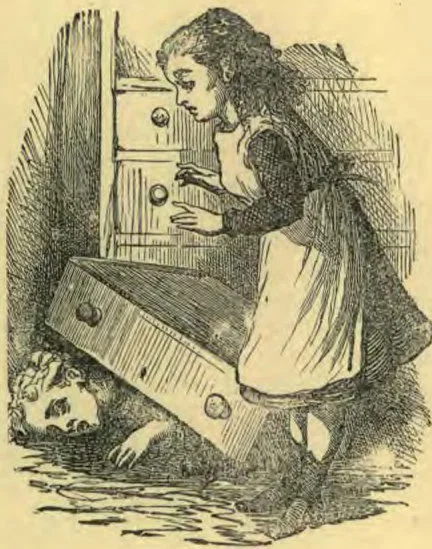
Meantime, Annie had gone quietly down-stairs, taken her geography, and was studying her lesson for the morrow, when she heard a terrible crash in the chamber over her head. She ran up quickly, and found Fred lying on the floor under a bureau drawer, which had fallen directly on his head.
In his haste, while searching for the book, he had pulled the drawer beyond the edge of its socket, and it had fallen upon him.
There was a gash cut in his head, and a bruise on his hand, which will be a long time in healing; and the disgrace of having it known how his wounds came, by disobedience, will last much longer than his bruise or gash.
Anna pitied his pain, but was not sorry if it would teach him the lesson, “Obey your parents in all things.”—Sel.

COMET II., 1880.

The present year thus far has been marked by the advent of only two comets. The first, or Comet I., 1880, has winged its flight to parts unknown. A second comet, known as Comet II., 1880, was discovered on the 6th of April by Professor Schaeberle, of Michigan University.
The little wanderer was not remarkable for size or beauty, for its tail was but three minutes long, about one thousandth part of the length of the tail of its southern rival. It had no head worth mentioning, and its light was too faint to be seen by the naked eye.
It was noteworthy, however, for its northern declination; being, when first seen, a few degrees below the polar star. It moved in a southerly direction, and its tail increased till it attained six inches in length.
This was the maximum; for the comet then traveled from the earth toward perihelion, dwindling away till the telescope could detect no vestige of the celestial visitor. It has not, however, left terrestrial territory for good, but its perihelion passage being now passed, it will re-appear in our sky, attaining its former, or larger proportions in November.
It is not difficult to form a comparative estimate of celestial measurements. The average diameter of the sun, as seen from the earth, is thirty-two minutes, or a little more than half a degree. Six minutes will therefore be a little less than one-fifth of the sun’s diameter. This is easily perceptible, if the object is bright enough to be visible; for Venus, when largest, measures a little more than a minute.
Comets are named on astronomical annals by the year and order of their discovery, and often take also the name of the discoverer, or record some associated event. Thus for 1880 we have Comet I., or the Great Southern Comet, and Comet II., or Schaeberle’s Comet. It is a coveted honor to become the discoverer of a comet, for the Vienna Observatory rewards the fortunate finder with a gold medal, and the fame of the event is world-wide.
Comet I. was seen simultaneously at several places, and no single observer can claim priority, but the discoverer of Comet II. will win the proud distinction.— Youth’s Companion.

Manual Training at the Spring Garden Institute

THERE is a school in Philadelphia called the Spring Garden Institute, where an interesting experiment is being tried. Shops have been fitted up for the boys to work in, part of every day. They practice common carpenter work, turning, forging, and iron work generally, under the direction of good foremen, who will also give lectures upon materials and the use of tools.
Such schools are common in Russia and other parts of Europe. We believe that they will succeed well here, if the boys are old enough. Little boys need to play a great deal for their proper growth and development; but boys and girls, when they have got most of their growth, ought to have a good lesson in work every day.

HAPPY LITTLE MAY.

Just six years old was little May, Just six years old that happy day, When she as usual, lovingly, With good-night kisses, came to me, But with a sunny, beaming face, E'en so beyond its wonted grace, I wondered, and, by impulse led, “What is it, darling!” softly said. The little face grew brighter still; With joyful tears my eyes did fill, For quickly answered little May, “Oh, Jesus loves me, and to-day He told me,—not out loud, you know,— But just as true he told me so; And right away I answered, too, ‘O dear, dear Jesus, I love you!’ And I am glad as glad can be That I love him, and he loves me!”
With words of my great joy a part, I drew her closer to my heart; “Oh, happy little May,” I thought, “So early to such knowledge brought,— So soon in life to find the Friend Whom she can trust till life shall end! To her, come care or sorrow, ne’er, Since she has Jesus, need she fear. To her, joys bountiful and pure, His favor ever will insure. Oh that all little folks might know As early this dear Saviour! Oh, How happy each one that can say, As confident as little May, “I am as glad as glad can be That I love him, and he loves me.”

LETTER BUDGET.

Emily Cavell, of Southampton, England, writes: “It is with pleasure that I tell you I have been trying to keep the Sabbath two years. I am taking the weekly INSTRUCTOR, which I like very much. I am ten years old. I go to meeting and Sabbath-school every Sabbath. I want to be an overcomer, and be saved when Jesus comes.”
Irving A. Frink, of Monterey, Michigan, tells us, in a nicely written letter, how much he likes the INSTRUCTOR, and how he learns his lesson every week, although he cannot attend Sabbath-school very often. He is trying to be a good boy.
Next we have letter from Nason A. Crawford, of Byron, Wisconsin. He says: “I am eleven years old. I have kept the Sabbath with my people ever since Eld. Tenney preached here four years ago. We take the INSTRUCTOR, and love to read it. We like the lessons that are in it.”

You have reached the end of this edition.

The Youth’s Instructor · Sep 29, 1880