The Youth’s Instructor, Vol. 29, No. 21.

THE WALDENSIAN COLPORTEUR

The Youth’s Instructor

May 25, 1881

S. D. A. Publishing Association · Battle Creek, Mich. · May 25, 1881

THE WALDENSIAN COLPORTEUR.
Some thirty years ago, at Geneva, Switzerland, I was a seminary student under the late Dr. Merle d'Aubigne. There were thirty students only in the Oratoire—as the theological school was called—and we knew each other better than in Princeton, where I had been with one hundred and fifty mates, among whom were the Alexanders, Miller, Hodge, and Greene. There were some eight or ten Waldensian students at Geneva, for there was no seminary then at Florence. A few of us boarded in a beautiful environ of Geneva called Melangnou. The student who roomed next to me was Rivoir, a Waldensian, and we had frequently had sweet converse, whether in regard to the ancient “Israel of the Alps,” or concerning the things of the kingdom.
One day my friend tapped at my door, and asked me to come into his room and hear him read an interesting French poem about the manner in which his ancestors of the valleys did good and propagated the truth in the olden time, “when,” as Milton wrote in his beautiful sonnet, “our fathers worshiped stocks and stones.” I gladly accepted the invitation, and listened to a short, but very interesting poem, called “Le Colporteur Vaudois,” which was in Vinet’s Chrestomathy of French Literature. Your readers are aware that the French term for Waldensian is Vaudois, and that the term colporteur in French is much wider than with us. There it meant an itinerant hawker, or peddler. They are also probably aware that the late Vinet, the greatest and most eloquent preacher in the French language, was also an eminent literary man. More than forty years ago, while he was Professor in the University of Basle, he gave several courses of lectures on French literature, which were afterward published in three volumes, under the title of a “Chrestomathy of French Literature.” So excellent were the selections, and so admirable were the criticisms, that whatever was found in this collection became classic in the French language.
I naturally inquired of my friend Rivoir, “Who is the author of this poem?” It represented an old Waldensian colporteur going with trinkets and silks for sale, and thus being in the end the means of giving to the noble lady of the castle, the “Pearl of Great Price.” He replied that he did not know, but that it was translated from the English by Prof. G. de Felice, of Montauban.
I afterward found that this poem, “The Colporteur Vaudois,” was not only a portion of general French literature, but was taught to every Protestant child in France, and that among the Waldenses it was as familiar as a household word. When all Italy was open to the gospel, the brave Waldenses began their work. They established schools and churches, and wherever converts were made, the “Colporteur,” after the Bible, was taught to the people, both old and young.
But to revert to the original question, “Who wrote the original English?” The next year after Rivoir had read to me the translation, I thought I had found the journal wherein it first appeared. The London Observer had published it some years before, and Dr. Baird, in the American and Foreign Christian Union Magazine, said that it was “attributed to the London Observer;” and the Presbyterian Board of Publication still issued a book on the Waldenses, in which it stated that the poem appeared originally in the London Observer.
But strange to say, I did not learn who the author was until 1854, when I returned from Brazil for the first time. Then it was that I learned that the poem was not written by an Englishman, and that it did not first appear in the London Observer, but that it originally appeared in the press of the United States, and that its author was no other than the most American of American poets, John Greenleaf Whittier. Its title in his works is “The Vaudois Teacher.”
In 1857 I contributed an article on the fact narrated above to the Boston Saturday Evening Gazette. A short time afterward, I visited Whittier in his little home in Amesbury, when he informed me that he had been more moved in hearing that the “Vaudois Teacher” had touched the brave Waldenses, than by any other piece that he had ever written for any purpose whatever.
A few years ago, finding that the Waldenses themselves did not know who had composed the beautiful piece, translated by G. de Felice, I wrote up to the Moderator of the Waldensian Synod at La Tour, telling him who the author was. In September, 1875, when the Synod met amidst the fastnesses of the Alps, the Moderator, at the clerical banquet always given at the conclusion, arose and said that it gave him the greatest pleasure to make known to his brethren, who wrote the “Colporteur Vaudois.” “It was,” he continued, “written by Jean Greenlyaff Vittier, of America; and, my brethren, I propose the health of Monsieur Vittier.” All rose to their feet, and with a right hearty good-will they drank to the Quaker poet. A letter was written by the Moderator to Whittier, stating that he thanked him in the name of the Waldensian Church for the beautiful “Colporteur Vaudois.” I afterward saw Whittier’s answer, translated into Italian and printed from one end of Italy to the other.
Believing that the poem will be interesting to your readers as the only poem which has become classic in French, and which has become a household word to the Waldenses and all other Protestants in Italy, I append it, together with the portion from Rhenarius Saccho, (an inquisitor of the twelfth century,) which inspired Whittier to write the “Vaudois Teacher.”

THE BAPTISM OF RAIN.

Oh, how the bubbling rain comes down! So wide apart were the headlong drops At first, that you could run between Without a wetting—now it stops.
Those blurred and misty lines of blue, That fringe the clouds o’er yonder hills, Tell us of storm there, while a burst Of sunshine all the valley fills.
Ah! fresh and sweet the scent of leaves And early flowers; in spots, the road, Lately deep with tawny dust, By the brimming brook is overflowed.
From greening trees a gush of melody— A grateful incense from the plain; Joy! praise! beneath the breaking sky, For God’s baptism of the rain.

SCENES IN THE LIFE OF CHRIST.

LESSON 18.—CHRIST HEALS THE NOBLEMAN'S SON.

At the close of our last lesson, we left Jesus sitting by the well of Jacob, talking with his disciples, while the Samaritan woman had gone into the city to call her friends to come and see “a man that told me all things that ever I did.”
By this time the woman was returning with a company of Samaritans; and Jesus, lifting up his eyes and looking on them, said to his disciples, “Say ye not there are yet four months, and then cometh harvest? Behold, I say unto you, Lift up your eyes and look on the fields; for they are white already unto harvest.” By the first part of this expression, we see that this visit must have been in the early part of December, while the grain was yet young and tender; so when the Saviour said that the fields were already white unto harvest, he could not have meant the harvest of grain, but the harvest of souls that were ready to be gathered into the garner of the Lord.
And many of the Samaritans believed on Jesus as the Messiah, because of what the woman told them; and “they besought him that he would tarry with them, and he abode there two days,” and taught them. “And many more believed because of his own words; and they said to the woman, Now we believe, not because of thy saying; for we have seen him ourselves, and know that this is indeed the Christ, the Saviour of the world.”
After staying two days at Sychar, Jesus and his disciples went on into Galilee; and he went throughout the country both teaching and healing the people, and preaching in their synagogues, urging them to repent and believe the gospel. And many of the Galileans believed on him because of the wonderful things which they had seen him do at the passover at Jerusalem, when he drove the changers of money out of the temple. This feast was in April, and it was in the early part of December that Christ was at Sychar; so we see he must have been away from Galilee six or seven months at least.
And as Jesus was going from place to place, teaching the people, he came to Cana, where he had performed his first miracle. “And there was a certain nobleman whose son was sick at Capernaum. When he heard that Jesus was come out of Judea into Galilee, he went unto him and besought him that he would come down, and heal his son; for he was at the point of death. Then said Jesus unto him, Except ye see signs and wonders, ye will not believe. The nobleman said unto him, Sir, come down ere my child die. Jesus saith unto him, Go thy way; thy son liveth. And the man believed the word that Jesus had spoken unto him, and he went his way. And as he was now going down, his servants met him, and told him, saying, Thy son liveth. Then inquired he of them the hour when he began to amend. And they said unto him, Yesterday at the seventh hour the fever left him. So the father knew that it was at the same hour in the which Jesus said unto him, Thy son liveth; and himself believed, and his whole house. This is again the second miracle that Jesus did, when he was come out of Judea into Galilee.”

QUESTIONS.

  1. Where did we leave Jesus at the close of our last lesson?
  2. What did Jesus say to his disciples as he lifted up his eyes and saw the woman returning with a company of Samaritans? Verse 35.
  3. At what time of year was this visit to Sychar?
  4. When does the harvest come in that country? and how long does it continue?—The harvest in Palestine lasts about two months, usually from near the middle of April to the middle of June.
  5. To what harvest did Jesus refer, when he said the fields were already white unto harvest?
  6. How do we know that he could not have meant the harvest of grain?
  7. How long did Jesus tarry with the people of Sychar? Verse 40.
  8. At whose invitation did he do so?
  9. What was the result of his teaching? Verse 41.
  10. What did those who believed say to the woman after they had heard Jesus for themselves? Repeat verse 42.
  11. Where did the Saviour go, on leaving Sychar? Verse 43.
  12. What did he do there? Mark 1:14; Luke 4:14, 15.
  13. What did he urge the people to do? Mark 1:15.
  14. What caused many of the Galileans to believe on Christ? John 3:45.
  15. What wonderful things had they seen him do at this feast?
  16. About how long was it from the time Jesus went down to Jerusalem to attend this passover until he returned to preach throughout Galilee?
  17. To what place did Christ come as he traveled about the country, teaching the people? Verse 46.
  18. On what occasion had he been to this place before?
  19. What miracle had he performed here at that time?
  20. Who came from Capernaum to Cana to see Jesus?
  21. What did the nobleman ask the Saviour to do?
  22. Did Jesus go with him?
  23. How did he heal the man's child? Verse 50.
  24. Who came to meet the nobleman as he was on his way home?
  25. What good news did they bring the father?
  26. At what time did they say the child had begun to amend?
  27. What good effect did this miracle have upon the nobleman and his family?

THE VAUDOIS TEACHER.

“The manner,” says Saccho, “in which the Waldenses and heretics disseminated their principles among the Catholic gentry was by carrying with them a box of trinkets, or articles of dress. Having entered the houses of the gentry, and disposed of some of their goods, they cautiously intimated that they had commodities far more valuable than these—inestimable jewels, which they would show if they could be protected from the clergy. They would then give their purchasers a Bible or a Testament; and thereby many were deluded into heresy.”
Here is the poem:—
“O lady fair, these silks of mine are beautiful and rare— The richest web of Indian loom, which beauty’s queen might wear; And my pearls are pure as thine own neck, with whose radiant light they vie; I have brought them with me a weary way— Will my gentle lady buy?”
And my lady smiled on the worn old man, through the dark and clustering curls, Which veiled her brow as she bent to view his silks and glittering pearls; And she placed their price in the old man’s hand, and lightly turned away, But she paused at the wanderer’s earnest call—“My gentle lady, stay!”
“O lady fair, I have yet a gem which a purer luster flings Than the diamond flash of the jeweled crown on the lofty brow of kings,— A wonderful pearl of exceeding price, whose virtue shall not decay, Whose light shall be as a spell to thee, and a blessing on thy way!”
The lady glanced at the mirroring steel where her form of grace was seen, Where her dark eyes shone clear, and her dark locks waved their clasping pearls between; “Bring forth the pearl of exceeding worth, thou traveler gray and old, And name the price of thy precious gem, and my page shall count thy gold!”
The cloud went off from the pilgrim’s brow, as a small and meager book, Unchased with gold or gem of cost, from his folding robe he took. “Here, lady fair, is the pearl of price; may it prove as such to thee! Nay, keep thy gold, I ask it not, the word of God is free!”
The hoary traveler went his way, but the gift he left behind Hath had its pure and perfect work on that high-born maiden’s mind; And she hath turned from the pride of sin to the loveliness of truth, And given her human heart to God in its beautiful hour of youth! —J. C. Fletcher.

J. N. LOUGHBOROUGH

ANCIENT BRITAIN.—NO. 7.

Although the dwellings constructed by the Romans in Britain have for the most part moldered away, there are still many of their castles remaining; some of which are in a very perfect condition. Richborough Castle, in Kent Co., is supposed to be the earliest Roman castle constructed in this island. It is said to have been begun by Claudius, and completed by Severus, his successor in power. It still retains the leading features of one of the most perfect of the stationary castles built by the Romans. In the walls are the traces of the four gates; and the layers of brick, or Roman tile, occur with great regularity in the cement.
These Roman castles, like those of later times, were inclosures, or encampments, surrounded by a heavy wall, and furnished with a tower or towers. They were strongly constructed, and intended as a place of safety from the attack of any foe. Usually these castles were furnished with a strong tower called “the keep.” I examined “the keep” in the Taunton castle, and found that the outer walls were solid mason work of stone and cement thirteen feet in thickness. Some of these castles inclose several acres of ground and are sufficiently large to accommodate quite a garrison of soldiers.
Of course the Saxons had much hard fighting to get possession of these castles; but they were glad to get them, and went on and made many of their own. The Britons struggled hard to resist them, not willing to yield their land to barbarous strangers. It took the Saxons and Angles nearly two hundred years to fully establish their heptarchy in England. Their conquest, however, was complete. The historian says, “A few of the vanquished people may have lingered as slaves round the homesteads of their English conquerors, but the Briton had disappeared from the greater part of the land which had been his own; and the tongue, the religion, and the laws of his English conquerors reigned without a rival from the Essex to the Severn, and from the British Channel to the Firth of Forth.”
Although these Saxons and Angles were truly heathens and idolators, they sought to maintain a form of justice. They claimed that the only “free man” or “churl” was the landholder. He who had never bent his neck to a lord, “the weaponed man,” who bore spear or sword, was regarded as his own revenger of wrong. They allowed what they called “blood wite,” meaning a money compensation for damage done. They claimed that a person’s relatives were responsible for the wrong committed by one of their number, and so also vengeance might be executed by one of the kindred of the wronged. Thus each little group of English people was bound to protect their kinsman from wrong, to hinder him from doing wrong, and to decide whether he was guilty or innocent when charged with crime. This blood-bond gave their society both a social and a military form. Each kinsman fought for the honor of his house. As they fought side by side, so they lived side by side, “Harling abode by Harling, and Billing by Billing;” calling their place of abode “wick” or “ham” or “ton.” The town of the Harlings was Harlington; and the home of the Billings was Billingham. Not only was each individual jealous of his independence among his settlers, but each settlement, with its surrounding agricultural district, was girt with its own border “mark.” This mark was a belt of forest or waste or fen, a ring of common ground, which none of the settlers were allowed to claim as their own. This was held as a death-ground, where criminals met their doom, and their superstition held that it was the dwelling place of “nixie” (the devil) and will-o’-the-wisp. If a stranger came through this wood, or waste, it was his duty to blow his horn as he came. If he stole through secretly, he was taken for a foe, and any man might lawfully slay him.

J. N. LOUGHBOROUGH

Early American Glass Factories

THE first glass factory in the United States of which we have any definite knowledge, was built in 1780.

THE RUNAWAY KNOCK.

“TEACHER,” said a bright, earnest-faced boy, “why is it that so many prayers are unanswered? I do not understand. The Bible says, ‘Ask, and ye shall receive; seek, and ye shall find; knock, and it shall be opened unto you;’ but it seems to me that a good many knock and are not admitted.”
“Did you never sit by your cheerful parlor fire,” said the teacher, “on some dark evening, and hear a knocking at the door? Going to answer the summons, have you not sometimes looked out into the darkness, seeing nothing, but hearing the pattering feet of some mischievous boy, who knocked but did not wish to enter, and therefore ran away? Thus it is often with us. We ask for blessings, but we do not really expect them; we knock, but do not wish to enter; we fear that Jesus will not hear us, will not admit us; and so we go away.”
“Ah, I see,” said the earnest-faced boy, his eyes shining with the new light dawning in his soul, “Jesus cannot be expected to answer runaway knocks. I mean to keep knocking until he cannot help opening the door.”

NEW-TESTAMENT HISTORY.

LESSON 30,—CHRIST'S TESTIMONY CONCERNING JOHN THE BAPTIST.

“And when the messengers of John were departed, he began to speak unto the people concerning John, What went ye out into the wilderness for to see? A reed shaken by the wind? But what went ye out for to see? A man clothed in soft raiment? Behold! they which are gorgeously appareled, and live delicately are in kings’ courts. But what went ye out for to see? A prophet? Yea, I say unto you, and much more than a prophet! This is he of whom it is written, Behold! I send my messenger before thy face, which shall prepare thy way before thee. I say unto you, Among those that are born of woman there is not a greater prophet than John the Baptist; but he that is least in the kingdom of God is greater than he.”
Matthew says, “And from the days of John the Baptist until now the kingdom of heaven suffereth violence, and the violent take it by force. For all the prophets and the law prophesied until John. And if ye will receive it, this is Elias [Elijah], which was for to come. He that hath ears, let him hear.” Luke in relating the same thing, says, “The law and the prophets were until John: since that time the kingdom of God is preached, and every man presseth into it.”
“(And all the people that heard him, and the publicans, justified God, being baptized with the baptism of John. But the Pharisees and lawyers rejected the counsel of God against themselves, being not baptized of him.)”
“Whereunto then shall I liken the men of this generation? and to what are they like? They are like unto children sitting in the market-place, and calling one to another, saying, We have piped unto you, and ye have not danced; we have mourned to you, and ye have not wept. For John the Baptist came neither eating bread nor drinking wine; and ye say, He hath a devil. The Son of man is come eating and drinking; and ye say, Behold a gluttonous man, and a winebibber, a friend of publicans and sinners! But wisdom is justified of all her children.”
“And one of the Pharisees desired him that he would eat with him. And he went into the Pharisee’s house, and sat down to meat. And, behold, a woman in the city, which was a sinner, when she knew that Jesus sat at meat in the Pharisee’s house, brought an alabaster box of ointment, and stood at his feet behind him, weeping, and began to wash his feet with tears, and did wipe them with the hairs of her head, and kissed his feet, and anointed them with the ointment. Now when the Pharisee which had bidden him saw it, he spake within himself, saying, This man, if he were a prophet, would have known who and what manner of woman this is that toucheth him; for she is a sinner.”
“And Jesus answering said unto him, Simon, I have somewhat to say unto thee. And he said, Master, say on. There was a certain creditor which had two debtors; one owed [him] five hundred pence, and the other fifty. When they had nothing to pay, he frankly forgave them both. Tell me, then, which of them, therefore, will love him most? Simon answering said, I suppose he to whom he forgave most. And he said unto him, Thou hast rightly judged.”
“And he turned unto the woman and said unto Simon, Seest thou this woman? I entered into thine house, thou gavest me no water for my feet; but she hath washed my feet with tears, and wiped them with the hairs of her head. Thou gavest me no kiss, but this woman since the time I came in hath not ceased to kiss my feet. My head with oil thou didst not anoint; but this woman hath anointed my head with ointment. Wherefore I say unto thee, Her sins, which are many, are forgiven; for she loved much; but to whom little is forgiven, the same loveth little. And he said unto her, Thy sins are forgiven. And they that sat at meat with him began to say within themselves, Who is this that forgiveth sins also? And he said to the woman, Thy faith hath saved thee; go in peace.”

QUESTIONS.

1. When John’s messengers had departed, what questions did Christ ask the people? Luke 7:24, 25.
2. What purpose were these questions probably meant to serve?—They called attention to John’s firm and self-denying course.
3. How had he denied himself the luxuries of life?
4. How had he proved his firmness and faithfulness?
5. Where do those dwell who live delicately and dress gorgeously?
6. Had John sought the favor of kings?
7. What did Christ say about his being a prophet?
8. What rank did he give John among the prophets?
9. In what sense was John a great prophet?—He was great in having a noble character, but more especially on account of his important mission as a forerunner of Christ.
10. What is meant by the kingdom of God? Verse 28. See Notes.
11. In what sense are the least in this kingdom greater than John?
12. In what sense was the kingdom of heaven taken by violence in Christ’s day?
13. In what sense may it be so taken now?
14. Who were the only religious teachers up to the time of John? Matt. 11:13; Luke 16:16.
15. What did Malachi predict concerning a prophet that was to come in the spirit and power of Elijah? Mal. 4:5, 6; Luke 1:17.
16. How were these predictions fulfilled in John the Baptist?
17. What classes of people rejected the preaching of John, and neglected to be baptized by him?
18. By what comparison did Jesus show the unreasonableness of the men of that generation?
19. How is wisdom justified of her children?—They accept and obey her precepts, and thereby honor her.
20. Describe the conduct of the woman who anointed Jesus as he sat at meat in the house of a Pharisee. Luke 7:36–38.
21. What did the Pharisee secretly think while the woman was doing this?
22. What did Jesus say to him?
23. When Simon had expressed his willingness to listen, what short parable did Jesus give?
24. What question did he then ask?
25. What answer did Simon give?
26. What parallel did Jesus then draw between the attentions paid him by Simon, and the tokens of love and gratitude manifested by the woman?
27. What general truth did he then state?
28. What did he say to the woman?
29. What thoughts did those have who sat at meat with him?

NOTES ON THE LESSON.

“From the days of John the Baptist, or from the time in which he bore his public testimony to an approaching Messiah, even to the present time, the spirits of men are so raised and animated by a desire after the kingdom of heaven, that it is (as it were) attacked with violence, like a besieged city; men of all sorts are pressing to get into it, and the violent seize it with eagerness: multitudes are flocking around me, to be instructed in the nature of my kingdom; and some of most licentious characters, who have been looked upon as little better than ruffians and bravoes, seem resolutely set on securing it; while others of graver and fairer characters are found to neglect it.” —Doddridge.
“This is a new, and very wonderful event. For till [the time of] John the Baptist, all the prophets prophesied; and the law of Moses, as explained by them, was the only revelation of God’s will to the people of Israel; which, so far as it related to me [Christ] was but an obscure intimation of what men were to expect from my appearance; but John opened a much more perfect dispensation. And indeed (to speak more plainly than I have commonly done), if you will hearken to my testimony, and receive [it], this John is the Elijah who was to come, or the person whom Malachi describes under that name, as to be sent before the coming of the day of the Lord. (Mal. 4:5, 6.) This is so important an intimation, that I must urge your most attentive regard to it: and therefore, He that hath ears able to hear, let him hear [it], and let every one that has a mind capable of reflection, reflect seriously upon it; for to understand and regard the character and mission of John aright, will have a most happy tendency to promote your receiving Him whom John was sent to introduce.”—Doddridge.
“Notwithstanding, he that is least in the kingdom of heaven. By the kingdom of heaven in this verse is meant, the fullness of the blessings of the gospel of peace; which fullness was not known till after Christ had been crucified, and had risen from the dead. Now the least in this kingdom, the meanest preacher of a crucified, risen, and glorified Saviour, was greater than John, who was not permitted to live to see the plenitude of gospel grace, in the pouring out of the Holy Spirit. Let the reader observe, 1st. That the kingdom of heaven here does not mean the state of future glory. See chap. 3:2. 2dly. That it is not in holiness or devotedness to God that the least in this kingdom, is greater than John; but 3dly. That it is merely in the difference of the ministry. The prophets pointed out a Christ that was coming; John showed that that Christ was then among them; and the preachers of the gospel prove that this Christ has suffered, and entered into his glory, and that repentance and remission of sins are proclaimed through his blood. There is a saying similar to this among the Jews: ‘Even the servant maid that passed through the Red Sea, saw what neither Ezekiel nor any other of the prophets had seen.’”—Clarke.
“The prophet John was the connecting link between the two dispensations. He was the lesser light which was to be followed by a greater. . . . Although not one of the prophets had a higher mission, or greater work to perform, than had John, yet he was not to see even the result of his own labors. He was not privileged to be with Christ and witness the divine power attending the greater light. It was not for him to see the blind restored to sight, the sick healed, and the dead raised to life. He did not behold the light which shone through every word of Christ, reflecting glory upon the promises in prophecy. . . . In this sense, many who were favored by the teachings of Christ and saw his miracles, were greater than John.”—Spirit of Prophecy.
“The kingdom of heaven suffereth violence.—The tax-gatherers and heathens, whom the scribes and Pharisees think have no right to the kingdom of the Messiah, filled with holy zeal and earnestness, seize at once on the proffered mercy of the gospel, and so take the kingdom as by force from those learned doctors who claimed for themselves the chiefest places in that kingdom. Christ himself said, The tax-gatherers and harlots go before you into the kingdom of God. See the parallel place in Luke 7:28–30. He that will take, get possession of the kingdom of righteousness, peace, and spiritual joy, must be in earnest: all hell will oppose him in every step he takes; and if a man be not absolutely determined to give up his sins and evil companions, and have his soul saved at all hazards, and at every expense, he will surely perish everlastingly. This requires a violent earnestness.
“All the prophets and the law prophesied until John.—I believe the word translated prophesied means here, they taught, or continued to instruct. They were the instructors concerning the Christ who was to come, till John came and showed that all the predictions of the one, and the types and ceremonies of the other, were now about to be fully and finally accomplished; for Christ was now revealed. The word is taken in this sense, Matt. 7:22.
“This is Elias which was for to come.—This should always be written Elijah, that as strict a conformity as possible might be kept up between the names in the Old Testament and the New. The prophet Malachi, who predicted the coming of the Baptist in the spirit and power of Elijah, gave the three following distinct characteristics of him. First, That he should be the forerunner and messenger of the Messiah: Behold, I send my messenger before me, Mal. 3:1. Secondly, That he should appear before the destruction of the second temple: Even the Lord whom ye seek shall suddenly come to his temple. Ibid. Thirdly, That he should preach repentance to the Jews; and that, some time after, the great and terrible day of the Lord should come, and the Jewish land be smitten with a curse, chap. 4:5, 6. Now these three characters agree perfectly with the conduct of the Baptist, and what shortly followed his preaching, and have not been found in any one else; which is a convincing proof that Jesus was the promised Messiah.
“He that hath ears to hear, let him hear.—As if our Lord had said, These things are so clear and manifest that a man has only to hear them to be convinced and fully satisfied of their truth.”—Clarke.

BABY'S SERMON.

The children had been up in their mamma’s room after breakfast, that morning, learning their text; and when they had it perfectly, and were coming down stairs again for a run in the garden while nurse was busy, Nannie and Frank fell to disputing. And what do you think it was about? Why, who should carry the great rubber ball down stairs?
Nannie wanted it because she had thought of it first, and Frank wanted it because he was the oldest. “You’re a mean, selfish boy,” said Nannie.
“You’re a pig,” said Frank.
“I’ll just tell papa what a horrid boy you are,” said Nannie.
“And I’ll tell mamma I wish she would sell you to somebody. I don’t want such a sister,” answered Frank.
“I don’t love you one single bit,” said Nannie.
“And who wants you to?” inquired Frank.
So these naughty children went on from bad to worse, saying all sorts of unkind and unpleasant things to one another,—so very unkind that they were ashamed enough whenever they remembered them afterward.
All this time baby Ben was coming down stairs behind them. Slowly, one foot at a time, holding fast to the banisters with both small fat hands, the little man made his way; and wider and wider opened his big blue eyes, more and more surprised he looked, as he heard the angry words.
The children stopped to finish their quarrel at the foot of the stairs. Frank was trying very hard to get the ball away from Nannie, and she had got as far as pulling his hair (the naughty girl), when the baby stopped on the lowest stair, and preached his sermon to them.
“Ickle chillen,” said he, “love one anodder.”
That was every word he said. It was the text the children had been learning in their mother’s room such a short time before. Nannie dropped her hands, her face flushed, and she turned half away from baby Ben, and nobody said anything for a moment.
“Here, Frank,” said Nannie at last, holding out the ball, you may have it. I’m going to be good.”
“So am I,” said Frank. “You shall have the first toss, Nannie. I’m—I’m real sorry I was cross.”
So the two went off to the garden, hand in hand, ashamed enough of having been so naughty, while the baby curled himself up in papa’s big chair in the study; and there nurse found him, after a long hunt, fast asleep, with his thumb in his mouth.
—The Churchman.

BUTTER-CUPS

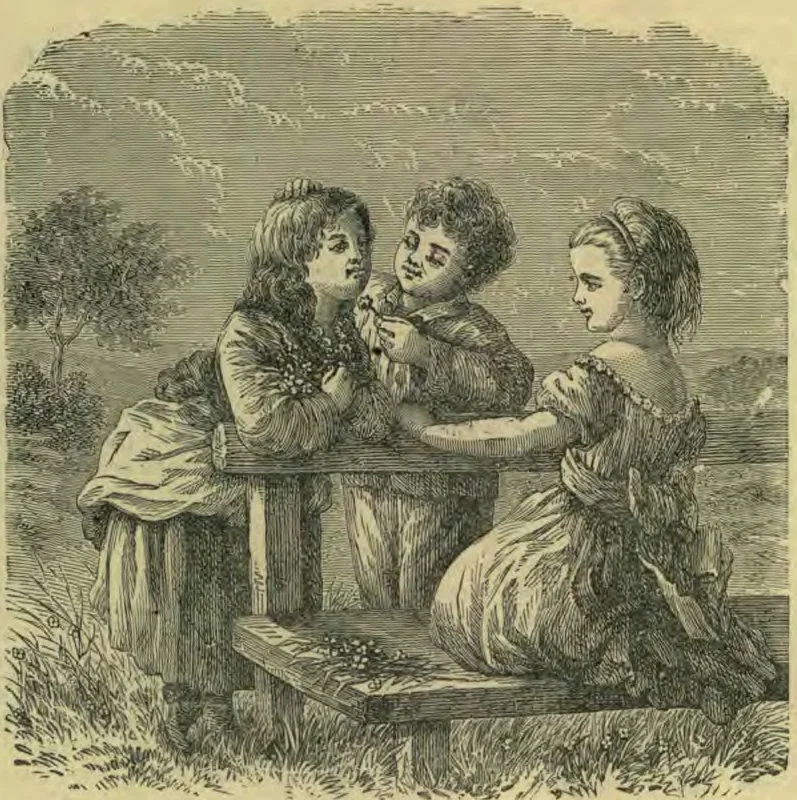
Do you love butter? Now wait till I see; Stand just as still as you ever can be; Hold up your head now, and I will begin, Holding this butter-cup under your chin!
“Ah! it turns yellow; and so it does seem You do love butter, as kittens love cream; No use in laughing, I know it right well; No use denying; the butter-cups tell!”
Butter-cups glisten as brightly to-day As when in childhood we plucked them in play; But the plump fingers are shrunken and old, Gray are the locks that were raven and gold.
Short is the time since the graybeards were young, Hushed by the lullabies dear mother sung; Swift have the days of our pilgrimage been, Since we held butter-cups under the chin.
Charlie is grandpa now, weary and old; Gertie is grandmamma,—precious as gold; Sweet little Lucy,—above her, entombed, Forty long years have the butter-cups bloomed.
Daisies are faded and butter-cups fled, Little ones, fairer and brighter, are dead; Yet while the aged are lingering here, Flowers bloom around them, for childhood is near.
Still with their butter-cups grandchildren play, Still in their gladness they wander and stray; While the old pilgrims, with earth-wearied eyes, Look for their city prepared in the skies.
There where the flowers unfading shall bloom, There where the loved ones arise from the tomb; There where the aged their rest shall be given, Children,—Of such is the kingdom of Heaven.”
—H. L. H., in Little Christian.

GENTLE JEAN.

JEAN was a young French girl with a kind and loving heart. Her father died when she was but a small child, and yet there were three others smaller than she! Her mother was timid and delicate, and wept a great deal, so lonely and sad and fearful she felt at the life which lay before her.
Jean was greatly troubled when she saw her mother weep, and she thought one day that she would comfort her. She put her little arms around the dear neck, and said,—
“Dear mamma, do not weep. I will take care of you and the little ones.”
The mother smiled sadly, and shook her head; but she did not know what strength of love was in that gentle little heart.
Early next morning Jean asked permission to visit a little friend whose father was gardener to a very rich man. The gardener loved the kind little girl, and when she asked him if he could give her a few rosebuds and violets to make into little bouquets and sell, “to buy bread for mamma and the children,” the tears came into his eyes. He went to the mistress, who was a kind woman, and told her what the child had asked. She told him to give her all the flowers she could sell, that day and every day, and then she went in her fine carriage to see the mother, and gave her sewing and embroidery to do, so that with her own work, and the money that Jean brought home from the sale of the flowers, they could live very comfortably. Jean loved flowers, and by-and-by began to raise them herself. At first she had only a few pots in the windows, but as the years went by, a pretty little hot-house was built, and the garden bloomed all summer long, and Jean was known as the sweet flower maiden to rich and poor alike; for in her prosperity she never changed her gentle kindness; for the same love which sent her to ask for a few flowers in her little girlhood, that she might take care of mamma, made her the helpful friend of all whom she knew.
So she came to be known all through the town as “Gentle Jean,” and her love to others brought back love in return.—S. S. Advocate.
Continue reading: BE THOROUGH