The Youth’s Instructor, Vol. L, No. 22

Some Common Birds

The Youth’s Instructor

May 29, 1902

Review and Herald Publishing Company · Battle Creek, Mich. · May 29, 1902

Some Common Birds
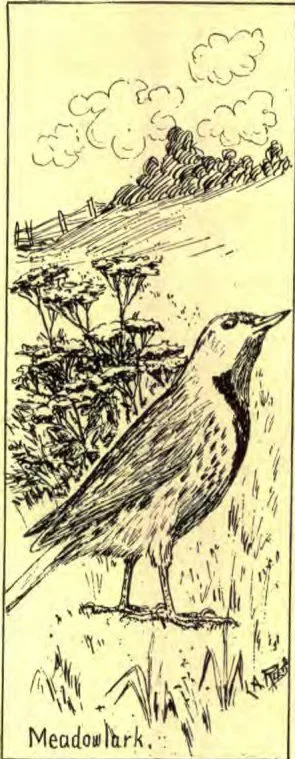
On your strolls, did you ever find the nest of the Meadow-lark? If you did, you have good eyes, and are to be congratulated. It is a difficult thing to discover. It is made on the ground, and is a very cozy, snug little home. It is not an open, cup-like nest, that one can easily glance down into. Instead, it has an arched roof, and a covered walk, so to speak, leading into it. The roof is made by drawing the stems of grasses over, and weaving them together. In this way the nest is well covered from rain and prying eyes; and being hidden in the deep, tall grass, is not easy to discover. If any of you find one this spring, I wish you would write to me or to the editor of the INSTRUCTOR, and tell all about it. But don’t molest the eggs or young, nor scare the old birds.
The Meadow-lark is not a lark at all, but a relative of the blackbird and the crow. The bird lives in meadows and pastures, and walks about on the ground; when he feels especially jubilant, he gets up on the fence or upon a stone or a hummock of earth, and sings for a long time. Some think his notes sound like, “Spring o’ the year! spring o’ the year!”

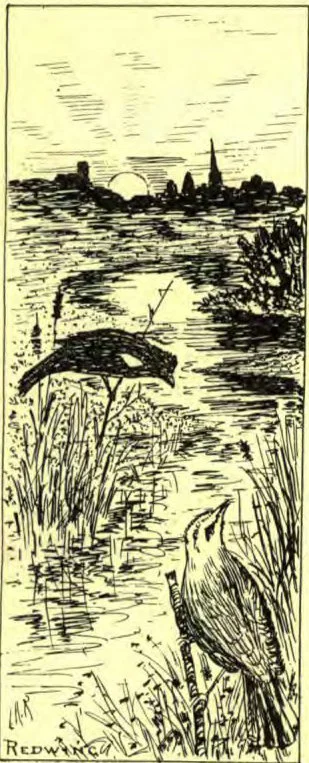
The Red-winged Blackbird

When I first hear the conker-a-kee of the Red-winged Blackbird, I feel certain that spring is here; and when along with it there comes to my ears the peeping of the frogs, and I catch sight of the first spring wild flower, all fears of winter weather vanish; for all these are unmistakable signs.
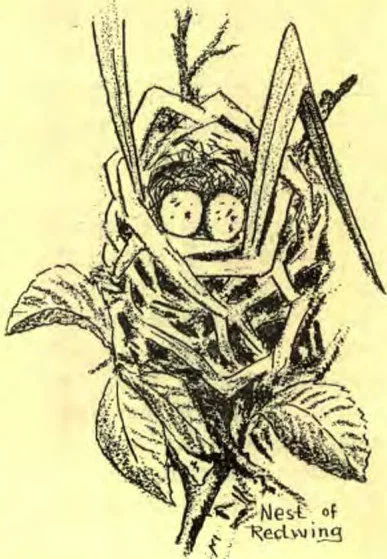
The nest of the Red-wing is a rude affair, as is shown by the picture. It is composed of coarse grasses, weed-stalks, and the like, lined with finer grasses and rootlets, and attached to low bushes or reeds.
Olive Thorne Miller tells some interesting things about a young Red-wing: “The young Red-winged Blackbird is a droll fellow, and has decided notions of his own. Mr. Keyser tells a story of one he picked up. He was put in with some other young birds,—meadow-larks and cat-birds. They were all babies together, and all used to being fed. So when the little Red-wing got something to eat, they would open their mouths, and beg for it, in the pretty bird-baby way. At first he fed them, though he wasn’t much more than a baby himself; but they liked it so well that they coaxed everything away from him. He soon got tired of that, and at last refused to feed them at all.
“This little bird liked to play jokes on the sober young Meadow-larks. His way was to seize one by the wing or tail, and dance around the floor, dragging his victim after him. The young larks scolded and held back, and at last they learned to stop his pranks. They did it by throwing themselves over on their backs, and holding up their claws ready to fight.”
“In spite of this naughty fun, the young blackbird was really fond of them. The larks slept on the ground, and at night, when the little fellows settled down on the floor, the Red-wing would often leave his perch, and cuddle down by them. This must have been for company only; for it was his way to sleep on a perch.”

The Kingfisher

I suppose you have already met the Kingfisher. He has been fishing along the streams and lakes since about the first week in April. I think you will agree with me that he is rather large and chunky. You have doubtless many times seen him splash into the water after fish. Then he goes back to his perch, and beats the fish to death before he swallows it. He does not stop to chew it,—not he! Perhaps he can’t. Anyway, he swallows the fish whole and head first. He is wise to take it head first; for if he swallowed it tail first, the fins would surely stick in his throat. This bird can take a large fish. A Kingfisher was once shot, and it was seen that the bird had swallowed a fish so large that the tail stuck out of his mouth, and he could not get it down.
Meadowlark.
Meadowlark.
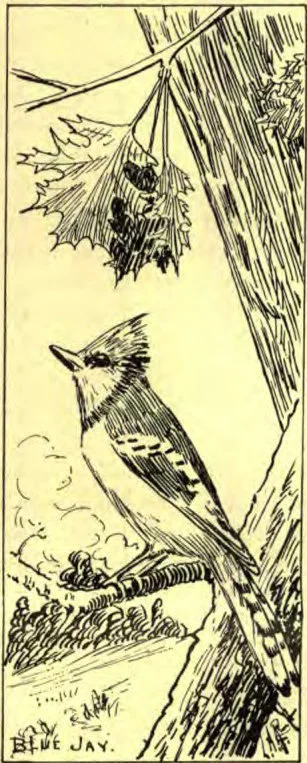
Do not confuse the Blue Jay and the Kingfisher. I have known people to do this. Both birds are blue, and both have crests. But the Kingfisher lives by the water, and catches fish, and makes a queer kind of rattle when he flies. The Blue Jay is here and there through the trees, and is shrieking wherever he goes.
L. A. REED.

The Loafing Song-Sparrow

I SAT on the porch one afternoon, lazily and dreamily watching the busy world of little things in the grass in front of the house. There were plenty of grasshoppers, and the chickens and turkeys, which had been turned out from their yard for a feast, were making havoc with them. After a while the chickens scattered farther off into the meadow, and several little wild birds from the woods came in for their turn at this particular grasshopper patch.
But all my attention was presently taken up with two song-sparrows. I soon found out that the relationship between them was that of father and son. There was no way of telling it at first glance, for they were both full-grown cock-sparrows; but as soon as they settled down to the grasshoppers, the young fellow, instead of going to work and hunting for himself, began to trail around after his daddy, and to beg for grasshoppers. He was fully as large as his father, and could fly just as well, and had the same kind of tools for catching grasshoppers; but the big loafer was too lazy to work, and so he chirped and begged, and every little while the father would take mercy on him, and give him a grasshopper.
In the course of the half-hour or more that I watched them, the father sparrow fed that youngster seventeen grasshoppers by actual count, and the lazy youth did not kill one for himself. The insects were very thick, and he would almost step on them sometimes; but he never saw them, because his eyes were all the time on his father, and his thoughts were taken up with getting a meal through some one else’s work.
As I watched the little drama, I thought to myself that there is a great deal of human nature in a song-sparrow. I have seen boys and girls of just that stripe—young people with health and a good education, able to do fair work at many things, and yet hanging around, loafing on their parents or grandfather, or some uncle or aunt, wanting somebody else to catch the grasshoppers for them.
As I watched that loafing sparrow, I did wish that the father would stop feeding him, and let the young rascal get good and hungry once, so that he would learn to hunt for himself. I have often seen parents who were spoiling their children by not teaching them to rely on themselves. Boys and girls, no matter how good-looking, or how well-educated, or nice-mannered, are, after all, only respectable loafers if they depend on somebody else to do everything for them, and are not ready and willing to do their own work in life.
The old knights, in the days of chivalry, used to send their bright young boys away from home to grow up in some distant castle, among strangers, so that they would become strong and valiant and self-reliant. They feared that if they kept them at home, they would be too easy on them; let them sleep too late in the morning; let up on them concerning the training and hard discipline required to make a strong and brave knight. It is possible that these old knights went to an extreme; but I am sure that, in our day, we go to the other extreme, and that many young folks coming up into manhood and womanhood are first cousins to that loafing song-sparrow, who wanted all his grasshoppers to come to him on the end of his father’s bill.
Hardihood is a great virtue. Real strength of body can never be had without exercise and hard work; power of mind can not be had without study; and a trustworthy moral character, which can face temptation and come off pure and clean, can be won only by self-relying, honest effort. A loafer in this live, vigorous world is a blot on its beauty.—Young People’s Weekly.

Thorns and Flowers

TO-DAY I have been trimming a hedge of thorns along a country roadside. It is the month of May, the leaves are bursting from their buds, and all nature is serene and beautiful. But I am so busy with these thorns that I see nothing else. Nearly all the forenoon I have been fully engaged with them; and only now, at noontime, has my attention been taken from them long enough to notice that just outside the hedge, along the highway, is a wide border of golden dandelions, scattered in rich profusion among the grass, and extending in a glow of gold away down the road.
In this I see a parable. Often we become so occupied with the thorns of life that we give no attention to its beauties. The eye grows dim resting only upon the dry, thorny hedgerow of cares and perplexities. But every such hedge along life's way is richly bordered with flowers. We must cast the eye toward the flowers, and their brighter tints will quicken and cheer. The sting and poison of the thorns in your hands will be removed by the sense of delight received from the flowers.
This hedge is not mine. I have volunteered to trim it for another. God planted the flowers along the way for me, and they are mine; but I have been too busy with others' thorns to see my own flowers. So it goes when we volunteer to find and trim out the thorns from the character of others. This disagreeable work keeps one so busy that he has no time for happier employment. In the case of many, the miserable business occupies the whole forenoon of life, and with some the afternoon and eventime as well. What a contrast between the character of one who is always getting pricked with his brother's thorns, real or imaginary, and another whose countenance grows brighter from seeing the tints of the flowers planted by the Master Gardener in that same brother's heart!
I am glad I found the flowers before noon! How far along in life's day have you gone? Are you a thorn-monger,— a faultfinder, a suspicion-vender? Did you ever plat a crown of thorns? “Inasmuch as ye have done it unto one of the least of these my brethren, ye have done it unto me.” Find the flowers along life's hedgerow, and make a wreath of them.
JOEL C. ROGERS.

Boys Who Love Mother

WHEN the average boy begins to look forward to becoming a man, he conceives the idea that the associations of his mother must be gradually broken off, and left out of his life, even as he leaves off his dresses, aprons, waists, and knee trousers. He wants a vest that opens in front, and he earnestly desires to wear suspenders and not waists. He spends hours studying the ways of men and older boys. Everything that in his mind contributes to manliness he covets.
With the same ambition he discards everything that is associated with femininity. When he is hurt, he will crush back his crying, lest some one shall suggest that he run to his “mammy.” When he is tempted to do wrong, his greatest weakness is his fear of being taunted with an attachment to his mother’s apron strings. When he has done wrong, he congratulates himself on his manhood in rising above the authority of his mother.
All boys are not like that. Long ago there lived twin brothers, one of whom kept up his attachment for his mother as he grew to manhood. The other spurned the restraint and influences of home. As the former listened to his mother’s counsels, and helped her in her cares and work, she became especially fond of him. The father, on the other hand, watched with interest the development of his other son in athletic games and hunting. He became a champion in the “manly sports.” He roamed the forests, “camped out,” and “roughed it” to the delight of his father’s heart. But he knew nothing of the godly counsels of his mother. The first boy became familiar with the will and plan of God. He became the father of a great people, and a prince having power to prevail with God. On the other hand, Esau’s children for many generations were the enemies of God’s people, doomed to final destruction.
It was the prayers and influence of a godly mother that gave Samuel to the people of God at a time when the word of God was scarce, and there was a great dearth of piety. The love and devotion of Jochebed gave Moses to the world. Her faithful counsels made him the hero he was. Timothy was proud to be reminded that he had received from his mother and grandmother that faith and instruction in the Scripture which made him a useful man in Christ’s service.
The mother of Jesus is closely associated with his earthly career, even to its close. His love for her spoke from the agonizing cross. The Bible uses the love of a mother as the best illustration of divine love. It is true she may forget, but she seldom does. Many a son leaves home, going out to battle with an unsympathizing world, and cutting the ties which bind him to the restraints and protection of his father’s house. But there is one tie he can not sever if he would. Wherever he goes, whatever he becomes, no matter what his fortunes may be, his mother’s love and blessing are his secret portion, her prayers are his defense. If he falls sick, if he is beaten and defeated in the strife, his mother’s heart keeps a place sacred to him. He may be sure of one friend in need.
Boys, don’t be ashamed to love mother. Don’t be ashamed to let the world know it. Don’t love in word and tongue, but in deed and in truth. Don’t leave home without your mother’s benediction and prayers. Listen to her counsel; for she has been with Jesus, and learned of him. Think of her cares and burdens, and make them lighter. Don’t add to them the terrible weight of a life of reckless folly and sin. G. C. TENNEY.

O-ka-lee!

FROM the edge of the marsh where the hazel bush grows, Comes a resonant call, O-ka-lee! For the red-wing has come from the South, and he knows That he heralds the spring: O-ka-lee!
Not a leaf in the wood, not a blade in the field; Yet the prophet proclaims, O-ka-lee! That the moment is near when the winter shall yield, And the trees shall be green—O-ka-lee!
And the dash of his epaulets proudly outspread But repeats the glad song, O-ka-lee! For the meadow shall blossom in yellow and red When the summer is come—O-ka-lee!
Not a tinge of despair, not a shadow of doubt In that text of good cheer, O-ka-lee! But a glorious message of hope: ring it out From the hazel-bush twig, O-ka-lee! —Selected.

Over and Over

OVER and over it comes to me— The thought of Christ on the stormy sea, In times of trouble and loss and pain, When my heart’s a ship on the wind-swept main.
Over and over it comes to me— The thought of my comrades on Galilee; And their awe when the winds obeyed his will As he spake, and said to them, “Peace, be still!”
Over and over it comes to me— Each human life has its Galilee; And Christ is ever the Christ of old, When his “Peace, be still!” to the waves was told.
Over and over it comes to me— The message of comfort from Galilee; The voice of Christ through the storm I hear: “Lo, it is I! There is naught to fear!”
—Eben E. Rexford, in Well Spring.

Why Am I Here?

THIS is a question that sometimes presents itself to the young. Since we are plainly told that we can carry nothing with us from this world, it is evident that our work must show itself here, or it will count for naught. First, we are to obey our parents in the Lord; for this is right. Home duties, cheerfully performed, will help in forming a good character. Our work should be well done, not simply “well enough” to pass inspection. Form and maintain regular habits in working as well as in eating.
Neither live nor dress for show, but for comfort and usefulness. “Always spend less than you earn,” is an excellent maxim; but it may safely be disregarded for a short time if a young person is spending a year in school, in order that he may do better work for the Lord.
Always connect manual labor with mental effort. The former will bring financial aid, and will make the latter more lasting and of a better quality. Use all the faculties you have. By exercise they will become stronger and better servants; but if they are not used, they will gradually weaken, and become useless. Do everything in the best possible way. Yet if you are employed by another, remember that he is paying for your work, and that his methods should be followed. If you can convince him that another method is better, that is your privilege. Remember that all good things come down from above. Strive earnestly to secure the best. Keep climbing the ladder of progress, and don’t give up.
C. L. TAYLOR.

Carpenters, Masons, and Upholsterers

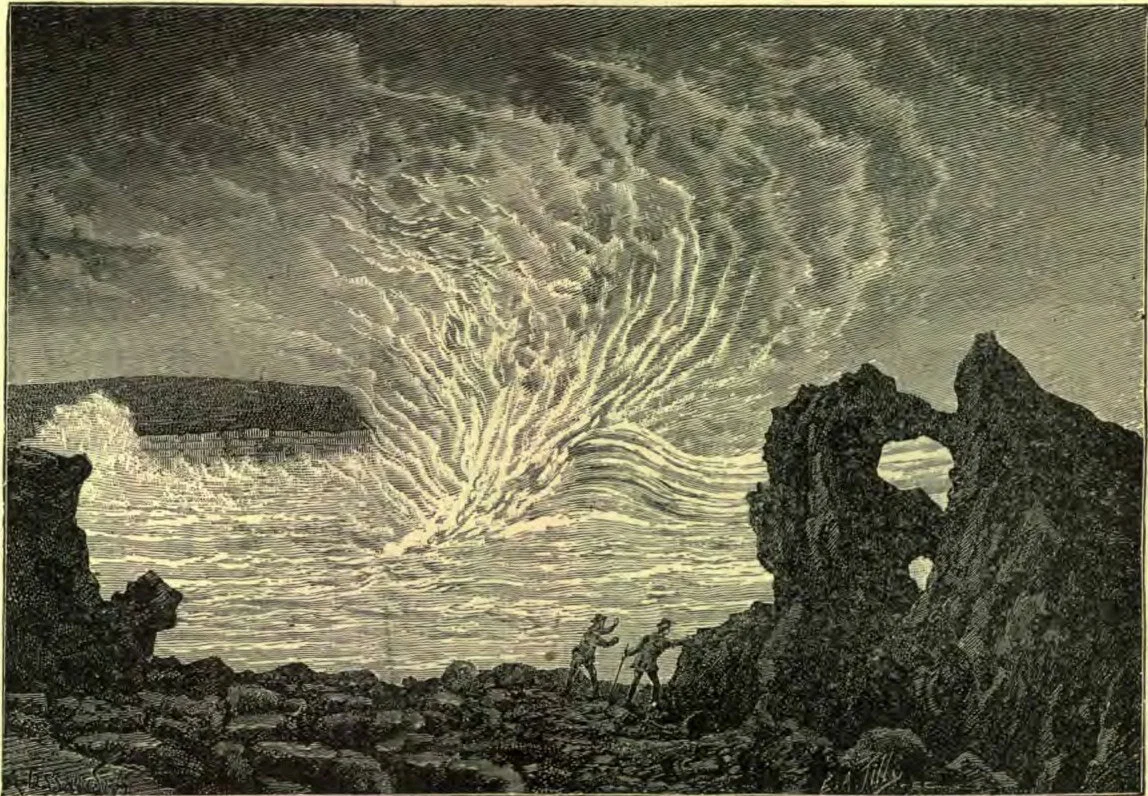
THE VOLCANO OF KILAUEA
HIVE bees have been in all ages admitted to be clever, and well worthy the study of the most wise and learned, and many books have been written about them. But there are also a number of bees that do not gather honey into hives, nor live in great colonies, which are yet full of interest for us, though they have not been so much written about or talked of.
This morning I walked down the garden, and wishing to water some of the flower-beds, I took down from a nail a siphon made of small lead pipe, such as gas-fitters use. I had intended with the aid of this to obtain some water from a tank which had no tap out of doors; but, applying my lips to one end to draw the water through, I found the pipe was stopped up. The obstruction was not far within, and with the small blade of my penknife I was able to get it out. It proved to consist of small oval pieces cut out of rose leaves, not from the petals of the flower, but from the green leaves. Those I extracted were formed into a tiny thimble-shape.
Now who do you think had been busy in this way? I knew as soon as I saw the green leaves. Had I not missed those same pieces from my rose bushes? And had I not seen a small bumblebee cutting similar bits out? There could be no doubt that the upholsterer bee had taken advantage of my leaden pipe to make her neat little cells in it. The proper thing for this bee to do is to find out an old, rotting post, and in it dig out a tunnel and line it with rose leaves. But I fancy this bee is getting either lazy or artful; for whenever it can find a round, smooth hole already constructed, it takes possession, and thus saves itself both time and labor.
I dare say you have sometimes seen rose trees with their leaves cut, and wondered what insect had cut them so clean and regularly. Perhaps you have gone further in your wondering, and asked yourself what purpose the pieces were intended to serve. Here is the answer: Having bored her tunnel, or found a suitable hole ready made, the bee cuts out several large pieces of rose leaf, and fixes them neatly against the walls of the tube, making them all lap over a little at the bottom, so forming a thimble-shaped cell. This is now lined with smaller ovals of rose leaf, and these again with others.
When the cell is completed to the bee’s satisfaction, she lays an egg in the bottom of it, and fills up the cell with honey and pollen, finally corking it up with several circular pieces of rose leaf, so carefully cut that they exactly fit the space, and touch the cell walls all round. The first cell thus completed, she makes another and another, in precisely the same manner. The egg hatches, and the grub finds itself surrounded with food sufficient to last it until it becomes a bee like its mother. This does not take place until the following spring.
Another of these solitary bees, as they are called, is the carpenter bee. It has very powerful cutting jaws, by means of which it bores long tunnels, often nearly two feet in length, into solid wood. The tunnel is begun in a slanting direction, and afterward bored straight down toward the earth. When this deep tunnel, or well, is finished,—and it takes weeks to complete it,—the bee places a mass of pollen almost as big as herself in the bottom, and lays an egg upon it. Over this she makes a kind of floor out of the chips and sawdust made in cutting out the shaft, and upon it places another mass of pollen with an egg. And so she proceeds, until the whole length of the boring is filled up, there being usually twelve of these compartments in each tunnel, or well.
For so small a creature this piece of work is enormous. It is as if one man, without any laborers to assist him, were to dig a well about one hundred and forty feet in depth, clearing out every particle of the loose earth, and afterward bringing back enough to work up into a kind of mortar with which to construct a dozen floors across it. In addition, the bee has to collect the proper amount of food to inclose for the bee-grubs.
There is a bee very appropriately named the mason, because she makes her own mortar, and builds an eight- or ten-roomed house for her family. She very carefully selects her grains of sand, and cements them together with moisture from her mouth, until the whole structure, with its many chambers, resembles a dab of mortar that some careless bricklayer has left upon the wall. A quantity of pollen mixed up with honey is placed in each cell, with an egg.
It strikes many people as being wonderfully strange that all these bees know just how much food will last the grub until, in its turn, it becomes a bee; but they forget that He who teaches the industrious creatures how to fashion their wonderful nests also implants in them a knowledge of what is requisite for the well-being of their offspring.—Young People.

The Origen of Honeydew

IN most places where there is plenty of timber, and especially in new countries, where there is an abundance of moisture, and the vegetation is luxuriant, there is often found a great deal of honeydew. This falls (?) only on certain kinds of trees and plants, but on these it is sometimes very abundant. The honey is clear, pure, and of excellent flavor. I have seen it so abundant that the leaves of the box-elder trees were covered with it as thickly as the grass is covered with dew in the morning; but this is unusual. When we were children, my sister and I used to hunt leaves with honeydew on them, and eat it.
My mother tells me that fifty years ago, among the Ozark Mountains, honeydew fell in abundance, and sometimes the young wild turkeys would get so stuck up with it that they could not fly. Often, warmed by the sun in the morning, it would drip from the young black-jack trees in strings, and even great drops, till the fallen leaves were all stuck together with it. In the early days in Iowa, my father tells me, it was almost as abundant, though here it was found chiefly on the wild spiroea. All insects are very fond of honeydew; and wherever it is found in abundance on a tree, there may usually be seen a regular procession of black ants traveling up and down the trunk, and the tree will be a-hum with bees and other insects.
I have often wondered where all this honey came from, but never found a satisfactory solution till the winter of 1891-92. That winter I was staying with one of my sisters, attending high school. We had a large number of plants of various kinds in the window, and they became infested with various kinds of plant pests. On a large solanum vine were a number of rather peculiar and very large aphids. We were struck with their appearance, and so allowed two of the largest to live. They did not seem to injure the leaves particularly, and never ate holes in them, only sucking the plant juices by piercing the leaves with their bill-like suckers.
These had been on the leaves for some time when one morning, as she sprinkled the plants, my sister noticed something on the window-sill, and called me, not thinking what it was. We examined; and lo! the honeydew had been secreted in such quantities on the leaf where the insects were that it had run off, and several drops had fallen on the window-sill. It was as good-flavored honey as I ever tasted.
At first it was hard for me to believe that two insects, not much larger than a pin-head, could possibly secrete so much honey; but as I watched them day after day, I found that such was the case. They have two glands on the abdomen that secrete the honey; and so far as I could tell, it is always secreted late in the evening or at night.
Now the secret was out, and I knew why honeydew is found only on certain plants. This species of insects lives only on certain plants. Then I knew, too, that certain stories of “honey-dew falling from heaven in long strings, like spider-webs, just about the time the sun sets,” were at the best only the result of very poor observation.
This variety of aphids is rather scarce, and must not be confounded with either our common plant-lice or the variety that ants so carefully herd and care for. FLOYD BRALLIAR.

Kilauea: A Live Volcano in Hawaii

Kilauea

IN our Hawaiian possessions we have one of the great natural wonders of the present-day world,—a live volcano as high as Vesuvius, and twice its diameter.
Kilauea, on the island of Hawaii, stands thirty miles from the sea, in a mountain range in which are three dead volcanoes and one partially alive. This last, called Mauna Loa, from time to time sends streams of lava down its slopes. In 1881 three streams burst forth from the sides of this mountain, and one of them came within three quarters of a mile of Hilo, the chief city of the island.
There have been several outbreaks of Kilauea in the last hundred years. In 1840 there was a brilliant eruption of lava, the light of which, it was said, could be seen a hundred miles away, while at the distance of forty miles one could read print at midnight.
Where the lava flowed through the forest, it has left curious relics in lava arches, bridges, and great vases. These vases were formed by the lava piling itself about some lofty tree-trunk, burning away the wood within, and killing the upper part of the tree. In the course of time, seeds were deposited in the open top, filled with decaying bark, until now there is a gigantic lava vase holding ferns and flowers and vines.
The visitors to Kilauea often camp for the night on the summit. Some years ago, at a time of unusual activity, two boys went up the volcano, and at night rolled themselves up in blankets, and lay down between two small cones. They were awakened from their heavy sleep by strange sounds, and sat up to see that one of the cones near which they were lying was throwing great rocks up into the air. Needless to say, they moved their camping-place.
On the brink of the crater of Kilauea has stood for ten years the Volcano House, a comfortable hotel for the tourists who wish to see this live volcano.
At present there is a prospect of renewed activity in Kilauea. Recent visitors to the volcano say that the temperature has risen considerably, and that there are signs of disturbance on the floor of the crater, which may soon result in another lava flow.— Youth’s Companion.

The Father in School

UNFAMILIAR work and rule,— Little lad's first day in school. “Stay! O papa, stay with me!” Thus he murmurs tearfully. And, though business calls away, Papa stays the livelong day. Hard the lessons, hard and new, All the little lad can do; Strange the room, companions strange, Everything a trembling change; But — there's papa sitting near, Ready with a look of cheer, Ready with a whispered word No one else has overheard: “Be a little man, my boy! Fill your father's heart with joy!”
So, dear Father of us all, When relentless school-bells call,— Schools of failure, schools of woe, Schools of pain,— and we must go, Then thy children thou dost own; We need never go alone. Strange the school where we have come, Ah, so different from home! Strange the lessons, hard to learn, And the master cold and stern. But — though endless labors stand Waiting for his sovereign hand— See the Father sitting near, Ready with a look of cheer, Ready with a whispered word Not another soul has heard: “I am here; my child thou art; Fill with joy thy Father's heart!”
Earthly fathers can not stay Longer than the entrance day; But that other loving Friend Stays till school is at an end.
— Amos R. Wells, in Young People’s Weekly.
Continue reading: Report from Des Moines