The Youth’s Instructor, Vol. 38, No. 8.

THE STRANGE DOINGS OF THE KIWI

The Youth’s Instructor

Feb 19, 1890

S. D. A. Publishing Association · Battle Creek, Mich. · Feb 19, 1890

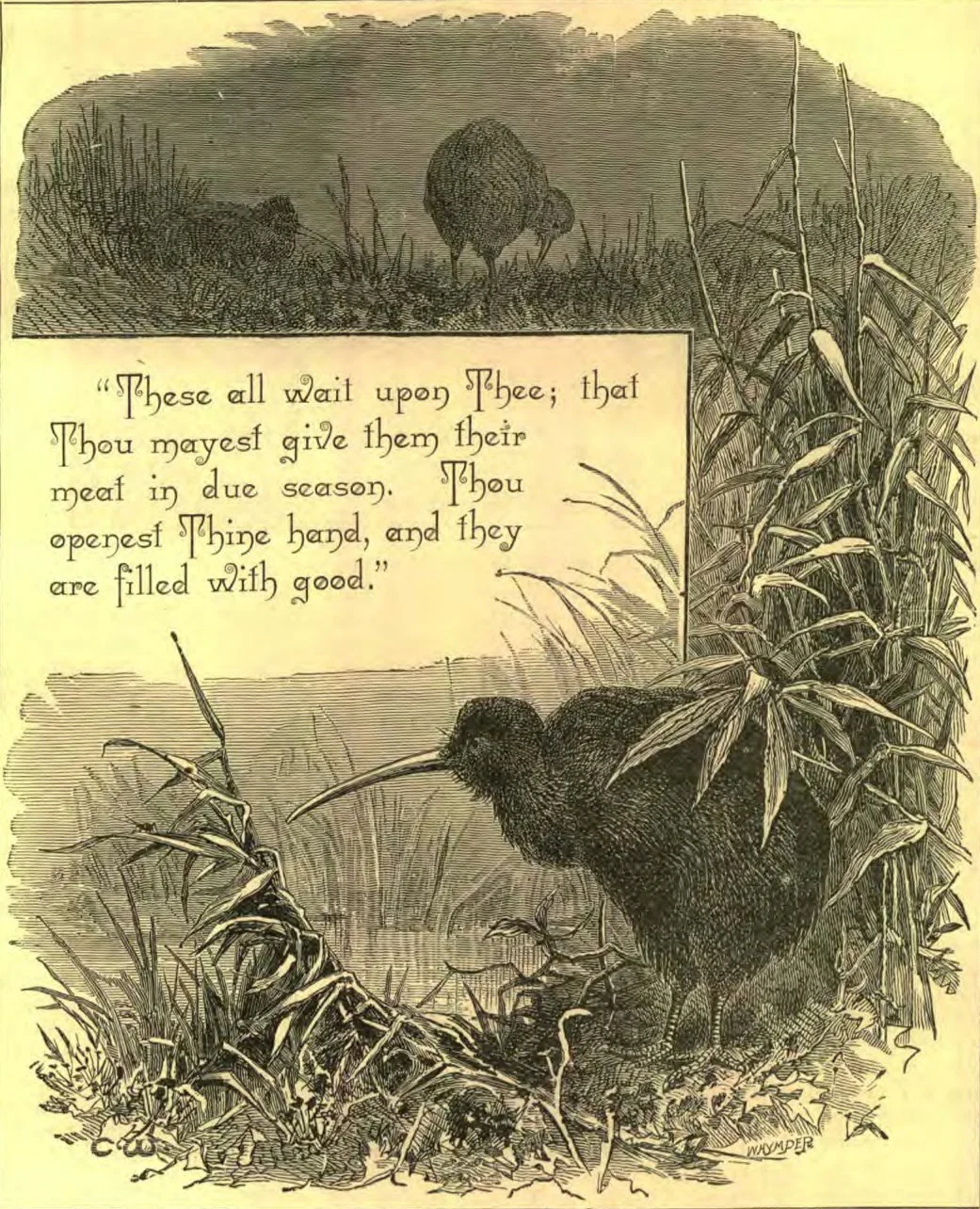
THE STRANGE DOINGS OF THE KIWI.

ALMOST anything might be expected of so absurd a creature as the apteryx; but, really, it is surprising that it should be so foolish as to put its babies in prison. And perhaps, to be very correct, it does not do so, but what is almost as bad, it runs the risk of having its little ones imprisoned as soon as they come out of their shells.
Kiwi-kiwi is the creature’s real name, but scientific men call it apteryx, which is a Greek word meaning wingless, because, though a bird, it has no wings.
That is absurd enough, but it does not satisfy the kiwi, who seems to have tried to be as unbirdlike as possible, and in order to be so, has gone to very ridiculous extremes.
It not only has no wings, but it has no tail—not even so much as an apology for one. And, as if that were not enough, it has no feathers worthy of the name. Its quills are covered with soft down for about one third of their length, and then are fringed with hair-like webs out to the ends, which are sharply pointed. It is only as large as a common domestic fowl, but it has much stronger and stouter legs and bigger feet.
Of course you cannot be surprised to learn that such a bird looks at first sight like a quadruped. It carries its head low, and hobbles along in a most uncouth fashion, moving so swiftly when pursued, however, that it is very difficult to capture this ridiculous bird.
When it sleeps in the daytime—for naturally it is odd enough to choose the wrong time for sleeping—it rests its long bill on the ground, and so makes itself look like a strange sort of three-legged stool. Most other birds use their beaks or their wings or their spurs to fight with, but it would be foolish to expect any such natural proceeding from the kiwi; and, in fact, its plan of fighting is to kick. It is very fond of earth-worms; and one of its ways of procuring them is worthy of so odd a bird. It thumps the earth with its big feet, and if there are any worms in the vicinity, up they come to discover what is the matter.
It would hardly be in keeping with the rest of its habits for this absurd bird to live in an ordinary place; therefore it should not surprise us to know that it is found only in New Zealand. When it was first described, naturalists refused to believe in its existence, and who can blame them? But after awhile, a stuffed specimen of the apteryx was taken to England, and later, several living ones, so that the learned gentlemen were forced to acknowledge its reality.
It is a cousin of the ostrich, and though its plumage has no such value for us as its large relative’s has, it is very highly valued by the natives of New Zealand. The kiwi has a very tough skin, which, when it is properly dressed, makes good leather. The bird is so small that it takes many skins to make a kiwi cloak, and, as it is very rare and hard to capture, it is a difficult matter for a man to obtain skins enough for a garment. In former times only chiefs were permitted to wear kiwi cloaks, and the happy possessor of such a treasure would not part with it for any consideration.
All this may seem like wandering from the subject of how the baby kiwi is imprisoned, but if you did not know how consistently absurd the kiwi is, how could you believe the crowning piece of absurdity?
Most birds sit on their eggs; but though the kiwi lays but one, she sits under it. Yes, she lays only one egg, but such an egg! The kiwi weighs about four pounds, and her egg weighs about one pound—one-quarter of the weight of the bird. Usually this monstrous egg is laid among the roots of a tree and covered with leaves and moss. Then mamma kiwi digs under the egg, so that one end of it protrudes through the roof of the tunnel she has made. Having accomplished this, she squeezes herself into the tunnel and remains there, warming one end of the egg with her back, while the decomposing moss and leaves above produce heat enough to keep the rest of the egg warm. Papa kiwi takes turns with mamma kiwi at this curious sort of brooding, and neither of them appears to be at all aware of the peculiar danger to which their little birds may be exposed. For even city children must have noticed how in the spring the trees throw out roots and branches in a wonderfully short time. And it is not at all unusual to see even the heavy flag-stones lifted out of place by the vigorously growing roots. Is it astonishing, then, that sometimes the trees selected by the kiwis should throw out roots which grow over the eggs laid at their feet? It takes the egg six weeks to hatch, and during that time the roots have ample time to become so stout that the poor little kiwis, after breaking their shells, find themselves securely hemmed in, able to look out, but unable to get out? It is thus the baby kiwis are imprisoned.—St. Nicholas.

A BIT OF A SUGGESTION.

“How is your Latin class getting along, Herbert?” asked his father at the breakfast-table.
“Oh, tolerably, sir,” said Herbert, with a half scowl which was becoming very familiar with his face. “I don’t like Latin much myself. And some of the boys are such bad scholars they keep the whole school back. I wish I was in some other class.”
“Will you have some more potatoes, Herbert?” asked his mother.
“No, I don’t believe I want any. I don’t think this is a very good way to cook potatoes; we used to have them a great deal nicer.”
“Can you spare a quarter of an hour after breakfast, to help me with my examples, Herbert?” asked his sister.
“Oh, I suppose so. I did want to stop and speak to Jack Lee about that book of mine he borrowed and hasn’t returned. I wish folks wouldn’t borrow; but if they will borrow, I wish they would return things. What are your examples?”
“In the least common multiple.”
“That’s easy enough, I’m sure. I wonder if you’re bright at arithmetic, Lill? But of course I’ll show you. Seems to me this steak is tough.”
“We’ll have to be looking after the wood supply soon,” suggested mother.
“And then there’ll be more piling for me, of course,” remarked Herbert. “Bridget must burn a lot of wood in the kitchen.”
“While you are helping your sister with the examples, Herbert,” said his mother, “I’ll put a stitch into that necktie if you’ll hand it to me. Something about it seems to be wrong.”
“It’s a miserable fitting thing, scarcely worth mending. I wore it last night, and it bothered me all the evening.”
“By the way, did you have a pleasant time last night?”
“Oh, rather. But I expected to hear something finer. I could have done nearly as well myself.”
Herbert’s father folded up the newspaper he had been reading, held it beside his plate, and turning toward the boy, gazed at him so fixedly and so critically that at length Herbert asked,—
“Well, what is it, father?”
“Herbert, do you know that we all love you?”
“Why,” exclaimed Herbert, greatly astonished at the question, “I suppose you do.”
“Are you not sure of it?”
“Yes,” said Herbert, laughing a little, “I am quite sure of it.”
“You are sure that you, with your sister, are the object of the most constant, loving care and solicitude on the part of your mother and myself?”
“Yes, father,” said Herbert, more thoughtfully, “but why do you ask?”
“You are sure that your best and highest welfare is the thing most earnestly sought by us?”
“Yes, sir.”
“And that there is nothing in the world so precious to us at this table as just we four?”
“Yes, sir.”
“You are a bright boy,—yes, bright as the average, perhaps a little brighter, although my thinking so may come of my being slightly partial to you,—well-looking, too, well-kept, and healthy. You are able to take in the full delights of out-door boy life; and you enjoy your school in a general way, don’t you?”
“Yes, sir.”
“You are fairly happy in your surroundings?”
“Yes, father, in everything. But will you please tell me what all this means?”
“Yes, I’ve come to that now. You wake in the morning in the full enjoyment of every earthly blessing. You come to the table surrounded by those to whom your happiness is dear.”
Herbert looked into his father’s eyes, waiting to hear more, as he made a slight pause.
“It seems as if a boy in your condition of life ought to find happiness in everything. But instead of this, everything, to your own showing, seems to bear a thorn for you. Of the half dozen things touched upon within the last fifteen minutes, some pertaining to your studies, some to your amusements, some to your small duties to others, everything has been met by you with either a direct or indirect complaint or fault-finding. I am really afraid, my boy, that life is becoming a burdensome, unhappy thing to you.”
“Oh, you are mistaken, father,” said Herbert, with rising color. “I really don’t mean to keep up a scowl and a growl about things. I don’t think of it half the time.”
“Then,” said his father, with the half-jesting expression of his face giving place to one wholly serious, “isn’t it time you were thinking of making dear to you the happiness of those to whom your happiness is dear? Do you ever reflect how a spirit of fault-finding casts a shadow about you upon those who are entitled to something better than shadows from you, how a complaining voice and a scowling face take away all the sweetness and beauty from the hours which should be highly prized,—hours in which we who love each other are together?”
“Indeed, father, I never took it to heart before; but I will.”
There are many such boys in the homes all over the world. Wouldn’t they do well to take it to heart?—American Messenger.

Dependence on God for Daily Bread

“These all wait upon Thee; that Thou mayest give them their meat in due season. Thou openest Thine hand, and they are filled with good.”

ROUND THE WORLD.—8.

We have now traveled over a considerable portion of South Africa, but have not as yet met with any adventures such as most travelers on this continent relate. However, we have learned something about the wild men and animals that inhabit some parts of the country.
The “darkies” are very numerous all through Cape Colony, the Orange Free State, and the Transvaal. The various tribes differ vastly from one another. In the vicinity of Cape Town they are mostly Malays and Kaffers. The former were originally brought here as slaves by the Dutch, and are as a rule more intelligent than their colored brethren. They come from the East Indies, Java, Sumatra, and other islands. They are nearly all Mohammedans, and observe Friday as a day of rest, because on that day God created man. They are good tradesmen, but adhere closely to their religion, so that all the efforts that have been put forth to Christianize them have had but little effect. They are the only colored tribe that do not partake of the white man’s “fire water,” and the result is manifest, in that they are the only tribe, that, as they mingle and become associated with the whites, do not rapidly die out. They are also to some extent hygienists, and will not eat pork, nor even enter a butcher’s shop where it is vended.
The Kaffers, Griquas, and Zulus are usually employed to perform all the hard manual labor, and also as domestics in families. The Europeans and the English in the Colony, having always been brought up with a whole train of “darkies” to wait on them, are seemingly unable to do anything for themselves. Many of these native servants are said to have been converted. True, they have renounced their idols, and believe in the true God, but, after all, they do not hesitate to steal and lie, often more than they did before. The reason ascribed for this is that when they are converted, they also receive in the mission schools some degree of education, and so learn the value of money; they then have more of a desire to possess it, and will resort to almost any means in order to obtain it. The government of the Colony has done much to educate them and to instruct them in various trades; but although in many cases they seem to make good workmen, they have not the least particle of ability to plan, engineer, or construct anything for themselves. They must always work under a “boss.”
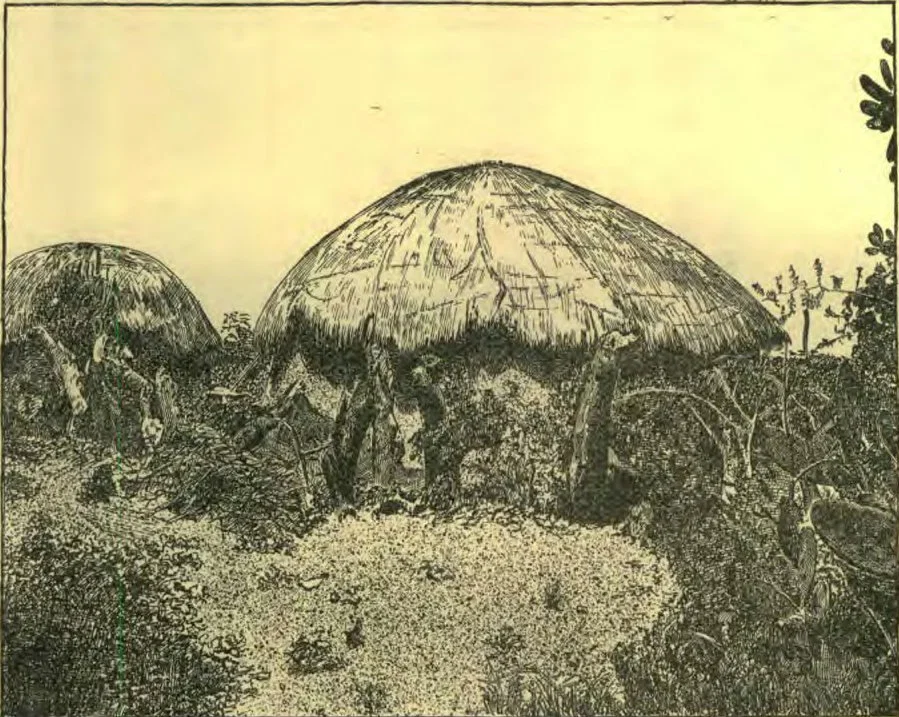
The Kaffers and other natives live in round huts, something like a large bee-hive. These huts are called kraals, and are made of wattles, plastered on the outside with mud. Their furniture is of the crudest description. They do, however, go so far as to have pianos, but it would be impossible to describe them so as to give a correct idea of their appearance. The accompanying is a picture of one of these kraals.
The most dreaded enemy with whom the pioneers had to contend was the Bushmen. These are a race of dwarfs of a dirty yellow color, with spindling legs and arms, and the hair growing only in patches over their heads. They are so degraded that none of the other tribes will claim any relationship to them. They build no houses, but dwell in holes in the ground. Their sole weapon, and indeed the only thing that they have ever been known to invent, is a bow, from which they send, with unerring aim, poisoned arrows, bringing certain death to the man or beast at whom they are aimed. They received the name of “Bushmen” from the fact that when they go to battle, they usually cover their heads with bushes, and then crawl on the ground like four-footed animals.
The country inhabited by them, the Zulus, and the Kaffers has been, and is to a great extent, infested with enormous snakes and other reptiles. A single sting from these snakes means certain death to a white man. Living among them as the Zulus and Bushmen do, it might be thought that many of them would suffer death from the bites and stings. But in order to guard against this catastrophe, a very singular method is adopted. When a man is bitten, a native doctor is sent for, and he prescribes a cup of poison which has been extracted from a snake of the same or of a similar character. This poison has the effect of throwing the patient into a state of intoxication, and when he comes out from under the spell, he is cured of the sting, and moreover in the future is proof against the snakes. It is even stated that when a snake draws near a person that has drank of this poison, it seems to become aware of it, and will retire without attempting to harm him.
There is another kind of snake called the “boom-slang,” or “tree snake.” These partly wind themselves on the boughs of trees, and when a man or an animal comes underneath, the snake stoops down and bites. It is claimed that these snake bites are not as deadly as some others. Another kind of snake seems to have the power of mesmerizing its victim, so that he is powerless to move or get away from it. By firing a shot, or by another person’s walking between the two, the spell may be broken. But the most deadly and most common of all is the “puff adder.” It is the color of an old dry log, and lies on the ground in a stupid condition. As long as one is in front of them, they cannot bite; but when their back or tail is stepped on, they will throw their heads back and bite. P. T. M.

“BY THEIR FRUITS YE SHALL KNOW THEM.”

TINY STRONG and her friend Rachel were sitting in the parlor of the boarding-school where they were pupils, talking very earnestly over their work. They had chosen a quiet corner in the large room, quite apart from the merry groups of girls scattered here and there.
“I want to do and be something better than I have been!” said Tiny, soberly, pushing back the soft hair from her face. “I don’t feel a bit satisfied with living just as I used to! It seems as if a Christian girl ought to be about the King’s business,” she said softly.
“And one has such chances here,” said Rachel, “to be kind and thoughtful, and to do a great deal for others.”
“Yes; and the girls are always watching, when we never dream of it, to see whether Christian girls are, after all, any different from other people.”
“There’s only one thing to be done about it, and that is to begin right away to do better,” said practical Rachel. “If we start together, we can help each other.”
Tiny was silent for a moment; she was asking for God’s help. Then she smiled brightly, as she answered:—
“Let us begin now, dear. There is Helen Rogers all alone over there. Suppose we go.”
A moment later Tiny’s arm had stolen around Helen, and the warm squeeze she gave her brought a loving light into her dull face.
“We wanted you,” said Rachel, in answer to her wondering look; for she was not a favorite with the girls. “Didn’t you want us?”
“Oh, yes!” was the quick response. “I was thinking of mother, and feeling so lonely.”
“Whenever you feel that way, come and find us,” said Tiny. “You may always be sure of a welcome.”
“Oh, thank you! I shall be so glad to have some friends,” was the fervent reply.
“Suppose we go and sit with Laura Stevens a little while. It must be forlorn enough up there,” said Rachel. “She has been sick all this holiday week. I feel so sorry for her.”
“Wait a minute. I have some fresh flowers which mother sent me to-day; let me carry them.”
Already the “King’s business” was spreading, and there was work for three pairs of hands instead of two.
“It is a great deal pleasanter than trying to please ourselves; why haven’t we begun before?” whispered Tiny in Rachel’s ear, as they waited for Helen at the door.
Days followed, filled with kind words, looks, thoughts, and deeds done by these two simple, every-day girls. One and another felt the influence of their kindness, and sought to emulate it; and the angels carried the record of it to heaven.—The Well-Spring.

INDIAN FISHERS.

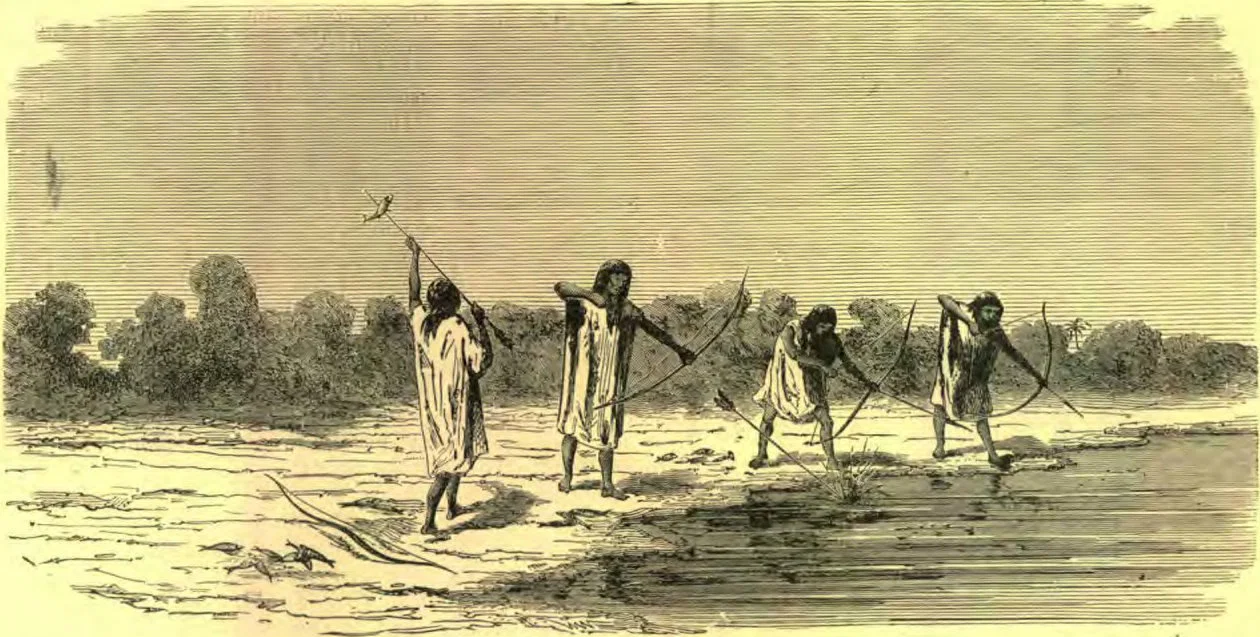
FISHING with bows and arrows! Isn’t that an odd thing to do? That is the way the Indians in the picture are fishing, and I suspect it is the way Indians have always fished until they lived among civilized folks, and could buy Yankee fish-hooks in the stores. There are still a good many Indians who fish with bows and arrows and spears. I will tell you about them.
Away up in the northwestern part of North America is a very interesting country, called Alaska. Can you find it on your map? It belongs to the United States. Maine, New Hampshire, Vermont, Massachusetts, Connecticut, and Rhode Island, all put together, would only fill up a corner of Alaska. Alaska is nine times as large as the New England States.
The winters there are long and cold. But in the ocean, along the coast of this great country, there flows a river of warm water. This river of water warms the cold air that blows from the land, and makes the atmosphere mild and pleasant. Beautiful forests cover the slopes of the mountains, and dashing cascades and waterfalls tumble down the rocks. Great rivers come rushing and roaring down, to empty their waters into the ocean.
In this beautiful country a great many Indians live. They have dwelt here ever since we have known anything about their country. The Alaskan Indians are sailors and fishers. They live near the coast, and along the great rivers.
Have you ever eaten that delicious fish called salmon? Up in Alaska these fish live in great numbers. It is the greatest salmon country in the world. There are always plenty of fish in the Alaskan rivers. But at certain seasons of the year, they swarm in the waters in great numbers. They are going up the streams to find a safe place to raise their families, where the great fishes that live in the sea will not find the little salmons and eat them up.
At such seasons the waters are so full of fish that it would be useless to try to catch them with a hook and line. They often crowd one another on to the river banks.
Then the Indians in the villages leave their homes, and every one goes fishing. They pitch their tents, or build little huts of bark, all along the banks of the streams. They catch the fish with spears or with bows and arrows. Often the fish are so thick that the Indians can shovel them ashore with the paddles of their canoes. Is that too great a “fish story” to believe? It is true. The great silver-backed fishes leap and play in the water in a way that is enough to drive an angler crazy if he cannot catch them.
The Indians dry these fish with salt, or smoke them. This is to be their food during the long winter months when everything is frozen up, and covered deep with snow.
But other people live in the salmon country besides the Indians. In many places the traveler sees great buildings by the banks of the river; and lots of little bark houses in which Indians live. These large buildings are salmon canning factories. Indians and Chinamen live in the little bark huts, and work for the white men who run the factories. They pack thousands of cases of salmon every year, and send them all over the country. They take great pains to have everything clean and neat about the works. In the rivers near the factories, the salmon are not so plentiful as in the other streams further north, because so many are caught every year. The Indians catch them with nets also.
Would you not like to go fishing in such streams as these? Sometime I will tell you more about this part of our great country. W. E. L.

GRANDMOTHER MUDGE.

Aunt Louise Tendall had been keeping house for Papa Tendall and Annie three weeks, because mamma was away taking care of Grandma Sapperfield, who was very sick. It would be a long time before she would be able to travel, and then she was coming home with mamma.
This was what made Miss Louise think so hard, and look so soberly at Annie. For Annie was a little household tyrant, and a tyrant is apt to make things pretty uncomfortable for everybody, and especially for grandmas.
So Miss Louise thought and thought, and finally she decided to make a surprise for Annie’s birthday.
The little girl, so soon to be six years old, was not long in finding out that something was being kept from her, and one afternoon she slipped away from her nurse, and ran to her auntie’s door. In answer to her rap, Miss Louise peeped out with a queer smile, and said, in a low tone: “Run away, Annie. Auntie is very busy preparing a surprise for your birthday.”
Annie returned to her nurse. “Why, auntie’s making a surprise for my birthday,” she said. “We mustn’t any of us bother her.”
The birthday came, and very early in the morning Annie ran down-stairs, where papa caught her, and gave her six hugs, and six kisses, and six loving little pats.
Then he set her down that she might see her presents. Oh, so many presents! Presents from everybody! But Annie only glanced at them carelessly, and ran to her aunt, who just then entered the room.
“Where’s that supwise you was a-making?” she demanded.
“It isn’t time for that,” answered Miss Louise, with a kiss. “You must wait till after breakfast.”
“Don’t want to wait forever and ever,” said Annie, with a pout.
“Oh!” cried auntie. “A pout on your birthday! I wouldn’t allow a pout to come to my birthday. I’d say, ‘You ugly little pout, a birthday is a nice day, and you are not a bit nice, and you can’t come.’”
“Pout, go away! Go away!” commanded Annie.
“Pout’s gone, auntie.”
“That’s good,” said Miss Louise; “but you must watch, or Pout will come back.”
Breakfast over, and papa gone, Miss Louise and Annie set out, hand in hand, to view the surprise. Up the stairs and along the hall they went, till they came to auntie’s room. The door was flung open, and the child gazed at the pretty sight before her.
“Oh, what a lovely supwise!” she cried. “See the pretty new dresses on my dollies!” Then, as her eyes spied a stranger in the group, “What a funny doll that is in the new rocking-chair. Where did you get that doll, auntie?”
Annie ran forward, and picked up the new arrival to inspect her more closely.
“Gently, gently, Annie,” cautioned Miss Louise. “That is Grandmother Mudge.”
“Grandmuvver Mudge! What a funny name!” cried Annie, as Miss Louise took the doll, and held it out at arm’s length.
“Grandmother Mudge is an old lady,” said Miss Louise. “See her quiet gray dress, with the kerchief pinned across her breast. See her gray hair fastened up with a silver pin. See her spectacles with silver bows.”
“Let me take her! Let me take her! Quick, auntie,” cried Annie.
“Well, just this once, to get acquainted with her. She is not meant to be held. She must sit in her nice rocking-chair.”
“Why?” asked Annie.
“Because she is old,” said Miss Louise solemnly.
“Old! why, I thought she was new.”
“She is new, and yet she is old. Look at your other dolls. They are all young. There is the baby in its cradle. There are the little boys, and the little girls, and the young ladies, and the young gentlemen. But Grandmother Mudge is old. You must teach all the rest to be very polite to her.”
“How? how?” demanded Annie, who liked to play at teaching.
“They must never take her chair,” said Miss Louise impressively, as she put Grandmother Mudge back again.
“They never s’all.”
“They must never dispute her.”
“No.”
“They may kiss her hand, and sometimes lay an arm gently about her neck.”
“That’s nice.”
“They must never act cross when she asks them to do anything.”
“No.”
“And in every way you must teach them to be respectful to Grandmother Mudge, because she is old.”
“My dollies s’all be ’spec’ful to Grandmuvver Mudge, ’cause she’s old,” said Annie.
And the child began at once her lessons to the dolls in politeness to the aged.
Every day Grandmother Mudge grew in favor with Annie, who quickly learned to love her more than she did all the others, and every day the young dolls learned to behave better and better.
It was two months after Annie’s birthday, when a carriage drove up, from which Mrs. Tendall and her mother alighted.
“O auntie, auntie!” cried Annie, “here comes a twuly Grandmuvver Mudge!”
“No, darling. That is your dear Grandma Sapperfield. But you must always treat her just as your dollies treat Grandmother Mudge.”
“Louise,” said Mrs. Tendall, a few days later, “Annie’s ways toward mother are just lovely. Where did she learn to be so prettily attentive and respectful?”
“I think she learned from Grandmother Mudge,” answered Miss Louise, with a smile.—The Christian Weekly.

BONNIE'S PRAYER.

Dear little Bonnie, four years old, Thoughtful as child of her age could be, Said her prayers as her mother told, Nightly kneeling beside her knee,
But she said one night, this quaint little elf, "I've a wish, my mamma, so good and true, Let me kneel by the bedside, all by myself, And make my prayers as the big folks do."
So we were quiet as mice could be, While Bonnie, robed in her night-gown white, Stole on tip-toe, and bent her knee, All alone for her prayers that night.
Only a moment the wee head bowed, Then the face came up with a smile most fair; While the other children laughed aloud At the wondrous shortness of Bonnie's prayer.
Then came a little flush of dismay Over the radiant face so small, "I couldn't think of much to say, So I said, 'Lord keep me,' and that was all."
Papa kissed her gravely and smiled. "That was the best of prayers, my dear; It was all you needed to say, my child, You could ask no more if you prayed a year."
—Ladies' Home Journal.

Overcoming Our Faults Through Patient Effort

However good you may be, you have faults; however dull you may be, you can find out what some of them are; and however slight they may be, you would better make some patient and earnest efforts to overcome them.
Continue reading: WHAT THE WORD MEANT