The Youth’s Instructor, Vol. 30, No. 1.

THE ELEVENTH COMMANDMENT

The Youth’s Instructor

Jan 4, 1882

S. D. A. Publishing Association · Battle Creek, Mich. · Jan 4, 1882

THE ELEVENTH COMMANDMENT.

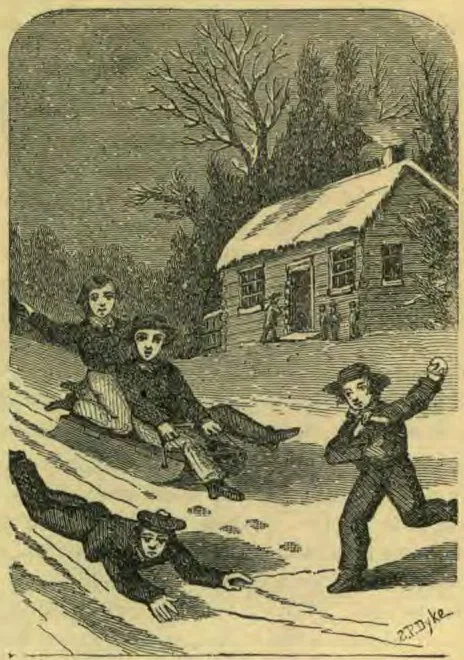
No, I will not lend you my sled, Willie; I want to use it myself, so you needn't beg any longer," said Charlie Albertson, as he and Willie Miller were standing on the village hill one winter's afternoon. "If your father is too poor to buy you one," he continued, "I can't help that; so move out of the way now, for I want to ride down hill."
The boy moved away, and watched the flying sled with longing eyes. Charlie was right, though he did not know it. Willie's father could not afford to buy his son a sled; for it took all his hard-earned money to purchase clothes and food for the many little ones at home, and Willie had tried to make one, all in vain. It was a trial for him to see the other boys coasting, and he could not help thinking that Charlie was unkind to refuse him "just one ride." But he brushed away the tears and ran home, trying not to feel so very sorry.
Did the ice melt after Willie left, or were the sled runners out of order? What is the reason that Charlie did not enjoy coasting as he had done before? There was no one now to beg for "just one ride," no one to stand in the way; then why was it he so soon left the hill and dragged his sled into the house?
In the evening just as Charlie had finished studying the last lesson, his father looked up from a book he had been reading, and asked him if he could say all the commandments.
"Yes, indeed, papa," replied Charlie. "What a question! I knew them all years ago."
"Very well, repeat them," returned Mr. Albertson. Charlie commenced, and ended the tenth exultantly, without missing one word,
"Go on," said his father, "I want to hear the eleventh."
"The eleventh, papa!" exclaimed the child, "I never heard of it. There are no more in my Bible, at any rate;" and Charlie brought his little Bible, open at the twentieth chapter of Exodus.
"Suppose God should give us a new commandment, wouldn't you call that the eleventh?" asked his father.
Mr. Albertson then turned to the thirteenth chapter of the Gospel of St. John, and asked him to read the thirty-fourth verse:
"A new commandment I give unto you, that ye love one another; as I have loved you, that ye also love one another," read Charlie.
"Now, when I tell you," said his father, "that I passed through the woods on the hill this afternoon, I guess you will know why I wanted to hear if you remembered the eleventh commandment."
Charlie blushed; for he knew that his father must have heard his cross words to Willie, and he felt very sorry indeed that they had ever been said.
"I wonder if my son knows how hard Mr. Miller has to work in order to buy even bread and clothing for his many children," said Mr. Albertson. "I wonder if he saw the tears that filled Willie's eyes, as he turned away from the hill this afternoon. If my boy had seen how sad the poor child looked, I do not think he could have enjoyed even coasting afterward."
"And I'm sure I didn't enjoy it at all, papa," said Charlie, trying in vain to dry the tears which would come, as he thought of Willie. "I am very, very sorry that I was so unkind; but what can I do now?"
"Think for yourself, Charlie," said Mr. Albertson, "and try to find some way to show your love for poor Willie."
Charlie thought a long while, and then springing up, clapping his hands, exclaimed, "I know what would be splendid, papa; I will take some of the money that you gave me at Christmas, and buy a sled for Willie; wouldn't he be pleased?"
"That is a capital plan," replied his father, "and to-morrow we will go to select one."
Very early the next morning Mr. Albertson and Charlie started out, and bought the prettiest sled in the village store; and before school commenced, Charlie asked Willie if he would not like to try it.
The poor boy was delighted, and after having rode down the hill several times, brought the sled back to Charlie, with many thanks.
"Keep it," said Charlie, so excited that he did not know what to say; "I don't want it; it's yours; I didn't mean to be so cross."
Willie could not understand what was meant, and it was some time before he could realize that the beautiful sled with a prancing black horse painted on it, was really his own, "to keep for ever and ever," as Charlie said. Then how happy he was, and how happy they both were together, I cannot begin to tell you.
"I mean to write the eleventh commandment in large letters and hang it in my room," said Charlie, after he had told his father how happy the sled had made Willie. "Wouldn't that be a good plan, papa?"
"Yes, my boy," said Mr. Albertson; "but do not forget to ask God to write it on your heart as well, and give you strength to keep it always."
"Yes, indeed, I will ask Jesus to help me," said Charlie, "for I never could keep it all alone."
Now I wonder what the boy is going to do who has just finished this story. Will he lay the paper aside, and forget the beautiful new commandment Christ has given him, or will he not rather think of the great love Jesus showed for him when dying on the cross that he might live, and pray God to help him show forth his love for that dear Saviour, by keeping the new commandment?—New York Observer.
WINTER.
WINTER.

WINTER'S COMING.

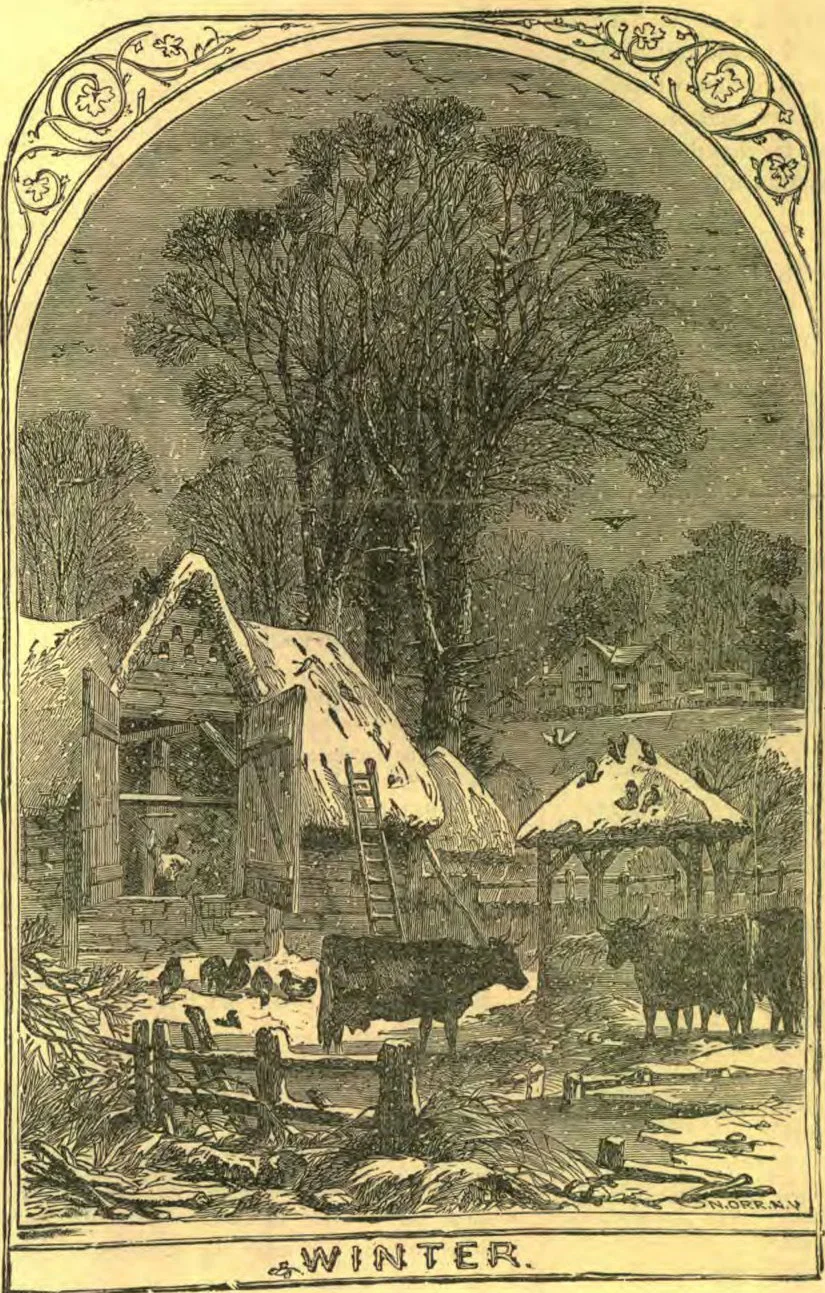
Winter's coming! Winter's coming! Don't you hear him drawing nigh? Hark! the north-west winds, his chariot, Hear them sweeping through the sky, Whistling gaily, calling loudly, “Winter's coming, coming near; Snow-flake crown and icy scepter I have formed that he may wear.”
Long ago, the flowers, listening, Heard the rumbling of his car; Tenderly they dropped their petals On the brown earth, cold and bare, Whispering softly, “Winter's coming, We will hie us out of sight; Ha! he thinks to overtake us, He will find us gone to-night.”
Long ago, gay Robin Redbreast, Swallow, Thrush, and all their train, Plumed their wings and sang their sweetest, Sang, “Good-by, we'll come again.” In the woods where nuts were dropping, Squirrels hoarded up their store, Dainty ferns flung out their banners, Waved good-by, and were no more.
And now the winter's coming, coming, Snow-flakes whirling through the sky; Stir the fire and draw the curtain, We'll not heed his passing by. Many a pleasant thought he brings us, Warmth, and glow, and Christmas cheer; We'll not spurn him from our pleasures, But welcome in his glad New Year. —Kate.

THE BELLS OF DREAM-LAND.

A NEW YEAR'S CAROL.

The bells of dream-land ring for joy, And echo through my brain In one triumphant choral song, One sweet, melodious strain: Hopes of youth are twined with flowers, Love and tenderness, Fancy dwelleth in her bowers Rich with loveliness. Bells of dream-land, ring, Oh ring! Youth and children gayly sing! Darkness flee, and clouds away! Welcome, welcome, New Year's Day!
O magic dream-land, distant, dim, Yet near at midnight hour! I love thy visions and thy songs, I love thy weird, strange power. Vain, illusive all thy scenes May to many be, Yet not fleeting are the truths That abide with me. Bells of dream-land, ring, Oh ring! Youth and children gayly sing! Darkness flee, and clouds away! Welcome, welcome, New Year's Day!
The sun-bright scenes I view in dreams Speak of a glorious clime, Beyond earth's gloomy doubts and fears, Beyond the hills of time: Years of fadeless beauty, bloom, Years of heavenly calm, Years that soothe the weary heart Like an evening psalm. Bells of dream-land, ring, Oh ring! Youth and children gayly sing! Darkness flee, and clouds away! Welcome, welcome, New Year's Day!
The year of eighteen eighty-two Upon the threshold stands, With garlands twined around his head And blessings in his hands. We may grasp the treasures, We may make our days Bright with God's own sunlight, Radiant with its rays. Bells of dream-land, ring, Oh ring! Youth and children gayly sing! Darkness flee, and clouds away! Welcome, welcome, New Year's Day!
And not in dreams alone may we Be earnest, active, true, In life's great workshop here below There's much for all to do. Carols breathing faith and love, Hymns of grateful praise To the Father of all good Joyfully we'll raise. Bells of dream-land, ring, Oh ring! Youth and children gayly sing! Darkness flee, and clouds away! Welcome, welcome, New Year's Day!
Fill every moment as it flies, The bells of dream-land ring, With kindly deeds, and then the year Will only gladness bring. Help the needy, raise the fallen, Scatter far and wide Seeds of goodness, and their fruitage Will with you abide. Bells of dream-land, ring, Oh ring! Youth and children gayly sing! Darkness flee, and clouds away! Welcome, welcome, New Year's Day!
Mortals, beware, “live not for self,” The bells of dream-land chime, The coming year may be most blest, Most sacred, holy time. Live for God, and live for others, Live for justice, truth, Live for all that's noble, generous In the days of youth. Bells of dream-land, ring, Oh ring! Youth and children gayly sing! Darkness flee, and clouds away! Welcome, welcome, New Year's Day!
O pity the mourner, pity the sad, The bells of dream-land toll, O pity the bleeding, sorrowing heart, O pity the wandering soul. Sympathy will lift the burden That thy brother bears, Make his heart “a watered garden,” Drive away his cares. Bells of dream-land, ring, Oh ring! Youth and children gayly sing! Darkness flee, and clouds away! Welcome, welcome, New Year's Day!
Resolve to live a noble life, The bells of dream-land peal, Then in your heart and soul, the peace Of God you'll know and feel. Blessed peace, so sweet and restful, Roll thy waves afar, O'er the earth in mighty billows, Keep the “gates ajar.” Bells of dream-land, ring, Oh ring! Youth and children gayly sing! Darkness flee, and clouds away! Welcome, welcome, New Year's Day! ELIZA H. MORTON.

COMMON SCENES.

AMONG THE CLOUDS.

The ocean of clear air giving life to all living things and supporting its countless fleet of clouds, contains beauties and mysteries as well.
Probably a hundred miles in depth, it is supposed to present above, like the ocean of water, a definite surface. It also has currents, as may be felt in every breeze, and counter-currents, as may be proved by watching separately different clouds, which, driven by these currents, appear moving in opposite directions.
Mingled with the air and extending beyond it even to the planets and distant suns, is an unseen fluid called ether. Through this ether, light is carried from those distant bodies to our eyes, and through it heat comes to us from the sun.
Since the color of objects is due to the properties of light, it appears that through it and this wonderful ether, we gratify our love for the beautiful; for beauty of form and grace of movement become visible through them alone. The light alone is very beautiful. Can we then look unmoved upon the first star of evening, upon the silent mysteries of the milky-way, or the calm heavenly brilliancy of the morning star?
In the light of day, the clouds contribute largely to “the splendid scenery of the sky.” These bodies formed by vapors that rise from land and sea float at varying heights according to their density. Far up in the thin cold air are scattered the cirrous, or curl clouds, light and ragged in appearance. In the warmer currents beneath, particularly during summer days, are seen those great silver-lined, rolling masses known as cumulus clouds. These are succeeded at night by the stratus, or stratified, clouds, often remaining through the day, if cool, and really the most common form.
Near the earth and ready to be discharged in showers, we often see the nimbus, or rain-cloud. Who in the cool shade of June has not reclined gazing into the unfathomed blue of heaven where white clouds floated dreamily? In the cooling fleeciness of a zenith cloud is something of inimitable freshness—its depths of mist create a soothing thought which painter's brush and canvas cannot reproduce.
Had our sky been always “black, all black”—had no airy clouds been suspended in mid-air and no bow been bent, no more beauty would have remained uncreated than is even now by many unadmired. To many, the only meaning of the most glorious sunset is “a good hay-day to-morrow” or a “fine time for the show.” Such, may be, are not to blame for not loving beauty which no one has taught them to love, but our Saviour teaches us to “consider the lilies”; and I think it will please him if we admire his works as we do his will.
Stop but a moment to-night and look at the sunset! Through day's open gate a long line of brazen sky reaches to the south afar. Above, extends farther than our eyes can trace, a cloud of fleecy richness; mellow and sumptuous it is with color, but ever varying,—at first a lovely brown, tinged then with purple, to be the next moment checkered and illuminated with the most brilliant beams.
A path of light, expanding as it rises, shoots up, up toward the blue ether of heaven, and while the upper clouds seem breaking into fragments, a long line of darkening blue, half hidden by forest, extends along the horizon. Suddenly the great sun emerges from behind an even-bordered cloud and appears in an ocean of light; while above and below, to the north and to the south the clouds are colored gorgeously—crimson and purple are there, scarlet and gold, vermilion and indigo as painter never can combine them. With the sinking of the sun these colors yield to others less and less brilliant, and when at last twilight covers the earth, we are left wondering at the power, the skill, and the goodness of Him who paints the sunset. GEO. R. AVERY.

CHEERFULNESS

THIS is a trait of character we should all cultivate. A cheerful, happy face is welcome everywhere, while a sullen, morose disposition no one admires. We often meet with boys and girls who seem cheerful and happy, and their kind, winning ways draw them to us, and we love them. They are a blessing to society, for they exert a good, cheerful influence over all with whom they come in contact.
We may be happy and cheerful, and still not be boisterous and rude. Sometimes people are called unhappy, when they are only thoughtful. It is not necessary to make a great noise when we are cheerful; we can show it in a more subdued manner,—by pleasant smiles, kind words, and good deeds. Try it, and see if it will not work well.

The Bond of Mutual Trust

THERE is nothing that binds heart to heart so quickly and so safely as to trust and be trusted.

NEW-TESTAMENT HISTORY.

LESSON 63.—THE PHARISEES REPROVED.

ABOUT this time our Lord seems to have repeated the prayer which he taught his disciples in the Sermon on the Mount. He then set forth the efficacy of earnest, persevering prayer by saying, “Which of you shall have a friend, and shall go unto him at midnight, and say unto him, Friend, lend me three loaves; for a friend of mine in his journey is come to me, and I have nothing to set before him? And he from within shall answer, and say, Trouble me not; the door is now shut, and my children are with me in bed, I cannot rise and give thee. I say unto you, Though he will not rise and give him because he is his friend, yet because of his importunity he will rise, and give him as many as he needeth. And I say unto you, Ask, and it shall be given you; seek, and ye shall find; knock, and it shall be opened unto you. For every one that asketh, receiveth; and he that seeketh, findeth; and to him that knocketh, it shall be opened. If a son shall ask bread of any of you that is a father, will he give him a stone? or if he ask a fish, will he for a fish, give him a serpent? or if he shall ask an egg, will he offer him a scorpion? If ye, then, being evil, know how to give good gifts unto your children, how much more shall your Heavenly Father give the Holy Spirit to them that ask him.”
“And as he spake, a certain Pharisee besought him to dine with him; and he went in, and sat down to meat. And when the Pharisee saw it, he marveled that he had not first washed before dinner. And the Lord said unto him, Now do ye Pharisees make clean the outside of the cup and the platter; but your inward part is full of ravening and wickedness. Ye fools, did not he that made that which is without make that which is within also? but rather give alms of such things as ye have; and, behold, all things are clean unto you. But woe unto you, Pharisees! for ye tithe mint and rue and all manner of herbs, and pass over judgment and the law of God: these ought ye to have done, and not to leave the other undone. Woe unto you, Pharisees! for ye love the uppermost seats in the synagogues, and greetings in the markets.”
Then he tells them that they do all their works to be seen of men, making broad their phylacteries and enlarging the borders of their garments; that they want the most honorable places everywhere, and love to be called rabbi, or master. Then, addressing his disciples, he said: “But be not ye called rabbi, for one is your Master, even Christ, and all ye are brethren. . . . He that is greatest among you shall be your servant; and whosoever shall exalt himself shall be abased, and he that shall humble himself shall be exalted.”
“Woe unto you, scribes and Pharisees, hypocrites! for ye are like unto whited sepulchers, which indeed appear beautiful outward, but are within full of dead men’s bones, and of all uncleanness. Even so ye also outwardly appear righteous unto men, but within ye are full of hypocrisy and iniquity.”
“Then answered one of the lawyers, and said unto him, Master, thus saying thou reproachest us also. And he said, Woe unto you also, ye lawyers! for ye lade men with burdens grievous to be borne, and ye yourselves touch not the burdens with one of your fingers. Woe unto you! for ye build the sepulchers of the prophets, and your fathers killed them. Truly ye bear witness that ye allow the deeds of your fathers; for they indeed killed them, and ye build their sepulchers. . . . Woe unto you, lawyers! for ye have taken away the key of knowledge: ye entered not in yourselves, and them that were entering in ye hindered.”
“Wherefore, behold, I send unto you prophets, and wise men, and scribes: and some of them ye shall kill and crucify; and some of them shall ye scourge in your synagogues, and persecute them from city to city; that upon you may come all the righteous blood shed upon the earth, from the blood of righteous Abel unto the blood of Zacharias son of Barachias, whom ye slew between the temple and the altar. Verily I say unto you, All these things shall come upon this generation. O Jerusalem, Jerusalem, thou that killest the prophets, and stonest them which are sent unto thee, how often would I have gathered thy children together, even as a hen gathereth her chickens under her wings, and ye would not! Behold, your house is left unto you desolate. For I say unto you, Ye shall not see me henceforth, till ye shall say, Blessed is he that cometh in the name of the Lord.”

QUESTIONS.

1. What did one of the disciples of Jesus ask him to do at one time after he had been praying? Luke 11:1.
2. When had Jesus first taught this prayer?
3. After having taught the prayer again, what did Jesus set forth?
4. Relate the circumstances under which a friend is supposed to ask for bread?
5. What objections are made to complying with his request?
6. What finally secures the favor?
7. What admonitions does the Saviour then give?
8. What promises accompany these admonitions?
9. In what way did our Lord then show the willingness of God to bestow real blessings upon them that ask him?
10. What invitation did Jesus receive as he was speaking? Luke 11:37.
11. What caused the Pharisees to wonder?
12. What did Jesus say to him? Verses 39, 40.
13. What did he advise them to do? Verse 41.
14. For what did he condemn them?
15. Was there sin in what they had done, or in what they had neglected to do?
16. Why had they neglected the most important things?
17. How did they manifest their desire for preferment?
18. Of what wrong motive were they guilty?
19. What admonition did he then give his disciples?
20. Who did he say should be exalted, and who debased?
21. How did he expose the hypocrisy of the scribes and Pharisees? Matt. 23:27, 28.
22. How was he then addressed by one of the lawyers that were present? Luke 11:45.
23. How did Jesus then reprove the lawyer?
24. How did he show that they endorsed the wicked deeds of their fathers? Verses 47, 48.
25. What enormous guilt rested upon them? Verse 52.
26. What did he say he would send them? Matt. 23:34.
27. How did he say the lawyers and Pharisees would treat them?
28. What awful condemnation would thus be brought upon them?
29. How did he manifest his compassion for Jerusalem?
30. How had the people of Jerusalem responded to his efforts to bless them?
31. What consequences were now to follow?

SCENES IN THE LIFE OF CHRIST.

LESSON 50.—REVIEW.

  1. Why was John the Baptist cast into prison?
  2. How was the Herod that John reproved related to the one who slew the infants in Bethlehem?
  3. In what castle was John imprisoned?
  4. Where did that castle stand?
  5. Give a description of it.
  6. How long was this good man kept in one of the gloomy dungeons of this castle?
  7. How do we know that some of his disciples were allowed to visit him?
  8. What was finally done to John?
  9. How was Herod led to do such a wicked act?
  10. After John was beheaded, what was done with his body?
  11. What did Herod’s troubled conscience make him think when he heard of the miracles of Jesus?
  12. On returning from their tour, what report did the twelve make to their Lord?
  13. How did he show a tender care for them?
  14. Where did they seek a place of rest?
  15. Why were they obliged to go across the sea to find quiet?
  16. Near what city was the mountain where they sought repose?
  17. Why would Jesus be likely to have some sad thoughts at this time?
  18. How did the people get to the Saviour after he had crossed the sea?
  19. Did he send them away at once?
  20. How did he show his love for them after teaching them till nearly night?
  21. Tell how the great multitude were fed?
  22. How many men were fed? and how many baskets full of fragments were gathered up?
  23. How did the people show their faith in Jesus, when they saw this great miracle?
  24. What did the Jews think the Messiah would do when he should come?
  25. How did they come to make such a mistake?
  26. Why could not Jesus consent to let the people make him king?
  27. Whom did he first send away?
  28. After withdrawing from the multitude, where did Jesus spend most of the night?
  29. How was he employed there?
  30. How had the disciples prospered in trying to cross the sea?
  31. Tell how Jesus went to their relief.
  32. What did they think when they saw him?
  33. How did they find out who it was?
  34. Tell what Peter did.
  35. How did they succeed in their voyage after they had taken the Lord aboard?
  36. What took place after they landed?

NOTES

Offer scorpion.—The scorpion is an animal with eight feet, eight eyes, and a long, jointed tail, ending in a pointed weapon, or sting. It seldom exceeds four inches in length. Its sting is extremely poisonous, and is sometimes fatal to life. The body of the white scorpion, when rolled up, has a considerable resemblance in size and appearance to an egg, and the figure is used, therefore, with great appropriateness by our Lord.
Ye tithe mint and rue, etc.—These were herbs of little value. The law of Moses said that they should pay tithes of the fruit of the earth. It said nothing, however, about herbs. It was a question whether these should be tithed. The Pharisees maintained in their extraordinary strictness, that they ought. Our Lord means to say that they were precise in doing small matters which the law had not expressly commanded, while they omitted the greater things which it had enjoined.—Barnes.
Phylacteries.—Pieces of scrip, upon which were written portions of the law of Moses. These were worn by the Pharisees upon the arm and the forehead. The Pharisees enlarged them, or made them wider than other people, either that they might make the letters larger, or write more on them—to show, as they supposed, that they had peculiar reverence for the law; but they really became badges of vanity and hypocrisy.
Enlarge the borders of their garments.—This refers to the loose threads which were attached to the borders of the outer garment as a fringe. This fringe was commanded in order to distinguish them from other nations, and that they might remember to keep the commandments of God. They made them broader than other people wore them, to show that they had peculiar respect for the law.—Barnes.
Taken away the key of knowledge.—A key is made to open a lock or door. By their false interpretation of the Old Testament, they had taken away the true key of understanding it. They had hindered the people from understanding it aright. ‘You endeavor to prevent the people also from understanding the Scriptures respecting the Messiah; and those who were coming to me ye hindered.’—Barnes.

Teachers Urged to Teach Love of Truth

TEACHERS, endeavor to educate your scholars to the love of truth and virtue. Dwell particularly upon the moral teachings of the Bible. Make goodness attractive and wickedness odious. Above all things, don't teach that it costs a sacrifice to be good. It does not. A really good person is happier than one accustomed to the evil ways of the world.

THE NEW SCHOLAR.

ONE of the children seemed to know his name; for he had come from the poor family that had just moved into the village.
It was a raw spring day; yet there he stood in the school-house yard, amidst a noisy crowd of boys and girls, barefooted, and with trousers coming only just below the knee. His jacket was scant and threadbare, and his cap of a shape so odd as to make it a source of great mirth to the larger boys, who, after playing various pranks with it, at last placed it again on the child's head, well spattered with mud.
Rudeness is apt to grow by what it feeds on; so it was not strange that, from roughly handling the stranger's cap, the next step should be to hustle the boy himself about.
Suddenly the teasing stopped, and the sobbing child heard a sweet voice say something about lambs.
Lambs? He had always lived in the city till now: so he had never seen the real little frisking beauties; but he had seen a picture of them, and felt sure he should know them. Were any near?
He brushed the tears away hastily, and looked about. All he saw was a lady coming toward him with an eager look, as if she were going to protect him; and the children looked ashamed. This was all; there were no lambs.
In an instant more she had laid a soft hand on the despised and muddy cap, and was saying,— “This child is one of His lambs.”
Blue eyes, brown, and gray, were all gazing into her face amazed.
“One of whose lambs?” the wondering eyes asked; but the lips were all silent. I think most of them suspected they had gone very far in wrong doing, and it was their turn to be afraid.
The lady said, patting the soft cheek so far below her own quiet face,—
“You have all heard of the Good Shepherd. ‘He will gather the lambs in his arms, and carry them in his bosom;’ and can you be cruel to one of the least of these?”
The child had seen the lambs in the picture of “The Good Shepherd.” He remembered the tender face of Christ, with the circle of light about it, and the tiny creatures snugly reposing, held by the clasping arm, so warm, so safe.
Then, with the same soft, nestling movement he imagined in the tired, cold lambs when they were taken up, he leaned against the garments of the lady who stood in His dear name, and said,—
“’Tisn’t cold now, and I am not afraid any more.”
She kissed him, and then asked the children standing about,—
“Do you believe the Good Shepherd likes you to be cruel to the weakest of his lambs?”
The boys and girls sighed as they shook their heads, and walked slowly after their teacher into school; for this was she.
Next day the little feet pattered to school in shoes and stockings; for the teacher, remembering the words, “Inasmuch as ye have done it to the least, ye have done it to me,” had called on the new poor family, and helped them out of her own pocket.
The children, too, told the story at home; and the parents in the little village were always kind; so I am glad to say the new scholar never went so poorly clad again; and, what was better, he never wholly forgot to whom he belonged, and that he should try to deserve the name given him that first terrible day of school,—“One of His lambs.”—Mrs. M. A. Parsons, in Well-Spring.

HAPPY NEW YEAR.

“Wish you a Happy New Year!” rings out from ten thousand voices, and we add ours to the chorus, and wish all our readers, most heartily, “A Happy New Year.” Wishes are cheap, but we are always glad to hear the joyful shouts that fill the air on Christmas and New Year’s mornings.
We may do much toward making our good wishes real to all our friends. A kind thoughtfulness of their comfort and convenience, a readiness to lend a helping hand, and a disposition to make the best of our circumstances, will go far toward making smooth paths for weary feet, and lifting burdens from weary shoulders. So may we help to make each day, as it passes, a happy one; and if we fill the year with happy days, it will be, in truth, a Happy New Year.
And this we must remember; the year is to be made happy for our friends and ourselves, not by any grand demonstration now and then, as on holidays and birthdays and other special occasions, but by regular attention to the common duties and courtesies of daily life.
Many of these things seem of small account, but none of them are so in reality. Nothing by which we may help another, or make another’s life brighter, is beneath our notice and careful attention. Let us begin the year with a fixed determination to leave nothing undone which may increase the happiness of those around us, and we shall be sure to find large happiness ourselves.

CARVING CHARACTER.

DID you ever watch a sculptor slowly fashioning a human countenance? It is not molded at once. It is not struck out at a single blow. It is painfully and laboriously wrought. A thousand blows rough-cast it. Ten thousand chisels polish and perfect it, put in the fine touches, and bring out the features and expression. It is a work of time; but at last the full likeness comes out, and stands fixed and unchanging in the solid marble. So does a man carve out his moral likeness. Every day he adds something to the work. A thousand acts of thought and will and effort, shape the features and expressions of the face. Habits of love, piety, and truth, habits of falsehood, passion, or goodness, silently mold or fashion it till at length it wears the likeness of God, or the image of a demon.

THE STRAIGHT PATH.

“THE Bible is so strict and old-fashioned!” said a young man to a gray-haired friend who was advising him to study God’s word, if he would learn how to live. “There are plenty of books written nowadays that are moral enough in their teaching, and don’t bind one down as the Bible does.”
The old merchant turned to his desk and took out a couple of rulers, one of which was slightly bent. With each of these he ruled a line, and silently handed the ruled paper to his companion.
“Well,” said the lad, “what do you mean?”
“One line is not straight and true, is it? When you mark out your path in life, don’t use a crooked ruler!”—Churchman.

Better to Fail Than Live Without God

BETTER fail a thousand times, and in everything else, than attempt to shape for yourself a life without God, without hope in Christ, and without an interest in Heaven.

Improving the Present: An Accountability Reflection
God demands an account of the past, and that we must render hereafter; he demands an improvement of the present, and this we must attend to now.—Jay.

A JANUARY SONG.

The Old, Old Year is dead, The snow lies on his bed, The new year has come merrily in, with a cheerful sound of bells; The wind blows sharp and keen The naked boughs between, There are no song-birds in the woods, no flowerets in the dells.
Sing hey! sing ho! As down the slide we go, With laugh and shout that ringeth out upon the frosty air; Sing up! sing down! Oh, leave the sloppy town, The sports, the pastimes, and the joys, of country boys to share!
The air is full of snow, The cattle stand and low, Knee-deep in straw, beside the barns and ricks all roofed with white, The huddled birds cry “Cheep!” Beside the folded sheep, Whose fleeces brown and dingy look, where all is fair and bright: Sing hey! sing ho! As down the slide we go. —G. H. Adams.

Letter Budget.

Maud S. Larnard writes from Plattsburg, New York, Dec. 21. She says: “I am a little girl nine years old. I go to school. I have three brothers, Charley, Ernest, and Freddy. I once had a little sister Maggie, but she was drowned nine years ago in the Saranac River. We are going to have a Christmas tree. I go to church every Sunday to the Presbyterian Church. My Uncle Seth is an Adventist. I do not take the INSTRUCTOR. He sends them to me; I like them very much. I hope you will think this worthy of printing. If so, I will write again soon.”
Florence E. Hart writes from State Center, Iowa. “I am a little girl eight years old, I have no brothers or sisters to attend Sabbath-school with me. I think we have a good Sabbath-school, and I love my teacher very much. Her name is Miss Serada Logan. I try to get my lessons well. I am in Progressive Bible Lessons, No. 3. My papa goes with the tent in the summer, and my mamma and I go with him. I try to get the little boys and girls to take our nice paper. I want to be a good girl, and be saved with the rest in God’s kingdom.”

You have reached the end of this edition.

The Youth’s Instructor · Jan 4, 1882