Your ShelfYour Projects

The Youth’s Instructor, Vol. 65, No. 17.

Jesus Loves Youth and Calls Them as Coworkers

The Youth’s Instructor

Apr 24, 1917

Review and Herald Publishing Assn. · Takoma Park Station, Washington, D. C. · Apr 24, 1917

Jesus Loves Youth and Calls Them as Coworkers
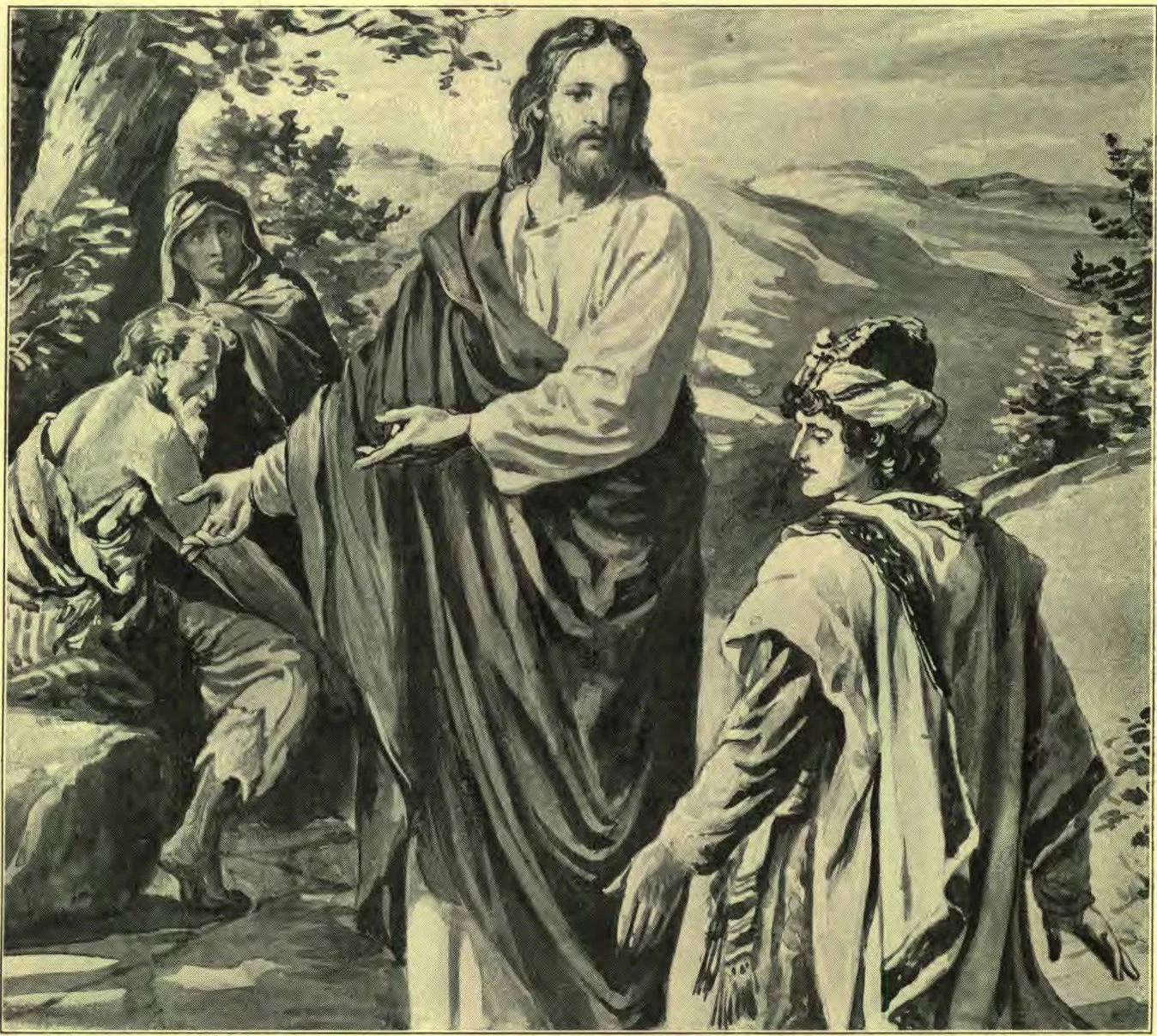
JESUS AND THE RICH YOUNG MAN
“Then Jesus beholding him loved him.” Jesus saw in this young man just the help he needed if he “would become a colaborer with him in the work of salvation.” Jesus loves every young man and every young woman, and longs to see them coworkers with himself. “The Lord has appointed the youth to be his helping hand.”

What the Missionary Volunteer Work Has Done For Me
(A Symposium)
No measuring rod has ever been devised to measure adequately the influence of the Missionary Volunteer movement; only the clear light of the city of God will show what has been accomplished. The work sometimes seems a little intangible, and to show only small results; but after a time the fruit begins to appear in the form of mature Christians, men and women who are giving their entire time to the message of the present-day Exodus movement. From only one society two conference workers and three church school teachers have come in the past few years.
R. F. Farley.
“I am sure the Missionary Volunteer work has helped me to be a different girl in many ways.”
“Reading the ‘History of the Waldenses’ has made me more courageous and stronger spiritually.”
“I have come to the conclusion that I cannot study for Attainment, and be a half-hearted Christian.”
“Regularly attending the Missionary Volunteer Society meetings has taught me to be faithful in all things.”
“The Morning Watch Calendar has truly been a blessing to me. Often I have found that the verse for the day is just what I need.”
“Never a day goes by but something I have read in my Morning Watch helps me to be more patient, and makes the trials and cares of the day lighter.”
“The Missionary Volunteer work has given me a much better idea of the needs of our young people than I ever had before, and has created in my heart a longing desire to be a help to them.”
“Until taking up the Missionary Volunteer work, I little realized the work there is for us as Volunteers to do. Through this department I have received an inspiration to become a soul-winner.”
“One of the greatest benefits I have derived from the Missionary Volunteer work has been the knowledge it has brought me of the work in foreign fields, and the desire for service in the regions beyond.”
“The Missionary Volunteer Society has drawn me closer to Jesus. It has taught me to think less of self, and more of the welfare of others. It has given me a clearer idea of how a Christian should live.”
“I learned good lessons from the study of the Vaudois. They were true to principle, and the Lord surely was with them. Our trials and persecutions are light when compared with those of the Waldenses.”
“The Missionary Volunteer Society has enabled me to appear in public with less embarrassment, and to work more intelligently on committees. Above those things I value the interest it has given me in personal work for the young people.”
“The reading of the ‘History of the Waldenses’ has given me broader views of the sacrifice and hardships endured by others for the cross of Christ. It makes me feel more determined to prepare to live the life of a missionary, and I feel sure it will help me to stand more firmly for the truth.”
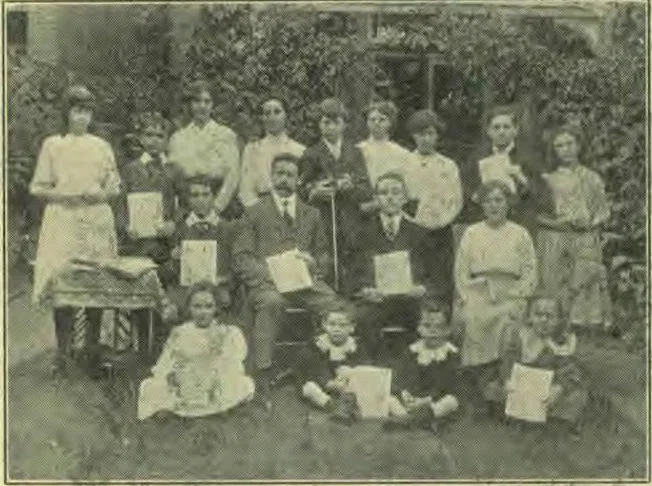
A LONDON MISSIONARY VOLUNTEER SOCIETY
“I believe those who planned the Standard of Attainment were guided by the Spirit of God. It has been a great blessing to me. I feel better acquainted with the great principles upon which our denomination is founded, and the spirit of sacrifice and devotion which characterized the pioneers in this work.”
“A few years ago, I had little ambition to make anything of myself, but on connecting with the Missionary Volunteer work, I noticed that nearly all the other members had a definite object in view, and that was to do something in the Lord’s work. This aroused me, and I am now in school preparing to teach a church school.”
“My connection with the Missionary Volunteer Society has given me an increased interest in missions, both at home and in the foreign fields. It has made me feel a greater personal responsibility in the salvation of unconverted young people.”
“The Missionary Volunteer work has inspired me to do something for the Master. Before taking up that work, I had no real object in life; but now my plan is to enter one of our sanitariums next fall, and take a nurse’s course, to fit myself for usefulness in the Lord’s vineyard.”
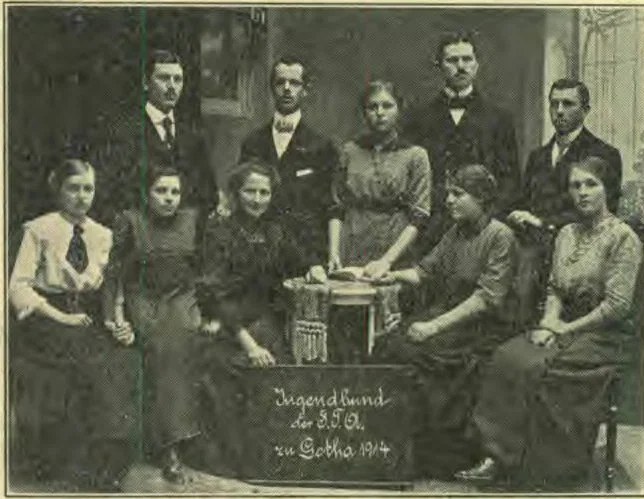
MISSIONARY VOLUNTEER SOCIETY AT GOTHA, GERMANY
“The Missionary Volunteer work has made a man of me, and has made me think of the Lord more each day. It taught me how to pray in public; at first I could say only a few words to the Lord. The Society has had a great influence upon my soul, and I have felt the touch of the Lord’s kind words in my heart. Through its influence I have been drawn nearer to God and to my brethren and sisters.”
“The Missionary Volunteer Society has been a training school to me. Preparing papers to read, learning texts for Scripture drills, and doing other small tasks have given me an experience which has been valuable. Reading our good books and studying the great harvest field have helped me to become acquainted with our best Friend, and have given me a greater desire to devote my strength and talents to his service.”
“The Missionary Volunteer work has widened and deepened my Christian experience, and led me to work more earnestly for the salvation of others. The Morning Watch and Reading Courses, as well as the Bible Year, have added to my faith in this message, brought me closer to God, and made me desire to help in every land. My work in connection with this Department has made me feel that I am debtor to every youth who comes within my reach.”
“The first time I attended a Missionary Volunteer meeting was shortly after the Mount Vernon convention. I did not join the society then, because I was not a church member; but as I saw young people happy in the service of Jesus, I was brought to a full decision for him. There I first testified for my Master, and learned to love to speak his praise. There I gave my first talk in meeting. There I gave my first public Bible study. There I first bore responsibility in this work to which we are pledged. There I had my first experience in leadership. The Missionary Volunteer Society has been a great factor in training me for service.”
“The Missionary Volunteer Society has done everything for me. I can remember when I was afraid to join the Adventist Church, because I knew the members were expected to testify in social meeting, and I was too timid to say even a few words for my Master. The experience gained as leader of the Missionary Volunteer Society has helped me more than I can ever express. Now nothing seems hard to do for the Master, even selling the TEMPERANCE INSTRUCTOR. I used to find it impossible to keep my mind on solid reading. Now I find my Bible so interesting that I do not want to stop when I begin reading, and good books are my delight.”

The Real Purpose of the Missionary Volunteer Movement

MATILDA ERICKSON
The Missionary Volunteer movement has been organized for the purpose of saving young people. That is the real purpose, the great object, of its existence; and may we not say that no organization ever had a nobler purpose or a higher aim?
The Missionary Volunteer movement may be likened to a tree, which has for its root the one all-absorbing purpose of saving young people. Every branch of the movement is dependent on that root for its growth. It is to save young people that the Morning Watch has been added to the plan. The Morning Watch endeavors to lead young people morning by morning into the chamber of secret prayer, that they may learn to know Him whom to know is life eternal, and that they may receive from him power to live the victorious life, and to render efficient service.
The Bible Year and the Standard of Attainment are helping young people everywhere to become acquainted with the Bible,—the one book they must know in order to defend themselves against false “isms,” and to be able to direct others to the heavenly port. In addition to this, one part of the Standard of Attainment plan gives young people a knowledge of our denominational history; and for young people to know how marvelously God has led and blessed in our denominational work both at home and abroad breeds a confidence in God’s guidance and protection that men cannot shake.
Another branch is the Reading Course work, which has been used of God to give thousands of young people a desire for good, helpful reading. The Reading Courses contain books on a variety of subjects, but special attention is given to missions; for it is regarded as essential that Missionary Volunteers become acquainted with missionaries, missionary work, and missionary methods. “It is acquaintance that awakens sympathy, and sympathy is the spring of effective ministry.”
Practical missionary work also constitutes one of the principal branches of the Missionary Volunteer movement. An effort is made to teach the young people how “to do by doing;” and every live Missionary Volunteer Society aims to have each member a working member; for “it is in service with the Master here below that we gain a preparation for heaven.”
Some churches have lost scores of young people; there are conferences in which the total loss in the churches has exceeded sixty per cent. Some years ago one American conference, becoming alarmed over the number of her young people that were slipping out into the world, began an investigation. When the churches had reported local conditions, it was found that out of the two hundred young people on their list, only forty-three remained faithful. This is a report that quivers with heartaches; some of these young people went beyond recall.
But there is a bright side to this dark picture; the tide has turned. Under the leadership of an earnest, enthusiastic secretary, the Missionary Volunteer movement was inaugurated in the churches throughout the conference; and time has proved its effectiveness in stopping the leakage, and in helping to train a strong, irresistible army of soul-winners for the Master. A worker in a local church in another conference wrote, some time ago: “Since we organized our Missionary Volunteer Society, not one of our young people has drifted into the world.”
How is it in your church? What are you doing as church officers to save the young people? What are you doing as parents? What are the young people “who really love Jesus” doing to save other young people? All the plans and methods of the Missionary Volunteer movement are at your service; the workers stand ready to help you. Use them! Are you using the organization which God has called into existence to help save your young people? What are you doing with the Morning Watch? the Bible Year? the Standard of Attainment? the plans that are submitted for practical missionary work? and the suggestions that are given to help guide the young in their social life? All these plans and methods originate in prayer; they are sent out on the wings of prayer; and they can be used by any worker who has a burden for the youth.
But, dear friends, the Missionary Volunteer Department cannot do these things alone. It cannot do for your young people what it should do, without the hearty and active coöperation of parents, workers, and Christian young people. It cannot fully fulfil its purpose without your help. Then will you not test the efficiency of the Missionary Volunteer plans for saving young people? In earnest prayer, in tireless effort, and with dauntless courage will you not lead them into loving, cheerful, patient service for the young people in your community? Before the church lies no grander work, and upon it rests no heavier responsibility, than that of saving these children and training them for God’s service. And as you press on in this noble work, let not your courage fail, nor your prayers cease, nor your hand grow weary; for God’s promise to you is: “I will contend with him that contendeth with thee, and I will save thy children.”

Our Motto: “The love of Christ constraineth us.”

Our Aim: “The Advent message to all the world in this generation.”
Our Pledge: “Loving the Lord Jesus, I promise to take an active part in the work of the Young People’s Missionary Volunteer Society, doing what I can to help others, and to finish the work of the gospel in all the world.”

Historical Glimpses of Our Young People’s Work

Our First Young People’s Society
“LET’S form a boys’ society,” said I to my close friend, Harry Fenner, as we walked along a country road in southern Michigan one summer day back in 1879. The subject was one that had been on my heart for some time. I felt there should be some sort of organization in the church that would hold the young people together, and make them a definite, tangible entity in the work, and a greater power for good.
We talked the matter over awhile, and finally sought the seclusion of a convenient fence corner, and laid the burden of our hearts before the Lord.
Some days later a few boys gathered for our first meeting in the unfurnished upstairs room of our new log house, where the initial steps were taken in the carrying out of our plans.
We were all country boys, and belonged to a country church in Shiawassee County, Michigan. We discussed ways and means for the furtherance of the work,—how we could best help ourselves and others to be ready for the coming of Jesus.
There were only about six or eight of us at the first meeting, and we were somewhat diffident and backward in trying to carry on religious exercises together, but we sought to do things according to our ideas of order. We elected officers,—a president and a secretary-treasurer. The meeting was opened with prayer and a song, and we endeavored to conform to parliamentary rules in the transaction of business.
At our weekly meetings the work done was reported,—papers and tracts given away, missionary letters written and received, and other work of like character. A temperance pledge was drawn up, and signed, against the use of alcohol, tobacco, tea, coffee, and pork. Our collections were used to buy literature, etc., except the small amount needed for record books and running expenses.
A short time later some one suggested that a number of the girls desired to join with us in our work, and after some discussion it was decided to invite them to unite with us in our meetings and work. After this our plans were somewhat enlarged. We held prayer and social meetings, missionary meetings, and temperance meetings, with special programs.
The boys’ meetings were held with none of the older folks present; but after the girls joined us, the meetings were held in the open family room, and were usually attended by adults of the family where the meeting was held.
Some of the names familiar to us in those days were the Fenners, the Rathbuns, the Van Horns, and the Warrens. They were grandchildren of persons who had accepted present truth during the first year of tent effort held by Elders J. N. Loughborough and M. E. Cornell in 1854.
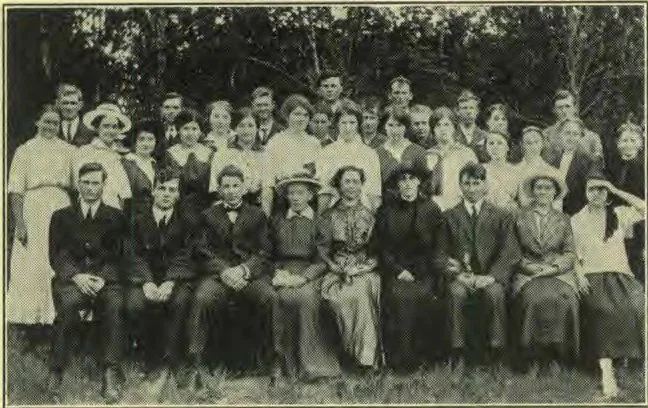
MISSIONARY VOLUNTEERS OF MANITOBA, CANADA
That was the morning of the advent message. The evening hours are now drawing upon us. Time’s sun is nearing the western horizon. The last rays are lighting up this sin-sick old world, soon to be wrapped in the shadows of night. Let it not be true of any of us at that time that the summer is past, the harvest is ended, and we are not saved.
LUTHER WARREN.

Early Experiences in Young People’s Work
My first experience in young people’s work was gained in the church at Antigo, Wisconsin, in 1891. I was but a youth, and had no one to counsel with; but I felt that something ought to be done to help and inspire the young people. I had never heard of any young people’s organization among our people, but acquaintances of mine attended meetings of the local Christian Endeavor Society and the Epworth League, and I felt that our own young people needed something of this kind, as well as those of other denominations. I proposed holding a young people’s meeting, but my proposal was met with a most universal disapproval. However, the elder, a saintly old man, long since dead, placed his hand on my shoulder and said, “My boy, you go right ahead. You may have the church for your meeting, and I will stand by you.”
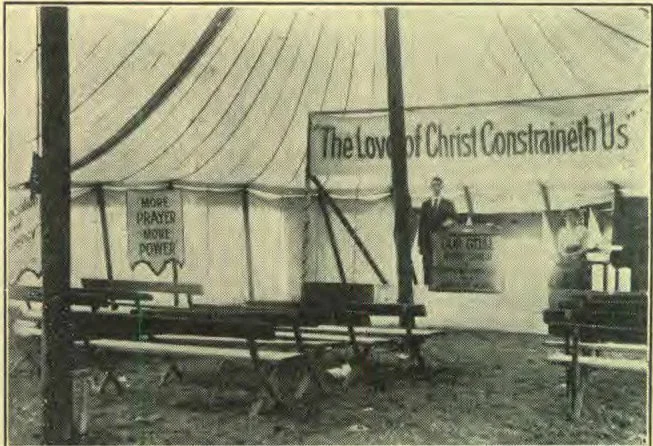
A MISSIONARY VOLUNTEER TENT AT CAMP MEETING
Camp meeting Missionary Volunteer work is one of the strongest factors in the evangelization, education, and mobilization of our young people.
A MISSIONARY VOLUNTEER TENT AT CAMP MEETING Camp meeting Missionary Volunteer work is one of the strongest factors in the evangelization, education, and mobilization of our young people.
We held our meetings on Saturday nights. There were thirty members. Our program consisted mainly of singing, Scripture study, and much prayer and testimony. I can remember distinctly how intensely disappointed we always felt if even one person failed to testify; but this seldom occurred. We had not the slightest disorder. I believe God restrained the enemy because he wanted this work to go forward, and the people were not sufficiently in favor of it to stand by us if mistakes were made.
Many an hour I spent in prayer over that society, sometimes alone, and sometimes in company with one or more of the boys out in the woods. I am sure the meetings we held that year proved a real spiritual help and uplift to us all. MEADE MACGUIRE.

The “Christian Volunteers” of Ohio

It was only a little “Caleb and Joshua” band, but look at the record that is handed down to us! One of the members is connected with the Foreign Mission Board, some became Bible workers, and some are ministers (two sailing for England). Only one is not out in the field, and even he is actively engaged in the Lord’s work in his home church. This is the first result we can find of young people’s work in Ohio before the department was recognized by the conference.
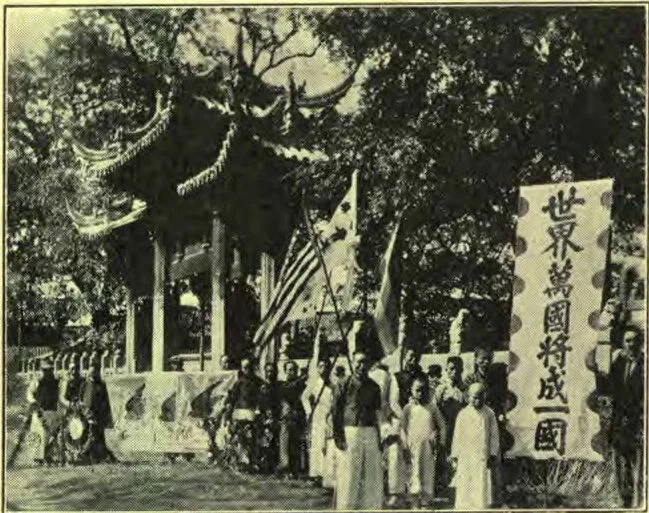
The Missionary Volunteer Society of Naziang, China, helping in the opening of a series of meetings at Kading. They marched through the streets of the city carrying flags and banners, announcing the meetings and distributing handbills.
The first steps toward the organization of the young people’s work in Ohio were taken at the State meeting in Mount Vernon, April 14, 1899, where time was spent in studying what was given through the Testimonies concerning the encouragement of young people to enter the work of the Lord. At the camp meeting following, definite plans were laid by the conference to aid and encourage work for and by the young people in Ohio, and the name “Christian Volunteers” was selected for the organization. Albert Carey was chosen as the first leader, and one page of the State paper, the Welcome Visitor, was given over for the use of the new department. At this time about sixty young persons signed the Volunteer certificates, which were presented to them. Here is the pledge:
“Recognizing the preciousness of God’s gift to me, I volunteer for service for him anywhere in the wide world that his Spirit may lead, and in any form of service that he may direct.”
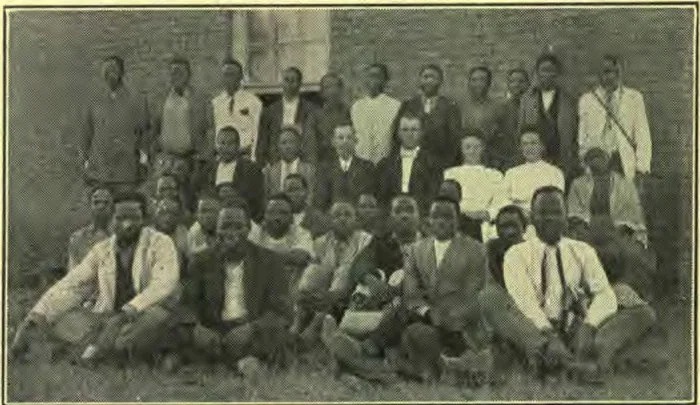
Charter members of the Missionary Volunteer Society on the Solusi Mission. Every member is a reporting member. See page 12.
Brother Carey acted as a faithful and enthusiastic leader until his resignation to go to Honolulu, where he took up work among the Chinese in July, 1900. At the camp meeting at Dayton in August of that year, Elder H. H. Burkholder was chosen as the new leader. It was at this time that plans were made for the study of foreign missions. Collections were also taken for foreign missions and for defraying the expenses of the society. An amount sufficient to purchase a typewriter for the secretary’s use was raised by the society.
In 1901 the constitution of the Ohio Conference was changed, and at this time the Sabbath school, church school, and young people’s work were placed in charge of the educational secretary, Elder W. H. Wakeham, who afterward went as one of our workers to Egypt. Before this the young people’s work had been a separate organization. In 1902, Prof. C. E. Welch was chosen educational secretary, holding the position nearly two years. At the close of his term, while at the Marysville camp meeting, August, 1904, the youth’s India fund was started. The object was to get every young person in Ohio to give at least six cents each week throughout the year for that field. At this time James Shultz became leader in the young people’s work, and held the position until his call to Korea in 1907. Under his leadership, various missionary enterprises were taken up, conventions were held, and the work grew stronger continually.
With 1907 and the month of July, came the first General Conference Sabbath School and Young People’s Convention. This was held in Mount Vernon, Ohio. Following came the reorganization of the different societies, and the movement was continued under the name of the Missionary Volunteers. The spirit and purpose remained the same, and with steadily increasing ranks we endeavor to give “the advent message to all the world in this generation.”
BESSIE ACTON.

A Pioneer Young People’s Society

In June, 1893, there was organized at College View, Nebraska, the Young People’s Society of Christian Service. This society had many of the characteristics of our present denomination-wide organization. Their record book, containing their constitution and by-laws and the reports of their meetings, lies before me.
The objects of this society, as set forth in the constitution, were “to secure the increased spirituality of the young people, their enlistment in all missionary activity through existing channels of work, and their elevation to a higher plane of living and thinking.”
The society was organized into five departments: Religious Work, Sociability and Help, Juvenile Work, Literary Improvement, and Health and Temperance. The department of Religious Work arranged for all meetings and lectures of a religious character. It was to provide for instruction in Scripture knowledge and in the history and doctrines of the denomination. The department of Sociability and Help was to form the acquaintance of strangers stopping in the village, and introduce them to other members of the society, and also to render deeds of kindness and help to the sick and unfortunate. The department of Juvenile Work was expected to assist in the children’s meetings, and in other work for the general elevation of the children. The department of Literary Improvement was to arrange for literary programs and lectures, provide for a course of reading for the society, and take steps for founding a library and reading-room. These departments were to take turns in providing programs.
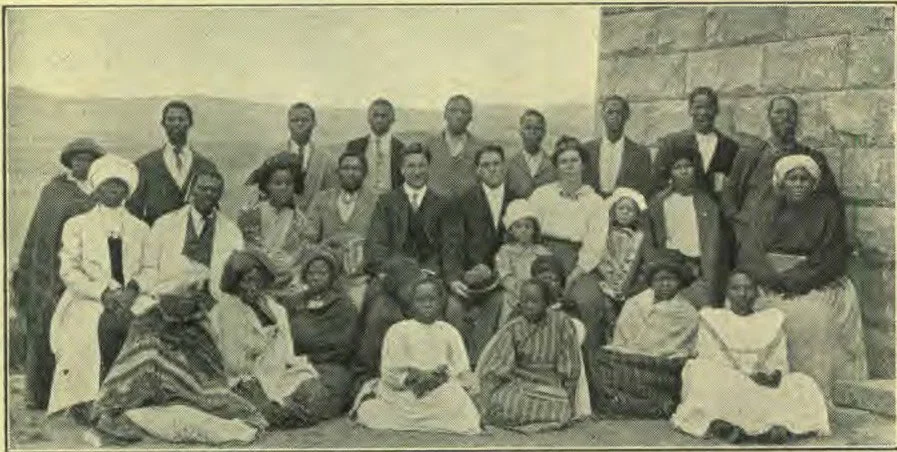
MISSIONARY VOLUNTEER SOCIETY AT EMMANUEL MISSION, SOUTH AFRICA
The relation of the society to the church was thus defined: “The society hereby acknowledges its allegiance to the church, and invites the church, through its officers, to assist in its plans and management.”
There are ninety-three names attached to the constitution. Many of these are now engaged in various kinds of missionary work—as teachers, nurses, secretaries, doctors, and ministers. I notice the names of the following well-known ministers: L. V. Finster, H. E. Reeder, F. L. Perry, C. R. Kite. Later this society became one of the regular bands of missionary activity in Union College. C. C. LEWIS.

The Young Women's Dorcas Society

In the history of the Seventh-day Adventist church at Battle Creek, Michigan, a number of groups of young people, at different times, formed organizations with the special purpose of seeking the Lord in prayer and helping the needy. The Young Women's Dorcas Society was one of these. It was organized in the early “nineties,” and held its regular meetings in the commodious home of Elder Uriah Smith. The large dining-room was cleared for action; and here, with scissors, needles, and thimbles, a number of earnest young women met to follow the example of Dorcas of old, in the “good works and almsdeeds which she did.” The sick and afflicted were visited and ministered to, garments and food were distributed to the needy; the young men were encouraged to become auxiliary members, splitting wood, and helping in other ways.
Later, the name “Christian Help Band” was adopted by this society.
These little societies, which sprang up here and there during these years, not only served the immediate end for which they were planned, but pointed out the need for a permanent, well-organized work among Seventh-day Adventist young people.
A. B. E.
Continue reading: Beginnings and Progress in Australasia