The Youth’s Instructor, Vol. 29, No. 51.

THE FLAMINGO

The Youth’s Instructor

Dec 21, 1881

S. D. A. Publishing Association · Battle Creek, Mich. · Dec 21, 1881

THE FLAMINGO.
THERE are several species of the curious bird known as the flamingo, and some of them are to be found in all the warmer countries of the globe. They are wading birds, and always make their home near the water,—by the sea, or in some marshy place. Their food consists of clams, oysters, marine insects, small fish, etc. These birds always keep in companies, whether in the air or on the land; and while they are feeding or resting, one of them acts as sentinel, and on the approach of danger gives the alarm by making a trumpet-like noise, and starts off, leading all the rest of the flock. They can both fly and run swiftly, but though web-footed, they cannot swim. Their web-feet, however, assist them in wading, by keeping them from sinking in the soft, muddy bottom. When flying over the land, they keep high up in the air, but fly very low over water. They never alight on land, but keep sailing round and round over a shallow place until they finally alight in the water, and then wade to shore. The small head, huge crooked bill, long and slender neck, stilt-like legs, and comparatively small body give the flamingo the most peculiar form among birds. They fly with head and legs extended, and in this position often measure five feet from bill to end of claws, and the same distance from the tip of one wing to the tip of the other.
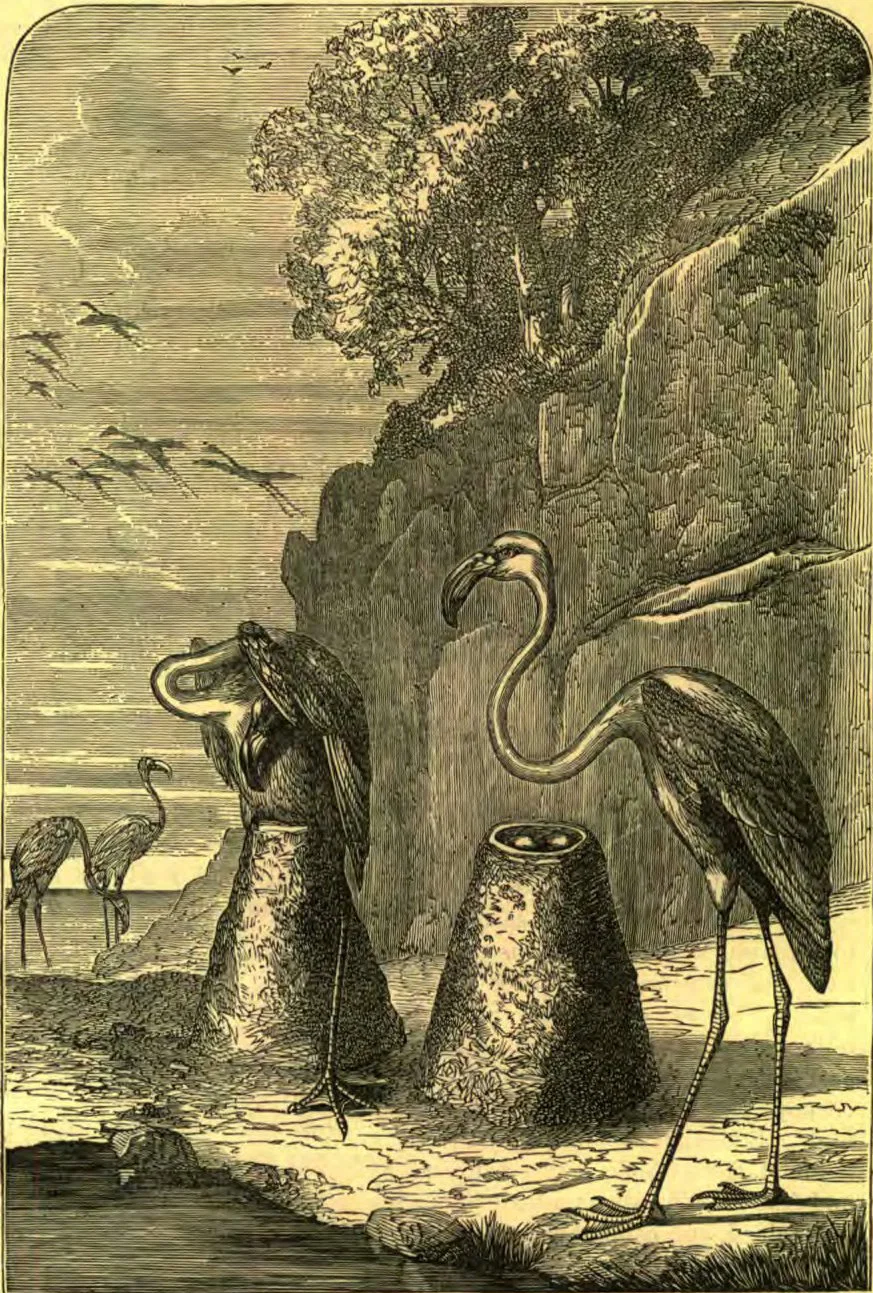
The nest of the flamingo is a curious affair. It is built on the ground, near the edge of the water, and is made of mud. These nests are about twenty inches high, and of a very queer shape, as we see by our picture. The hillock is solid, but in the top is a basin, or hollow, in which the eggs are laid on the bare earth. The eggs are pure white, and usually three in number, being about the size of a goose egg. In order to hatch the eggs by the warmth of her body, the bird gets astride the nest, with one leg on each side of it.
The flamingo is very shy, and is seldom hunted except for its beautiful feathers. The male, when in full plumage, is of a rose-red color, with deep purple wings. The female is of a less brilliant color. The young are at first nearly white, and do not appear in their full red plumage until the second year. The European flamingo is usually known as the Red Flamingo; those found along both the east and west coasts of America are more of an orange hue.

HOW THE EARTH IS KEPT UP.

In an English book, entitled “Glimpses of the Globe,” written for young readers by Mr. J. R. Blakiston, of Trinity College, Cambridge, we have the following instructive dialogue between a little boy and his uncle:—
“Uncle, I have often meant to ask you how the earth is kept up, as it travels spinning around the sun?”
“I thought you would be asking me that some day. I fear you will have to wait till you are much older before you can hope to understand it. Do you see yon bright star rising over the windmill? That also, like the earth, is a roamer round the sun. Yon star setting behind Dungeness is another planet; and there are many others,—some greater, some less,—which wheel day and night, without ceasing, around the sun, spinning as they speed along.”
“Then they, too, have days and nights, as we have?”
“Yes, and perhaps seasons; for they all travel, as we do, somewhat aslant. Two of them are as much larger than our earth as a large and a small orange are than a pea, and have, one four, the other eight, moons wheeling around to light them by night.”
“And do they travel as quickly as we do?”
“The largest planet (large enough to make thirteen hundred earths) spins more than twice as fast as the earth. Even at the equator, the earth spins only at the rate of seventeen miles in a minute.”
“Seventeen miles in a minute! Why, I wonder we are not all of us, houses and everything, hurled off, as the water when one trundles a hoop.”
“Look at the hands of the clock. You know that the large hand goes all round once every hour, and that the short hand takes twelve hours to go once round. Well, if your eyes are good enough to see the long hand moving, you certainly cannot see the short hand move, can you?”
“No, indeed!”
“Now, the earth takes twice as long as that to roll once round.”
“Yes; I remember, it takes twenty-four hours to roll round. How many miles is it round the earth?”
“Nearly twenty-five thousand at the equator. Thus every hour the earth has to roll more than a thousand miles. It would take a train five weeks to go round the earth, if it went thirty miles an hour, day and night, without stopping.”
“You once told me that the sun was as much larger than the earth as an orange is larger than a tiny seed. Is the moon, too, as large? It looks as big.”
“Oh, dear, no! The moon is far smaller then the earth; but it is not so far away as the sun is. More than a million earths could be made out of the sun. Fifty moons might be made out of the earth.”
“And how many stars could be made out of the moon? I’ve heard Widow Jones say the old moons were cut up to make stars.”
“Why, my dear boy, the stars are mostly great suns, so far away, that, if a new star were created, years would pass before its light could travel through space to reach our eyes, and enable us to see it. If one of them were destroyed, years would pass before its light would cease to twinkle. Such a thing has really happened oftener than once. A star has blazed up, burnt out, and been seen no more.”
“What an awful thing to think of!”
“Ay, Charlie, you know the psalm, ‘The heavens declare the glory of God.’ There are few things more solemn than to sail for days together over the great deep, and to watch the countless stars rise and set as one keeps watch on deck at night. They that go down to the sea in ships see the wonders of the sky as well as of the deep. Alone with God, we hear his still, small voice speaking to us in the night-watches.”
“What a grand sight it would be to be set somewhere so that one could see the earth rolling round the sun! How fast does it travel?”
“Every minute it speeds more than a thousand miles on its way, every second more than eighteen miles. But figures like these are mere words to us. We can neither see nor feel the earth’s motion. You may form some faint idea of a heavenly body’s motion from a sling. As long as you keep the sling whirling round your head, the stone is held tight: let go the string, and off flies the stone. The string is as the sun, drawing in the planets, which else would fly off—who knows where?”

SUNSET ON THE SEA OF GALILEE.

Along the shores of far-famed Galilee, The day, in dying, folds the dun rocks in A softened haze. Beyond, the barren plains Uplift unpeopled deserts from the sea, In patient waiting for unbidden rains. E'en snow-crowned Hermon fades into the dim, Soft distance. Here, some ruined cities lie Upon the pebbled shores, their broken walls Lapped by the sacred waves; their quiet streets Unguarded, save by lonely, dark-plumed palms. Now with the falling night deep silence falls And broods o'er Gennesaret. Outlines meet And melt together, gaining greater charms Through faintness; Galilee grows dark as wine Below the hills that frame an opal sky.
Through settling dusk one lustrous star flames out, And arrow-beams of light along the line Of Galilee. Another burns on high, And soon the darkling, rarely tinted sky, Star-gemmed, bends o'er the solitary sea, Which shivers back the light from shifting waves, In broken gleams, and star-beams sliding out.
O sacred sea! that by divine command Upbore the blessed Jesus on thy breast; Thou, whose bright shores the Master's feet have pressed So many centuries agone,—give back Some token of the years that are no more; Some sign of blessing dropped by that dear hand, Which, lifted, turned the tempests from their track; Some whisper of that mystery divine Yon desolate hills did witness on this shore; Some certain comfort for all future time, Some glory for all nations to adore.
Most rash! the nearness of antiquity Rebukes the wish to know what must not be; And only warm winds stir the sleeping sea That holds the key to much of mystery.
—Mary N. Hawley.

CURIOUS WATCHES.

In the South Kensington Museum at London is a small watch about a hundred years old, representing an apple, the golden case ornamented with grains of pearl. Another old Nuremberg watch has the form of an acorn, and is provided with a dainty pistol which perhaps serves as an alarm. In London is an eagle-shaped watch on which, when the body of the bird is opened, a richly enameled face is seen. They are sometimes found in the form of ducks or skulls. The Bishop of Ely had a watch in the head of his cane, and a prince of Saxony had one in his riding saddle. A watch made for Catharine I. of Russia is a repeater and a musical watch. Within are the Holy Sepulchre and the Roman guard. By touching a spring, the stones move away from the door, the guards kneel down, angels appear, and the holy women step into the tomb and sing the Easter song that is heard in the Russian churches. King George III. of England had a watch not larger than a five-cent piece, which had 120 different parts, the whole not weighing quite as much as a ten-cent piece.—Selected.

ONE NEST MORE.

EDWARD CARSON is an intelligent lad, something over ten years old, who takes great interest in all that is going on around him.
Like most other boys, he loves play, and, like some other boys, he loves work. He also loves his parents and friends, loves his Sabbath-school and the week school, and is making good progress in his studies.
We call him a pretty good boy; but he has some faults we would like to have him correct.
It is vacation now, and according to promise, he is visiting his uncle, aunt, and cousins, and having a fine time. The cows to bring up and milk, horses to get and harness, fruit and eggs to gather, he finds plenty to occupy the time from morning to night. Sometimes a bumble-bee's nest is found, from which, with great care, and fear of being stung, a little honey is obtained, and called a prize.
One day he came to the house in great excitement, one side of his face much swollen and red.
“What is the matter now, my boy,—another bee's nest to-day?”
“No, uncle, not a bee's nest, but a nest with plenty of sting in it, but no honey.”
“Ah! the hornets have been at you, have they?” said his uncle.
“Were they hornets, uncle? The boys called them ‘yellow-jackets;’ and they came out of a little gray nest on a bush, about as large as my head, which I only just touched accidentally as I passed by.”
“Yes; they are sometimes called by that name, because they have yellow bodies with brown stripes across them. Their nests, or homes, are very curiously arranged, all made of a very soft, thin paper, which the little fellows spread out in sheets formed from decaying wood.
“The nest is usually shaped like a strawberry or pine-apple,—the smaller end down, with a very small opening at the bottom. This serves to keep out all the rain, and, with only one small door, they are able to keep out all enemies.
“Perhaps the next nest you find will be on the ground by the side of a stone, or sod of grass; but the door, or place where they come out and go in, will always be at or near the bottom.
“They have a large family of cousins, called ‘wasps,’ which are also easily irritated, and sure to sting at the first opportunity; and this is why we say of some boys and girls who are always fretful, ‘They are waspish.’”
“But, uncle, I don’t want to be stung any more, and I would like to know how to destroy that nest, and every one I find; and I’ll watch for them all the time.”
“Well, the way I do when I discover a nest of these naughty chaps where I think nobody will be likely to be harmed by them, is to let them entirely alone; but if it is a frequented place, where children or others often pass, I wait until evening, when they are all within, and then apply a burning torch, or if the nest is on the ground, stamp it all to pieces, with my foot.”
“I am afraid of them, it hurt so when I was stung; but if cousin Ben will help me, I’ll try it anyhow.”
Within the next three weeks the two boys had destroyed that nest and two others; but the fourth one, which was situated between two pieces of wood, seemed for a long time to defy them both.
They had been stung several times, and had always to retreat. This, together with several other little mishaps, had often sadly irritated Edward, and caused a certain little organ to be very unruly, and send out some unpleasant sounds.
One day soon after, he came up to his uncle in quite a hurry, and said,—
“We have ruined that nest, and that is the last one I know of.”
“Isn’t there one more?” said uncle slowly.
“Not that I know of. That is the last one; and I am glad of it.”
“One nest more,” said uncle, “that I want my little boy to destroy; for if he does not destroy it, he will be stung by it as long as he lives.”
“What is it?” asked the little fellow with eagerness.
“The nest of waspish thoughts and feelings which so often cause fretty, scolding words to fly out of your mouth, and sting our ears.”
“I will try, uncle. But ’tis so hard, for I speak before I think, and then I know it’s naughty.”
Remember that sweet promise, “Him that overcometh will I grant to sit with me in my throne.”—Well-Spring.

Do as You Would Be Done By

Do as you would be done by.

COMMON SCENES.

ON THE PRAIRIES.

One whose life has been spent in a forest home can form little thought of the vastness and unique beauty of the prairies.
Leaving the last rude “dug-out” behind, the traveler soon finds himself alone with the blue sky and gently rolling hills. Involuntarily he stops where the brown slopes spread out illimitably before him, and the cool breeze fans his first wonder into feelings of sublimity. Traveling over the crisp grass and sere autumn flowers, that Power which first planned this magnificence seems more than ever worthy of our wonder and admiration.
The sun, fast sinking through the distant haze, warns him to seek shelter; away to the east he catches the gleam of sunlight from a single window. On and on he travels, while the darkness gathers, stars appear in the sky, and a lamp in the window. A hundred prairie chickens, startled by his coming, startle him, in turn, by the whir of their wings and the sound of their voices.
Now on the hill-top, he sees the lamp, and now in the valley, as he drives the sparrows from their resting place, he loses it again. The people of that cottage, though poor to-day, are very kind, and have seen better days. Happy children, but too happy “to see somebody again,” cluster around and talk of prairie flowers and prairie-fires. As if by magic, the outer atmosphere seems lighted, and stepping to the door, the long living lines of flame are seen miles away leaping against the sky. The eye seems riveted to the scene, and so new and strange is the sight, with those of the day, that all seems but a pleasant dream.
But how shall we describe the prairies of spring? A careless observer might at first sight pronounce them monotonous; but here, as in the woodland, the works of nature are wrought with the finger of Infinity.
The last drifts of winter disappear, and the blanched hills reflect once more the vernal sun. It warms into life the dormant rootlets, and loads the morning air with obscuring fog, which seems filled with the cries and plaintive cooing of ten thousand prairie chickens.
A week of mists and showers, a score of arrivals among the birds, and all the hills have assumed a look of life. The pasque-flower blooms along the ridges, while grass and sedge so green lure the herds along the water courses. Hazel bushes and the dwarfest of oaks put out their catkins on many a hill-side, while patches of the little Antenneria (Indian tobacco) cover the lower slopes far as the eye can reach, and are watched in departing by a million blue-eyed violets.
A month later, all is starred with Golden-ragwort and ablaze with phloxes, while the air is filled with the breath of the wild roses. Hills gently rising and swelling one into another, alternately catch the light shadows of clouds, and reflect “the beautiful light of the morning.”
GEO. R. AVERY.

FROM EARTH TO HEAVEN.

TURN from earth’s broken cisterns, The thirsting soul they mock; Seek thou the living waters ’Neath the shadow of the rock.
Go thou in life’s glad morning, Ere its sunny hours have flown, Hear the voice of the Heavenly Shepherd, And be numbered with his own.
Little by little, the work is done, Step by step, may the race be run; Ne’er for earth’s glitter thy footsteps stay, Onward and upward press thy way.
Earth is fading, life is fleeting, But a brighter land’s in sight, Where the good, with happy greeting, Friendship’s broken ties unite.
With thy hand in Christ’s, press onward Till the journey of life is o’er; After its struggle, resting Will be sweet on the other shore.

SCENES IN THE LIFE OF CHRIST.

LESSON 48.—THE FIVE THOUSAND FED.

The damsel who received the head of John the Baptist gave it to her mother. “And when his disciples heard of it, they came and took up his corpse and laid it in a tomb.” But Herod’s conscience troubled him, and when he heard of Jesus and his wonderful miracles, he said, “It is John, whom I beheaded; he is risen from the dead.”
Now when the twelve apostles returned from the tour on which they had been sent, they told Jesus all that they had done, and what they had taught. Then he said, “Come ye yourselves apart, . . . and rest awhile.” For so many were coming and going that the weary disciples and their Master could not get time even to eat. So they got into a boat, as privately as they could, and went over to the northeast shore of the lake. There they sought a quiet retreat in one of the grassy glades among the mountains not far from Bethsaida. It was now about the time of the Passover, which was celebrated every year at Jerusalem. Jesus did not attend this feast; for at the one held the year before, the Jews had tried to kill him, and he well knew that they still thirsted for his blood. It was now in the spring-time of the year, and no doubt the place to which our Lord and his disciples retired was made beautiful by fresh leaves and bright flowers. Yet we may easily imagine that the Saviour would be sad while thinking of the Passover ceremony at Jerusalem. The Passover lamb was a type of Christ, and he knew that as the blood of that lamb was shed to save the first-born from destruction, so his blood would soon be required.
But Jesus and the twelve did not have long to remain alone; for when the people saw them depart, they went on foot along the shore, and crossing the Jordan at the head of the lake, soon found the Lord whom they sought. Jesus had so much compassion for them that he began to teach them again, and to heal all who were sick. But the people had been a long time without food, and were so faint and weary that Jesus did not want to send them away fasting. So he commanded his disciples to have the men sit down in ranks, upon the grass, by hundreds and by fifties. Now all the provision they had there was five barley loaves and two small fishes, which was carried in a basket by a lad. When the men were all seated on the green-sward, Jesus took the bread, blessed it, broke it, and gave it to his disciples, who passed along the ranks and gave to the hungry people. Just so has heavenly truth, our spiritual food, been given to inspired men, who have imparted it to the people; and as Jesus blessed the bread, so the Holy Spirit attends the word of God, and makes it soften the hearts of those who will receive it.
Now there were about five thousand men, besides women and children, who were fed; and when they had all had enough, Jesus said, “Gather up the fragments that nothing be lost.” And when they had done so, they had twelve baskets full of the food that was left. Just so the grace and mercy of God are sufficient for all who will come to him and receive his blessing.

QUESTIONS.

1. To what damsel was the head of John the Baptist given?
2. What did she do with it?
3. What did John’s disciples do when they knew that he was beheaded? Mark 6:29.
4. How did Herod feel after he had taken the life of this good man?
5. What did he say when he heard of Jesus and his miracles? Mark 6:16.
6. What did the twelve disciples say to their Lord when they returned from their tour of preaching? Verse 30.
7. What did he tell them to do?
8. Why could they not rest where they were?
9. How did they try to get away without being seen?
10. Where did they go?
11. What kind of place did they seek out when they had reached that shore?
12. What important feast was held at Jerusalem about this time?
13. What was this feast meant to keep in mind?
14. Why did not Jesus attend this one?
15. At what time of year was the Passover held?
16. What was the probable condition of the place to which Jesus and his disciples retired?
17. What may we suppose the feelings of Jesus must have been, notwithstanding all this beauty?
18. What thoughts were likely to have made him sad?
19. What did the people do when they saw Jesus and his disciples crossing the sea?
20. What did Jesus do when they came to him on the other side?
21. What caused the people to suffer?
22. What did Jesus tell his disciples to do?
23. How much provision was to be had among all the company?
24. What did Jesus do when the men were all seated?
25. How was this like the way that God takes to give us spiritual food?
26. What is our spiritual food?
27. What book contains heavenly truth?
28. After Jesus had broken the bread, what did he do before giving it to his disciples?
29. To what may the blessing of the bread be compared?
30. What does the Holy Spirit cause the word of God to do?
31. How many men were fed from the five barley loaves and the two small fishes?
32. When they had all eaten as much as they wanted, what did Jesus tell his disciples to do?
33. How many baskets full of fragments did they take up?

NEW TESTAMENT HISTORY.

LESSON 61.—THE GOOD SAMARITAN.

“And the seventy returned again with joy, saying, Lord, even the devils are subject unto us through thy name.”
Then Jesus said, “I beheld Satan as lightning fall from heaven. Behold, I give unto you power to tread on serpents and scorpions, and over all the power of the enemy; and nothing shall by any means hurt you. Notwithstanding, in this rejoice not that the spirits are subject unto you, but rather rejoice because your names are written in heaven.”
“In that hour Jesus rejoiced in spirit, and said, I thank thee, O Father, Lord of heaven and earth, that thou hast hid these things from the wise and prudent, and hast revealed them unto babes: even so, Father, for so it seemed good in thy sight. All things are delivered to me of my Father: and no man knoweth who the Son is, but the Father; and who the Father is, but the Son, and he to whom the Son will reveal him.”
Then he said, “Come unto me all ye that labor and are heavy laden, and I will give you rest. Take my yoke upon you, and learn of me; for I am meek and lowly in heart: and ye shall find rest unto your souls. For my yoke is easy and my burden is light.”
“And he turned him unto his disciples, and said privately, Blessed are the eyes which see the things that ye see; for I tell you that many prophets and kings have desired to see those things which ye see, and have not seen them; and to hear those things which ye hear, and have not heard them.”
“And, behold, a certain lawyer stood up, and tempted him, saying, Master, what shall I do to inherit eternal life?” Jesus said unto him, “What is written in the law? how readest thou?” The lawyer answered, “Thou shalt love the Lord thy God with all thy heart, and with all thy soul, and with all thy strength, and with all thy mind; and thy neighbor as thyself.” Then Jesus said, “Thou hast answered right: this do, and thou shalt live.” But the lawyer, trying to justify himself, said, “And who is my neighbor?” Jesus then related the following parable:—
“A certain man went down from Jerusalem to Jericho, and fell among thieves, who stripped him of his raiment, and wounded him, and departed, leaving him half dead. And by chance there came down a certain priest that way; and when he saw him, he passed by on the other side. And likewise a Levite, when he was at the place, came and looked on him, and passed by on the other side. But a certain Samaritan, as he journeyed, came where he was; and when he saw him, he had compassion on him, and went to him, and bound up his wounds, pouring in oil and wine, and set him on his own beast, and brought him to an inn, and took care of him. And on the morrow, when he departed, he took out two pence, and gave them to the host, and said unto him, Take care of him; and whatsoever thou spendest more, when I come again, I will repay thee. Which now of these three, thinkest thou, was neighbor to him that fell among thieves?” And the lawyer said, “He that showed mercy on him.” Then said the Master, “Go, and do thou likewise.”
“Now it came to pass, as they went, that he entered into a certain village; and a certain woman named Martha received him into her house. And she had a sister called Mary, who also sat at the Lord’s feet, and heard his word. But Martha was cumbered about much serving, and came to him, and said, Lord, dost thou not care that my sister hath left me to serve alone? bid her therefore that she help me. And Jesus answered, and said unto her, Martha, Martha, thou art careful and troubled about many things: but one thing is needful; and Mary hath chosen that good part which shall not be taken away from her.”

QUESTIONS.

  1. What did the seventy say when they returned from their tour? Luke 10:17.
  2. What did Jesus say he had seen?
  3. What does this probably mean?
  4. What power did he say he would give them?
  5. In what were they to rejoice?
  6. For what did our Lord give thanks to his Father?
  7. What did he say about the intimate relation between himself and the Father?
  8. What precious invitation did he then give? Matt. 11:28.
  9. What did he promise to give?
  10. What did he admonish all to do?
  11. How did he describe his own character?
  12. Under what figure did he set forth the mildness of the service he requires?
  13. What will those find who take this yoke upon them?
  14. What did he say to his disciples privately? Luke 10:23.
  15. Who stood up and tempted Jesus?
  16. What did he say?
  17. What question did Jesus ask in return?
  18. Give the lawyer’s reply.
  19. What did Jesus say of this answer?
  20. How did the lawyer try to justify himself?
  21. By what method did Jesus lead him to answer his own question?
  22. Tell what befell the man who was going from Jerusalem down to Jericho.
  23. Describe the course taken by the priest and the Levite.
  24. Who were the Levites?
  25. What did the Samaritan do when he saw the poor man in trouble?
  26. How did the Jews regard the Samaritans?
  27. Where did the Samaritan take the wounded man?
  28. What provision did he make for his recovery?
  29. When Jesus had related the story, what question did he ask?
  30. What reply did the lawyer make?
  31. What admonition did Jesus give him?
  32. By whom was Jesus received in a certain village whither he went?
  33. What did Mary do?
  34. What complaint did Martha make?
  35. What did Jesus say to her?

NOTES

I beheld Satan as lightning fall from heaven.—The word rendered “devils” is always used for those spiritual agents employed in demoniacal possessions—never for the ordinary agency of Satan in rational men. When, therefore, the seventy say “the devils (demons) are subject unto us,” and Jesus replies “Mine eye was beholding Satan falling,” it is plain that he meant to raise their minds not only from the particular to the general, but from a temporary form of satanic operation to the entire kingdom of evil.—Jamieson, Fausset, and Brown.
The disciples triumphed in casting of devils out of the bodies of people. But Christ sees and rejoices in the fall of the devil from the interest he has in the souls of men, which he called his power in high places. He foresees this to be but an earnest of what should now be shortly done and was already begun—the destroying of Satan’s kingdom in the world, by the extirpating of idolatry, and the turning of the nations to the faith of Christ.—Henry.
From the wise and prudent.—That is, from those who thought themselves wise—wise according to the world’s estimation of wisdom.—Barnes.
Hast revealed them unto babes.—To the poor, the ignorant, and the obscure; the teachable, the simple, the humble. By the wise and prudent here he had reference probably to the proud and haughty scribes and Pharisees. They rejected his gospel, but it was the pleasure of God to reveal it to obscure and more humble men.—Barnes.
From Jerusalem to Jericho.—The distance from Jerusalem to Jericho is perhaps sixteen miles, in a north-easterly direction. The expression “went down from Jerusalem to Jericho” is very appropriate; for between these two places there is a descent of nearly 4000 feet, Jericho being about one thousand feet below the ocean level. On leaving Jerusalem and going out at St. Stephen’s gate, you cross the brook Kidron by a stone bridge near the garden of Gethsemane, and winding round Olivet, in half an hour you are at the village of Bethany, once the humble home of Martha, Mary, and Lazarus. As you leave Bethany, the country begins to shelve down in a succession of naked hills of white limestone, and dreary gray glens. The road lies through the Wilderness of Judea, and every traveler tells of the desolation here. It is a stern wilderness, rocks everywhere, and rocky soil. Some one has well remarked that if we might conceive of the ocean as being suddenly congealed and petrified when its waves are tossed mountain-high, and dashing in wild confusion against each other, we should then have some idea of the aspect of this desert.
The journey is still full of perils, from the roughness of the way and the wild Arabs everywhere to be seen skulking among the rocks, ready to pounce upon any way-faring man courageous enough to venture into these forbidden grounds without proper guards. Says Dr. Fish: “It is a place where one would be likely to be waylaid. Except beyond the Jordan, it is to-day the most dangerous locality in Palestine. If one be alone, he must expect to be ‘stripped,’ perhaps killed, for it is the chosen haunt of thieves and assassins.” In the time of Christ, also, Judea abounded with robbers. Josephus says that at one time Herod the Great dismissed forty thousand men who had been employed in rebuilding the temple, and a large part of them became highwaymen.
Two pence.—About twenty-seven cents. This may seem a small sum, but we are to remember that that sum was probably ten times as valuable then as now—that is, that it would purchase ten times as much food and the common necessaries of life as the same sum would now.—Barnes.

THE NORTHERN SEAS.

It is a dangerous thing to go to sea anywhere, but those who sail away to the Arctic regions, where are snow and ice and cold all the year round, must meet many dangers which sailors on the temperate seas know nothing about.
True, in those cold lands of the north they have what they call a summer, but it is very short, and we would hardly think it a summer at all, for it is colder than our coldest winters. During this short summer, which lasts about two months, the sun shines all the time, making a continual day; after this, the light gradually grows less and less, until for several months of the year they have one long dark night,—noonday and midnight just alike. By the first of September it is very, very cold, and all along the shores are sheets of solid ice several feet thick, and reaching far out into the sea. The bays and inlets are frozen solid all over. In different ways large pieces of this ice are broken off, and go floating out to sea. Often the open sea is filled with these great cakes of ice, tossing and grinding against each other in the wildest way. Sometimes many of them freeze together, and so form large “ice-fields.”
When a ship gets in among these masses of floating ice, it is in a dangerous place. Sometimes these great “ice-floes,” as they are called, freeze together all around the ship, and so it is locked in for several months, until the warmer weather comes. Then the people in the ship have to stay there in the darkness and cold all winter. If they do not have food enough in the ship to last them, they have to go out on the ice-fields, and hunt seals, whales, and other sea-animals which they can eat.
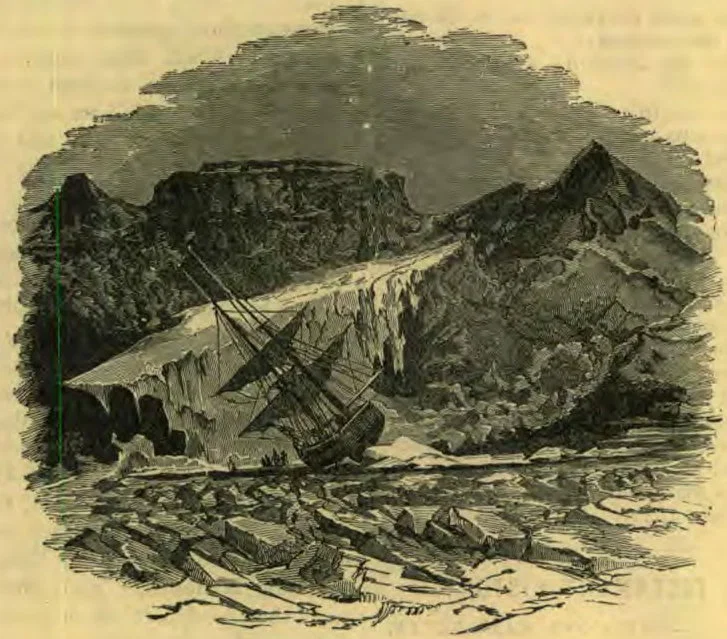
At other times the great floes of ice close together under the ship, and lift it right out of the water. In our picture you see a ship in this condition. The sailors then have to work for many days cutting away the ice, so as to let the ship down into the water again. Sometimes they can do this, and at other times the ship has to stay up on the ice all winter. But worst of all is when the great sharp pieces of ice close around the ship, and instead of freezing it in, keep beating and tossing it about like a plaything until it is broken and crushed in pieces. Then the poor sailors must either perish with their ship, or be left on the floating ice, without a shelter. But many times, companies of men so left have, by getting from one field of ice to another, finally floated to shore, or perhaps been picked up by some other ship. One such company floated about in this way for six months, but were finally saved. They made themselves ice huts to live in, and ate the flesh of the whales, seals, and other animals which they caught. They warmed themselves by fires made by burning the blubber of the whales.
Sometimes, too, ships are run upon, and crushed or sunk by an iceberg. These are great masses of floating ice, often a mile or more long, and rising very high above the water, like a great building. They are really glaciers, which have slid down from mountain-gorges into the sea, where thousands of them go sailing about like floating mountains. They are of many strange shapes, and often look like huge cathedrals with tall spires. During the short summer they do not melt, and as the sun shines upon these icy palaces, they look very pretty. As they float southward into the warmer seas, they gradually melt away, and streams of clear water may be seen leaping down their sides.
There are many wonderful and beautiful things in this northern world, and at another time we may tell you more about them; and then perhaps you will understand better why men leave their homes, and sail into these cold, dreary regions, where they must endure so many hardships and dangers. E. B.

THE FIRST SNOW.

THE day had been a calm and sunny day, And tinged with amber was the sky at even; The fleecy clouds at length had rolled away, And lay in furrows on the eastern heaven,— The moon arose and shed a glimmering ray, And round her orb a misty circle lay.
The hoar-frost glittered on the naked heath, The roar of distant winds was loud and deep, The dry leaves rustled in each passing breath, And the gay world was lost in quiet sleep. Such was the time when, on the landscape brown, Through a December air the snow came down.
The morning came, the dreary morn, at last, And showed the whitened waste. The shivering herd Lowed on the hoary meadow-ground, and fast Fell the light flakes upon the earth unstirred; The forest firs with glittering snows o’erlaid Stood like hoar priests in robes of white arrayed. —Bryant.
Continue reading: A CHAPTER EVERY DAY