The Youth’s Instructor, Vol. 38, No. 40.

THE TAJ MAHAL

The Youth’s Instructor

Oct 1, 1890

S. D. A. Publishing Association · Battle Creek, Mich. · Oct 1, 1890

THE TAJ MAHAL.
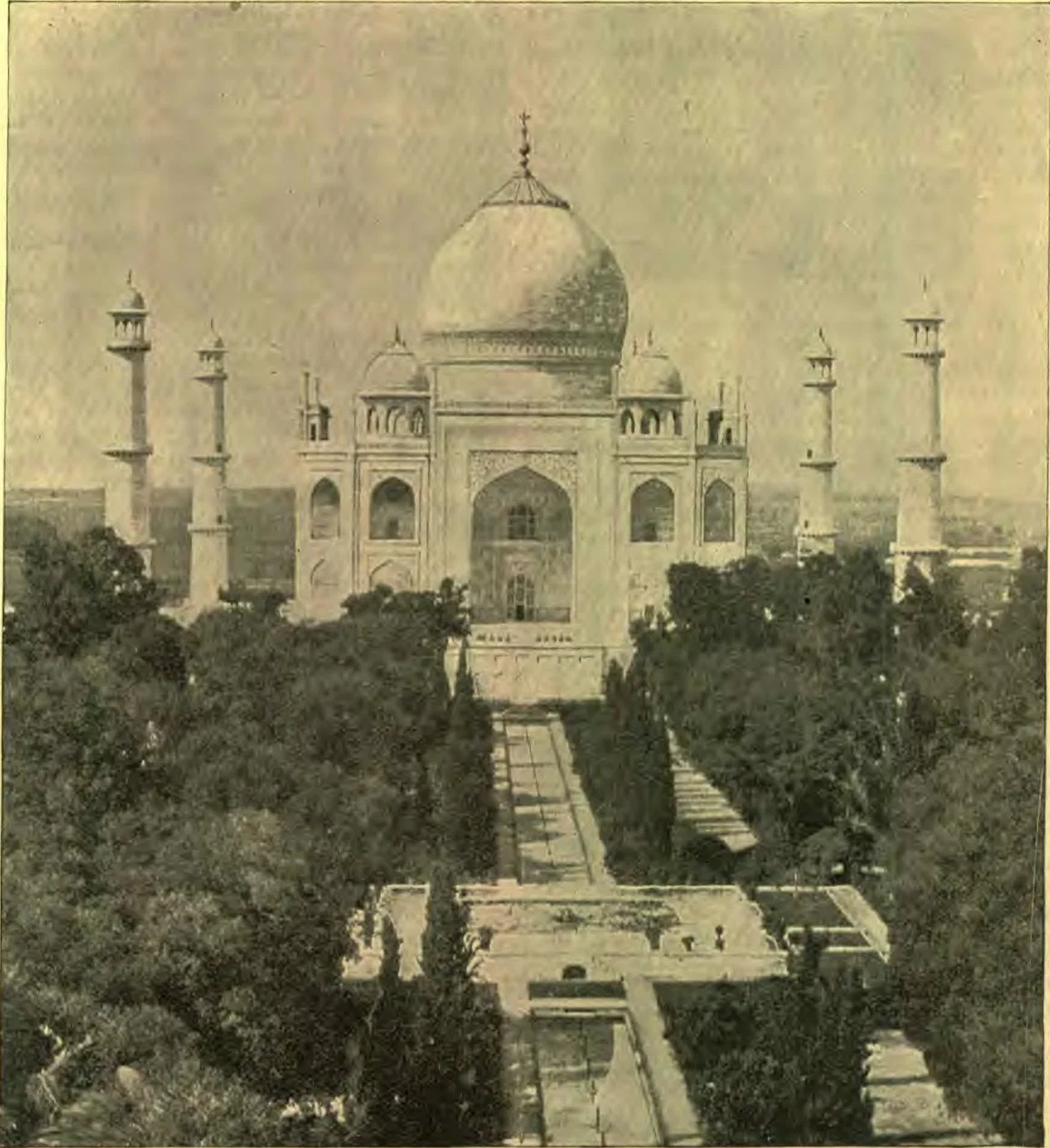
Americans may boast of Fifth Avenue residences, or of their Government buildings at Washington; the English may plead Westminster Abbey or St. Paul’s; into the list of rival structures the Italians may bring St. Peter’s at Rome. But, alone in its glory, grandly sublime above them all, resting in a magnificence which is beyond comparison, stands the Taj Mahal. Though an orator were to elaborate upon it in eloquence rolling out like the Falls of Niagara, though a Raphael were to endeavor to reproduce it on canvas, he would utterly fail to do it justice. It is a masterpiece of architecture, equaled by no other building on earth.
It is situated at one end of a noble court-yard, the depth of which is 450 feet. The whole is surrounded by a red sandstone wall, adorned with arcades, and pierced by four gateways. The principle entrance is elaborately carved, and on it are many inscriptions from the Koran. Twenty-six marble cupolas ornament its summit. A long paved pathway leads up to the Taj, which is situated at the river end. On either side of this avenue are trees of gigantic proportions, with lovely foliage, and flowers of varied hue spring up on every side. In the center is a splendid raised marble chubutra, with a fountain, and a row of jets d’eau is carried from end to end. At one side is a fernery, containing many varieties, and on their soft green leaves the drops of water sparkle like myriads of diamonds in the sunlight.
THE TAJ MAHAL.
THE TAJ MAHAL.
The Taj is raised on a platform of red sandstone, measuring 964 feet by 329 feet, one side of which is washed by the Jumna. Two mosques occupy the east and west sides; they are of red sandstone, inlaid with white marble, with marble domes. That to the east was built as a jawab, or answer, to the other, in order to preserve the symmetry of the group. From this platform rises a superb terrace of white marble, 313 feet square, in the center of which stands the beautiful pile itself. At each angle is a lofty minaret of exquisite proportions, built of white marble, surmounted by a light, graceful cupola, supported on eight pillars. They are about 150 feet in hight, and a beautiful view is gained from the top, which is reached by a spiral staircase.
The plan of the Taj is that of an irregular octagon, the sides facing the four cardinal points, which contain the entrances, and are about 130 feet long. The roof is about 70 feet from the terrace, and each angle is surmounted by a slender minaret. From the center springs the marble dome, 70 feet in diameter, and rising to a height of 120 feet; it is surmounted by a gilt crescent, about 260 feet from the ground level. The whole is of the finest Jeypore marble, highly polished, and retaining its pure white color, as when it was first quarried.
“On each side,” to quote from Bayard Taylor, “there is a grand entrance, formed by a single pointed arch, rising nearly to the cornice, and two smaller arches, one above the other on either side. Every part, even the basement, the dome, and the upper galleries of the minarets, is inlaid in ornamental designs in marble of different colors, principally a pale brown, and a bluish violet variety. Great as the dimensions of the Taj are, it is as elaborately finished as one of those Chinese caskets of ebony, which are now so common in Europe. It is asserted that the whole Koran is thus inserted in the Taj. The building is perfect in every part, and any dilapidations that it may have suffered are so well restored that all traces of them have disappeared. Before entering the central hall, we descend to the vault where the beautiful Mumtaz Mahal is buried. A sloping passage, whose walls and floor have been so polished by the hands and feet of thousands that you must walk carefully to avoid sliding down, conducts to a spacious vaulted chamber. There is no light but what enters at the door, and this falls directly upon the tomb of the queen in the center. Shah Jehan, whose ashes are covered by a similar cenotaph, raised somewhat above hers, sleeps by her side. Frequently the Mohammedans fill the vault with the odors of rose and jasmine and sandal wood, the precious attars of which are sprinkled on the tomb. These were the true tombs, the monuments for display being placed in the grand hall above. This is a lofty rotunda, lighted both from above and below by screens of marble and jasper, and ornamented with a wainscoting of sculptured tablets representing flowers. The tombs are sarcophagi of the purest marble, exquisitely inlaid with blood-stone, agate, carnelian, lapis-lazuli, and other precious stones, and surrounded with an octagonal screen six feet high, in the open tracery of which lilies, irises, and other flowers are interwrought with the most ornamental designs. It is of marble covered with precious stones.”
The building is said to have been designed by a man who acquired his profession in Italy, and who originally came from the Indian State of Rajputana; and a legend says that after the building was finished, he was seized, and his eyes put out, to prevent his executing one of grander proportions for the Maharaja of Jeypore, king of his native home.
The dome of the Taj contains an echo more sweet, more pure, and more prolonged than that of the baptistery of Pisa, the finest in Europe. A single musical note uttered by the voice floats and soars overhead in a long and charming undulation, fading away so slowly that one seems to hear it after it is silent,—as you see, or seem to see, a lark that you have been watching, as it is swallowed up in the blue vault of heaven. The responses that would come from above in the pauses of the song must resemble the harmonies of the angels in paradise.
The best time of all to see the building is by moonlight, and there is no tongue that can tell the effect produced on the mind by the soft lunar light streaming down on this gem of architectural perfection. It then looks like a floating palace in the air, and as you approach, it seems to recede.
The Taj was built by Shah Jehan as the tomb of his favorite wife, Begum Mumtaz Mahal, hence the name,—Taj. It was commenced in 1630, and it is said to have taken seventeen years to complete it, and that its cost was $15,000,000. One writer has said that there were 20,000 workmen engaged in its erection for twenty-two years.
The black marble came from a place called Charkoh, and cost $30 a square yard; the crystal from China, at a cost of about $190 per square yard; jasper from the Punjab; carnelian from Bagdad; turquoises from the far-off plains of Thibet; lapis-lazuli from the island of Ceylon, at a cost of about $389 a square yard; coral from Arabia and the Red Sea; and amethysts from Persia. There are in the inlaying of the flowers many other stones used, which have no longer a name in our language.
It seems wonderful how such a building could have been erected by a people who possessed none of the appliances of modern science,—how the huge blocks of marble were ever raised and placed in the dome, without steam cranes or anything of the kind. But there it stands, an emblem of the skill of the forefathers of the Mohammedans of to-day, and unequaled in any other country on earth. P. T. M.

THE FLOOD-GATES.

Each day comes to us like a fair, walled city Under the mist of the dawn; But whether its gloomy or bright and pretty, Lying there under the morn, Depends upon which gate we ope in its wall; There are just two gates to the day, that is all.
One gate is the flood-gate of joy and duty; It opens to a path of light, Where the towers shine with a heavenly beauty, And sparkle with glory bright. If we choose this gate, we shall make our way Into the beautiful city of Day.
The other gate is the flood-gate of sorrow; Its path is dark with woe, With crumbling ruins and doles of to-morrow, And rivers of tears a-flow. And it's full of selfishness all the way, Through the gloomy city that men call Day.
There's a key that opens the gate of glory Forever and evermore, And I will tell you, sweet hearts before me, What is the key to the door. It is love, pure love that hides self away, And looks out for others in the city of Day.
There's a key that opens the gateway, deary,— An old, rusty key, though it's used so often,— And the gate, I imagine, creaks out a-weary, Like the opening of a coffin; And the key is selfishness, and alway It opens a gate of gloom to the day.
Which gate will you choose, bright eyes before me? Which way will you take? I inquire. The gate of gloom, or the gate of glory? The downward path, or the higher? O choose the beautiful way that pleases, And walk through the city of Day with Jesus.
FANNIE BOLTON.

SEVERAL WAYS NOT TO DO IT.

It was nothing but a yelping street car whose leg had just been run over by a passing wagon, but it had a voice pathetic and shrill enough to wake the dead.
“Get out!” yelled a man close to whom it passed, and he raised his cane to chastise it for offending his ears with such unearthly howls; but the poor brute only “ki-yi-d” the louder.
“Seat!” cried a bootblack, swinging his kit around a lamp-post after the cur. “Tie a tin can to its tail!” he yelled to some more boys, on second thought, and off they scurried after the caudal ornament, one pausing long enough to shie a stone, which produced a new and more discordant series of yelps.
“Why doesn’t some one call the police to shoot him?” indignantly demanded a well-dressed lady, stopping her ears to shut out the sound. “It’s a shame to allow such things!” And still the dog’s cries of pain rang shrilly down the street.
“If some one only had sense enough to give him a dog-button, that would soon quiet him,” suggested a knowing-looking man, with a leather case in his hand.
The drivers cracked their whips at him from their seats; clerks ran out, and wildly gesticulated at him to make him stop; but still the cur limped and yelped along the gutter—none of these things seemed worth anything so far as stopping his noise was concerned.
Then everybody stood still, and stared at a very unusual scene. A lady, well-dressed and refined in manner, motioned the street-boys nearest her to stop yelling, and stepped quickly up toward the dog, with a soft, white hand out-stretched, and some soothing, soft-spoken words. The poor, frightened thing stopped, and cringed down nearer the curbstone as if expecting another blow. She spoke to it again, calling it “poor doggie” and various pet names, until it turned its wistful eyes in mute pleading, and allowed her to put her hand on it. Then she stroked it softly, and re-assured it further, while a boy ran to a near drug-store for something. She saturated her handkerchief with it, and bound up the dog’s leg. In a moment the brute was perfectly passive, and had ceased even to whine. She turned it over to the kind-hearted Irish janitor of the big Equitable building, who had taken in the situation, and brought out a box partly filled with excelsior. But before he could take it into the basement, the knowing man with a leather case had changed his mind about “dog buttons,” and, saying that he was a doctor, offered his services to set the broken bone; the lady who had talked of shooting the cur politely tendered her own handkerchief to brush the dust from the hands of the dog’s friend; the boys came back without the tin can, and, gathering around, proposed to “chip in” and buy some bologna for the patient; and every one went away saying, “Well, I declare, she must be very fond of dogs, and quite used to their ways, to be able to do just the right thing so cleverly.”
She had never kept a dog in her life, and was just the least bit afraid of them; but she was the possessor of a heart as sensitive to the suffering of the meanest of God’s creatures as to her own, and her little act of thoughtful humanity had stirred the better natures of those whose thoughtlessness only would have made them inhuman.—Congregationalist.

CHARLES WHEATSTONE

The great electrician, inventor, and professor of experimental philosophy at King's College; Sir Charles Wheatstone, was from his boyhood resolute, ingenious, and remarkably persevering in his scientific undertakings. He believed, and acted on the belief, that whatever was worth doing at all was worth doing well; that few difficulties were too great to be overcome, and no hitch too small to be investigated. A contributor to the Leisure Hour relates an interesting and characteristic incident, which occurred when he was between twelve and thirteen years old.
His mother was an invalid, and his father, though proud of his clever son, was too careless to trouble himself about him, so that he and his brother William were left unhindered to pursue their rather perilous experiments in the laboratory. They escaped without serious injuries, though their researches included one experiment which blew out a part of the roof with a loud report.
One day Charles saw on an upper shelf in a book-store a work describing some of Volta's discoveries. He gazed long at the fascinating volume, and finally inquired the price. This proved to be far above his means, and, greatly disappointed, he turned homeward in the direction of Pall Mall.
He went at once to what he considered the best and most interesting part of the house, the laboratory, on which he and William spent all their time and pocket money. There was their crucible, made entirely by themselves, wherein they compounded the most appalling smells, and there, as a sort of offset to it, was the still, in which they were able to distill perfumes, a work which Charles particularly liked.
William believed his brother to be the cleverest boy in the world, and had listened sympathetically while Charles described the wonderful book, which he declared he meant to have if he had to go without sweets for a month.
Day by day, as Charles passed the book-store, he looked anxiously to see if the volume was still in its place. It would be cruel if some one else should buy it. The moment he had saved money enough, he hurried away and bought it.
But here a terrible disappointment met him. The work was written in French, and neither of the boys knew a word of the language.
“What will you do now?” asked his faithful satellite.
“Buy a dictionary as soon as I can afford it,” replied Charles promptly.
He did not regret having bought the book. After all, French was a language that could be learned, if one only set about it in earnest.
Charles had again to save his scanty pocket money. Having bought the dictionary, he applied himself to the work of reading Volta's discoveries. The task would have been difficult for a grown man; but the boy of thirteen finished it at last, not only mastering the words, but understanding what he read.
Then he wanted to make the experiments for himself. “We must have a battery,” he observed to William.
“But where are we to get it? It would cost an immense deal of money, and we have next to none,” replied the younger brother.
“Of course we cannot buy one, but we can try to make one,” was the answer.
If Charles had proposed to put a girdle round the earth, a feat which he really accomplished afterward with his electric system, William would have seen nothing out of the way in the proposition. He would have known that the thing would be done.
The battery was begun forthwith. The materials were of the roughest, the boys' knowledge was rudimentary, and their progress slow. They were prepared to wait patiently, however, provided the work was satisfactory in the end. But there came a bad day when money and supplies failed altogether. The copper plates of the machine were still wanting, and the boys' funds were reduced to a few pence. Those pence were not such as are in use now, but clumsy pieces of nearly twice the present size.
William eyed the coppers, as if by hard staring he might convert them into silver. But Charles now, as ever, rose above the difficulty.
“We must use the pennies themselves and see how that will answer,” said he. The battery was successful, as William knew it would be. They used it for years, to their own intense delight and the great gratification of their father.
What became of it is, unhappily, not known. Probably it was an ugly, uncouth thing, but it is doubtful if in the eyes of those two boys anything in the world possessed greater beauty. Out of experiments upon it, we may believe, came the germs of some of Sir Charles Wheatstone's great achievements in later years.—Youth's Companion.

THE ROBIN'S SONG.

The robins were singing, overhead, Their songs at the close of day, And slowly the clouds in the western sky Were fading from gold to gray; And sweetly and low, in the twilight fair, The robins were singing, sitting there.
And the mellow hue of the skies grew pale, And the night came on apace; While the storm-clouds gathered with angry mien, O'er the shadowed earth's dim face; When soft, 'mid the murmur of falling rain, Came the sound of the robin's song again.
“Why is it?” I said, as I lingered there, Till the last sweet notes were gone,— “Why is it, through earthly shadows and care, Unheeding, the birds sing on, Teaching us ever a song to raise, Through darkest hours and dreariest days?”
Sing on, little bird, with your note of cheer, In the shadows and sunlight fair; A lesson of trust to our hearts you bring, Ye are ever the Master's care: Sing on, with your voices of sweetest sound, Not a note, unheeded, shall “fall to the ground.” —Selected.

FIGHT THE GOOD FIGHT.

Excuses are too often on a boy's lips: “I cannot help it; I try, but I fail;” “If you lived where I do, you wouldn't be any better than I am;” “You don't know my temptations.”
These excuses should never be made. You can help it, and have no reason for failing in your Christian life; for the Lord is always waiting to help you. Where you live does not make a particle of difference. The Lord will live with you, no matter where your home is, if you ask him to do so. Your temptations are never greater than the strength the Lord will give you to battle with them.
Remember how our Saviour was tempted and resisted temptation; remember, too, that Satan did not say to him, “I will cast thee down,” but “Cast thyself down.” That is what he says to you,—“Cast thyself down.” If he could do it himself, he would do so very quickly, without waiting for any words on the subject. There he is powerless, and he knows it. So he gives the command; and O, it is a command which is all too often obeyed!
If you would only realize two things—how helpless Satan really is, and how strong the Lord is, you would oftener conquer. Instead of that, I sometimes fear boys think the other way.
As for your surroundings, they are nothing; your surroundings have nothing to do with it. The Lord is able to keep you pure, no matter where your life is cast. Only pray and trust and watch. It is all in your hands, and your Saviour's.—Selected.

TO LESSON-LAND.

A LITTLE path, much worn by little feet, With stones and briars beset on either hand, That climbing, climbing still, Winds upward round the hill,— This sunny path we take with eager will To Lesson-Land.
A chanting chorus loud of little tongues, That scarce the lisping syllables command; A hum of A B C's, Like orchards full of bees,— Such busy, buzzing sounds we hear as these, In Lesson-Land.
Books full of puzzling sums or pictures gay, Or tales that tiniest tots can understand; Great globes and painted maps We see, and then, perhaps, Cracked slates and inky blots and dunce's caps, In Lesson-Land.
Bright heads that nod at noontide's sultry hour, Bright eyes that slumber soon with teasing sand; Small frowns and little fears There are, and sometimes tears, And smiles like sunbeams when the weather clears, In Lesson-Land.
Loud ticks the clock, and slow the minutes pass Till swings a glad bell in a sturdy hand; Then with a rush, a glow, A joyous overflow, Out pours the throng, and down the hill we go From Lesson-Land.
—Margaret Johnson.

THE TWO VOICES.

Dottie was a very small girl, barely five years old. But she was plenty old enough to want her own way. When she was told not to do anything, she always wanted to know why she could not do it. Sometimes her mamma would be too busy to explain. Then Dottie would fret until she made every one about her unhappy.
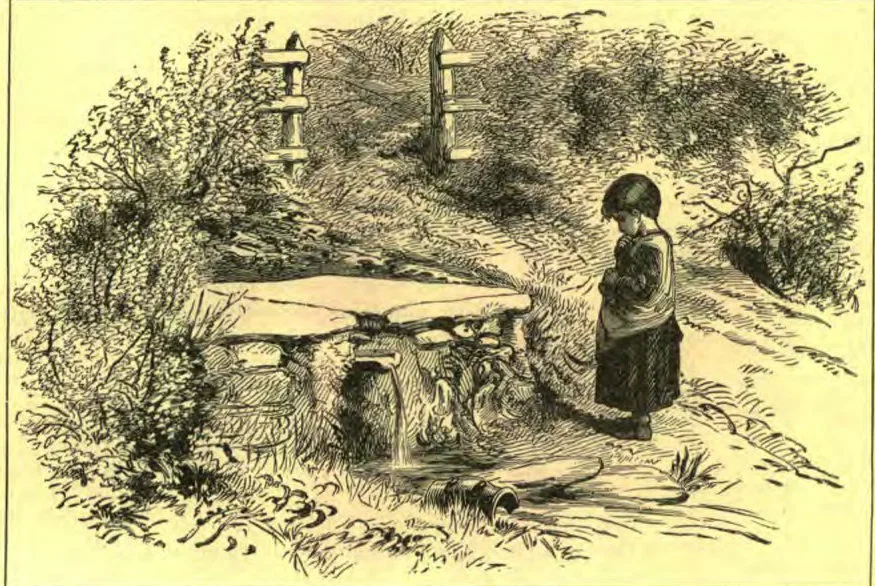
From the back door of the house where Dottie lived, ran a well-beaten foot-path. It led down through the garden, and under the grape-vine arbor to the back fence; then on through the gate to a sparkling spring that bubbled up under a tall clump of beech and maple trees. The spring made a little brook that trickled along, passing into a big box made of stones on the sides and bottom, and covered over with a large wooden lid, and then it ran out through a wooden trough to hurry down to a lake.
Dottie's mother kept milk and cream in the box with the heavy wooden lid, and she came down there to work over the nice yellow pats of butter. Dottie often came to this place with her mother. It always seemed to her that the great wooden lid covered up a mysterious quantity of good things, and she never came to the spring with her mother for so much as a pail of water, without teasing to have the lid raised so that she could look in.
Now Dottie had been forbidden to go down to the spring alone; for the ground was spongy and moist, and she was very apt to get her feet wet.
One day Dottie's mother was very busy putting up peaches. Dottie liked to be around in the kitchen when this was going on. She enjoyed the spicy smell of the fruit, and sometimes her mother gave her pieces of the softest ones to eat. But this day Mrs. Brown did not want her in the kitchen. Company was coming to dinner, and there was a great deal of work to be done. So Dottie was sent off into the yard to amuse herself.
This made the little girl cross. The yard was a nice place, but she wanted her own way. Instead of trying to be pleasant and amuse herself, and in that way help her mother, she wandered around in the green grass, pouting to herself. By and by she saw her mother hurry down to the spring with something in her hand.
“Mamma! mamma!” screamed Dottie, running after her, “wait for me.”
“No,” called Mrs. Brown, without looking back, “stay where you are. I am in a hurry.”
“O dear!” fretted Dottie, “she is mean, when I want to go so bad. I s’pect there is something nice in that basin, and ’sides, I haven’t been to the spring to-day.”
“Why, Dottie Brown!” a voice seemed to whisper at her side, “aren’t you ashamed to talk about your mother in that way?”
“I don’t care,” replied Dottie to the voice, “I don’t have one bit good times. I wouldn’t be in the way in the kitchen.”
“Think how kind your mother is to you,” began the voice again.
But Dottie would not listen to it, nor think of anything but how much nicer it would be in the kitchen or down to the spring than it was in the green old yard. So the good voice ceased to talk to Dottie.
By the side of every little child a good angel walks, that puts good thoughts into the child’s mind when that child is tempted to do evil, and that tries to keep him from harm and from doing wrong. But if the child will not listen to this good voice, there is always an evil angel ready to suggest wrong things to say and do. It is very dangerous to refuse to listen to the good voice; for there is no telling how many wrong things the bad voice may tempt us to do.
When Dottie closed her ears to the good voice, the bad voice said, “Why don’t you go down to the spring to play?”
“Mamma has told me not to go to the spring,” said Dottie, walking down slowly toward the path.
“She is busy, and will never know you went there,” urged the voice.
“I believe I will just look through the gate,” said Dottie.
“There is no harm in that,” said the bad voice.
“Dottie! Dottie! don’t go there; it is the path to the spring,” said the good voice, again pleading with the little girl.
“I ain’t a-going to the spring,” said Dottie almost out loud, the voice seemed so plain.
But when she got to the gate, it seemed very green and pleasant on the other side. She could hear the water gurgling over the stones and falling with a little splash from the trough. Some pretty white and purple asters and bright golden-red beckoned Dottie to come and pick them. When she had gathered all these she could find, she began to wonder what mamma had in the basin she left down there.
“It won’t do any harm to lift the cover and find out,” suggested the bad voice.
Dottie listened to it, and laid down her flowers. She tugged with all her might at the heavy cover, and at last raised it up. What should she see but the very thing she liked best for dessert set down in the spring to cool for dinner! A great quaking custard, delicately browned on top. Dottie balanced the cover with one hand, and bent down to sniff at it. Then she slipped one little brown finger in the edge of the dish for a taste, and then two fingers. Mamma never made so good a custard before, that was certain.
When Dottie was thinking of that, her feet slipped in the soft earth, and down came the heavy cover on the naughty fingers. Of course she got her feet wet. She was too much astonished to cry, but she could not lift the cover with one hand, and could not get her fingers out. Presently they began to pain her, and her loud screams brought her mother to the spot.
When Mrs. Brown saw the wet feet and the broken top to the custard, she was too surprised to say anything. She picked Dottie up, and carried her to the house. She did up the bruised fingers in liniment that smarted, and she wrapped the cold feet in a blanket, and set Dottie in the corner till after dinner.
Dottie had to eat by herself that day, for her mother did not have time to dress her in any more clean clothes. Then when the company was gone, she talked a long while to Dottie. Dottie told her what the voices said.
“The good voice,” replied her mamma, “is conscience. God put that voice in our hearts. It tells us what we have been taught is right. If we do not listen to the voice, by and by it will cease to talk to us. Then we shall be left without any guide, and we will do much wrong. If we continue to do wrong, the good angels will not stay where we are. We must ask Jesus to give us strength to do right.”
Dottie was much alarmed at the thought that the good angels would go away from her if she persisted in wanting her own way. “I will ask Jesus right away to help me,” she said. And her mamma is sure that Jesus does help her to grow sunny-tempered and obedient. W. L. K.

HOW NELL SAW INTO IT.

“You haven’t such a poor memory, Nell; how is it you learn other things fast enough, and this you—”
“O, things I can understand, yes! But there’s no seeing into this; it’s all throwing a thing away, and then having more than ever, and I can’t possibly see into that, papa.”
“Hum—m,” said Papa Frazer, as if trying to remember something he had forgotten. “O, yes,” he suddenly exclaimed; “never mind about that text now, Nell. How would you like an afternoon at the office?”
“O, splendidly, papa! May I?”
“Yes, and suppose you bring some of your things along—let’s see; why, one or two of your best dolls, some little picture-cards, and that box of bonbons from Aunt May.”
“I know, you’re afraid I’ll get tired, and tease to go out and bother you; but I won’t. If I just had as much to amuse me at home as some girls, I’d be perfectly happy to stay here—if it wasn’t for learning texts, I mean.”
A quarter of an hour brought them up on the third floor back of the big telegraph building, right in the heart of the busy city. While papa was putting on his office coat, he said, “Now, while you sort these gum bands for me, and I look over the afternoon mail, may be it will crack open a little of itself.”
“Crack open! What, papa?” asked Nell in surprise, just as if she hadn’t been complaining of not being able to see into something.
While both were as busy as they could be, there came the patter of bare feet up the alley way, and the sound of children’s voices.
“Softly!” cautioned papa; “wait a moment,” as Nell would have rushed to the window. “Now,” after the footsteps had continued on up the alley to the hydrant, and the sound of someone drawing water had ceased, “watch, but don’t speak a word.”
Nell nearly said “O my!” before she thought. Such a funny little low, stout girl, with the bandiest legs and feet all bare, and with her almost black hair twisted in a hard knot on the back of her head! And no wonder she was so bow-legged; for on her back she carried a year-old baby brother, his arms clasped close around her neck, and her arms passed under his legs, while in each hand was a small tin pail of water. While Nell looked at the odd figures with amusement, they halted at the corner of the big building, where a projecting portion made a shady little nook, just under papa’s office window, and down on the damp brick pavement they sat to play.
Nell’s eyes twinkled at papa, as the girl spread out the skirt of her dress for the baby a cushion, and then pulled from her bosom a torn and soiled card, a broken ring from a harness, a piece of tin foil, and the half of a hollow rubber doll that had been split into two parts along the seam in the middle, and then proceeded to dress the doll in the dirtiest of handkerchiefs imaginable. But papa looked very sober as he whispered, “She has a new trinket to-day; that tin-foil is a great find for her.”
“When did you ever see her before?” whispered Nell back.
“Before? She comes here every day; carries all the water for a large family in ‘Italy,’ as they call the Italian huddle on the alley; and this seems to be her sole amusement—unless carrying that strapping baby every trip is one—squatting down a few minutes, and going over those poor bits of trash, like a miser over his gold.”
“Do you s’pose they’re all she has, papa?” queried Nell soberly. “I mean—but, O dear, I didn’t s’pose—”
What it was Nell “didn’t s’pose” papa was left to guess, but not for long. Then came a little pull at his sleeve, and the two eyes that looked at him were dewy instead of laughing. “Papa, do you s’pose if I would go down and take one of my dollies, she would be so very glad?”
“I thought my little girl was ‘s’posing’ something good all this while. Now let’s see; here’s a ball of twine. I’ll tie it to both handles of the small waste-baskets. Good-by, Miss—what’s her dollship’s gracious name? In she goes; no wetness about this. Yes, the cards too. Why, bless you! What a heart you have!” as Aunt Mary’s box of bonbons followed.
Nell got a good place by the window while papa was unwinding the twine, and if ever eyes sparkled, hers did, as the basket went noiselessly down, down, until it struck the bricks, and rolled over, not two feet away from the Italian children. The girl gave one startled look, and seized her brother, and prepared to fly, when a look at the two smiling faces above re-assured her. Then Nell pointed at the doll and things, and made her understand they were hers.
It was over all too soon—most sweet morsels are soon gone—and the girl and her chattered thanks disappeared down the alley, when Papa Frazer heard from among his papers: “I don’t care if it was my best one, my very best. It’s all she has, and I’ve lots of others, and they’re ten times prettier, and I love them better than I ever—”
“O,” said he, “‘There is that scattereth and yet increaseth;’ I can see into it now—a good ways.”
“And so can I,” said Nell, “but I never should, if I hadn’t a’come here.”—Interior.

SPOONS AND DISHES.

THE history of the table fork has been told often, doubtless for the reason that people never cease to wonder how the world got along, through by far the greater part of its history, without this simple and convenient implement. But the history of the spoon is not so often related. It really seems as if people who ate at tables must have had spoons always, but this is by no means the case.
The first spoon was not a spoon at all, but a cup with a rather long handle. It was used for the purposes of a cup rather than for those of a spoon, and was often, as was the case with cups, made of metal. Gradually the form changed, and at last a spoon was developed from the long-handed cup.
It is an interesting fact that in Anglo-Saxon the word spoon or spon, as it is there spelled, means a chip, thus suggesting that the first spoons used by the Anglo-Saxon race were made of a humbler material than either gold or silver.
The salt-cellar had an even more humble beginning, but reached, after a long course of development, a more magnificent state, probably, than any spoon has yet attained. The first salt-cellars were merely pieces of bread, packed and hollowed out by the hostess’s thumbs and fingers so as to hold salt.
These simple contrivances were long found to be sufficient; but, to save others trouble and bring themselves money, ingenious silversmiths presently began making salt-holders of silver in imitation of the form of the dish of bread made by the housewife’s fingers.
From this beginning they became larger and more elaborate, until one which was constructed by Benvenuto Cellini, in the sixteenth century, was an architectural monument rather than a salt-cellar. Happily there was a reaction from this craze, and the people have returned to the use of comparatively small and simple receptacles. If the change had not taken place, persons on opposite sides of a dinner-table would have been by this time completely hidden from one another by the salt-cellar.
The plate is probably by far the oldest table implement. The ancients, in very ancient times indeed, possessed plates, or pieces of metal hammered out flat. The word “plate” is almost the same in the Greek and Latin languages as in English.
Perhaps the most curious thing about the introduction of porcelain plates into use—a form which these dishes did not take until quite a late period—was the belief which was long entertained that porcelain had the property of counteracting poisons. A few centuries ago the unpleasant habit of mixing deadly poisons with other people’s eatables was vastly more common than it is in this age. And its frequency led people to suspect poison in almost everything.
When, therefore, it was reported that a substance had been found, of which dishes might be made, that was an antidote to poisons placed upon them, great numbers of people hastened to provide themselves with plates of this material. This was greatly to the profit of the makers of porcelain, who had probably adroitly obtained the circulation of the story. Advertising seems to have been almost as much of an art in those days as it is now.
Not only were plates made of this material, but immense tankards and tureens as well. These great dishes give an impression that our remote ancestors were persons of immense capacity. But the dishes were made so large simply because it was convenient that the same vessel should serve for several people at the same time.—Selected.
Continue reading: THE STORY OF THE VIOLETS