The Youth’s Instructor, Vol. 28, No. 47.

SOMEBODY

The Youth’s Instructor

Nov 17, 1880

S. D. A. Publishing Association · Battle Creek, Mich. · Nov 17, 1880

SOMEBODY

“Ah yes,” said Grandma Edson, “I lived in the same house with Jenny’s father and mother when Jenny was a little girl, and I know just how it was that she first began to say to herself, ‘Somebody means Jenny.’ She was at that time very nearly six years old. One day her brother Dick came into the house, shouting, ‘Ting-a-ling! Ting-a-ling, a-ling! Who’s got a string? The boys are waiting, and my top’s waiting—for a string! Two red apples for a string! What does become of the strings? There ought to be somebody to take all the strings and paper that come into the house, and put them in a good place!’
“Jenny was sitting on a cricket by Aunt Dorothy,—her mother’s Aunt Dorothy,—and as Dick went out, he patted her on the head, and said, ‘Sis, do you know who somebody means? It means Jenny.’
“After Dick had left the room, Jenny looked up at Aunt Dorothy with so curious an expression that the old lady asked, ‘What is my little girl thinking about so soberly?’
“Jenny waited a moment or two, and then she told Aunt Dorothy that she felt a little voice saying something.”
“‘You mean that you hear a little voice,’ said Nell, her older sister.”
“‘No, feel the little voice,’ said the child, earnestly.”
“‘But what does the little voice say?’ asked Aunt Dorothy.”
“‘Say—say—what Dick says,’ answered Jenny.”
“‘For my part,’ said Nell, ‘I can’t make out what this young puss is talking about.’”
“‘I think I know,’ said Aunt Dorothy; ‘I think the idea has come into her mind that perhaps it is really true that “somebody” means Jenny.’”
“‘You say it ’zactly right, Aunt Dorothy,’ Jenny exclaimed.”
“‘I am glad to find out, at last, who “somebody” is!’ said Nell, laughing. Aunt Dorothy looked thoughtful, but said nothing. Not long after this, she took Jenny out for a walk. They walked across the fields as far as a clump of maple-trees, and there they sat down and had a quiet talk. And in the course of the talk, Aunt Dorothy said to Jenny, ‘My dear, if you live long in this world, you will many times hear of acts which “somebody” ought to do. Now I hope you will not grow up a selfish person, thinking only of your own needs and your own comforts. I hope that when you hear of these good deeds which “somebody” ought to do, you will very often “feel a little voice” saying, “Somebody means Jenny.” And you can begin now, in a small way, even if this small way is nothing more than taking care of the strings and the wrapping-paper, and I will show you how to do this.’”
“I was often in and out of their part of the house after that, and it was very curious to see how eagerly the little girl watched for packages, and to see the little fingers and thumbs fold away the papers and pick away at the strings. Everybody in the house got fun out of the business. Her father would come behind her and drop great sheets of stiff brown paper on her head for fun. She found strings rolled up in the toes of her stockings, and strings tied in bow-knots on her kitty’s tail. Her mother and Nell, just for fun, would bring her all the little wrappers which came around starch, or yarn, or bread-loaves, buttons, spools of cotton, shoe-strings,—if the paper was no more than two inches square, they gave it to Jenny.”
“I remember plenty of incidents connected with her school-life,” said Grandma Edson, “for I was the school-ma’am a part of the time; and I want to tell you some of them, to show you how it was that a woman who did a great deal of good in the world began very early in life to ‘feel a little voice’ saying, ‘Somebody means Jenny.’”
“Among the scholars was a poor child named Peggy Dunbar, who wore black pantalettes to school. It was the fashion, in those days, for the small girls, say those under thirteen, to wear pantalettes reaching down to the ankle. The every-day ones were of the same material as the dress, the best ones of white, with fancy trimmings. Now Peggy, whose parents were poor and were new-comers in the neighborhood, wore a calico dress and black pantalettes. The school-girls made fun of her, and sometimes the fun was plain enough for Peggy to notice it. One day, when they were talking the matter over, Sukey Sims said, ‘It’s too bad! Somebody ought to go to that child and tell her, kindly, that black pantalettes are not the thing!’”
“The very next day, Jenny walked home with Peggy Dunbar, and not only explained to her, all in a friendly way, that pantalettes like her dress would be prettier than black ones, but actually went into the house and waited until a roll of the calico could be found, and then helped to piece some strips of it together.
“The boys and girls had recess at different times, and the girls, at their recess, used to rush for the boys’ sleds, and coast down hill. There were not enough sleds to go round, and so ‘the little ones,’ as the smaller girls were called, seldom got any. One recess-time a passer-by made the remark, ‘Somebody ought to give the little ones a ride, and not let them stand there shivering.’ After this, many a ‘little one’ got a ride with Jenny.”
“As Jenny grew to be a young woman, she saw hard times, very hard times. Her brother Dick was lost at sea, her sister Nell married a man of the good-for-nothing kind, and moved away to the western country, as Ohio was then called, and her father and mother died, and she was left without a home and with very little money. She then hired two rooms, and by taking in sewing managed to support herself and Aunt Dorothy. After the old lady’s death she gave up the rooms and went to live, for wages, in a neighbor’s family. But what I wanted particularly to say was, that through all this time she must have very often felt the little voice saying, ‘Somebody means Jenny.’ For in watching the sick, and in lending a helping hand here, there, and everywhere, she was sure to be foremost.”
“Why, there could n’t be a subscription paper circulated but that Jenny must attend to it. ‘Pray how is it,’ people would ask, ‘that Jenny, more than others, finds time for all these things?’ I told them just exactly how it was, for I could trace her life all the way back to her childhood, and I saw that she had never forgotten what Aunt Dorothy said to her about ‘the little voice.’”
“One useful thing she accomplished was the starting of a ‘Fragment Committee’ in the town. The idea came into her head from hearing a remark of this kind, ‘There are old garments and reading-matter stored away in the garrets of some families, which, if somebody would only go round and collect them, would do a great deal of good to families who need them.’”
“Jenny began by collecting these things herself, and carrying them where they were needed. Afterward others joined her. They called themselves ‘The Fragment Committee,’ because they gathered up what was left; and there has been such a committee in the town from that day to this. They collect clothing, bedding, reading-matter, food, fire-wood, anything that anybody has to spare, and see that all these things go to the right places. Even the boys and girls helped in this, for, as Jenny said, it seemed as if their feet were made on purpose to run from house to house.”
“When Jenny was between thirty and forty years old, she went to a distant city to work in a shop, and her friends lost sight of her for a number of years. We found, afterward, that to the last week of her life she remained the same unselfish, earnest person who had made us all love her so well.”
“In the city there was plenty of work for ‘somebody’ to do. Somebody was needed to collect poor children for Sunday-schools, and to teach in those schools; somebody was needed to collect ignorant people for evening classes, and to teach in those classes; somebody was needed to carry flowers to the poor who were sick, to talk with them pleasantly, to read to them pleasantly, and to look at them pleasantly; somebody was needed to help in the mission schools; somebody was needed to ask the rich for means to aid the poor; somebody was needed to search out destitute families who were too shy or too proud to ask for help, and to give them that help in a delicate way; somebody was needed to procure work for such as could not get work; somebody was needed to visit those who were degraded by sin and to assure them that they still had power to rise. And we found that in very many of these cases, our dear friend had ‘felt the little voice’ saying, ‘Somebody means Jenny.’”
“Such a life as Jenny’s,” said Grandma Edson, “was worth the living. It was a blessing not only to Jenny herself, who was one of the happiest people I ever knew, and to those whom she helped, and to those whom she taught to become helpers, but to others who knew her only by hearsay. For the phrase, ‘Somebody means Jenny,’ has come to be a proverb in her native town, and is sure to be repeated, and with good effect, too, whenever an undertaking is mentioned which ‘somebody’ ought to attend to, and which calls for self-forgetfulness and real hard work.”—Youth’s Companion.

THE LOOM OF LIFE.

All day, all night, I can hear the jar Of the loom of life, and near and far It thrills with its deep and muffled sound, As the tireless wheels go always round.
Busily, ceaselessly goes the loom In the light of day and the midnight’s gloom, The wheels are turning early and late, And the woof is wound in the warp of fate.
Click, clack! there’s a thread of love wove in; Click, clack! another of wrong and sin; What a checkered thing this life will be When we see it unrolled in eternity!
Time, with a face like mystery, And hands as busy as hands can be, Sits at the loom with its arms outspread, To catch in its meshes each glancing thread.
When shall this wonderful web be done? In twenty years? Perhaps in one; Or to-morrow. Who knoweth! Not you or I. But the wheels turn on and the shuttles fly.
Are we spinners of woof for this life-web, say? Do we furnish the weaver a thread each day? It were better then, O my friend, to spin A beautiful thread than a thread of sin.
Ah, sad-eyed spinner, the years are slow; But each one is nearer the end, I know; And some day the last thread will be woven in,— God grant it be love instead of sin.—Sel.

STILL AT SEA.

On the ninth day of our voyage we have a heavy atmosphere, which prevents the usual “observation,” but gives us an opportunity to see how the progress of the ship can be determined without an “observation.”
Near noon the captain resorts to what the sailors call “heaving the log.” This log is simply a piece of board with lead on one edge, which floats uprightly in the water. It has a long line attached to it, which is wound on a reel that has handles at each end so that a man can take hold of them, hold it over his head, and let the line pass off. The line is marked off into different portions called knots; and these knots are marked by different colored rags tied to them.
When the time comes to heave the log, three men come to the stern of the ship, one holding the reel over his head, one the log, and another the time-piece. The log is thrown, and as soon as the first rag passes over the stern of the ship, there is a call for the time to be kept. The line is permitted to run just one minute, when it is stopped and drawn in. By counting the knots that have passed out in one minute, the number of miles the ship has sailed per hour can be told.
They have been “heaving the log” once in two hours, and now calculate from the rate of speed per hour how far they have sailed. By comparing this with their position yesterday, they decide just where we are on the sea; so here it is on the map,—distance sailed, two hundred and twenty miles; distance from New York, two thousand two hundred and forty-three miles; longitude, 23° west; latitude, 51½° north.
The sea calms down, and we have the most quiet night since leaving New York Harbor. The morning of the tenth day dawns bright and fair. All is cheerful. Our ship is making better time, and we begin to be anxious to see land once more. A nice breeze from the south-west is helping us on.
Our noon observation shows that we have sailed two hundred and fifty-eight miles, and are two thousand five hundred and one miles from New York. If our captain’s “observations” and “reckoning” are all correct, and he affirms they are, we cannot be far from land. He says that if no misfortune befalls us we shall see land to-morrow morning at eight o’clock, and that by ten o’clock we will be sailing past Cape Clear on the southern coast of Ireland. We will see how this prediction comes out.
J. N. L.

Kindness of Disposition.

YOUTH is the time to cultivate kindness, gentleness, and love. The tender heart of the little child may grow more lovely as the years roll on. A daily discipline in kindness will transform and beautify the life. Dear children, if you value your own happiness and desire to make others happy, then be generous, helpful, and willing to aid those who need help.
The measure that you mete unto others will be measured to you again. Do you desire friends? then be friendly. Do you desire sympathy? then be sympathetic. Do you desire a life of calm happiness? then strive to make the lives of those around you happy.
I once heard a lady remark, “I am tired of helping other people; I receive no reward, and hereafter I shall look after my own interests.”
The remark was unwise and the conclusion erroneous. No reward may be received in the shape of dollars and cents, but the good-will of the community is worth something, and no act of kindness is unnoticed by God. No unkind person will ever tread the golden streets of the city above.
ELIZA H. MORTON.

A GOOD REPLY.

“Sir,” said a young man who came to Philip Henry, the great divine, “how long should a man go on repenting? How long, Mr. Henry, do you mean to go on repenting yourself?” What did old Philip Henry reply? “Sir,” said he, “I hope to carry my repentance to the gates of Heaven? for every day I find I am a sinner, and every day I need to repent; and so I mean to carry my repentance, by God’s help, up to the very gates of Heaven.”—Rev. J. C. Ryle.

LESSONS FOR CHILDREN.

LESSON XCIX.—CONNECTION BETWEEN THE OLD TESTAMENT AND THE NEW.

ABOUT the time Esther became queen of Persia, a good priest by the name of Ezra was sent to Jerusalem, where he taught the people the way of the Lord more perfectly. This was much needed; for the people, when in captivity, had learned many of the bad ways of other nations, and were neglecting many things which the Lord required of them. He had the people all gathered together, and then read the word of God to them so that they might know just what was right.
A few years later, Nehemiah, another good man, who, although a Jew, was an officer in the king’s court, got leave to go to Jerusalem. Nehemiah was a man of great courage, and helped his countrymen build the wall of their city, although their enemies opposed them so fiercely that a part of the men had to stand guard, with weapons in their hands, while others worked at the wall. Nehemiah, like Ezra, corrected the bad habits of the people; and about this time, the Lord put his Spirit upon Malachi, a fearless young prophet, who reproved not only the people but the priests also, and foretold the coming of John the Baptist, who was to be the forerunner of Jesus Christ, the Saviour of the world.
From the time of Malachi, the Jews remained under the control of the Persians for about eighty years, when the Persian empire was conquered by Alexander the Great. The Persians treated the Jews kindly, leaving them, in the main, under the control of their own high priest. Alexander honored the Jews, and granted them many favors; but he lived only ten years after his first visit to Jerusalem. Then he died, and his vast kingdom was divided among his generals. The Jews now fell under the control of the kings of Egypt for nearly a hundred and twenty years. These kings were generally kind to the Jews; but one of them became so angry because the priests would not let him go into the most holy place of the temple that he gathered all the Jews he could find in Egypt, and when he had shut them up in a great building, called the hippodrome, he turned elephants upon them to destroy them. But the elephants, instead of harming the Jews, turned upon the people who came to see the show, and killed a great many of them.
After this, the people of God came under the dominion of the Syrian kings for a little more than forty years. One of these kings, An-ti’o-chus E-piph-a-nes, was very cruel. He killed many thousands of the people, and took many thousands more as slaves. He sent his soldiers to kill the people on the Sabbath day, when they were gathered in their synagogues to worship; for he knew they would not defend themselves on the Lord’s day. Finally, many of the people hid themselves in caves, of which there are a great many in Judea. There they fought so desperately that, by-and-by, their enemies grew weary of pursuing them. After some years of hard fighting, under the leadership of a family of brave men called the Maccabees, they gained their independence, and held it for a hundred years. Then they began to quarrel among themselves, and so fell under the control of the Romans, who appointed governors to rule over them.
Finally, Herod became governor of Judea, and by wicked plans and unjust measures at length obtained the title of king. He was one of the most cruel persons ever known. His wife’s brother was high priest; but Herod had him drowned, just because the people liked him for his pleasant ways. He next put to death Hyrcanus, who had been high priest, and was now eighty years old. He finally became so jealous, and so afraid that some one would take his life in order to get the throne, that he killed Mariamne, his wife, and afterward, two of his sons.
He tried to make up for his bad actions by building cities and costly temples. But he grew more and more unhappy, and finally died a terrible death. He did one good thing, and that was to rebuild the temple, which, as it had been built about five hundred years, was now much decayed. We shall learn more of this wicked king in another lesson.

QUESTIONS.

1. Who was sent to Jerusalem about the time Esther was made queen of Persia?
2. What did he do there?
3. Why did the people need instructing at this time?
4. How did he show all the people just what was right to do?
5. Who got permission to leave the Persian court and go to Jerusalem, a few years later?
6. What was the rank and character of Nehemiah?
7. What did he help his countrymen to do?
8. How fiercely did their enemies oppose them?
9. In what other way did Nehemiah help his people?
10. Upon whom did the Lord bestow the gift of prophecy about this time?
11. What did this fearless young prophet do?
12. What did he foretell?
13. How long after the time of Malachi did the Jews remain under the control of the Persians?
14. How did the Persians treat them?
15. How long were they under the control of Alexander the Great?
16. How did he behave toward them?
17. Who held dominion over them for about one hundred and twenty years after the death of Alexander?
18. How did the Egyptian kings generally treat the Jews?
19. What made one of these kings very angry at them?
20. How did he take revenge?
21. Who next ruled the Jews for about forty years?
22. Which of these kings was noted for his cruelty?
23. What did he do to the Jews?
24. Why did he send his soldiers against them on the Sabbath-day?
25. Where did the people finally take refuge?
26. Who led the people out to defend themselves?
27. What did they accomplish after some years of hard fighting?
28. How long did they keep their independence?
29. What wicked man finally became governor of Judea?
30. How did he become king?
31. What is said of his cruelty?
32. How did he treat his wife’s brother?
33. Why did he do this?
34. What was his next crime?
35. Who was Hyrcanus?
36. What did Herod’s jealousy finally lead him to do?
37. How did he try to make up for his bad actions?
38. What finally became of him?
39. What one good thing did he do?
40. When had the temple been destroyed?

Spurgeon's Pastor's College, Orphanage, and Sunday Schools

SPURGEON not only has a “Pastor’s College” and an “Orphanage,” but also carries on not fewer than nineteen Sunday-schools, in which are some five hundred teachers and nearly six thousand scholars. He is at the head of a respectable sized army, and has all the generalship that such a position demands.

THE MASTER'S PRESENCE.

The first and main want of the modern Sabbath-school is the Master's presence. The spiritual mission of the institution has been forgotten, less by the talkers at conventions than by the great majority of teachers who never attend conventions. The theory of the few outreaches the practice of the many. We have reason to fear that there are many teachers who make no personal religious appeals to their pupils, who never pray with them, in whose classes young persons have remained for years without a knowledge of Christ, without any deep-wrought convictions, and even without one zealous effort on the teacher's part for their conversion. Such classes and such schools seem to lack only one thing, but it is the one thing needful. Enthusiasm, numbers, attractiveness, and a score of other charms they may possess, but oh! where is the Master?
We trace this lamentable lack to the indefinite if not incorrect theories which underlie the Sabbath-school. If what we build be a breakwater instead of a light-house, why be surprised that no rays fall upon the black night from its summit? If the Sabbath-school be a human, temporary substitute, independent of the church, and without divine authority, who can wonder that the divine co-operation has not been sought or secured. If it is organized merely to hold childhood until the church itself shall come in with divine powers, we need not measure its worth by any spiritual result, and may expect that in the zeal to perfect its organization, display its drill in music, martial movement, and Biblical scholarship, it will too often forget to pass its pupils over to the church, and not infrequently alienate them from it. But the school is more than this theory allows, and it needs first and always the divine co-operation.
No degree of convenience and elegance in architectural arrangements, no completeness in appointments, no precision and harmony of movement in discipline, no thoroughness in intellectual training, no impressive proprieties in devotional services, no ingenious illustrations from the superintendent's desk or blackboard, no occasional addresses,—none of these can compensate for the absence of the “power” which the Holy Ghost alone imparts. The Master's presence is indispensable, for ours is the school of Christ. We need the Spirit in the school of the Word, because the Word is the “sword of the Spirit.”—J. H. VINCENT, in The Church School.

HOME INFLUENCE.

THERE is no place like home as a help to Sabbath-school work. It helps most when all its members attend the school. All should attend, for all need to study the Bible. But attendance is not the only thing that is needed. There must be hearty co-operation between the family and the school. In many cases there is no co-operation, and in some cases there is evident antagonism. By true co-operation, the complaint against the school as lessening the sense of parental obligation, would be forever silenced.
The first element of this co-operation is a good understanding between parents and teachers. It should be distinctly recognized that they form a mutual-aid society, laboring for the same ends, and using, where possible, the same means. This co-operation should cover the matter of reading collateral scriptures at home, carefully preparing every lesson, examining children at home, both before and after recitation, securing a cheerful punctuality, advising teachers as to hopeful or discouraging symptoms in a scholar; in short, it should include every means whereby the parent can help the teacher, or the teacher can help the parent.—Baptist Teacher.

THE SAILOR BOY.

CAPTAIN TRUEMAN, when only a small boy, went on board of a large ocean steamer to commence a seafaring life.
He was a bright, cheerful, active boy, and his mother loved him very much, and wanted him to become a sober, useful man. But she thought that he would be greatly tempted on shipboard, for many of the sailors were drunken and profane; so she asked him to promise her that he would never touch or taste a drop of liquor; and when he gave her his farewell kiss, he made the desired promise.
He was soon a great favorite with the captain of the ship, the weather was pleasant, and for a while everything moved along smoothly; but, by-and-by, there came a fearful storm, and all the crew, even the little sailor boy, had to work all night to keep the ship afloat.
After the storm had somewhat abated, the captain called all hands together, and gave to each a ration of whisky. He said that they had worked very hard, and that they needed it. But when he offered the cup to the boy, he refused it. The captain commanded him to take it as a medicine, but the brave lad said that he was not sick and did not need it. He reminded the captain that he had promised his mother to take good care of him. “And I promised her in God’s name,” said the boy, looking his commanding officer full in the face, “that I would never touch or taste a drop of liquor.”
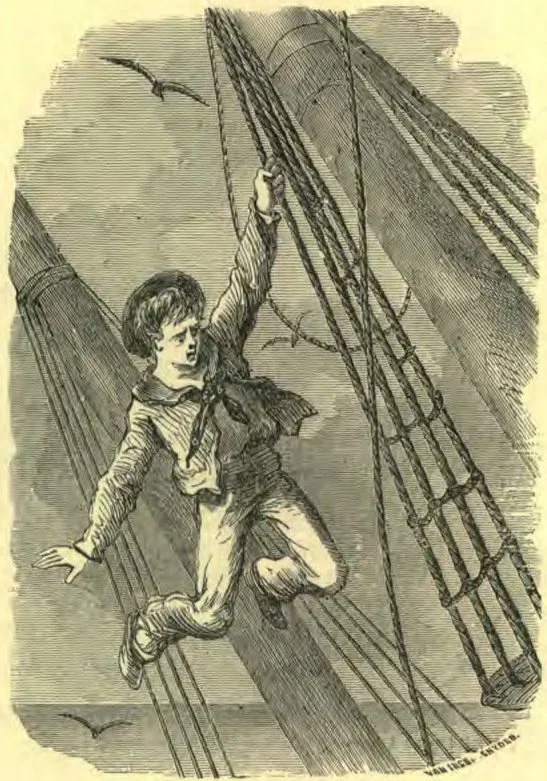
The captain laughed and called him a fool, and pretended that he did not care, but in truth he was very angry. Shortly afterward, although the sea was still rough, and the ship was plunging fearfully, the captain ordered the boy to go aloft. The sailors expected that he would disobey; but he did not hesitate a moment,—up he went. Once or twice he lost his hold, as seen in the engraving, but regained it, and came down in safety.
He was afraid to disobey his mother, or break the promise he had made to God; but he was not afraid to climb the ropes, although the vessel was tossing, and the sea-birds were screaming about the rigging. His head was steady and his arms were strong.
Not long after that, while the ship was lying in port, the captain and some of the men went ashore; the boy remained on board. The officers and men, who were left in charge of the ship, forced open the captain’s room, and helped themselves to his choice liquors, and were soon dead drunk below.
After a little while, the boy, who was in another part of the ship, thought that he smelt something burning, and looking about found the captain’s room on fire, for the sailors had been smoking, as well as drinking, in the room. He worked very hard, and soon succeeded in putting out the flames.
You may be sure that the captain, when he returned, was very glad and thankful; for he saw that the brave lad had not only saved the ship, but the crew, who were too drunk to save themselves. After that no liquors were kept on board of that ship.
The noble boy who had the courage to keep his promise, and never touched or tasted a drop of liquor, is now the captain of a large, fine ocean steamer,—a temperance ship.—Sel.

LETTER BUDGET.

John Frederickson, of Swan Lake, Dakota, writes that he attends Sabbath-school every week, and tries to learn his lessons well. He has four brothers and one sister, all Sabbath-keepers. He is thirteen years old.
Lena Roese, of Maiden Rock, Wisconsin, says that she has kept the Sabbath with her father and mother seven years. She thought it very strange at first for her parents to keep Saturday instead of Sunday. Their nearest place to attend meeting and Sabbath-school is seven and one-half miles, and they can go only in the summer. In the winter they learn and recite their lessons at home. She attended the camp-meeting last summer, intending to be baptized, but there was no baptism. She desires the prayers of the INSTRUCTOR family.

INSTINCT OF THE STORK.

At the great fire, some years since, in Auerbach in the Upper Palatinate, more than half the city was laid waste, the fire being so intense as to melt porcelain, stoneware, glass, and even the six bells in the church-tower.
The wind blew brands and sparks on the city wall tower, which was eighty feet high. This tower was called Stork’s tower, because the Storks had had a nest on the point of its roof for a number of years. At the time of the fire there were three unfledged storks in the nest, which was made of brush, straw, and other combustible materials, all very dry, owing to the heat of the season. Notwithstanding their intense suffering, the parent birds did not forsake their young, but flew alternately to a pond, outside the city near the tower, dove in, filled their crops with water, and, returning through smoke and flame, sprinkled the water on and about the nest and over their open-beaked young, which they tried to protect with their outspread wings. This they continued to do until late in the evening, when the danger to nest and young was over.
The tower, with its inhabited storks’ nest, remains to this day, a speaking testimony of the parental love, as well as the instinct, versus understanding, of the stork.—Our Dumb Animals.

Weight of British Royal Crowns Compared

George III.'s crown weighed seven pounds; Victoria's only weighs nineteen ounces.

NOVEMBER

'Tis said that thou art “dreary;” Unpleasant in thy reign; Too chill and wet thy mantle, With autumn fogs and rain.
“Too few” thy gleams of sunshine Amid half-leafless trees; Too full of “wail” the burden Of thy wind harmonies.
In heart, a stern “twin brother” Of April,—child of tears, With less of birds and brightness And more of clouds and fears.
Nay, let the world deride thee, And cast their stone of blame; I’m still thy friend, November, And smile to write thy name.
I love the skies so changing, Thy floating folds of mist; One sunbeam lights the landscape, And is enough, I wist.
And joy to me, the scudding Of leaves before the wind; The scattering nuts; the squirrels With frolic feet behind.
The sheltered ferns, unfrosted, With bits of golden rod; The asters bright, the milk-weed, White-winged in every pod.
The berries red and purple, The unchanged immortelle; With here a sprig of yarrow, And there a heather-bell.
By all these outward tokens, November days are here,— To many dark and dreary, To others full of cheer.—Sel.

You have reached the end of this edition.

The Youth’s Instructor · Nov 17, 1880