Review and Herald Publishing Company · Battle Creek, Mich. · Sep 6, 1900
EVERY THOUGHT AND ACTION INFLUENCES THE CHARACTER
By W. S. Sadler
EVERY thought, purpose, and deed has a positive influence in the formation of character. The thought that they are daily erecting a character-structure that must either stand throughout eternity or fall in the final test, should be ever before the young men and women who live in these solemn times.
The thoughts and actions of to-day will be perpetuated in the character of to-morrow, and must either strengthen or weaken us for the great struggles just ahead. These are serious thoughts, and the terrible result of indifference to them should cause us to stop, and seriously ask ourselves the question: Am I to-day, by my thoughts, by my reading, by my associates, by my actions, contributing to the developing, purifying, and strengthening of my character? Am I building a character that God will by and by crown with eternal glory and everlasting life? Remember, it is the little foxes that spoil the vines; and so it is on the little points—perhaps bitter thoughts and secret sins—that Satan would seek to undermine the foundations of our character, and sooner or later produce the downfall of the structure that represents the sum of our life's work.
It is a great mistake to think that God will work some mighty miracle to strengthen and develop our characters. This work, if done at all, will be accomplished by conscientious and faithful attention to the small, yes, even the smallest, things in our daily life. The slightest compromise of right, the smallest deed, the least sin, however insignificant and unimportant the enemy may represent them to be, have a positive influence either to strengthen or weaken the character. By nature we are sinful; and therefore natural traits of character, if unsuppressed, will, as in the sons of Eli, mar the holy work of God with which we are connected. As Christians, we must be led by the Spirit, walk by the Spirit, live by the Spirit; and then the character we are daily developing will be a spiritual character,—a character with which the Holy Spirit can co-operate. W. S. SADLER.
THE BETTER WAY
By Elizabeth Rosser
The world has griefs enough;
It has no need of thine,
Or mine:
So hide from human gaze
The thorn that thou must bear;
But on thy breast, where all may see,
The rose of gladness wear.
The world has tears enough,
From hearts more sad than thine,
Or mine.
Then in thy closet shut,
Let all thy tears be shed;
But to the world do thou still turn
A smiling face instead.
The world has doubts enough;
It must not hear of thine,
Or mine.
If of thyself thou hast
No tidings that will please,
The grace and goodness of our
Lord,—
Oh, let it hear of these!
ELIZABETH ROSSER.
THE GARDEN OF THE GODS
By David Paulson
“This world is dark and drear,” sighs the gloomy Christian,—if, indeed, there can be such a thing as a gloomy Christian. As a matter of fact, it is doubtful whether one who does not appreciate the evidences of God’s goodness as manifested in his providences, nor recognize his beauty and glory as seen in the physical world, would feel at home if he were suddenly transported to heaven. If what we see here through a glass darkly does not to some degree awaken melody in our hearts, what reason have we for supposing that we should be enraptured if the full blaze of that glory were suddenly to burst upon us?
There is scarcely a spot on earth, no matter how stained and marred by the curse, but still reveals some of the glory of the divine Creator. There are some places on earth where God has seen fit to allow to remain more evidences of his majestic handiwork than in others; and it is strikingly appropriate that in the mountain fastnesses, which are to be the hiding-places of his children during the last great struggle between truth and error, he should leave the greatest evidences of his might and power. The mountains of Colorado have furnished an inspiration for the poet’s pen and the artist’s brush for at least a generation, but neither has exhausted the sublime grandeur of the scenery.
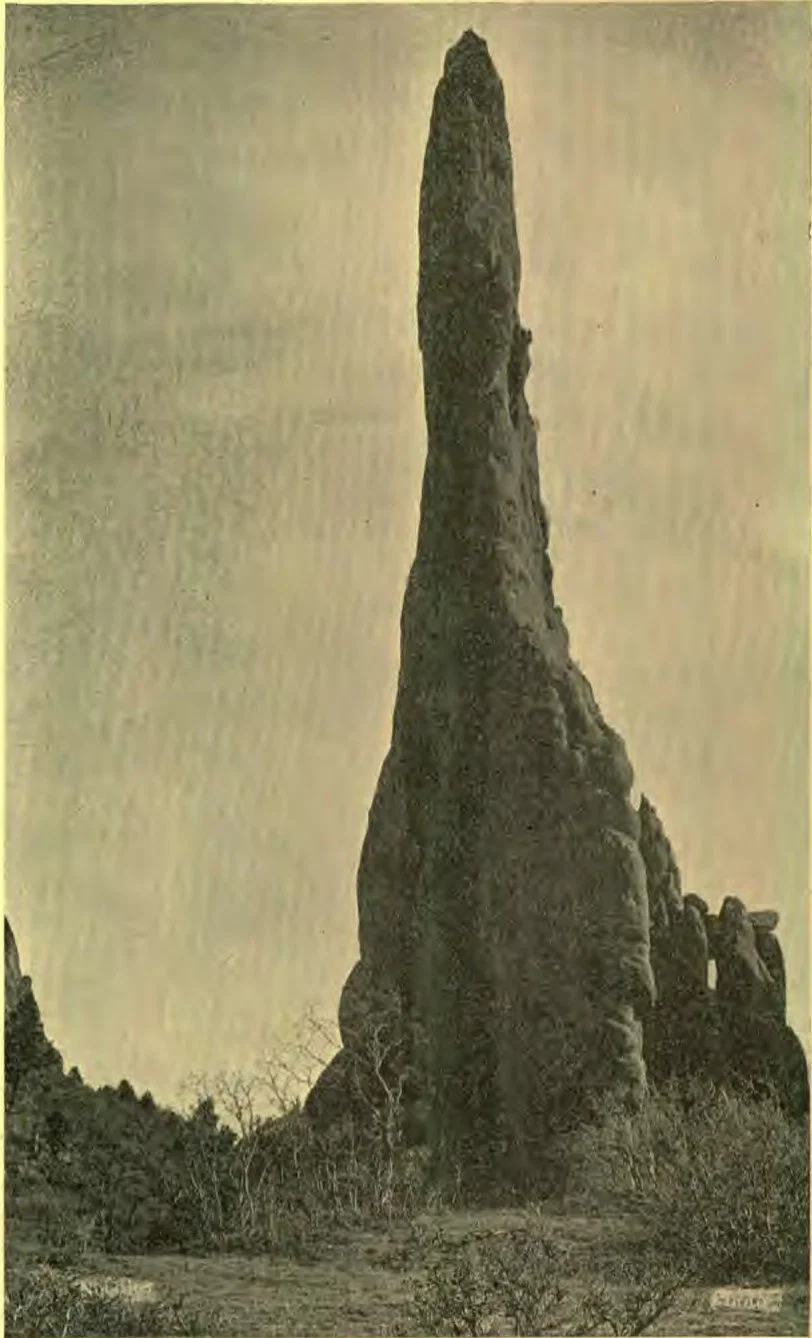
CATHEDRAL SPIRE
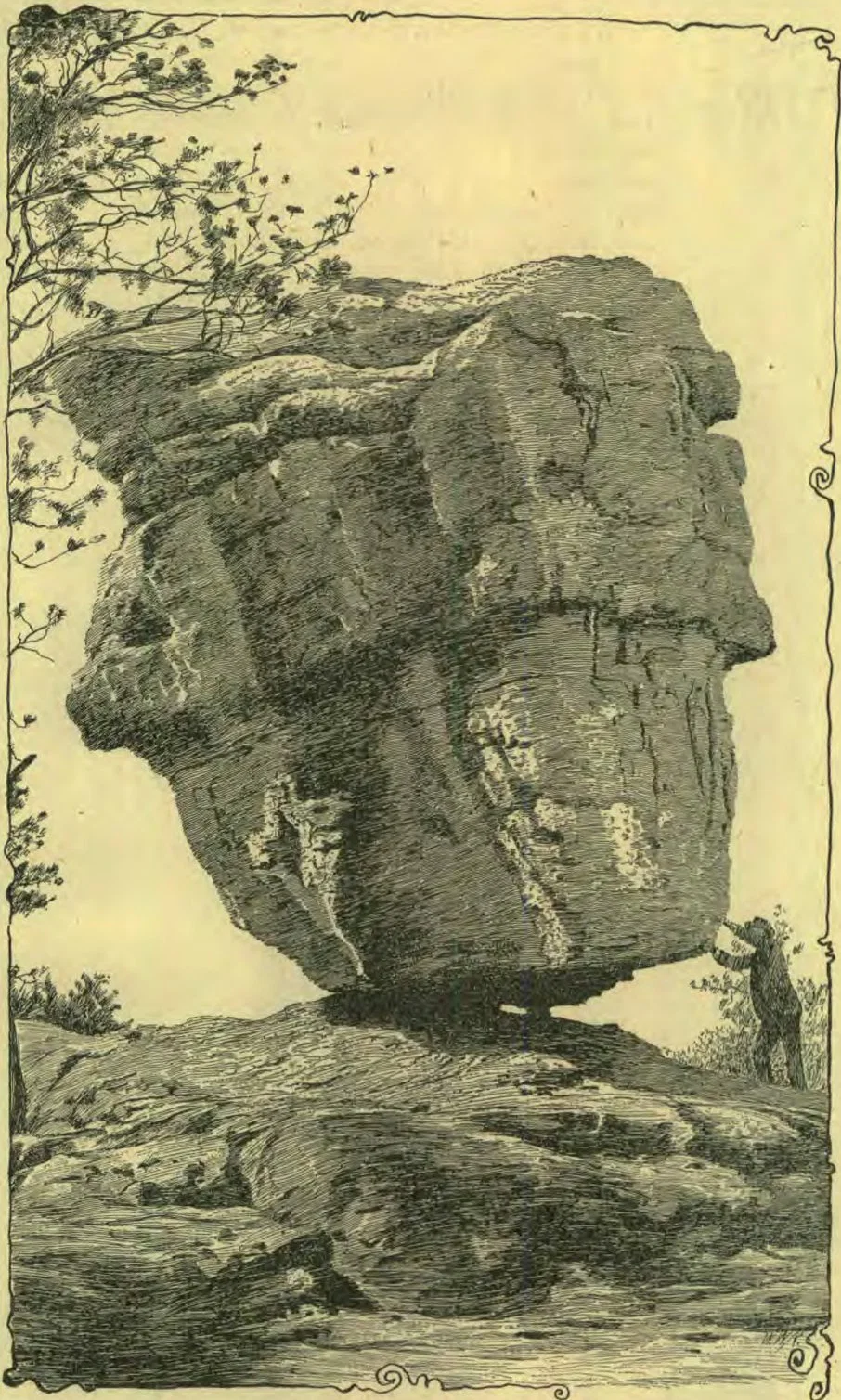
The “Garden of the Gods” has been so named from the great number of marvelous rock formations scattered in every direction. Some of these bear certain resemblance to the images of various historic gods, and it is difficult to conjecture what combination of nature’s forces was required to produce such monuments in rock. A striking example of the exactness whereby nature sometimes leaves her work is the Balance Rock. This immense boulder, weighing many tons, rests on a base of only about four square feet. One can not help thinking, as he sees it, that the light touch of an infant would start it rolling down the hillside. Yet there it has stood, probably for thousands of years, withstanding the fury of storms, an object-lesson to all of how accurately God can balance that which he has the opportunity to control. It is he who maintains the balance between nutrition and tissue breakdown in our bodies, and who regulates to a unity the relation between heat formation274and heat elimination, so that the body temperature in health remains the same under ever-varying conditions. And it is the same infinite Wisdom that has declared, “With what measure ye mete, it shall be measured to you again.” Oh, why should we ever allow Satan to lead us to doubt for a moment that Providence can maintain this balance as readily as he does this rock, as in the tissue building, or the heat formation! “I the Lord do all these things.”
Another striking freak of nature in this garden is a rock known as “Cathedral Spire.” Though not reared by human hands, it stands, singly and alone, as straight as a steeple spire. Three other rocks, of almost equal height, standing side by side, whose tops bear a fancied resemblance to human forms, have been named, respectively, Faith, Hope, and Charity.
The lover of the beautiful and grand in nature could spend many weeks among the mountains and cañons of Colorado, and then go away feeling that he had caught only a glimpse of these wonderful remnants of God’s original handiwork.
DAVID PAULSON, M. D.
URIAH
By Anna Agee Hall
“Howdy, Missus!”
A small, round, black face, with bright eyes and white, shining teeth, smiled up at me as I answered the greeting.
It was Uriah, who lives with his granny, an old-time slave-woman, up in the mountains of Jamaica. I had spent a few months there the previous summer, and so came to know them.
Granny used to love to sit on the ground by her cooking fire, which was also on the ground, and around some stones, on which she would set her one black kettle. She would smoke her clay pipe, and talk of old slavery days by the hour if I would listen to her. Uriah did most of the cooking. He gathered the sticks for the fire, made it, kept it going, and carried the water in a “pan” (all pails are called pans here) on his head, to say nothing of finding the food, too.
“And how is granny? and where have you been?” I inquired.
“Granny, he so-so, an’ I been to groun’ to bring him bread-kind,” answered Uriah.
You would have been interested, I know, could you have peeped into the hampers. Uriah was carrying most of his provisions on his donkey, but he had a basketful on his head, too. The donkey looked stupid and sleepy. The hampers were two large baskets, fastened each side of a wooden pack-saddle, which was girted astride the animal’s back.
Let us examine the load. You can not name those queer-looking things, I know. First, there are “plenty cocoes,” to speak as Uriah would. These are the tubers, or roots, of a plant that resembles common rhubarb, or pie-plant, in appearance,—large leaves on the end of a soft stem. The tubers are somewhat egg-shaped, with a neck that fastens them to the plant. Then there are plantains, which you would call “such big bananas.” These are boiled while green; and if kept until ripened, they are excellent either boiled or roasted; they may also be cooked in a variety of other ways. Here is a bunch of green bananas, or “munchie,” as Uriah calls them. This has been cut up in “hands” of about fifteen bananas, or “seeds,” each. These he will peel and boil while still green, and eat with salt or salt fish, a common accompaniment of the native foods.
BALANCE ROCK
He has both red and yellow sweet potatoes, too; also some negro yams. All yams are large, coarse roots, and do not look fit to eat. Some kinds taste very good, however, when roasted or boiled. There are three principal kinds,—negro, yellow, and white. The latter is the best. Yams are the tuberous roots of long vines, which are trained up tall poles. The leaves are heart-shaped. The longer and ranker the vine, the larger and better the tuber. Should the wind blow down the pole that supports the plant, it would stop its growth and ruin the yams.
What are those queer, round balls, which look like osage-oranges? you ask. Why, they are breadfruit. Uriah will peel, quarter, core, and boil some, and others he will roast by the open fire, turning them occasionally so they will roast evenly. Then he will peel the blackened rind off; cut, and core, and eat, while hot, with salt fish, or some of those alligator pears in the basket on his head. How he will smack his lips!—and I think you would be tempted to do so, too. Uriah scarcely knows what real bread tastes like, but he eats “plenty bread-kind.”
Uriah was soon ready to trot on. He had cried, “Bur-r-r-r!” to his donkey as we met, so it stopped, and fed by the roadside while we talked. Now he hit it with his supple-jack,—a section of a long, woody vine that can be bent, while green, into almost any form. This is the common riding- and driving-stick of Jamaica, and one usually lies on the teacher’s desk in day-school.
The donkey understood, and started on. But he soon concluded that he was tired, and his load too heavy; so he picked out a green spot by the roadside, and began to lie down. “Whack! whack!” came the supple-jack, until Mr. Donkey concluded he would go on, and wait until home was reached for his coveted rest.
“Good-by, Missus,” called Uriah.
“Good-by, Uriah. Tell granny howdy,” I returned. I should have been thought very impolite had I failed to send granny “howdy.”
Soon boy and donkey were lost to my view, and a mind-picture alone remains,—a little woolly-headed urchin, wearing only a shirt, and carrying a basket on his head as he trudged behind the loaded donkey, rope and stick in hand.
ANNA AGEE HALL.
THE COLLEGE BOY'S ROOM
By Frank Walcott Hutt
The rooms of most college boys in the city are not the comfortable dens that the imaginative reporter sometimes paints them. As a matter of fact, they are often dreary, desolate places, where work-all-day and toil-all-night students merely abide, and can hardly be said comfortably to live. Of course this is not always the case, but there are many students' rooms of which it is true. The reporter of the enterprising daily usually discovers some ideal “den,” and writes it up in glowing style, enlivening his column with a fanciful illustration or two, in one of which perhaps is shown a student's “quiet corner,” hung with pictures and engravings, and adorned with costly rugs.
But there are rooms here and there that are rarely visited. A bit of attic room, with a single window and barely necessary furniture, is the extent to which many a poor but determined collegian will cater to his needs, at least for a while. There are many flights of stairs for him to climb in order to get to this poor room, but to him they are only typical of the flights he means to attempt in the accomplishment of many cherished plans. His den is lighted only by a dim kerosene lamp; but the light of ambition and youthful aspiration burns275bright within his breast, and he trims that light with his zeal, and often with a prayer. The furniture generally consists of a fairly well-ordered bed, a rickety table, a small, rusty stove, a bureau, and one or two chairs. Often there is not an ornament on the walls, with the exception, perhaps, of a bookcase, which the student has himself made, and on which he has placed his precious schoolbooks. Sometimes there is neither bookcase nor table; and he puts his books on the window-sill, where he also writes out his themes.
In his behalf, there is an excellent opportunity for missionary work of a most helpful sort. That opportunity ought first to be seized upon and improved by the sisters and girl cousins of the college boy—those who know how to make the dainty belongings that go so far toward giving a poor room an appearance of cheerfulness and brightness. Those who are able and willing to brighten and make comfortable a college boy's room, will to some extent lessen the bitter details of his college experiences, and so far be doing real missionary work. Not to overcrowd a room, but to set dainty reminders of home here and there, will suffice. A picture or two, and a plaster cast on the walls, will transform the most uninviting room, and render it in some wise a “living-room,” that its denizen will grow to love for the sake of those who care to remember him in this pleasant way during his college years.
FRANK WALCOTT HUTT.
25—Great Mullein
By L. A. Reed
24—Moth-Mullein
VERBASCUM Blattaria, MOTH MULLEN.
You would not suppose that this plant is related to our Common Mullein. However, it is closely related to it. The Moth-mullein is quite smooth, whereas our Common Mullein is very woolly throughout. The stem of the Moth-mullein is green and slender, while the stem of the Common Mullein is of a whitish green, and is tall and stout. The flowers of the Moth-mullein are large, showy, yellow or white, tinged with purple, and arranged at distances from one another on the stem: this method of flowering is called a “loose raceme.” The flowers of the Common Mullein are crowded close together in what is called a “dense spike,” and the flowers are much smaller than those of the Moth-mullein, and yellow.
The Moth-mullein is much visited by moths; hence its name. The flowers of the Moth-mullein perish in a short time after being picked. It is claimed that the cockroach and this plant can never agree, cockroaches holding it in great abhorrence.
25—Great Mullein
The Common Mullein, or Great Mullein, is called in Europe the “American Velvet Plant.” However, it is not a native of this country, but has been naturalized from Europe. It first came, it is claimed, from the Island of Thapsus.
VERBASCUM. Thapsus. COMMON MULLEN.
From its leaves the Greeks made lamp-wicks. The Romans prepared the dried stalks in suet, and burned them as funeral torches, calling them candelaria.
For a number of years the flowers have been collected, thoroughly dried, and kept in dry, well-stoppered bottles; dampness causes them to lose their delicate color. They are used to make poultices, and by the Germans to make a gargle for ulcerated sore throat. An infusion of the leaves is used for catarrhal affections.
Children sometimes rub the velvety leaves of this plant against their cheeks to produce a flush of color that almost rivals cosmetics.
L. A. REED.
THE VIRGINIA CREEPER
It is a curious fact that this same climbing plant, so universal and so easily domesticated, is also one of the most wonderful in the botanical world. A creeper that needed culture and attention could never have prospered and covered half London with its branches, as this creeper has done. Be it man or vegetable, there must be some special gifts and faculties in whatever invades a metropolis, and holds its own there, without any external aid.
The Virginia vine displays almost miraculous powers of adaptation. It sends out tendrils three or four inches in length, which grow in an apparently aimless way for a few days in five or six slender fingers until they touch and feel a wall, a window, a water-pipe,—any flat surface. Then the curved extremities of the tendrils swell, become bright-red, and expand into little disks, or cushions, closely pressed to the adjacent surfaces.
It takes from thirty-eight to forty-eight hours for this remarkable change to occur in the seemingly simple ends of the tendrils or hooks; but once the disks are formed, they secrete a fluid that fixes them to the wall or window as firmly as any glue or gum. No solar heat, no warmth of the adherent surface, can evaporate the liquid thus exuded; the climbing juice of the fig will remain liquid for one hundred and twenty-eight days, and that of the Virginia creeper is nearly as highly proof against desiccation. Yet, once affixed, it dries into an indomitable cement; and by these wondrous hands the little plant climbs and thrives. As soon as ever the disks have found a firm foothold, they discharge this hold-fast fluid, which hardens; and then the tendril curls itself into a watch-spring, twisting first one way and then the other, to avoid destructive tension, and by this method obtains a serviceable and elastic stay. Thus anchored, the little sentient mooring dries up and dies, but retains its strength and elasticity in the withered state, so much so that one single branchlet of the plant, dead276for ten years, has been found capable of supporting a weight of two pounds, the entire tendril easily sustaining ten pounds.
Hereby it will be easily understood how the lavish wealth of foliage displayed by this friendly and familiar creeper is held up. It has a thousand hands, and these possess ten thousand fingers, all feeling about for eligible points of vantage, which, once seized, are grasped for good.
A still more remarkable thing is that, once it has climbed as high as it can go, it takes no more trouble to develop these tendrils and disks. It seems to be quite aware that its aspiring days are over, and lays itself out to produce leaves and branches, just like the ivy, which shoots no more adhesive rootlets when it once arrives at the top of a tree or wall.
Nobody can be unaware of the Ampelopsis; everybody must see its graceful summer foliage and beauteous autumnal adorning; and, so seeing, have within reach and examination one of the deepest mysteries of creation.—Selected.
THE EARTH MADE NEW
By Laura Bennett; Ida Salton
When we think of the beautiful earth made new
And the river of life so fair,
Our hearts swell with love to our Father above,
For the home he has gone to prepare.
Oh, we're longing to drink of that life-giving stream,
And to gaze at its beauties untold!
Oh we're longing to walk in heaven's meadows so green,
And to dwell in its mansions of gold!
There our bodies, made glorious, will never decay,
And our sorrows forever will cease;
There will be no more night; for the Lamb is the light
Of the kingdom and city of peace.
Laura Bennett and Ida Salton.
THOUGHTLESS WORDS
By S. Roxana Wince
“I WONDER why Mab clings so to you,” said a lady who was visiting a friend, and who had with her a little motherless girl of three or four summers.
“Because I don’t starve her,” was the thoughtless answer, given in a roomful of company.
The little girl’s eyes had been ailing; and in accordance with the physician’s orders, the motherly woman who had charge of the child had put her on a plain diet, but her friend thought this unnecessary, and humored Mab to her heart’s content. Of course the guests did not know the state of the case, and do not to this day. No explanations could be made; and so the woman had to suffer from the sting of the cruel words, and the mortification of having it thought that she had treated her self-accepted charge unkindly. She could hardly lift up her head, or bear to mingle in society afterward; and though many years have passed, the sting of those words still causes a feeling of pain in her heart.
It is wrong to be too free in “speaking our mind.” We may, in so doing, make wounds that will never heal. We must concede that others are conscientiously striving to do right, and must judge kindly, and carefully weigh what we say, remembering that we can never obey the command, “Be courteous,” and at the same time make cruel speeches.
S. ROXANA WINCE.
THE BIG OUTDOORS
By F. W. Field
Oh, the joyous, beautiful, big Outdoors,
With its green grass carpets on long, wide floors!
With its pale-blue sky, stretching far over all,
And clouds, like pictures, on its high, arched wall!
The only partitions in its one big room
Are the fences and hedges where flowers bloom.
'Tis the jolliest place, we children all say,
To run and caper and shout in our play;
With a stump for a table, a stone for a chair,
Who would wish better furniture anywhere?
There's no need for a stove on a summer day,
For the sun drives all the cold far away.
You can wash your hands and cool your face
In the brook that runs right through the place.
As for water to drink, there's the clear, cool spring,
Where we stoop and sup for want of a cup,
While rich berries invite us to eat them up.
There are insects that hum, and birds that sing,
As they fly through the air on tireless wing;
There are little fishes that gleam and flash,
And frogs that jump into the brook with a splash;
There are sheep and lambs, and horses and cows,
Under the shade of the tall trees' boughs.
The squirrels chatter, then scamper and leap,
Or run up the trunks of the trees to sleep;
And everywhere there are beauty and joy,
To thrill the heart of each girl and boy.
Oh, the big Outdoors is the place for me,
Where everything is so happy and free!
And when the sun sets at the close of day,
And we're all tired out with our work and play,
We feel like thanking our Father above
For the tokens he gives of his wonderful love.
And then we're reminded that sometime erelong,
The whole world shall ring with a glad, new song,
When Jesus our Saviour makes everything new,
And prepares a bright home for the tried and true;
And if we are faithful until he appears,
It surely can not be many more years
Until we shall rest in his home above,
And enjoy forever his wonderful love.
F. W. FIELD.
A LESSON FROM DANIEL'S EXPERIENCE
By Ellen G. White
God helps those who place themselves where they can be best qualified for his service. Divine power unites with the efforts of the earnest seeker for truth, giving him the fitness he needs for God's work. Daniel placed himself in right relation to God, and to his outward circumstances and opportunities. He was taken a captive to Babylon, and with others was placed under training to be prepared for a place in the king's court. His food and drink were appointed him; but we read that he determined not to defile himself with the king's meat, nor with the wine which he drank.
In taking this step, Daniel did not act rashly. He knew that by the time he was called to appear before the king, the advantage of healthful living would be apparent. Cause would be followed by effect. Daniel said to Melzar, who had been given charge of him and his companions: “Prove thy servants, I beseech thee, ten days; and let them give us pulse to eat and water to drink.” Daniel knew that ten days would be time enough to prove the benefit of abstemiousness. “Then let our countenances be looked upon before thee, and the countenance of the children that eat of the portion of the king's meat: and as thou seest, deal with thy servants. So he consented to them in this matter, and proved them ten days. And at the end of ten days their countenances appeared fairer and fatter in flesh than all the children which did eat the portion of the king's meat.”
Having done this, Daniel and his companions did still more. They did not choose as companions those who were agents of the prince of darkness. They did not go with a multitude to do evil. They secured Melzar as their friend, and there was no friction between him and them. They went to him for advice, and at the same time enlightened him by the wisdom of their deportment.
It was God's purpose that these youth should become channels of light to the kingdom of Babylon. Satan was determined to defeat this purpose. He worked upon the minds of the youth who had refused to be God's representatives, causing them to be jealous of Daniel and his companions. At Satan's suggestion they laid plans to entrap those who were making such steady, rapid advancement in knowledge. They tried to mislead and deceive the Hebrew youth, endeavoring by flattery to lead them into wrong. But they failed signally, because these youth had on the armor of light; they fastened themselves to the promise, “Let him take hold of my strength, that he may make peace with me; and he shall make peace with me.”
Daniel and his friends knew that they must keep the eye single to the glory of God, seek wisdom and strength and grace from on high, and not allow themselves to be led, by smiles or frowns, to yield to the sophistry of Satan. They knew that no human power could be to them wisdom and righteousness and sanctification. Satan was trying to compass their destruction. Nothing but the wisdom and strength and firmness and heroism that God could give would enable them to maintain their position in the way of holiness. They knew that they were not yet fully acquainted with the character of Satan's enmity. They would have to watch unto prayer; for they were ignorant of the obstacles they would have to surmount. They knew that barriers would rise in their way, that embarrassment would surround them on every side.
They made a faithful study of the word of God, that they might know the divine will. By faith they believed that the One whom they served would communicate to them his will; and in answer to their faith God opened his will to them. The word of God was to them a light shining in a dark place. They made that word their text-book, looking upon it as the foundation upon which they must build character. They had only a part of the Old Testament. The youth of to-day have increased light. The Bible teaches the whole duty of men, women, and children.
Divine wisdom came to Daniel and his companions as they studied God's word. They knew that it was their authority, and that it demanded their obedience. The truth was to them of the highest importance; for it placed their duty before them in a clear light.
Satan often cast his shadow across their pathway, to obscure their view of divine light, and darken their faith and confidence in God. But they would not yield, and the Lord gave them wisdom and power to prevail with him in prayer. As they followed the course of study outlined for them in the courts of Babylon, they made it their aim to become statesmen who would never sacrifice principle in order to obtain advantages for themselves. They knew that they were in an enemy's country, under the power of the Babylonian king; and they were obedient in all things save where they were asked to sacrifice truth.
“Now at the end of the days that the king had said he should bring them in, then the prince of the eunuchs brought them in before Nebuchadnezzar. And the king communed with them; and among them all was found none like Daniel, Hananiah, Mishael, and Azariah: therefore stood they before the king. And in all matters of wisdom and understanding, that the king inquired of them, he found them ten times better than all the magicians and astrologers that were in all his realm.”
He who gave wisdom and understanding to Daniel is willing to give wisdom and understanding to all who place themselves in the same relation to him that Daniel did. None need have a superficial education. Read how Paul enjoined on Timothy constancy and perseverance in the faithful performance of duty. “Thou therefore, my son,” he wrote, “be strong in the grace that is in Christ Jesus. . . . Study to show thyself approved unto God, a workman that needeth not to be ashamed, rightly dividing the word of truth.” Work for God with humility and earnestness, teaching truth from love to God and man. Untold good is accomplished by the faithful, humble Christian, who prays, and then lives his prayers. MRS. E. G. WHITE.
PRAYERS AND GYMNASTICS
By Elizabeth Holmes
“I KNOW I ought to take more exercise,” the girl said. “I mean to. I joined the physical culture class because I thought that would make me practice; but I come home tired, and it seems such an effort that nine times out of ten I just let it go.”
“I know,” her friend answered; “I did, too, until ——,”
“Until what?” the girl prompted her.
Her friend turned to her with a sudden bright smile. “Until I made it part of my worship,” she answered, slowly.
The other girl repeated it after her; it sounded almost irreverent. “A part of your worship! What do you mean?”
“Just what I say. I knew that I needed the exercise,—sewing so much as I do, I need it especially,—but it seemed to me that I couldn’t take the time: or if I did have time, I was too tired. Then one night when I couldn’t get to sleep, it came to me suddenly. God had given me this body to use for him; it was one of my ‘talents.’ If he should ask me how I had used it,—if I was keeping it strong and vigorous, so that it should be ready for any work he should send me,—what could I say?”
“I knew that I wasn’t; that brain as well as body was getting dull and sluggish; and that, disobeying the physical laws he had set for me, I was disobeying him. So then I began the very next day; after my Bible reading came my exercises. Sometimes — it was hard at first — I had to pray for resolution to hold myself to it, but I did. I couldn’t pray, and then sit right down and not take the answer to my prayer! The experience has taught me that religion is not one thing, and everyday living another; but that religion is, or should be, in everything we do.”
The other girl did not answer, but she was thinking.—Elizabeth Holmes, in Well-Spring.
The Little Virtues Give Life Its Beauty
“NO LIFE is beautiful without the little virtues; and a life that lacks beauty, lacks power. Good principles are the best things a man can possess, but they do not make up for a lack of the small courtesies. It is pitifully common for a person to sacrifice the greatest joys of life for others, and yet throw away the results of his sacrifices by making disagreeable speeches. We should not put courtesy and tact in the place of higher things, but we must remember that without them no life reaches its possibilities of usefulness.”
THE HANDS DIVINE
By Mabel Earle
Merciful hands they were to set men free
From binding chains, with word and touch divine;
Pitiful yet, and through eternity,
Lord, be that pity mine!
Life-giving hands they were, on fevered brow,
Thrilling the wasted veins with vigor new.
Almighty hands of healing, then, and now,
Let mine be healing, too!
Dear, loving hands they were, while long years passed,—
Would they were laid upon this head of mine!—
Stretched wide in blessing on the cross at last.
Lord, make my hands like thine!