THE Illinois compulsory school law is in a fair way to be somewhat modified ere-long. A political paper in that State says of it:—
The Illinois school law, to which reference is made occasionally in the press, and of which the Prohibition Party is striving to make an issue, provides for the compulsory education of children to the extent of requiring that each child between the ages of seven and fourteen shall be sent to public school at least sixteen weeks each year. A child may be sent to a private school, however, instead of public, if the private school is approved by the Board of Education or directors of the city, town or district in which the child lives.
There is no controversy between parties in Illinois as to the propriety of a law compelling parents and guardians to give children a certain amount of school privileges. They are all agreed that compulsory education is a good thing.
There is objection, however, to that clause of the law which practically gives to the Boards of Education the right to decide whether a private school, to which it may be desired to send a child, is the right and proper one to be substituted for the public school. The people feel that after paying their school taxes they ought to have the right to send their children to private schools if they prefer325without being compelled to ask the approval of a Board of Education.
Each of the two great parties stands pledged to the enactment of a compulsory education law which will resemble the present one, eliminating, however, the obnoxious provision giving to Boards of Education the right to interfere with private or parochial schools.
This is the very provision of the law which THE SENTINEL criticised some two years ago. Our position then was that to give the public school boards a right to supervise private schools was in effect to make them public schools, and that it was an invasion of the sacred rights of parents. THE SENTINEL was censured then for taking that position; now, however, the two great political parties are tumbling over one another in their haste to do the very thing we said should be done.
Legalized Caste.
By A. Smith
THE Government of the United States is a Government of the people in their united capacity. The “divine right” of an autocrat is not recognized here. The officers of the Government are delegates of the people and are amenable to the people for the use or abuse of their power.
The citizenship of this country is made up of all nationalities and religious beliefs, and is blended upon the constitutional foundation of equal civil rights and perfect religious freedom. No other union of discordant elements could be possible in an earthly government. No departure from this principle is possible without establishing the conditions of caste, and such conditions can only be created and maintained by brute force, or by coercion, and by such compulsion on the part of professed Christians collectively, or individually, as would be a repudiation of the principles upon which the propagation of Christianity was based by its divine Author, who declared: “My kingdom is not of this world;” “Resist not evil;” “Love your enemies, bless them that curse you, do good to them that hate you, and pray for them which despitefully use you, and persecute you.”
Every true Christian is Christ-like. “If any man have not the spirit of Christ, he is none of his.” How then can a Christian go before a magistrate and swear out a complaint against a fellow servant because forsooth “he followed not us” as has been done in this last decade of this enlightened century? It is impossible. Such an act proclaims the hypocrisy of the complainant. In the decision of the Supreme Court of the United States declaring this Nation—Christian; and in the act of Congress enforcing a religious usage or the observance of Sunday by a potent financial consideration, this Government has given preference to the religious belief and practice of one class of religionists above others who honestly differ with them on religious issues, and has relegated such dissenters to a lower caste, although they are expected to be and are, equally with their peers, contributive to the support of the Government financially, politically, and physically in time of war. Such an act of Government is a practical repudiation of one of the most sacred provisions of the Constitution—religious freedom.
The intrinsic potency of this act of Congress, in closing the Exposition at Chicago, on Sunday, lies not so much in the immediate and local results of that act as in the precedent it establishes of making legislation possible upon every tenet or usage of the dominant religionists of the country. If, at the beck of a powerful clergy, congressmen can sacrifice their own better judgment and yield to the pressure of a fanatical demand for a Sunday law for fear of being “knifed at the polls,” as has been done, it is very probable that the volume of legislation upon the Sabbath question and other religious usages will, unless freemen are alert, in the near future be limited only by the satiety of the clerical zealots of a corrupt and fallen Church. A. SMITH.
Flippancy.
By J. Bowden
HARMLESS, impersonal satire is above any hypercritical reproof; but flippancy of tone, or sneering at the opinions of those who differ with us on important subjects, places the sneerer in the seat of the scorner and under the condemnation of Jesus Christ (see Matt. 5:22). Discussing the divisions among Christians a recent writer uses a very common illustration, for example: “Is not this Quaker devout? The churchman looks on him as an excellent man but not religious, the Baptist thinks him deficient because he has not been immersed, and the Quaker in turn doubts the religion of his honest churchly friend because he goes to ‘church’ instead of to ‘meeting,’ and listens to a priest instead of an exhorter.” This is the style of a class of talkers who belittle doctrines about which other men disagree in order to exalt the importance of those doctrines of which they are special advocates. The quotation may correctly give the Churchman’s opinion of a Quaker, but to say that immersion stands for all the difference between the Baptist and the Quaker or any other class of Christians, is untrue. Baptists are not ritualists as to baptism, unless they are of the denomination known as Disciples. If Christians are unable to agree with Christ Jesus that “thus it becometh us to fulfil all righteousness” by imitating their public profession of Christ with the symbol of death unto sin and resurrection unto righteousness and eternal life, it is at least charitable to doubt they understand what baptism is. The Quaker knows there is a vast deal more than the difference between listening to a priest instead of an exhorter in the distance between him and the churchman. There is all the large doctrine of the inner light, the operation of the Holy Spirit, and the testimony against a hireling ministry.
It argues (1) an assumption of the mental superiority of the person who thus emphasizes the apparent difference between Christians without notice of the real difference; (2) it is calculated by its tone of ridicule to lower in the mind of the person ridiculed his belief in the real difference between Christian denominations; and thus (3) by substituting a personal influence for the power of truth upon the conscience it saps the strongest foundation of character. For be it understood the enemy of souls is a person, an aggregate of personalities, chief of whom is Mephistopheles, the sneerer. From the pathos with which Jesus noted that woe comes from offenses he turned to the denunciation of woe against him by whom they come, the personality by which offenses are put in operation. They who would speak the truth in love will never barb the arrows of divine truth with flippancy or scorn. J. BOWDEN.
“Justice Standeth Afar Off.”
THE following extract from a letter dated “Henry County Jail, Paris, Tenn., July 15,” written by J. Moon, one of the persecuted Adventists, to his brother, Allen Moon, Washington, D. C., shows how the Adventists are discriminated against and singled out for a persecution for Sunday work:—
While I am writing to you, it being Sunday, there is a train load of workmen passing in the streets not thirty feet from the jail, going out to work; and they have done so every Sunday since we have been here, and it apparently does not disturb any one. But if a poor Adventist takes his hoe out in his field and labors on Sunday, it disturbs the people for miles around.
Surely “justice standeth afar off; for truth is fallen in the streets, and equity can not enter.” The first case of this kind in the State of Tennessee was that of W. H. Parker, who spent seventy-four days in the Henry County jail in 1886. At the same time James Stem, one of the four men recently imprisoned, and William Dortch, father of the J. H. Dortch recently imprisoned, spent three months in the same jail for doing farm work on Sunday.
In 1890 occurred the case of R. M. King in Obion County. This case was appealed first to the Supreme Court of the State; then to the Circuit Court of the United States, and finally to the United States Supreme Court, where it was suddenly terminated by the death of the defendant. “These persecutions,” remarks a recent tract by the National Religious Liberty Association, “instead of destroying themselves by their own venom, have steadily326increased in frequency and severity; and it now rests with the people of Tennessee to decide whether they will so adjust their laws as to make such persecutions impossible, or allow this outrage on the inalienable rights of God-fearing men and industrious citizens to go on.”
Not To Be Entertained.
THE Christian at Work has this to say of the attitude of the Catholics toward the public school question:—
In issuing a pastoral letter read from all the pulpits of his diocese denouncing the Compulsory Education law of that State, Bishop Jansen, of Illinois, takes the ultra Roman Catholic position that it is an injustice that the Roman Catholics should have to contribute to the public and the parochial schools. This, however, is only threshing the old straw over again. The simple fact is—and it has been iterated and reiterated a thousand times—the State furnishes non-sectarian education to all, for which all must pay. If the Catholics prefer one system and the Jews another, and the German Lutherans another—it matters not; it is the office of the State to furnish the facilities of public education, and for what the State supplies to all it is clear all must pay. That the children should be educated religiously goes without saying. For that office there exists the family and the Church. If, however, a religious organization prefers to establish religious schools, it is no more in order that they should be relieved of their share of the school tax than that the property of a blind man should be relieved of the cost of furnishing street signs for those who do read, or that a cripple should be free of paying taxes for repairing a road over which he is unable to travel.
It would seem that the public school tax is not such a great burden but that all should be willing to bear it for the good that it does in educating those who would otherwise grow up in ignorance. The Catholic proposition to divide the school funds upon sectarian lines ought never to be favorably entertained. Money raised by public taxation for school purposes should be expended by the State in giving instruction in the common branches of knowledge, not in imparting a knowledge of the dogmas of any religion, either true or false. The State has nothing to do with such questions.
NATIONAL RELIGIOUS LIBERTY ASSOCIATION.
DR. A. T. RAVLIN, of San Francisco, Cal., has been speaking in Chicago in opposition to the Sunday closing of the World's Fair. He takes the position that those who are responsible for the closing of the World's Fair will also be responsible for the mischief which Satan will find for idle hands to do on that unoccupied day.
AT the convention of the Christian Church, in session at Washington, D. C., last week, resolutions were passed calling for the complete closing of the World's Fair on Sunday.
There are those in that denomination who do not sympathize with legislative efforts to enforce religion; some of the ministers present at the convention have a keen sense of the impropriety of such a course, yet no voice put itself on record against this error, even though it be known to be fatal to true religion. It is everywhere the same. Those who know the right in this matter among the popular churches, do not uphold the right. Why is this so?
THE Central Labor Union, of Boston, has petitioned that the Columbian Exposition be opened on Sunday, and at the same meeting requested the Massachusetts Mechanics’ Charitable Association of that city, to open the doors of its Fair on that day.
The Boston Congregationalist comments upon this,—“Vigilance right here at home is necessary. Organized labor in this country is not led by wise men.”
Whom does the Congregationalist assume possesses the wisdom of this country?
THE Golden Rule, the organ of the Christian Endeavor Society, published in Boston, in an article by Rev. R. V. Hunter, Chairman of the Christian Endeavor Sunday Closing Committee, commenting on the action of Congress closing the World's Fair on Sunday, says:—
But our work is not yet done, Christian people must see that the Local Directory obeys the instructions of Congress. Said a commissioner to the writer since Congress took its action, “The World's Fair will be opened on Sunday. When the five million dollars are used up, the Fair people can do as they please. What can Congress do? Whom can Congress put in jail?”
The managers care nothing for law. They have arranged to ignore the statutes of Illinois. There is great danger that they will attempt to ignore Congress. They have shown that spirit. We need to be on the alert.
No, their work is not yet done. But it will, no doubt, be done quickly. Of all the pitiful things in connection with this great delusion one of the most pitiful is the deception by which these tens of thousands of youth are led to believe that they are doing God service in upholding measures which will bring persecution for conscience’ sake upon their fellow-men.
THE Dubuque Telegraph, of October 3, contains the following local item:—
Isaac Foster and Joseph Gordan were before Police Justice Hoffman this morning, charged with violating the Sabbath, contrary to the city ordinance. They are Hebrews living at Washington and 13th streets. Saturday they observed the Jewish Sabbath by fasting and prayer, it being the day known as Yom Kipper or the day of Atonement. Sunday they engaged in stone cutting in their own house which they are finishing. This annoyed their neighbors who caused their arrest. They pleaded not guilty this morning, and Justice Hoffman fixed their trial for Saturday next, the Jewish Sabbath. He did this because his calendar for the intervening days of the week is taken up with civil cases. It is understood the Hebrews will make a desperate fight and if the case goes against them it will be carried to a higher court.
Will the courts of Iowa be governed by the decree of the Supreme Court of the United States, that the civil control of religious matters in this country proves this to be a Christian Nation? Will they follow the precedents established in the case of R. M. King, of Tennessee, in both State and United States Courts; and of the similar cases, tried and to be tried, in Henry County, Tennessee? Will they follow these precedents? or will they not?
A CORRESPONDENT for the Chicago Inter-Ocean writing in reference to the World's Fair souvenir coins says:—
I would suggest that the acts of Congress relative to the passage of such a provision, together with the specification for the closing of the Fair on the Sabbath, be indelibly stamped upon the coin that all nations may look upon them, not only with respect but with profound gratitude that the American Congress of 1892 has shown to the world that the people of the United States believe in being obedient to the demands of their Creator, and respecting the Sabbath as all Christian nations should; and would also suggest that a proper inscription, in language expressive of the acts, be stamped upon the coin so that, in the lapse of time, through the generations to come, our children’s children shall read the inscription on these coins and emulate the example of those who occupied the halls of Congress in 1892.
The maker of these suggestions is evidently a religious enthusiast, without a thought of the impropriety of the acts which he wishes to commemorate. He is right that, so far as this world is concerned, no more enduring record could possibly be made than an inscription upon a coin. But let him stop and think. Let him understand that this is not a record of true religion, only the evidence of a lack of it, and he will then see that it would be well placed as a stamp on the treasure of this world which we are told will corrupt and rust away.
THE Christian Register mentions, with hearty commendation, the resolution of the New York State Board of Women Managers of the Columbian Exhibition, asking that the Exposition be kept open on Sunday. Still, although the Register comments at some length, it makes no mention of the real issue at stake in this matter.
But it makes up for this in another place by saying, editorially, under the title, “Congress and Christianity”:—
“The American Unitarian Association let slip a great opportunity to put itself on record on the right side, when it took action in regard to the Sunday opening of the Columbian Exposition. Without any reference to what should be the proper decision of that question, the true ground would have been that Congress has no right whatever to pass special laws in favor of religion in any form. Before the law and Constitution of the United States, Jew and Gentile, Christian and pagan, stand with equal rights. It is a wonder that no one of us thought of it at the time. It is a wonder that, when opinion was divided as to what recommendation we should make to Congress, no one was wise enough to arise, and say that the whole scheme was foreign to the temper of Unitarianism and the spirit of our Government. We have been consistent heretofore in our opposition to the attempt to legislate Christianity into the Constitution of the United States; and now, unthinkingly, we fall into the trap set by the adversary of religious liberty, and go on record with the request to Congress that it shall take action in regard to the observance of the Christian Sunday. Are we mistaken when we say that the mere mention of this fact will convince all our readers that we might have taken higher ground in our May meeting? The question is likely to come up in our autumnal meetings. Let us fall back upon our record and fundamental principle, and say that all special legislation by Congress in regard to Christianity or any of its institutions, except to declare liberty of conscience to all men, is foreign to the spirit of our institutions. We see what has come of such legislation. Could anything be more pitiful than the readiness of habitual Sabbath breakers to put themselves327on record, for political purposes, as being in favor of the ‘Christian Sabbath’?”
“The precedent is a dangerous one. Once let the question as to Christianity come before Congress; and who does not see that there is definite danger that a majority of senators and representatives will vote that Christianity is the law of the land, that this is a Christian Nation, and that we are bound to support by law Christian principles and to forbid unchristian practices?”
“If, through inadvertence, we have slipped away from our well-defended post, let us make haste to renew our vigilance. There can be no doubt that every advocate of ‘Christianity in the Constitution’ has taken courage at his success in vindicating the honor of the ‘Christian Sabbath’ by voting a restriction on the loan granted to the Columbian Exposition. There can be no doubt that the next step will be taken with greater confidence and more hope of success. It is equally certain that, to make our influence felt, we must not merely support the legislation that we like, and oppose that which is not of our way of thinking, but we must resist all legislation which has the slightest tendency to limit religious liberty in belief, spirit, and practice. Let us remember that it was Anne Hutchinson’s fruitful maxim, ‘No man a delinquent on account of creed,’ which put the spirit and letter of religious liberty into the Massachusetts Bill of Rights and the Constitution of the Commonwealth.”
THE Baptist ministers of the city of Chicago, in their Conference held Monday, October 3, passed resolutions endorsing the action of Congress in regard to requiring the gates of the Exposition to be closed on Sunday, and protesting against the repeal of the same by that body, when it shall again assemble. Mayor Washburne and other prominent citizens, were severely censured for their opposition to the Sunday closing act. It was noticeable that the Conference was not a unit, although the vote was declared to be unanimous. Some left before the vote was reached, and many that were present did not vote on either side.
There were about sixty ministers at the Conference. This is the first action this Conference has taken in favor of Sunday legislation. About one year ago, the same body had a similar matter under consideration, which provoked an animated discussion, in the course of which a prominent minister solemnly arose, shaking his arms, saying, “I imagine I can again hear the chains rattling on the arms of conscientious Baptist ministers.”
These ministers are the representatives of the church that in the days of Cotton Mather, declared that it was not within the realm of the State to enforce obedience to any one of the first four commands of the Decalogue, for the reason that they alone related to man’s duty to his God.
CONGRESSMAN HEMPHILL is Mayor of Atlanta; he is also Chairman of the House Committee on the District of Columbia, which, during the last session of Congress, reported favorably to the House the bill to prohibit the sale and delivery of ice on Sunday in the District of Columbia, as well as the provision punishing profanity in the District. It seems that as Mayor of Atlanta Mr. Hemphill is keeping up the record made in Congress on this question. Not long ago the Atlanta City Council passed an ordinance allowing the Atlanta Parcel and Express Company to deliver ice cream and such commodities on Sunday. This measure Mayor Hemphill promptly vetoed.
There was a ground upon which this measure should have been vetoed; it was not upon this ground, however, that Mr. Hemphill’s veto was based. The Atlanta City Council has no right to say that the parcel delivery shall or shall not serve its customers on Sunday, any more than on any other day. If the veto had stated this and called for the repeal of other existing similar ordinances it would have taken the proper position; not otherwise.
Church Political Power and the Sunday Question
THE Congregationalist has the following sensible item:—
It is reported that Commander Ballington Booth has publicly announced that the Salvation Army in America will vote with the Prohibition Party. We hope the statement is not true, and that, if it is true, Mr. Booth has made this pledge without authority. Any religious organization whose “commander” could command with authority its members to vote with any political party would be out of place in this country, a foe both to the Republic and the Christian religion.
This is true; but is it any worse for the commander of the Salvation Army to give such a pledge for that organization than for the leaders of the American Sabbath Union to make a similar pledge for their much larger following?—Certainly not.
The threat of political boycott, by which Congress was induced to pass the Sunday closing proviso to the World’s Fair appropriation, was in effect an avowal of ability to control the votes of the church members of the land, and it was not an idle boast. The result is that the churches have learned that they hold the Government in their hands, and they will not be slow to use their power, and thus, according to the Congregationalist, they are “a foe both to the Republic and to the Christian religion.”
National Reform Work and the Gospel's Power
By Editor
IN a recent communication to the Christian Cynosure, Rev. M. A. Gault says:— For more than ten years I have given my time to National Reform work, and so long as health permits I feel constrained to continue the work. I have a growing conviction that this work is most important to the salvation of souls and the coming of Christ’s kingdom. No department of Christian work is so necessary at this time, because so much neglected. More than nineteen-twentieths of the churches’ efforts is now employed in applying the gospel to men in their individual, family and church relations, to the neglect of their civil or political relations. The strategic movement of Satan in these times is to get control of the world’s politics and operate it against the churches. He is doing this by inducing Christian people to restrict their efforts to prayer-meeting, Christian Endeavor, missionary society and Y. M. C. A. work; and to neglect and even oppose efforts to bring religion in contact with politics.
Could there ever be a more emphatic denial of the importance and power of the gospel than are these words by Mr. Gault? Christ commissioned his apostles to preach the gospel and sent them out into an unfriendly world promising them a glorious triumph by divine power, but National Reform makes the success of the gospel dependent upon the favor of the rulers of this world.
THE Signs of the Times pertinently remarks that “the men behind Sunday laws and religious persecutions are no worse than men in general. In persecuting those who oppose them, they but carry out the inevitable logic of their position. Of course, God will not help in what is not his. They have, therefore, gone down to Egypt for help, and they will have to take what Egypt has to give. This gift is spiritual death, however, to its recipients.”
As citizens, we oppose National Reform, so-called, in all its phases, because it is un-American; as Christians, we oppose it because it is subversive of the principles of the gospel of the Lord Jesus Christ.
SOCIAL PURITY.
By John Harvey Kellogg
BY J. H. KELLOGG, M. D.
Just from the press, a new and attractive edition of this popular little work, carefully revised, and with much fresh, excellent matter added.
This is not a dry, dull homily, which will be thrown down by the reader before the middle of the first page is reached, but a live, vigorous, and “telling” little work, written in the interests of pure morals and worthy citizenship.
Nothing more chaste, concise, and effective in the line of social purity literature has ever been written. The special attention of all social purity organizations throughout the country is called to this work. Between one and two hundred thousand copies are already sold. Order largely and scatter widely, if you would preach to the people the gospel of clean living. 82 pages; single copy, 25 cents. Write for special terms per 100 on large orders.
Complete Dictionary OF SYNONYMS AND ANTONYMS.
By Samuel Fallows
BY RIGHT REV. SAMUEL FALLOWS, A. M., D. D.
With an appendix, embracing a dictionary of Briticisms, Americanisms, colloquial phrases, etc., in current use; the grammatical uses of prepositions and prepositions discriminated; a list of homonyms and homophonous words; a collection of foreign phrases, and a complete list of abbreviations and contractions used in writing and printing. 512 pages, cloth, $1.00.
PACIFIC PRESS PUBLISHING COMPANY
The above named books will be sent post-paid on receipt of price.
PACIFIC PRESS PUBLISHING COMPANY
12th & Castro Streets,
OAKLAND, CAL.
43 Bond Street,
NEW YORK.
USEFUL AND INTERESTING BOOKS FOR BOTH OLD AND NEW SUBSCRIBERS.
By Editor
—:O:—
We will send the Signs of the Times one year, with your choice of either one of the following books, post-paid, for $2.00:
*PROPHETIC LIGHTS,* by E. J. Waggoner, Prophecies of the Old and New Testaments, interpreted by the Bible and history. Paper bound, 180 pages, handsomely illustrated.
*HISTORICAL SKETCHES OF FOREIGN MISSIONS* of Seventh-day Adventists, with maps showing location of churches, etc., 294 pages, paper binding.
*LIFE AND WORDS OF CHRIST,* by C. Geikie, D. D. This is a cheap edition, contains over 800 pages, and is bound in cloth.
Every library ought to contain these interesting and instructive books.
The Signs of the Times
By Editor
is a 16-page weekly religious journal, and will be furnished at the following prices of subscription:
Single copy, one year, post-paid, — — $1.50.
In clubs of 10 and over to one address, 1.25.
To foreign countries in Postal Union, — ($2) 8s.
Address
SIGNS OF THE TIMES.
12th and Castro Sts., Oakland, Cal. U. S. A.
The Grand Trunk Railway of Canada and the Chicago & Grand Trunk Railway
Form the GREAT THROUGH LINE to all Points in the West, AND OFFER TO THE TRAVELING PUBLIC THE ADVANTAGE OF THROUGH TRAINS WITHOUT TRANSFER, AND A VIEW OF
THE ST. CLAIR TUNNEL,
“THE LINK THAT BINDS TWO GREAT NATIONS.”
It is the greatest submarine tunnel in the world, extending from Port Huron, Mich., under the St. Clair River to Sarnia, Ontario, and connecting the Grand Trunk Railway System of Canada with the Chicago & Grand Trunk Railway. It has just been completed at a cost of $2,700,000.
The tunnel proper is a continuous iron tube, nineteen feet and ten inches in diameter, and 6025 feet, or more than a mile, long. The length of the approaches, in addition to the tunnel proper, is 5603 feet, making all told a little over two miles.
Trains of the Grand Trunk and Chicago & Grand Trunk Railways are hauled through this tunnel by engines specially constructed for the purpose. They are said to be the largest engines in the world. The entire weight of the engine and tender rests upon ten drive-wheels. The weight of one of these monster engines in actual service is found to be approximately one hundred tons.
N. J. POWER, W. E. DAVIS,
G. P. A. Grand Trunk Ry., G. P. & T. A. C. & G. T. Ry.,
Montreal, Canada. Chicago, Ill.
FRANK P. DWYER,
Eastern Passenger Agent, G. T. Ry.,
271 BROADWAY, NEW YORK CITY
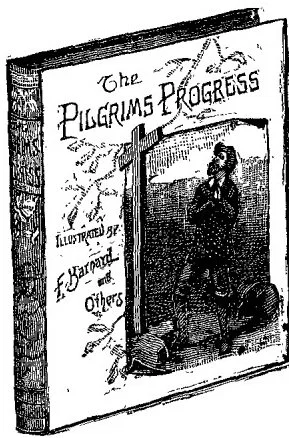
THE PILGRIM'S PROGRESS
By John Bunyan
By John Bunyan.
Royal Octavo Edition in large type, and contains over 100 illustrations, 50 of which are full page. Cloth, with side stamp in ink and gold, $1.00.
REVEL'S IMPERIAL GLOBE ATLAS
Of modern and ancient geography. Containing 33 imperial quarto maps, with an index of 20,000 names. Size of page, 12 x 14. Full cloth, $1.00.
JOHN WILLIAMS, the Martyr of Erromanga
—By Rev. J. J. Ellis. 12mo, 160 pages, fully illustrated, cloth extra, 75 cents.
FOUND AT LAST!
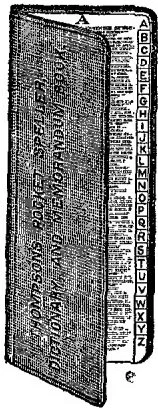
A POCKET SPELLER, DICTIONARY, AND MEMORANDUM BOOK COMBINED.
It gives the right orthography of all words (over 22,800) in common use, and in nearly every instance their definition. It also gives rules for the use of capitals and punctuation marks, abbreviations of names of States and Territories, letters of introduction and recommendation, definitions of commercial terms, forms of notes, due bills, receipts, letters of credit, orders for money, merchandise and goods stored, principal holidays, marriage anniversaries, combination of shades, and carefully selected laws of etiquette in social and business life, also a silicate slate for memorandums.
This Speller gives the most complete list of words in common use; it is a Speller, Dictionary, Handy Companion, and Memorandum Book combined; it is indexed; it prints all words pronounced alike but spelled differently, so they can be distinguished at a glance; it shows where the letter e at the end of a word is to be dropped when adding ed or ing; it gives a complete list of the most practical business forms; it gives the laws of etiquette in social and business life; these rules alone are worth the price of the Speller.
This Speller is bound in leather, is of convenient size to be carried in vest pocket, and its price brings it within the reach of all. American Russia leather, gilt edge, 50 cents. Sent post-paid to any address on receipt of price. Address Pacific Press Publishing Co., 43 Bond St., New York City.
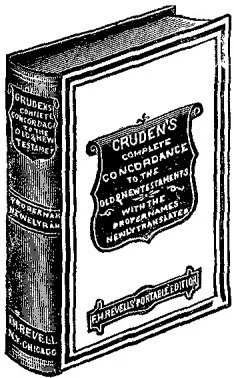
CRUDEN'S CONCORDANCE,
A DICTIONARY, And Alphabetical Index TO THE BIBLE. Cloth, $1.25. Sheep, $2.50.