S. D. A. Publishing Association · Battle Creek, Mich. · Mar 19, 1884
THE FLIGHT INTO EGYPT, AND THE EXILES IN CHALDEA.
For a time, everything went well with the remnant at the capital in Mizpeh. Gedaliah himself was gentle and popular; his reputation for hereditary piety was great; he was the representative of the mighty and victorious government of the Chaldees. Large crops were gathered in, and the sorrows of the people began to be softened by hopes of safety and peace under a foreign rule. But in the fall of that sad year all these rising hopes were quenched, and a deeper darkness than before settled upon the doomed country.
On the third of September, Ishmael, with ten companions, paid a visit to Gedaliah, and was cordially received and entertained in the governor's castle. The feast was a very lavish one, according to Josephus, and Gedaliah, the generous host, was overcome with wine. This was the opportunity of Ishmael and his associates. They rose and fell upon him, slew him with the sword, and having taken possession of the castle, they put to death all, both Jews and Chaldeans, whom they found on the premises. None escaped to tell the news, so that for two whole days the people dwelling in the neighborhood, being busy with harvest, knew not the calamity which had befallen the settlement.
During this time a company of eighty pilgrims from the North, including, what is very remarkable, a number of Samaritans, came to Mizpeh to pay their respects, and offer their sympathies and gifts, to the ruined temple of Jerusalem. Ishmael easily ensnared them into his den of slaughter, where he and his associates put seventy of them to death.
The melancholy fate of Gedaliah, and the subsequent slaughter in the castle, completely broke the spirits of the people. Their leader was slain, the Chaldeans would be disposed to hold them responsible for the overthrow of the government, and they no longer felt themselves safe in Mizpeh, or indeed in any part of their country. In the panic, even the influence of Jeremiah could not control their movements. They pretended to ask his advice, but refused to listen to the messages divinely sent through his mouth. Against his earnest remonstrances, they set their faces southward, and returned to the country of their captivity, idolatrous Egypt.
The remnant who had fled into Egypt, soon fell back into the sin of idolatry, notwithstanding the fact that it was idolatry which brought upon the nation the chastisement of the Chaldean invasion. In Egypt they suffered for their idolatry the sore affliction of another Chaldean invasion. That under Cambyses, “the madman,” was especially cruel and severe, both to the people and to their false gods. The conqueror ordered the great temple at Thebes to be pillaged and burned. At the celebration of an idolatrous feast in Memphis, he stabbed the sacred ox with his own poniard, ordered the priests to be scourged, and all the people who assisted at the sacrifice to be massacred.
Amid such bloody scenes, the Jews in Egypt vanish from our knowledge. Far different was the destiny of those who had been carried away by Nebuchadnezzar into exile in Babylon. While those who remained in possession of the land proved unfaithful to the covenant, those in exile actually saved and perpetuated the spiritual life, and thus secured the high destiny of the people.
The history of these exiles gathers about the persons of the two great prophets, Ezekiel and Daniel. Ezekiel had been carried away to the country of the Chaldeans, with other distinguished persons, eleven years before the destruction of Jerusalem. The river Chebar, on which he and his companions dwelt, cannot now be recognized. These exiles formed a little colony with local arrangements almost amounting to self-government. Ezekiel, who was both priest and prophet, was held in the highest consideration among his companions, and was consulted by the elders on all occasions.
Five years after the beginning of his captivity, his call as a prophet came to him by the river Chebar, and for twenty or more years he continued to exercise its high duties. By his visions and predictions, he performed an important work in keeping alive the spirit of the exiles. The fact of his inspiration assured them that the God of Israel had not deserted his people. They were warned and rebuked for their worldly-mindedness, their false confidence, and their unfaithfulness. They were instructed in the sins and the ill-desert of their nation which led to its downfall. Such men, with such a calling, formed the strength of Judaism. Without them there could have been no recovery from the calamities under which it was suffering.
The history of the colony on the Chebar ends with the record of Ezekiel himself. How, when, or where he died we are not told. But the colony need not be viewed as separate from the whole settlement of exiled Jews in Babylonia, which lasted as long as the city of Babylon itself. That great and magnificent city was the home of many of these exiles. Here, doubtless, much of the bitterness of their captivity was felt. Not held as slaves or seriously restricted in their personal liberty, they were yet strangers in a strange land. Here, by the river Euphrates, which ran through the city, they hung their harps upon the willows, and sat them down and wept while they remembered Zion. Here their enemies made sport of their griefs, and in the midst of their tears demanded a song. Here they made those vows which held them together as a people, and gave assurance that whether returning from captivity or preferring to remain in exile, they would be faithful to the hopes and destinies with which God had distinguished them from the other peoples of the earth:—
If I forget thee, O Jerusalem,
Let my right hand forget her cunning.
If I do not remember thee,
Let my tongue cleave to the roof of my mouth;
If I prefer not Jerusalem above my chief joy.46
These early griefs indeed passed away, and more or less of contentment with their new circumstances came to be felt by the exiles. Especially would they be consoled when several of their number were treated with favor by the court, and were raised, like Daniel and his three companions, like Nehemiah and Esther, to very high positions in the government or about the king's person.—From Exile to Overthrow.
MARCH
March! March! March! They are coming
In troops, to the tune of the wind,—
Red-headed woodpeckers drumming,
Gold-crested thrushes behind;
Sparrows in brown jackets, hopping
Past every gateway and door;
Finches, with crimson caps, stopping
Just where they stopped years before.
March! March! March! They are slipping
Into their places at last,—
Little white lily buds, dripping
Under the showers that fall fast;
Buttercups, violets, roses;
Snowdrop and bluebell and pink;
Throngs upon throngs of sweet posies,
Bending the dewdrops to drink.
March! March! March! They will hurry
Forth at the wild bugle-sound,—
Blossoms and birds in a flurry,
Fluttering all over the ground.
Hang out your flags, birch and willow!
Shake out your red tassels, larch!
Grass-blades, up from your earth pillow!
Hear who is calling you—March!
—St. Nicholas.
SAYING AND DOING.
Mary and her father were left at home for a few days, while the rest of the family went on a visit. Some of Mary's young friends came in the afternoon with a request for her to spend the evening with them. Papa came home from business not feeling very well, and looking forward to a quiet evening with his daughter. She told him of her invitation, and spoke of some special reasons why she desired to accept it. Her father did not want to deprive her of the pleasure she anticipated, and yet he did not exactly want to pass the evening alone, nor sit up as late as would be necessary if Mary went out. So he put the matter wholly in Mary's decision, saying, “My daughter, you must do as you think best. I will not say you cannot go.”
“I don't want to leave you alone, papa,” said Mary—but all the same she went.
Now I do not mean to say that she did anything wrong. Her father was glad that she should have the pleasure of meeting her friends. There was nothing especial that she needed to do for him if she stayed. But she would have been company for him, and her staying would have been proof of unselfish affection.
The thing that struck me, when I heard of this little incident, was its illustration of the difference between saying and doing. Mary said she did not want to leave her father alone for the evening, and I dare say she did regret doing it. But she did leave him alone. So what she said, you see, went for very little against what she did. Her actions spoke louder than her words.
This is true all through our life. We must be judged by our actions rather than by our words. It is easy to make promises and protestations, but by no means so easy to act always in just the right way. Children, as well as their elders, sometimes cheat themselves into thinking they are better than they are, because they talk so glibly about their right feelings—their sympathy, their affection, their desire to be of service. But the question is not what they say, but what they do.
“I am very sorry for Mr. Gray,” said one, speaking of a man who had met with misfortune, and who was in pressing need of aid. “Yes,” said the friend spoken to, “I am sorry for him five dollars; how sorry are you?” He did not mean that his sympathy should be mere words.
There is another matter in which we are very often tempted to let words take the place of something better. We try to put God off with promises. We try sometimes to make fair words take the place of a Christian life. How foolish is this! We cannot deceive God. He understands us through and through. When he says to any one, “Give me thy heart,” he is not deceived for a moment when the reply is, “Yes, Lord, I will,” but no corresponding actions follow. “By their fruits ye shall know them,” is his way of judging, just as it should be ours. Let us learn not to put mere empty talk in the place of doing the things our Heavenly Father would have us do.—The Child's Paper.
THE WIND-FLOWER.
WIND-FLOWER, wind-flower, why are you here?
This is a boisterous time of the year
For blossoms as fragile and tender as you
To be out on the roadside in spring-raiment new;
For snow-flakes yet flutter abroad in the air,
And the sleet and the tempest are weary to bear.
Have you not come here, pale darling, too soon?
You would seem more at home with the flowers of June.
“Why have I come here?” the wind-flower said;
“Why?” and she gracefully nodded her head
As a breeze touched her petals: “Perhaps to teach you
That the strong may be sometimes the delicate, too.
I am fed and refreshed by these cold, rushing rains;
The first melting snow-drifts brought life to my veins;
The storm rocked the cradle with lullabies wild;
I am here with the Wind—because I'm his child.”
—St. Nicholas.
AN INCIDENT IN THE LIFE OF CHIEF JUSTICE MARSHALL.
By JOHN R. CALKINS
JOHN MARSHALL was one of the most noted men of our country.
In 1801 he became chief-justice of the United States. “He was a man of acute and penetrating judicial intellect, and dispassionate in the hearing of causes.” Says Judge Story, “His judgments, for power of thought, beauty of illustration, variety of learning, and elegant demonstration, are justly numbered among the highest reaches of the human mind.”
Marshall was a very plain man. He looked more like a farmer than a judge. It is related of him that while chief-justice, he stopped one night at a public house in Virginia to get supper and lodging for the night. As the old man drove up, it was noticed that both shafts of his gig had been broken, and were bound up with withes, also that he was plainly dressed; and so they supposed him to be a farmer. At about the same time, three or four young lawyers also stopped for the night.
After they were seated for the evening, one made a remark about a very eloquent sermon he had heard that day, and another replied to him in a sarcastic manner. Then a warm debate took place upon the merits of the Christian religion. From six till eleven o’clock the young men argued pro and con, bringing out with ingenuity and ability, all that could be said upon the subject. During this time the old man sat very quiet, listening with all the meekness and modesty of a child. Finally one of the young men remarked that it was no use to argue with long and established prejudices, and turning about, said, “Well, my old man, what think you of these things?”
“If,” said a man present, “a streak of vivid lightning had at that moment crossed the room, their amazement could not have been greater than it was with what followed.” For nearly an hour the old gentleman made the most eloquent and unanswerable appeal that he had ever heard; so perfect was his recollection, that every argument urged against the Christian religion was met in the order in which it was advanced, and in the whole talk, there was so much simplicity and energy, pathos and sublimity, that not another word was uttered. “An attempt to describe it,” said our traveler, “would be an attempt to paint the sunbeams.”
The question immediately was asked, “Who is this? Who is this?” They were answered, “He is the chief-justice of the United States.”
JOHN R. CALKINS.
Avoid Excuses and Confess Your Faults
Do not form the habit of making excuses. Remember what the old proverb says, “A man who is good at making excuses is good for nothing else.” If you have done wrong, be willing to confess it. Do not try to hide it, or to throw the blame on another. You will gain nothing by hiding or excusing a fault; but, while confession is good, there is nothing better than amendment.
HOW TO BECOME HAPPY.
MANY young persons are ever thinking over some new way of adding to their pleasure. They always look for chances for more “fun,” more joy.
Once there was a wealthy and powerful king, full of care, and very unhappy. He heard of a man famed for his wisdom and piety, and found him in a cave on the borders of a wilderness.
“Holy man,” said the king, “I come to learn how I may be happy.”
Without making a reply, the wise man led the king over a rough path, till he brought him in front of a high rock, on the top of which an eagle had built her nest.
“Why has the eagle built her nest yonder?”
“Doubtless,” answered the king, “that she may be out of danger.”
“Then imitate the bird,” said the wise man; “build thy home in heaven, and thou shalt have peace and happiness.”—Child’s World.
EDITOR'S CORNER.
By Editor
MOTHER NATURE is awakening again from her long, cold sleep beneath the snows and frosts of winter. How gladly we welcome every sign of returning spring! We expect a few more rough, stormy days before she fully re-instates herself; but we know that winter has turned his back upon us, and that soon the fields will be clothed with loveliness, and the sweet strains of music from the feathered choir will burst upon the ear at every turn. O happy day, we long for thee!
God would have us, too, waken with the plants and flowers. He would have us reach out for warmth in the sunshine of his love, when he will let rich showers of grace descend upon us to re-beautify our characters, and to give us the necessary fitting up for a part in his closing work.
In anticipation of Nature’s new life, and in contemplation of the new life God waits to impart to our souls, we already feel new love for his work enkindling within our hearts; and we would offer up praise and thanksgiving to the Giver of every good and perfect gift. Will not you, too, open your hearts to the genial influence of the new life extended to you; consecrate anew to God your whole soul, body, and spirit, and henceforth bend your energies to impart to all around you a love for the author of all our happiness?
In the sleeping and waking of Nature, behold the omnipotence of the Creator! What mysteries are connected with the sleep of plant-life in winter’s cold embrace, and then in the unfolding of the same by the touch of spring’s warm breath! Here again is study for those restless Christians who so frequently agitate the amusement question.
The unusual severity of the present winter has no doubt hindered the young in the work of canvassing; but now, as spring opens, and you arise out of sleep with her, you will doubtless be impressed to devote a part of your time to this work. We do not feel satisfied with what has been accomplished thus far, and are quite sure none of you are; but with a new zeal in proportion to your increased vigor, very much may be done through the spring months. Who will be the first to report progress? Who the second? Come, young friends, we look for a strong pull now, all together; you surely will not disappoint us.
M. J. G.
“A LITTLE LOWER THAN THE ANGELS.”
By Marie Bell
“SOMETHING, my God, for thee,
Something for thee!
That each day’s setting sun may bring
Some penitential offering;
In thy dear name some kindness done,
To thy dear love some wanderer won,
Some trial meekly borne for thee,
Dear Lord, for thee!”
The hands of the old clock down in the village pointed to the hour of three; and as it struck, sending its silvery message out over the tops of the small white houses, nestled down among the snow-clad hills, few heeded the familiar sound.
A young girl, however, fresh and rosy as the morning, who was passing by at the moment, paused, and looking up, said, as she counted:—
“Only three, six, nine more hours in the old year, then the book closes! No more good deeds, no more bad ones, can be entered there! I wonder where God puts it away, with those that have gone before? to be opened, when? I must crowd in a few more kindnesses while I may, for my account has been but a sorry one this year. I began it with so many good resolutions, but they were so soon forgotten; and each Sabbath has found me ashamed of the little I have done. What should we do without the Sabbaths, which make us think about being good and true and faithful and noble and in earnest? We should drift far away from goodness and holiness, I am afraid.
“Dearie me! What didn’t I mean to do for God and for man, for father, for mother, for sisters, for brothers, for the whole world lying in sin and want,—want of heart-help and head-help,—and in such sore need of comforting! Now, besides all my bad deeds, there are so many blanks to be left forever unfilled,—the things I didn’t do. What a difference there is in lives! Some crowded so full of good deeds done for others, some so worthless and full of self! O dear Lord, help me to begin this moment to finish my account well, as a preparation for opening and carrying out the new one the more worthily!”
Helen’s feet had been flying fast, as all these sober thoughts passed through her mind. She stopped and went into a small store, and bought some cookies and two or three trifling toys. Now she had reached the door of a humble home, not an unfamiliar spot; for the faces of the children brightened as she came in, and the hungry look upon the woman’s face (hungry for comforting, I mean) changed to one of satisfaction.
“I’m so glad you’ve come, Miss Helen,” she said, “I’ve been so lonesome. I hope you’ll never know what it means to be a stranger in a strange land.”
Helen had one of the children upon either knee, and, while she dealt out sympathetic words and looks to the woman, invited the children to “dive” into the depths of her pocket, whence they drew forth delightedly the treasures she had brought. A half-hour she remained; and, as the door closed behind her, it was as if the sun had been shining after rain. Through her head floated the words of James, the apostle. “Pure religion and undefiled, is this: To visit the fatherless and widows in their affliction.” “It does give one pure happiness to visit such people,” she said. “I must stop at lame Jennie’s for just a moment.”
“Mr. Gray,” she called to a man who was passing by in his wagon, “don’t you want to give Jennie and me a wee bit of a ride? You can’t do anything better before the old year closes. Only eight hours and a half left, you know! Ashamed to ride in your wagon? Not a bit! Aren’t you one of the King’s sons? They don’t all ride in chariots! Thank you! It will do Jennie so much good! And it will do him good to take her,” she added to herself.
As Farmer Gray sat at the gate waiting for the girls to make ready, his face took on a new expression. “‘Son of a King!’ I never thought of that before. I won’t be down-hearted and fearful then. Why should a King’s son? I’ll go about the King’s business better than I ever have done. ‘Only a few more hours in the old year!’ Sure enough, but time enough to do something for my Lord!”
What a glorious day for a ride, and how Jennie did enjoy the unexpected pleasure, always more sweet than an anticipated one! So God sent her new strength for bearing her heavy cross.
“Only seven more hours in which to do something for each of my dear ones!” thought Helen, as she hurried home. “Oh, how often we neglect those whom we love best!
‘We have careful thought for the stranger,
And smiles for the sometime guest;
But oft for our own the bitter tone,
Though we love our own the best.’”
She took off her things, and went about as an angel of light might have done, intent upon the Lord’s errands. She set the table for the tired maid, whose work was never done; she solved the hard problem over which her brother Hal had grown cross and disheartened; she rearranged her grandmother’s cap and tie, always a blessing to those who are helpless and need help. “‘Comfort the feeble-minded, support the weak,’ says St. Paul. That must be what he meant,” thought Helen, as she caught the loving look upon the old lady’s face. She took the little dress out of her mother’s hands; and, when one more of the precious hours was gone, it was finished and laid away. She told sweet stories to the sleepy children, which made them long to be good and kind to each other. She brought her father’s slippers, warmed them at the fire, and then stood watching to give him a welcome.
And now it was bedtime, and soon the silence of sleep rested upon the still home; but Helen was keeping watch with the dying year, kneeling by the bedside, her eyes wet with tears of penitence for the past. But was it the dawning light of the new, young year, so full of promise and hope, which was shining through them, or was it a glimpse of the glory caught by those who have been in the very presence of God?
—Marie Bell.
A RECEIPT IN FULL.
Do you remember the story of Martin Luther when Satan came to him, as he thought, with a long, black roll of sins which truly might make a swaddling band for the round world? To the arch-enemy, Luther said,—
“Yes, I must own them all. Have you any more?”
So the foul fiend went his way, and brought another long roll; and Martin Luther said,—
“Yes, I must own them all. Have you any more?”
The accuser of the brethren, being expert at the business, soon supplied him with a further length of charges, till there seemed to be no end to it.
Martin waited till no more were forthcoming, and then he cried,—
“Have you any more?”
“Were these not enough?”
“Aye, that they were. But,” said Martin Luther, “write at the bottom of the whole account, ‘The blood of Jesus Christ cleanseth from all sin.’”—Selected.
The Slow Progress of Knowledge
The progress of knowledge is slow. Like the sun, we cannot see it moving; but after awhile we perceive that it has moved, and moved onward.
Correction to Lesson 174, Question 33
In question 33 of lesson 174, read generosity instead of curiosity.
Hiding God's Word in the Heart
By Westminster Teacher
What we want is the hiding of God’s word in the heart—not like the wedge of gold hidden by Achan under his tent, an inert, lifeless thing buried in the earth, but rather as the planting of a living seed, having within it a living germ, in the mellow earth. The heavens shower down their rains, the sun sends forth his warming beams, the winds fan it, and it grows and bears rich fruit. So if we have within the heart God’s word, the living germ of a holy life, pervading our being and supplying the motive of action, the dews of God’s grace water it, the Sun of righteousness shines upon it, the Spirit’s influences nurture it. Thus our lives become beautiful with the rich graces of Christian living, goodness, holiness, usefulness.
As teachers in the Sabbath-school, we are compelled to study the word of God. While studying it, we should make it our aim, our constant earnest endeavor, that the very life of that word may be hidden within our souls, that we ourselves may be enriched by it, and so may be enabled to enrich others. The teacher whose soul is not informed by the vital truths of the gospel, can impart little to the scholar; but he who feeds upon God’s word, who meditates in it and lives by it, has that to bestow which learning in all the languages, living and dead, cannot confer. Let us so hide the blessed truths of God’s revealed word in our very heart of hearts, that from us shall flow “rivers of living water.”—Westminster Teacher.
Notes on the Sabbath School Department
For Notes, see S. S. Department in Review for March 18.
14. How was Paul's promise to the Ephesians fulfilled while Apollos was at Corinth? Acts 18:21; 19:1.
15. What inquiry did he make? Verse 2.
16. What course did he take when he found that they had been baptized only with the baptism of John? Verses 3–6.
17. How did God show his approval of this act? Verse 6.
18. Why did Paul leave the synagogue, and enter the school of Tyrannus? Verses 8, 9.
19. How extensively did the gospel spread in the vicinity of Ephesus? Verse 10.
20. How did the Lord show his approval of Paul's preaching? Verses 11, 12.
21. How did he expose some who tried to counterfeit these miracles? Verses 13–16.
22. What was the result of these manifestations? Verses 17–20.
23. What epistle did Paul write while at Ephesus? —The First Epistle to the Corinthians.
24. What were the leading sins that were reproved in this letter?
25. What comfort and encouragement was given?
REMEMBER, BOYS.
Little friends, when you are at play on the street,
Half frantic with frolic, laughter, and noise,
Don't ever forget to bow when you meet—
When you meet an old man with gray hairs, my boys.
Is the aged man feeble, decrepit, and lame?
Does he lean on his staff with unsteady poise?
Never mock at his sorrow, but stop in your game,
And bow to the man with gray hairs, my boys.
Remember the years are only a few
Since he, on the street with his games and his toys,
Was healthy and happy and active like you,
And bright as the sun were his curls, my boys.
But age has furrowed the cheek that was fair,
While sorrows have broken his once mellow voice;
And now there is many a silvery hair
On the head where the curls were so bright, my boys.
The spring-day of youth is a gem, it is gold;
But time all its glorious luster destroys;
And then, don't you know, if you live to be old,
Your steps will be slow, your locks gray, my boys?
So when you are blithely at play on the street,
Half frantic with frolic and laughter and noise,
Remember to bow when you pleasantly meet—
When you meet an old man with gray hairs, my boys.
—The Independent.
ALLAN'S GARDEN.
By W. E. L.
ALLAN! Allan!” called Mrs. Gray from the back door. Allan left the windmill he was making in the barn, and went to see what his mother wanted.
“Take the little tin pail,” said she, “and go over to Mrs. Smurthwaite’s, and get me some yeast. Don’t spill it; and hurry right back, for I want to set some yeast myself.”
There was nothing Allan liked better than to go over to Mrs. Smurthwaite’s, for she lived almost a mile off, and the path to her house ran along the trout brook in the meadow, and through the woods. So he went merrily down the road.
“Halloo,” said Johnnie Smurthwaite, from his perch on the gate-post, as Allan came up the path. “I say, Allan, do you know there’s a minister stopped at our house, and he’s going to preach at the school-house next Sabbath? We’re going to have a Sabbath-school.”
“O good!” cried Allan, and he would have said more, but the minister came down the path then, so he turned and went into the house.
It was a rare thing for them to have a visit from a minister; for they lived in the heart of the White Mountains, seven or eight miles from any railway station.
“I wonder,” thought Allan, as he scuffed his bare toes in the dust, on his way home from Sabbath-school the next Sabbath, “I wonder how the man thinks we’re going to get any money to put into the Sabbath-school. He said we ought to bring our pennies to the teacher every Sabbath. And then he said, too, we ought to save some money to send papers and tracts to people that didn’t know about the things God has written in the Bible, and try to get them to love and serve him. Guess he never lived on a New Hampshire farm, or he’d know we couldn’t dig up money like potatoes. Why, the leaves are half gone from my speller, and pa can’t get me another.”
So he put his hands in his pockets, and began to whistle; but he couldn’t help thinking of what the man had said about giving, for he had talked to the children as well as to the older people, and Allan knew very well just what he meant.
“Father,” said Allan the next morning as his father went out to the barn to milk the cows, “can I have that strip of ground out by the wood-pile for my very own!”
“Why do you want it, my son?” asked his father.
“Well,” he replied, shifting to one foot, “I want to make a garden, and sell the things down in the village.”
“What are you going to do with the money?”
“I want to earn some money to give. The minister told us, you know,” he added, as his father looked puzzled.
“Well, I am willing, but I don’t think you’ll raise much off from that piece of ground.”
But Allan was bound he would; so taking his spade and wheelbarrow, he went to the barnyard, and wheeled several loads of manure to his garden, and dug it in carefully. Then he went to his mother, and begged some garden seeds. He took great pains to plant his seeds well, and after they began to grow, he spent most all his spare time in hoeing and weeding his garden. How the vegetables grew!
“I declare!” said Mr. Gray, one day, “I shall begin to be sorry I let you have so rich a piece of ground.”
“That’s because it’s a missionary garden,” said Allan.
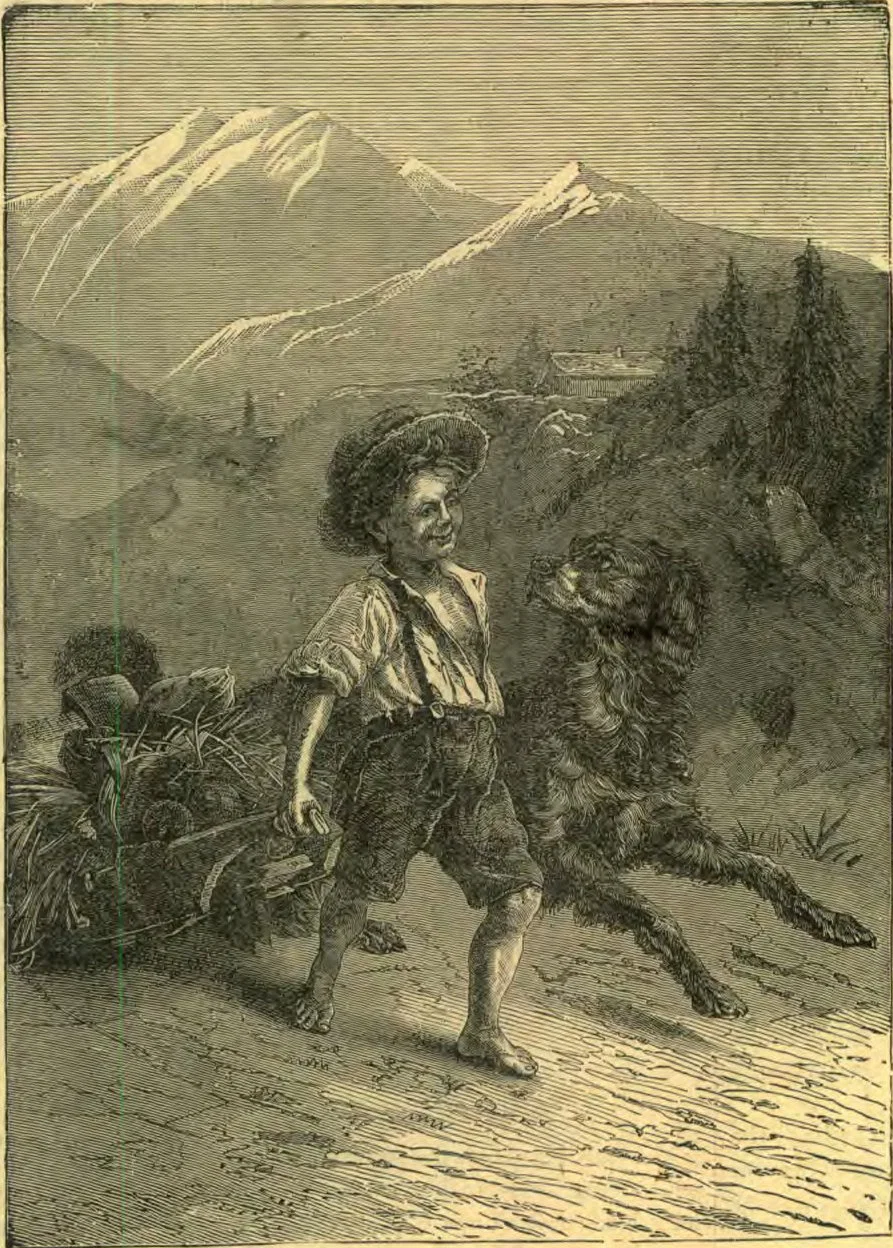
When the things were large enough to sell, Allan, early every morning, washed some of them up nicely, and piling them on his wheelbarrow, he and his dog Rover trudged down the mountain road to the village three miles away. He never failed to find a ready sale for his vegetables, because they were so large and clean.
When the minister came back in the fall to make another visit, Allan had quite a little money saved up for him.
“Did you ever hear of any other boy who had a missionary garden?” asked the man, as Allan handed him the money and told him how he earned it.
“No, sir,” said Allan.
“A long time ago,” said the man, “a little boy asked his father for a piece of land, to use just as you have used your ground,—for a missionary garden. He raised potatoes, and sent the money to a school in Cornwall, where heathen boys are educated. His name was William E. Dodge. He is dead now; but through all his busy life he never forgot to be kind and helpful to all who needed help. He became wealthy, but he remembered to do good. I hope you will be as useful as he has been.”
“I will try,” said Allan.
Allan has grown to be a large boy now, but he remembered what the minister said to him, and he is always ready with his earnings and with his hands to do good to other people.
W. E. L.
Letter Budget.
NORA WORDEN writes from Kent Co., Mich. She says: “I am nine years old. I study in Book No. 1. There is a small church of Sabbath-keepers here. I go to Sabbath-school, and try to have my lesson. I have a good teacher, and I love her very much. I have a little brother who has been sick a long time. We all love him dearly, he is so patient. I am trying to be a good girl.”
EMMA STICKNEY, of Berrien Co., Mich., writes. She says: “I am eleven years old. I keep the Sabbath with my father and mother. I go to Sabbath-school, and learn my lessons in Book No. 2. My grandpa is staying here now. He is eighty-five years old. I love him ever so much. I want to be a good girl so as to meet the INSTRUCTOR family in the kingdom of heaven.”