The Youth’s Instructor, Vol. LII, No. 48

Thoughts of Evening

The Youth’s Instructor

November 29, 1904

Review and Herald Publishing Assn. · Washington, D. C. · November 29, 1904

Thoughts of Evening

THE cares of day from off my soul are taken By the quiet peace of even, As though an angel from his wings had shaken The pearly dews of heaven.
There comes a sense of gentle peace and healing In the breezes from the west, And a living faith is to my soul revealing The Aiden of the blest.
Though snares, and pain, and death are thickly lining The pilgrim’s upward way, Still on my brow I feel the blessed shining Of a purer, grander day.
O glorious day, long has the prophet’s vision Looked up, through scourge and thorn, Oft have they told us of the fields elysium In the glad soon-coming morn.
When, like a gem new set, the glad earth lieth Beneath fair bending skies, While from her bosom never mourner crieth, But endless psalms arise.
I’m glad to know ’twill be but little longer I must tread the pilgrim way, And my desire is ever growing stronger For that purer, grander day.
L. D. SANTEE.

In the Rice Fields of Louisiana

TWENTY-EIGHT years ago the railroad system known as the Southern Pacific, or Sunset Route, was completed, and travelers who dreaded the idea of being snow-bound on the more northern roads went to New Orleans, and there began their long journey to the Pacific coast. In passing through Louisiana they became much interested in the rice fields. The railroad company published glowing accounts of what immense and quick returns could be realized from the cultivation of rice, so it was not long until farmers from the Northern States began to arrive in the level prairies of southwestern Louisiana. They brought their families, and were prepared to make homes. The Acadians were their neighbors, and from them they learned the first lessons of rice culture. But the Acadians had not made the cultivation of rice a business, having planted only a few acres for their own use; so they always trusted the clouds to water their crops. They had not thought of mechanically flooding them.
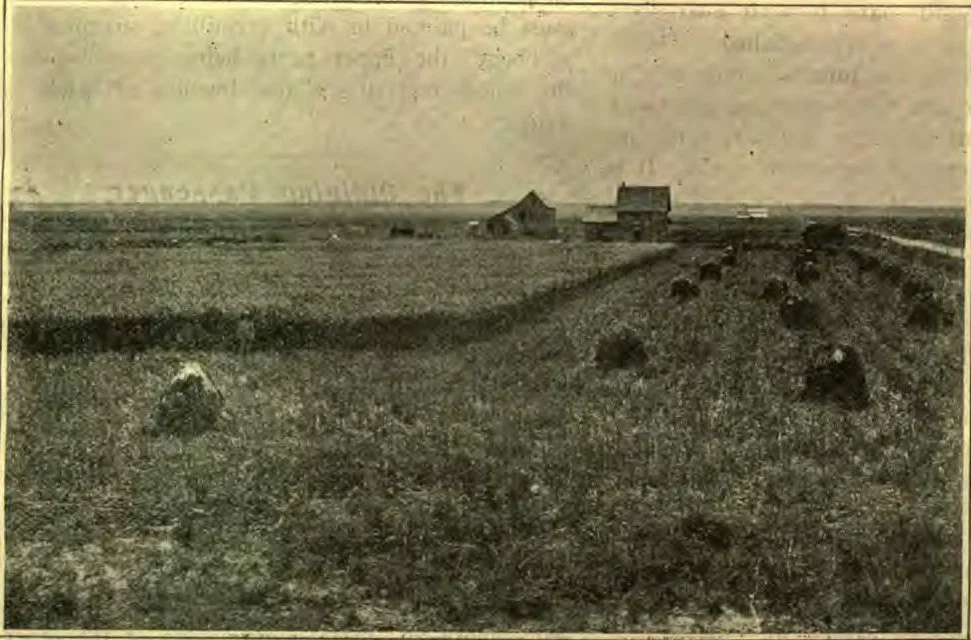
LOUISIANA RICE FIELD
The Northern farmers seemed to think that if there was profit in raising a few acres, there was more in raising many, so they planted great fields of rice very much as they had sown wheat in the North; then they pushed up the levees around the fields to hold the water on them, and, like the Acadians, they waited for the clouds to flood them, but often the rain did not come, and they saw their fields dry up and wither away, until they almost doubted that they had planted rice. Other summers, however, the clouds brought rain in abundance, and then the farmers all looked cheerful and happy, and in the beautiful autumn the fields gave up their treasure, and all felt repaid for the disappointments of the past. When they did have a good crop, they reaped such little fortunes that they began to scheme with all their Yankee ingenuity for a way to make their water-supply sure; for they had learned that rice demands an abundance of water. The bayous are generally bordered with timber and swamp-land, so it was impossible, with their limited means, for the farmers to build the necessary canals, and put in the machinery for pumping bayou water, but soon a company of men, with sufficient capital, started a large pumping plant which proved a success. It was not long then until there were many such canals, and the rice industry in Louisiana took its first bound toward a financial basis.
But there were many farmers out on the prairies, away from the canals, and they continued to plant rice and succeeded in getting a crop about once every three years. They were given the name of “providence” rice farmers by their neighbors on the canals, who were reaping yearly large harvests, and getting rich. They didn’t seem to realize that it was through Providence that they were successful, and through Providence that we all “live, and move, and have our being.”
A WELL FOR IRRIGATION
In boring wells for the water-supply for their homes, some of these “providence” farmers noticed that at a certain depth they reached a strata of water that was inexhaustible, and that it came very near the surface; in some instances flowing over the top like a spring.
They determined to try a large well for irrigating purposes, and were well repaid; for there was more water than they had ever imagined could come from the ground. Those who first drilled these wells found that with a small engine and boiler and pump they could flood a quarter section or more of rice land. They decided that it was not so bad after all to be “providence” farmers; and they congratulated themselves still more, when, one autumn, the farmers on the canals awoke to the fact that they had flooded their rice with salt water, and had ruined the crop. The summer had been dry, and the canals so numerous that all the fresh water in the bayous had been pumped out on the fields, and salt water from the Gulf had come back to the pumps. It was a new idea to flood rice from the Gulf of Mexico, and a complete failure taught the canal men that it was not a good one; hence some way must be devised to keep the salt water out; for it is worse than none at all. It not only ruins the rice, but for sometime also the land.
During these years of experiment and advancement, persons from the North had been coming in by thousands, and they brought the latest improvements in farming methods from their Northern farms.
Wells became so numerous that the supply of water was almost exhausted under the ground as well as above. It is said by geologists that this strata of water is simply a great underground lake, and that its source of supply is probably the Ozark Mountains. The pumps on the numerous wells lowered this underground lake so that instead of coming nearly to the surface, it was forty feet or more below, and many of the wells failed altogether.
In drilling some of these wells the drill has passed through logs which were well preserved over a hundred feet from the surface, and many other curious specimens were brought to light.
The presence of crude petroleum was discovered near Welsh when one of these wells was being drilled, and it has since developed into quite an oil field, but the oil field, though very interesting, is distinct from the rice field, so we will not speak of it at present.
From a good irrigating well, about twelve or fifteen hundred gallons of water can be pumped in one minute, and this will flood at least ten acres in twenty-four hours. To give some idea of the large number of wells and pumping plants on the prairies, it is enough to say that the engineers of the plant in the illustration could count fifty engines in sight, all pumping at the same time.
There are among these engineers, young men who have been reading the INSTRUCTOR since they were small boys, and now they are paying their way through school by working during the summer on the rice farms. There were three of these young engineers in the Keene Industrial school last year, one in Union College, and three in the Southern Training School at Graysville.
As soon as the pumping season is over, harvest begins, and the boys enjoy work of a different kind. Rice is harvested with binders, very much as wheat is in the North. There is one difference, however, in the binders of the rice fields. They are made in such a way that they will work in mud and water if necessary; for often the rains begin before harvest is over, and a rain of eight or ten inches in as many hours is not uncommon on the Gulf coast: but the autumns are usually the most pleasant part of the year. The sun shines very clear and bright day after day, and yet it is not too warm for comfort. Every one seems to take new life, and harvest is indeed a merry time.
The rice looks very pretty as it stands in the shock ready to be thrashed, but it is never permitted to stand long, for fear of storms. The thrashers follow close in the wake of the binders, and then the great bags of rough rice are ready to be taken to the mills, where the rice is hulled and prepared for market.
In the mills the hulls are cracked between two large millstones something like the stones in the old-fashioned flour-mills; then after being well fanned and cleaned of waste, the rice goes to the polisher, where it is rubbed and polished with sheepskin until it is perfectly smooth and white, and now it is almost ready for market. Still, first, it must be waxed carefully with paraffin, powdered lightly with talcum powder, and then graded according to the size of the kernels. It is sewed up in strong bags containing just one hundred pounds, and is shipped in this form all over the world.
As one buys rice from the little corner grocery, he probably never thinks of how it was polished, waxed, and powdered to make it look attractive; but it all passes through these processes, and is becoming every year more popular as a staple food. Japan is buying much rice at the present time, but the market for this cereal is not increasing as fast as the production, and on this account the farmers do not receive as much for it as they did a few years ago. Taken all together, however, the life of the Louisiana rice farmer is interesting, and generally a happy one.
J. W. PEABODY.

Holidays of Students

A MOVEMENT is on foot in Russia to diminish the number of holidays granted to students. During a four years’ course in a Russian university the work done covers only one year and 295 days of actual time spent in study and lectures. In France the time covered is two years and 74 days; in England, two years and 158 days; in the United States, two years and 210 days; in Germany, two years and 290 days. In Denmark the hardest work is done, as the students there toil for two years and 364 days.—Selected.

The Obliging Passenger

An American traveler, who tells the story in a letter, was traveling, not long ago, in Norway. He bought a ticket for Drontheim, and engaged and paid for what the company called a first-class berth. But when he came to take the train, he found himself put into a second-class compartment, with three other men, one of them a consumptive. The berth assigned to him was an upper one; and altogether he felt injured and angry. Losing his temper, he began to complain loudly.
The conductor, a big Swede, listened patiently, but said he could do nothing. The American became more and more angry. One of the other three men, who had listened without saying a word, now came forward. He had a lower berth, he said, but he was quite willing to exchange. Would the gentleman take his berth, and give him the upper one? The American jumped at the chance. The obliging passenger was a quiet, pleasant fellow, and they fell into conversation.
Next morning, the obliging passenger left the train at a way station. He held out his hand, as he said good-by to the American. “I hope,” he said, “that some time you will think of Prince Bernadotte.” Then came the American’s turn to feel small, when the other passengers told him, as the train went on, that it was, indeed, the second son of the king of Sweden who had changed berths with him. Prince Bernadotte, they told him, further, had renounced the succession in order to marry the woman of his choice, and had taken up missionary work. He was on his way, at this time, to preach among the Laplanders.
The American went on his way with new ideas of true royalty. It is safe to say that the next time he did not complain so loudly of discomfort. Some sermons are preached without words, and the princely missionary reached others besides the Laplanders that time.—William Rittenhouse.

Attention as the Corner-Stone of Memory

“ATTENTION is the corner-stone of memory.”

Pleasing Others Versus Standing for Truth

“If the end and aim of life is to please, it must be at the expense of truth.”

New Railway Signals at Crossings

A NEW system of railway alarm signals at grade crossings has recently been tested with success in Germany. Each signal-box contains a small electric motor actuating a hammer, which strikes a bell. In addition to the audible warning thus given, a 16-candle power light is simultaneously turned on, which makes visible in plain letters the words, Zug kommt, “Train coming.” The entire apparatus is automatically worked by a series of electric track contacts made by the train. The first contact, as the train approaches, turns on the double alarm; the second stops the alarm when the train passes the point of danger; and the third resets the apparatus in readiness for the next train.—Youth’s Companion.

The Yearly Commerce of the World

THE annual report of the Chief of the Bureau of Statistics, just issued, contains some interesting figures relative to the world's commerce. Taking the latest years for which statistics are available, the experts find that eleven billion dollars, represents the annual value of the articles entering into international commerce.
It is impossible to conceive of the meaning of this vast sum except by comparisons that may assist the imagination in grasping the figures. Reducing it to dollar bills, and joining their ends, we should have a financial ribbon that would encircle the globe over fifty-four times. If we could stand at one side of the globe in space, and feed this ribbon to the earth as a great reel, it would take nearly two lunar months to wrap the whole sum on its immense bobbin. Or if we might have set the first Pilgrim Father who landed on Plymouth Rock to counting these dollar bills at the rate of one a second, and kept him and a successor of his descendants at it day and night, we should still have to wait over sixty years before the task was accomplished.
When we turn to the internal trade of the United States, we are confronted annually with twenty-two billions to count, just twice the international commerce of the entire world. It is interesting to note that of the six and a half billions of exports from Europe, the United States absorbs over six and a quarter per cent, and of the eight and a third billions of European imports, the United States sells nearly fourteen and a half per cent of this large total amount.
On this side of the water the matter also stands in our favor. The United States buys from other North American countries 50.25 per cent of their exports, and sells them 54.38 per cent of their imports. Taking all other countries of the world, we buy 9.59 per cent of their exports, and sell 14.7 per cent of their imports, so that we should be satisfied, on the whole, with the balance in our favor.—Week's Progress.

How to Paint in Water Colors

First of all you must see that your colors are clean, and that your brushes are perfectly unsullied. Then you must carefully outline your picture with a sharp-pointed pencil, and after getting a small glass of pure water, you may begin operations.
First, paint in the sky, supposing your sketch should be a landscape, with a pale wash of indigo or ultra-marine blue, leaving the clouds, which, after the sky has completely dried, should be painted over pure water. For a sunset, vermillion and Indian red should be used, with a few gamboge and purple lines across the whole.
After the sky has dried, paint in the ground with pale washes of gamboge, and when this has nearly dried, rub over in some place with a few lines of burnt sienna and pale sepia. Should the foreground happen to be a grass plot or meadow, emerald green should be applied, touching up here and there with a bright full green (produced by mixing a little indigo with gamboge), to give variation.
Should any trees be scattered over the landscape, they should be painted in with darker green, the stumps and trunks being washed over with a pale wash of sepia, and upon this a second and darker shade for the shadings, and finally a few touches of dark sepia, to represent the roughness and burrs usually seen on tree trunks.
But some persons like to paint figures; for instance, a boy playing with a ball. Of course the dress should be painted to the liking of the artist, though indigo or Vandyke brown always looks well. For the flesh tint, a little burnt sienna (very pale), with a little crimson lake, should be applied with great pains and delicacy, the lips being touched with vermillion. The eyes should be done with great care, the color used being very pale indigo for blue eyes, and Vandyke brown for brown ones. The hair must be tinted with Vandyke, pale sepia, or gamboge, with a little burnt sienna.
Suppose our sketch should be a horse’s head, in color, say dark bay. First, wash all over the head with a wash of yellow ochre, leaving the white on the nose, face, and eye. Then paint the nostrils with a wash of pale sepia, shading with a rather darker shade, and finally a spot of Indian red, which gives a fierce aspect to the animal. The eye must then be put in with brown madder, leaving the high light to make it appear more natural, and dotting the pupil with lampblack. Then a second wash, this time of sienna and Vandyke, must be applied to the head; and when this is dry, the whole must be shaded with sepia and Vandyke. The mane must finally be painted in with sienna and ultramarine blue.
To paint birds, a steady hand is required. The bird should be very delicately colored, and a wash of indigo for the sky should form a background. First outline your bird, and suppose it should happen to be a robin, begin with the breast, which must be painted in with vermillion mixed with gamboge, the upper parts being olive brown, the whole receiving a few touches of black.—Selected.

Redeem the Time

“TIME is short,— If thou would'st work for God, it must be now; If thou would'st win the garland for thy brow, Redeem the time.”

A Letter to the Young People in Our Schools, Colleges, and Young People's Societies

DEAR YOUNG FRIENDS: Since coming to India, I have received a number of letters from teachers in our schools, and from young people and those interested in young people's work, making inquiries about India, and desiring to know about our work here. To answer some of these inquiries, and with a desire to quicken and, if possible, arouse the wider interest of our young people in these far-off heathen lands, I write this letter.
My mind goes back to the time when, with others, I was a student at Battle Creek College, and to the pleasant associations I had with young men and women who were preparing themselves for the Lord's work. There were, during those years, a goodly number of young men and women attending this school who were much interested in foreign mission work. Again and again in our “Foreign Mission Band,” as it was called, were the benighted countries of Africa, India, and China brought to our attention, and many prayers were offered for these millions outside of Christ. It is with gratitude to God that we look back to those little meetings, and to the zeal and inspiration which they kindled concerning foreign lands. As a result of those gatherings, combined with the influence and training of God-fearing teachers, there are representatives to be found in many parts of the world, giving the message for this time. Since then our schools have greatly multiplied, for which workers in distant lands are deeply grateful to God, and there now is a large company of young people in different parts of America and other lands who have given themselves to the Lord for his work in this generation. We are thankful for these schools, for the number of devoted teachers, and the large company of zealous young people who are seeking an education.
The fact that there are so many of these schools being brought into existence, with so large a number of able instructors and intelligent young people, is an evidence that the Lord has a world-wide work to accomplish in this generation; and to do it he is multiplying his facilities and sharpening his agencies for finishing the work. We who are at the ends of the earth are looking to these schools, hoping and believing that God will mightily stir the hearts of teachers and young people at this time to give their strength and their intellect to warn the Christless millions in these heathen lands.
You are mostly the sons and daughters of Christian parents, and have, for the most part, been raised in English and American homes, and have ever enjoyed the blessings of Western civilization, so free from superstition and caste. What a contrast when compared with this great sea of people, the majority of whom know not God, and have never learned of his love. Could you but see these people and the degradation into which the iron fetters of superstition and caste has brought them, your hearts would be touched.
It is a momentous fact that nine hundred million of the people of this world are still groping in gross idolatry, unwarned. The company in India alone is so great that if joined hand to hand, they would reach three times around the earth. These three hundred million in India must hear the gospel call before our Lord shall come. Should we not make haste in entering these heathen lands? At every tick of the watch, a soul for whom Christ died is brought by the hand of death to a heathen burial. If Mohammedans, they are buried; if Hindus, cremated; and if Parsees, their bodies are given to the birds of the air. Should not the fact that so many people die every day without Christ and a knowledge of his love, stir our hearts? O dear young friends, in the name of Jesus, and for the sake of these multitudes who know not their Master's love, I beseech you prayerfully to consider these unentered fields.
You are young men and women of the last generation; and are called to undertake and anticipate a work in these darkened lands, which you have not yet appreciated. In no age, by no people, has there been so great a work to be accomplished in so short a time. Only an advance guard has gone to a few of these distant centers of heathen influence to spy out, as it were, the enemy to be met. They have skirted the coasts of some of these confines of darkness, and discovered a few of the bays and inlets; but our work is before us. There are in India a hundred languages and dialects in use. Who are better able than our young people to grapple with these different tongues? While body and mind and memory are strong, rapid work can be made in these languages. A strong, consecrated young man or woman can soon be talking to these people in their own tongue. We have been terribly hampered in India because nearly all our workers have been drawn into the English-speaking work, so that we have had scarcely any competent to speak the language. Most of the languages of India come from the ancient Sanscrit, and a knowledge of it is invaluable to a student of almost any language of this country. We are looking forward to the time when a company of young people shall lay siege to these languages and master them.
India has been opened up for evangelistic work in a marvelous way during the past few years. Peace and quiet reign everywhere. From the Himalayas in the north to Tuticorin in the south, and from the Arabian Sea in the west to the frontier of China in the east, the Indian empire lies in peace and quiet. A woman can travel safely alone anywhere, and be kindly treated. Two of our young sisters have been traveling through southern India and Ceylon the past two years entirely alone. They have traveled many hundred miles from city to city, soliciting orders for the Oriental Watchman and other literature; and while being courteously received have had excellent success. Railways have been built by the government with astonishing rapidity to leading centers all over the country. Up to the present there has been twenty-six thousand miles of railway built in India, and most of it is under careful management with good service. The amount of traffic both of passengers and of freight is something enormous. A single junction station by the name of Asansol (a short distance from Karmatar, where one of our schools is located) has one hundred and fifty trains a day passing through it; and in its sheds two hundred engines are kept and cleaned for daily use. This will give you some idea of how the Lord has gone before us to prepare the way and to provide the facilities for going to all parts of this land with the warning message of this time. Railway fares are cheap. People are able to go long distances for a comparatively small sum. An intermediate ticket from Bombay to Calcutta, which by rail is 1,227 miles, is only $6.90, or a little more than one half cent a mile. Surely the means of running to and fro quickly, are being prepared to speed on the message, and God is doing his part to rapidly end this work.
The means of education in this country are also very remarkable. There are one hundred sixty colleges in India, with over eighteen thousand students. In Calcutta University alone there are three thousand on an average that enter the university class for degree every year. The opportunity of meeting this class is comparatively easy, and among them are scholars of high rank of intellectual attainment. Their powers of application are great, and in memorizing they surpass English and American students. Last year, through a little effort in the leading medical college of this city, two young students took their stand for the truth. One of these is proving an active worker among his companions.
Very much might be said about our work in India; but space will not permit. There is, however, one feature which to us seems especially important. It is the printing of our literature in the different languages of this country. About two years ago, through funds which had been given, a small printing plant was purchased; and since that time, besides printing the Oriental Watchman, we have been doing what we could in printing tracts in the vernacular. We are now just finishing printing “Steps to Christ” in the Bengali language.
Aside from this, we have several tracts that are printed in Bengali; we now want to publish tracts in the Hindi, Burmese, and Santal languages. Continually we are being met with urgent calls for our literature in these languages, and our plans now are to get out, as soon as possible, leaflets that will give in a concise way different points of present truth. A vast amount of good can be accomplished in this way; for the better classes of this country are very inquiring and studious. In Burma, it is said that all the men and women can read and write their own language. This being true, you will see how important it is that we make use of the press in reaching the people. It is to the advantage of the work that printing here is cheap. For one dollar, a thousand four-page tracts can be printed, and for two dollars, one thousand eight-page tracts. Do you not believe that, having been given a printing-press and an outfit, we should keep it continually busy in publishing present truth?
If one thousand young people should each give a dollar, what an amount of present truth could be placed in the hands of the people of this land! One thousand dollars would print a thousand thousand, or one million, tracts. What a tide of truth a million tracts would give to these many millions! Would you not like some part in such a work? and would you not like to make some sacrifice toward a mission which has in view such far-reaching results. The Mission Board at Washington will be glad to pass on to this field any money contributed to this purpose. If in this way you can give to other souls, and, perchance, lead one to the light of present truth while preparing for service yourself, so much faster will go the gospel call to the unwarned. Now is the time to work in India. There is an open door in this land just now. The condition of the people, the opening providence of God, and the demands of the last generation cry in no uncertain tones.
Will you not, dear friends, more carefully consider these unevangelized millions? We need young men and women, strong in body and firm in principle, to hold aloft the banner of truth in these unentered fields. Will you not, therefore, more definitely consider the regions beyond, and prepare to join the army of trained workers who are yet to lift the cross of Christ beyond the seas? Yours in the Master's service, J. L. SHAW.

DECEMBER FIELD STUDY

A Call to Service
(December 10)
OPENING EXERCISES:—
Singing.
Prayer.
Scripture Reading—Rom. 10:1-17.
FIELD STUDY:—
(a) The Message Spreading in Korea.
(b) Appeals from Our Missionaries.
A LETTER from India to our Young People.
CONSECRATION SERVICE:—
Prayer and Testimonies.
CLOSING EXERCISES.

Notes

Since the day for our missionary study is the first Sabbath of the week of prayer, plan to make the service a special one. We have suggested but a few topics, that the larger part of the hour may be devoted to the prayer and social service.
The progress of the message in Korea will be found in a leaflet which has been sent to the church elder. It is a marvelous story, showing how people are accepting the message before we are able to send the worker. It will bring inspiration into your meeting. Appoint some one to give a brief outline of this work.
Another one may be appointed to bring in a few of the many appeals from our workers, which have appeared in the recent numbers of the REVIEW. Some urgent appeals will be found in the week-of-prayer number. A map should be used with this exercise.
The letter from India was written to our young people. It will touch a responsive chord in many hearts. Although not yet prepared for active service in the fields abroad, all may share in this work by their gifts, their sympathies, and their prayers. The reading of this letter can well be followed by a consecration service.

Sound Business

IN addressing the State convention of the Young Men’s Christian Association, Governor Mickey, of Nebraska, declared that young men should give ten per cent of their possessions to Christianity, increasing the immediate proportion to what they were able to add to their wealth.
The governor spoke on “Practical Business Methods.” In the course of his address he said: “If you have a dollar, boys, give ten cents of it to the Lord. I would rather my son would earn one dollar honestly by working eight or ten hours a day than make a million on the board of trade in one day. It is the millions that send men to destruction; without their possession many men would be saved to the Lord.”—The Worker’s Educator.

Climb Thou Above the Tempests

“CLIMB thou above the tempests,” the voice sang; “Patience! ‘On every height there lies repose.’”

The Week of Prayer

I HAVE been wondering whether all our youth read that touching editorial in the REVIEW of Nov. 10, 1904, by Elder Spicer, Secretary of the Mission Board, entitled, “A Cruel Necessity.” It tells in a word how from the millions of earth’s dark lands who know not God, there comes an urgent call for some one to come and teach them the gospel, and that our financial response to their piteous appeal averages less each week than the price of a single loaf of bread. Inexpressibly sad does this seem, knowing, as we do, that the Lord is soon coming, and the probation of the world is almost past.
Perhaps you have been wondering what you can do to help in this work. The week of prayer is appointed for the special purpose of unitedly seeking the Lord, and making an offering for needy fields as a token of our gratitude to God for his manifold blessings. December 10-17 is the time fixed by the General Conference. All the young people within the denomination should be preparing to enter heartily into the spirit and work of this special season. You can do much to help, and be greatly strengthened and refreshed yourself. Says the apostle, “I have written unto you, young men, because ye are strong.”
In a searching appeal to the youth in “Testimonies for the Church,” Vol. III, we read: “Young men and women, you are accountable to God for the light that he has given you. This light and these warnings, if not heeded, will rise up in the judgment against you.” “God has appointed you a work to do for him which will make you co-laborers with him. All around you there are souls to save.” “The youth in our day may be workers with Christ if they will; and in working, their faith will strengthen and their knowledge of the divine will increase.” “If the youth could only awake to deeply feel their need of strength from God to resist the temptations of Satan, precious victories would be theirs, and they would obtain a valuable experience in the Christian warfare.” “The only safety for the young is in increasing watchfulness and humble prayer. They need not flatter themselves that they can be Christians without these.”
When the week of prayer begins, put aside your usual work, and attend the meetings appointed. Even now enter into an examination of your own heart. Begin labor for others. Perhaps you know of some of your companions who have become indifferent to spiritual things, whose feet are sliding toward the precipice of ruin. Go and visit such ones, and pray with them, and labor to have them renew their hold upon the imperishable things of the world to come. Doubtless you have heard of the man overtaken in a Western blizzard far from home, who refused to leave his companion who was growing numb with cold. He stayed with him, and dragged and carried him through the blinding storm to a place of safety. Then he realized that his efforts to save his companion had been his own salvation from the freezing cold. Labor for each other. Gather together in companies for prayer. Seek the Lord alone in the closet, and there dedicate your life unreservedly to his service to be used wherever he may choose in his vineyard.
Then, too, plan concerning the annual offering, to be taken Sabbath, December 17. The holiday season is approaching, and you may have been planning to give to some dear friend a present, or make a special outlay of money for some need, either real or imaginary. Stop and think prayerfully before you do this, and see if you can not make a real sacrifice to carry the truth to the “regions beyond.” Plan how you can save and earn something to give. With thought and a spirit of sacrifice you can give the price of many loaves of bread to feed the famishing souls of those lost in the dark places of the earth. There is much greater joy in giving to God’s cause than in consuming on ourselves. Both parents and children should plan to turn the sum annually devoted to needless presents during holidays, and much more besides, into the Lord’s treasury, that the news of the coming Saviour to those who have not heard it may be greatly hastened. G. B. THOMPSON.
Continue reading: The Week of Prayer for Our Young People