The Youth’s Instructor, Vol. L, No. 1

The King of the Storm

The Youth’s Instructor

January 2, 1902

Review and Herald Publishing Company · Battle Creek, Mich. · January 2, 1902

The King of the Storm
MANY hundred years ago, in a little village away up on the rugged coast of Norway, a poor fisherman lived with his wife and child. Their home was only a tiny hut of driftwood and stones, yet it was “home” to them, and the good wife and mother made it a pleasant one. I do not know what furniture they had, nor how many rooms there were; but this I know: Above the little bed where their child, Oneric, slept, there hung a picture—a drawing of a seaman. Out on the stormy ocean a ship was sinking, and he was rowing out to reach it. His face was kind and noble and strong, and his name was called “The King of the Storm.”
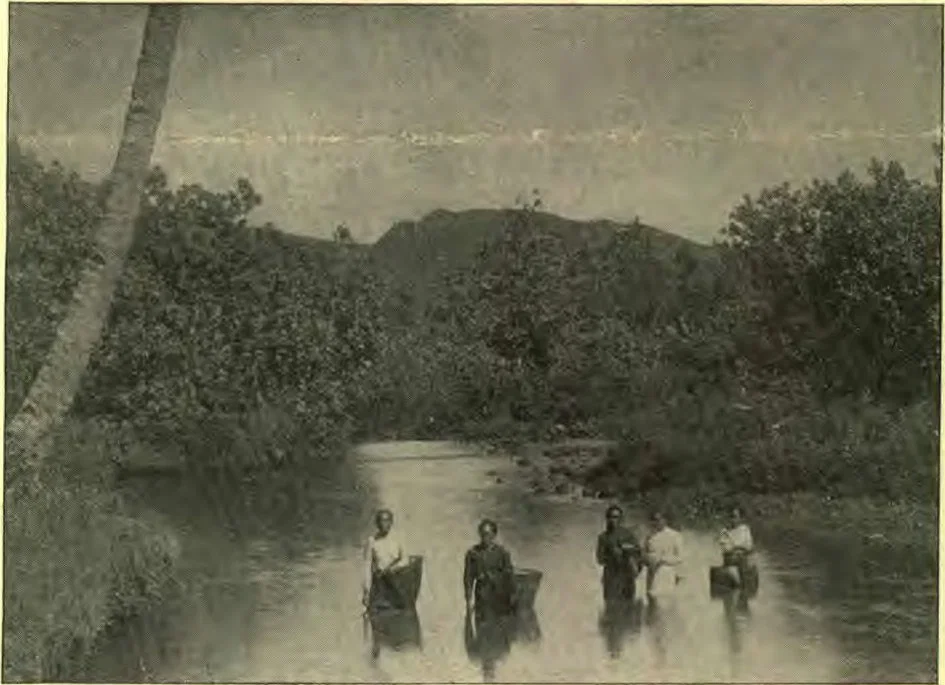
TAHITIAN SCENE
TAHITIAN SCENE
Over and over again the mother and father told Oneric the story of this brave and mighty man. They told how he reached the sinking vessel, and saved the lives of those on board. They told how Oneric’s father had been among the saved, and how they loved the man who had saved him. As the years came and went, Oneric learned to love the story better, and the picture more and more. He repeated the brave deeds to himself and to his playmates; and at night, when the winds were wild and the ocean roared, he dreamed of the “King of the Storm.”
He grew older and stronger, and his father and mother looked from his fair young face to the picture, and smiled; and the mother whispered to herself, “There will some day be another king, I think.” In the pride and joy of her heart she told the story again and again. It never grew old to them.
Oneric became a fisherman. Day after day he lived a life of simple justice and toil, unconsciously patterning after the man of his dreams. His kindness grew, his bravery increased, and his nobleness bore no stain. The village learned to depend on his integrity and wisdom, bringing their difficulties for him to settle, asking his advice, and treasuring his words in their memories. He was content. He dreamed of no honors. But with the years, the village had become a city. The people needed a leader, and when the question was asked, Who shall it be? with one voice they shouted, “Oneric—Chieftain!” Then the aged mother looked from the noble face of her son to the face of the king on the wall; and they were one.
Thus one good story and picture bore their fruit. We, however, can tell a better story than that of the “King of the Storm;” for we can tell the story of the “King of kings.” We can tell it till it becomes the most wonderful and loved story in all the world to the little one, so that as he grows, he will naturally follow the Pattern, and Christ will be the joy, the love, and the dream of his life. EDISON J. DRIVER.

TALKS WITH OUR BOYS

Boys are the stuff men are made of,—just common, every-day boys.
Often people act as if they had forgotten this, if they ever knew it; but it is true, nevertheless. “Men are only boys grown tall.” In order ever to become a man, one has first to be a boy. Many boys never become men,—true, noble, able men,—even though they attain to the form of men.
Boys, be true, whole-souled, jolly, rollicking boys; it will do you good; but be boys, not scamps. Be a boy among boys, if you would ever be a man among men. Do something better than any one else can do it, if it is no more than to whittle. I have known boys who won the admiration of every boy in the neighborhood because they could whittle, and did whittle; but they whittled to some purpose. When you can excel in one thing, try something else. Aim high. You can do almost anything better than most people do it, simply because they are too indolent to try. So many are content to be just ordinary, that we measure ourselves by them, and don’t try. It takes hustle to succeed.
Let me whisper a secret: It won’t hurt you to work. You may doubt this, but I have talked with and watched those who have tried it. Very few people act as if they knew this secret, so there is no reason why you can not surpass them. Did you ever notice how much more machinery rusts out than wears out? While your companions plod listlessly along, get some life into you, and move; then you will excel whether the work be physical or mental. Your head is not like your boots,—the more you wear them, the less valuable they are: it is like putty,—you must pound it and work it before it is of much use, and even then, if you let it lie idle long, it will become useless.
Did you ever see any one who would not study, even in school? I have. A boy who was willing to stay at the foot of his class rather than study,—and he would even bother others. What a shame! Boys, have grit. Many a grindstone would be thrown into the ditch were it not for its grit. Sometimes, I know, you “feel tired,” and don’t enjoy the work. I know arithmetic is puzzling, spelling is poky, and grammar dry; but what of that? Do you ever stay at home from skating because you have to buckle on your skates? or fail to go swimming because you must first take off your shoes? Master these things. Let no one do better work than you. A steam engine will go farther in a day than an ox-team, because it goes faster. If you will wake up, and go to work on your lessons with half the energy that you bestow on a game of “black man,” they will be easy.
We hear a great deal nowadays about prodigies and geniuses; but when you find one, you will learn that he is just a plain, simple, hard-working man, to whom his neighbors have given that name to hide their own laziness. So set your stakes to become men. You can do it: of course you can. It will take patient, careful toil for years; but everything worth the having has cost some one much painful effort. You will meet discouragements. Very good. They will show you to be a man, if you are one; and if you are not, all the propping and petting you can get will never make one of you. Fertilize and water and cultivate a buttercup all you please, and it will never make a butterfly. The kind of man you are to become rests with you. If you would be a noble, honorable, and honored man, you must cultivate these qualities, in spite of discouragements. The one necessary thing is to persevere against any and all difficulties.
If any one save an idiot or a lunatic will make up his mind to succeed, and stick to it, I am convinced that for him success is possible. On our Western prairies the soapweed has clung for years, despite the winds and dust. It would be half-dead, half-alive for months; but it would stick till rain came, and then the more firmly root itself as an ornament in the grandest gardens of the world. And men have come to know that it will grow and bloom, let come what will.
FLOYD BRALLIAR.

THE ISLES AFAR OFF

LET me call your attention for a moment to one of the islands in the South Seas,—Tahiti. As we approach it, we see tall mountains covered with luxuriant foliage in many shades of green—a beautiful contrast against the blue sky. Then rich valleys of cocoanuts, breadfruit, mangoes, bananas, oranges, and other tropical fruits in abundance, greet our eyes. The houses are almost hidden among the foliage.
With so much to tell them of God’s love, and how plentifully he has provided for their needs, we may wonder that the natives need any missionaries. Surely that “which may be known of God is manifest in them; for God hath showed it unto them. For the invisible things of Him from the creation of the world are clearly seen, being understood by the things that are made, even his eternal power and Godhead; so that they are without excuse.” Yet God, not willing that any should perish, sends his missionaries to these islands, to be his witnesses that he is able to save to the uttermost all that come unto him by Jesus Christ. But many come here entirely from selfish motives. In this class, many nationalities are represented, and many phases of religious belief. The Chinese, for instance, of whom there are numbers in the islands, have a large Joss-house, in which they worship a very hideous monster, made by their own hands.
These things make us sad, and give us a greater desire to point them to the living God. With Christ we shall not fail nor be discouraged; and we are his witnesses in these islands that the gospel “is the power of God unto salvation to every one that believeth.” G. F. JONES.

HIS TENDER MERCIES

His tender mercies are over us all, On the just and the unjust his rain doth fall, On the good and the evil his sun doth shine, Child of his tenderness, canst thou repine? He heareth the ravens that, hungering, cry; He, pitying, noteth the sparrows that die; He decketh the lilies, all snowy and tall: His tender mercies are over us all.
His tender mercies are over us all; Let nothing affright thee, let nothing appall, Nor earth-tempests fill thee with sudden alarm; By no means shall anything bring to thee harm. Eye hath not seen, and ear hath not heard, What hath been prepared for the loved of the Lord; His eye is upon us; he lists to our call: His tender mercies are over us all.
ELIZABETH ROSSER.

SUGGESTIVE PROGRAM FOR THE YOUNG PEOPLE’S MEETING

(January 5-11)
1. OPENING EXERCISES. Ten minutes.
Missionary hymn.
Prayer season, in which several may take part.
Scripture reading: Isa. 42:1-12.
2. Study of the Testimonies—The Youth to Be Missionaries. Twenty minutes.
3. Field Study. Fifteen minutes.
Message of Progress from Italy, South Africa, Paraguay, Jamaica, England, Porto Rico, Colombia, Utila, Trinidad, Spanish Honduras, St. Thomas, Japan, Mexico, India, Chile, Russia, France, Mexico, and Zambezi district.
4. Closing Exercise. Five minutes.
NOTE.—Excellent material for the study from the Testimonies may be found in Volume 6. But if this is not available, abundant help can be gathered from any of the other volumes. This may be read, or prepared in the form of a reading in which several may participate, selections in answer to questions being handed out to the different members.
Material for the field study is all to be found in the January issue of the Missionary Magazine. As this number contains so much that shows progress in the many fields mentioned, it would be of interest to have as many of the young as possible take part. Let each give, in a sentence, some encouraging item from one or more of the fields suggested. A good map will add very much to the interest of the meeting if each speaker first announces his field, allowing the leader to point to it on the map, and then gives in a distinct manner his message of tidings.
This will give an idea of how widely the message is being preached. Another month we may take a more extended view of some of the fields mentioned.

“PASS IT ON”

It is an interesting bit of experience told by Mark Guy Pearse. When fourteen years of age, he was returning from Germany to his Cornish home in England. At Bristol he took ship for Cornwall, there being no trains running there in his day. The passage money, which he thought included his meals, exhausted the whole of his cash, and his surprise was great when the steward, toward the close of the passage, brought him a bill for his food. He told him that he had spent all his money. “Then,” said the steward, “you should not have ordered the things you did,” and asked him for his name and address.
No sooner had the lad informed him than the steward in amazement exclaimed: “I never thought I should live to see you.” Then he told how, years before, when a fatherless boy, his mother in great distress, the father of Guy had befriended them; and he had resolved if ever opportunity afforded, he would repay the kindness thus shown. So now he paid the lad’s bill, gave him five shillings, and saw him safely landed.
When the youth reached home, and told his father the incident, his reply was: “My lad, I passed the kindness to him long ago, in doing what I did, and now he has passed it on to you. Mind, as you grow up, to pass it on to others.”
What sound and beautiful advice! Frequently kindness costs us little, but it means much to others. Jesus never thought of himself, but was continually thinking of others, and “went about doing good.” Are you, dear boy or girl, doing the same? Ask and answer this question. It is said,—
“Somebody did a golden deed; Somebody proved a friend in need; Somebody sang a beautiful song; Somebody smiled the whole day long; Somebody thought, ‘Tis sweet to live;’ Somebody said, ‘I’m glad to give;’ Somebody fought a valiant fight; Somebody lived to shield the right.”
Young reader, was that somebody you?
Wm. P. Pearce.

WORK

CAN you work? Will you work? Do you work? God is calling for workers. To plan is good, to pray is better, but to work is best. Prayerless work will accomplish but little, but workless prayer does nothing. So much time is spent by many in planning to work, in talking about how to work, that there is no time left really to do anything. We get so much heavy harness for our poor little horse, that it takes all his strength to carry it, and also keeps us busy buckling the straps, and guiding the poor “beastie.”
Now that, in our work as young people, so simple a form of organization is given us, let us stir ourselves, and do something. Let us no longer love in word, but in deed. Listen to God’s plea. Let us see what he wants of us: “Young men and young women, can not you form companies, and as soldiers of Christ enlist in the work?” What work? Not study, not prayer, not planning, but doing. Don’t forget that prayer, study, and plans are absolutely necessary to successful work; but all these fall short, unless we reach the point of actual work, to “save souls from ruin.”
“Let there be companies organized in every church to do this work.” These companies are to be organized, not for study, not for singing, not for planning, but for work. The companies will study, they will plan; and they ought to do these things. And most of all, they must pray. But all this in order that they may work. “Let young men and women and children go to work.” “Go to. work.” “GO TO WORK in the name of Jesus.” “Let them unite together upon some plan and order of action.” It is a plan of work; it is to be orderly action.
“Can you not form a band of workers, and have set times to pray together, and ask the Lord to give you his grace, and put forth united action?” It is “action” God asks,—“united action;” well-planned action; prayerful, orderly action; but it is action, work, deeds. “You should consult with men who love and fear God, and who have had an experience in the work, that under the movings of the Spirit of God, you may form plans and develop methods by which you can work in earnest for certain results.”
“Form companies,” “unite together,” “consult with men who love and fear God,” “develop methods,” “form plans,” and “have set times to pray together;” but do all these that you may put “all your tact and skill and talent” into earnest work for “certain results,”—“that you may save souls from ruin.” Don’t wait; do something, and do it now. Plead with God till he gives you soul-winning power. It is his will that you should see “certain results.”
May God richly bless you, dear young people, and fill you with his own constraining love for souls, during the early weeks of this new year. I shall be glad to hear from any of you. Write me at 400 West Fifty-seventh St., New York City.
LUTHER WARREN.

A MINISTRY WITHOUT WORDS

If Christian service were all talking and praying in meetings and visiting the sick, it would be discouraging to some talentless people. But are our tongues the only faculties we can use for Christ? There are ways in which even silent people can do service for God, and be a blessing in the world. A star does not talk, but its calm, steady beam shines down continually out of the sky, and is a benediction to many. A flower can not sing bird-songs, but its sweet beauty and gentle fragrance make it a blessing wherever it is seen. Be like a star in your peaceful shining, and many will thank God for your life. Be like a flower in your pure beauty and in the influence of your unselfish spirit, and you may do more to bless the world than many who talk incessantly. The living sacrifice does not always mean active work. It may mean the patient endurance of a wrong, the quiet bearing of a pain, cheerful acquiescence in a disappointment.

Noble Deeds and Hearts of Patience

“Noble deeds are held in honor; But the wide world sadly needs Hearts of patience to unravel The words of common deeds.” —Glimpses Through Life’s Windows.

Everyday Greatness Through Patience and Gentle Temper

He who walks through life with an even temper and a gentle patience, patient with himself, patient with others, patient with difficulties and crosses, has an every-day greatness beyond that which is won in battle or chanted in cathedrals.—Doctor Dewey.

DIVISION I — GEOLOGY

Chapter XV — The Animals before the Flood
§160. WERE it not for the fact that the actual remains of immense monsters, such as this world knows no more, are being continually found in nearly all parts of the world, we would naturally discredit the possibility of such creatures ever having existed. When God first made these monsters to inhabit both the land and the sea, they were harmless in their nature, and in perfect subjection to Adam; but when man rebelled against the government of heaven, God allowed Adam’s subjects to rebel against man’s authority.
§161. Only a powerful, gigantic race, like that which lived before the flood, could have withstood the terrible fury of those monsters. It was in mercy to our rapidly degenerating race that the Lord caused these ponderous creatures to become extinct. The animals, as well as man and the vegetable kingdom, have dwindled to a mere nothing in comparison with what they originally were.
§162. At present there are in all Asia but two species of living reptiles over fifteen feet long; in Africa, but one; in all America, but three; and not more than six in the whole world. The length of the largest living reptile of the present time does not exceed twenty-five feet. The elephant and the whale are the two largest living animals now known; while the condor, of the Andes, is the largest bird of flight. And the expanse of this bird’s wings rarely exceeds twelve feet. When we compare these mere pigmies that we see to-day with the animals that lived before the flood, whose remains bear undeniable evidence of their size, species, and habits, as well as to their numbers and location upon the earth, we get some idea how the animal kingdom has degenerated physically under the blight of the curse during the past six thousand years.
§163. In the British Dominion there are found the remains of four or five species of dinosaurs —a gigantic, lizard-like monster, which was from twenty to fifty feet long; and ten or twelve species of the crocodilians, which were from ten to sixty feet long. These were certainly somewhat larger than the crocodiles and lizards of our time.
§164. Whatever Job’s “leviathan” (Job 41) may have been, we are not ready to say; but we do know that there were certainly, at one time, monsters of the deep; for we find their well-preserved remains. The mosasaur, which was a swimming, snake-like reptile some eighty feet in length, was one of these. Its body was covered with overlapping, bony plates; its four paddles had regular finger-bones, like those of the present whale. The remains of fifteen of these reptiles have been found in New Jersey; six or more in the Gulf States; and over twenty in Kansas.
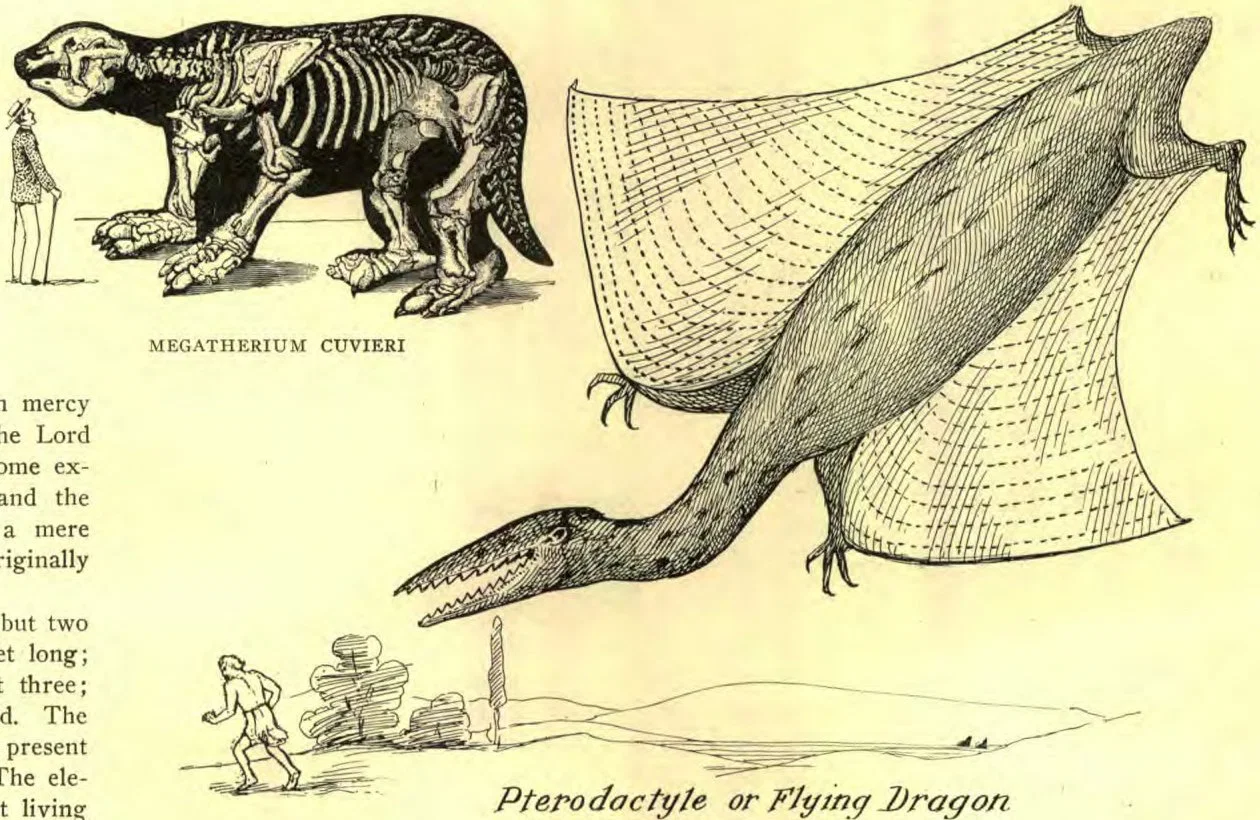
§165. So far as known, the most formidable, though not the largest, creature of those times was the pterodactyl, or flying dragon, of which the remains of more than a dozen specimens have been found. They resemble a gigantic bat, or vampire, with strange, dragon-like wings, extending, in some instances, twenty-seven feet from tip to tip. In most of them, the nose extended like the snout of the crocodile, and the jaws were armed with conical teeth. From the upper angle of their wings projected fingers, terminating with long hooks, forming a powerful claw. Their eyes were of vast size, enabling them to see well at night. They were equally qualified for flying or swimming, and could also walk upon the ground. The fabled legends of armed knights fighting with dragons during medieval times were undoubtedly based upon the finding of the remains of this reptile.
Pterodactyle or Flying Dragon
§166. The turtles of those days were frequently eight and even nine feet in length of shell; and according to Cope had a breadth between the tips of the extended flippers of more than fifteen feet, and in some instances an estimated weight of fully a ton. In Nebraska, where in some places they lay imbedded by the hundreds, they give evidence of having been washed there by the waters of the great deluge.
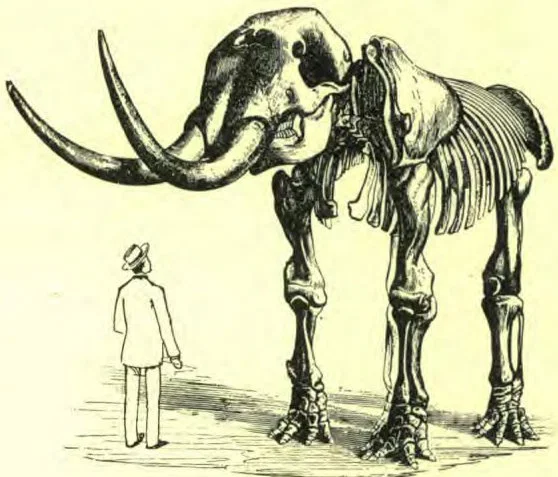
§167. The mastodon was the elephant of the tropics,—not an elephant in the true sense; but very similar, as will be seen from the skeleton that appears in the accompanying illustration. The remains of this animal are found plentifully in North America. A monster of this kind was exhumed near Bellevue, west of Battle Creek, Mich., a few years ago in a fair state of preservation.
§168. In the summer of 1845 the remains of a mastodon were found in a swamp in Newburg, N. Y. Its length was twenty-five feet; height, twelve feet; length of tusks, ten feet. The skeleton was purchased by Dr. J. G. Warren, of Boston, and weighed two thousand pounds. In the place where the stomach lay were several bushels of bruised and chopped twigs and leaves,—the remains of his last meal. These animals wore a heavy coat of dun-brown hair from two to seven inches long.
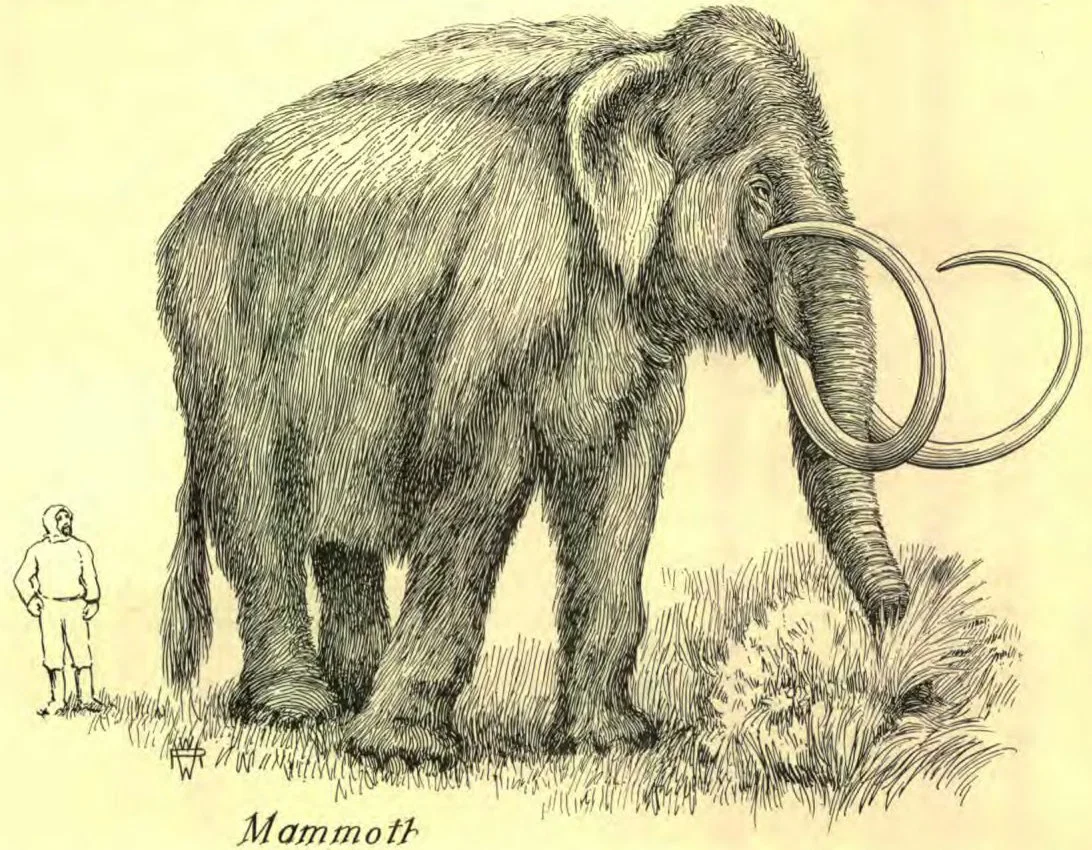
§169. The mammoth was the largest of the land animals, and inhabited the polar regions, living upon the dense foliage of spruce and cedar trees that then grew there in abundance. It is estimated to have been about five times the weight of the modern elephant. These animals roamed in vast herds where the British Isles are now located. In proof of this we have but to state that between the years 1820 and 1833 the fishermen in the neighborhood of Norfolk brought ashore no fewer than two thousand grinder teeth of the mammoth, besides great tusks and numerous portions of skeletons.
The cliffs of frozen earth that line the arctic coasts of Siberia contain such vast amounts of the remains of extinct animals that when the ground is upturned, it exhales a strong, disagreeable odor, like that of a well-filled graveyard. Captain Kellet also says that at Eschscholtz Bay the fossil bones of animals are so abundant that huge tusks and horns not unfrequently project through the soil. He brought from that locality the remains of the mammoth, horse, moose-deer, reindeer, bison, musk-ox, and others. In northern Siberia, where the ground remains frozen the year round, entire carcasses of the mammoth are frequently found in a high state of preservation. In 1799 one was found near the River Lena, being but partially exposed to view. In 1803 the ice had so melted that the enormous carcass became entirely disengaged, and fell down upon a sand-bank below. The tusks weighed three hundred and sixty pounds. The body was covered with long, wiry hair, intermatted with a thick body of reddish wool. The pupils of the eyes were plainly distinguishable, and the flesh was so perfectly preserved that the people in that vicinity carried away immense quantities, and fed it to their dogs. The skeleton was taken to St. Petersburg. So numerous were these animals, that in Siberia the collection and sale of their tusks constituted a regular business.
Mammoth
Mammoth
These animals, though so great, were little less to be feared by the powerful human race that lived as their contemporaries, than are the venomous insects and reptiles, and the fierce denizens of the jungles and forests, of to-day.

QUESTIONS

Before man’s rebellion, what spirit pervaded the animal creation? What change took place in the animals at the time of the fall? What lesson should the race learn from this? Why did the Lord cause these powerful animals to become extinct? Why were their remains so fully preserved? What besides man has deteriorated in size? Measure upon the school-yard the dimensions of some of these extinct beasts and reptiles, and compare them with those of the present. Does this look like a fulfilling of that much-vaunted law of infidel science known as the “survival of the fittest”?
Glyptodon Clavipes
Glyptodon Clavipes
DR. O. C. GODSMARK.
MASTODON AMERICANUS
MASTODON AMERICANUS

HONORED OF MEN AND HONORED OF GOD

A FEW months ago I visited the national cemetery at Vicksburg, Miss. As I entered the grounds, I could see on all sides how the art of man had combined with the work of nature to make the place beautiful and attractive. The grounds are all on the sides of curiously shaped hills. To one beholding the scene from a distance, it has the appearance of immense steps. First is a level spot large enough for from one hundred to five hundred graves; then a steep incline of from four to twelve feet to the next higher elevation; and so on to the top of the hill. About twenty thousand soldiers are buried in this cemetery.
As I contemplated the scene, the question occurred to me, “Why is all this done?”—It is in grateful remembrance of the sacrifice made by these men in the hour of their country’s need, that this care is bestowed upon their resting-place by the nation. Then the question arose, “How are the soldiers in the Christian warfare honored?” Though their graves may be unknown, though they be in the darkest corners of the earth or in the depths of the sea, those who have left home and friends to fight in a cause that to them is dearer than life, will, on the glorious resurrection morning, hear the voice of Jesus calling them to come forth, and receive the crown of life that is laid up for the faithful.
Many of the occupants of the graves in this cemetery are unknown, but the Lord knows every one of his children by name. In this national cemetery, man has aided nature in beautifying the resting-place of the soldiers of the nation, but the Christian will be given the privilege of aiding nature in beautifying the dwelling-place of the righteous. Isa. 65:21-25.
GEORGE CRAWFORD.

A LOST FLOWER

MORE than a hundred years ago a new flower was found in the wild and rugged mountains of North Carolina by Michaux, a Frenchman, who had traversed many lands, and known many perils and adventures in his search for rare plants. He had traveled through his native country and Spain, climbed the Pyrenees, crossed sea and desert, and been despoiled by Arab robbers, so that he arrived in Persia with nothing but his books left to him of his baggage. Luckily he cured the shah of an illness, and was allowed to carry back to France many Eastern plants. He was then sent by his country to explore the forests of North America. In the mountainous country of North Carolina there were no roads, only Indian trails, used by a few missionaries and traders. In this wild and lonely region he found a new flower, that belonged to no recognized genus, and was mentioned by no previous botanist. It is a modest little flower; its pure white cup rises on a wand-like stem in the midst of shining and tender leaves, round in shape and prettily edged. He secured a specimen, but had no leisure to study its habits in the montagnes sauvages, as he called these mountains in his own language. Rumors reached him of the French Revolution, and he immediately hastened to return home. He was shipwrecked on the voyage, and lost nearly all his collections.
From this time the flower was lost, so far as any knowledge of its existence was concerned. But after the death of Michaux, our botanist, Dr. Asa Gray, happened to be in Paris with his son, the youngest Michaux, also a lover of plants. Very naturally, Michaux showed his American guest his father’s new specimens of American plants that had escaped the shipwreck, and Dr. Gray was much interested in this little flower marked “Unknown.”
When he returned to the United States, he sought it in vain. All trace of it seemed to have disappeared. Year after year when he heard of any one going to the North Carolina mountains, he would ask him to look for the lost flower.
At last, by chance, some one found a blossom, in early spring, growing in a different locality, and not recognizing its genus or species, sent it to Dr. Gray, as one of the highest botanical authorities.
As soon as Dr. Gray saw it, he exclaimed, with delight: “Why, this is the little unknown flower of Michaux.”
After its strange disappearance of a century, it had again come to light. It has since been found in various parts of upper South Carolina, and is now cultivated by more than one florist and grower of rare plants. Its leaves are like those of the southern wild flower, the galax, akin to the pyxie, or flowering moss, so it has been placed in the same family, and named Shortia galacifolia; i. e., with a leaf like galax. The first name is given in honor of Short, the botanist, a lovely way of keeping alive the remembrance of one who loved flowers.—Selected.

SWEET NAMES

By the endearing name of friend Jesus calls me to his side; Sweet the message he doth send,— “ Henceforth, friend, in me abide.”
Calls himself my Brother, too. Home, the loving name implies. Sweet affection! let it woo All my tenderest sympathies.
Father, too, and I his child. Strong, pure, restful, loving ties! Comfort sweet and undefiled, Perfect peace that underlies.
Thus he kindly leads me on With his wondrous words and true; Tunes for me my morning song, Cheers and comforts all day through. MRS. P. ALDERMAN.

STILLING THE TEMPEST

(Concluded)
We Perish.— The disciples thought their greatest need was to be saved from perishing, but in reality their greatest need was faith. However, the merciful Saviour attended to the lesser need first, and then asked them where their faith was. The disciples were far more afraid of the waters of Galilee than of the enemy’s flood of unbelief and doubt. The Saviour did not save them from the latter without first quieting their fears of the former. As Christian workers we should not forget nor ignore the physical and temporal needs of those for whom we are laboring, although they may be considered minor as compared with the greater needs of the soul. Let us first minister to the outward need, although it may be less important, and thus prepare the way to supply the greater needs of the moral nature.
He Arose, and Rebuked the Wind.— “The wicked are like the troubled sea, when it can not rest, whose waters cast up mire and dirt. There is no peace, saith my God, to the wicked.” Isa. 57: 20, 21. Human power can not control the raging passions of the unsaved soul. The unconverted man is storm-tossed and wave-beaten; and it is only the word from nature’s
Continue reading: Peace, Be Still: Faith Amid the Tempest