Your ShelfYour Projects

Review and Herald, Vol. 75, No. 2.

MRS. E. G. WHITE

Review and Herald

Jan 11, 1898

Seventh-day Adventist Publishing Association · Battle Creek, Mich. · Jan 11, 1898

MRS. E. G. WHITE

CHRISTIAN BENEVOLENCE.—NO. 2.

MRS. E. G. WHITE

THOSE who are yoked up with Christ will not give with a patronizing air, as though they should have great praise for their benevolence. They will realize that they are trading in their Lord’s goods, not their own, and that they will have to give an account, in the Judgment, of the use they have made of their entrusted capital. Those truly love their neighbor as themselves who realize their responsibilities and the claims that suffering humanity has upon them, and carry out the principles of God’s law in the daily life.
It is not God’s plan at all that the rich should give gifts to those who have abundance. It is the distressed, the downtrodden, the discouraged, the hungry, the suffering, the naked, the poor, of whom Christ says, “Ye have the poor always with you.” We need to take closer views of God’s word and of eternity. This will not disqualify any one for the duties of life, or to act a Christlike part in society. The gospel of Christ is not only to be believed, but to be acted. We are to be doers of the word. We are daily determining our destiny in the future life by the character we develop in this.
Jesus, the world’s Redeemer, laid-off his royal crown, laid aside his royal robe, and clothed his divinity with humanity; though adored and worshiped by the angelic host, he left his high command, and for our sake became poor, that we, through his poverty, might be made rich. This is not riches in houses and lands, but the riches which will endure unto eternal life.
Christ penetrated into the very inner circles of life. He sought to arrest the actors in domestic life, in the midst of their household cares, and call their attention to the fact that they had eternal interests to secure. He told them: Your various endowments are so many talents. These the Lord has entrusted to you to be improved, and by their use to gain other talents. They will increase through constant exercise. God has made men almoners of his providence, to use wisely the entrusted capital, as well as the endowments of his grace, to do all the good they possibly can, and thus constitute themselves wise, faithful stewards, laborers together with God, to reshape characters, and to elevate and help those who need help.
The command is given, Work while the day lasts: the night cometh, when no man can work. Jesus asks, “Are there not twelve hours in the day?” If these hours were employed as if men realized that they were accountable human beings, responsible before God, as serious, candid, heaven-bought subjects, keeping eternity in view, there would be sufficient time to secure for every soul an inheritance among the sanctified in the kingdom of God. There would be time for each one to be instrumental in the saving of many souls through precept and example. But we have no time to waste, no time to devote to selfish pleasure-loving, no time to give to the indulgence of sin. Time is golden. We have characters to form for the future, immortal life. Angels of God are watching our development of character; they are weighing moral worth.
It is said that one of earth’s rulers, when told by the physician that he could live but a few moments, exclaimed, “A kingdom for one hour’s time!” Year after year he had been granted the twelve hours of the day, but he had not spent them in securing his eternal interests.
Christ points out to us that which he expects us to do. He has given us a glimpse of eternity, that we may realize that there is something higher than temporal things to engage our attention, and call into activity all our delegated powers. They must be used to glorify our Redeemer. Christ calls for the human agents to co-operate with the divine agencies in saving the world. Not one is to feel that he can use his time as he chooses. Heavenly requirements are not to be ignored.
It is the almost universal practice of men to subordinate the eternal to the temporal; the claims of the future, the unseen, to the common affairs of the present. But Christ declares, “Ye cannot serve God and Mammon.” “No man can serve two masters.” The god of this world claims wonderful activity and constant slavery to his will. Christ, the uplifted Saviour, calls men to look and live. He declares, “I am the way, the truth, and the life.” “Seek ye first the kingdom of God, and his righteousness,” he declares, and all needed things of secondary importance “shall be added unto you.”
If the churches that have had great light and great opportunities will walk humbly with God, the Lord will give every member a work to do for him. If you make no success in the highways, go into the byways, to those who are poor, despised, and forsaken. If you work for them while mounted upon the stilts of your dignity and superiority, you will accomplish nothing; but if you will be truly converted to the Lord Jesus Christ, and learn of him who is meek and lowly in heart, you will show that you have learned how to work the works of God. This is the work of God, that you believe on him whom he hath sent, that you go to him for counsel and instruction, and pray, and watch, and work.
Waste nothing in your life practice. Jesus worked a miracle to feed the five thousand tired people. He selected a pleasant place for them,—for “there was much grass in that place,”—and gave his orders, commanding them to sit down. Then he took the five loaves and two small fishes. No doubt many remarks were made as to the impossibility of satisfying five thousand hungry men, besides women and children, from that scanty store. Then Jesus gave thanks, and placed the food in the hands of his disciples, to distribute to the multitude. The food increased in the hands of Christ, and as often as the disciples returned to him, they received a fresh supply.
Here is a lesson to be learned. Blessings, either spiritual or temporal, will accompany those who impart to the multitudes that are in need of these gifts. In the act of imparting, an increase is given of God.
The necessities of the great multitude were supplied. Then came the words of Christ, “Gather up the fragments that remain, that nothing be lost.” He who had all reserves at his command gave a lesson that not a fragment should be wasted. He who has plenty should not waste. Let nothing be wasted that can do good to any one. Collect every fragment; for some one will need it.
The souls of the poor are of just as much value in the sight of God as are the souls of the rich. Then labor for those who need your help, although you may receive very little sympathy from those who are prosperous. Christ says, “Freely ye have received, freely give.”
In every large city there are human beings who are not cared for, and are made of less consideration than the brutes. Moral degradation meets the eye and pains the senses. Human beings live in dark cellars, in houses that are reeking with dampness and filth. Children are born in these terrible places. Through the years of infancy and youth, their eyes behold nothing attractive; nothing of the beauty of nature cheers their vision. They hear the name of God only in profanity.
These children are allowed to grow up molded and fashioned in character by low precepts, disagreeable surroundings, and wretched examples. Impure words and the fumes of liquor greet the senses. Want and wretchedness are on every hand, because of the insufficient and miserable food, which is unfit for human beings to subsist upon; and from these abodes of want there are sent forth piteous cries for food and clothing by many who know nothing about prayer.
Christians, will you consider that Jesus gave his life to save these souls? Will you not co-operate with him in this great work? It is not fitful service that God accepts; it is not emotional spasms of piety that make us children of God. He calls upon us to work for principles that are true, firm, and abiding. If Christ is formed within, the hope of glory, he will be revealed in the character, it will be Christlike. We are to represent Christ to the world, as Christ represented the Father.

“IN THE FACE OF CHRIST.”

Have you and I to-day Stood silent, as with Christ, apart from joy or fray Of life, to see by faith his face; To look, if but a moment, at its grace, And grow, by brief companionship, more true, More nerved to lead, to dare, to do, For him at any cost? Have we to-day Found time, in thought, our hand to lay In his, and thus compare His will with ours, and wear The impress of his wish? Be sure Such contact will endure Throughout the day; will help us walk erect, Through storm and flood; detect, Within the hidden life, sin’s dross, its stain; Revive a thought of love for him again; Steady the steps which waver; help us see The foot-path meant for you and me. — George Klingle.

THE PRESENT, NOT THE PAST.

F. M. WILCOX.
(Boulder, Colo.)
1898! How strange does this new division of time sound to our ears! So long have we been accustomed to speak “1897,” that the new year seems almost an innovation. But 1897 is gone. It is numbered with the past. No more, only in memory’s dream, can we count, one by one, its days and weeks and months. Its passing has been like a tale quickly told, a short watch in the night.
And yet, although so short, the year 1897 was a way-mark in life’s highway. In the balance sheet in heaven’s ledger it counted gain or loss to every soul. It has lifted the soul nearer God, or drawn it farther away. But it has gone. No more shall we be enlightened with its joys, nor can it evermore bring to us fresh sorrows.
The year 1898 reminds us that we have reached one more nick in the wall of time, one more round in the ladder of experience. Our experience of the past has become history. We may read its pages at will. Our future experience remains unwritten. What will be its history? What joys and hopes will cheer us onward in the year to come? What dangers appal? What discouragements and failures dishearten? These are the queries that demand solution as we stand at the threshold of another year, and peer into the unknown future. No answer comes to our anxious thought. The future yields up no information in advance. With each coming year, as in the past, unfolding time may discover to us our destiny. To the Infinite alone does the future stand revealed. His discerning eye can see the end from the beginning, and in his knowledge the history of the future is already written.
But it will not do for us to stop to theorize or speculate on the outcome. In thus doing we shall take time from the duties of the living present. We know this,—that the new year will bring us into new relations to God, to the world, and to ourselves. It will bring to us new burdens, new responsibilities, new hopes, new desires. The past has brought small measure of success. We turn to the future for a greater measure. But neither the hope of the future nor the remembrance of the past must engross our time and attention to the neglect of the present. We can ill afford to snatch time from the living, pressing issues of to-day to relive, in memory, the experiences of yesterday. True, there will come to us galling remembrances of broken vows, unfulfilled promises, misimproved opportunities, blasted hopes, and misspent moments of precious time. They will remind us of neglect and unfaithfulness. With one voice they will proclaim our inefficiency to cope with present issues, and prophesy for the future only discouragement and utter failure. All this will they do if we but grant them audience of time and place. This we cannot afford. While we must not repudiate the past, we must forget it. Have we sinned? We must confess the wrong, and cease to do evil. Have we wronged others? It is for us to make restitution so far as lies in our power. We must repudiate self, and take, in its place, the Lord Jesus. And O, this repudiation of self means so much! It forms the measure of true success in the work and service of God. Our success for 1898, if true and genuine, will be measured by deeds, not words; by love, not fear. It may cause the frustration of every earthly plan, the relinquishing of every earthly hope, and the utter destruction of self. Along with it may come trial, affliction, and suffering; and it is only the true metal that will be able to stand its proving process. It is only the loyal and the brave who can hope to gain success purchased at the sacrifice of self. But to those who will submit to God, allowing him to chisel and polish in his own way, and by his own means, there will be, in the process, true joy, true delight, in the contemplation of the state to be attained. With physical sorrow and pain may come uplifting joy and satisfaction.
But we must forget the past. The mold of our experience last year must not fashion our experience for the year to come. We must have higher motives, holier objects, purer purposes, wills more resolute to resist evil and choose the good, more implicit trust in God, and less confidence in our own power. “Forgetting those things which are behind, and reaching forth unto those things which are before,” we must “press toward the mark for the prize of the high calling of God in Christ Jesus.” Here is the standard for our strivings. Here is the ideal of Christian character and perfection. Make Christ the pattern; make the ideal of advancement and attainment the spotless purity of the Lamb of God.
What progress shall we make in pressing toward this mark? What victories shall the year 1898 record for us? Will the record be a repetition of the history of 1897,—of discouragement, failure, and even times of utter rout?—It need not be so. For Christ, in Christ, and by Christ, we may achieve great things. We need not run the span of the new year alone, nor fight its battles all ourselves. Paul says, “I can do all things through Christ which strengtheneth me.” And Christ himself promises, “Lo, I am with you alway, even unto the end of the world.” In that blessed companionship we may take delight; from it we may draw strength; through it we may conquer triumphantly. We may sometimes feel discouraged as the way looks dark, but “he shall not fail nor be discouraged.” With his courage as ours, and his wisdom as ours, there can be no failure. His love is as boundless as the sea. That love will enlist for us his wonderful wisdom and his mighty power.
For the year to come, then, let us commit the keeping of our souls to him in well-doing as unto a faithful Creator. For him let us labor; in him let us trust. Where he leads, we may safely follow. Although the future may be unknown to us, victory is assured, through Christ, come what may. Then let us not worry nor repine. The duties of to-day require our clearest thought and best endeavors. “Do present duty,” should be the motto for every day in the year to come. Only let God direct, while we follow the movings of his providence. With the resources of infinite fulness at our disposal, what may we not do in 1898?
“My Saviour, as thou wilt! All shall be well for me; Each changing future scene I gladly trust with thee: Straight to my home above I calmly travel on, And sing, in life or death, ‘My Lord, thy will be done!’”

Individuality Retained in the Christian Life

WHEN a man becomes a Christian, his individuality is not taken away. The Christian is not something distinct from the man. He is the man filled with Christ. Of course, the regenerating power of the Holy Spirit changes the purpose of the life, turns it from self to God. Every renewed man is, in this respect, like every other. Each child of God is bound to overcome that which remains of evil in him, and to foster that which is good. Thus, regenerated men are alike, as elm-trees are alike, or crystals, or ocean billows, or human faces. But the Christian man whose nature is emotional will be an emotional Christian; he who is business-like and matter-of-fact will have that coloring in his Christian life; he who is thoughtful and contemplative will exhibit that phase of Christian experience. “As every man hath received the gift,” says the apostle.—Selected.

FAITH IN THE WORD.

M. E. KELLOGG.
(Battle Creek, Mich.)
THE word of God informs us that “faith cometh by hearing, and hearing by the word of God.” In other words, one hears the word of God, and believes it. We first hear, then believe. Hence every time when this word is brought before us, we have the opportunity of believing. But we also may, if we will, disbelieve. How necessary, then, it is for us to acquire the habit of believing what God says! We may not always fully understand it, we may not see how it can be; but if we have a proper sense of our own weaknesses, this should rather stimulate than lessen our faith.
If we cannot take the word of the Lord, whose word can we take? Napoleon never confided all his plans of a battle to his marshals. He told each one what he wished and expected him to do. The marshals did not know why they should advance here, or retreat there; but they knew that Napoleon knew, and they felt certain that it would all come out right in the end. How much more should we trust God, that his plans will all be carried out, believing that what he says is the truth, whether we can see it or not.
We should rest on God’s word alone, and not require any other aids for our faith. If God gives other helps to faith, we should thank him for them; but at the same time it is well for us so to learn the lesson of faith that the word of God will always be sufficient for us. At one time during Christ’s ministry, a certain nobleman besought him that he would come to his house to heal his child. The Lord said, “Except ye see signs and wonders, ye will not believe.” But the nobleman did not require that his faith should be strengthened in that way. He cried, “Sir, come down ere my child die.” Then Jesus tried his faith. He did not accede to his request, and go to his house; but he said, “Go thy way; thy son liveth. And the man believed the word that Jesus had spoken unto him, and he went his way. And as he was now going down, his servants met him, and told him, saying, Thy son liveth.” This was no surprise to the man. He did not say, “Is that so? how very strange!” He had believed the word of Jesus, and expected to find his son well. He only asked when he began to amend, that he might see how surely, in point of time, healing followed the word of Jesus. Then we read that “himself believed, and his whole house.” John 4:47–54. He had believed before, but now his faith was stronger, and his whole family joined him in believing in Jesus.
Why not believe all that Jesus has spoken? When he says, as he does through his word, that if we confess our sins, he is faithful and just to forgive them, why not believe it? Why should a professed Christian persist, as some do, in carrying his own sins, when Jesus has borne the sins of the whole world, and offers to each one free pardon of all his offenses? “Believe on the Lord Jesus Christ, and thou shalt be saved.”

Shame Before the Soul Versus Shame Before Men

“THERE is a great difference between one who can feel ashamed before his own soul, and one who is ashamed only before his fellow men.”

THE PROMISE TO US.

WM. A. WOOD.
(Darlington, Wis.)
We are in the time of the “latter rain.” It is falling upon all who believe. The blessing of Abraham—the “righteousness of God by faith”—has been directly given since 1888. This blessing of Abraham was given “that we might receive the promise of the Spirit.” Why, then, should not we receive it? There is no work about it; there is no effort about it: it does not require any effort to receive things. After we have received it, it will certainly move us to effort; but in the receiving of it, there is no effort. If there were, how much would a person be able to accomplish who has no strength? It is not by our own strength nor our own effort that we obtain it; but it comes as a precious gift, freely given, and all we have to do is to accept it.
See, however, the steps: (1) Christ has redeemed us, (2) that the blessing might come, (3) that we might receive the Spirit. Gal. 3:13, 14. The blessing, as has been suggested, is “the righteousness of God by faith.” So paraphrased, the statement of the different steps would run thus: Christ has redeemed us, that the righteousness of God by faith might come on us, that we might receive the promise of the Spirit. The righteousness of God by faith must come before we can receive the promise of the Spirit—before we can receive the latter rain.
But have we not received the righteousness of God by faith?—Yes, long ago. We have believed that our sins are forgiven, actually forgiven; and that, in the books of heaven and in the heart and mind of God, there stands no more against us than against Jesus himself. We have received this righteousness, and it has been the most precious thing we have ever received in Christian advancement.
Yet all this came to us only that we might receive the promise of the Spirit. What! to us? really us?—Yes, to us: the promise is to us and to our children. Then let us receive it.
If we do this, we shall have in our hearts something that will keep us from doing those things that we know we ought to abandon, but keep on doing; those things that are wrong; those things that we do not mean to do, and do not want to do, but cannot help doing,—things that we do in spite of ourselves. This is the solution of this serious problem. This is the help in this matter, the lack of which has troubled us so long. Let us now, therefore, receive this, and—glory be to the Lord!—we shall no longer commit sin. We shall be kept, and we shall be filled with the peace, and love, and joy of the Holy Ghost.
We shall love the truth. Is that worth anything?—It is worth so much that unless we do love it, we shall never succeed. The fact that we do not love it, is just why we do not keep it. If one actually and at all times loved God’s way, he never would depart from God’s way. O, let us receive the love of the truth! The promise of the Spirit will fill us with love for all, with the love of God. That is the Holy Ghost; that is the latter rain; that is Jesus in the heart. Praise be to God!

PURIFIERS OF LIFE.

Drummond.
THERE are some men and some women in whose company we are always at our best.
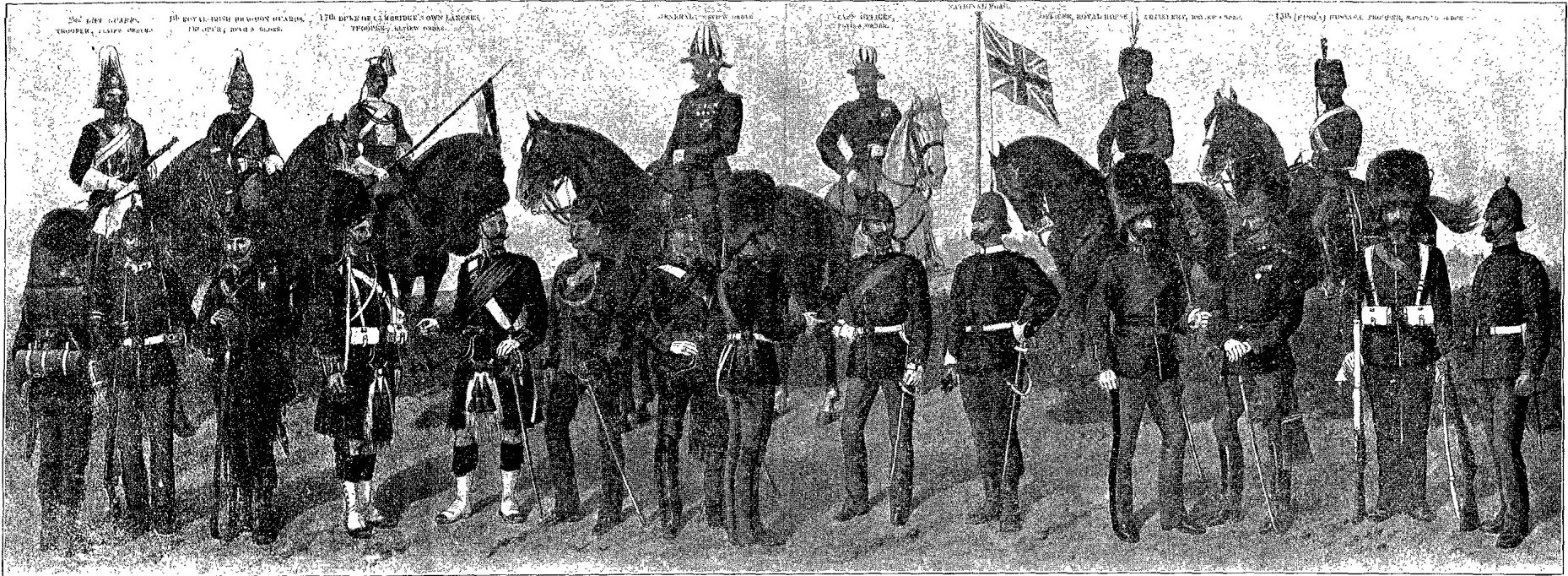
Styles of the British Army. War-footing, 634,706.
While with them, we cannot think mean thoughts or speak ungenerous words. Their mere presence is elevation, purification, sanctity. All the best stops in our nature are drawn out by their intercourse, and we find a music in our soul that was never there before. Suppose that influence prolonged through a month, a year, a lifetime, and what could not life become? Here, even on the common plane of life, talking our language, walking our streets, working side by side, are sanctifiers of souls; here, breathing through common clay, is heaven; here, energies are charged, even through a temporal medium, with the virtue of regeneration.
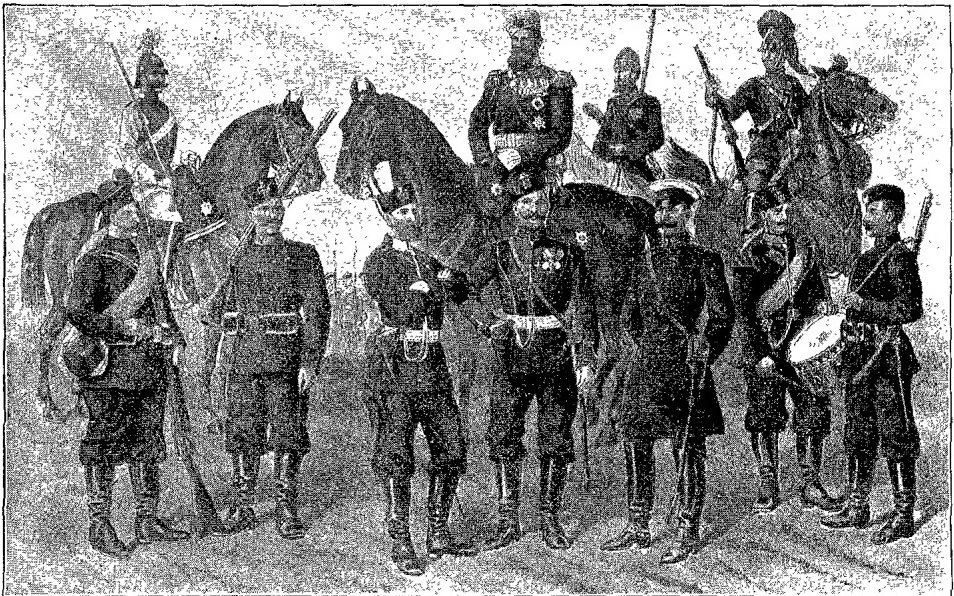
Styles of the Russian Army. War-footing, 2,151,000.
If to live with men diluted to the millionth degree with the virtue of the Highest can exalt and purify the nature, what bounds can be set to the influence of Christ?

“AND THE NATIONS WERE ANGRY.”

A. O. TAIT.
(Oakland, Cal.)
IN our previous articles, showing that the great spirit of war in the world is a conspicuous sign that we are in the last of the last days, only the weapons of warfare have been dwelt upon. When we consider the vast number of men in the navies and standing armies of the world, and the immense sums of money expended to equip and maintain them, the picture becomes still more appalling and impressive.
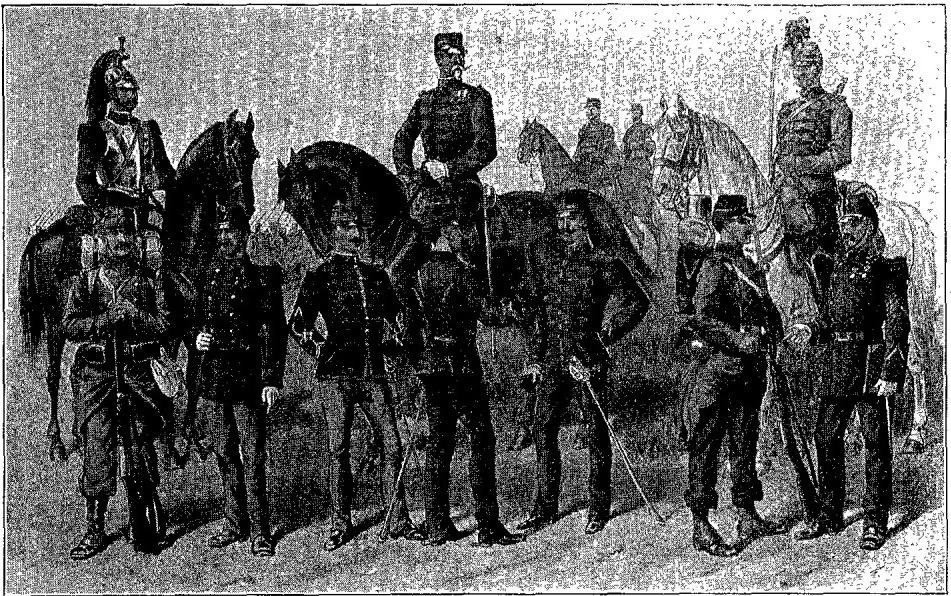
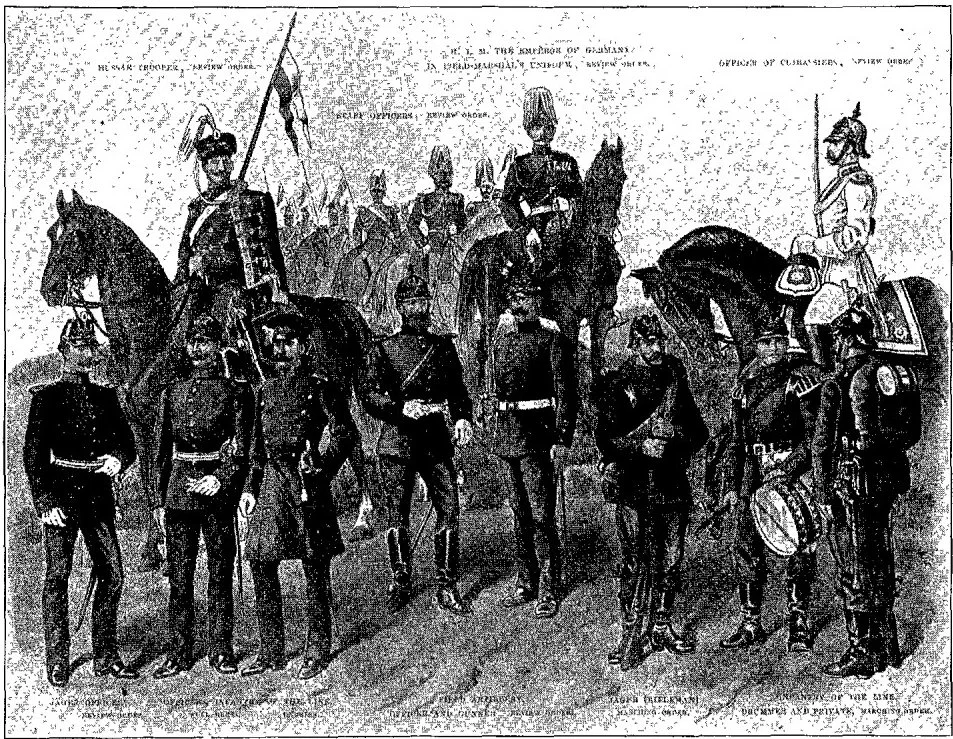
The “World Almanac for 1897” informs us that the armed force of the leading nations of Europe amounts to 18,550,946 men; and, in addition to these, 2,260,302 armed men from some of the lesser countries stand ready to be called to the battle-field in a moment. Think of it! Over twenty million men under arms in the Old World alone, without mentioning what is being done to prepare for war in the United States and other countries not included in the list. Perhaps it may be said that the standing army of the United States is insignificant, and that, therefore, there is no evidence of war here; but it is an open secret that this country is rapidly building up one of the best navies afloat, and nowhere are more of the big cannon manufactured than here. While the United States has not, as yet, established a very large standing army, she is drilling a strong militia in every State; and she believes that her resources are such that she could drill and call into action an immense army in a short time if it should become necessary.
But returning to the more than twenty million men under arms in the Old World, consider what it means. When such vast armies, equipped with the terrible weapons of modern warfare, are brought into action, who can estimate the awful results? In 1812, when Napoleon Bonaparte was at the height of his military power and glory, the records inform us that he “could count not far from four hundred and seventy-five thousand men ready for the field.” Napoleon was then preparing to invade Russia; and, speaking of his armies, he wrote to Davout, “I have never made greater preparations.” All Europe was then in arms against him, and stood in terror before his army of less than half a million men. The world has stood in awe as, in bewildered contemplation, it has viewed the military exploits of Napoleon, one of the greatest of all the military chieftains of the past. But suddenly turning the gaze from Napoleon and his time to our own day, how tamely insignificant seem the armies and equipments of those times, compared with what we see all about us now! And if half a million men, under skilful generals at that time, were the terror of civilized Europe, what will it be when the multiplied millions of men, armed with their modern death-dealing weapons, are urged on by “unclean spirits” to “the battle of that great day”?
Styles of the French Army. War-footing, 2,000,000.
No wonder that such unparalleled preparations for war should cause the Marquis of Salisbury, at the opening of the British Parliament, Jan. 19, 1897, to say: “What would you say is the great change which has passed over Europe since the older of us were young men?—It is this tremendous increase in the burdens which the necessity of self-defense has cast upon every nation of the world. That burden goes on getting higher and higher; a larger and larger part of the population is devoted to military service; more and more money has to be spent in the provision of the mechanical apparatus of war; and as the conquests of science are extended, not only are all previous efforts determined to be obsolete and have to be thrown away, and something new introduced in their place, but a larger and larger proportion of the public wealth has to be devoted to this unremunerative purpose. The burden has become so serious to many nations that many have thought that the day will come when nations will rather rush into war, and provoke a decision, once for all, than continue to groan under the suffering which modern necessity forces upon them.”—London Times, Jan. 20, 1897, page 6.

Neglecting the Holy Spirit's Knocking at the Heart

“We seek for the gold of Ophir, and search for the hidden treasures of earth, while we let the Holy Spirit knock at the door of our heart for admittance, and continue to remain indifferent to its pleadings. Rev. 3:20.”

THE JEWISH CREED.

1. I FIRMLY believe that God, blessed be his name forever, is the Creator and the Master of all things; and that everything was, is, and will be, made for him alone.
2. I firmly believe that this Creator of all things, blessed be his name forever, is One, by unity peculiar to himself, and that he alone has been, is, and will be, our God.
3. I firmly believe that this Creator, blessed be his name forever, is not corporeal; nor can in any manner whatsoever be conceived to be corporeal; and that there is nothing in the world that is like him.
4. I firmly believe that the Creator, blessed be his name forever, is eternal; and that he is the beginning and the end of all things.
5. I firmly believe that the Creator, blessed be his holy name forever, ought alone to be worshiped, exclusive of any other being.
6. I firmly believe that all the words of the prophets are true.
7. I firmly believe that all the prophecies of Moses our master (may his soul rest in peace!) are true; and that he is superior to all the sages who went before or come after him.
8. I firmly believe that the law which we now have in our hands was given by inspiration to Moses.
9. I firmly believe that this law will never be changed; and that the Creator, blessed be his holy name, will never give another.
10. I firmly believe that the Creator, blessed be his holy name, knows all the actions and all the thoughts of men; as it is said, “He hath formed the hearts of men, and is not ignorant of any of their works.”
11. I firmly believe that the Supreme Creator rewards those who keep his law, and punishes those who break it.
Styles of the German Army. War-footing, 1,492,104.
12. I firmly believe that the Messiah must come; and though his coming is delayed, I will always expect it till he does appear.
13. I firmly believe that the dead will rise at the time appointed by the Creator, whose name be blessed, and his glory magnified throughout all ages, to all eternity.—“Paths Eternal.”

POWER OF THE BIBLE OVER LIFE.

WHERE is a second book, uninspired by Scripture, that has demonstrated its inherent and unassisted energy to take hold of life, grapple with it, transform it, regenerate it, and lead it out into the likeness of the life of God? Only he who knows man could have made man a book. Only he that made all hearts could produce a book that should go to the wants of all hearts. “I see,” wrote Hallam, “that the Bible fits into every fold and crevice of the human heart. I am a man, and I believe that this is God’s book because it is man’s book.”— C. H. Parkhurst.

Education and the Gift of the Holy Spirit

“EDUCATION is necessary to the various professional callings of life, and to certain attainments in order to receive the approbation of men; but the Holy Spirit can be had ‘without money and without price’ (Isa. 55:1) by confessing and forsaking our sins. Prov. 28:13.”

Purifying the Body as a Temple of the Holy Spirit

“We arrange our homes for the entertainment of guests, and array ourselves in clean apparel for society, but are negligent to purify the body for the indwelling of the Holy Spirit.”

OUR LEADER.

“BEHOLD, when I am risen from the dead, I go before you into Galilee; I lead you still, as I have ever led; Where’er I go, I bid thee follow me.”
Thus spake the Master, ere he, crucified, Had finished up the work he came to do. The vile tribunal where the Just was tried Meanwhile assembled to condemn him too.
Lo, in the garden of Gethsemane He drank the cup of sorrow that must be; A thorn-crown pressed his brow on Calvary, Where he expired to pay the debt for me.
And shall I fail the Man of Galilee, Who trod the crimson wine-press all alone, That, crowned and glorified, I too might be An heir of glory near the shining throne?
My risen Master, I will follow thee. As thou hast borne my sins on Calvary, I’ll nail my follies to the cursed tree Where Christ my Saviour bled and died for me,
Sharp thorns and briers may beset my path, But there’s a voice which says, “This is the way.” It is the road that leads from flaming wrath Unto the regions of eternal day.
Should fierce winds blow, and raging storms arise, And troubles thwart my path along the way, Or cheering sunshine beam from fairest skies, Amid all changes, I will watch and pray.
Cheer up, my comrades; it will not be long Ere we shall stand on the eternal shore, And join the millions of the blood-washed throng Who songs of triumph sing forevermore. — A. B. Russell.

Jonah's Fish Story and the Missed Lesson

WE have always wished that those Phenician sailors had tied life-preservers on Jonah before they pitched him overboard. It would have saved later mankind from gawking and gaping and jeering like a lot of idiots over the fish-story, getting no further, and missing one of the most important books of revelation in the Old Testament. A person who will do that, you can set down as a specimen of arrested development.—Interior.
Continue reading: THE LORD'S WISH