The Youth’s Instructor, Vol. 47, No. 50.

THE STAR OF THE EAST

The Youth’s Instructor

Dec 21, 1899

Review and Herald Publishing Company · Battle Creek, Mich. · Dec 21, 1899

THE STAR OF THE EAST

The people sat in darkness deep, Nor sun nor star to shed the heavenly light; Over the hearts of men brooded the night, And souls were buried in Lethean sleep.
Hopeless, the people lay in bondage vile, Yearning for freedom from the chains of sin; Fear reigned without, and doubt and dread within; God veiled his face, and Love withheld her smile.
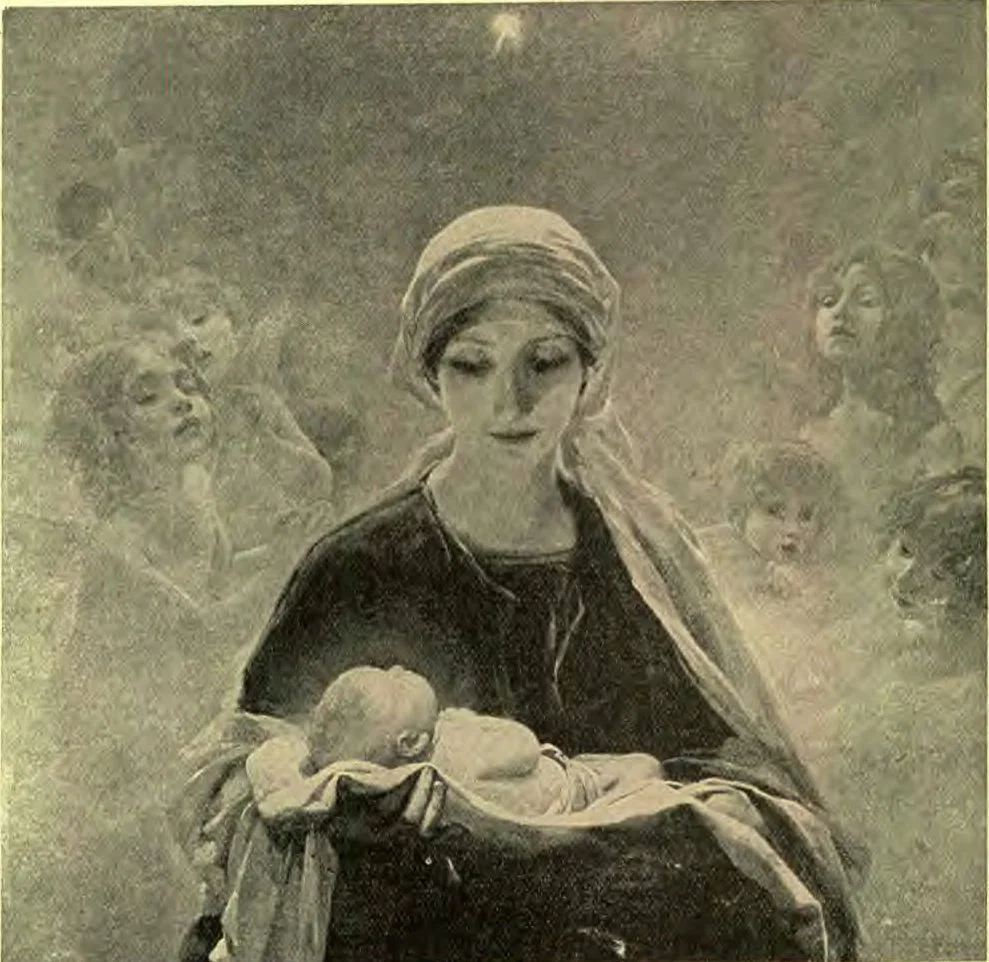
Then in the Eastern sky there flashed to birth A radiant Star. The expectant seer Greeted its rays with joy; for it was here To guide him to the Hope of the lost earth,— A helpless Babe — God's pledge of saving grace— Smiling into a human mother's face!
JAMES KNIGHT.
SMILING INTO A HUMAN MOTHER'S FACE.

GRANDMOTHER'S CHRISTMAS RENTER

“Marthy! do you suppose I ain't going to get my Christmas eve mission money out of my mission chamber this time? It'll be the first time in more than twenty years—oh, you are n't here, are you?—well——” and Grandmother Preston sat with folded hands a few minutes. Then she arose, and, going across the room, called, “Marthy!”
The call was stentorian and prolonged, shouted down the stovepipe hole. The reply was a merry, musical laugh, close at hand.
“Well, well, dearie! you are here, are n’t you? I guess you’d a heard me if you’d been deaf as a post. I thought you were never coming. Did you lock the door, and lay the fire, and put out the lamp, and send Janet and Jim to bed?”
“Yes, grandmother, every one of them; and I did something else.”
“I’ll warrant. You’re always doing things. But what is it now?”
“Guess!”
“Well, let me see,—something practical, or ornamental? ’broidery or painting? or——”
“Oh, it’s practical, and might possibly be ornamental.”
“You don’t say! What can it be? How long did it take you?”
“Twenty minutes, maybe.”
“Land sakes! that all? But you always were the greatest girl for doing things up smart. Well, I give it up,—no, I won’t, either. I don’t like to give up things. It isn’t a mark of good character. I never used to do it, and I don’t think I’ll begin now. I’ll sleep on it. Will that do, dearie?”
“Yes, it’ll do to sleep on and to wake on. Maybe you’ll guess it, though, while I’m bathing your feet and combing your hair.”
“Bathing the feet might wake me up to it, but combing my hair, you know, always puts me off to niddy-nodding. I’m ready for bed when that’s done. Get the Bible, dearie. We’ll see what the good Lord will send us to-night out of his word; and then we’ll ask him for the rest. You see we have a right to ask him for anything, provided we’re ready to be satisfied with his answer. You understand that, don’t you?”
“I try to, grandmother, but I’m afraid I want to make the answers as well as the prayers sometimes.”
“Of course you do, child; but that’s because you haven’t learned your lesson yet. But you’re learning. I’m not a mite worried about your understanding, in due time.”
“What shall I read, grandmother?”
“Let me see,—I think I’ll let you do the picking, this time.”
It was a fair young face that bent over the great old book, upon whose pages everywhere were the marks of use by more than one generation of devout but diligent hands. The face that had been so merry a few moments ago was thoughtful, earnest, and not a little perplexed, as, with a few quick movements of her fingers, Martha laid the book open at a certain place. She turned toward the old woman, who was sitting in a low, easy chair, waiting, with clasped hands and bowed head, for the words and tones that she loved the best; for to Grandmother Preston there was nothing that had fallen upon her ear for many a day so sweet as the sound of Martha’s voice. There had been other voices just as sweet in long-gone-by days, but she had lost them: some had been swallowed up in the roar of the great world, and many had been hushed in the silence of the grave.
“Grandmother!” The tone was very earnest, and full of inquiry.
“Yes, dearie. Can’t you find anything?”
“Oh, yes, lots; but I want to ask you something. You won’t think it’s strange, will you?”
“What if I do? If you have strange thoughts like everybody else, you’ll likely ask a strange question once in a while; but I guess I can get acquainted with it. Maybe I can recognize it as a grandchild to some of my own.”
“Oh, I think you are the darlingest old dear!” and the girl dropped lightly to her knees beside the old woman, and laid her arms tenderly about her neck. “You never, never—you always make everything so easy, so easy, for me. I wonder that I don’t always come right to you with everything, before it gets heavy.”
“Sure,—why not? Has something got heavy again?”
“Yes,” with a little sob. “The same old thing, though; only this time, you see, I can’t help wondering when your prayers are ever going to be answered, even if mine never are, and bring my father home. I would like to see him just once since I can remember.”
These disjointed parts of sentences were told off rapidly, Martha’s lips against her grandmother’s cheek. The old eyes had grown moist, but a smiling patience sat on the old lips as grandmother said: “Well, now, who knows just when, but the One who knows all things? He knows. I’ve waited longer than you have, child, and——”
“Don’t I know that?” interrupted the girl; “and that is one thing about it that bothers me,—that I should have been born here, and my mother die, and I be left for you to bring up to be so old, and all since any of us ever saw him; and I never,—my own father,—not even to know how he looks, nor he me; and you praying and trusting that promise in the Bible all this time——”
“What special promise is it to-night, dearie,—something you opened to?”
“I turned to it on purpose. It came to me all at once. You know what it is.”
“I dare say; but suppose you read it, just as you started to do.”
Martha arose and read, beginning with John, fourteenth chapter, fourteenth verse: “If ye shall ask anything in my name, I will do it.” As she read these words, she paused an instant, looking at her grandmother, her lips open to speak; but as she noticed the closed eyes and the absorbed expression, she returned to the reading, and went on to the end of the chapter.
“Oh, how good that is!” said grandmother; “how could anybody ask for any more than that? That is good enough for any Christmas eve. But what is your strange something you wanted to ask, dear?”
“Did n’t I ask it?”
“Nothing strange that I heard; that is, not to any poor human creature, nor to the angels by this time, I reckon. They have heard just such things before. When the promise gets so it isn’t any stranger to us than your question, we’ll begin to get answers. It was—let me see, you are eighteen and a half?”
“Yes, grandmother.”
“Well, it was nineteen years ago, to-morrow,—Christmas day,—that I saw my boy last. God knows,—I don’t,—and he cares. All the caring that I ever knew came out of his own loving bosom, and there’s any amount left where that came from—more than I could possibly lug around. I’ve left all the worrying to him this many a day. It’s safe, dearest. Trust your old grandmother to know that, if she does n’t know any more. Let us pray.”
They knelt, the old woman’s arm thrown like a wing over the bright head, which was laid with one cheek on the cushion of the chair, the other turned up toward the face which, if it was wrinkled and old, was yet, to the young eyes that saw in it a constant reflection of heaven, the sweetest face in all the world.
Just as the last words were uttered, there came the sound of a closing door, and movements about the room at the other end of the hall.
“I wonder,” began the grandmother.
“Well, you need n’t,” said Martha; “for——”
“Wait!—I’ve guessed it!—you rented that room;” and the grandmother laughed almost as merrily as Martha had at first.
“That’s it,” giving her a hug; “and the hall alcove, too; and here”—putting her hand into her pocket, and drawing out a purse—“is your money for the first week,—your Christmas eve money, all right. I was going to put it under your plate at breakfast if you didn’t guess the riddle before.”
“And yet right on top of that you wondered if prayer was answered?”
“There! I knew you would think it was strange. But, you see, that was n’t the prayer. We need a son and father more than that room rent.”
“‘My God shall supply all your need according to his riches in glory by Christ Jesus.’ He has sons and fathers to spare. Only let us be patient.”
“I will, grandmother. I almost am now, I think. I almost came to it while you were praying. And now, dear, I will get you ready for bed, as you used to say to me when I was the youngster of the family.”
They had settled down in their respective bedrooms very near each other, and were just dropping off to sleep, when the lifting of the window in the rented room, which squeaked as it went up, aroused them both, and they called each other in the same breath.
“Marthy!”
“Grandmother!”
“What is it, Marthy, a man or a woman?”
“A man.”
“Young or old?”
“Rather old, or tired, I don’t know which,—one of the heart-achy kind. I felt—oh, I don’t know how I felt, but I thought I’d like to have him comfortable, at least.”
“Jim was here to see him, I suppose, or Janet?”
“Jim showed him up, but had to go then. The man said he didn’t want anything but to be left alone.”
“Poor creature! The Lord be merciful to him. He wants air, I guess, by the sound of that window.”
“I guess so; he breathed like it. But if one asks the Lord to send a roomer, he has to take what comes, does n’t he, grandmother?”
“Yes, dear, and be thankful.”
“Well, I am. You’ve never yet missed Christmas eve rent for your missionary money, have you?”
“No, never.”
After that all was quiet until early in the morning, when the grandmother’s voice very carefully broke the stillness, with the soft call, “Marthy!” To which came the laughing reply, “Merry Christmas, grandmother.”
“The same to you, dear. You are awake, then?”
“What a funny question! Yes, I am awake! Are you?”
“I suppose that did sound funny, but the best laughing is made out of just such little slips in talking. Yes, thank you, I am awake; and I thought it would be a suitable thing to ask that poor old creature to have some breakfast when it’s ready; don’t you?”
“A very suitable thing for him,” laughed Martha, “and I presume he’d like it.”
“And we’ll ask him in to worship. Maybe it’ll do him good.”
“That’s just like you, and I’m glad you thought about it. I’ll hurry down and tell Janet, and ask her to turn on the steam and to send Jim up with some hot water. It’s c-o-o-o-ld! You will ask him down yourself?”
“Yes; he’s a representative, you know. If it were in the old Bethany days, and he were the old Bethany Guest, I should ask him down myself; so I will now, for he’s a wayfarer and a stranger.”
“I think that old fellah up there feels mighty bad ’bout somethin’. Not much merry in his Christmas,” said Jim, the colored boy, to Janet, his mother, as he came back to the kitchen after taking up the hot water. Martha overheard him from the dining-room, where she was laying little sprigs of holly over the table, and setting things in order generally.
“What makes you think that, Jim?” she asked.
“And what was he doing?” asked Janet, almost in the same breath; and Jim tried to answer both impartially.
“’Cause why? he looked awful down in the mouf, an’ never said nothin’, only sat staring at a photograph—looked like that one of old Mis’ Preston’s that was on the hall stand.”
“How did it get in there, then?” asked Janet. “What business has any roomer a staring at Mis’ Preston’s photograph?”
“I donno’ know nothin’ ’bout that. I only tol’ you what he was doin’ ’cause you asked.”
Martha stood still, with a branch of holly in her hand, while a tide of changing colors swept from lip to brow and back again. Her hands began to feel weak, and her knees to quiver.
She could not have put into words the language that was trying to utter itself within. She was more afraid than she had ever been in all her life. She stood thinking for a full minute, rooted to the spot, until an exclamation from Jim of, “Massy, Miss Marthy! how pale you look!” aroused her; and laying the holly branch down on the table, she turned, and went up to the suite of three rooms that, for companionship, she had always shared with her grandmother.
“Grandmother,” she began, “how long have we lived in this house?”
“Ever since the old homestead was taken by the railroad;—let me see, that was—you were about three months old, I remember; for you had just been put into short clothes. That would make it——”
“Well, then, he wouldn’t come here expecting to find us, would he?”
“What do you mean, child?”
“Jim says that the gentleman in there has got your photograph off the hall table, and is feeling all sorts over it. O grandmother! I am perfectly sure something is happening to us. Do you suppose——”
“Happening! don’t take the doings of God in vain that way. His good hand is about us, shaping things. Let us call it by the right name.”
“I will, and”—in a tone of awe—“I believe it’s the answer, grandmother. Go and find out, quick!”
But grandmother had already started, Martha following. When about half-way down the hall, she stopped, and returned. “Will you please call Jim?” she said. “I’ll send a message, just as I intended in the first place. ‘He that believeth shall not make haste,’ nor do anything unbecoming.”
When Martha returned with Jim, her grandmother handed her a note to read:—
We do not know your name; but as you are in the house with us, we wish you a happy day for the sake of our Lord, and invite you to take breakfast with us. I will call at your door at seven.
MRS. MERCY PRESTON, AND GRANDDAUGHTER, MARTHA KEYES PRESTON.
“That’s clear as a bell, grandmother. You always know just what to do. If it is he, he will understand perfectly.”
Mrs. Preston handed the note to Jim, saying, “You can wait outside for a reply,” and then sat down and waited, while Martha stood leaning over her shoulders.
In a very short “few minutes” the boy returned with a scrap of paper from a note-book, on which was written:—
Mother, daughter, may I come? YOUR PENITENT SON AND FATHER;
and the three met midway of the hall.
The story that followed, while it had a purpose to serve, is yet not worth telling again; but the lives of restitution, sacrifice, consecration, faith, and loving service for one another that followed, and that made the old house a home, were worth the living, proving that at least the Christ of the Christmas time, and his beautiful gift of himself, are real, even if the day is mythical. MRS. S. M. I. HENRY.

Missionary Giving Compared with Tobacco Spending

THE missionaries of the world receive less money in one year to save the world than the smokers of the United States burn up in one month; that is to say that while thirteen million dollars is given to send missionaries to foreign fields, the smokers burn up fifteen million dollars every month. What does this show?

THE CHILDREN'S OFFERING

THE wise may bring their learning, The rich may bring their wealth; And some may bring their greatness, And some bring strength and health. We, too, would bring our treasures To offer to the King: We have no wealth nor learning— What shall we children bring?
We'll bring him hearts that love him; We'll bring him thankful praise, And young souls meekly striving To walk in holy ways; And these shall be the treasures We offer to the King, And these are gifts that even The poorest child may bring.
— Selected.

MEASUREMENT AND PROPORTION

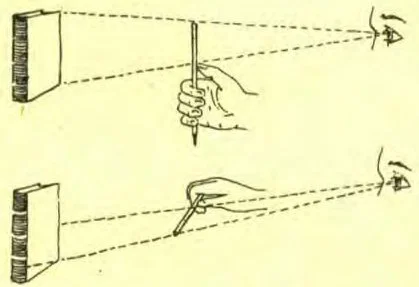
Something might be said here about measurement and apparent proportion. If you have ever visited an art school, you have perhaps noticed, with no little amusement, the students holding at arm’s length a pencil or ruler, and with one eye closed, apparently criticising the same intently.
If you will take a pencil and hold it out at arm’s length before you, closing one eye, that you may the more clearly see both the pencil and the object to be measured, you will see for yourself the use of this practice. Suppose you wish to draw the view you see from your window. There is a house in the distance, which appears smaller than another near by, and you wish to draw it so. But how much smaller? Perhaps you guess at it, and after drawing it, find that it is either too small or too large. This is where the pencil at arm’s length will help you.
Measure upon it the height of the house in the distance; then, still keeping your arm out, compare the height of the distant house with that of the nearer house. Perhaps it will be one and one-half times, perhaps four times, the height of the small house; but whatever it is, you know that this is the size of the smaller house, compared with that of the larger one; that is, in proportion to it. By comparing, in this way, the width of any object with its height, you can easily find the proportion.
By stepping back from the object, the amount of space taken on the pencil each way will be lessened; but the proportion will remain the same.
Be sure, in taking such measurements, to keep the arm always straight, as any deviation will make a corresponding variation in the measurements.
You should make a practice of measuring only until your eye is so trained that, unaided by measurements, you can draw objects in their correct proportion. An excellent way to obtain this training is to make a drawing without measurements, and then, by measuring, to note how closely its proportions compare with those of the object drawn.
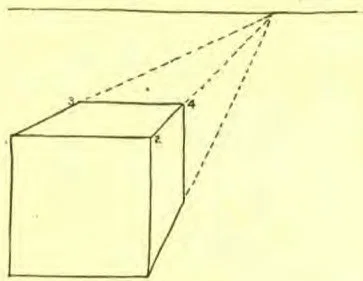
It will also be well to test, by measuring, what you learn by observation. For example, place in front of you a box or some other object having sides of equal length; then step back and a little to one side, so that both the top and one side can be seen. By measuring on your pencil the length of the box (the line marked 1 and 2 in the accompanying drawing), and comparing it with the line marked 3 and 4, you will see that line 1 and 2 is longer than line 3 and 4.
Compare the height, or the nearer side-line, with that of the farther side-line, and you will see that the nearer line is also longer than the farther line. Notice that none of the receding lines appear parallel, showing how, if the lines were carried on, they would meet at a point opposite the eye.
When we are drawing, we must realize that the direction of our retreating lines is to be the same as those we see before us, and that just as the lines in a block or road retreat toward an imaginary line, so on our paper they must retreat toward an imaginary line.
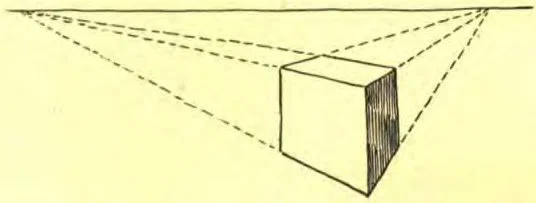
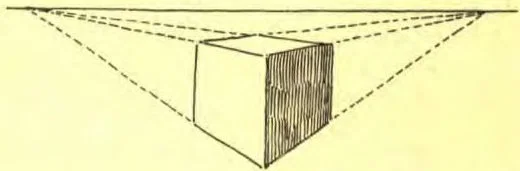
If we take our box, and turn it so one corner will be facing us, there will then be two sets of lines vanishing toward two different points on the imaginary horizon line; and according to the extent the block is turned, so is the distance of these points on the horizon line, as shown in the accompanying drawings. Such drawings as these, or any enlarged forms, such as street corners or angles of houses, are said to be in “two-point perspective.”
PEDRO LEMOS.

“TEMPTED IN ALL POINTS LIKE AS WE ARE”

I
As Christ’s ministry was about to begin, he received baptism at the hands of John. Coming up out of the water, he bowed on the banks of the Jordan, and offered to the Father such a prayer as heaven had never before listened to. That prayer penetrated the shadow of Satan, which surrounded the Saviour, and cleaved its way to the throne of God. The heavens were opened, and a dove, in appearance like burnished gold, rested upon Jesus; and from the lips of the Infinite God were heard the words, “This is my beloved Son, in whom I am well pleased.”
This visible answer to the prayer of God’s Son is of deep significance to us. It assures us that humanity is accepted in Christ. The repenting cry of every sinner, the petition of every believing soul, will be heard, and the suppliant will receive grace and power. Christ has opened the way to the highest heavens for every bereaved heart. All may find rest and peace and assurance in sending their prayers to God in the name of his dear Son. As the heavens were open to Christ’s prayer, so they will be opened to our prayers. The Holy Spirit will come to every son and daughter of Adam who looks to God for strength.
From the Jordan, Jesus was led into the wilderness of temptation. “And when he had fasted forty days and forty nights, he was afterward an hungered. And when the tempter came to him, he said, If thou be the Son of God, command that these stones be made bread.”
Christ was suffering the keenest pangs of hunger, and this temptation was a severe one. But he must begin the work of redemption just where the ruin began. Adam had failed on the point of appetite, and Christ must conquer here. The power that rested upon him came directly from the Father, and he must not exercise it in his own behalf. With that long fast there was woven into his experience a strength and power that God alone could give. He met and resisted the enemy in the strength of a “Thus saith the Lord.” “Man shall not live by bread alone,” he said, “but by every word that proceedeth out of the mouth of God.”
This strength it is the privilege of all the tempted ones of earth to have. Christ’s experience is for our benefit. His example in overcoming appetite points out the way for those to overcome who would be his followers.
Christ was suffering as the members of the human family suffer under temptation; but it was not the will of God that he should exercise his divine power in his own behalf. Had he not stood as our representative, Christ’s innocence would have exempted him from all this anguish; but it was because of his innocence that he felt so keenly the assaults of Satan. All the suffering that is the result of sin was poured into the bosom of the sinless Son of God. Satan was bruising the heel of Christ; but every pang endured by Christ, every grief, every disquietude, was fulfilling the great plan of man’s redemption. Every blow inflicted by the enemy was rebounding on himself. Christ was bruising the serpent’s head.
Satan had been defeated in the first temptation. He next took Christ to the pinnacle of the temple at Jerusalem, and asked him to prove his sonship to God by throwing himself down from the dizzy height. “If thou be the Son of God,” he said, “cast thyself down: for it is written, He shall give his angels charge concerning thee: and in their hands they shall bear thee up, lest at any time thou dash thy foot against a stone.” But to do this would be presumption on the part of Christ, and he would not yield. “It is written,” he replied, “thou shalt not tempt the Lord thy God.” Again the tempter was baffled. Christ was victor still.
Presumption is a common temptation, and when Satan assails men with this, he gains the victory almost every time. Those who claim to be enlisted in the warfare against evil frequently plunge without thought into temptation from which it would require a miracle to bring them forth unsullied. God’s precious promises are not given to strengthen us in a presumptuous course, or to rely upon when we rush needlessly into danger. The Lord requires us to move with a humble dependence upon his guidance. “It is not in a man that walketh to direct his steps.” In God is our prosperity and our life. Nothing can be done prosperously without his permission and his blessing. “Commit thy way unto the Lord; trust also in him; and he shall bring it to pass.” As children of God, we are to maintain a consistent Christian character.
While you pray, dear youth, that you may not be led into temptation, remember that your work does not end with prayer. As far as possible you must answer your own prayers by resisting temptation. Ask Jesus to do for you that which you can not do for yourself. With God’s word for our guide, and Jesus for our teacher, we need not be ignorant of God’s requirements or of Satan’s devices.
“Again, the devil taketh him up into an exceeding high mountain, and showeth him all the kingdoms of the world, and the glory of them; and saith unto him, All these things will I give thee, if thou wilt fall down and worship me.” Then divinity flashed through humanity. “Get thee hence, Satan,” Christ said; “for it is written, Thou shalt worship the Lord thy God, and him only shalt thou serve.” Satan did not then present another temptation. He left the presence of Christ a conquered foe.
MRS. E. G. WHITE.

Give as You Would to the Master

“Give as you would if an angel Awaited your gift at the door; Give as you would if to-morrow Found you where waiting is o’er; Give as you would to the Master If you met his searching look; Give as you would of your substance If his hand your offering took.”

BEREAN LIBRARY STUDY

Dan. 2:40-49; “Thoughts on Daniel,” pages 56-77
THE regular Outline of these studies is published in the Review and Herald and also in the Missionary Magazine. What is here given is only supplementary, and should be studied in connection with the Outline.

NOTES ON LESSON 4

  • (December 24-30)*
1. “Write the Vision.”—No doubt most of the INSTRUCTOR readers are familiar with the prophetic chart, which has been so extensively used by Seventh-day Adventists in presenting the prophecies of Daniel. Hab. 2:2, 3, gives this instruction: “Write the vision, and make it plain upon tables, that he may run that readeth it. For the vision is yet for an appointed time, but at the end it shall speak, and not lie: though it tarry, wait for it; because it will surely come, it will not tarry.” Elder J. N. Loughborough, in “Rise and Progress,” page 29, says of this text: “Those who gave the Advent proclamation claimed that this ‘vision,’ with its ‘appointed’ time, included the visions of the prophecy of Daniel. This they made so plain in their delineations of it upon their prophetic charts, that he who read the interpretation could indeed ‘run,’ and impart information to others.” The first chart was published by J. V. Himes, and a few of these highly prized relics are still extant. The chart was so large that two stones were required in making it, the chart being made in two pieces and glued together. Thus the statement that the vision should be written upon “tables” was literally fulfilled.
2. An Ancient “Ovation.”—After the death of Alexander, the countries over which he ruled were finally reduced to four separate kingdoms,—Egypt, Syria, Thrace, Macedonia. Gradually, but surely, these kingdoms were brought under the dominion of Rome. After a signal victory, which virtually put an end to the Macedonian monarchy, B. C. 168, Paulus, the conquering general, returned to Rome, where his victory was celebrated. The following description by Ridpath will be of interest, as it gives an excellent idea of the honors accorded military heroes in those days: “Returning to Rome, Paulus was honored with a magnificent triumph. . . . Three days were required for the completion of the procession. During the first, two hundred and fifty vehicles, laden with the magnificent art treasures of Greece,—paintings, sculptures, bronzes,—passed along the Sacred Way, and were exhibited to the thousands. On the second day, the splendid arms and other military trophies of which the Macedonians had been despoiled, headed the procession. After these came three thousand men, carrying the silver coin and vessels which had been captured from the enemy. On the third morning, the procession was preceded by the animals intended for the sacrifice, and then were borne along the treasures of gold which ages of war had heaped together at the court of Macedon. After this display came the royal chariot of Perseus (the captured king), his armor, and his crown. Then followed on foot the king himself, and his children and servants,—a pitiable spectacle of wretchedness and despair. . . . Then came Paulus himself, seated in his chariot of war, . . . and carrying the laurel branch of triumph. Finally, the rear of the procession was occupied by the army, bearing the emblems of victory, singing battle songs; . . . and the festival was then concluded with a sacrifice of animals on the hill of the Capitol.”
3. Soldier Boys Are Wanted.—To show that the same spirit of hero-worship here portrayed is manifest to-day, we have only to refer to the recent demonstration in New York City in honor of the “hero of Manila.” The effect of a nation’s extending honor, almost to the point of worship, to a man because of his achievements in battle, is to cause the boys of that nation to choose above all else to be soldiers, that the possibility of such honor may be theirs. Yes, boys, soldiers are needed, and the work is most desirable. But the fight is not against “flesh and blood,” but against “the rulers of the darkness of this world.” The Captain furnishes the armor; put it on. There are a breastplate, a shield, a helmet, and a sword all ready for you. See Eph. 6:11-16. If you are provided with these, the fiery darts of the enemy will have no effect upon you. You must be prepared to “endure hardness as a good soldier,” and “war a good warfare;” and just as surely as you continue in the service until the end, the crown of the victorious will be yours. Read all the promises that are made to the “overcomer;” then strive for the reward that does not perish.
4. Will the World Be Converted before Christ Shall Come?—Many people really believe so. Some think that the kingdom represented by the stone that smote the image upon the feet, will absorb the material of the image, until it fills the whole earth. Read carefully Dan. 2:34, 35, 44, 45, and determine for yourself whether the process described is a gradual conversion of the world, or a sudden destruction. For texts which clearly set forth the condition of the people before Christ comes, read 2 Tim. 3:1, 12; Luke 17:26-30; 2 Thess. 1:7-10; Matt. 13:24-30, 36-43.
5. Where Are We To-Day?—For over fourteen hundred years the image of Daniel 2 has been developed, in the history of the world. We are still “in the days of these kings;” and the next event in this line of prophecy is the setting up of the kingdom of God.
Continue reading: THE FIELD