1. The Basis of Study.—Read “Experiences in Barbados,” “Leaves from My Diary,” and “Samoa,” pages 491, 499, and 503 of the Missionary Magazine, November number. Questions on these articles will be found in the December Magazine and in the Review and Herald of December 19. We would still encourage those having access to these publications to follow the instructions suggested. That “knowledge is power” is just as true of missionary work as of any other.
2. Our Ship Missionaries (Missionary Magazine, page 491).—The promise, “Cast thy bread upon the waters: for thou shalt find it after many days,” seems literally applicable to ship missionary work. Such efforts are now in operation in the harbors at Hongkong, China; Port Said, Egypt; Hamburg, Germany; Helsingfors, Finland; Liverpool, England; Barbados, West Indies; and New York. We have two ships devoted wholly to this work,—the “Herold,” in Hamburg, and the “Sentinel,” in New York.
3. What This Work Means.—From Hongkong: “A young German sailor aboard the United States cruiser — has accepted all the truth. I do not know that I ever saw a greater turning from darkness to light than in his case. While the ship was in port here, we had some interesting experiences. For a time after it left, I received letters from him regularly. He had only fourteen months more in the service, and then desired to devote himself to the Lord’s work.” From Liverpool: “An intelligent Japanese sailor, a student of the Nautical College, on the eve of returning to Japan, has shown a deep interest to know more of the Bible. He spent two days here, and might be seen studying the Bible far into the night. He gave me his Japanese Bible, which he had carried twice around the world. After going to Glasgow, he wrote: ‘I desire to thank you most cordially for your care and attention to me. As I return to my native land, I will carry the reading-matter you gave me, and distribute it among my friends. I can find no word to thank you, only to follow your kind advice with all my heart.’” And so the seed is scattered. Eternity will reveal the result.
4. Barbados (Missionary Magazine, page 491).—This is one of the most beautiful spots in the West Indies. It belongs to Great Britain, and is sometimes called “Little England;” for with an area of one hundred and sixty square miles, it gives a home to one hundred and eighty-five thousand persons, more than eleven hundred to the square mile. The population is so dense that although our work began ten years ago, it has not covered much territory. During the last three years a minister has been working here, and more has been accomplished. There is one organized church. One of the most pressing needs is a commodious house of worship.
5. The People.—About ten per cent are white. There are but two classes, the rich and the poor. The elegance of some homes, as compared with the poverty of others, is a good index to the condition of the people. Common labor is looked upon as a disgrace. Small wages are paid to all workers. After the dreadful storm of about a year ago, carpenters and masons were getting sixty cents a day; bookkeepers and clerks from nine to thirty dollars a month. Farm laborers were employed for nine cents a day.
6. Educational Advantages.—A large number of elementary schools are in operation, also many higher schools, all under the control of the Church of England. There are a number of private and church schools, also a college for boys, which was founded almost two hundred years ago. Children, however, seem to make slow progress, except in wickedness. It has been said that Barbados surpasses any other seaport in wickedness. But amid the rubbish, jewels are being found.
7. The Samoan Islands and the United States (Missionary Magazine, page 499).—The arrangement for the disposition of the Samoan Islands in the South Pacific Ocean, recently entered into by the governments of the three protecting powers, which only awaits ratification by the Senate to become final, settles a question that has been open for twenty-five years. We are indebted to the Independent of November 30 for the following facts concerning this arrangement: The share which falls to the United States is Manua and Tutuila. As early as 1878 a treaty was signed which gave “our vessels the privilege of entering and using the port of Pago Pago, on the latter island, and establishing there a station for coal and other naval supplies for their naval and commercial marine.” Commercially, these islands are unimportant, but their location makes them of value from a naval point of view. Lying, as they do, in the course of vessels from San Francisco to Auckland, from Panama to Sydney, and from Valparaiso to China and Japan, and being outside the hurricane tract, these islands are the key to the Samoan group, which, in turn, is the key to Central Polynesia. The population of the entire group scarcely exceeds thirty-five thousand persons, although the islands cover an area of eleven hundred and twenty-five square miles. The two in which the United States is interested contain about five thousand persons.
8. The First Missionary Work in the Samoan Islands is so interesting that we have reserved it for an article for this department next week. We would recommend to our young people the book “Missionary Enterprises in the South Sea Islands,” by John Williams.
WHERE DO THE BUTTERFLIES GO?
By Ethel Terry Reeder
“Mama, where have the butterflies gone? Do they go away to the South, where it is warm, when the cold weather comes, as the birds do?”
Nell had been standing at the window, watching the first snowflakes of the season as they floated down, and covered the sear brown leaves scattered over the lawn; but now she turned from the window, and sat down on an ottoman at her mother's feet.
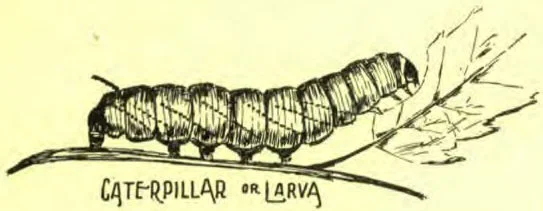
CATERPILLAR or LARVA
“No; the butterflies do not go away to spend the winter; for they, like most other insects, have lived as long as nature intended, and die before the winter really begins.”
“Where do the next year's butterflies come from, then?”
“That is an interesting question, Nell. Do you remember that big green caterpillar we put in a fruit jar early last fall?”
“Yes, and we filled the jar about half full of earth, and tied a piece of mosquito-netting over its mouth, to keep the caterpillar from getting out; but one morning when I went to give it some fresh leaves, it was gone, and you said to let the jar alone, and sometime we would see what we could find in the jar.”
“Well, suppose you bring it here, and we will see if we can find any trace of Mr. Caterpillar. Now spread a newspaper out on the floor, and empty the earth out on that. What do you find?”
CHRYSALIS
“Nothing but some lumps of earth. Oh, yes! here is a queer-looking brown thing. What is it?”
“That is the Mr. Caterpillar of last year, and the Mr. Butterfly of next year.”
“A caterpillar and a butterfly both? How can that be?”
“It does seem strange, and yet it is simple, too, when you understand it. During her short life each female butterfly deposits, in some suitable place, a large number of tiny white or yellow eggs. It is not long before these eggs burst, and send out a swarm, not of little butterflies, but of tiny, crawling, hairy things, which you would no doubt call worms, but which scientific men call ‘insect larvæ.’ Some day we will talk about the real worms, and then you will understand the difference better.”
“For lack of a better name we will call these little creatures insect-worms; but we must be sure to remember that they are not real worms, and that we use this name only because it is convenient.”
“But what becomes of these little insect-worms? and how do they get to be butterflies?”
“As soon as they come from the eggs, they go to eating as if to eat was the one thing worth doing. Sometimes when they find a tender plant just to their liking, they do not leave it until nothing is left of it but the woody stems. The result of this great appetite is that the little insect-worms grow very fast. In many species, the larvæ grow so fast that it becomes necessary for them to change their skin more than once during their short life in the larval state. When one of these insect-worms has grown to its full size, it stops eating, crawls away to some quiet spot, and goes through a wonderful change. If you leave the place for a while, and then go back, you will not find the lively creature you left, but a lifeless looking object like this one you found in the jar. This stage of the caterpillar's life is known as the ‘chrysalis state;’ and the particular form the insect takes in this stage depends upon the kind of insect. Some spin themselves beautiful silk houses; others fold leaves about them; others like the one we are keeping, go into the ground. It would be interesting for you to see how many different varieties you can find, and make a collection of them.
“After the insect has been asleep in its curious little house as long as Mother Nature thinks necessary, she helps it make itself a door; and out steps—not a caterpillar—but a butterfly, just like the one that laid the eggs from which the little insect-worms came in the first place. However, when this chrysalis opens, it will not be a true butterfly, but a great soft-winged moth, that will come out. Moths and butterflies are near relatives, and their habits are very much alike. This is one of the great hawk-moths, which you have often seen hovering over a bed of flowers in the summer evenings, and which are sometimes mistaken for humming-birds as they flutter above some flower, and draw their food from it by means of their long tongues.”
Nell picked the queer brown thing up in her fingers, and looked at it with wondering eyes. “First an egg, then a worm,—”
“Insect-worm,” corrected Mrs. Dean.
“An insect-worm,” went on Nell, “then a chrysalis, and then a butterfly, or a beautiful moth! It’s more wonderful than a fairy story.”
“And this is only one of the many wonderful stories that nature will tell you if you are a good listener, and keep your eyes open,” answered Mrs. Dean, as she replaced the earth in the jar, with the brown lump that would some day open to release the beautiful hawk-moth.
ETHEL TERRY REEDER.
THE TREE THAT MENDED ITSELF
It was a beautiful Russian mulberry tree, with long, slender branches and glossy leaves. It stood close to the house, and bore large quantities of delicious fruit. But the house burned, and the poor tree was scorched. For several years we thought it would die; yet it struggled on, and made a brave fight for life.
It lost many of its lovely branches; but each side of the scorched places it sent out a growth of new wood, that as far as possible, spread over them. It threw out new branches, and sent new roots down into the rich earth to search for life and moisture. Now it looks like a new tree; we hardly know it for the sadly scorched one.
It has done the best it could. It has looked to heaven for help from the bright sunshine, cooling dew, and refreshing rain. But the scars are there; it can not cover them. As long as it lives, it will be a patched tree.
It makes me think of sinful young men and women. They, too, have been scorched by the fire. Beautiful branches, bright leaves, precious fruit, life-giving roots, are all lost. Death is before them unless the mending process is begun. Like the tree, they must look to heaven for help, must give themselves up to the renewing process of divine grace. The scorched places must be covered with new growth; the old burned branches must be thrown off, and new ones take their place. New roots must be sent down, down, to the deep fountains that flow from the Saviour’s side.
Human lives can be mended, but there is only one way. We must turn, if we would live. We must be covered with the righteousness of Christ; we must work the works of God.—The Young Pilgrim.
A JAPANESE STUDENT
By R. W. Munson
The Anglo-Chinese school at Singapore, of which the writer was principal for several years, and in which he taught from 1887 to 1892, was opened in 1885, in a small house in an obscure corner of the city. It has rapidly extended its borders until it is now the leading school of the colony, and has property valued at forty thousand dollars, and nearly six hundred pupils, mostly Chinese. Among these is a sprinkling of Malays, Japanese, Eurasians, and Europeans.
One young Japanese who came to Singapore to work in one of the Japanese stores, was enabled to attend school, and entered our classes. He was an intelligent young man, with a good mind and no small degree of ambition. He made rapid progress, and in a short time stood at the head of his class in all subjects. He was promoted in advance of the class, and at the time of our departure from Singapore in 1896 was in the highest department of the institution. During this time he was converted through the labors and influence of one of the teachers, Brother Wm. E. Horley, who is a true missionary, and succeeded in winning the hearts of many boys. I baptized him in 1894, and from the latest information received learned that he was still in the institution.
He was abreast of the times; for he possessed a kodak, and was able not only to take pictures but also to develop them. Further than this, he offered to teach the Chinese boys how to manipulate the camera, on consideration of a small payment for his services; and in this way he was able to earn a considerable sum of money.
He entered heartily into every form of Christian work, and was always willing to accompany us in street meetings, to serve on the hospital visitation committee, or do anything that he could to help on the cause of Christ. I wish he might be introduced in person to the readers of the INSTRUCTOR; for if you could see him, and converse with him, you would quickly come to regard him with the highest degree of respect and Christian affection.
People in this part of the world, who do not read much, or study the missionary work, have strange ideas concerning the character of Oriental races. Because they are Buddhists, or Mohammedans, or Hindus, does not prove that they are for that reason unintelligent or wanting in the qualities of true manhood. The term “heathen,” in the minds of Western peoples, has come to be a synonym for ignorance and degradation. This is a serious error. The Japanese are intellectually among the most alert of all the races of mankind; and the astonishing facility with which they have taken on Eastern thought and civilization is a standing marvel to the newcomer in the Land of the Rising Sun. R. W. MUNSON,
EDWARD
By Elizabeth Tilley
My earliest remembrance of Edward is that of the day when he first came to do odd jobs around our house. He was then a thin, small, ragged, underfed, cross-eyed child of ten years. Some squints have an effect of moral obliquity, as if the owner were slyly avoiding your eye; Edward’s was a straightforward, honest deformity, that added to the general air of simplicity and helplessness that distinguished him. We took him just because he was so helpless, and because something had to be done with him. His mother had been left with seven small children to support, and no visible resources.
Now, it is not right for children under twelve to work, of course; but what else can be done in such cases? Edward’s two elder sisters went to the mill; and Edward, being too pitifully small even for that, started out to find a living somehow, on the streets. He carried papers, he ran errands, he helped market people with their baskets, and, twice a week, he came to our house to do any odds and ends of work we might have for him. There wasn’t much that he could do, except wash the pavement and clean the knives; and he was further complicated by his eight-year-old brother Jim, whom he seemed always to have in charge, and who was a lively and unruly child. If it had been anybody else but Edward, the experiment would not have lasted a week; but before that first week was up, we had learned that there were peculiar reasons for being patient with the little fellow, and peculiar virtues in him to admire, which balanced any objections. To be poor, sickly, and stunted is handicap enough in the race of life; but Edward was more heavily weighted still. I hesitate to say that he was half-witted; because, like a squint, that seems to carry moral obliquity along with it. Rather, he was curiously limited in his intelligence, but unfalteringly conscientious.
For instance, he was instructed to wash the pavement once a week, and his sentiment of duty was so strong, and so unchecked by any mental perceptions, that he would go out cheerfully under a drenching rain, and work away at the sidewalk with his bucket and broom. And when my mother called him in, and reproved him, he would look so confused, and say, so falteringly, “I didn’t know it was wrong, ma’am!” that the reproof stopped at once. We finally arranged that he should not do the pavement without previous notice from the cook (who knew fine weather when she saw it); and after that he worked as happily as possible, Jim playing away alongside under the fraternal eye. Whenever one of the household went by the two children, Edward always straightened up and took off his cap, and admonished Jim to do the same. Where he picked up his manners no one knew; but he evidently had a severe code of his own, for he always insisted on shaking hands with a new cook or housemaid, much to her astonishment.
This home experience with Edward did not last long, for his sisters got him a place at the mill when he was not quite twelve. From this time he worked steadily till he was fifteen, and then his mother tried to apprentice him to a trade. It is a hard thing for a lad without father or friends to get into the overcrowded, jealously guarded trades; and it was a year before the boy had his chance. And then— poor little patient worker!—after six months’ apprenticeship, he was told that he could not go any further. The “boss” was not a hard man; he was impressed, indeed, with Edward’s perseverance and simplicity; and he came himself to see the mother, and tell her the truth. Edward could not remember more than one machine, one kind of tool, at a time; and when he went on to another, he forgot how to use previous tools and machines, and spoiled the work. The real reason was never told to the boy himself; the “boss” agreed with his mother to make lack of bodily strength the pretext for dismissing him. His self-respect was not hurt; but he went sadly back to the mill. I never heard him complain except once, just after this, when he told me, gravely, that he liked the work at the shop so much better than mill work, because it “occupied his mind more.”
With all this plentiful lack of intelligence, he yet could read after a fashion, and write a plain, round hand; and he had a great fondness for music. His first savings went toward a violin; but the family was still so poor that all the money was needed at home, and, after the precious violin was bought, it was a year or so before he could again save enough to take a few lessons upon it. He did not learn very easily, but was infinitely patient; and night after night he practiced delightedly on his poor little instrument.
“Edward ain’t like most boys; he never runs at night,” said his mother, “jest stays in, ’nd plays his fiddle till bedtime. He’s the best child I’ve got, if he ain’t very bright.” This was her euphemism to express her son’s limitations. But as her own horizon was not large, and she had much besides to trouble her, the familiar fact of Edward’s mental drawbacks might well be forgotten. Jim had grown up “wild,”—not brutally so, but unreliable and drunken,—and the poverty of the household was great; for Edward and one sister were the only steady workers. Besides that, it seemed as if the mother was becoming discouraged by her wayward children, and as if moral misery and degradation were creeping steadily into the household.
Edward was then about eighteen. He had been in my Sunday-school class for a year or so; and, though I had taught the gospel to him as to the others, I had always doubted whether he really understood anything of it. I had views, then, on the intellectuality of faith, and these bright young lads of mine were all so different from Edward that I can not say I thought much about him in teaching the lessons. He listened with the most dignified attention; but I never liked to ask him questions, for I knew he could not answer them, and I did not wish to embarrass him before the class. We were having special services for the school that year, and I urged the class, as a whole, to attend. I was rather surprised, however, to see Edward coming to meeting after meeting; and I could hardly understand it when, after a week or two, I found that the lesson, one Sunday, affected and interested him very much. I am ashamed to say that I hesitated about speaking to him after the session was over. His limitations, his surroundings, the pitiful inadequacy of his life, were opposed to all my ideas concerning strong, intellectual, powerful Christianity. I hesitated; but my heart, I am thankful to say, got the better of me, and I was glad that it had when I heard his quick response to my somewhat embarrassed questioning.
“Yes, Miss Ella, I’ve been trying to do what God says a long while. Do you think I could be a Christian, Miss Ella? Because I’d like to say I was a Christian, before people, if I could be one.”
That was about all he knew. We tried not to confuse nor discourage him, and asked him only necessary questions. He went before the elders of the church, a little timidly, but sure it was all right, since I told him to go; and he seemed, to them, to know what he was doing. Still, I felt a trifle nervous when he was baptized, and made his confession of faith. I thought of that miserable, unhappy home of his, and the total lack of helpful influence587around him, and the weakness of the lad himself; and I wondered if he truly understood what it means to be a Christian.
I found out very soon. Three of my scholars joined the church at that time. The other two were ordinary, intelligent lads. Their religion was also ordinary—real, but negative. In Edward, the church had gained a member of a different stamp. He began at once, toilsome as it was to his half-educated eye and brain, to read his Bible. Even his beloved violin was neglected. Week after week, in the class, he began to answer Bible questions and to quote Bible verses. He didn’t always get them right, and he couldn’t always read the lesson straight; but beside the halting, imperfect mind one could see the soul growing up, straight and strong. It was like a miracle; it opened all our eyes to the divine possibilities of the gospel. Edward was utterly unconscious of himself or of us; he only desired to know more of the only book he could understand. His straightforward simplicity shamed us all. The bright boy of the class (who had rather pitied him) was moved to do what he had never done before,—read the Bible,—for “I’m ashamed to let Ned get ahead of me,” he said. And when Edward read aloud, stumblingly, in his turn, there never was so much as a smile. Mistakes, however, were rare; and he literally read his Bible until he knew how it ought to be read, and learned many verses by heart.
The first effect of the gospel upon such a transparent, child-like soul was to illuminate it; the next, to shine through it to others. He began to bring his brother to the services. How he did it no one knew; nobody else had any influence whatever over Jim. But Edward soon brought him regularly, and looked so happy as he ushered him in, that everybody sympathized. And the faithful love had its reward; Jim, repentant and sincere, came before the elders of the church to confess his faith. When he was asked the manner of his conversion, his simple answer, “It was my brother, sir,” touched every heart that heard. I think Jim would have slipped and fallen out of the fellowship of the church, once and again, afterward, but for that simple faith and love that flowed unfalteringly from his brother toward him, and kept him steady through his temptations till he turned out a manly Christian after all.
When Jim joined the church, Edward began to hold family worship, and that humble service, with its faltering prayers, its childish, reverent reading, was a lesson that settled my intellectual theory of Christianity once and for all. The gospel entered into that poor house with its full power and blessing. A wayward sister learned that a new life might be hers, as Edward sought out the promises for her in his little Bible. He brought her to the church, and she was welcomed into it. Then his mother came, then another sister, till all, except the younger children, were gathered in. And every one of them, when questioned, had the same answer, “It was Ned who made me want to be a Christian.” After his own people came a fellow worker in the mill; then a friend of Jim’s, and so on. Wherever his life touched another’s, there his influence began. His speech was halting, his mind weak; the cup was small, but the gospel overflowed from it. His simple Christianity was so loving and comprehensive that it was a message to everybody. You couldn’t evade it; you couldn’t argue with him; he had no opinions of his own, and no words except the words of the Bible.
As time went on, and he learned more about his one Book, it became an education to him, and reacted on his mind; so that I could see that he really thought more, and was able to reason about elementary, every-day matters.
The Sunday-school superintendent one day spoke to the school of having heard a well-known hymn whistled in the streets of a foreign city once, and how it cheered him, and added: “I love to hear the music of a hymn floating out among the sounds of business and the noise of the world. It does every heart good that hears it. Whistle the old hymns, boys!”
That was enough for Edward. One of my scholars, who was a clerk in the mill offices, told me next Sunday that Edward had whistled “Rock of Ages” hour after hour all the week long, and couldn’t be induced to stop. And once, when some tracts were handed him for distribution, he wasn’t content with giving one to each fellow workman, but went straight to his employer, and gave him one, too. I quaked when I heard that; for the employer was not a man to whom I should have liked to offer a tract. However, no evil result followed. And a month later, Edward’s wages were raised.
I am glad to say, indeed, that Edward’s days of hunger and forlornness are in the past. This year has been a happy and important one for him. The family has moved into a new house, and Jim and three girls are working steadily; so that Edward could afford, without extravagance, to give his mother, out of his wages, a rocking-chair and a picture for the parlor as her Christmas gift. He has a new violin, and has become a prominent member of the Sunday-school choir; for he plays his beloved instrument correctly and well. Best of all to him, he has been asked to lead the Christian Endeavor meetings in his turn. The clergyman said he knew no one in the church more fit than Edward for such a duty. And if you could hear his short prayers, all in the words of Scripture, and yet coherent in petitions and their praise; if you could see the simple reverence and dignity with which he presides over the little meeting, you would, I am sure, agree with the minister.
Edward always refreshes me. He always helps me. When I get worried over a theological tangle, I think of his simplicity; and I remember that theology isn’t essential to salvation or everyday usefulness. When people lament over the decline of the gospel, I think of this living example in which it has brought forth, with such thoroughness, every fruit that can be desired. When I become lazy, I look at Edward, with his infinitesimal powers, going on cheerfully, and “bringing forth an hundred-fold,” and I am shamed into activity. And in the hope that Edward may do some one who reads this a small part of the good he has done me, I write this inadequate history of him, which has only the one merit of being absolutely true.—Elizabeth Tilley, in Independent.
A PARABLE
Two crossed the ocean together,
One willing and one loth;
The chances of the weather
Befell the same to both.
The selfsame vessel bore them,
They there were like bestead:
The selfsame port before them,
They thither like were sped.
One took his fortune cheerly,
Hoping and trusting still;
The other ever drearly
Foreboded something ill:
Both reached the haven whither
They both set out to sail;
But of his voyage thither
Each told a different tale!
—Independent.
JUDAS THE TRAITOR, AND THE PREPARATION FOR THE PASSOVER
SABBATH-SCHOOL LESSON—NO. 13
JUDAS THE TRAITOR, AND THE PREPARATION FOR THE PASSOVER
Time: A. D. 31. Place: Jerusalem. Persons: Jesus, disciples, chief priests, scribes, elders.
QUESTIONS
1. When Jesus had concluded his instruction to his disciples, what did he say? Matt. 26:1, 2. About this time, what gathering took place in Jerusalem? For what purpose? Vs. 3, 4. Why were they so anxious to arrest Jesus secretly? V. 5; note 1.
2. What did Judas now do? V. 14. What proposition did he make? What was the sum agreed upon? V. 15. Thereafter what was his constant purpose? V. 16. What special change took place in Judas, that he could do this? Luke 22:3; note 2.
3. What important day was finally reached? Luke 22:7. What request did Jesus make of his disciples? V. 8. What question did they ask in reply? V. 9. By what were they to determine where to go? V. 10.
4. What message were they to deliver to the owner of the house? V. 11. What would he then do? Mark 14:15; note 3. How fully did they carry out the directions of Jesus? V. 16.
NOTES
1. The priests and rulers knew full well that the closing talks of Christ in the hearing of the people had greatly lessened their influence and increased his power. They were therefore afraid openly to oppose him longer; for to do so would only injure their case so much the more, and perhaps provoke a riot. Hence it was determined to crush out his life, secretly if possible, and at all events to arrest him only when they could do so without danger to themselves.
2. At the supper at Simon’s house, held shortly before this time, Judas had been openly rebuked by Jesus for his covetousness. His anger burned within him, and erelong developed into a desire to avenge himself by betraying Jesus to his enemies. How quickly sin grows, if allowed a place in the heart! By secretly cherishing his evil trait, Judas opened the door to Satan, who came in and took full possession. The last acts of his life were more satanic than human, and illustrate what the devil will finally do in every heart that is not fully given to Christ.
3. At the time of the Passover, the inhabitants of Jerusalem prepared their homes for the reception of guests. It is to one of these prepared rooms that reference is here made.
Dr. Worst's New Scientific CATARRH INHALER ON TRIAL FREE!
By E. J. Worst
DR. E. L. WORTH, ASHLAND, OHIO
It cures Catarrh, Colds, Pains and Roaring in the Head, Bronchitis, Sore Throat, Headache, Partial Deafness, and all diseases of the Air Passages.
CURES BY INHALATION.
Air is the only agent fine enough to carry any medical influence into the small air cells and homes of the living germs, that will effectually destroy the causes of these diseases. It was the agent that carried the disease there, and it must be the one to successfully remove it.
SPECIAL OFFER.
For a short time I will mail to any reader, naming this paper, one of my new Scientific Catarrh Inhalers, with medicine for one year, on three days' trial, free.
If it gives satisfaction, send me $1.00; if not, return it after three days' trial. If you are willing to comply with such reasonable terms (agents wanted), address—
DR. E. J. WORST, 402 Main St., Ashland, O.
ON TRIAL FREE!
Just from the Press!
DO NOT LOOK ELSEWHERE FOR A HOLIDAY BOOK.
If you want something new for yourself and friends,—a beautiful, devotional, practical setting of the “old, old story,” free from idle sentimentalism and heathen philosophy,—send for our new holiday book,—
“NAOMI, a Friend of Jesus.”
BY FLORENCE D. McGREW.
The beautiful life of the Master is here beautifully told in the spirit of loving earnestness and tender sympathy which must have characterized his true followers eighteen hundred years ago.
Its perusal gives a practical, not a fanciful, appreciation of the saving influence that breathed forth from the Master’s life of love, permeating and molding the home and social life of numerous families among both Jews and Gentiles.
It is also a helpful treatise of suggestions relative to many of the ancient Jewish customs and manners, naturally weaving them into the life-story of the Saviour’s mission among men and women of all shades of belief and culture, from the poor shepherd-girl, Naomi, to her maturity as the wife of a wealthy Jewish rabbi.
FOR OLD AND YOUNG ALIKE.
The large full-page engravings (about twenty in number) are clear and artistic. The size of the book is popular,—6½x8¼ inches,—having over 100 pages.
THE POSTPAID PRICES ARE LOW:
Heavy paper cover with beautiful design..... 25 cents.