Your ShelfYour Projects

Review and Herald, Vol. 75, No. 20.

MRS. E. G. WHITE

Review and Herald

May 17, 1898

Seventh-day Adventist Publishing Association · Battle Creek, Mich. · May 17, 1898

MRS. E. G. WHITE

PARENTAL RESPONSIBILITY.—NO. 2.

MRS. E. G. WHITE

If parents desire their children to be pleasant, they should never speak to them in a scolding manner. The mother often allows herself to become irritable and nervous. Often she snatches at the child, and speaks in a harsh manner. If a child is treated in a quiet, kind manner, it will do much to preserve in him a pleasant temper. The grandest and noblest work that parents have to do for their Master is to bring Bible discipline into their government. Mothers, teachers, and guardians of the youth, be careful. If things arise to irritate, you are not at liberty to act out your feelings. Educate yourselves to carry a pleasant countenance, and to bring sweetness and melody into the voice. The angels of God are ever near your little ones; and your harsh, loud tones of fretfulness are not pleasant to their ears. Let love and tenderness, patience and self-control, be at all times the law of your speech. Winning love is to be like deep waters, ever flowing forth in the management of your children.
All through his life, Christ performed acts of love and tenderness for the children. He took the little ones in his arms, and blessed them. On one occasion he called a little child to him, and set him in the midst of his disciples, and said: “Verily I say unto you, Except ye be converted, and become as little children, ye shall not enter into the kingdom of heaven. Whosoever therefore shall humble himself as this little child, the same is greatest in the kingdom of heaven. And whoso shall receive one such little child in my name receiveth me.”
Parents should heed the words of Christ: “Take heed that ye despise not one of these little ones; for I say unto you, That in heaven their angels do always behold the face of my Father which is in heaven.” These words are not spoken for the benefit of those only who are young in years. They include all who are newly come to the faith, who are little children in experience, born again into the kingdom of God.
It is your duty, parents, to educate and train your children to do service for him whose they are by creation and redemption. If the Lord could present a little child in its simplicity as an object-lesson, then be careful how you treat the precious little ones, the lambs of the flock. There need be no harsh tones, no hard, painful strokes upon the little form. If, in the fear and love of God, you will do your duty, you will not deserve the pain you cause your child to suffer because of your masterly spirit that is so easily provoked. We would be much happier if we would manifest the gentleness of Christ in dealing with the little ones, who have everything to learn from the lips and character of the parents. It is a pleasant thing for God and the angels above to behold this work carried on in the families of earth in a Christlike manner, the parents fully appreciating the value of the souls of the little ones committed to their care.
The long, protracted effort made to obtain an education in books is a mistake. There is danger of arousing love for pleasure and amusement. This gives the youth an education which is deleterious and unprofitable, and which God can not bless; for it divorces the thoughts from him, and corrupts the soul. Those who receive this training are wavering and irresolute. They crave those things that are not essential for this life, or for the future, immortal life. They are full of conceit and self-importance. Unless completely transformed in character, they will never understand and know the truth.
All are to be students in this life. We are to improve our faculties, that we may do the best kind of service for him who has given his life to redeem us. We are to think soberly, and consecrate ourselves to God day by day. Then we shall consider every hour precious, and shall purify our souls with stern resolution. Our opportunities and privileges are golden. We have a high standard to reach. We are to do missionary work for the Master, co-operating with Christ in restoring the moral image of God in men.
The glory of God is to be kept before the mind’s eye. This should be the one aim and purpose of parents. Everything that would hinder in this consecrated service is to be left. We are to separate ourselves from whatever position we have placed ourselves in that would fetter us to cheap habits, common words, common works, or littleness of purpose. Christians are to be Christlike. All who sincerely believe that the living oracles of God mean just what they say, will act that faith.
Nothing can excuse parents from their responsibility toward their children in their influence in the home discipline and education. Low, cheap, common talk should find no place in the family. When the heart is pure, rich treasures of wisdom will flow forth. The heart should be a holy temple for God, where no entrance of corrupt principles is allowed to divorce us from God, and extinguish our moral and spiritual power. In the training of their children, parents should inculcate right principles. Every action is liable to be repeated. Every course of action has a twofold character and importance. It is virtuous or vicious, right or wrong, according to the motive which prompts it. A wrong action, by frequent repetition, leaves a permanent impression upon the mind of the actor, and also on the minds of those who are connected with him in any relation, either spiritual or temporal. The parents or teachers who give no attention to the small actions that are not right, establish those habits in the youth. Principle must be firmly held by parents and teachers. They must reverence the principles of God’s holy word, and let their own lives reveal that they are pure and noble and heavenly.
On every hand we see a neglect to train children to engage in useful labor. They are allowed to grow up in ignorance of simple and necessary things. But those who are so unfortunate in their training must awake; take the burden of the matter upon themselves; and, if they ever expect to have success, find incentives to the honest employment of their God-given powers. Their own enlightened understanding must lead them to engage in useful work. Without this kind of education, this principle of action will not be established. Their work will be fitful, and their efforts in every line, feeble.
Parents are not to be slaves to their children, doing all the self-sacrifice, while the children are permitted to grow up careless and unconcerned, letting all the burdens rest upon their parents. The children are God’s precious heritage, to be disciplined, educated, and trained to lift burdens in their early years. These should be light at first; but children should be carefully educated to do their part, that they may understand how to do their work with willing aptitude. Young men and young women who have been so unfortunate as to have the idea impressed upon their minds that work is degrading to ladies and gentlemen, will in the end lose the credit of being ladies and gentlemen. There are domestic duties calling for a helping hand; in every place there are things that require energetic, persevering, skilled activity, which ready, experienced hands know how to undertake. The laws of necessity require that our missionaries, in the fulfilment of the duties of common, practical life, become wise in methods and plans.
Work is constantly being done in heaven. There are no idlers there. “My Father worketh hitherto,” said Christ, “and I work.” We can not suppose that when the final triumph shall come, and we have the mansions prepared for us, idleness will be our portion,—that we shall rest in a blissful, do-nothing state. We have a great work to do in this our day to prepare the way for the King of kings and Lord of lords. Be sure he finds us at the occupation he has given us. To every man he has given his work,—a fitting occupation,—to prepare a people to stand in the great day of the Lord.

GOD'S FINANCIAL SYSTEM.

One tenth of ripened grain, One tenth of tree and vine, One tenth of all the yield, For ten-tenths rain and shine.
One tenth of lowing herds That browse on hill and plain, One tenth of bleating flocks, For ten-tenths shine and rain.
One tenth of all increase From counting-room and mart, One tenth that science yields, One tenth of every art.
One tenth of loom and press, One tenth of mill and mine, One tenth of every craft Wrought out by gifts of thine.
One tenth of glowing words That glowing dollars hold, One tenth of written thoughts That turn to shining gold.
One tenth! and dost thou, Lord, But ask this meager loan, When all the earth is thine, And all we have thine own?
— The Churchman.

THE FIGURE OF THE TRUE.

L. A. REED.
(Jacksonville, Ill.)
In our last article we learned something of what is meant by such expressions as “the true Bread,” “the true Light,” etc. We saw that the bread of the table and the light of the sun are, like the earthly sanctuary, but a shadow of a more enduring substance.
Now, bread is bread, because it sustains life. But if bread is kept a short time, it becomes corrupt. Its ministry is not an abiding ministry. Like the priests of old, it is not suffered to continue by reason of death. Heb. 7:23.
And bread, as bread, nourishes the body; but it can not preserve from death those who partake of it. “Your fathers did eat manna in the wilderness,” says Jesus, “and are dead. This [the true Bread, verse 32] is the bread which cometh down from heaven, that a man may eat thereof, and not die.” And that, thank God, is bread to a purpose. All else is bread in only a very inferior and subordinate sense. Like the earthly sanctuary, since it is but a shadow of good things to come, and not the very image of the things, it can not make the comers thereunto perfect. Heb. 10:1. But we may all thank God that there is a true Bread, of which, if a man eat, he shall live forever.
In the earthly sanctuary all its life and efficiency lay in the antitype to which it pointed. It had no vigor nor life of its own; it was but a shadow of the vital things in heaven. “For it is not possible that the blood of bulls and of goats should take away sins.” Heb. 10:4. These were sacrifices which could never take away sins. Verse 11. It was not the blood of bulls and goats, but the blood of Jesus; it was not the ministry of the Levite, but the ministry of Christ, that atoned for sin. And the power of the bread to sustain life is not the power of the bread in itself; rather, it is the power of the Word, manifested in and through the bread to the sustaining of our lives.
If Jesus Christ, the living Word, should withdraw his energy from the food products of this world, they would be as valueless for our sustenance as so much sand or pulverized rock. It is the power of the ever-living Word that makes the earth bring forth the herb yielding seed, and the fruit-tree yielding fruit; and the power of these to sustain life is the power of the Word. If Jesus Christ should withdraw his sustaining, upholding power (Heb. 1:3) from the sun, it would stumble in its path, and go out in darkness. And then speedily, in less than a month, all the heat necessary for life would be dissipated from this earth, and we would all lie down in an everlasting sleep.
Ah, then, with what significance do the words of Jesus, “I am the light of the world,” flash to our minds! God maketh his sun to rise on the evil and on the good. Not of its own inherent power does it do this—no, no! he maketh his sun so to rise. And O, how miserably did the heathen miss the truth of these things when they traced the light and power no farther than to yon shining orb, and then fell down with their faces to the east, and worshiped it! And we, do we, instinctively, when we look at its great round face as it rises above the earth,—do we, I say, at once think of whose power and light and energy it is but the bearer and the emblem?—Certainly we should view it thus.
It is time that all our nature and science study were leading us to God. God has ordained that our education should be from nature up to nature’s God. He who has not so studied and learned, like those who looked at the earthly sanctuary as the final and complete atonement, has but dropped into a round of dead ceremony and dry routine that can never save his soul.

THE HOLY SPIRIT A PERSON.

R. A. UNDERWOOD.
(Mesopotamia, Ohio.)
Is THE work that has been noticed in these articles done by an influence?—There is an influence and a power, it is true; but we should not make the mistake of believing in an influence simply, when we so much need the One who carries the influence and power. The Holy Spirit is Christ’s personal representative in the field; and he is charged with the work of meeting Satan, and defeating this personal enemy of God and his government.
It seems strange to me, now, that I ever believed that the Holy Spirit was only an influence, in view of the work he does. But we want the truth because it is truth, and we reject error because it is error, regardless of any views we may formerly have held, or any difficulty we may have had, or may now have, when we view the Holy Spirit as a person. Light is sown for the righteous.
Satan’s scheme is to destroy all faith in the personality of the Godhead,—the Father, Son, and Holy Ghost,—also in his own personality; and when this is done, he would have men deify the state, and set that up as a personal god, to be worshiped and obeyed.
Dr. Adler, as quoted in Harper’s Weekly of Nov. 27, 1897, voiced a growing sentiment when he said that “men are gradually passing from the belief in a personal God,” and that “religion based on that belief is losing its vitality.” He further said: “In the state let us find the personal deity which is passing out of men’s lives. Let the state be the object of our worship. Let us make it sacred; and when we have done so, the state will have taken the place of the personification. Let the state be that personification.” Satan knows that he can control the state, and use it to oppress the servants of God, as he always has done. Let us beware lest Satan shall lead us to take the first step in destroying our faith in the personality of this person of the Godhead,—the Holy Ghost.

FORMER DIFFICULTIES.

It was once hard for me to see how a spirit could be a person; but when I saw “that God is a spirit” (John 4:24), and that he is no less a person; when I saw that the last Adam (Christ) “was made a quickening spirit” (1 Cor. 15:45), and that he is a person; when I saw that the angels are “spirits” (Heb. 1:7, 14), and even that the fallen angels, called “devils,” are said to be “unclean spirits” (Luke 8:26, 29; Acts 19:15, 16); and knowing that all these are persons, I could understand better how the Holy Spirit can be a person.
Another question perplexed me; namely, If the Holy Spirit is a person, how can he be omnipresent? While we “see through a glass, darkly,” and should always bear in mind that “if any man think that he knoweth anything, he knoweth nothing yet as he ought to know,” and that we know nothing at all only as God has revealed it to us by his Spirit, yet let us look at the other spirit for a moment, and we may see something that will help us to understand this question. “Wherein in time past ye walked according to the course of this world, according to the prince of the power of the air, the spirit that now worketh in the children of disobedience.” Eph. 2:2. Here the prince of the power of the air, in other places called the “prince of this world,” or Satan, is called the spirit (singular number) “that now worketh in the children of disobedience.”
That Satan is the spirit referred to in this scripture, and that he is omnipresent, working for the destruction of the human family, is plain from this and many other scriptures. See Zech. 3:1, 2; 1 Peter 5:8. If, then, Satan, who was Lucifer, a shining seraph, “who, next to Christ, had been most honored of God, and who stood highest in power and glory among the inhabitants of heaven” (“Great Controversy,” page 493), is a person, and yet omnipresent, I can see that Christ would clothe his personal representative, the Holy Ghost, who now stands next to Christ, with at least no less power than Satan has.
But how is Satan omnipresent? Can he be personally everywhere?—No and yes. He can be, and is, everywhere present in this world by his representatives,—the fallen angels, who “kept not their first estate,” and who have given themselves up to carry out Satan’s plans, and execute his work against Christ and his loyal subjects. “Michael and his angels fought against the dragon; and the dragon fought and his angels, and prevailed not. . . . And the great dragon was cast out, that old serpent, called the devil, and Satan, which deceiveth the whole world: he was cast out into the earth, and his angels were cast out with him.” Rev. 12:7–9.
That this warfare is still going on, and will continue to the end of this world, is clear from verse 17 of this same chapter. Christ has put into the field, as his personal representative, the Holy Ghost, who is in charge of all the forces of God’s kingdom to overthrow Satan and his angels; and the Holy Ghost is the only one to whom is delegated this authority from God. “The prince of the power of evil can be held in check only by the power of God in the third person of the Godhead, the Holy Spirit.”—“Special Testimony,” No. 10, page 37. God and Christ have placed all the angels and the power of the throne of omnipotence under him, to overthrow the rebellion against God’s government.
The prophet Ezekiel had a wonderful view of the workings of God’s throne. “The wheel-like complications that appeared to the prophet to be involved in such confusion, were under the guidance of an infinite hand. The Spirit of God, revealed to him as moving and directing these wheels, brought harmony out of confusion; so the whole world was under his control. Myriads of glorified beings were ready at his word to overrule the power and policy of evil men, and bring good to his faithful ones.”—“Testimony,” No. 33, page 280. Hence we see that the Holy Spirit, the third person of the Godhead, has at his disposal “myriads,” or “an innumerable company,” of holy angels, who go, at his command, to the rescue and to the aid of every child of God. “Whithersoever the Spirit was to go, they went.” Eze. 1:20.
In my former difficulties there was one more point to be settled; and when that was made clear, I saw, as I had never seen before, the wonderful workings of God’s kingdom. It was this: Is it a settled principle, laid down in the Bible, that when one in authority and power delegates to another a work, with power to execute the same, and the work is accomplished by the one entrusted with it, the work is accredited to the one directing and delegating such power?—Yes; this is a principle recognized by God, and accepted by all civilized nations.
Let us look at this principle.
Christ was delegated with authority by the Father to represent the Father. Hence Christ says: “He that hath seen me hath seen the Father.” Why?—Because he was the authorized representative of the Father in creating and redeeming the world. Christ acted under the authority received from the Father; and the work committed to the Son, and accomplished by the Son, is accredited to the Father. See John 1:10; Heb. 1:1–3; John 5:26, 30; 6:57. The Holy Ghost being Christ’s representative, and Christ being the Father’s representative, the Holy Ghost represents both the Son and the Father; and the work done by the Holy Spirit is accredited to those whom he represents, for he is their agent.
Again: the Holy Spirit being in charge of all the holy angels, whatever is done by them under the authority of the Holy Spirit, is accredited to the work of the Holy Spirit. And this should be so; for the authority comes from the one directing the work: therefore whatever the angels of God do by the command of the Holy Spirit, and acting as his representative, the Spirit is the one that does the work. It is through these angels that the Holy Spirit does his work and manifests the power of God. “And to you who are troubled rest with us, when the Lord Jesus shall be revealed from heaven with the angels of his power.” 2 Thess. 1:7, margin.
The following extracts from the pen of Mrs. E. G. White are comprehensive, covering the whole field: “By the holy beings surrounding his throne, the Lord keeps up a constant communication with the inhabitants of the earth.”—REVIEW AND HERALD, July 20, 1897. “All the miracles of Christ performed for the afflicted and suffering were, by the power of God, through the ministration of angels.” “All the blessings from God to man are through the ministration of holy angels.”—“Spirit of Prophecy,” Vol. II, pages 67, 68. “Are they not all ministering spirits?”

GEORGE MULLER.

Who cometh? Say, is it prince or peer, That the people go forth to meet the bier? That the flag is lowered, uncovered the head, And a city mourns for the silent dead?
Ay, a prince of God lies at rest to-day; To the mold we render the lifeless clay, While we praise the Lord for the life-work done, And the quiet passing at set of sun.
“I am tired,” he said; for his feet had trod O’er many a mile as he walked with God; The pilgrim leaned on his staff at last, His token had come, and his toil was passed.
Now God be thanked for that voice which rose As a clarion blast on this world of woes: “One star that never has set, shines fair: God lives! God listens! God answers prayer!”
It shall ring through the ages till time is o’er,— It is echoing now from shore to shore. Who can say where the waves of its music broke? For a world to the power of prayer awoke!
— Mary Gorges.

SIGNS OF SPEEDY DESTRUCTION.

A. O. TAIT.
  • (Oakland, Cal.)*
The great storms of modern times have not stopped on the plains of Kansas. They have invaded the older and more thickly settled States of Ohio, Pennsylvania, New York, and the eastern part of this country generally, and have even swept across the ocean. The nations of Europe, where men have been for thousands of years “to report,” have felt the effects of these “last-day” storms.
These terrible wonders are being spread over all the world, because all must see the signs, know what they mean, and have a chance to repent of their sins, and get ready to meet the Lord at his coming. And, further, what we have had so far is only the beginning. These storms and other marvelous phenomena in nature are to increase in frequency and furiously disastrous effects as we near the end. “Blood, and fire, and vapor of smoke” are to be seen; and “fearful sights and great signs shall there be from heaven.” Isaiah tells us that the earth is to be “moved exceedingly. The earth shall reel to and fro like a drunkard, and shall be removed like a cottage.” Isa. 24:19, 20.
Says the Spirit of prophecy: “These wonderful exhibitions will be more numerous and terrible just before the second coming of Christ and the end of the world, as signs of its speedy destruction.” Men sometimes laugh at the idea of this world’s ever being destroyed. They would gladly make themselves believe that their career of sin will not be interrupted. But in the storm and earthquake, so terrible in power, God would show how easily he can overthrow the things that seem to men to be the most secure.
These great upheavals in nature do not break upon the world in their greatest fury at the start. The Lord gives men a chance to see what is coming, and thus graciously offers them a way of escape. But there are those who, like Pharaoh of old, refuse these admonitions so divinely sent; therefore stronger and still more frequent judgments come, until, in the language of the prophet, “The earth shall reel to and fro like a drunkard, and shall be removed like a cottage.”
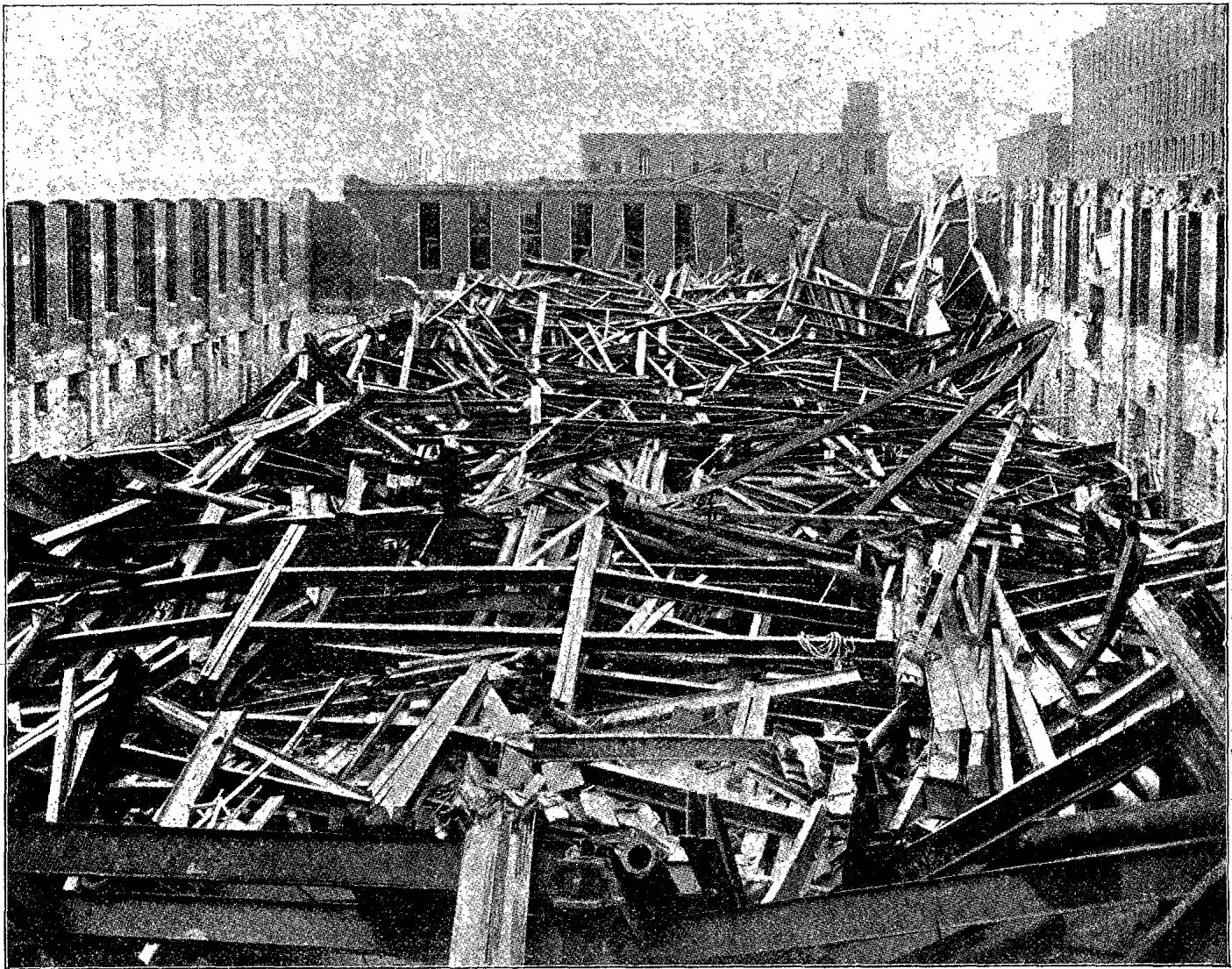
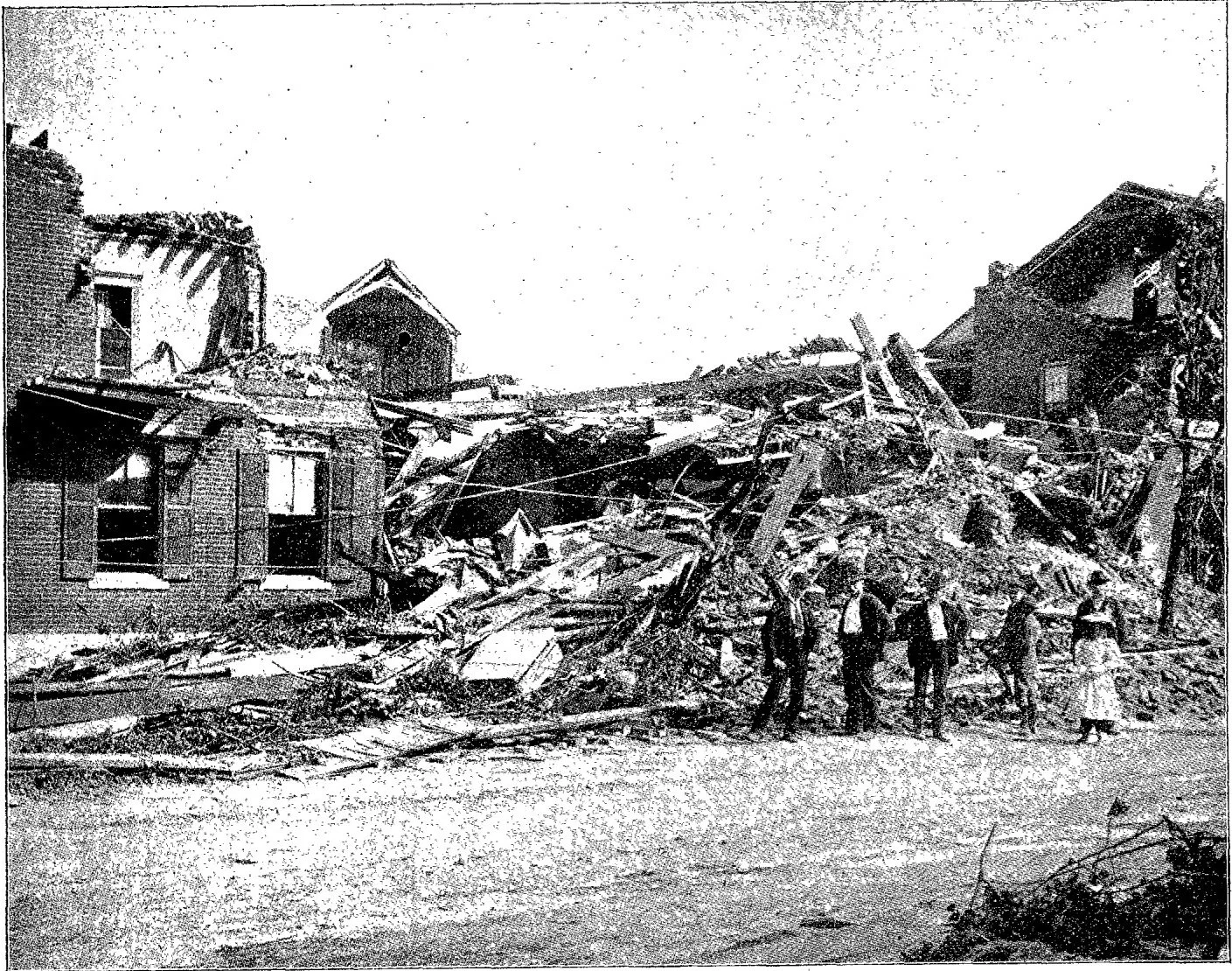
Men have theorized that these most terrific storms could come only in “great heat centers” and “during the heated term.” But no sooner are such groundless theories well set forth than they are dashed to pieces; for it is coming to be no uncommon thing to have some of the worst of these storms in the winter, and what used to be the calmest months of springtime are now visited by the destructive tempest. Perhaps there is no more frightful storm on record than the great cyclone that occurred at St. Louis, May 27, 1896, in which hundreds of lives were lost, and of which the estimated destruction to property was over $50,000,000. The “heated centers” of the “heated term” are by no means reached in St. Louis in the month of May; and yet right in the balmy springtime, was one of the worst of storms.
Our illustrations but faintly and dimly portray the desolation that marks the track of the great cyclone; but an idea may be gathered from the pictures of the infinite power that is exerted when such strong steel and stone structures are broken into a heap of ruins. Let it be ever remembered that we have seen only the beginning of these “fearful sights and great signs.”
As we see these evidences thickening around us, we should act with haste and increasing diligence; for the Lord has given the promise for these very times that “whosoever shall call on the name of the Lord shall be saved.” Acts 2:21. When you see or hear of the great storms of our times, are you filled with fear and dread? You should not be; for this Word plainly says, “Whosoever shall call on the name of the Lord shall be saved.” Are you in faith calling on his name? If so, be assured he will save you.
There is another very important point in this connection: Hundreds are to-day anxiously asking, “What do these great storms mean? Is there any shelter and protection from them?” Hasten to point all such to that sure word, “Whosoever shall call on the name of the Lord shall be saved.” Time is hastening to its close with most intense speed. A little delay on our part may result in the eternal loss of souls. Let us hasten.

REMEMBER—PARLIAMENTARY RULES.

“AMENDMENT” means that which improves, or makes better.
Remember that a motion can have but one amendment at a time.
Remember that each amendment must be germane to the motion.
Remember that the amendment to an amendment must be germane to the amendment.
Remember that when an amendment is carried, it becomes a part of the motion, and another amendment is in order.
Special Remark.—It seems difficult to understand that when an amendment is either carried or lost, another amendment is in order.
Remember that in amending a motion, only three steps are in order: First, the original motion; second, an amendment to the original motion; third, an amendment to the amendment.
A motion may be amended by adding words or phrases, by inserting words or phrases, by striking out words or phrases, by substituting words or phrases, or by dividing the question.
Remember that all amendments must have a direct bearing on the original motion.—Harper’s Bazar.

Hymn Lamenting the Approaching Battle

“The waiting nations hold their breath To catch the dreadful battle-cry; And in the silence as of death, The fateful hours go softly by. O, hear Thy people where they pray, And shrive our souls before the fray!
“Before the sun of peace shall set, We kneel apart a solemn while; Pity the eyes with sorrow wet, But pity most the lips that smile. The night comes fast; we hear, afar, The baying of the wolves of war.”

The Wages of Sin: Deadness of Conscience

“You can sin yourself into an utter deadness of conscience, and that is the first wage of your service of sin.”

IN JESUS’ NAME.

T. E. BOWEN.
(Newburg, W. Va.)
“HITHERTO have ye asked nothing in my name: ask, and ye shall receive, that your joy may be full.” It is often the case that a request for some favor would be denied were it not for the influence of some man whose name is attached to the request. To illustrate: A brother who served faithfully in the Civil War recently applied for an increase of pension. The matter rested in the hands of a lawyer in Washington. Nothing was heard of the claim, although every requirement had been met. The brother then wrote to the representative from this district, asking him to call up the claim. It was done, and the claim was presented in the representative’s name, with the result that it received immediate attention.
Scene on Lafayette Avenue. If a cyclone could be said to discriminate, it would appear as if the great St. Louis storm selected churches for its special victims. A fragment of a church, with its memorial windows, is shown in the illustration. The remainder of the building was demolished. Yet the Seventh-day Adventist mission house was directly in the track of the storm, and was untouched, save by the blowing in of one pane of glass.
Much attaches to the name. “In my name,” says Jesus. I give you the unbounded and unprecedented privilege, if you are my follower, of making any request at the eternal throne of heaven, and signing my name to it. No matter how great the request, sign my name. “All . . . thine are mine,” Jesus said, in petitioning his Father. All power, all riches, all glory, are Christ’s, by inheritance; and he says, Sign my great name. Wonderful liberty!
God has tested his Son; he can trust him; so when a request comes to the throne in that name which is above every name, the Father can not deny it, neither has he the disposition to do so.
Again: our petitions are often feeble; but the Holy Spirit, which is sent to help “our infirmities,” knowing them all perfectly, steps in, and makes “intercession for us with groanings which can not be uttered.” Then he signs Jesus’ name to his own petition; “for he shall not speak of himself.” Can there be any doubt of a hearing, think you, when the Holy Spirit presents our earnest prayers, with Jesus’ name signed as positive proof that the petition is a genuine one? Be sure your requests are in that name. Without Jesus’ name they are worthless; but if we ask in his name, the promise is that we “shall receive.”

FEW BUT NOISY.

Are you beginning to tremble for the safety of the Bible? Do you fear that the “critics” are about to destroy it? Have you concluded that these scholarly destructionists are multiplying so that their name is legion?
Fear not.
The destructive critics are few, but noisy. They remind us of a story we heard a while ago. A man came to a hotel-keeper, and asked him if he would buy two car-loads of frog legs.
“‘Two car-loads!’” exclaimed the astonished landlord. “Why, I could not use them in twenty years.”
“Well, will you buy half a car-load?”
“No.”
“Twenty or thirty bushels?”
“No.”
“Twenty or thirty dozen?”
“No.”
“Two dozen?”
“Yes.”
A few days later the man returned with three pairs of legs.
“Is that all?” said the landlord.
“Yes; the fact is, I live near a pond, and the frogs made so much noise that I thought there were millions of them; but I dragged the pond with a seine, drained it, and raked it, and there were only three frogs in the whole thing.”
You have already made your application.— Epworth Herald.

Learning What It Means to Be In Christ

“In Christ! in Christ! So much is said about that in the Bible. What does it mean?—Ah! you have now asked a question which only God can answer. The profoundest theologian, attempting to explain it, would but befog the mind the more. But the Holy Spirit can explain it all to you while you are behind your counter, or on your dray, or in your school-room, or following your plow, or gathering your harvest, or sewing a garment, or teaching the children. Go, dear one, and sit down at his feet as a little child,—he will teach only those,—and let him explain it to you. It is impossible to tell what joy, what satisfaction, what peace, the knowledge of this mystery affords! Go, call for the divine Teacher, and let him lead you into this land of delight.”

“AM I MY BROTHER’S KEEPER?”

M. E. OLSEN.
(Sanitarium.)
This was Cain’s answer to the Lord when asked, “Where is Abel thy brother?” and it is the answer given to-day by the great majority of people when their attention is called to the needs and destitute condition of their fellow men. “What have I to do with that? Is it my fault that some people can’t get along in this world? What business have they to live in the slums, anyway? Why don’t they go to work, make some money, and get along like other folks? It’s all I can do to take care of my own family. When I do that, I have done well.”
No doubt it is seldom that people come right out, and express themselves in this plain, outspoken way; but if we will be honest with ourselves, we must admit that a great many of us have just such feelings in our hearts. We must have them; for our actions show it, and actions speak much louder than words. As some one has well said: “What care I what you say, when what you do stands over my head, and thunders in my ears?”
It is an easy thing for us to say we are sorry for our neighbor’s misfortunes: it is another thing entirely to help him out of them. No doubt the priest and Levite felt sorry for the poor man who lay by the roadside, stripped, wounded, and bleeding; but their sorrow did not lead them to do anything; it was only a passing sentiment. Probably their thoughts ran about like this: “Poor fellow! they have treated him pretty roughly. How much I would like to help him if I only had the time and the proper facilities at hand. But there is that important service at the temple, at which I must be present without fail, and I have just time enough left to make it. The man ought to have known better than to let himself get robbed that way. Really, thieving is getting to be pretty common around here. Something must be done to rid the country of these robbers. I know what I will do. I’ll report the case to the governor, and have him send officers in pursuit of the rascals. They will also look after the victim of the foul outrage, and take him to some place of safety, where he can be cared for. A man in my position can do a great deal for his fellow men by simply using his influence on the right side. Other people, who have more time, can attend to the details of the work.”
There is much of this kind of sympathy in the world. There are many people of all classes in society, who wish their fellow men well, and are willing to use their “influence” in behalf of what they believe to be right, but who are unwilling to touch their fingers to the actual work. They want to do good, but think they can do it just as well by proxy; in this they are greatly mistaken. God showed his love for fallen sinners by giving his only begotten Son to die for them on Calvary’s cross. That was supreme self-sacrifice. It was the outgrowth of infinite love. “Hereby perceive we the love of God, because he laid down his life for us: and we ought to lay down our lives for the brethren.” God’s love for man is demonstrated by what he has done for him; our love for our fellow men is demonstrated by what we do for them. We are admonished by the apostle John, “My little children, let us not love in word, neither in tongue; but in deed and in truth.”
Continue reading: THE LIQUEFACTION OF AIR