The Youth’s Instructor, Vol. 30, No. 30.

A TRUE HISTORY OF TWO BOYS

The Youth’s Instructor

Jul 26, 1882

S. D. A. Publishing Association · Battle Creek, Mich. · Jul 26, 1882

A TRUE HISTORY OF TWO BOYS.
THEY attended the same school, sat side by side on the same seats, vied with each other in the same classes, played the school-games together, and were to each other as brothers. They were ambitious, and often spoke of the future “when they would be men of distinction,” and even in boyhood began to plan about the best way of obtaining a classical education, which they considered indispensable to success. Their fathers were men of limited means, having to work hard for the support of their children, and never dreamed of giving their boys an education higher than that furnished by the common school. In the village school, however, these boys had an excellent teacher, who taught them more than how to read and write and do sums. He inspired them with the idea of working for themselves, and fostered their ambition to rise in the world without the help of others, by using for that purpose all honorable means with perseverance and a will.
Already each had got hold of a Latin grammar, and they were conning over “bonus, boni, bonum,” to the utter astonishment of their fellow-pupils, while the still more puzzling mystery was declared that the angle A, B, C is equal to the angle D, E, F, and that x is equal to anything in this world.
While quite young, the boys left school, taking charge of schools of their own as teachers, but still pursuing the path which to each seemed to point out the way to the object of their ambition. John had the credit of being just a little brighter than his fellow, but James had the reputation of being a young man of excellent character; and it was a matter of some amusement to his rival to learn that when he became a teacher, wishing to mold the characters of his scholars, he had openly espoused the cause of temperance and refused to touch, taste, or handle that which could hurt the body or the mind of others. John claimed to be as temperate as James, but said he would not run to such foolish extremes by taking pledges, joining Rechabites, and all that sort of nonsense.
And so these two young men struck out in different directions. John taught his school and read his Virgil and Homer, and, when fatigued with close study and late hours, sometimes he refreshed himself with a glass of wine.
“Pugh!” said he to the expostulations of his friend James, when they happened to meet after two or three years’ separation, “if I never do worse than to take a glass of wine, I do not think much harm can come to me.”
“That may be,” said James, “but so many do come to harm that I would not run the risk for all the good it does.”
“Nothing refreshes me so much after a hard night’s study as a glass of sherry,” responded John, with earnestness; “and I think if you but knew the value of it, you would try it. Young men like us have so much study to do that we must have something to keep up our strength; and I hope we are not foolish enough to hurt ourselves.”
“I think my strength will hold out as long as yours,” said James; “besides, when I do not feel the need, I do not care to risk the danger. I can get along well enough without such helps.”
Years passed away, and I sought the two young men. I knew where to find one of them, but was not certain about the other. After many inquiries, I knocked at the door of an obscure house in an obscure street, and in response there came to the door a man, John, who had the reputation of being a fine scholar, knowing Latin and Greek, Hebrew and Arabic, French and German; but I noticed that he had hard work to stand steadily on his feet for the few moments I spoke to him, and his tongue was evidently too large for distinct communication. He seemed an utter wreck at thirty-five years of age.
I sought the lodgings of James. He was a college graduate, and was busy preparing to stand a special examination for a high academic degree. He showed me a “call” which he had recently received from an important church, urging him to become its pastor, and he told me that he probably would accept it. He was still a temperance man—a man of sterling principle and splendid mind; and he still lives to prove that, to become great, a man must rule his own spirit and shun the very appearance of evil.
“But what became of the other young man?” you ask. The question can be answered in a very few words. About six months after I last saw him, he died suddenly in a fit of delirium tremens, and was laid in a drunkard’s grave.
And so the history of these two boys comes out in perfect harmony with the principles of character which each planted for himself. There is little difficulty in predicting results: “For whatsoever a man soweth that shall he also reap. For he that soweth to the flesh shall of the flesh reap corruption; but he that soweth to the spirit shall of the spirit reap life everlasting.”
—Rev. R. H. Craig, in N. Y. Observer.

THE PEACE OF THE SUMMER DAY.

Oh, the perfect peace and quiet Of the fair midsummer day, As upon the rippling waters Heaven’s lights and shadows play. From the depths of distant woodlands Hear the robin’s piping call, While the breezes through the tree-tops Croon a lullaby for all.
Far from city haunt and bustle Came we on a summer’s morn; ’Neath the shine of heaven’s glory Lingering till the week was gone. Ah, could hearts grow cold and selfish, Or forgetful of the “Best,” As in God’s own grandest temples Heart and mind sought daily rest?
Life must have its winter season, Summer cannot last for aye; Storms must come, and storm clouds follow Brightest sunshine in the sky; But the peace that maketh perfect, Never-dying, gladsome rest, Only comes when there is cherished Love’s sweet summer in each breast.
Love which goeth on forever, Hand and hand with charity; Love which wearies not, nor faileth In its gentle sympathy; Love which has its sweet beginning In the God whose name is Love: Then, indeed, will peace and gladness Make the bluest skies above.
—Mary D. Brine, in Christian Weekly.

THE BANYAN TREE.

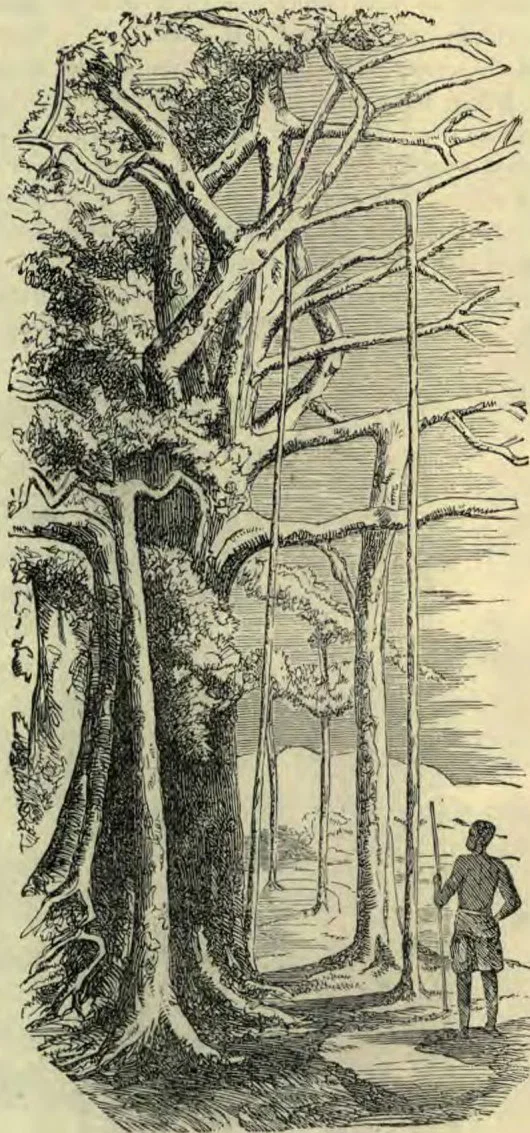
THERE is one plant in the world that can be said to never stop growing, and that is the Banyan (or Banian) tree. This tree grows in India.
In the picture it appears somewhat as though its branches were propped up with poles. But by looking a little closer you will readily see how it grows. Every branch of the tree sends little shoots downward, which take root as soon as they touch the ground, and in their turn, send out other branches to root in the same way. One tree has been found to have as many as three hundred fifty stems of the size of our large oaks, and more than three thousand smaller ones. This tree covers so large a portion of ground that seven thousand men would be able to find shelter beneath its immense roof! The banyan tree is a specie of the fig-tree, the fruit being about the size of the cherry, and of a scarlet color. A certain writer in describing the wild monkeys of India, tells how well they like to live in the branches of the banyan. He says:—
“There are a great many wild monkeys in India. In some parts of the country, they live among the mountains, in the ravines and gorges, and seem afraid of people; but, in other parts of the country, they seem quite tame, and live in the trees that grow along the sides of the roads. It is so in Southern India, where almost all the great roads of travel have splendid large banyan trees growing on either side of them, whose branches meet overhead, and form miles of archway most delightful to travel under in that hot country. These trees swarm with monkeys swinging on the branches, chattering, shrieking, and cutting up all conceivable antics. It is funny to watch the little young ones. They jump up on to their mother’s back, and cling hold of her, while she leaps from bough to bough, or else they clasp hold of her waist underneath with their hands and feet, swinging themselves as if in a hammock, utterly regardless of what their mother’s movements may be; or sometimes, when they see a tail swinging above them, the temptation is too great, and they catch hold of it, and swing. Baby monkeys seem really to be the jolliest creatures alive. Monkeys live mostly on fruit. These fine, large banyan trees bear little scarlet figs, which are not fit for man to eat, though during the awful famine of 1877 many a poor child was thankful enough to get them; but the monkeys think they are very nice.”

LONGFELLOW AND THE CHILDREN.

MR. LONGFELLOW loved all children, and had a word for them whenever he met them.
At a concert, going early with her father, a little girl espied Mr. Longfellow sitting alone, and begged that she might go and speak to him. Her father, himself a stranger, took the liberty of introducing his little daughter Edith to the Poet.
“Edith?” said Mr. Longfellow, tenderly. “Ah! I have an Edith, too; but my baby Edith is twenty years old.” And he seated the child beside him, taking her hand in his, and making her promise to come and see him at his house in Cambridge.
“What is the name of your sled, my boy?” he said to a small lad, who came tugging one up the road toward him, on a winter morning.
“It’s ‘Evangeline.’ Mr. Longfellow wrote ‘Evangeline.’ Did you ever see Mr. Longfellow?” answered the little fellow, as he ran by, doubtless wondering at the smile on the face of the pleasant gray-haired gentleman.
Professor Monti, who witnessed the pretty scene, tells the story of a little girl, who last Christmas inquired the way to the Poet’s house, and asked if she could just step inside the yard; and he relates how Mr. Longfellow, being told she was there, went to the door and called her in, and showed her the “old clock on the stairs,” and many other interesting things about the house, leaving his little guest with beautiful memories of that Christmas day to carry all through her life. This was characteristic of the Poet’s hospitality—delicate and courteous and thoughtful to all who crossed his threshold.
It is often said, and with reason, that we Americans do not think enough of manners—that politeness of behavior which comes from genuine sympathy and a delicate perception of others’ feelings. Certainly our young people might look to Mr. Longfellow as a model in this respect. He was a perfect gentleman, in the best sense of that term, always considerate, and quick to see where he might do a kindness or say a pleasant word.
A visitor one day told him in conversation of a young lady relative, or friend, who had sent to Mr. Longfellow the message that he was the one man in the world she wanted to see.
“Tell her,” said the Poet, instantly, “that she is the one young lady in the world whom I want to see.”
Some young girls, from a distant part of the country, having been about Cambridge sight-seeing, walked to Mr. Longfellow’s house, and venturing within the gate, sat down upon the grass. He passed them there, and turning back, said:—
“Young ladies, you are uncomfortably seated. Won’t you come into the house?”
They were overjoyed at the invitation, and on entering, Mr. Longfellow insisted upon their taking lunch with him. They saw that the table was set for four, and were beginning to be mortified at finding themselves possible intruders upon other guests. They so expressed themselves to their host, who put them at ease at once, saying that it was only his regular lunch with his children, and that they would be happy to wait.
One of a group of school-girls, whom he had welcomed to his house, sent him, as a token of her gratitude, an iron pen made from a fetter of the Prisoner of Chillon, and a bit of wood from the frigate “Constitution,” ornamented with precious stones from three continents. He wrote his thanks in a poem, which must be very precious to the giver, “Beautiful Helen of Maine,”—to whom he says of her gift that it is to him “As a drop of the dew of your youth On the leaves of an aged tree.” —St. Nicholas.

A SUMMER EVENING.

How fine has the day been! how bright was the sun! How lovely and joyful the course that he run, Though he rose in a mist when his race he begun, And there followed some droppings of rain! But now the fair traveler's come to the west, His rays are all gold, and his beauties are best: He paints the gay sky as he sinks to his rest, And foretells a bright rising again.
Just such is the Christian; his course he begins, Like the sun in a mist, when he mourns for his sins, And melts into tears; then he breaks out and shines, And travels his heavenly way: But when he comes nearer to finish his race, Like a fine setting sun, he looks richer in grace, And gives a sure hope at the end of his days, Of rising in brighter array.
—Isaac Watts.

CAN YOU STAND FIRE?

A YOUNG fellow, who had just enlisted in the English army, had his courage severely put to the test on the very first night of his stay among his new comrades. Before going to bed, he knelt down to pray as he had been accustomed to when at home. Instantly there was a great noise among the soldiers in the room. Caps and belts were flung over at the man, but he did not move until, having finished his devotions, he rose from his knees and went to bed.
There was a great deal of talk among his comrades, and the question was asked,—
“Will he try it again?”
When bed-time came on the second night, there was a momentary hush, and glances were turned toward the bed of the new recruit. Down he went on his knees again, and again were caps and belts thrown at him as on the night before, and the men whistled and made all sorts of strange noises. On the third night the same occurrence took place, and on the fourth, and also the fifth; the brave young soldier, doing his duty like a hero, never flinching and never complaining of the rude treatment of his companions. At last one of the roughest of them all, said,—
“Boys, he's genuine; he stands fire;” and from that time the annoyance ceased. Every one in the room respected him, and some of them followed his example.
Why should any one be ashamed to pray, or do anything else that is right? Dare to do your duty, whatever it is or wherever it may place you, and God will surely bless you in it. The very people who laugh at you for being religious often wish themselves the same, and those who seek to annoy and to persecute you because of your love for God, feel in their very hearts that you are right.—Sel.

Blindfolded Over the Mountain Pass

THERE is a mountain pass in Switzerland over which the traveller is conducted blindfolded. He might lose his footing if he caught but one bewildering glimpse of the chasm below. In like manner a wise love conceals from us those circumstances that might distract our attention from the immediate line of duty, and withholds the knowledge that might occasion bewilderment and a fall.

SCENES IN THE LIFE OF CHRIST.

LESSON 79.—PRAYER, HUMILITY, AND THE LOVE OF RICHES.

One day as Jesus was teaching that men ought always to pray, he spoke a parable, saying, “There was in a city a judge, which feared not God, neither regarded man; and there was a widow in that city; and the same came unto him, saying, Avenge me of mine adversary. And he would not for a while: but afterward he said within himself, Though I fear not God, nor regard man, yet because this widow troubleth me, I will avenge her, lest by her continual coming she weary me.” Then, after asking them to consider carefully the parable, he said, “And shall not God avenge his own elect who cry unto him day and night, though he bear long with them? I tell you that he will avenge them speedily.” If this unjust judge who was so hard-hearted and selfish, could be moved by the entreaties of the poor widow, how much more probable is it that God, who is full of love and tenderness, who pities all that suffer, and who notices even the sparrow’s fall, will hear and answer the prayers of all those who humbly call on him for help. Although for a time it may appear that our cry is not regarded, we should never be discouraged, but pray on, knowing that God will keep his promise.
He then spoke another parable for the benefit of some who trusted in themselves that they were righteous, and despised others: “Two men went up into the temple to pray; the one a Pharisee, and the other a publican. The Pharisee stood and prayed thus with himself, God, I thank thee, that I am not as other men are, extortioners, unjust, adulterers, or even as this publican. I fast twice in the week, I give tithes of all that I possess. And the publican, standing afar off, would not lift up so much as his eyes unto heaven, but smote upon his breast, saying, God be merciful to me a sinner. I tell you, this man went down to his house justified rather than the other; for every one that exalteth himself, shall be abased; and he that humbleth himself, shall be exalted.” We see from this that God is not pleased with people when they are proud and boastful, but wants them to be humble and modest, not thinking too highly of themselves.
Some of the people brought infants to him that he might touch them, but when his disciples saw this, they were much displeased, and rebuked the people; but Jesus said, “Suffer little children to come unto me, and forbid them not, for of such is the kingdom of God.” He also said, “Whosoever shall not receive the kingdom of God as a little child, shall in no wise enter therein.”
“And a certain ruler asked him, saying, Good Master, what shall I do to inherit eternal life? And Jesus said unto him, Why callest thou me good? none is good, save one, that is, God. Thou knowest the commandments, Do not commit adultery, Do not kill, Do not steal, Do not bear false witness, Honor thy father and thy mother. And he said, All these have I kept from my youth up. Now when Jesus heard these things, he said unto him, Yet lackest thou one thing; sell all that thou hast, and distribute unto the poor, and thou shalt have treasure in heaven; and come, follow me. And when he heard this, he was very sorrowful; for he was very rich. And when Jesus saw that he was very sorrowful, he said, How hardly shall they that have riches enter into the kingdom of God!” Since riches make it hard for men to gain the kingdom of heaven, it must be very unwise for us to desire them. It is better to be content with what the Lord chooses to give us in this life, and to seek rather for the true riches which will be given in the life to come.

QUESTIONS.

  1. Relate the parable of the widow and the unjust judge. Luke 18: 2–5.
  2. What did Jesus mean to teach by this parable? Luke 18: 1.
  3. After asking them to consider the parable, what more did he say? Verse 7.
  4. How does this parable make it appear probable that God will hear and answer prayer?
  5. What should we do if for a time our prayers seem to be disregarded?
  1. For whose benefit did he then speak another parable?
  2. What two men act a part in this parable?
  3. Repeat the prayer of the Pharisee.
  4. How did the publican pray?
  5. What remark did our Lord make about these men? Verse 14.
  6. What may we learn from this?
  7. Why did some of the people bring infants to Jesus?
  8. How did this please the disciples?
  9. What did they do?
  10. What did Jesus say? Verse 16.
  11. How did he show that we must be simple-hearted, trusting, and obedient, if we would gain a home in heaven? Verse 17.
  12. What question did a certain ruler ask him? Verse 18.
  13. Before answering the ruler, what question did Jesus ask, and what remark did he make?
  14. What must he have meant by this remark?—
That the best of men are not wholly free from faults.
  1. What did he afterward say to him about keeping the commandments?
  2. How did the ruler reply?
  3. Among the commandments that teach our duty to our fellow-men, what one had Jesus purposely left out?
  4. How did Jesus show the young ruler what he lacked? Verse 22.
  5. How did the young man receive this saying?
  6. Why did it make him so sorrowful?
  7. What did Jesus say as he noticed the young man’s sorrow?
  8. Why must it be unwise to desire riches?
  9. What is the better course to follow?

NEW-TESTAMENT HISTORY.

LESSON 92.—PREPARATION FOR THE PASSOVER.

The parable of the ten virgins must illustrate some movement that will take place in the church just before the second advent of our Lord; and, after giving that parable, Jesus went on to speak of his second coming, giving, in the following words, a figurative illustration of some things which are to take place at that time. “When the Son of man shall come in his glory, and all the holy angels with him, then shall he sit upon the throne of his glory; and before him shall be gathered all nations: and he shall separate them one from another, as a shepherd divideth his sheep from the goats: and he shall set the sheep on his right hand, but the goats on the left. Then shall the King say unto them on his right hand, Come, ye blessed of my Father, inherit the kingdom prepared for you from the foundation of the world; for I was an hungered, and ye gave me meat; I was thirsty, and ye gave me drink; I was a stranger, and ye took me in; naked, and ye clothed me; I was sick, and ye visited me; I was in prison, and ye came unto me. Then shall the righteous answer him, saying, Lord, when saw we thee an hungered, and fed thee? or thirsty, and gave thee drink? When saw we thee a stranger, and took thee in? or naked, and clothed thee? Or when saw we thee sick, or in prison, and came unto thee? And the King shall answer and say unto them, Verily I say unto you, Inasmuch as ye have done it unto one of the least of these my brethren, ye have done it unto me. Then shall he say also unto them on the left hand, Depart from me, ye cursed, into everlasting fire, prepared for the devil and his angels: for I was an hungered, and ye gave me no meat; I was thirsty, and ye gave me no drink; I was a stranger, and ye took me not in; naked, and ye clothed me not; sick, and in prison, and ye visited me not. Then shall they also answer him, saying, Lord, when saw we thee an hungered, or athirst, or a stranger, or naked, or sick, or in prison, and did not minister unto thee? Then shall he answer them, saying, Verily I say unto you, Inasmuch as ye did it not to one of the least of these, ye did it not to me. And these shall go away into everlasting punishment; but the righteous into life eternal.”
“And it came to pass, when Jesus had finished all these sayings, he said unto his disciples, Ye know that after two days is the feast of the passover, and the Son of man is betrayed to be crucified. Then assembled together the chief priests, and the scribes, and the elders of the people, unto the palace of the high priest, who was called Caiaphas, and consulted that they might take Jesus by subtilty, and kill him. But they said, Not on the feast-day, lest there be an uproar among the people.” “Then entered Satan into Judas, surnamed Iscariot, being of the number of the twelve. And he went his way, and communed with the chief priests and captains, how he might betray him unto them. And they were glad, and covenanted to give him money. And he promised, and sought opportunity to betray him unto them in the absence of the multitude.
“Then came the day of unleavened bread, when the passover must be killed. And he sent Peter and John, saying, Go and prepare us the passover, that we may eat. And they said unto him, Where wilt thou that we prepare? And he said unto them, Behold! when ye are entered into the city, there shall a man meet you, bearing a pitcher of water; follow him into the house where he entereth in. And ye shall say unto the good man of the house, The Master saith unto thee, Where is the guest chamber, where I shall eat the passover with my disciples? And he shall show you a large upper room furnished; there make ready. And they went and found as he had said unto them; and they made ready the passover.”

QUESTIONS.

  1. What must the parable of the ten virgins illustrate?
  2. Of what does Jesus speak immediately after giving that parable? Matt. 25:31.
  3. How does he describe his coming?
  4. How does he illustrate the separation which will then take place between the righteous and wicked? Verses 32, 33.
  5. What is the King represented as saying to those on his right hand? Verse 34.
  6. Why does he pronounce this blessing upon them? Verses 35, 36.
  7. What questions do the righteous ask? Verses 37–39.
  8. How does the King answer them? Verse 40.
  9. What may we learn from this?—That if we do good to the needy followers of Jesus, he will accept it as done to himself.
  10. What is the King represented as saying to those on his left hand? Verse 41.
  11. Why did he pronounce such a curse upon them? Verses 42, 43.
  12. How do they express their astonishment at this? Verse 44.
  13. How does the King answer them? Verse 45.
  14. What is to be the fate of those who thus neglect to do good? Verse 46.
  15. What reward is promised to the righteous?
  16. When Jesus had finished all these sayings, what did he say to his disciples concerning himself? Matt. 26:1, 2.
  17. What course was taken by the chief priests, the scribes, and the elders of the people? Verses 3, 4.
  18. Why did they think it not safe to do violence to Jesus on the feast-day? Verse 5.
  19. For what purpose did Judas hold a consultation with the chief priests and the captains? Luke 22:3, 4.
  20. How did they receive his proposition?
  21. What did he then seek opportunity to do?
  22. How was he led to pursue such a wicked course? Verse 3.
  23. How had Judas previously encouraged the presence and influence of Satan?
  24. When the day of unleavened bread came, the day on which the passover must be killed, on what errand did Jesus send Peter and John?
  25. What question did they ask him?
  26. How did he tell them they should be able to find the house where he intended to eat the passover?
  27. What were they to say to the man who occupied the house?
  28. What would he show them?
  29. How were these predictions fulfilled?

Personal Work for Sabbath School Scholars
THINK about your scholars. Pray for them. Talk with them personally during the week. Set them a good example. Show them personal attention. Send them good books. Invite them to your homes. Write letters to them. Visit them, especially if they are in trouble. If you do all these things wisely, besides teaching them the lesson, it will hardly be possible for them to be kept out of the kingdom of God.

WHICH LOVED BEST.

“I LOVE you, mother,” said little John; Then forgetting his work, his cap went on, He was off to the garden swing, And left her the water and wood to bring.
“I love you, mother,” said rosy Nell; “I love you better then tongue can tell.” Then she teased and pouted full half the day, Till her mother rejoiced when she went to play.
“I love you, mother,” said little Fan, “To-day I’ll help you all I can; How glad I am school doesn’t keep!” So she rocked the babe till it fell asleep.
Then stepping softly, she fetched the broom, And swept the floor and tidied the room; Busy and happy all day was she, Helpful and happy as child could be.
“I love you, mother,” again they said, Three little children going to bed. How do you think the mother guessed Which of them really loved her best?

HOW TO REMEMBER LARGE NUMBERS.

WHEN reading in newspapers, or books, where large numbers are mentioned, if you will stop a minute, and think of them in the nearest round numbers which you can easily remember, and group them into comparative tables, you will be astonished to find how well you can retain figures, which you would hardly try to do without some such method.
For instance, it may be that some of you would like to remember the quantity of corn that was raised in this country in the year 1880, the last year that is reported in the Report of the Commissioner of Agriculture at Washington. You will find the total amount of corn raised in the United States during that year to be put down at 1,717,434,543 bushels. You see at once that it is very much easier to remember that it is about a billion and three-quarters bushels, than to try to commit to memory the ten figures given.
In the same year there were 498,549,868 bushels of wheat raised. Now, that is about half a billion bushels. The product in oats was 417,885,380 bushels. That is also equal to about half a billion bushels. The potato product was 167,659,570. This is just about one-sixth of a billion bushels. Of barley there were 45,165,346 bushels. Call that fifty million bushels. Of rye there were 24,540,829 bushels; that is about twenty-five million bushels.
Here we have the six great crops of the country, whose standard of measurement is the bushel. First comes corn with one and three-fourths billion bushels; second, wheat with one-half billion bushels; third, oats, one-half billion bushels, but not quite up to the amount of wheat; fourth, potatoes, one-sixth of a billion bushels; fifth, barley, fifty million bushels; sixth, rye, twenty-five million bushels.
Thus, with a little attention, you may easily fix in your minds the comparative amounts of these products.—Little Star.

A SERPENT AMONG THE BOOKS.

A GENTLEMAN in India went into his library one day, and took a book from the shelves. As he did so, he felt a slight pain in his finger like the prick of a pin. He thought that a pin had been stuck by some careless person in the cover of the book. But soon his finger began to swell, and then his arm, then his whole body, and in a few days he died. It was not a pin among the books, but a small and deadly serpent. There are many serpents among the books nowadays. They nestle in the foliage of some of our most fascinating literature; they coil around the flowers whose perfume intoxicates the senses. We read, we are charmed by the plot of the story, by the skill with which the characters are sculptured or grouped, by the gorgeousness of the word-painting—we hardly feel the pin-prick of the evil that is insinuated. But it stings and poisons us. When the record of ruined souls is made up, on what multitudes will be inscribed: “Poisoned by the serpents among the books.”—Selected.

BE PATIENT.

“I WISH I could go out now and then by myself, without always having my little sister tagging after me.” It was a sweet-faced girl who said this, only the face for the moment was clouded and cross. Another girl came by; she had on a deep mourning dress. As she had heard what I did, I was not surprised to hear her say, “My little sister is dead.” The child who had first spoken, said nothing, but presently she took the chubby hand gently in hers, and seemed to be patient with the little “tagging” sister.

A TALK WITH THE LITTLE FOLKS.

What if I could have all the little ones of the INSTRUCTOR family around me this afternoon! What a large company it would make! There would be blue eyes, black eyes, and gray eyes,—all wide open with wonder; and how busy you would be, getting acquainted! Perhaps, though, when you were tired of other amusements, you would ask, as all the little people do, who know me, “Now, Miss ——, do tell us a story.” So here it is:—
It was raining the other day, one of those cold, ill-natured, driving storms, that makes you feel all out of sorts, you know.
The first school-bell was ringing, and a little fellow of perhaps five or six years, was trudging down the street, struggling against the wind and rain, which seemed too much for his slender strength. He was a little orphan child, who had lately been adopted by a kind neighbor. While we were pitying him, we saw his adopted sister, a girl of not more than ten years, turning back from the schoolhouse, which she had reached before him. She came running down the street, and meeting him, took off her cloak, and put it around him, leaving herself entirely unprotected from the storm. Then, thinking, no doubt, that he was too wet to go to school, she wrapped him up in a motherly fashion, and took him home.
I have thought much of this generous little member of the INSTRUCTOR family, and have wondered how many more there are like her. She is worth a dozen whining, babyish girls who want all the good things themselves. I wonder whether she will carry the same noble spirit up to womanhood, or allow her own self to be the great object of which she thinks, and for which she lives. Will any of my little friends learn a lesson of generosity from this simple story?
L.

IF

If I had been made a rooster, Of course I could only crow; If I were a chicken or a hen, I'd have to cackle, you know.
If I had been made a pussy cat, I could only say, “Mew, mew;” If I were a dog, to bark and howl Would be all that I could do.
But do you see? I am none of these, I'm a little talking girl, And mother says that every word From my lips should be a pearl,—
Bright and polished with cheery tones, And set in a loving smile; Think of the pearls in a single day,— For I'm talking all the while!
— Youth's Companion.

True Charity Lies in Cheerful Giving

TRUE charity consists not so much in doing what our hands find to do, as in doing it cheerfully.
Continue reading: LETTER BUDGET