The consecrated child of God will live and labor as in the personal presence of his Lord. This was the secret of Elijah’s power. When declaring to wicked Ahab the judgment of God which would be visited upon the land of Israel, he prefaced it with the remark, “As the Lord God of Israel liveth, before whom I stand.” At the end of the long three years of famine, Elijah appeared to Obadiah, and requested an interview with Ahab. When Obadiah feared to become the messenger, Elijah declared, “As the Lord of hosts liveth, before whom I stand, I will surely show myself unto him to-day.”
The prophet fulfilled his promise. Upon Mount Carmel he confronted the haughty Ahab, the wicked prophets of Baal, and the backslidden hosts of Israel. He stood on this memorable occasion as the one true witness of Jehovah, but he was not alone. He stood as in the divine presence, the mighty hosts of God surrounding him. All heaven bent with interest and sympathy to view the scene. Inspiring heroism was Elijah’s on this occasion, and yet after all he was but a humble man,—a man, as the apostle James tells us, “subject to like passions as we are.” It was the Lord of hosts, before whom he stood, who filled him with his divine Spirit. It was the great God of the universe, who used this poor instrument of clay as the means whereby all Israel was made acquainted once more, and that, too, in a most remarkable manner, with the Creator of the heavens and the earth.
This consciousness of the divine presence proved a keeping power in the life of Moses, and led him to attempt, and to accomplish, great things for God. In the humble garb of his pastoral calling, his shepherd’s staff in hand, accompanied by his younger brother, he entered the palace of proud Pharaoh. He appeared not in the role of a suppliant, but as the representative of a mightier monarch than ever earthly kingdom knew. His words to Pharaoh were a demand: “Thus saith the Lord God of Israel, Let my people go, that they may hold a feast unto him in the wilderness.” Again and again this uncompromising demand was made upon the Egyptian king. Driven out of Pharaoh’s presence, forbidden under pain of death to again see his face, Moses returned with the same unfaltering message. Fearing that disaster would be visited upon himself and his entire kingdom, Pharaoh at last yielded to the force of circumstances, and hastened the children of Israel upon their journey.
For forty years Moses stood as the visible head and leader of Israel. Criticized, censured, plotted against by the chief princes, and even by his own12brother and sister, he endured heroically the trying experiences of the forty years’ wandering. Only once, so far as the record tells, did he fail. He endured all these trying experiences because, as did Elijah, he stood as in the presence of the great God. “He endured, as seeing him who is invisible.” He saw the end of the journey, the final results of loyalty to God, and in contradistinction, the final fruits of unrighteousness.
Elijah and Moses are set forth in the Scriptures of truth as the types of two classes,—the resurrected ones and the translated ones,—who will constitute the inhabitants of the coming kingdom. We are living in the day when that kingdom is soon to be set up. We must possess in our lives the spirit which actuated those men of old. We must stand, as did Elijah, in the presence of the Lord of hosts, realizing that his watchful eye is upon us, and that he takes account of all that we do and say. Like Moses we must endure, “as seeing him who is invisible.”
This consciousness of the divine presence should take from us the fear of man. We are the servants of one greater than king or potentate. To him we are answerable for our course of conduct. He stands as our mighty Helper here, and as our final Judge at last.
This consciousness will rob life of its selfishness and sordidness. How mean will appear our selfish purposes, how groveling our earthly hopes, how degrading every impure, fleshly desire! The pleasures of time and sense will be lost in the anticipated joy of heaven. The glitter, tinsel, and show of worldly glory will fade into insignificance before the greater glory soon to be revealed. Life will be possessed of a high and holy purpose, and before the accomplishment of that purpose, selfish propensities will bow the knee. Then shall we recognize that life does not consist of a mere personal, selfish existence, but that it is a grand possibility, fraught with mighty and far-reaching questions, involving allegiance to the great God of the universe and loyalty to the principles of his government, as against the enemy seeking its overthrow. O, we need to cultivate in our Christian living this union with God! We need to sense this consciousness of the divine presence. Only in this shall we be kept from falling. Only in this can we withstand the seductive wiles of the enemy of our souls, and keep from being switched off from the great track of truth.
To-day every soul is on trial before the universe of God. The testing, proving process is going forward. The chaff will be sifted out, and only the sound wheat remain. The conflict between God and Satan is not one of personal difference alone; great principles are involved in the controversy. By our lives we are declaring on which side of the conflict we will arraign ourselves. Satan is bidding for the allegiance of every soul. To the young men and women among us, he presents the pleasures of the world; to our sisters, the foibles and follies of fashion; to our brethren, the enticing allurements of speculation.
The spirit of these things has already too greatly invaded the church of God. Some of our church-membership have departed from the old-time simplicity of faith and practise which once possessed this people. With too many, personal devotion is neglected, the family altar broken down, the Bible laid aside for the magazine or newspaper, the church prayer-meeting forsaken for personal convenience or social pleasure. Love is lacking in homes. Alienation and criticism exist among brethren. These conditions must be changed. God can not baptize his remnant people with power while these wicked principles control the life. Every heart needs to realize the exceeding sinfulness of all unrighteousness, and cry mightily to God for deliverance.
In every church-membership godly men and women should sound the rallying cry of return to the old-time simplicity of faith and Christian living. There are needed more men and women whose hearts God has touched, and who, living in the light of his countenance, and with hearts filled with his blessed, divine Spirit, will set an example of simple faith and devout Christian living in their churches and communities. The Israel of God must return to the old-time spirit of consecration if they would have the old-time spirit of power. Turning a deaf ear to the voice which would bid us link up with the influences of evil, we must set our faces resolutely toward the kingdom, placing our all—houses, lands, positions, families, and lives—upon the altar of God’s service.
The spirit of apostolic days, the spirit of the 1844 movement, will sometime actuate this people. One hundred forty-four thousand in whose mouth is found no guile, who are without spot or blemish in the sight of a holy God, will stand upon Mount Zion, and sing the song of Moses and the Lamb at last.
Dear reader, will you be among that number? It is your blessed privilege. Though unworthy of yourself, though weak in your own strength, by God’s grace and through his mighty power you may be an overcomer at last; but it must be because you will to submit yourself to God. It must be because you have a heart and a spirit to surrender all to him, and without a single reserve let him come in and fill your life. It is this surrender that will bring to you the power of his Holy Spirit. It is this daily living as in his presence, this standing before him, this seeing of him who is invisible, that will bring God into your life, a mighty controlling and sanctifying power.
All heaven is waiting to bestow upon the remnant church the Holy Spirit of power to-day. Why put off the blessed time of visitation? Why longer delay to ally ourselves with the heavenly intelligences and heavenly powers? Why longer refuse God his rightful place in our hearts and lives? Let him be supreme. Let him come in and fill us with his fulness. Then shall we be enabled to fill our heaven-appointed place in this great movement, and do the work which God designs shall be done by his Spirit-filled and Spirit-directed church.
F. M. W.
Always of Good Courage
By W. A. S.
IT has been cheering to receive the words of courage from brethren in the mission fields during the recent time of shortage of mission funds, necessitating the deferring of plans for extension and calling for retrenchment. From all the four quarters of the earth have come expressions of confidence in the God who can save by few as well as by many.
Word was passed to India that long-cherished plans for the proper equipment of their medical training center would have to be still further deferred. The workers had confidently expected authorization to go forward with their plans. In reply, Dr. H. C. Menkel wrote from out of what we know was a keen disappointment:—
This is only one of those experiences that have a definite lesson for us; and we are able to realize more fully that this work is in God’s hands, and that it depends not upon the effort of man to do the work, but upon God. And whatsoever he orders is best, not only for us who are directly connected with the movement, but for all people everywhere. We therefore have no reason whatever for feeling discouraged, but, on the other hand, we are waiting to see what the next move of the Lord will be. The longer I am connected with this movement, the more I am enabled to see that it is a wonderful provision of God that enables us to work out an experience of blessing, regardless of circumstances. It is wonderful, also, how the way of God’s providence is adapted to meet all situations in all parts of the world as they arise.
It was just after speaking of being “pressed on every side,” “perplexed,” “pursued,” “smitten down,” meeting trials and difficulties and disappointments in pioneer missionary service, that the apostle Paul used the phrase, “Being therefore always of good courage.” 2 Cor. 5:6, R. V.
Our courage is in God; and he lives and reigns, always. It is cheering to see God’s hand in favoring conditions. It is cheering also to know that God’s hand is not shortened when conditions are unfavorable. In personal experience, or in the work of the cause of God, we must take our courage every day, fresh down from heaven, as a gift of God, and as a thing not springing up from surrounding conditions. We serve a living God, and one who cares for his work.
W. A. S.
The Ministry of Reconciliation
By C. M. S.
THE purpose of the gospel and of the life and death of Christ upon this earth was not that God might be reconciled to us, but that we might through the ministration of the gospel learn of God’s undying love for us, and so be reconciled to him. He who knows the Father by living, personal knowledge knows that it is not God who needs the reconciliation.
When man sinned in Eden, and fled to hide from God’s presence, he was fleeing from life to the silence of an eternal death. If God had needed to be reconciled, he would simply have allowed man to continue to flee from his presence, and go down into a grave that would hold him forever. The race would have stopped right there, and the history of Adam would have ended with his sin.
Satan in the beginning taught the innocent pair that God was unjust in withholding from them even one tree of that glorious garden. His deception succeeded, man sinned, fled from God’s presence, and, as a race, has been fleeing ever since. Now Satan comes with a second accusation against God, teaching that he must needs be reconciled, appeased, like the gods of the heathen; and that by the sacrifice of his own Son. But our blessed Lord was not sacrificed for that purpose. If Satan can succeed in making man believe that he was, he has accomplished a master-stroke in his war of the ages against the best interests of man. If he can induce religious teachers to teach that, then is his success the more complete, his charge against God so much the more convincing. Accusing God of injustice in the beginning, and then making it appear that God must be reconciled, Satan attempts to shut the door of salvation in13the face of man. He succeeds in the case of those who believe his sophistries. Let us see what Inspiration teaches in reference to this matter of reconciliation.
God has never been the enemy of man. His own declaration is, “I have loved thee with an everlasting love: therefore with loving-kindness have I drawn thee.” Jer. 31:3. He says of himself, “I have no pleasure in the death of him that dieth; . . . wherefore turn yourselves, and live ye.” Eze. 18:32. “The mercy of the Lord is from everlasting to everlasting.” Ps. 103:17. “The Lord is good; for his mercy endureth forever.” Jer. 33:11. “God so loved the world, that he gave his only begotten Son, that whosoever believeth in him should not perish, but have everlasting life.” John 3:16.
It has always been man’s sin that has put a cloud between him and his Maker. It is not that God has withdrawn himself from the sinner; but, as in Eden of old, when man has sinned, he has hid himself from his Maker. “Your iniquities have separated between you and your God, and your sins have hid his face from you.” Isa. 59:2.
In view, then, of God’s everlasting love toward men, of his ever-enduring mercy, and the fact that man has hid from God and not God from man, with whom is the reconciliation necessary? What was the purpose of Christ’s ministry? what the purpose of his life and sacrifice upon this earth? Let us answer in the language of the Bible: “But all things are of God, who reconciled us to himself through Christ, and gave unto us the ministry of reconciliation; to wit, that God was in Christ reconciling the world unto himself, not reckoning unto them their trespasses, and having committed unto us the word of reconciliation.” 2 Cor. 5:18, 19.
Thus has the Word made plain that it is man who must be reconciled to God, not God who must be reconciled unto us. God never has been unreconciled. His arms have ever been outstretched toward the erring race, and are stretched out still. Christ’s work in the earth was “to reconcile all things unto himself.” “And you . . . hath he reconciled in the body of his flesh through death.” Col. 1:20-22. We are told in Rom. 5:10 that we are “reconciled to God by the death of his Son.”
So the plea of God’s representative in the land of the unreconciled is, “We pray you in Christ’s stead, Be ye reconciled to God.” 2 Cor. 5:20. The ministry of Christ, the ministry of those who are Christ’s, is the “ministry of reconciliation,” the reconciliation of an unreconciled world to the great God, whose love is everlasting, whose mission is ever drawing, whose kindness never faileth, and whose arms will continue to be stretched out to the human race as long as there is hope of saving a single soul. Christ died that he might ransom out of the enemy’s land those who had forfeited their heritage, bartered their souls, and fled from the face of God—that he might turn them, win them, and bring them back with him, the fruits of his ministry of reconciliation.
C. M. S.
About Good Resolutions
By W. A. S.
As the early new year proceeds, the writers of press paragraphs pass their usual light remarks about good resolutions and their easy abandonment. There is no virtue, however, in decrying good resolutions. And the turn of a year, or any other time in which one is led to think reflectively and to look forward with determination, is a good time to resolve to choose and cleave to the right.
True, a good resolution is not an end in itself; nor is it a means to an end. It is rather a taking hold of the means and the power by which to accomplish the good desired. In one who has not learned to believe, it may be a summoning of the powers of the will to put away some physical habit or to achieve a worthy object; and we admire the disposition, and recognize the fact that every good impulse is from above. In the believer, a genuinely good resolution is a laying hold of divine power, by faith; and for such a one there is the assurance of strength from heaven for the doing of the will of God. The confidence is not at all in the good resolution or purpose, but in the grace of Christ, that inspires the purpose.
The apostle Paul was not above making resolutions. But he made them in the right way:—
“When I therefore,” he said, “was thus minded, did I show fickleness? or the things that I purpose, do I purpose according to the flesh, that with me there should be the yea yea and the nay nay?” 2 Cor. 1:17, R. V.
The fickleness, the yea and the nay, the up-and-down experience, the breaking of good resolutions, are because too often the purpose is indeed purposed “according to the flesh,” and the resolution is but as a rope of sand. The apostle formed his purposes in Christ, and his trust was in him for the execution of them: “For the Son of God, Jesus Christ, . . . was not yea and nay, but in him is yea.”
Our trust also must wholly be “in him” for the positive, steady experience of climbing the upward way. Let our resolutions be rooted in his grace, with no confidence in the flesh.
Paul had learned the powerlessness of mere resolutions to conquer sin, in the experience that drove him to Christ. “For to will is present with me,” he said of that struggle; “but how to perform that which is good I find not.” Rom. 7:18. And he cried out, “O wretched man!” But he found the Saviour of sinners; and he never ceased to tell of the power by which he was set free from the dominion of sin, and enabled to triumph in Christ over natural tendencies and weaknesses.
The Lord has made the will free, in order that we may choose, and will to know and to do. By his Spirit he ever works on every will to draw it toward himself. We may resist his power just here. But if only we exercise the will power for the right, and resolutely submit our wills and our lives to God, he will work in us “both to will and to do,” strengthening every right purpose and every good resolution.
Let our resolutions, our determinations, reach out after God, and he will meet us. The prodigal son made a good resolution when he resolved, “I will arise and go to my father.” “And he arose.” And the father, the awakening memory of whose love inspired the resolution, met the wanderer “when he was yet a great way off.” Eternal life, and a place in the Father’s house, are worth gaining. By the grace of our Lord Jesus, in whom is the yea and the amen, let us cultivate a resolution and determination of purpose that shall hold on by faith to the power divine.
So many humor the weak will instead of strengthening it by watching unto prayer. The power of the will grows by exercise, the same as any other faculty. Christians have need to throw the resolution of purpose into serving God that successful men put into worldly business or the pursuit of the earthly prize. Inwrought by divine grace, our wills may become iron-like and flint-like for constancy. “For the Lord God will help me; . . . therefore have I set my face like a flint, and I know that I shall not be ashamed.” Isa. 50:7. There is no strength in our resolutions, but with resolution of purpose let us lay hold of God’s strength.
The same apostle who tells us how athletes trained for the prize in the games of the old Roman arenas, expresses his own determined resolution of purpose in words that we may well take as our motto for every new year and every new day:—
“Brethren, I count not myself to have apprehended: but this one thing I do, forgetting those things which are behind, and reaching forth unto those things which are before, I press toward the mark for the prize of the high calling of God in Christ Jesus.” Phil. 3:13, 14.
W. A. S.
Unwearied Well-Doing
By F. M. W.
It is by the maintenance of an undaunted purpose that success is ordinarily achieved. Singleness of heart and unswerving fidelity to an ideal have marked the lives of the men and women who have accomplished results in the world's work. It is only by the possession of this spirit that the child of God will succeed in the Christian warfare. The apostle Paul says that he desired to know but one thing, and that was Christ and him crucified. In writing to the Philippian church, he stated that one purpose possessed his heart: “Brethren, I count not myself to have apprehended; but this one thing I do, forgetting those things which are behind, and reaching forth unto those things which are before, I press toward the mark for the prize of the high calling of God in Christ Jesus.” We shall be “made partakers of Christ, if we hold the beginning of our confidence steadfast unto the end.” “Cast not away therefore your confidence, which hath great recompense of reward.”
God has committed to this people to-day a great work. It embraces nothing less than giving the last gospel message to a sinful world. What an exalted privilege does God give to us, in making us colaborers with himself, in constituting us the representatives of his government, heralds of his coming kingdom, the messengers of his grace! Higher than any position which this world can afford, more honorable than the estate of kings and potentates, is the position of one who truly fulfils this mission for his divine Lord.
But this position involves in this world the acting of a humble part. While we are called to be Christ’s free men, called to occupy the position of friends, we are called also to follow in the lowly footsteps of the Man of Nazareth, to partake of his spirit of self-denial and self-abnegation, to live in all lowliness and meekness, even as he lived, to minister rather than to be ministered unto. As he who hath called us is holy, so we are to be holy in our great calling. To the prosecution of this calling we are to bend every energy, and devote every purpose of the heart and mind.
It may seem to us many times that our efforts are unappreciated, and they truly may be. Even Christ was set at naught by his fellows, but the Captain of our salvation has his eye upon every soldier of the cross. He marks not alone every step in the warfare, but the spirit which prompts the life. Standing, as it were, in his presence, and knowing that his eye is upon us, what can we not attempt and endure for his sake? If the cross is heavy, the crown will be more glorious in the end. If the toil is hard and unremitting, sweeter will be the rest. We are to endure, as did Moses, “as seeing Him who is invisible.” We are to judge of the merits and outcome of the conflict, not by outward appearance, but in the light of eternal realities.
We know that God is true; and if we commit to him the keeping of our souls, he will see to it that our confidence is not misplaced. Of ourselves we are utter weakness, but in his might we are well able to conquer the foes that beset us. Let us maintain undaunted singleness of purpose to persevere even unto the end. We shall see, in the glad day of final reckoning, that we have not labored in vain. F. M. W.
Note and Comment
By Editor
Bible Distribution
CHICAGO recently witnessed a unique procession. One thousand young men, each carrying half a dozen Bibles, marched through the down-town streets, stopping at the leading hotels, and supplying free copies of the Bible to the guest-rooms. The Bibles were furnished by one of the traveling men’s associations. The supply of Bibles to the hotels for the benefit of the traveling public is certainly a commendable work, even if we may question the somewhat spectacular method by which it was done. Only good can come from the circulation and reading of the Word of God. Every laudable effort having this for its purpose should receive our encouragement.
An Expensive Luxury
BUT few comprehend the large amount of money which has been invested during the last few years in automobiles. While many of these machines have been used in practical ways in the prosecution of the business of the country, a very large majority are used as a means of pleasure only. The Christian Herald of December 7 furnishes the following figures:—
In 1909, 80,000 power-driven cars were built, including those for business use as well as pleasure. Seventy-three thousand were propelled by gasoline, and the remainder by electricity and steam. The total value of these cars was $135,000,000. Three hundred firms are engaged in manufacturing automobiles, and they have 125,000 employees.
Alarming Divorce Figures
THE editor of the Christian Work and Evangelist, according to the Literary Digest of December 24, sees great danger in the rapidly increasing divorce figures presented by the country’s record. He feels that while a terrible hue and cry is raised every time an anarchist or well-known writer advocates free love as a proper and permanent condition of society, in the present tremendous growth of the divorce habit the nation is rushing toward it about as fast as it would by popular consent:—
We see nothing but free love if the increase in the ratio of divorces to marriage goes on during the next thirty years as it has during the last thirty. Divorce at present is increasing two and one-half times as fast as our population. In 1906 the increase had risen to that point where it was one divorce for every twelve marriages. We presume the percentage is much higher now. In some States it is much higher than this, where it can be had for the mere asking, as in one State. There it is one to every six. You can see the incredible increase in twenty years when you remember that in 1880 the percentage was only 38 for 100,000 population, whereas in 1900 it was 73. When you subtract the great Roman Catholic population, you can see at once that these figures are really much higher. There is no sign of this abating, but it rushes on with ever-increasing speed. It becomes easier every year. It is already so easy that many men and women are no longer stopping to consider whether they are fit for each other or not, whether they wish to live together always or not, but rush into marriage as lightly as in Paris two members of the Latin Quarter go and live together for a while. Everybody knows that two thirds of the required causes, “cruelty,” “desertion,” “non-support,” etc., are nothing but pretexts, often agreed upon by both parties.
The Irony of Fate
THIS is the term by which the St. Louis Republican of December 19 designates the prevailing Christmastide conditions existing in the world. With some “conjuring up visions of peace on earth and good will among men,” the nations of earth, in feverish haste, are vying with one another in increasing their naval armaments, preparing for the future deadly conflict. Says the Republican:—
Naval estimates for the current year show that Great Britain will spend about $175,000,000 for ships and men; the United States, $140,000,000; Germany, $110,000,000; and France, $68,000,000. Russia’s expenditures are about two thirds as much as those of France, and Japan’s are but one fourth as much as those of France; but the different purchasing power of money in the two countries entirely vitiates the comparison. Now such expenditure as this is war. We are pouring out our dollars and our men just as we should if the wires were burdened to-day with messages of victory or defeat on the high seas. Obsolescence takes the place of battle as a retirer of ships from service; our powder is utilized in practise instead of in conflict; our boys come back after their terms of service expire. The pride, pomp, and circumstance of war are lacking, but the grim fact of costly struggle remains.
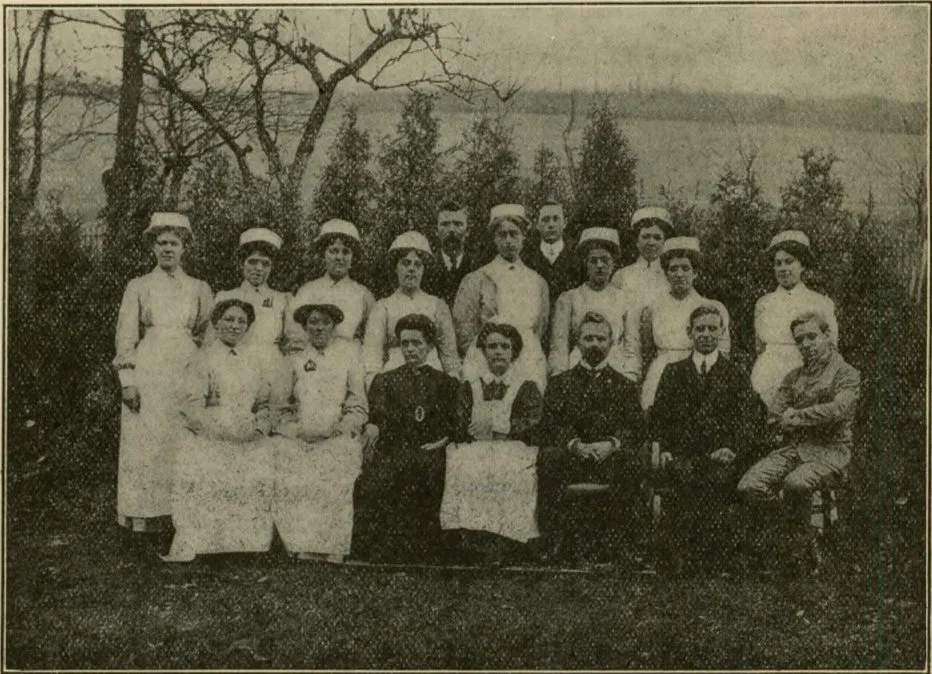
NURSES AND FACULTY, CATERHAM SANITARIUM
Sanitarium Work in England and Ireland
By A. B. Olsen
THE health and medical missionary work is conducted in the British Isles through various agencies, but particularly through sanitarium work, our Good Health magazine, our Good Health League, and lectures before health culture, temperance, and vegetarian societies.
The Drs. D. H. and Lauretta Kress made the first beginning of institutional work in England in 1899. They rented a commodious mansion house, beautifully situated at Meadvale, near Redhill, among the charming hills of Surrey; but on account of the temporary illness of Dr. Kress, it was necessary to relinquish this effort the following year.
In the autumn of 1902, a small sanitarium was started in Belfast by Dr. J. J. Bell. The house used was not a large one, and they had only eight or nine rooms available for patients; nevertheless the institution met with considerable success. Later, however, it was moved into the country at Rostrevor, near Warrenpoint, a beautiful estate consisting of a mansion house, lodge, and several outbuildings, and a farm of one hundred thirty acres, which was secured on a long lease. The institution, which is known as the Rostrevor Hills Hydro, is situated on the southern slopes of the Mourne Mountains, about four hundred feet above Carlingford Lake, which it faces. The mountain scenery, the delightful grassy meadows, the beautiful garden, and the proximity to the sea, make the location an ideal one in many ways.
The institution has been fitted out with modern bath-rooms, and has its own electric and central heating plant. It is an ideal place for invalids, for those who are tired of city life, and for those suffering from fatigue and overwork. Here they come in contact with the great outdoors, with plenty of bracing air, and many delightful walks. There could be no better place in which to take the fresh-air cure than at Knockbaragh, which is the name of the estate.
The Rostrevor Sanitarium is in charge of Brother and Sister E. H. Brown, both graduate nurses. Mrs. Brown was trained at the Swiss sanitarium, when it was still located at Basel. She has had a large experience in teaching in connection with the London County Council schools. Since taking up her work at Rostrevor, she has been successful in organizing a considerable number of good health schools, with marked success. The last one was conducted this autumn at Kilkeel, a village thirteen miles from the sanitarium. This class was under the patronage of Lord and Lady Kilmorey. The earl of Kilmorey took the chair at the preliminary meeting when the class was organized, and spoke very favorably of the school. Lady Kilmorey joined the school, and attended the classes regularly. The fee for the entire course of six classes was only $1.25. Nearly forty persons joined. This effort was so successful that Mr. and Mrs. Brown are now planning to open a new school this month (January) in the same district, and under the same patronage. After paying the out-of-pocket expenses, which were small, there was a net profit of thirty-five dollars to compensate the workers for the time spent in conducting the school.
Similar classes have been organized at Rostrevor and Warrenpoint, each time with increasing interest and success. Brother and Sister Brown have found these good health schools a great advantage in promulgating the principles of life and health, and in educating the public on matters pertaining to diet, hygiene, sanitation, and the care of the sick.
The staff of workers at Rostrevor numbers eight,—the manager, the matron, the head bath-man, the head nurse, and four nurses in training.
A Sanitarium Free From Debt
The Caterham Sanitarium was purchased in March, 1903, the entire purchase money being paid in cash, through the liberality of our American friends and our people in the United Kingdom. Roughly speaking, the cost was about sixteen thousand dollars, including about one thousand dollars spent on decoration, repairs, and medical equipment; consequently, the Caterham institution enjoys the unique reputation of being started without debt, and of never involving itself in debt since its opening. It was dedicated May 30, 1903, and since opening its doors many hundreds of patients have received its benefits. The last year has been by far the best of its experience, and the patronage for a period of something like six months was so large as16to require renting extra rooms in order to provide for the guests. With only thirty-six bedrooms for patients and guests, it had a patronage averaging fifty or more, even reaching sixty-five during the height of the summer season. The large patronage has enabled the institution to make some material improvements. Hot-water radiators were provided nearly two years ago, and since then the drawing-room has been enlarged, a solarium and veranda have been added, and other material improvements have been made.
The Institution in Leicester
The Leicester Sanitarium was acquired through the generosity of one of the leading citizens of Leicester, Mr. J. W. Goddard. After attending a good health school conducted in Leicester in the winter of 1903, Mr. Goddard offered the free use of a large double villa, furnished throughout, including bed and table linen, silver, cutlery, crockery, etc., and he further offered to build and equip suitable bath-rooms. This offer was accepted, and the new institution was opened by the mayor of Leicester early the following year. At the present time it is in charge of Brother and Sister W. M. Scott, both graduates of the nurses' training-school at Caterham. It has a capacity for twelve or more resident patients, and ample facilities for treating a large number of outside patients. On going to Leicester, Brother and Sister Scott made a personal canvass of the leading physicians in the place. They made an appointment to call upon these doctors, and told them of their bath- and treatment-rooms, and of their desire to co-operate with the doctors in treating their patients. The success of this canvass was manifest from the beginning, and the institution now enjoys a good outside patronage, which depends largely upon the local doctors. The corps of workers at Leicester numbers nine.
A. B. OLSEN, M. D.
The Shepherd of Love
THE Shepherd looked out from the
heavenly fold
To the mountains far away,
And he said: “I must leave the ninety
and nine,
The lambs of the flock that are always
mine,
And go seek the one that’s astray;
For the wolf is fierce, and the nights are
cold,
And my lamb can not find its way back
to the fold.”
Then the sandals of peace on his feet he
bound,
And he took the staff of prayer,
And his smile was full of pardon and
grace,
And the light of heaven was in his face,
And a crown was set in his hair;
But ah! dear child, ’twas a crown of
thorn,
And his hands and his feet were all
bleeding and torn.
Yet he toiled all day over rock and
stone,
To seek for the erring one,
Till he came to the garden of bitter pain,
Where the blood-sweat dropped from his
brow like rain
As the night of wrath came on;
For he knew that the river of death
would be
Close, close by the side of Gethsemane.
But the Shepherd of love went on his
way,
And passed through the flood so cold,
Though the stream ran deep, and the
waves rolled high;
For beyond he could hear the lost lamb’s
cry,
And brought it back to the fold!
And thou, dear one, art the lamb he did
love;
’Twas for thee the good Shepherd came
from above.
— Selected.
North England
By Guy Dail
THE meeting of the North England Conference was held at Manchester, October 4-9. This is one of the great weaving and industrial centers of Great Britain, and the meeting was held just at the time of a critical struggle between capital and labor in that up-to-date city.
Workers and people sought God, and studied together concerning the best methods of presenting the message to the more than sixteen million inhabitants of this great and promising field. Special stress was laid on the importance of securing good halls for public efforts. Often such locations must be sought for months in advance. The advantage of a judicious use of literature in systematic house-to-house work was emphasized. It was reported that in at least one cathedral city this sort of labor had been productive of very encouraging results when all other methods seemed fruitless.
The brethren responded to the invitation to raise their share of the $10,000 supplementary fund that Europe is adding to the $300,000 Fund. The need of working up permanent lists of readers for our periodicals was carefully considered, and practical instruction and examples were given by those who are experiencing God’s special help in such17work. All were made glad by seeing the number offering themselves for baptism at this meeting. One hundred nine have accepted the message in North England during the last three quarters.
In addition to the resident laborers in the field, Brethren W. J. Fitzgerald, W. T. Bartlett, and W. H. Meredith assisted in the meeting. There was a fair outside attendance at the public lectures. The great labor struggles that were on during our stay served as fitting object-lessons to those who are observing the signs of the times.
Brother S. G. Haughey was re-elected president. He and his nearly twenty fellow workers have many reasons for encouragement, as they see the scores of large cities ripe for the truth committed to us. The reports given bespeak both spiritual and financial progress for the future. However, we should never imagine that God’s message goes, even in so free a country as England, without hard work, earnest prayer, and deep personal consecration. In behalf of North England we would ask the prayers of our brethren in other lands.