The Youth’s Instructor, Vol. 32, No. 27.

BOUND IN HONOR

The Youth’s Instructor

Jul 2, 1884

S. D. A. Publishing Association · Battle Creek, Mich. · Jul 2, 1884

BOUND IN HONOR.

THERE is Jeanie Paull. She has been visiting at Lulu Hardy’s,” said Constance Stacy to Eleanor Ames. “Now we shall find out whether Lulu’s father is as stern as he looks, and why Mrs. Hardy always has such a sad, woe-begone face.”
The two girls joined Jeanie, who greeted them very pleasantly. They walked on together, and presently Constance, bent on gathering information, inquired after Lulu.
“Lulu is well, and sent her love to all the girls,” said Jeanie.
“And did you enjoy yourself in Arlington?” asked Eleanor.
“Very much indeed. Lulu’s home is lovely, and she is so very thoughtful of her friends. It seems as though she cannot do enough for a guest.”
“Isn’t her father awfully queer and cross?” pursued Constance. “He frowns so in church, and never seems to be enjoying himself. I cannot imagine how you dared to stay in the house with him.”
Jeanie’s face was quite a study; her dark eyes almost flashed as she turned to Constance, saying:—“Mr. Hardy is a kind, good man, and Lulu’s father besides; but if he were what you seem to fancy, do you suppose I would tell you? I could not be so mean. Mother has always told me that what I see or hear in a friend’s house is sacred, and that to chatter things which a friend might not wish to have known, would be unworthy of a lady.”
At the corner the girls separated, Constance and Eleanor looking rather ashamed, and Jeanie walking down her own street with a very stately step, holding her head high. That she should be supposed capable of tale-telling was a great annoyance to her, for her mother had trained her to be honorable.
Children, may I whisper to you that we are sometimes bound in honor not to gossip about persons or occurrences, even when nobody has forbidden us to speak?
Should you happen to be sitting as quiet as a mouse, in a corner of the parlor with your book, when mamma, coming in with a friend, holds a conversation not meant for your ear, you should either get up and go away, or, if you cannot go away, you should forget all about what has been said. Above all, never go around looking wise, and dropping mysterious hints, which curious people may take up, as pegs to hang their questions on.
Curiosity, when it leads you to study carefully God’s wonders in stones and flowers, is a good thing. It is a good thing when it sends you to the library to find out everything the cyclopedia can tell you about a subject. When it is only an idle desire to peer into somebody’s home life, it is a very bad thing. In fact, I hardly know of any way in which trouble is so surely made in this queer world of ours, as by foolish people who go from one person to another thoughtlessly carrying wicked little bits of gossip.
If Nanny or Lucy tell you that Maggie says you are awkward, or slow, or vain, or any other thing which is uncomplimentary, you are not very likely to feel pleased with Maggie. She should not have spoken unkindly about you, for her part; but if you will blame any one, the needless talkers who carried her comments are worse than she.
The Bible says that “a whisperer separateth chief friends.” It was true in the old Bible times, and it is just as true to-day.
A private and confidential note should never be shown to a second pair of eyes.
If you ever have reason to think that a friend does not wish a matter to be repeated, make it your business to be silent.
“By thy words shalt thou be justified, and by thy words shalt thou be condemned.” This is another bit of wisdom from the best of books. We cannot always control our thoughts, children, but we can control our lips.—Margaret E. Sangster.

FOREST HYMN.

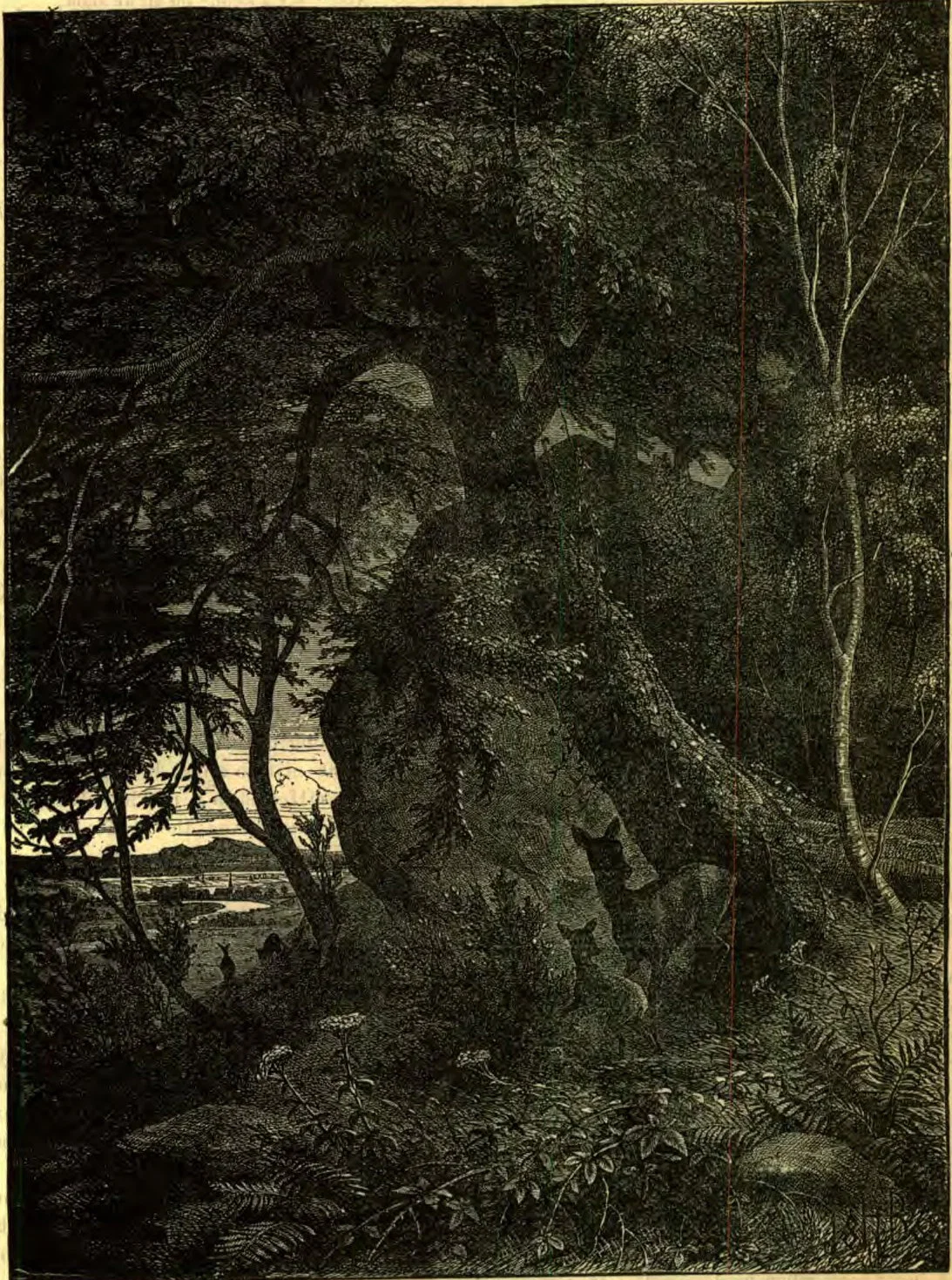
The groves were God's first temples, ere man learned to hew the shaft, and lay the architrave, And spread the roof above them—ere he framed The lofty vault to gather and roll back The sound of anthems; in the darkling wood, Amidst the cool and silence, he knelt down, And offered to the Mightiest solemn thanks And supplication.
Ah, why Should we, in the world's riper years, neglect God's ancient sanctuaries, and adore Only among the crowd, and under roofs That our frail hands have raised? Let me, at least, Here, in the shadow of this ancient wood, Offer one hymn—thrice happy if it find Acceptance in His ear.
Father, thy hand Hath reared these venerable columns. Thou Didst weave this verdant roof. Thou didst look down Upon the naked earth, and forthwith rose All these fair ranks of trees. They in thy sun Budded, and shook their green leaves in thy breeze; And shot toward heaven. The century-living crow, Whose birth was in their tops, grew old and died Among their branches; till at last they stood, As now they stand, massy and tall and dark, Fit shrine for humble worshiper to hold Communion with his Maker.
My heart is awed within me when I think Of the great miracle that still goes on, In silence, round me,—the perpetual work Of thy creation, finished, yet renewed Forever. Written on thy works, I read The lesson of thy own eternity.
There have been holy men who hid themselves Deep in the woody wilderness, and gave Their lives to thought and prayer, till they outlived The generation born with them, nor seemed Less aged than the hoary trees and rocks Around them;—and there have been holy men Who deemed it were not well to pass life thus, But let me often to these solitudes Retire, and in thy presence, reassure My feeble virtue. Here its enemies, The passions, at thy plainer footsteps shrink, And tremble, and are still. O God! when thou Dost scare the world with tempests, set on fire The heavens with falling thunderbolts, or fill, With all the waters of the firmament, The swift, dark whirlwind that uproots the woods And drowns the villages; when, at thy call, Uprises the great deep, and throws himself Upon the continent, and overwhelms Its cities,—who forgets not, at the sight Of these tremendous tokens of thy power, His pride, and lays his strifes and follies by? Oh, from these sterner aspects of thy face Spare me and mine, nor let us need the wrath Of the mad, unchained elements, to teach Who rules them. Be it ours to meditate, In these calm shades, thy milder majesty, And to the beautiful order of thy works Learn to conform the order of our lives.—Bryant.

MANNERS

Manners are more important than money. A boy who is polite and pleasant in his manners will always have friends, and will not often make enemies. Good behavior is essential to prosperity. A boy knows when he does well. If you wish to make everybody pleasant about you, and gain friends wherever you go, cultivate good manners. Many boys have pleasant manners for company, and ugly manners at home. We visited a small railroad town not long since, and were met at the depot by a little boy of about eleven or twelve years, who conducted us to the house of his mother, and entertained and cared for us, in the absence of his father, with as much polite attention and thoughtful care as the most cultivated gentleman could have done. We said to his mother, before we left her home: “You are greatly blessed in your son, he is so attentive and obliging.” “Yes,” said she, “I can always depend on Charley when his father is absent. He is a great help and comfort to me.” She said this as if it did her good to acknowledge the cleverness of her son.
The best manners are worth so much and cost so little that every boy can have them.—S. S. Herald.

ROME

FOREIGN TRAVEL.—NO. 10.

ROME

In our brief stay, we could take only a hurried look at the principal objects of interest. We visited the church of St. John of Lateran, one of the oldest cathedrals in the city, to see the beautiful statuary. This cathedral is on the opposite side of the city from St. Peter’s. In Constantine’s time, and for hundreds of years after, it was the principal church in the city. It has been rebuilt several times. Here is one of the most beautiful pieces of statuary I ever saw, representing Christ as he was taken down from the cross, with his mother supporting his head. The expression of the countenances and the fineness of the work are something wonderful.
In a building close to the church is a flight of twenty-eight marble steps, brought to Rome by the Empress Helena in A. D. 326. It is said that they were taken from the palace of Pilate in Jerusalem, and were the stairs ascended by Christ before his crucifixion, so that for this cause they are considered very holy. They are called the Scala Santa. They are covered with wooden steps, and people are permitted to ascend them only on their knees; other steps are provided at the sides, by which people can descend. These are the steps up which Luther was painfully toiling on his knees, when there came to his mind the scripture concerning justification by faith, and he then saw the uselessness of such works as he was engaged in.
We saw quite a number of people going through the exercise of climbing them on their knees. Some went up a step, and then bent down, and kissed the step with great reverence. Poor souls! How sad it seemed to see people so blinded with foolish superstition as to think there could be any value in such an exercise! While looking on, a dozen boys came in, and went through the same exercise. They were probably a class of scholars that the church had in training. They laughed and had a merry time as they ascended the stairs.
That these steps were the ones Christ ascended to enter Pilate’s palace seems exceedingly improbable, when we remember that Jerusalem was leveled to the ground in A. D. 70. That these steps were preserved under these circumstances for nearly two hundred years is very doubtful; but then, they are just as good for the purpose to which they are put as the original ones would be.
We next visited the Coliseum, once one of the largest theaters in the world, and now one of the most imposing monuments of the old Roman times. It was finished by Titus in A. D. 80, having been erected for the accommodation of the vast crowds who came to witness the gladiatorial combats. These combats lasted one hundred days, and oftentimes five thousand wild beasts were slain. The building contained seats for 87,000 spectators. This vast structure is nearly one-third of a mile in circumference, and is in the form of an oblong circle, 615 feet in length, 510 feet in breadth, and 156 feet high.
The arena, where the gladiators and wild beasts fought, was in the center, in size 279 by 174 feet. Above the arena rose the seats, tier upon tier, intersected by steps and passages. The outside of the building is composed of blocks of stone, originally held together by clamps of iron. Brick was used on the inside work. Underneath the building and the arena were dens and chambers for wild beasts. Only about one-third of this vast building remains. For centuries, it was used as a sort of quarry from which to obtain building materials. The iron holding the stones together was taken away, and it became a pile of ruins. On only one side do the walls retain their original height. Yet the building material still remaining is valued at $2,500,000. What a building this must have been in the time of its glory! What a monument of the power of Rome! And what a scene it must have presented when filled with the 87,000 spectators, who were watching the conflict going on in the arena between the lions, tigers, leopards, and other of the most ferocious wild beasts, and the men who were compelled to fight with them for the amusement of these cruel Romans! Thousands of Christians were in this place torn in pieces by the wild beasts.
A little distance from the Coliseum is the triumphal arch of the Emperor Constantine. It has three archways, and the structure is covered with sculptures. It was erected to commemorate his victories. Near by are the ruins of Constantine.
Some little distance away, yet in plain view, is the arch of Titus. It is smaller than the other arch, and has but one archway. It was built to commemorate the victory he obtained over the Jews when Jerusalem was taken, and the temple destroyed. Among the other things sculptured upon it is a representation of the golden candlestick, with its seven branches. Here is evidence which cannot be gainsaid of the truth of the Bible. Here, cut in the solid stone, to honor the victories of a heathen emperor, is a representation of the golden candlestick made in the wilderness in the time of Moses, nearly four thousand years ago. Infidels can never dispute its existence against such evidence.
All around this triumphal arch are to be seen interesting ruins. A few steps away lies the Roman Forum. This was the central point of interest in ancient Rome; and here the most famous scenes in Roman history were enacted. In the open space of the Forum, public assemblies were held. Here the great orators spoke; public business was discussed; and those mighty plans were formed which resulted in the subjugation of the known world. Funerals, courts of law, and gladiatorial combats were also held here.
Near by the Forum stood the temple of Vesta, with its “eternal fire;” and the Pontifex Maximus, the high priest of their heathen religion, whose title the pope afterwards stole, resided in the vicinity.
The Forum was once embellished with columns and beautiful sculpturing; now it is only a heap of ruins. Broken columns and portions of ancient walls still stand in and around it. It was not until the present century that the rubbish, which for ages has covered it, was to any extent cleared away. During the Dark Ages, the Romans used it as a quarry from which to obtain material for building churches and houses. They burned the marble into lime, so that vast numbers of the monuments of antiquity were destroyed. The Forum was covered many feet deep with rubbish, so that on removing it, the original pavement was found to be much below the surrounding streets.
Once there stood here triumphal arches and monuments of every description, in gilt and bronze; now all is desolation, broken pillars, and ruins. What a commentary on human greatness! The rubbish has been removed from quite a large space, so that we get something of an idea of the ancient Forum; but there is yet quite a pile of rubbish all around, perhaps to the depth of twenty feet. Some of the greatest events of the world’s history occurred here, making this one of the memorable spots in Europe. UNCLE IDE.

ONLY A WORD.

ONLY a word, do you tell me? Yes; And it matters so little, as you believe. Only a word! yet you cannot guess The mark on a life a word may leave!
Only a word! Oh, I know it well— That glib excuse for thoughtless speech! And yet, remember, you cannot tell How far or how deep a word may reach.
Only a word! But a word may harm, And open a wound with its ceaseless smart, And a word may heal like a magic charm, If it come direct from a loving heart.
And “only a word,” for all we know, May hinder a sin, or may save a soul; For the words we utter—they live and grow Though they pass in a breath beyond control.
'Tis nothing but tiny drops that fill Yon river that rolls so strong and deep; And a life's whole teaching, for good or for ill, Is made of the words we hold so cheap! —H. L. Pemberton.

Important Bible Subjects.

Lesson 1.—Second Advent.

[NOTE TO THE STUDENT.—Do not consider the lesson learned until you can give at least the substance of every text, with the correct reference for each. The references in black letters indicate those texts that should be committed to memory. A little diligent application each day will enable you to do this.]
“Let not your heart be troubled; ye believe in God, believe also in me. In my Father’s house are many mansions; if it were not so, I would have told you. I go to prepare a place for you. And if I go and prepare a place for you, I will come again, and receive you unto myself; that where I am, there ye may be also.” John 14:1-3.
“And as it is appointed unto men once to die, but after this the Judgment; so Christ was once offered to bear the sins of many; and unto them that look for him shall he appear the second time without sin unto salvation.” Heb. 9:27, 28.
“For the Lord himself shall descend from heaven with a shout, with the voice of the archangel, and with the trump of God; and the dead in Christ shall rise first.” 1 Thess. 4:16.
“And when he had spoken these things, while they beheld, he was taken up; and a cloud received him out of their sight. And while they looked steadfastly toward heaven as he went up, behold, two men stood by them in white apparel; which also said, Ye men of Galilee, why stand ye gazing up into heaven? this same Jesus, which is taken up from you into heaven, shall so come in like manner as ye have seen him go into heaven.” Acts 1:9-11.
“Behold, he cometh with clouds; and every eye shall see him, and they also which pierced him; and all kindreds of the earth shall wail because of him. Even so, Amen.” Rev. 1:7.
“Wherefore if they shall say unto you, Behold, he is in the desert; go not forth: behold, he is in the secret chambers; believe it not. For as the lightning cometh out of the east, and shineth even unto the west; so shall also the coming of the Son of man be.” Matt. 24:26, 27.
“When the Son of man shall come in his glory, and all the holy angels with him, then shall he sit upon the throne of his glory.” Matt. 25:31.
“And he shall send his angels with a great sound of a trumpet, and they shall gather together his elect from the four winds, from one end of heaven to the other.” Matt. 24:31.

Questions.

1. On what occasion did Christ deliver the discourse recorded in the fourteenth chapter of John?
2. What had Jesus said that caused the disciples sorrow? John 13:33.
3. Where was he going? John 13:1.
4. Was he going to the Father immediately?
5. With what words did he comfort his troubled disciples? John 14:1-3.
6. What idea is conveyed by the use of the word “again”?
7. What testimony does an inspired apostle bear on this point? Heb. 9:27, 28.
8. For what purpose does Christ appear unto them that look for him?
9. In what different ways will his coming affect the righteous and the wicked? Isa. 66:5.
10. What did Christ say he would do for his disciples at his second coming? John 14:3.
11. Then since he comes only the “second time,” what must we conclude?
12. When, after Christ’s resurrection, Peter asked what John’s work would be, what did Jesus reply? John 21:20-22.
13. What saying immediately went abroad? Verse 23.
14. Why did they think he would not die?
15. Does the inspired writer make a distinction between death and the coming of Christ? John 21:23.
16. Can you find, in Christ’s promise to his disciples, proof that his coming does not mean the conversion of sinners?
17. Will Christ come to earth in person? 1 Thess. 4:16.
18. To what will the manner of his coming be similar? Acts 1:10, 11.
19. How was he seen to go into heaven? Acts 1:9.
20. Is the one who is coming the same one who was crucified and buried here on earth? Eph. 4:8-10.
21. As Christ went up, what received him? Acts 1:9.
22. With what will he come? Rev. 1:7.
23. How many will see him when he returns?
24. Is it probable that before Christ comes any one will teach that he has actually come in a secret manner? Matt. 24:26.
25. Should we believe such teaching?
26. How can we prove it to be false? Matt. 24:27.
27. Who will attend the Saviour when he returns? Matt. 25:31.
28. What part will the angels have to act? Matt. 24:31.

Notes.

The fourteenth chapter of John is a continuation of the discourse begun by Christ while he and the disciples were still at the table, on the night of the last Passover. At its close, he said, “Arise, let us go hence” (verse 31), and the words of the fifteenth, sixteenth, and seventeenth chapters were uttered while on the way to the garden.
I go to prepare a place for you.—These words do not have reference to the death of Christ, but to his ascension, forty days after his resurrection. It was then that he entered “into heaven itself, now to appear in the presence of God for us.” Heb. 9:24. But although he did not leave the earth immediately after these words, he could very properly say, “I go away,” because his instruction to them was about to cease. He said, “Hereafter I will not talk much with you” (John 14:30); he was now gradually preparing their minds for the great change that was soon to take place.
I will come again.—The word again means “another time; once more;” no stronger word could be used to teach a second, literal coming. Jesus was on earth, in the flesh; according to his promise, he will come again.
And unto them that look for him shall he appear the second time without sin unto salvation.—Not that he will appear only to those who look for him, for this idea is forbidden by Rev. 1:7; but to them that look for him he will appear for a special purpose, i. e., “unto salvation.”
Without sin.—When Christ was here the first time, he “bore our sins in his own body on the tree” (1 Pet. 2:24); on him was laid “the iniquity of us all” (Isa. 53:6); although he knew no sin, he was made “to be sin for us” (2 Cor. 5:21); he was “offered to bear the sins of many;” but at his second coming he is “without sin,” he is no longer mediator, but king; he then bears the sins of no one, but every one bears his own.
Since Christ’s coming is for the purpose of taking his people to himself (John 14:3), and he comes only once more, “the second time” (Heb. 9:28), we are forced to the conclusion that all his disciples are with him at one and the same time; and therefore the coming of the Lord cannot be at the death of his saints, for they do not all die at the same time, and some will never die (1 Thess. 4:17).
In Christ’s promise to his disciples, we also find proof that his coming is not synonymous with the conversion of sinners; for he comes to take his disciples—those who are already converted—to himself; he appears “to them that look for him.”

“IF I WERE A BOY AGAIN.”

If I were a boy again, I would practice perseverance oftener, and never give a thing up because it was hard or inconvenient to do it. If we want light, we must conquer darkness. When I think of mathematics, I blush at the recollection of how often I “caved in” years ago. There is no trait more valuable than a determination to persevere when the right thing is to be accomplished. We are all inclined to give up too easily, in trying or unpleasant situations, and the point I would establish with myself, if the choice were again within my grasp, would be never to relinquish my hold on a possible success, if mortal strength or brains in my case were adequate to the occasion.
That was a capital lesson which Professor Faraday taught one of his students in the lecture-room, after some chemical experiments. The lights had been put out in the hall, and, by accident, some small article dropped on the floor from the Professor’s hand. The Professor lingered behind, endeavoring to pick it up. “Never mind,” said the student; “it is of no consequence to-night, sir, whether we find it or not.” “That is true,” replied the Professor; “but it is of great consequence to me, as a principle, that I am not foiled in my determination to find it.” Perseverance can sometimes equal genius in its results. “There are only two creatures,” says the Eastern proverb, “that can surmount the pyramids—the eagle and the snail.”
If I were a boy again, I would school myself into a habit of attention oftener. I would remember that an expert on the ice never tries to skate in two directions at once. One of our great mistakes, while we are young, is that we do not attend strictly to what we are about just then, at that particular moment. We do not bend our energies close enough to what we are doing or learning. We wander into a half-interest only, and so never acquire fully what is needful for us to become master of. The practice of being habitually attentive is one easily attained if we begin early enough. I often hear grown-up people say, “I couldn’t fix my attention on the sermon, or book, although I wished to do so.” And the reason is, a habit of attention was never formed in youth.
If I were to live my life over again, I would pay more attention to the cultivation of memory. I would strengthen that faculty by every possible means and on every possible occasion. It takes a little hard work at first to remember things accurately; but memory soon helps itself, and gives very little trouble. It only needs early cultivation to become a power. Everybody can acquire it.
—James T. Fields.

A REMARKABLE NEST.

The cow-bunting of New England never builds a nest. The female lays her eggs in the nest of those birds whose young feed like her own, on insects and worms, taking care to deposit but one egg in a nest. A cow-bunting deposited an egg in the nest of a sparrow, in which was one egg of the latter. On the sparrow’s return, what was to be done? She could not get out the egg which belonged to her, neither did she wish to desert her nest, so nicely prepared for her own young. What did she do?
After consulting with her husband, they fixed on their mode of procedure. They built a bridge of straw and hair directly over the two eggs, making a second story in the house, thus leaving the two eggs below out of the reach of the warmth of her body. In the upper apartment she laid four eggs, and reared her four children.
In the museum at Salem, Mass., may be seen this nest, with two eggs imprisoned below.—Golden Days.

Letter Budget.

Cora Clark, writing from Ingham Co., Mich., says she has always taken the Instructor, and thinks it is an excellent paper. She has never written for it before. She learns her Sabbath-school lessons in Book No. 2. She is nine years old, and is trying to be a good girl.
Jessie Price writes from Eaton Co., Mich. She says: “I am eight years old. I have one brother and three sisters, and my cousin lives with us. I like to read the letters in the Budget so well I thought I would write one for it. I have taken the Instructor three years. I study in Book No. 2. I send love to the Instructor family.”
Bertie Thayer, of Oceana Co., Mich., says: “I have kept the Sabbath with my father and mother and two brothers about four months. I have distributed one hundred and twenty pages of tracts, and I think I will distribute more by and by. I think I would like canvassing very much. I am eleven years old. I want to see Jesus when he comes.”
Agnes C. Bouchard writes from Kankakee Co., Ill. She says: “I am fifteen years old. I keep the Sabbath with my parents. We have a good Sabbath-school. We learn our lessons in the Instructor. I want to be a good girl. Pray for me, and for my dear old parents. My grandmother is here with us. She keeps the Sabbath too. She is eighty-one years old.”
Lena Sorensen, of Yam Hill Co., Oregon, writes: “It is a long time since I have written for the Letter Budget. We have taken the Instructor about eight years. We love to read it very much. We came to this place from Iowa about three years ago. Two ministers labored here several weeks last winter. A few persons commenced to keep the Sabbath, and we hope others will soon. We are anxious to have a Sabbath-school organized here.”
Tommy Blackburn writes from Rice Co., Minn.: “I was ten years old last August. My pa is dead. I keep the Sabbath with my ma. I have two brothers and two sisters. My sisters are both married and both keep the Sabbath. One sister lives about seventy miles from here; the other about one and one half miles away, and ma and I go there nearly every Sabbath, and have a little prayer-meeting and Sabbath-school. We like the Instructor well. I want to be a good boy, and meet the Instructor family in heaven.”

CITY GATES.

LONG, long years ago, all the large cities and towns in Palestine, and in other countries too, were inclosed with high, thick walls. In those days, when the people went to war, they did not use guns, and cannons, and bombshells, and all those other things that would so quickly tear down the walls; for they did not know about them. But they fought with darts, and spears, and swords, and bows and arrows. So these strong, high walls protected them very well from any of their enemies who might come up to fight against them.
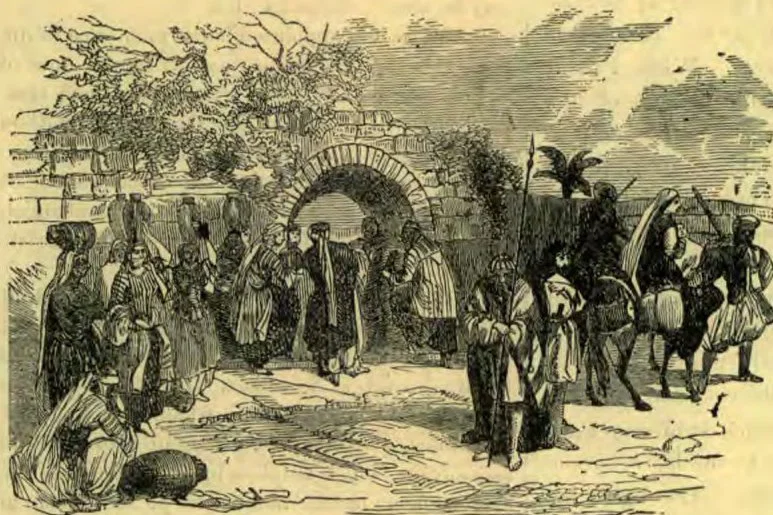
There are quite a number of cities in Palestine that yet have very good walls around them, protecting the people from the many robbers in the land. But the most of them have crumbled to ruins, as this one in the picture has done.
The openings through the wall into the city were closed at night by heavy gates, and the gates were locked. The gateways were generally broad and high; and as the walls were very thick, it made a cool, roomy place, large enough for a great many people to gather together in. Sometimes they built a chamber in the wall, above the gate. And they frequently built towers on either side over the gate, placing soldiers there to guard the city against the approach of foes.
People went to the city gates to chat with friends passing in and out, or to watch the strangers who entered the city. That was what Lot was doing, when he sat at the gate of Sodom toward evening, and saw two dusty, tired-looking strangers enter the gates. You remember that he took them to his own home to stay over night, and that they proved to be not men, but angels, come to save him and his family.
It would seem very strange to us, would it not, were our lawyers and judges to go out on the street corner in all the noise and confusion of a town, and there hold their trials, and decide their cases? Yet this is just what the judges and rulers in Palestine did, and still do at the present day. They hear their cases right in the crowded gateway, with men, women, and children jostling against each other, and with donkeys braying, dogs barking, and horses clattering by over the dusty way. But they are not in the least disturbed by the noise.
At night, everything has to be brought inside the walls, for fear that the robbers, of which there are plenty, will come and carry something off. At sunset, the people, with their flocks and herds and camels, can be seen hurrying home from their work in the fields, anxious to get inside the walls before the gates are closed. For when they are once shut, they are not opened again till morning; so if the people are behindhand, they have to stay outside the walls all night.
But all the gates are not as large as these we have been talking about. The narrow, or strait, gates are only about one fourth as wide as the main gates. They are not used very often; only a few go through them. They are not put in those parts of the walls where there is much going on, and you would have to hunt to find them. The most of the people go in at the broad gate; and if you were to follow the crowd, you would go there too. To enter the narrow gate, you must turn aside from the common highway.
How plain this makes the Saviour's words seem, when he says: “Enter ye in at the strait gate; for wide is the gate, and broad is the way, that leadeth to destruction, and many there be which go in thereat: because strait is the gate, and narrow is the way, which leadeth unto life, and few there be that find it.” Jesus was not speaking of city gates, but of the way to eternal life. He meant to teach us that to gain a home in heaven, we must not do as the world does; for that would be going in at the broad gate. We must follow the example he set for us when he was here upon the earth. To enter in at the strait gate, we must love God with all the heart, and our neighbors just as much as we do ourselves; for this is the way that leads to life. Have you searched for the strait gate, and have you entered it, children?
W. E. L.

SMALL AND GREAT.

From a tiny acorn A forest-giant grows; From a little streamlet A mighty river flows. Many fleeting seconds Go to make the day; Days glide into years, and Ages pass away.
Many tiny blossoms Sprinkled o'er the lea, Make it one vast garden, Beautiful to see. Many little songsters, Warbling 'mid the trees, Send a choral concert Floating on the breeze.
Many grains of knowledge, Added day by day, Lay a store of wisdom In your brains away. Every time you conquer Passion in the strife, You are one step nearer To a noble life.
Who will stand the highest In the Judgment day!— He whose valor conquered In the bloody fray. ’Round whose brow is circled Garlands-fair of fame!— Nay! but he of whom the world Knows not e'en the name; Who when passions battled, Conquered in that fight— He it is whose name will show The highest and most bright. —Kate Clyde.

You have reached the end of this edition.

The Youth’s Instructor · Jul 2, 1884