The Youth’s Instructor, Vol. 37, No. 22.

THE STONE-CHAT

The Youth’s Instructor

May 29, 1889

S. D. A. Publishing Association · Battle Creek, Mich. · May 29, 1889

THE STONE-CHAT.
“HAIL, O nation of folks with wings, Cleaving the air with your rapid flight! Men are glad when the season brings Ye to your homes in the branches light.”
Possibly a change of seasons does not usher in a more welcome event than “the time of the singing of birds,” when the great heart of Nature, so long bound by the frosts of winter, begins to beat, causing the plains and hillsides, the valleys and mountains, to blossom as the rose. The landscape, then no more dreary, is enlivened by the rustle of wings and the gay songs of birds, whose habits form one of the most pleasing of studies.
Of the feathered creation there is almost an endless variety, both in the Old World and the New, with habits adapted to their several localities, and of so much interest to the lover of birds as to awaken in his mind a desire to know more of their ways.
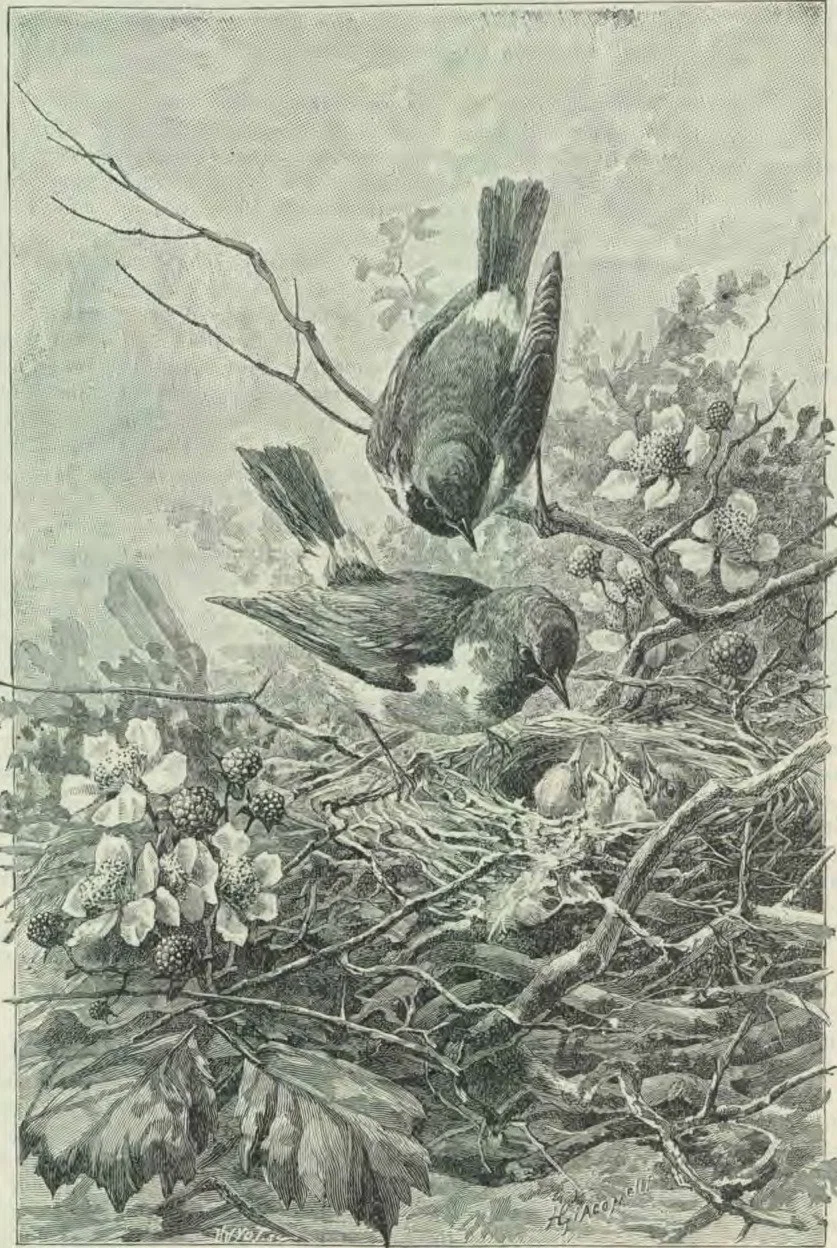
We have in our picture a European bird, the stone-chat, or hammer, as it is sometimes called. It is near kin to the thrush and fly-catcher. It frequents moors and heaths of some foreign countries, where other birds are rare; for this reason and because of its lively ways, it is a great favorite with the shepherd.
The stone-chat is a tiny but showy bird. Its back and tail are black, shaded with a rich brown. Its head is also black, spotted with white upon each side of its neck. Its breast is a beautiful russet brown color, while its black wings are “delicately ruled with white.” From its description I should think it was nearly as restless as the humming bird. One naturalist says of it:—
“You can see it perching on the highest tree-tops, constantly flapping its wings. On account of this unceasing restlessness they call it traquet or mill-clapper; for as the mill-clapper never stops as long as the mill-stone is grinding, so this restless bird is forever flapping its wings.”
Another writer who has observed its ways says:— “The stone-chat represents perpetual motion. Although it never soars high, its black feet never seem to touch the branches; and they appear to belong rather to the air than the ground. While continually dancing upon the flexible stems of the bramble and woodbine, it seems to be perfectly happy, uttering now and again its low cry of ‘Oup! tia, tia! Oup! tia, tia!’”
“Except in pairing time, this bird leads a solitary life, and never flies in company with others. In the fields it is easily approached, and only flies to short distances, without appearing to take any notice of the hunter.”
The stone-chat hides its nest among the roots and branches of entangled bushes, always visiting it stealthily. She lays five or six eggs of a bluish green color, slightly spotted with brown on the larger end. After the birds are hatched, the mother-bird uses the same precaution as at first in the secretion of her nest, always making her way some distance through the adjacent bushes both in going to and leaving her nesting-place, so that to discover it, one has to search diligently a considerable extent of underbrush.
M. J. C.

WHAT THE BURDOCK WAS GOOD FOR.

“Good for nothing,” the farmer said, As he made a sweep at the burdock’s head; But then, he thought it was best, no doubt, To come some day and root it out. So he lowered his scythe, and went his way, To see his corn, to gather his hay; And the weed grew safe and strong and tall, Close by the side of the garden wall;
“Good for a home,” cried the little toad, As he hopped up out of the dusty road. He had just been having a dreadful fright,— The boy who gave it was yet in sight. Here it was cool and dark and green, The safest kind of a leafy screen. The toad was happy; “For,” said he, “The burdock was plainly meant for me.”
“Good for a prop,” the spider thought, And to and fro with care he wrought, Till he fastened it well to an evergreen, And spun his cables fine between. ’Twas a beautiful bridge,—a triumph of skill; The flies came ’round, as idlers will; The spider lurked in his corner dim,— The more that came, the better for him.
“Good for play,” said a child, perplexed To know what frolic was coming next. So she gathered the burs that all despised, And her city playmate was quite surprised To see what a beautiful basket or chair Could be made, with a little time and care. They ranged their treasures about with pride, And played all day by the burdock’s side.
Nothing is lost in this world of ours; Honey comes from the idle flowers; The weed which we pass in utter scorn, May save a life by another morn. Wonders await us at every turn, We must be silent, and gladly learn. No room for recklessness or abuse, Since even a burdock has its use. —St. Nicholas.

HER OPPORTUNITY.

Lucy and Anna Pope were cousins. They were nearly of the same age, lived in the same village, and left school at the same time. They were both pleasant-tempered, warm-hearted girls, anxious to be helpful in their little world; but there the resemblance stopped.
“Have you noticed what a sad, pale face the new music-teacher has?” Anna said one day to her cousin. “She has been coming to the house for a month, and I often think I should like to help her if I had the opportunity.”
Lucy met the teacher that day for the first time. She sauntered down the street with her, brought her into the garden for a bunch of roses, with a few kind, sympathetic words won her confidence, and found that she was struggling hopelessly to support an old father and mother.
The next day she went out to find new scholars for Miss Clisbie, and ended in obtaining for her a position in a large school, with a good salary.
“What a pitiful figure that old woman is who sits in the back pew at church!” said Anna, languidly, a dozen times. “I wish I knew her! I’m sure she needs friends!”
Meanwhile Lucy, by dint of finding the old lady’s place in the hymn-book, and helping her down the steps, had become her friend, and found that she was alone and childless. A cataract was forming over her eyes. Lucy persuaded a physician to undertake her cure, went frequently to read to her, and brightened the last lone years of the poor woman’s life with her own tender, cheery courage.
Anna noticed that the lad who was employed in the drug shop was beginning to drink, and earnestly wished that she could do something to stop him in his downward way. But she was not acquainted with him, and only wished that she had an opportunity to do him good.
Lucy coaxed her brother George to be friendly with the boy, to ask him to join his ball club; in a word, to separate him from the companions who were leading him to ruin. The plan succeeded, and the boy was saved.
As years passed, and the two girls married, Lucy’s influence widened until it brightened and warmed almost every human life which came near to her own. Anna remained a gentle, well-meaning, inoffensive person, who helped and succored nobody. She always intended to cheer and encourage her husband in his duty, and to win her boys to lead a Christian life; but she put off the direct effort until some great emergency would give her the chance to make it.
Lucy bound every man and woman who came near to herself by a shining thread of good-will and sympathy.
When Anna heard of her full, helpful life, she smiled sadly. “God was good to her,” she said; “he gave her so many opportunities.”
But is it not true that God every day puts in our way, as in Lucy’s, needy, lonely, weak creatures, and leaves us to make out of their wants and our own blessings our opportunity to serve him?
Do we make it?
It was not alone the thieves who robbed and wounded the traveler, whom Jesus censured, but the indifferent stranger, who, seeing his extremity, but intent on his own business, passed by on the other side.
“Inasmuch as ye did it not to one of the least of these, ye did it not to me.”—Selected.

TRUE POLITENESS.

True politeness is always free from ostentation. To do a kind act and then publish it to the world is not polite, and to do any act in hope of reward is not polite. The effusiveness of a waiter who expects a fee, the porter tipping his hat to the hotel guest, or the boy who directs you on your way, and then holds out his hand for a cent,—these acts spring from mercenary motives, and although agreeable, are certainly not polite.
A New York man who went on a trip with his wife to Boston, tells that in the elevator of his hotel he met a pleasant-faced and quiet-spoken gentleman, who, on finding strangers desirous of seeing the city, escorted the couple about for nearly half a day, Among the places visited were the City Hall and the mayor’s office. “Which is the mayor?” asked the New Yorker of his guide, there being half a dozen persons in the office as they entered. “I am the mayor,” was the astonishing reply. That was true politeness, and if it pervades Boston, the city has a right to call itself the “Hub.”—Sel.

THE KANSAS CITY “CENTRAL.”

Do any of the young readers of the INSTRUCTOR know what is meant by the term used above? If not, I will say that it means the main office in a city having telephones, and is the place where parties wishing to converse have the proper wires connected, so that they can talk to each other. Through the courtesy of Elder D. T. Shireman, of the Kansas City Mission, I was taken through the operating room, and introduced to Mr. H. W. Ritterhoff, the Superintendent, and Mr. A. A. Barrett, in charge. Mr. Barrett is the inventor of some marvelously wonderful inventions for giving simultaneous notice by word of mouth to all the men on watch in every engine house in the city, of the breaking out and progress of a fire, and of a “switch board” to connect wires from other cities and towns directly with the parties in Kansas City whom they wish to talk with, and vice versa.
I have not time or space to describe all of the interesting things I saw, or to give the complete and satisfactory explanation of all connected with the office, that Mr. Ritterhoff gave me; but I will try to tell enough to give a faint idea of the work and how it is done.
Well, then, to begin. Between 700 and 800 miles of wire enter that office from every direction. These wires, over 2,500 in all, used to be connected directly to the “switches,” but during electrical storms and disturbances, there was great danger of fire, and so Mr. Barrett has invented what he calls “an electric light protector.” It is similar to a switch. The wires all enter the office as cables. These wires are wrapped around a pin, and connected with the switch wires. If fire occurs now, it must generate at the pins, and can be controlled. The number of these wires is simply inconceivable, and the arrangement must be seen to be understood. In front of this electric light protector hang two wire ropes, ending in clasp keys, on a sliding carriage that can be connected with a generator, the motor, or the telephone. By means of these, any wire in the office can be tested, and the trouble, if any, traced, and telephonic connection had with any telephone in the city, without the aid of the switch boards.
If we pass now in front of the switches, for what I have described is all behind them, we find that about 86 miles of wire, 3,000 connections, are complete in each two of them. The office has 13 switch boards, each one carrying 200 subscribers, or a total of 2,503, the total average number of “calls” being 31,000 daily, and answers 28,000. Each subscriber is “duplicated,” that is, can be connected with any other wire in the city, so that each one is duplicated 13 times, once on each switch board. The force employed is forty young ladies in the daytime and sixteen at night. Just after entering, the “morning relief” came into the room, and soon every switch had its attendants. After watching these young ladies for a short time, and seeing how patiently and perfectly they attended to the flood of calls coming in upon them, the writer made up his mind never again to give way to impatience if not answered quickly, or to utter the usual “Halloo, Central,” oftener than necessary.
To attempt to describe a switch board intelligently, or to give a description of the modus operandi, for young readers, is not possible; but I advise all who ever have the opportunity to do so, to call and witness the work done in such a place. An eight-horse-power motor from the Electric Light Co. supplies the electricity for “ringing up” subscribers, as the ladies have not time to do the ringing, as formerly. After making the proper connections, a button is pressed, and the motor rings for them. Five motors, similar to those in telephones, do this work.
In the office, the Superintendent has a beautiful arrangement to ascertain if all the telephones are in working order. If any complaint is made by any subscriber, or by any lady at the switch board (all of which connect with his table), he makes a minute of it, and passes the record to a second table, where the trouble is investigated. In different parts of the city are five inspectors, who report to the Central every half hour, and are sent to repair telephones, etc., which are out of order.
In addition to all this, there is a complete Fire Alarm system, in direct connection with the fire department by means of sixteen metallic circuits, and independent of the switches. Mr. Barrett rang up the department for the writer, and showed how it worked. A novelty in this is that the department breaks the connection when the alarm is over. There is an arrangement also to connect with the switch boards when desired. This instrument is a most ingenious and useful invention, saving time and money, and insuring perfect and instantaneous alarm in case of fire; but it is not possible to describe it to unscientific readers.
The “tow-lines,” the wires that connect other cities with subscribers in Kansas City, all enter the building in a separate room where two young ladies stand before a very large, but in comparison with the others, a very simple switch board, and attend to calls from outside the city, and from subscribers wishing to communicate with other points. W. S. C.

SELF-MADE?

A WEALTHY business man not long ago made a short visit to his native town, a thriving little place, and while there, was asked to address the Sunday-school on the general subject of success in life.
“But I don’t know that I have anything to say, except that industry and honesty win the race,” he answered.
“Your very example would be inspiring, if you would tell the story of your life,” said the superintendent. “Are you not a self-made man?”
“I don’t know about that.”
“Why, I’ve heard all about your early struggles! You went into Mr. Wheelwright’s office when you were only ten—”
“So I did! So I did! But my mother got me the place; and while I was there, she did all my washing and mending, saw that I had something to eat, and when I got discouraged, told me to cheer up and remember tears were for babies.”
“While you were there, you studied by yourself—”
“Oh, no, bless you, no! Not by myself! Mother heard my lessons every night, and made me spell long words while she beat up cakes for breakfast. I remember one night I got so discouraged I dashed my writing-book, ugly with pot-hooks and trammels, into the fire, and she burned her hand pulling it out.”
“Well, it was certainly true, wasn’t it, that as soon as you had saved a little money, you invested in fruit, and began to peddle it out on the evening train?”
The rich man’s eyes twinkled and then grew moist over the fun and pathos of some old recollection.
“Yes,” he said, slowly, “and I should like to tell you a story connected with that time. Perhaps that might do the Sunday-school good. The second lot of apples I bought for peddling were speckled and wormy. I had been cheated by the man of whom I bought them, and I could not afford the loss. The night after I discovered they were unfit to eat, I crept down cellar, and filled my basket as usual.
“‘They look very well on the outside,’ I thought, ‘and perhaps none of the people who buy them will ever come this way again. I’ll sell them, and just as soon as they’re gone, I’ll get some sound ones.’ Mother was singing about the kitchen as I came up the cellar stairs. I hoped to get out of the house without discussing the subject of unsound fruit, but in the twinkling of an eye she had seen and was upon me.
“‘Ned,’ said she, in her clear voice, ‘what are you going to do with those speckled apples?’
“‘S—sell them,’ stammered I, ashamed in advance.
“‘Then you’ll be a cheat, and I shall be ashamed to call you my son,’ she said, promptly. ‘Oh, to think you could dream of such a sneaking thing as that!’ Then she cried, and I cried, and—I’ve never been tempted to cheat since. No, sir, I haven’t anything to say in public about my early struggles; but I wish you’d remind your boys and girls every Sunday that their mothers are probably doing far more for them than they do for themselves. Tell them, too, to pray that those dear women may live long enough to enjoy some of the prosperity they have won for their children—for mine didn’t.”—Youth’s Companion.

“PISA THE DEAD.”

Pisa, in Italy, famous for its Leaning Tower, is called “Pisa la Morte” by the Italians; its commerce, once splendid, has been gradually taken from it by Leghorn, and it has declined in population and importance until it is little more than a place of resort for travelers from all over the world, who come to study its splendid architectural monuments of the Middle Ages, and enjoy its delightful climate.
The prosperity of Pisa has, indeed, received so great a blow that the city is in a state of bankruptcy. The Italian public was lately shocked by a statement that the town house, or city hall, of Pisa was likely to be levied upon by the city's creditors to satisfy their debt.
More lately still came the news of another and even still more startling suggestion. One of the members of the municipal council of Pisa proposed a lottery to raise funds to discharge the debt, and in order to offer a sufficiently tempting prize to attract investments from all over the world, he suggested that the famous Leaning Tower should be the first prize. To possess as one's private property the Leaning Tower of Pisa, which has stood for more than seven hundred years, would, this Pisan councilor thought, be a distinction which all the world would seek after. He did not indicate what he supposed the owner of the tower could do with it.
Fortunately, this original project did not meet with favor from the Pisan council, and some other way must be found to meet the city's difficulty. Pisa is still the center of a rich farming district, and its university is one of the best in Italy.
The decline of Pisa is largely due to a singular circumstance. In mediæval times it possessed a fine harbor, Porto Pisano, at the mouth of the River Arno. With the cutting away of the forests upon the Apennines, vast quantities of earth, no longer held in place by the protecting trees, were washed to the plains below.
This wash gradually filled up the harbor of Pisa. In 1442 its depth had been reduced to four feet; a century later only row-boats could enter it; it was soon abandoned forever. There are now no traces of this old harbor, and even its site is disputed. Pisa's distance from the sea is now about seven miles.—Companion.

The Chasseur Ants.

These ants are found in tropical countries. It appears that at particular seasons, when pressed for food, they leave their nests and enter the dwellings by millions. They are harmless to the residents if they do not disturb or kill any of their number. In half an hour the ants enter every room, wardrobe, trunk, and cranny in the house in search of insects. They cover the walls, the floors, the ceilings, and even the under side of the roof; and woe to every cockroach, fly, or wasp that does not immediately escape!
In Trinidad they filled Mrs. Carmichael's house for five hours, destroying hundreds of insects and a score of mice and rats, which she saw covered with hundreds of the little warriors until they were worried to death and then devoured. After this thorough depopulation, the ants suddenly left for their nests.
The negroes are so impressed with their usefulness that they call these ants “God's blessing.” One of them, passing Mrs. Carmichael's house just after the above scene, called out: “Ah, missus, you've got the blessing of God to-day; and a great blessing it is to get such a cleaning.”—Wonders of Insect Life.

Putting the Bible into a Child's Hands

“He that puts a Bible into the hands of a child, gives him more than a kingdom; for he gives him a key to the kingdom of heaven.”

CATCHING THE COLT.

With forehead star, and silver tail, And three white feet to match. The gay, half-broken, sorrel colt, Which one of us could catch? “I can,” said Dick, “I’m good for that;” He slowly shook his empty hat. “She’ll think ’tis full of corn,” said he; “Stand back, and she will come to me.” Her head the shy, proud creature raised, As ’mid the daisy flowers she grazed; Then down the hill, across the brook, Delaying oft, her way she took; Then changed her pace and moving quick, She hurried on, and came to Dick. “Ha! ha!” he cried, “I’ve caught you, Beck!” And put the halter round her neck.
But soon there came another day, And, eager for a ride, “I’ll go and catch the colt again; I can,” said Dick with pride. So up the stony pasture lane, And up the hill, he trudged again; And when he saw the colt, as slow He shook his old hat to and fro, “She’ll think ’tis full of corn,” he thought. “And I shall have her quickly caught.” Beck! Beck! he called; and at the sound The restless beauty looked around, Then made a quick, impatient turn, And galloped off among the fern. And when beneath a tree she stopped, And leisurely some clover cropped, Dick followed after, but in vain; His hand was just upon her mane, When off she flew, as fleet as the wind, And, panting, he pressed on behind. Down through the brake, the brook across, O’er bushes, thistles, mounds of moss, Round and around the place they passed, Till breathless Dick sank down at last, Threw by, provoked, his empty hat. “The colt,” he said, “remembers that! There’s always trouble from deceit; I’ll never try again to cheat.” —Marian Douglas.

CHED

I suspect that some of the children who live in the country, or in small towns, think it would be very much nicer to live in a large city.
May be some of you have been in the city, and have seen the big stores and the fine houses, and then perhaps you were very sorry you could not stay there all the time.
But not all the houses in the cities are large and nice. Many of them are not nearly so good as yours. And almost all the yards are so small that there is no good place to play and run; and you would miss the big shade trees, and the orchard, and the nuts, and the wild flowers, and the birds, and the good, rich milk.
I'll tell you about a little boy who used to live in a big city. His name was Ched. He lived in a large house; but only in a part of it, because three or four other families lived in the other parts.
There was no place out-of-doors for Ched to play, except on the back porch, where his mamma hung the clothes to dry; and when he looked out of the windows, he could see only the roofs of the houses, and the smoke from the chimneys, and the people and horses in the street.
Little Ched got tired of watching the people, because he scarcely ever saw any one he knew; and sometimes the men who drove the horses would whip them, and he didn't like to see that.
The rooms in which Ched lived were on the east side of the house; and sometimes, just after dark, before he went to bed, he would see the big, round moon rising above the tops of the houses.
When the moon comes up from the east early in the evening, it is always full and round; and when only a part of it shows, it is off in some other part of the sky early in the evening. But little Ched could not see any other part of the sky from their windows, so he never saw the moon except when it was full.
He used to see the stars, too; but he thought they were some of the street-lights, and when his mamma spoke about the moon and stars, he thought she just meant the moon, and so he called that the moon-star.
Ched had never seen a garden; and he didn't know how the things grew which they ate, nor what flour was made of, nor what meat came from. If he had been older, his mamma could have told him about them; but he was a very little boy.
They used to go to the park sometimes; and his mamma told him that the trees there were nearly like those that apples and other fruit grow on; then he thought everything they had to eat grew on trees.
His mamma told him that sometime they would go out into the country, to his Uncle Ched's, who had the same name that he did; and there he could see how things grew.
That was a great ride for Ched, he saw so many things along the road; but when they reached his uncle's, it was night, and little Ched was tired and sleepy, but he didn't want to stay there. He said that wasn't the country; it was a house.
The next morning, though, his uncle's two children, Nelly and Glen, took him out into the yard; and such wonderful things he thought he had never seen. At first, he was almost afraid when just the chickens came up to him to get something to eat; but in a little while he wanted to run right up to the colts, and horses, and cows, to pet them.
Nelly and Glen took him to the strawberry bed; and he was very much surprised to see strawberries lying right on the ground. He called the blossoms house plants, and the dandelions too. His cousins thought he was a very queer little boy.
Ched didn't know that his mamma had ever seen such things; so he ran into the house to tell her about them, and he tried to make noises such as the animals made.
Afterward, his mamma went out-of-doors with him; and when they saw a big gobbler, she told him that was like the turkey they ate at home. Little Ched looked frightened. He seemed to think he would not want to try to eat that old fellow.
When the cows were milked at night, Ched was surprised again. He had never thought where the milkmen got the milk.
In the evening, as they were sitting on the porch, little Ched exclaimed, in a very astonished way, “Mamma!” Looking around, she saw her little boy gazing up at the new moon, and she asked him what was the matter. He replied, very sorrowfully, “Poor old moon-star got broke!” When she asked him how he supposed it got broke, he thought a minute, and then said he guessed it had run against something when it was going around and around.
When their visit was over, and Ched and his mamma went back to the city, he was very glad to see his papa again. But the porch where this little boy played had never seemed quite so small, and the sky had never before seemed so smoky, nor the roofs and walls of the great city so dull; and a few weeks after, when his papa told him that he was going to get a little home in the country, just outside the city, Ched was a very glad little boy, and could hardly wait for the time to come for them to move; for he thought it was very much nicer to live in the country than in the city.
MRS. ADA D. WELLMAN.

HOW MAY TOOK CARE OF THE BABY.

ONE day when May's mamma sat by the window sewing, and May was on the floor playing with baby, Sammy Green came running in all out of breath, and said that his little brother Dick had fallen into the cistern, and there was nobody to get him out. May's mamma said to her, “Take baby into grandma's room, and she will take care of you till I come back.” Then she ran back with Sammy as fast as she could.
So May said, “Come Robbie,”—baby's name was Robbie—and she helped him get up; for he could only walk a very little by himself, and they went to grandma's room, but grandma was not there. Then May went all around the house, calling, “Grandma, grandma, come and take care of Robbie and me. Mamma's goned away.” But grandma had gone out a little while before, and there was no one to answer May.
She was not used to being left alone, and it was so still, and the big clock in the sitting-room made such a loud “tick, tick, tick,” that she began to be frightened. So she went to the window to see if mamma was not coming. But there was no one to be seen but an old beggar man coming down the road. He had a bag on his shoulder, and he looked up at the house, and May felt sure he was coming to put the baby into his bag and carry him off.
What should she do? She knew. She would take baby, and go to find mamma. So she took hold of his hand, and they went into the back yard. She was afraid to go out the front way because the man with the bag was there. Besides, Sammy Green always came to the back door, and Sammy's mamma, too, when she came every week to wash for May's mamma, and May thought their house must be out there somewhere. She pulled open the big gate, and went out into the street. She looked up and down, but there was no house in sight. So they started down the street; but Robbie was too tired to walk, and May had to carry him. Pretty soon they came to a corner, and there was the church. There was no other house to be seen, and May thought she should never find the one where mamma had gone. She was just ready to cry when she remembered that mamma had told her the church was God's house. “If we should go into God's house,” she said, “he would take care of us.” So they climbed up the steps. The door stood open, and they went in. Then May knelt down and said, “Dear God, Robbie and me have come to your house for you to please take care of us till mamma comes home. For Jesus' sake.”
And now she did not feel afraid any more. But Robbie was tired, and when he found mamma was not there, he began to cry. So May sat down and cuddled him up in her arms, and sang to him as mamma used to do, and pretty soon he was fast asleep. Before long, May was asleep too.
When May's mamma got to Sammy Green's house, she found that the water in the cistern was not deep enough to drown Dick, and she soon helped him out. His mother came home just then, so May's mamma went back to her own house.
When she found that May and Robbie were gone, and that grandma, who had just come in, did not know where they were, she was very much frightened, and called their papa in from the field. They went all around, looking for them, and some of the neighbors helped look, too. After a while May's papa and another man went into the church, and there they found the children. When May woke up, and saw her papa, she said, “We were so 'fraid, and we couldn't find mamma, so we went to God's house, and he took care of us.”—Christian Advocate.

LITTLE HELPERS.

One good man said, “I was eyes to the blind, feet was I to the lame” (Job. 29:15); and many little people can make themselves very useful to those who greatly need their help.
How is it, little ones? do you keep a sharp lookout for chances to help people who need help? Finding grandma’s spectacles and mamma’s thimble, picking up chips, looking after fires, fetching water, and doing many, many things which willing hearts and ready hands will find to do, will help along wonderfully, and make you happy in the bargain. An old man was pushing his heavy truck up the hill one day. Some boys saw him, and one said, “Poor old fellow; he can hardly get along. Let us lend him a hand.” So they pushed, too, and soon the truck was at the top of the hill. It did not hurt them at all, but oh, how it helped a weary old man. Every little helps—let every little one be a helper.—Little Christian.

OSTRICHES AND OSTRICH-FARMING.

It seems a queer thing to raise ostriches just as you do hens, doesn't it? but it is done. They run wild in Africa and Asia; for these are their native countries, you know. The people used to kill them to get their curly feathers for ladies to wear, and that is the reason people took to ostrich-farming. If they had kept on killing them, by this time there would not have been a live ostrich anywhere.
And so, as I said, people in South Africa took to ostrich-farming. And as soon as a bird is a year old, they begin to pick out the feathers, and this is done every six months. They do not pull them out, of course, for that would hurt; but they cut them off close to the skin. The best feathers are the white ones in the wings and tail, and each bird has about twenty-five.
Ostriches can run very, very fast, as fast as thirty miles an hour. The South Africans dress up in ostrich skins, so as to deceive the birds, and then creep close up to the herd, and shoot. But they have to be careful not to get between the wind and the ostriches; for the birds would scent them, and off they would go, with their long legs a-flying, and their wings spread out.
They lay their eggs in the sand, and pack them up on end, so they will not take up so much room. Two or three ostrich hens lay in one nest, just like barnyard hens. The natives like ostrich eggs; and so when the ostrich is away, they steal them; they have to draw the eggs out of the nest with a long stick, though; for if they should put their hands in, the ostrich would smell them, and never lay any more eggs in that nest. Their scent is very keen.
The people always leave an egg or two; and the ostrich can't count, so she keeps right on laying for months and trying to fill her nest. The eggs are large, weighing three pounds, and one egg makes a meal for a family. The cook knocks off a bit at one end, and then sets the egg on the fire, and cooks it, stirring it with a stick through the hole. The shells are so hard they are made into cups and bowls. That is what I should call real egg-shell china.
But you need to be careful how you deal with an ostrich, for he is a bad kicker. A little while ago, a man was bringing thirty ostriches from Africa to Paris. They were waiting for the train at a place called Marseilles, when a man slyly tried to steal some feathers out of the tail of one of the ostriches; but the ostrich lifted his foot, and gave the man such a blow that it killed him.
I have heard of a little English boy, whose father was an ostrich-farmer in South Africa. This little fellow was crossing the farm one day, when an ostrich chased after him. He lay down flat on the ground, and the ostrich couldn't hurt him; for an ostrich always kicks forward, you know. He had been told that was what he must do if an ostrich chased him, and there he lay and yelled till somebody came.
Ostriches do not like to set, and so the ostrich-farmers have a machine to hatch the eggs. When the baby ostriches are a few days old, they are given to the Kafir boys to take care of. They soon learn to love their keeper, and will come when he calls them; and when they are frightened, they run right to him, as they would to their ostrich-mother.
The natives like ostrich to eat, but it is not very good. Ostriches themselves eat grass and seeds, and the ostrich-farmers give them grain. Some people say they eat glass and nails, and all sorts of queer things. But they only swallow stones, just as fowls do gravel, to grind up their food. Of course if they are shut up, and can't get stones, they eat all sorts of hard things, instead.
But copper doesn't seem to agree with them. For one died in the London Zoo once, because he had eaten nine pennies and one half-penny.
Ostriches roar like a lion; they cackle, too; but when they get angry, they hiss.—Adapted from Our Little Men and Women.
Continue reading: OLD TESTAMENT HISTORY