IN behalf of all mankind this protest is made to the enforcement of so-called “Sabbath laws,” by which ordinary labor on any particular day of the week is made a crime to be punished by fine or imprisonment. Our opposition to such legislation is not because the wrong day may be selected for such a purpose, but because any day is thus designated. It is not a question as to which day is the Sabbath. The only point to be settled is whether or not the State should enforce any kind of Sabbath observance on any day. Men may differ as to whether the first or the seventh day of the week is the Sabbath, but this is not a subject for consideration in the present discussion. Neither is it the object of this paper to destroy reverence for the Sabbath-day. On the contrary these views are held by many who have the most profound respect for the Sabbath. Therefore, let no one mistake the single point at issue, namely: Shall the State enforce Sabbath observance of any kind, to any degree, on any day, upon any person? We answer with an emphatic NO, and give some reasons as follows:—
Sabbath-keeping is a matter of religion. It is based on the Bible and the command of the moral law. It is held to be a memorial instituted by Christ, and hence a part of the gospel. Not only is it called the “Sabbath,” a title first applied to the day on which God rested from the work of creation, but it is also termed “Lord’s day” and other names to designate a holy character. Hence it is plain that any law in reference to the Sabbath is based on the idea of at least protecting religion. This is equivalent to saying that religion needs the aid of human laws, and that the gospel will have more power to save men when supported by the State. Laws are made to protect the weak against the oppression of the strong; therefore any law to protect religion is virtually saying that evil men are stronger than the gospel, and hence they must be restrained from inflicting injury upon it. Thus the State can protect religion only by assuming that men have more power than the gospel. If this is true, then how can any man expect to be saved by the gospel? Can we be saved from ourselves by something weaker than ourselves? Is a gospel that is unable to live without man’s aid sufficient to save man from sin, which has the mastery over him? Who can have any genuine faith in or love for a gospel that must be supported by those it professes to save? Whoever looks to the State to protect religion, thereby declares that he has no faith in the power of religion to save the State. The State, and not Jesus Christ, becomes his saviour. He looks to the State to know his duty in religion instead of to God and his Word as the only authority in such matters. The Bible declares that the “gospel is the power of God.” Rom. 1:16. And again, Christ says, “All power is given unto me in heaven and earth.” Matt. 28:18. Can any power be added to “all power in heaven and earth”? Can man increase the “power of God”? Is it not presumption then to attempt to protect the gospel by human enactment? “Because the foolishness of God is wiser than men; and the weakness of God is stronger than men.” 1 Cor. 1:25. If God’s weakness is stronger than men, certainly the gospel is stronger than men, for it is not the weakness of God but his power. To regard the gospel as anything less than the power of God, able to save unto the uttermost, is only to deny the gospel and the power of God. Such a thing is not only possible, but it is one of the marked sins of the present day. “Having a form of godliness but denying the power thereof.” Is not this fulfilled when professed Christians demand of the Nation and State laws to protect their religious institutions? What then shall be said for those misguided souls who are so anxious to have the State make and enforce Sunday laws? Is it a fact that they know not the Scriptures nor the power of God? Do they realize their shame when they turn to the State with outstretched arms to save their religion? Have they not been turned aside to “another gospel,” which is not another—one made by man and dependent on man? Are they willing to let the observance of the Sabbath depend on the voluntary obedience of those who accept it as part of the gospel, the same as they do in baptism or the Lord’s supper? In short, do they see the sin that is caused by human legislation in matters of religion?
It has been shown that the principle underneath Sunday laws is opposed to the gospel, and hence it is false. We will now look at some of the vicious fruit borne upon its deadly branches. Reference might be made to the “Dark Ages” when the idea that religion must be protected by civil rulers was carried to its logical conclusion, in the dungeon, at the stake, and in the torture-chamber. All this was done to protect the gospel and make the people religious. But bear in mind that it is always a false gospel that seeks the aid of the State. The world now looks with shame and astonishment seeing how the true gospel of love was turned into a false gospel of hate. The fault then was not that the people were worse than now; the trouble was they did not know the power of the gospel of Christ, and so looked to the State for aid. The most zealous of them became the fiercest persecutors of others. And all the time they professed to be the true church of Christ and anxious only for the good of men. The same principle was planted in the New World by the misguided zeal of the Puritans. Quakers, Baptists and witches were persecuted, and the fact was demonstrated that Protestants, no less than Catholics, would stop at nothing in their blind prejudice. From these older colonies religious laws, more or less modified, have found their way into the statute books of the various States of the Union. For some time public sentiment has been opposed to the strict enforcement of these statutes. Owing to this fact and also to the supposed guarantee of the national and State Constitutions in regard to matters of religion, the Church has been left comparatively free from human legislation. As a consequence the gospel has had free course to run and be glorified, and the State has prospered while attending to its own secular business. In this way it is demonstrated again that the gospel and the State both thrive best when each is independent of the other. One might have fondly hoped that never again would the Church ask for, or consent to, the State’s protecting religion, and that the State, if solicited to such an unholy alliance, would refuse the lewd appeal. But alas! the last few years have witnessed the religious world not381asking, but demanding, by pulpit, press, and petition, of Congress and various State legislatures, acts of legislation pertaining to the Sabbath. As a consequence ancient Sunday laws are now being enforced and men have been arrested, fined and imprisoned for doing ordinary labor on that day. This course is usually at the instigation of members of the church who are determined that the gospel they believe shall be received by those who differ from them. Thus Sunday laws put the means in the hands of those who are bigoted to persecute persons who disregard their religious views.
In the interest of liberty for all men, in the interest of true religion, is it not fitting that a vigorous protest should be made to every idea that makes one man the servant of another man’s conscience, and degrades the wonderful gospel of Jesus Christ which is able to save all that accept it in faith as the power of God, to something that must be made subject to human enactment? The man who has the highest regard for the Sabbath is just the one who will refuse to have it made the subject for enforcement by the policeman and constable. Nothing but the power of God can make a man able to keep the Sabbath. The State does not have such power and therefore has no right to demand its performance. God has the power in the gospel to enable the Sabbath to be kept “holy.” He only has a right to punish for its rejection. Therefore let us render to Cæsar the things that are Cæsar’s, and to God the things that are God’s. H. E. ROBINSON.
Religion in Schools.
FOR some time there has been a controversy over the policy of the London School Board, in regard to religious instruction in the public schools. The controversy is not as to whether or not there shall be instruction, but as to the amount. Those who are opposing an increase, agree that there should be some, and thereby they deprive their protest of all force. The following letter to the Daily Chronicle, from the member of the board who is making desperate efforts to have specific religious teaching in the schools,—more of it,—gives opportunity to speak briefly of the principles involved in the question:—
The Education Department, acting upon certain rumors, has inquired as to the kind of instruction which is being given to the Jews in the London Board Schools. The answer of the board, as reported yesterday, discloses the fact that for nearly twenty years a more or less organised system of Jewish instruction has been in force in certain of the schools, that the board has made a regular practice of appointing Jewish teachers, and that at the present moment the board is giving instruction at the ratepayers’ expense in a “systematic knowledge of Judaism, with special reference to its distinctive dogmas and to tradition.” This denominational teaching the board shows no disposition to abolish—very wisely, as I think, for I have a rooted objection to teaching other people’s children a religion which their parents do not believe in. But I could not help asking the board, as I now venture to ask your readers, why it is allowable to teach Jewish doctrines at the ratepayers’ expense, but so very wrong to teach Christian doctrines in the same way. Why should the rights of Jewish parents be recognized, while the rights of Christian parents are so utterly disregarded that the writer of this letter, who has ventured to stand up for them, is treated as the enemy of religious liberty? I want justice for all, Christian, Jew, Unitarian, and Secularist alike: my only fault (surely a venial one) is that I am inclined to place the rights of parents before the convenience of a school board.
That is a fair presentation of the case. There is no reason to doubt the honesty of purpose of the gentleman who wrote it.
And if the principle be conceded, that State schools ought to teach religion at all, then the position taken in the letter is a very fair one. For if religion is to be taught at all, it is plain that the teaching ought to be definite and thorough; and the proposal that the parents have a right to say in what religion, if any, their children shall be instructed, is just.
There is no place in the world where religion ought not to be, not in form, but in fact. True religion—the religion of Jesus Christ—is not form, but fact, a living reality. And that is just the reason why it cannot be enforced by law, and cannot be taught by any system instituted by law. Therefore the teaching of religion in the public schools, is a far different thing from having religion in those schools.
It is true that it is just as proper to teach Christian doctrines in schools, as it is to teach Jewish doctrines, because neither is proper. Let the thing be carried further. It is just as allowable to teach Catholicism as Judaism; just as allowable to teach Mohammedanism as Catholicism; just as allowable to teach Buddhism as Mohammedanism; just as allowable to teach Spiritualism as Buddhism; just as allowable to teach infidelity as Spiritualism. “Oh, no, no; that would never do,” says the advocate of religious instruction in schools. Why not? “Oh,” would be the reply, “because infidelity and Spiritualism are wicked.” Of course they are, but are Mohammedanism and Buddhism righteousness? “No; and we would not allow them to be taught at the public expense.” But we ask again, Do you think that Catholicism and Judaism are the truth? “No;” would be the reply, at least as far as Judaism is concerned; “but we must respect the rights of parents.”
The reader can see by this presentation of the case that the rights of parents are not considered at all; for none of those who clamor for religious instruction in schools would listen for a minute to a proposition to teach Spiritualism or Mohammedanism, no matter how many parents might be of those persuasions. But a Mohammedan, a Unitarian, a Spiritualist, a Mormon, or an infidel, is a man, and therefore entitled to the same rights and privileges as any other man. And therefore we are forced to the conclusion that those who clamor for State instruction in religion, do so only because they are persuaded that their particular system of religion—their denomination—will be the gainer by it.
The fact is, there is no justice nor equality in the thing. There is no such person as the government, who impartially supplies the money for religious training. All public money comes from the people. Now the writer of the above letter allows that it is not just to teach children at public expense a religion in which their parents do not believe. Neither is it just to tax people, whether parents or not, to teach the children of others that which they themselves do not believe. But that is just what is done when any form of religion is taught in the schools. For all Christians are taxed for the support of Judaism, when it is taught in schools; and when a form of Christianity is taught, the Jews help to pay for that teaching; and infidels are taxed for the support of religion, when they do not believe in any form of it.
It may be urged that equality is maintained by using in the support of each form of religion, just the proportion of money that comes from the believers in that form.
This is not true, since there are many forms of religion which would not be allowed a moment’s consideration. If it were the case, then why not leave all the people free to provide their own religious teaching, instead of having the civil government handle the money and provide the teaching?
Any religious teaching whatever in the public schools is manifest injustice, and in reality to none more than to those who are taught. As said before, true religion is a life, not a form, nor a creed. Christianity does not consist of a system of doctrine, but of a vital connection with Christ. But the most that can be taught in any public school, is an outline of certain doctrines, so that the child is choked with a form, instead of being fed with the Bread of life.
There are many who think that the rights of Nonconformists are in danger of being trampled upon in this attempt to increase the amount of religious instruction in the schools, which attempt comes mainly from the High Church party. This is true, but their protests are all useless, as long as they admit the right of the civil government to have anything whatever to do with religion. Civil government is not adapted to that end. It can indeed teach religion but not Christianity; but religion without Christianity is paganism, which is all that the State can ever teach or enforce. Therefore in the interest of pure and undefiled religion, in the interest of the pure Gospel of Christ, the Present Truth will never cease to call attention to the essential wickedness of State connection with religion in any form whatever.—Present Truth, London, Eng.
Those Georgia Arrests.
[The Atlanta Journal, of November 22, has the following account of the arrest of the two Seventh-day Adventists, referred to elsewhere in this paper.]
LAST Sunday afternoon, in the city of Gainesville, Rev. W. A. McCutchen and Professor E. C. Keck were arrested and on Monday were tried and fined $50 and costs, before Mayor John A. Smith, for working on Sunday.
Rev. Mr. McCutchen came to Gainesville last summer with a tent and held meetings there during the warm weather, and raised up quite a church in his faith. This last fall they have built a new church and school-house in this city, and now have a high school and kindergarten school in full operation in their building, with Professor E. C. Keck, of Florida, in charge and Mrs. Keck teacher of the kindergarten. These people observe Saturday as their Sabbath, instead of Sunday, and they claim a right to work on Sunday after having kept Saturday.
Last Sunday Professor Keck went out to the church and school-house to fix up some conveniences desired by Mrs. Keck in her kindergarten. Rev. Mr. McCutchen went along with him, and as they were there at work an officer came and watched them through a window for a few moments and then went back to the city and arranged for their arrest, and returned with another officer and led the two men off to the calaboose, with their wives and children following and crying.
In the trial on Monday it was developed by witnesses that the party who complained of these men lived half a mile away from where the work was done, and never saw them at work nor heard them, but simply heard that they were at work382and was disturbed; while the neighbors, who are only fifty feet away from where the work was done, testified that they were not at all disturbed though they are devout Sunday observers. This complaining party said he was disturbed conscientiously, but, when in the trial, Mr. McCutchen stated that he kept Saturday as a matter of conscience, the mayor said: “Conscience is not in it at all.”
When Mr. McCutchen asked the complaining witness if he did not know of other Sunday work being done in the city, such as butchering of beeves, selling of groceries, and attending a tan-yard, etc., the mayor said:
“You need not answer that.”
After the testimony was all taken the mayor gave these reverend gentlemen considerable advice as to their belief, and future conduct; stating that since they had been in his city they had proved themselves good citizens and had done a good work and had succeeded in getting good people to follow them, and he had no reason to doubt that they were good conscientious Christian gentlemen, and then said: “I will fine you $50 and costs, or ninety days on the streets.”
The fines were not paid and the cases were appealed to the Superior Court, to be tried in the January term in the city of Gainesville.
There is considerable excitement in Gainesville as the result of this imprisonment and fining of these people, and many who were opposed to them before are now their friends. Some say it is a clear case of religious persecution, and reminds them of the time of Roger Williams and the persecution of the Quakers and Baptists.
Two Thanksgiving Proclamations.
We print side by side two Thanksgiving proclamations, one by the President of the United States, the other by officers of the General Assembly of the United Presbyterian Church:—
A PROCLAMATION.
While the American people should every day remember with praise and thanksgiving the divine goodness and mercy which have followed them since their beginning as a Nation, it is fitting that one day in each year should be especially devoted to the contemplation of the blessings we have received from the hand of God, and to the grateful acknowledgment of his loving-kindness.
Therefore, I, Grover Cleveland, President of the United States, do hereby designate and set apart Thursday, the 30th day of the present month of November, as a day of thanksgiving and praise to be kept and observed by all the people of our land. On that day let us forego our ordinary work and employments and assemble in our usual places of worship, where we may recall all that God has done for us, and where from grateful hearts our united tribute of praise and song may reach the Throne of Grace. Let the reunion of kindred and the social meeting of friends lend cheer and enjoyment to the day, and let generous gifts of charity for the relief of the poor and needy prove the sincerity of our thanksgiving.
Witness my hand and the seal of the United States, which I have caused to be hereto affixed. Done at the city of Washington on the third day of November, in the year of our Lord eighteen hundred and ninety-three, and of the Independence of the United States the one hundred and eighteenth.
By the President:
GROVER CLEVELAND.
WALTER Q. GRESHAM, Secretary of State.
THANKSGIVING PROCLAMATION.
To the ministers, elders, and people of the United Presbyterian Church.
In accordance with the action of the thirty-fifth General Assembly of the United Presbyterian Church, we, the officers of said Assembly, do hereby call upon you to lay aside all secular business on the 30th day of November, 1893, and observe that day as a day of thanksgiving, to assemble in your respective places of worship, and give that united, outward, formal expression of sincere, heartfelt gratitude to the Triune God, through Jesus Christ our Lord, and by the Holy Spirit, which is due to his great name for the innumerable blessings conferred on us as a Nation, as families and as individuals during the past year. The preservation of our peace with all the nations, and of our shores from the threatened invasion of the pestilence, the restraint put upon the passions of men, so that we have been preserved from serious outbreaks, notwithstanding the hundreds of thousands out of employment by reason of the financial troubles which have come upon us, bountiful harvests, and the progress made in social and moral reforms, are all suggestive. Thanks are due and should be gratefully rendered “for the precious things of heaven, for the dew, and for the deep that coucheth beneath, and for the precious fruits brought forth by the sun, and for the precious things put forth by the moon, and for the chief things put forth by the ancient mountains, and for the precious things of the lasting hills, and for the precious things of the earth and the fullness thereof, and for the good will of him that dwelt in the bush.”
By order of General Assembly, JAS. BRUCE, Moderator.
WM. J. REID, Principal Clerk.
It will be observed that one of these proclamations emanates from the civil authority; the other, from an ecclesiastical authority, yet they alike enjoin religious observance. The officers of the United Presbyterian Church say to their people we “do hereby call upon you to lay aside all secular business on the 30th day of November, 1893, and observe that day as a day of thanksgiving, to assemble in your respective places of worship,” etc. The President says, “I, Grover Cleveland, President of the United States, do hereby designate and set apart Thursday, the 30th day of the present month of November, as a day of thanksgiving and praise to be kept by all the people of our land. On that day let us forego our ordinary work and employments and assemble in our usual places of worship.”
In the essential points the intent, and even the language of the two proclamations is almost identical. They both enjoin acts of religious worship. But by what right does the President of the United States thus exercise ecclesiastical functions?
The American Sabbath Union in Indiana.
By J. P. Henderson
The Rev. Mr. Day, Secretary of the Indiana branch of the American Sabbath Union, recently delivered in Monticello, Indiana, a lecture which he boasted had been delivered three thousand times, in the State, to as many as three hundred thousand people. He declared his purpose to be to educate the people to a better observance of Sunday and secure the co-operation of all in the work of its enforcement.
The abstract theory of Sabbath observance which the speaker presented was excellent. He properly made the fourth commandment the basis of argument, and said truly,—“The Sabbath movement is one of the most momentous movements of the day. It is the paramount question before the American people. It is greater than the temperance question. The fourth commandment is just as binding on us as on any generation in any age of time. We cannot set it aside any more than we can the first, or third, or sixth commandments, neither can we keep it in spirit and not keep it in letter.”
He immediately attempted to show, however, that the fourth commandment is indefinite as to the day that should be observed, and that the observance of one seventh part of time is all that is required. This was emphasized, and yet it was lamented that all could not agree on the same day to save “confusion,” and the “disorganization of society.” This would make God the author of confusion, and lay upon man the duty of rectifying the defect in the commandment and name the day which God had neglected to specify. In doing this, the speaker held, the minority should yield to the majority, and, as there are forty millions of people in the United States, to-day, that believe in keeping the “Christian” Sabbath, so all ought to harmonize in the observance of that day. How could it be possible to make language more explicit than it is in the fourth commandment? “The seventh day is the Sabbath of the Lord thy God,” yet, in the face of this positive and emphatic declaration, men professing to be guided by the word of God will stultify themselves by bolstering up, with fabricated arguments, doctrines which are entirely unknown to the Bible.
When President Jackson vetoed the bill to charter the United States Bank in 1832, he asserted that every public officer had a right to interpret the Constitution as he pleased, and was only sworn to defend it as he understood it.
To this Henry Clay made reply as follows:—
No one swears to support it as he understands it, but to support it simply in truth. All men are bound to obey the laws, . . . but must they obey them as they are, or as they understand them? . . . If the party were bound to obey the Constitution, only as he understands it, what would be the consequence? There would be general disorder and confusion, throughout every branch of administration, from the highest to the lowest—universal nullification.
Still more forcible are the words of Paul, when he says: “We thank God without ceasing, because, when ye received the word of God which ye heard of us, ye received it not as the word of men, but as it is in truth.” 1 Thess. 2:13.
Men will, however, take more liberties with the words of God than they would dare take with those of men. The fourth commandment, as it is in fact, faces these advocates of Sunday legislation.
The position of Seventh-day Adventists was very honestly stated, in that it was said that they are opposed to the legal enforcement of the observance of any day of rest. Mr. Day’s vocabulary was exhausted, however, when he undertook to answer Adventists on the Sabbath question. But he truthfully said:—“The Sabbath is in no sense a Jewish institution. It had its origin many hundred years before a Jew was born. Read Gen. 2:2, 3, and you will find that it originated with creation itself. However, he immediately contradicted himself by asserting that ‘we have the Christian Sabbath’; that no man can tell which is the right day; that one seventh part of time is all that is required; that all cannot keep the same day from the fact that the world is round, and those on the opposite side of the globe would be keeping a different day. It did not seem to matter that these arguments were as forcible against first day observance as against the true Sabbath,—and that each proposition asserted was more or less in conflict with the others, and in flagrant contradiction to the letter of the fourth commandment. If the Sabbath was in no sense ‘Jewish,’ where is the authority for calling it ‘Christian’? The commandment speaks of it as the ‘Sabbath of the Lord thy God.’ All such names as ‘Jewish,’ ‘Christian,’ ‘American,’ etc., are human inventions. Mr. Day failed to inform his audience how it was possible to always know when the first day of the week comes and not know the seventh. He also failed to give any authority for a change. The Bible knows no such change. The only weekly Sabbath known to it is the seventh day or Saturday, and any teaching to the contrary is not the truth.383
More than this, the speaker was not in ignorance as to who has sought to change the Sabbath. He merely denied the facts of history, presumably not fearing contradiction.
The fact that the Bible is as silent as the dead in regard to first day observance leads the honest in heart to a skeptical position on Sunday observance, and it is an old time maxim that false theories must be bolstered up by compulsory laws. The speaker appealed to the word of God,—and asked his congregation to correct him should he speak contrary to it. Yet the position he took was in direct conflict with it.
The use of the fourth commandment to sustain a Roman, pagan Sunday is enough to bring the judgments of heaven upon us. Sunday rest, enjoined by Constantine, a pagan emperor, upon his pagan subjects in 321, afterwards taken up by the apostate Catholic Church and ingrafted by compulsory law into established usage is in these last days to be, as a “mark of the beast,” enforced by apostate Protestantism and will be the sign manual in the right hands or foreheads of all those who love the traditions of Romanism more than they do the literal word of God. Rev. 13:11–17.
Mr. Day said many truthful things in regard to the apostasy of Protestant churches, but seemed to think Sunday laws were necessary to hold their own members, even some of their ministers, to Christian duties; riding on trains, buying groceries, reading the Sunday newspapers, etc., were denounced in the bitterest terms. Several incidents were related showing why railroad men should have the law to secure them the privilege of becoming Christians, attending church, etc.; incidents of railroad accidents occurring on Sunday which were attributed to violation of the Sabbath law, were also related. Such arguments are folly to the reader of statistics who knows that as many or more accidents occur on other days of the week, proportionately, as on Sunday, and that Seventh-day Adventists and other Sabbatarians will give up good positions, and make heavy sacrifices, for the truth’s sake, obeying their sense of right without the aid of law. But false theories must be supported by “our Father which art in the legislature,” to which advocates of enforced Sunday observance are now directing their petitions.
The faithful keeper of the commandments of God, in the face of Mr. Day’s lecture, could say with the Apostle Paul, “I am not ashamed of the gospel of Christ, for it is the power of God unto salvation to every one that believeth.” Rom. 1:16.
It needs no power of man or legislative act to bring man to Christ or convert him to keep the Sabbath of the Lord when once his heart has been touched with the true spirit of obedience.
J. P. HENDERSON.
Goodland, Ind.
True Religion Stands Crosswise to the World
TRUE religion puts men crosswise to the world. A false religion conforms to the world. True religion by its crosswise course creates friction, arouses opposition, exposes itself to the charge of being contentious, self-willed and pugnacious. False religion gets a fine reputation for peace by its surrender. It is applauded by the world because it never resists it. —Christian Advocate.
Apples of Gold Library
ENVELOPE SERIES
Published monthly. Subscription price, 10 copies of each number for one year, postpaid, $1.00.
THIS Library is designed especially for use in daily, personal correspondence. Each number will contain from four to eight pages, of a size convenient to go into a number six envelope without folding. It is printed on thin super-calendered paper, and two or more numbers can be put in with an ordinary letter without increasing the postage.
The leading themes of the gospel will be presented in such a way as to arrest the attention and be helpful to all. These little leaflets should be circulated by the thousands.
The numbers now issued bear the following titles:
No. 1.—“Looking unto Jesus.”
No. 2.—“The Christian’s Privilege.”
No. 3.—“The Sure Promises of God.”
No. 4.—“How to Get Knowledge.”
No. 5.—“The Church and the World.”
These will be sent to any address at the rate of 50 cents per hundred, assorted numbers, or $4.00 per thousand, postpaid.
Pacific Press Publishing Co.,Oakland, Cal.43 Bond St., New York.
BOOKS FOR LITTLE ONES.
We are pleased to say to our many friends who have asked us in regard to books for little ones that BIBLE PICTURES AND STORIES, AND ITS COMPANION, Little Folks’ Bible Gallery, contain the most perfect and complete outfit of Bible illustrations and stories that we have been able to find. We can recommend them, or either one, to every one desirous of obtaining something good as a gift for a child. Size 7 x 9 inches, 96 pages each; 44 full-page pictures in one, 45 in the other.
Price $1 each, or both together, post-paid, $1.75.
PACIFIC PRESS PUBLISHING COMPANY.
12th & Castro Streets, OAKLAND, CAL. 43 Bond Street, NEW YORK.
OUR PRISON LIGHT
Trial year. Indorsed by SENTINEL. Wants active agents everywhere. Good pay. 15c. Particulars free. MYERS, PRISON LIGHT, Newfane, Vt.
BIBLE STUDENTS’ LIBRARY.
By Editor
We wish to call especial attention to the above important publication. It is now undergoing thorough revision as rapidly as is consistent with thoroughness and other circumstances. Some of the last numbers issued and about to be issued are as follows:—
Who Changed the Sabbath?
No. 107. This is the old title of a new and much better tract. It should be circulated everywhere. It shows by the Scripture who did not change and who would seek to change the day, and it confirms the Scripture testimony by Roman Catholic and Protestant witnesses. Price 3 cents.
Life, Its Source and Purpose.
No. 108. This is a ten-cent pamphlet by Elder Wm. Covert, on the positive side of the life question. It shows how we may obtain life in Christ Jesus our Lord. The last chapter, and there are nine in the little work, is worth the price of the pamphlet. Price 10 cents.
Tormented Forever and Ever;
Or God’s Test of Immortality,
No. 111. This tract of 16 pages treats on the fearful fate of the wicked, as shown by such texts as Rev. 14: 11; 20: 10; 19: 3; Matt. 25: 41, 46; Mark 9: 43-48, and others, in a new and reasonable light. Read and circulate. Price 2 cents.
Spiritualism: Its Source and Character.
No. 112. This tract contains all that is worth preserving in Nos. 12 and 13, and more. It is both of these 32-page tracts combined in one 24 page, and is worthy of a wide circulation. Price 3 cents.
The Christian Sabbath.
FROM A ROMAN CATHOLIC STANDPOINT.
No. 113. This is the reprint, by importunate request, of the articles in the Catholic Mirror which have recently appeared in the American Sentinel. It shows very conclusively the inconsistency of Protestants in holding to Sunday as a Bible Sabbath, and that while professing to go by the Bible and the Bible alone, they are following the tradition of the Roman Catholic Church. Price 4 cents.
The Identical Seventh Day.
No. 114. There are three stock objections brought against the Sabbath: (1) THE ROUND WORLD, (2) THE QUESTION OF LOST TIME, and (3) THE SEVENTH PART OF TIME. These questions have hitherto been considered in three tracts, Nos. 7, 21, and 39, aggregating 64 pp. These three numbers are now discontinued, and these questions are treated clearly in a tract of 16 pages. All essential arguments are given in No. 114, “The Identical Seventh Day.” Price 2 cents.
No. 115. This is a revision of what was once No. 5. But as it needed revision, and as the former title was to some extent a misnomer, it has been revised and issued under the above number. Price 2 cents.
The First Number for January, 1894, is The Sabbath-school Lessons on Luke.
No. 116. There will be one year’s lessons on this book, and each quarter’s lessons should be preserved. Price 5 cents.
Prophetic Lights. (January, Extra.)
No. 117. This is that most worthy little work written by Elder E. J. Waggoner some years ago. It is just the book for circulation among those who know not the truth. It is finely illustrated, and is issued as a number of the Library at 50 cents.
Christ Tempted as We Are.
No. 118. By Mrs. E. G. White. This is a most precious, comforting, and strengthening number. Price 2 cents.
Order by number. Address, PACIFIC PRESS, Oakland, Cal., or 43 Bond Street, New York.
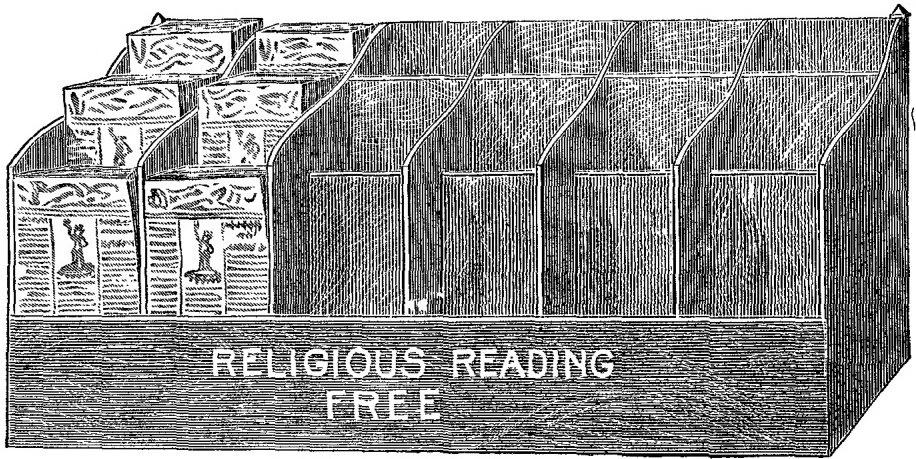
Literature Receptacle at Columbus Union Passenger Station
By C. L. Shelton
The above cut represents a receptacle for S. D. A. literature, now being used by the T. & M. Society in the Union Passenger Station, Columbus, Ohio. Societies or individuals desiring to get important matter before the public who would choose this method and style of box are informed that I am prepared to furnish the boxes and any information concerning same on application.