Your ShelfYour Projects

The Youth’s Instructor, Vol. 43, No. 12.

FREDERICK DOUGLASS

The Youth’s Instructor

Mar 21, 1895

S. D. A. Publishing Association · Battle Creek, Mich. · Mar 21, 1895

FREDERICK DOUGLASS.
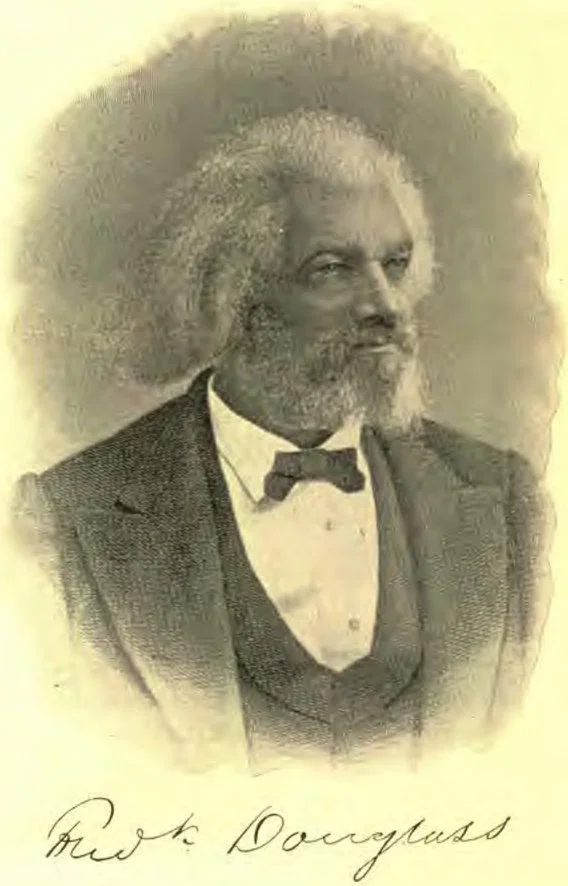
On the eve of February 20, in his seventy-eighth year, and unexpectedly, the greatest of America’s colored men died at his residence on Anacostia Heights, in the suburbs of the national capital. His death is an irreparable loss to the colored race, leaving a void which none is ready to fill. Commenting on his career the Inter Ocean says: “Few names in American history are surrounded with so much of the romance that delights the youth or instructs the old as is the name of this man, born a slave on a Maryland plantation [at Tuckahoe, Talbot county, in February, 1817] more than three quarters of a century ago, yet who, through his own practically unaided efforts, and at times combating against odds that would have overwhelmed a weaker man, climbed to the dizzy heights of fame. Though of an origin humble even for a slave, he has numbered among his friends the possessors of the brightest intellects that have adorned the century in this country and in Europe, and the wearers of all titles and patents of nobility. He probably was alone in the world in having lived to see all the hopes of his earlier years realized, beyond, indeed, his most fanciful longings. As an orator he probably had no peer, and he has enriched the language by the addition of many particularly striking epigrams, one of which—‘One and God are a majority’—will serve as an example of their originality and strength.”
His real name, given him by his mother, a slave, who like most colored persons was fond of high-sounding words, was Frederick Augustus Washington Bailey. At the age of ten his master sent him to Baltimore, having been hired, slave-fashion, by the proprietor of a shipyard. He soon earned good wages, but—every penny of the most scanty pittance his cruel master had allowed him he used to satisfy his great thirst for knowledge.
After this a good opportunity presented itself, and he, under the assumed name of Johnson, fled to New England, married, and settled down at New Bedford, Mass., where he obtained for several years permanent employment in a shipyard. As the Johnsons seemed to abound in that locality, he was induced by a certain gentleman who was a great admirer of the character of Douglass in Sir Walter Scott’s “Lady of the Lake,” to assume the name by which he became universally known. He was a reader of William Lloyd Garrison’s Liberator, and soon heard this great leader of the abolition movement lecture on his chosen subject, in which he made the famous declaration: “Prejudice against color is rebellion against God.” By this Douglass himself was won as an active worker in the cause that made him eventually so famous—the emancipation of the colored race. One of the first books he had ever purchased with the meager allowance of his slavery days was the “Columbian Orator,” for which he laid out all he possessed—fifty cents. Of the value of this book to him in after years Mr. Douglass himself says in his “Memoirs”:—
“This volume was indeed a rich treasure, and for a time every opportunity afforded me was spent in diligently perusing it. Among much other interesting matter, that which I read again and again with unflagging satisfaction was a short dialogue between the master and his slave. The slave is represented as having been recaptured in a second attempt to run away, and the master opens the dialogue with an upbraiding speech, charging the slave with ingratitude, and demanding to know what he has to say in his own defense. The slave rejoins that he knows how little anything that he can say will avail, seeing that he is completely in the hands of his owner, and with noble resolution calmly says, ‘I submit to my fate.’ Touched by the slave’s answer, the master insists upon his further speaking, and recapitulates the many acts of kindness which he has performed toward the slave, and tells him he is permitted to speak for himself. Thus invited, the quondam slave makes a spirited defense for himself, and thereafter the whole argument for and against slavery was brought out. The master is vanquished at every turn in the argument, and appreciating the fact, he generously and meekly emancipates the slave with his best wishes for his prosperity.”
“It is unnecessary to say that a dialogue with such an origin and such an end, read by me when every nerve of my being was in revolt at my own condition as a slave, affected me most powerfully. I could not help feeling that the day might yet come when the well-directed answers made by the slave to the master in this instance would find a counterpart in my own experience.
“This, however, was not all the fanaticism which I found in the ‘Columbian Orator.’ I met there one of Sheridan’s mighty speeches on the subject of Catholic emancipation, Lord Chatham’s speech on the American war, and speeches by the great William Pitt and by Fox. These were all choice documents to me, and I read them over and over again with an interest ever increasing because I was ever gaining in intelligence. The more I read them the better I understood them. They added to my limited stock of language, and enabled me to give tongue to many interesting thoughts which had often flashed through my mind, and died away for want of words in which to give them utterance. The mighty power of heart-searching directness and truth, penetrating the heart of a slave-holder and compelling him to yield up his earthly interest to the claims of eternal justice, are finely illustrated in the dialogue, and from the speeches of Sheridan I got a bold and powerful denunciation of oppression, and the most brilliant vindication of the rights of man.”
Here, then, we have a glimpse of the simple elements which entered into his make-up, like timbers for the framework of a mighty orator. He read many works of the leading minds, past and present, of different nations. His library was well equipped with standard English, French, and German works, and with current literature; for Mr. Douglass kept well abreast with the times up to the very day of his death, during the afternoon of which he attended the Convention of the Women of the United States, for whose work he had for many years manifested a very lively interest. He is the author of several works on slavery, and kindred topics, as well as of a history of himself entitled, “Life and Times of Frederick Douglass.” For several years he also edited a weekly paper, first (1847) called Fred Douglass’s Paper, and afterward the North Star, which he conducted with marked ability in the interests of the anti-slavery movement, although he met much opposition, even by such papers as the New York Herald. He filled various offices under the government, lectured in Europe and this country, on the abolition of the slave-system, and held equal rank with the foremost minds in the country in the great forensic art, the peer of the strongest men that dared to measure lances with him. Sneered at, hissed, mobbed, stoned, assaulted, he stemmed the tide, and came off conqueror every time. When even white men did not dare to speak the truth on the slavery question, he dauntlessly raised his clarion voice against that giant evil with no uncertain sound. And, thank God, he lived to see the fruition of his labor, his race freed from their disgraceful chains, their manhood vindicated, their civil rights recognized.
During the war he was one of the safest and among the most welcome counselors of President Lincoln. By his efforts several colored regiments were enlisted, and two of his own sons, Charles and William, served in them.
During the last years of his life Douglass lived quietly at his home, and spent his time with his friends and his books. Having learned to play the violin in his youth, he loved, when the young folks of Washington gathered about him at his Cedar Hill home, as they often did, to accompany some expert pianist with his violin, to the general satisfaction of his guests as well as his own; for he loved young people and their society very much.
He has gone to his long restingplace suddenly, but peacefully, and, as the writer has ample reason to believe, to rise in the first resurrection. Having been privileged to cross the ocean with him in 1887, when he returned from an extended stay in Europe, we frequently sought his society, and whilst conversing freely on current topics, in which we found him ever at ease, no matter what might be brought up, we sought to know his faith. In humble but frank and candid words he acknowledged his trust in the Great Redeemer for the salvation of his soul; and his whole life has been a bright and consistent one with such a faith, although he did not seem able to appreciate the importance of the seventh day Sabbath in distinction from first-day observance, as we could have wished he might.
A. K.

FREDERICK DOUGLASS.

O MAN of a despised race! Heaven's hand thy course of life did trace; Against each wily foe thy shield And strength in every battle-field. When Moses saw the bush aflame, He heard Jehovah speak his name; No less Jehovah spake to thee, And said: “Go! set thy people free!” As Moses went, so thou didst go To break their galling yoke of woe, And lead them through the purple sea Unto their Canaan — Liberty. And now, O Douglass, thou dost stand Among the honored of the land; Though dead, thy deeds live on for good, Proclaiming still man's brotherhood.
—Adapted from the Inter Ocean.

GLIMPSES OF ANIMAL LIFE.

I.—AMŒBA.

Did you ever consider how brimful our world is of life, and what a different place it would be if no living thing had ever been upon it? There is scarcely a waking moment of our lives in which our eyes do not rest either on some living thing or upon things which once had life. Even in our rooms, the wood of our furniture and our doors could never have been without the action of life. The marble from which our beautiful monuments are chiseled, is the remains of once living creatures, being composed of their broken shells. The food we eat, the clothes we wear, the very paper upon the wall, are all made of materials which life has produced for us.
Wherever we go, living creatures are to be found, and even if we sail out over the silent deep, and try to search what is hidden beneath, there, too, we find abundance of life.
Now since we live in a world teeming with living beings of every description, many of them leading very curious lives, but trying, like us, to make the best of their short time here, is it not worth our while to learn something about them? They, each in his way, all proclaim the love and skill of the heavenly Artist, and show forth the glory of God; for his character is manifested in all the beautiful objects of life and nature. Mrs. E. G. White says: “Every created thing has in it charms which interest the child of God, and mold his tastes to regard these precious evidences of God’s love above the work of human skill.” So let us continually keep this thought before us, as we study the works of the great Life-giver.
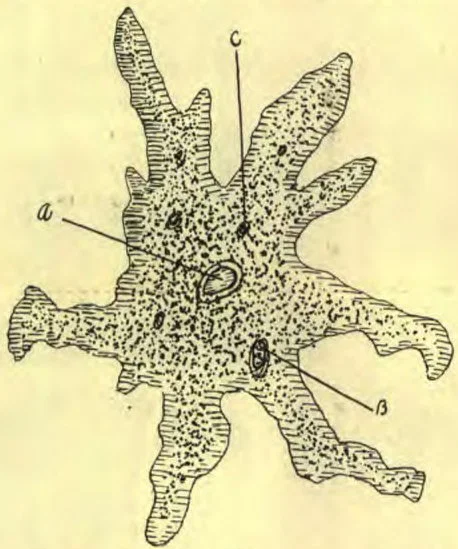
We will begin with the simplest form of living beings, aided in our search by the microscope. If we dip some water up out of a standing pool, where the leaves or stems of submerged plants are found, and place a drop of it under a microscope, we see thousands of living creatures floating in search of food. Selecting one, let us examine it. As we look at it, gliding over the glass, sometimes it appears like a mere drop of gum. Sometimes we see it with its pseudopodia, or false feet, stretched out and seeking food. But examine it as we will, we can find no mouth, no stomach, no muscles, no nerves. It is merely a cell,—a bit of protoplasm, which is the basis of all life.
This little animal is called the “amœba,” and belongs to the lowest class of life, the Rhizopoda. Its food consists mostly of portions of thread-like plants. But how does it eat without mouth or stomach? After selecting its food, as for example a minute plant, it swallows it by moving toward the object, and gradually closing around it, until it is enveloped within the creature’s body, which is so transparent that the food can be seen through it. The animal then has power to digest it and absorb it after digestion.
Throughout the body are granules which have a rude sort of circulation. Besides the food particles, there is also in or near the middle a clear round body called the nucleus, and, usually, a hollow, round, pinkish space, which enlarges and contracts, called the “contractile vesicle.”
The amœba reproduces its kind by simply dividing into two portions. The division begins by the nucleus separating itself into two parts, and this continues until the entire animal has split in two, and each half goes on its way rejoicing, as a living animal. It divides and subdivides itself in this manner several hundred times in a few moments.
But how can we be sure that it lives?—In the first place, it breathes. If we keep it in a drop of water, it uses up the oxygen, and makes the water impure by breathing into it carbonic acid. Then it moves, and can drag in and throw out its false feet, when and where it chooses. It eats; it grows; it reproduces itself. This little drop of slime, without eyes or ears or parts of any kind, knows how to find its food; without muscles or limbs, it is able to creep; without a stomach, it can digest the food in the midst of its own slime, and throw out the hard parts which it does not want. Thus are foreshadowed in this exceedingly simple organism all the important functions of higher animal life.
T. J. ALLEN.

The Tongue: Best or Worst of Creatures

PITTACUS (652–569 B. C.), one of the seven wise men of Greece, received from an Egyptian king at one time a sacrificial beast, with the request to cut out and return what he considered the best and the worst part of it, and to keep the rest for himself. The sage sent back the tongue of the beast to the donor, with the explanation that it, according to the use it is put to, for good or for evil, was either the best or the worst part in man. What use do you and I, dear reader, make of the tongue?

THE SEA ANEMONE.

THE sea anemone resembles in shape a morning-glory. Its mouth opens like the cup of that flower, and above it are seen a number of tentacles waving in the water. Its food consists of anything it can get, but generally it gets the minute insects that float in the sea. At any alarm it closes its cup, and is then hardly distinguishable from the rock on which it is rooted. It has a set of sucker muscles that attach it so firmly to the rock that it will sometimes be torn in pieces rather than let go. — Selected.

Gulf Stream Travel Time to Norway

It is estimated that two years are required for the Gulf water to travel from Florida to the coast of Norway.

TRADING WITH THE TALENTS.

IN TWO PARTS.—PART I.

Years ago there lived in London a preacher of the gospel—a good, courageous man, who was always on the look-out for opportunities to be of service in the Master’s vineyard. His plans were not soon set aside by difficulties or dangers. No opportunity was so unfavorable, seemingly, but he would try to improve it; and no danger so great as to prevent his entering an untried field where he believed good might be done. He thought he could find a field for personal labor in London’s neglected districts.
One day he walked into Ratcliffe Highway. This was at a time when that locality was known far and wide as a home for desperate and wicked characters of both sexes, and as a rule respectable people kept away from the neighborhood as far as they possibly could. His clerical dress and loitering movements soon attracted attention; for very few clergymen were ever seen in those parts. By and by an old woman, who was smoking a dirty clay pipe, spied him, and made up her mind to have some fun. She went up to him and accosted him. After a little conversation, she hurried away, and called the neighbors from different alleys to come and hear a parson preach a sermon, and said it was arranged that she was to give him the text for his discourse. Very soon an odd-looking congregation, out of sheer curiosity, gathered around the man—a company poorly clad, of rough manners, unlearned, in almost all respects the direct opposite of the cultured audience that Paul addressed at Athens, but perhaps no less hopeful in the eyes of Heaven as subjects of salvation.
When the minister had found a position from which he could see his congregation, the old woman called out to him in a squeaky voice that as soon as he was ready to begin, she would give him the text. At a nod from the minister she repeated the old nursery rhyme:—
“Little Bo-Peep has lost her sheep, And can’t tell where to find them; Let them alone, and they’ll come home, And bring their tails behind them.”
The text very much amused the congregation, who were given up for a time to merriment over it. This may seem strange to us, but it should be remembered that people in those days were not accustomed to hearing texts for a sermon taken from any other source than from the Bible. When the last hearty peal of laughter had died away, the minister, with heart uplifted to Heaven for that wisdom which cometh alone from above, began to tell the beautiful story of the good Shepherd, who left the ninety and nine sheep safely sheltered in the fold, and went away to find and bring home the one sheep that was lost. He told how he searched for it a long time, enduring weariness and suffering, finding it at last, torn and almost hunted to death by wolves, and brought it back upon his shoulders rejoicing.
“But none of the ransomed ever knew How deep were the waters crossed, Nor how dark was the night that the Lord passed through Ere he found his sheep that was lost.”
Passing on in his discourse, the preacher considered the line in this remarkable text,—
“Let them alone, and they’ll come home,”
and told his hearers it is one of Satan’s falsehoods to pacify those who feel anxious about the lost and perishing, to prevent them from leading such to the Good Shepherd, so that he whom we are warned in God’s word goeth about like a roaring lion seeking whom he may devour, might find the sheep at his mercy and destroy it. “Let them alone,” Satan says; “don’t worry over them; let them alone, and they’ll come home all right.” But no sheep would ever find its way back to the fold if the Good Shepherd did not go after it, and carry it home.
In dwelling on the last line of the text, he spoke of the tale the sheep brought home with him—a doleful story of unhappiness from the very first day of his wanderings—a tale of cold and hunger and of misery that followed; but the poor sheep never wearied telling of the great kindness of the Good Shepherd who heard his cry of distress, and came at once to his relief, when, as he brought him homeward,—
“All through the mountains, thunder-riven, And up from the rocky steep, There rose a cry to the gate of heaven, ‘Rejoice! I have found my sheep!’ And the angels echoed around the throne, ‘Rejoice, for the Lord brings back his own!’”
A. STUTTAFORD.

THREE LITTLE TOTS.

Three little tots, so glad and free, Came bounding down the street; The air was filled with shouts of glee And childish laughter sweet. For blossoms bright each one had found A bunch of gay-hued leaves, Where autumn strewed them o'er the ground From the many-colored trees.
When all at once,— O, sad mishap, One caught her foot, and fell! Her sweet face struck the cold, hard walk, And her leaves were thrown pell-mell. How quickly changed the voice of glee To tones of childish woe! She tried to rise from where she lay On the walk, so prone and low.
The other tots were sore dismayed To see this one in pain, And quickly ran to give their aid, And help her up again. And while one wiped away her tears, And said, “O do not c'y!” And with the thoughtfulness of years To soothe her grief did try,
The other picked her treasures up, And said, “I'll give you some Of mine with yours, because, you see, Some pretty ones are done.” And so with artless love and grace They comforted this one, Till smiles again illumed her face, And tears had ceased to run.
And then together on they went, As joyous as before; The cloud of but a moment spent, And all was bright once more. How sweet is kindly sympathy To those in trouble keen! How rare this grace of charity 'Mongst brethren to be seen!
MRS. S. W. CLARK.

JOURNALISM IN JAPAN.

JOURNALISM in Japan appears to be surrounded by some stern restrictions, the desirability of abolishing or amending which has lately been occupying the attention of the Japanese parliament. In Europe, when newspapers offend against the law, fines are inflicted on the editor, writer, printer, or publisher, as the case may be. But in Japan it appears that the journalists begin by paying a fine, though the amount may possibly be returned to them in course of time, for that is the practical result of depositing sums of money with the authorities, varying from three hundred and fifty to one thousand yen yearly as evidence of good faith. If fines are inflicted, at any rate, of less than the amount of the deposit, there can be no question of nonpayment.
A motion was made to abolish this deposit, as also the power of the government to suspend a paper which published anything calculated to disturb the public peace, but the right of suspension was retained by eighty-one votes to forty-eight, and as to the desirability of demanding the security, the House was unanimous. It was explained that the House felt the necessity of keeping some check on “irresponsible agitators unfit to wield journalistic influence,” and there is a good deal to be said for the contention. “Woman’s rights” advocates will be extremely offended at one amendment which was accepted. No woman is allowed to become an editor or publisher in Japan.—London Standard.

ENCOURAGED BY CHILDREN.

DURING the great Reformation the leading reformers once held a general counsel at Torgau. For a long time they had considered the situation, viewing it from all sides, and had become very solicitous and burdened with care over it. In the midst of their deliberations, Melanchthon was called out, and had to pass through a room where a number of Christian mothers and their God-fearing children had assembled to plead with God for the reformers. This sight cheered the down-cast man to such a degree that he returned with radiant countenance to the counsel chamber, and confidently said to Luther in the hearing of all, “We need not be worried any more; for I have seen those who wrestle for us in our defense, and they will not be put off nor overcome by anything.”
My dear young reader, are you praying for the work of God in such a manner that this could be said of you, too? If not, why not?

A FORGIVING DOG.

WHEN the dog tax was first imposed in France, many of the people set to work to get rid of their useless dogs, so as to avoid paying a tax for them.
A Frenchman had an old Newfoundland dog. He coaxed the dog to the river side, told him to lie down, tied all his four feet together with a rope, and pushed him into the Seine. The dog in his struggles loosened the rope, and, with great difficulty and panting for breath, scrambled up the steep bank. There stood his master, stick in hand, to drive him back. He struck at the dog, and then coming to close quarters, gave him a violent push, in doing which he somehow lost his own balance, and himself fell into the water. His hopes of life would have been very few indeed, if the dog had not been “the better man of the two.” But the dog, forgetting the treatment he had just received, plunged, of his own accord, into the river, where he had so nearly met his death, and spent the remaining strength in saving his would-be murderer. It was a hard struggle, but he came off conqueror; and the two walked home together, the one triumphant, the other, let us hope, repentant.—American Youth.

The Conceited Person Who Loves to Brag

A CONCEITED person loves to brag about self.

THE SILENT BATTLE.

SHALL I tell you about the battle That was fought in the world to-day, Where thousands went down, like heroes, To death in the pitiless fray?
You may know some of the wounded And some of the fallen, when I tell you this wonderful battle Was fought in the hearts of men.
Not with the sounding of trumpets, Nor clashing of sabers drawn, But silent as twilight in autumn All day the fight went on.
And over against temptation A mother's prayers were cast, That had come by silent marches From the lullaby land of the past.
And over the field of battle The force of ambition went, Driving before it, like arrows, The children of sweet content.
And memories odd and olden Came up through the dust of years, And hopes that were glad and golden Were met by a host of fears.
And the heart grew worn and weary, And said: “O, can it be That I am worth the struggle You are making to-day for me?”
For the heart itself was the trophy And prize of this wavering fight!
And tell me, O, gentle reader, Who camps on the field to-night?
— Interior.

THE ALTAR OF BURNT OFFERING.

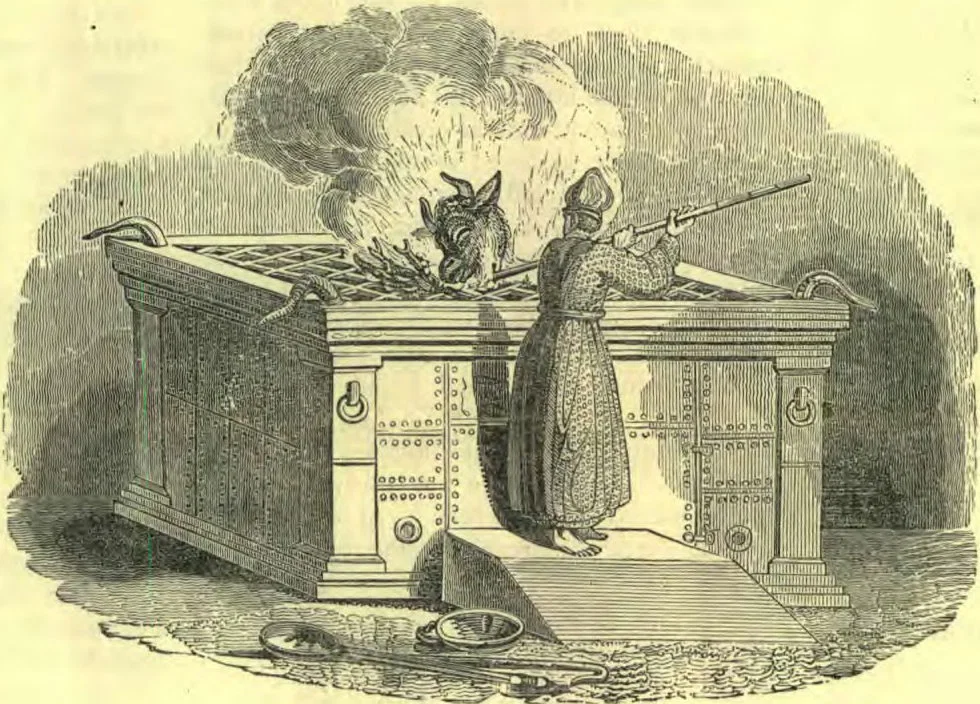
This altar, as erected in the wilderness, was five cubits long, five cubits wide, and three cubits high. This would make it perhaps eight feet long by eight feet wide by five feet high. It would be too high for a man to take care of the things that were offered upon it, unless there was a step to it. No account was made of the altar step in the wilderness, but in the direction given to Ezekiel the Lord told him where to place the step.
The altar was hollow, and on the top was a grate, like a register, only with larger openings, through which the ashes would fall as the wood and offerings were consumed. This grate had rings in it, so that it could be lifted out when necessary. Ex. 27: 1-8; 38: 1-7.
The fire upon this altar was to be kept burning continually. Every morning the priests would put the offering in order upon it for a burnt offering, and all during the day parts of the various offerings were put into the fire on the altar; then all during the night the fire burned. In the morning the priests threw the ashes out at the side of the altar; then, taking off their priestly robes, they carried the ashes out to a clean place without the camp, and deposited them. At this place where the ashes were placed, the parts of the offerings that were not burned upon the altar, were made to burn with the wood, set for that purpose.
When an offering was made by one of the children of Israel, the priest would take the blood of the sacrifice, and sprinkle a little of it before the veil, and with his finger he would put some of the blood on the horns of the altar of incense; then the rest of the blood would be carried out, and turned out at the side of the altar of burnt offering, on the side where the ashes were thrown out.
But that sacrifice which gave the altar of burnt offering its name, was the burnt offering of the morning, sometimes called “a whole burnt offering,” because the whole of the victim was consumed upon the altar.
Nothing was kept back, nothing saved; and so we are asked to present our bodies to God, “a living sacrifice, holy, acceptable unto God,” which for us is a “reasonable service.” If we do this, all the wrong and evil that are within us will be burned away; we will be tried in the fire until the gold is pure, and then we will be fit for the kingdom of God.
If we do not make this gift to the Lord now, by and by we will be compelled to be burned in the fires of the last great day, from which death we will never awake. Let us give ourselves unto God now, and then we will not be afraid to meet him when he comes; for we really are his, anyway. J. G. LAMSON.
THE ALTAR OF BURNT OFFERING.
The altar of incense was placed in a line between the door of the court and the door of the tabernacle, but nearer the door of the court. Ex. 40: 6, 29. The laver, with its foot, or base, stood between the altar of burnt offering and the door of the tabernacle. The laver was used to hold water for the priests. Here they were to wash their hands and feet before ministering in the tabernacle. The Israelites all came within the court to present their vows and offerings to the Lord. The door of the court and the tabernacle, when erected, always faced the east, as did also Solomon’s temple. The people turning to these to worship before the Lord would therefore turn their backs toward the east, to distinguish them from the idolatrous nations round about them who worshiped the sun, facing the east in so doing. (See Eze. 8: 5-16.) M. H. BROWN.
Continue reading: IN MERCY'S NAME