The Youth’s Instructor, Vol. 49, No. 5.

Tegucigalpa

The Youth’s Instructor

Jan 31, 1901

Review and Herald Publishing Company · Battle Creek, Mich. · Jan 31, 1901

Tegucigalpa
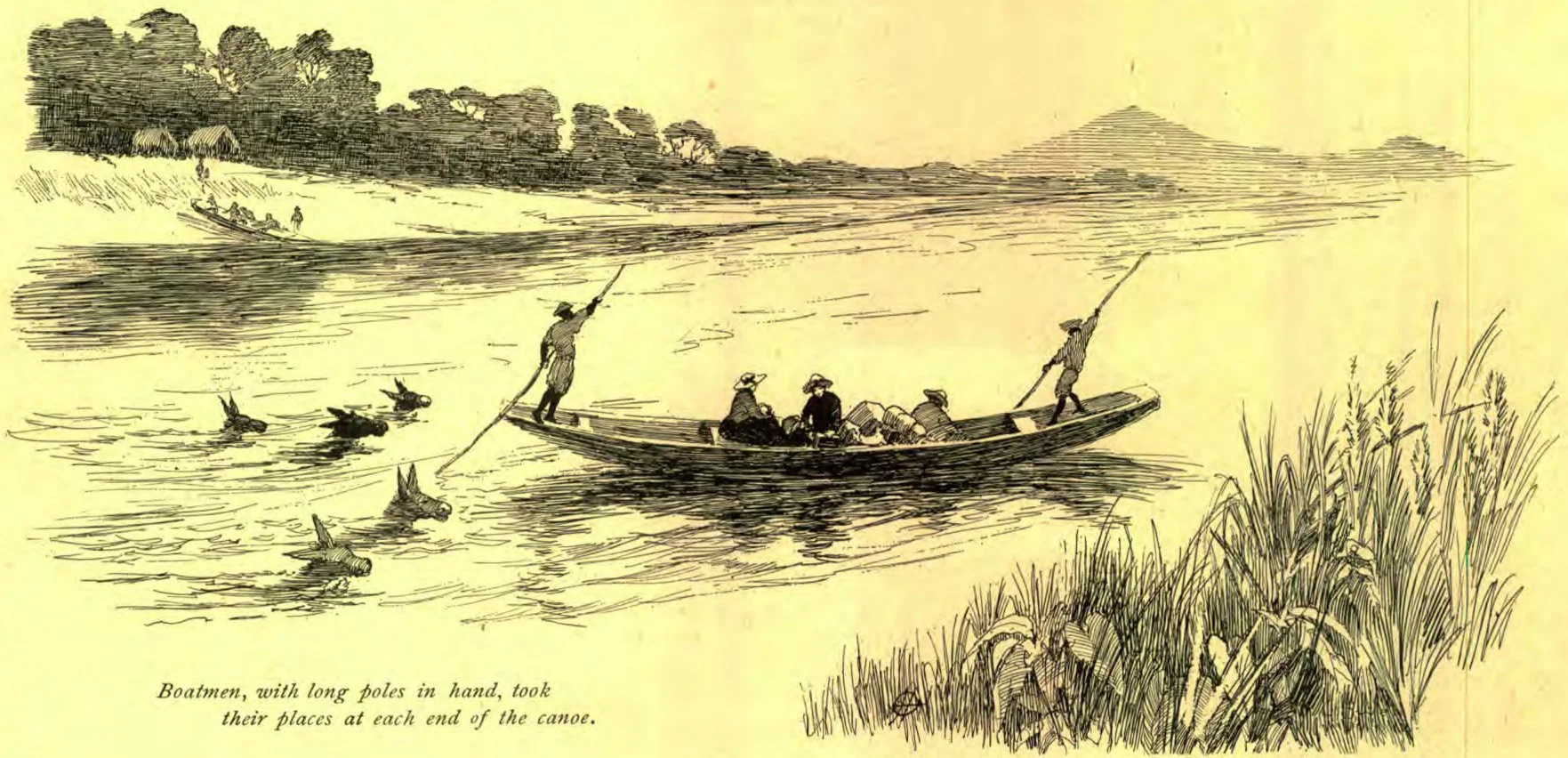
The caravan came to a sudden halt at the bank of a river. We alighted, and were led down to the water’s edge, where a long canoe awaited us. Saddles and packs were quickly stripped from the animals, and placed in the middle of the dugout, we finding seats on the packs. Half-naked boatmen, with long poles in hand, took their places at each end of the canoe, and we slid out into the current. The drivers urged the animals down the bank, and they followed us across, swimming with only their heads above water. At the landing-place, considerably down stream, they climbed to the grass-covered level, and stood grazing and dripping, their shiny coats reflecting the sunlight.
An hour’s rest in the shade of the boatmen’s hut, regaled with sugar-cane and muddy river-water, and entertained with the strains of a cheap accordion, and then at the call, “Listu!” we mounted, and rode until twilight.
The nights in the uplands of the country are cool, blankets being necessary to comfort. A heavy dew falls, and in the morning a fire is not objectionable. The tile roofs of the houses are of various tints, according to the quality of the clay in different sections of country; but the walls, when finished, are a uniform white. Sometimes the huts are more like playhouses for children than dwellings. Tiny doors made of a single cedar plank eighteen inches wide are common; and if there are windows, they are more tiny still, being as small as six by twelve inches, letting light into a room eight by ten feet square. But windows of any size are the exception, not the rule.
Every village we passed was situated by a stream of water, which serves as a public bath, also as a washing-place for the women. Little care is taken to obtain pure water for drinking and cooking purposes. The donkey water-carriers are driven into the streams either above or below a crowd of women, who are doing their week’s washing. This explained to us why the drinking-water had sometimes tasted soapy. Children attend the donkeys, and fill the leather or earthen water-bottles, using large gourds, or calabashes, as dippers.
Boatmen, with long poles in hand, took
 their places at each end of the canoe.
Boatmen, with long poles in hand, took their places at each end of the canoe.
In spite of warnings from the natives, we bathed in the streams after the heat of the day. These baths were a great treat. The soft rock formations had been scooped out in places by the action of the water, so that we found primitive bath-tubs of all descriptions. If you want a bath never to be forgotten, ride on the back of a mule to the valley of El Souce in Olancho, and inquire for the casa of Don Antonio Francisco. He or his good wife will take you by a path that leads from his door past the corral of split rails, and down a gentle slope of pasture. You will probably find women washing at a spring under some guava bushes at the right; and after leaving them a little way behind, you will begin to hear the fuss of a small stream as it jumps from one pool to another. There your guide will leave. You will forget, in the soothing of those waters, that there are fleas and jiggers in Honduras.
Near Tegucigalpa the paths that wind around the mountains are hewn from the soft rock, and though worn and washed for centuries, are still passable by the sure-footed mules. A cart is a useless encumbrance in this country, except in the larger towns.
The fertile flats along the course of a stream to which we descended later in the day were planted to corn. The time was late in September. The fields were well laid out, and the young corn was kept free from weeds. Men were at work in the fields with bill-hooked tools, which were unlike any agricultural implements used in the United States. We saw men plowing with oxen; the plow was of wood, with an iron point, and the plowman controlled it with a single handle.
Stone fences bordered the highway and separated the fields. At times we were reminded of New England, and then again a turn of the road would bring a cluster of native houses, a banana plantation, or a caravan of mules with rawhide pack-saddles—sights that would dispel our New England illusion abruptly. Once we crossed a stream on an iron bridge constructed by a North American firm; next time we forded it, and noticed that stepping-stones were provided for foot-passengers.
Caravans of mules and donkeys returning light from market, women with wooden trays on their heads, children carrying home unsold dainties from their parents’ stalls in the market, ox-teams with yokes lashed to their low-bent heads, and slow-moving carts, with clumsy wooden wheels,—all told us that we were entering the capital city.
At once we were there, a turn in the road bringing the city in sight. A Catholic school for boys was just ahead; and beyond, above the tops of the houses, rose the white walls of the churches and the government buildings. The streets were paved with cobblestone, and in the principal part of the town were narrow cement sidewalks, which made it much easier to get about than in Jutigalpa. Also greater crowds were here, more business, and an appearance of prosperity not found in the other cities visited.
President Serra seems to be much interested in the education of his people, and visits almost daily the school of mechanical arts that has been established near his palace. The native boys are quick to learn, and are turning out some very neat wood and metal work. Tramps who can not give an account of themselves are set to work upon the public roads, which are also an object of the president’s special care. Three miles of well-paved road are completed on the way to the Pacific coast town of Arna Pola, the seaport of the capital.
H. A. OWEN.

IDLENESS IS SIN

MINISTERS and physicians should understand their own building, the body. They should learn how to use and develop their capabilities. They should see the need of learning how to use every part of the human machinery, how to give solidity to the muscles by employing them in taxing, useful labor. Young men who do not think deeply enough to take in the situation, who do not reason from cause to effect, will never succeed as physicians. The love of ease, and I may say, of physical laziness, unfits a man to be either a physician or a minister. Those who are preparing to enter the medical work or the ministry should train brain, bone, and muscle to do hard work; then they can do hard thinking.
For healthy young men, stern, severe exercise is strengthening to the whole system. And it is an essential preparation for the difficult work of the physician. Without such exercise the mind can not be kept in working order. It becomes inactive, unable to put forth the sharp, quick action that will give scope to its powers. Unless he changes, the youth with such a mind will never become what God designed he should be. He has established so many resting-places that his mind has become like a stagnant pool. The atmosphere surrounding him is charged with moral miasma. Study the Lord’s plan in regard to Adam. He was created pure, holy, and healthy; and he was given something to do. He was placed in the garden of Eden “to dress it and to keep it.” He was not to be idle. He must work.
God has ordained that the beings he has created shall work. Upon this their happiness depends. Healthy young men and women have no need of cricket, ball-playing, or any kind of amusement just for the gratification of self, to pass away the time. There are useful things to be done by every one of God’s created intelligences. Some one needs from you something that will help him. No one in the Lord’s great domain of creation was made to be a drone. Our happiness increases, and our powers develop, as we engage in useful employment.
Action gives power. Entire harmony pervades the universe of God. All the heavenly beings are in constant activity, and the Lord Jesus, in his life-work, has given an example for every one. He went about “doing good.” God has established the law of obedient action. Silent but ceaseless, the objects of his creation do their appointed work. The ocean is in constant motion. The springing grass, which to-day is, and to-morrow is cast into the oven, does its errand, clothing the field with beauty. The leaves are stirred to motion, and yet no hand is seen to touch them. The sun, moon, and stars are useful and glorious in fulfilling their mission.
At all times the machinery of the body continues its work. Day by day the heart throbs, doing its regular, appointed task, unceasingly forcing its crimson current to all parts of the body. Action, action, pervades the whole living machinery. And man, his mind and body created in God’s own similitude, must be active in order to fill his appointed place. He is not to be idle. Idleness is sin.
There is true dignity in labor. Among the believers in Christ there was not one apostle who was exalted as was Paul by the revelation of the Saviour in his conversion. And Paul labored with his hands as a tent-maker. In the midst of his zeal in persecuting the Christians, Paul had been arrested by a voice and a great light from heaven. During his ministerial labors he had several visions, of which he spoke little. He saw and heard many things not lawful for a man to utter. That which was given him as a special revelation from God was not at all times dwelt upon when he spoke to the people. But the impression was ever with him, enabling him to give a correct representation of the Christian life and character. The impression made upon his mind by the revelation of Christ never lost its force. It influenced his estimation and delineation of Christian character.
The history of the apostle Paul is a constant testimony that manual labor can not be degrading, that it is not inconsistent with true elevation of character. Paul worked day and night to avoid being a burden to his brethren, and at times he supported his fellow workers, he himself suffering from hunger in order to relieve the necessities of others. His toil-worn hands, as he presented them before the people, bore testimony that he was not chargeable to any man for his support. They detracted nothing, he deemed, from the force of his pathetic appeals, sensible, intelligent, and eloquent beyond those of any other man who had acted a part in the Christian ministry.
In Acts 20:17-35 we see outlined the character of a Christian minister who faithfully performed his duty. He was an all-round minister. We do not think it is obligatory on all ministers to do in all respects as Paul did. Yet we say to all that Paul was a Christian gentleman of the highest type. His example shows that mechanical toil does not necessarily lessen the influence of any one, that working with the hands in any honorable employment should not make a man coarse and rough and discourteous.
MRS. E. G. WHITE.

THE WORLD’S ANNUAL BOOK CROP

It has not so far been ascertained just how many books are published annually throughout the world. Mr. Ronald Smith has, however, succeeded in giving us the average annual production of books in thirteen countries: the United States, the United Kingdom of Great Britain, Canada, France, Germany, Italy, Egypt, the Netherlands, Belgium, Norway, Denmark, Sweden, and Switzerland. From his report it appears that “the total number of books issued by these thirteen countries in a year averages 77,250. Germany has the honor of publishing the most books per annum, her average being 23,908; France produces 13,268 volumes a year; Italy, 9,567; the United Kingdom of Great Britain, 7,249; the United States, 5,315; the Netherlands, 2,863; Belgium, 2,272; Denmark, 1,198; Switzerland, 1,000; Canada, 735; Norway, 589; Egypt, It seems that “the figures for Sweden are given as 9,122, but as 8,346 of these are ‘pamphlets,’ it seems hardly fair to place Sweden by its full figures. It comes next to Switzerland, probably.” It is interesting to note that out of the total of 77,250 volumes produced by the thirteen countries, 11,631—nearly one seventh—are educational and classical books; 7,948 are novels; 7,306 are on the arts and sciences; 7,199 treat of political and social economy; 5,969, theology and sermons; 4,628, history and biography; 4,535, medicine and surgery; 4,420, essays and belles-lettres; 4,009, law and jurisprudence; 2,689, poetry and drama; 2,460, voyages, travels, and geography; 181, sport; and 13,275 were miscellaneous books and pamphlets. Finally, Mr. Percy L. Parker, who has carefully dissected and rearranged Mr. Ronald Smith’s figures, states that “Germany publishes the most books in no fewer than seven out of the twelve classes into which the books are divided. In only one class of books does England get a first place, and that class is—novels. France manages to get two first places, for history (which one would expect Germany to have), and for poetry and the drama. France also ties with the United States in publishing an equal number of books on sport. Italy is the only other country which secures a first place, and that is for its famous books on political economy.” Only about one fifteenth of the world’s yearly output of books is produced by the United States. AUGUSTIN S. BOURDEAU.

IF WE UNDERSTOOD

COULD we but draw back the curtains That surround each other's lives, See the naked heart and spirit, Know what spur the action gives, Often we should find it better, Purer, than we think we should: We should love each other better, If we only understood.
Ah! we judge each other harshly, Knowing not life's hidden force; Knowing not the fount of action Is less turbid at its source; Seeing not, amid the evil, All the golden grains of good: O we'd love each other better, If we only understood!
— Selected.

READERS AND READING

In these days, when the greatest literary efforts of the world’s renowned writers can be procured for a few pennies, what to read often becomes a difficult problem. Just as the physical man of the future depends largely upon what the boy eats to-day, so the intellectual attainments that the bright, ambitious young man is to reach to-morrow depend to a great degree upon the food he gives his mind to-day. And just as there can never be constructed an ideal universal diet list, that will be equally beneficial to all, so no stereotyped list of books and magazines, that will be equally valuable to all minds, can be compiled; but as there are certain general principles underlying the diet question, which are of universal application, so there are some fundamental principles that should be equally suggestive as to the class of literature we should patronize.
A proper diet for the physical man furnishes him with normal strength, rather than stimulation; so any reading that simply stirs up the emotions and impressions for the time being is sure to leave the mind weakened for the practical duties of life. I have seen a boy read a fascinating book, describing various imaginary Indian encounters and adventures on the Western borders; and as he read, he would become thrilled with ambition—not to care more tenderly for his little brother, but to go West, there to do still more wonderful things than those he was reading about. Who has not seen a girl so possessed with the desire to imitate some heroine of a story-book, that she looked upon peeling potatoes and ironing clothes as duties that were absolutely tame, and too insignificant for her to engage in?
Such books, no matter what their title, nor how well recommended they are, will simply act as stimulants to the mind, just as liquor does to the nerves, and will as surely leave corrupting influences behind them.
Good reading should be of such a character as to either impart valuable information or else create within us a noble purpose, that will inspire us to achieve greater attainments for God and for humanity. DAVID PAULSON, M. D.

GOD'S THOUGHTS

God has a thought for the maple; Lo, there is the thought — the tree. What is God's thought for the granite? Look at the granite, and see.
What God thinks of the grass Is told by the cool, green sod; The rose, unfolding its petals, Discloses a thought of God.
His thought for the butterfly Is writ on the insect's wings; The word he speaks to the skylark You hear when it soars and sings.
We think we are more than the flower, More than the tree or sod; But ah! do we live our lives As true to the thought of God? — D. M. Henderson.

THE CHICKADEE

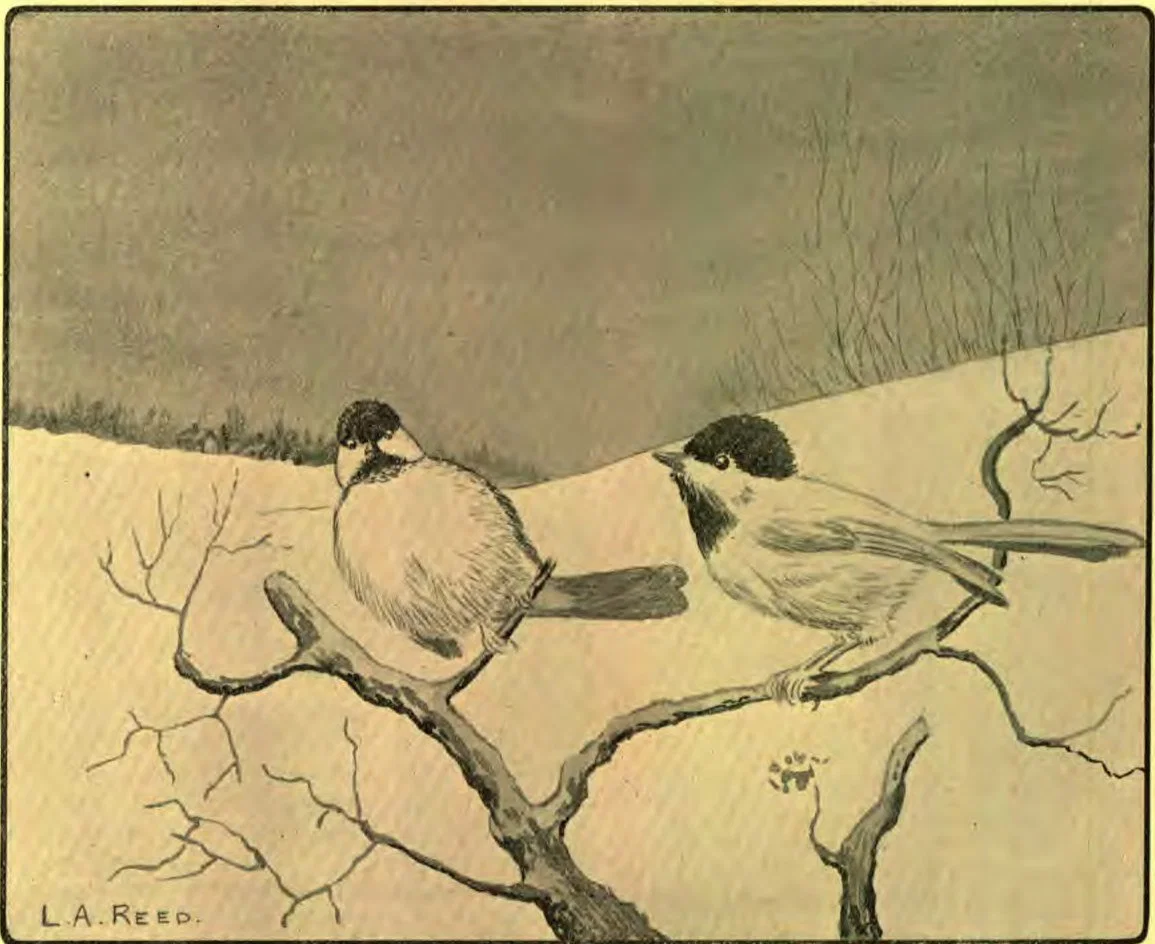
The Chickadee, one of the most interesting birds of winter, is very common everywhere in the Northern and Middle States, and is not confined to any special locality, being equally at home in the door-yard and in the depths of the woods. He has another name, Black-capped Titmouse, given him because of the black cap on his head. The name of Chickadee was bestowed on account of his familiar song. Chickadees are never silent, but are uttering their “chick-a-dee-dee,” “phee-bee,” or “tsee-deet” all day long. Some persons think the note “phee-bee” is the bird’s love call.
Chickadees are very tame. Dr. C. C. Abbott says he has often had them within arm’s length of his person. When thus near, they looked at him, he says, with a curious twist of the head, and expression of satisfaction, as much as to say, “I’m glad I’m not such a looking thing as that.”
Thoreau speaks as follows of their familiarity: “As I stood looking, I heard a smart ‘tche-day-day-day’ close to my ear, and looking up, saw four or five Chickadees, which had come to scrape acquaintance, hopping amid the alders within three or four feet of me. I had heard them farther off at first, and they had followed me along the hedge. They ‘day-dayed’ and lisped their faint notes alternately, and then, as if to make me think they had some other errand than to peer at me, they pecked the dead twigs,—the little top-heavy, black-crowned, volatile fellows.”
THE CHICKADEE
THE CHICKADEE
Professor Chapman relates that on two occasions Chickadees have flown down and perched upon his hand. “During the few seconds they remained there,” he says, “I became rigid with the emotion of this novel experience. It was a mark of confidence which seemed to initiate me into the ranks of woodland dwellers.”
A remarkable instance of the maternal devotion of a Chickadee is given by Dr. Brewer: “A Black-cap was seen to fly into a rotten stump near the woodside in Brookline. The stump was so much decayed that its top was readily broken off, and the nest exposed. The mother refused to leave until forcibly taken off by the hand, and twice returned to the nest when thus removed; and it was only by holding her in the hand that an opportunity was given to ascertain that there were seven young birds in her nest. She made no complaints, uttered no outcries, but resolutely and devotedly thrust herself between her nestlings and the seeming danger. When released, she immediately flew back to them, covered them under her sheltering wings, and looked up in the faces of her tormentors with a quiet and resolute courage that could not be surpassed.”
The Chickadee has an interesting way of answering when his call is skillfully imitated. Professor Chapman gives an excellent description of this habit:— “I never hear his voice in the woods without answering him. Soon he comes to me, mildly inquisitive at first, looking about for the friend or foe whose call has attracted him. In an unconcerned way he hops from limb to limb, whistling softly the while, picking an insect’s egg from beneath a leaf here, or larva from a crevice in the bark there, all the time performing acrobatic feats of which an accomplished gymnast might be proud. Finally his curiosity becomes aroused, he ceases feeding, and gives his entire attention to the discovery of the bird who so regularly replies to him. Hopping down to a limb within three feet of my head, he regards me with a puzzled intentness; his little black eyes twinkle with intelligence, he changes his call, and questions me with a series of ‘chick-a-dees,’ liquid gurgles, and odd chuckling notes, which it is beyond my power to answer; and finally, becoming discouraged, he refuses to renew our whistled conversation, and retreats to the woods.”
The Chickadee is one of the most useful of our winter visitors, as he helps greatly to prevent the ravages of several very injurious insects. He lives on grubs and on the eggs of moths hidden under the bark of trees, and is especially fond of the eggs of the cankerworm moth. One of the members of the Massachusetts State Board of Agriculture, Mr. Forbush, calculated that one Chickadee in one day would destroy five thousand five hundred and fifty eggs, and in the twenty-five days in which the cankerworm moths run or crawl up the trees, nearly one hundred and forty thousand eggs. He attracted a number of the birds to an infested orchard; and while other orchards in the neighborhood were seriously infested the next season, this particular orchard escaped with only a few worms.
Because of their practical value to man, no less than for their cheery companionship, the Chickadees should receive our loving and loyal protection. L. A. REED.

THE KIND TRAVELER

IN the railway station of a little town in northern Indiana were gathered, not long ago, a number of persons who were to take the evening train. Among the others was Mrs. Vance, a lame lady, going with her young nephew to a distant city.
Almost as soon as the glass slide of the ticket-office was shoved away, Mrs. Vance stepped up, poured out the contents of her little purse, and counted out the amount necessary to pay for two round-trip tickets. A tall gentleman who stood near, awaiting his turn, could not help seeing that the lame woman had but a few pennies left, and he asked, kindly, “Are you going to give it all?”
“No, not quite,” replied Mrs. Vance, smiling back in quick recognition of the sympathy conveyed in his tones.
Just then the ticket-agent, having counted the money, handed one piece back to Mrs. Vance, saying, “This will pass for only twenty cents; it is a Canadian quarter.”
“Let me have it,” said the stranger; “it will pass for twenty-five cents in South Bend, where I live.”
She was old, gray, shy, and plainly dressed, and in all her experience of more than sixty years, had seldom met with such quiet, matter-of-fact courtesy, and she felt very grateful, even though it was but a small thing.
A few moments more, and the train came rushing in; the lame woman was lifted to the platform, and went limping into the car. No one offered her a seat until she reached the kind traveler, who at once said, “Take this seat; I can find another.”
When she and her nephew reached their destination, their friend got off, too, and on passing him, the woman said, in spite of many listeners, “I hope, sir, you will always meet with uniform courtesy.”
“Thank you,” he replied, and she passed out with the feeling that something beautiful had happened, that she would never forget.
So little did it cost to brighten a human life—so little to flood a day with sunshine, that will be golden till the aged eyes are closed forever.
MRS. S. ROXANA WINCE.

IMPRESSIONS OF LAKE TAHOE

Sitting under the shade of some small pine trees, with a lovely carpet of green at my feet, I glance around to see what I shall jot down first of the scene before me. I know that behind me a grassy glade extends for a short distance, ending abruptly at the foot of the great mountains. A few feet of gravelly beach are in front, and reaching far beyond that, an expanse of water fifteen miles across. The deep green of the heavily wooded slopes rising from the water’s edge, disappears into the high mountains capped with snow; and these, in turn, are lost in the clear, blue canopy of heaven. Not ten feet to the right a brook is trying to rival the birds in their singing. Those changing silver lights upon its surface are caused by the incessant moving of the aspen leaves in the sunlight above. At a short distance on right and left, rocky cliffs extend out into the clear waters of the lake; and around one of these points a fisherman is trolling for trout. Such is my view from Zephyr Cove.
But I wish to tell something of our journey here. Behold us, then, in Carson City, Nev., a party of five, seated in a spring wagon behind two good horses, ready to start at six A. M. On the front seat are the men. Under this seat are our lunch-box, bread-box, etc. Mother and I have our rocking-chairs (oh, how delightfully comfortable and lazy we feel!); and under these are snugly stowed the few cooking-utensils we shall use, with some apples and potatoes. In the back of the wagon are a small trunk, horse feed, and camp-stools. On top of these are two rolls of quilts, covered with the folded wagon-sheet, which we expect to use for an impromptu tent.
Crossing a few miles of sand, we come to the mouth of the cañon. It is very narrow here,—just room for the small, rushing stream, telephone line, wagon-road, and that flume we saw depositing lumber and wood near Carson City. The scene is wildly picturesque. These sandy mountains were once heavily wooded, but their timber has gone to help build up the mines of Virginia City. Only occasionally do we see some old, probably decayed, tree in an inaccessible spot. Higher up, forests of young timber are springing up, so that in time new mills may be needed. Sometimes the road is above the flume; then again, under it. At one of the latter places, we climbed up for a closer view. About three feet wide, and perhaps eighteen inches deep, it carried the water past with great rapidity, and this, in turn, every few moments would bring lumber.
We walked along on the board at the side of the flume till we came to a small house, evidently used by the watchman. Presently the overseer came along. He has been in this work twenty-four years. Above and below him are five other men, who watch over the eight or nine miles of the flume now in use.
I wondered how it would seem to ride down with the lumber, and was informed that the men come down this part of the flume daily on lumber. When the flume was in good repair, one man came the entire distance of fifteen miles in a little V-shaped boat, with another boat, the same shape, for his blankets. It was a perilous ride.
Some of our party had been over this mountain before, and had been telling of the “fearful climb;” but now one remarked, “Why, this is a fine mountain road, not too steep.” He was told to wait. Shortly afterward the way appeared entirely shut off. We could see the flume coming straight down the mountain just in front of us. “Surely we don’t go up there?”—but we do, back and forth over the flume, at each crossing seeing more of its rushing foam below and less above. That man must have had to be flat, to go under these bridges in his rapid descent.
On each bridge, and much oftener, we stop to allow the horses to breathe, and to wonder at the continually increasing distance below. How that little stream of water rushes by! Where it appeared so swift a while ago, it now looks almost calm. We gaze in amazement as the wood swirls past, going so fast that it even carries the water with it, leaving the flume dry behind,—and what a wall of water it pushes ahead! “Oh! look! see the wood jump out!” Bennie exclaims; and sure enough, there is a jam below. The wood has piled up, stopping the coming water and wood, which fly out over the side.
Now we can see why the watchmen are needed; a while ago we thought they had such a “nice, easy job.” They work hard enough, trying to get at the first wood with their hooks, but more comes, and piles out continually. We are sorry there was a jam; but if it had to be, we are glad it happened now.
Behind us comes the stage, and we think it will probably pass us soon. The heat is intense. The men walk, and I drive; every little while Mr. Chapman blocks the wheels, for the horses can pull only a short distance at a time.
About a year ago a man took a contract to haul a large boiler and engine for a new steamer to be put on the lake. He had twenty-two horses and one long wagon; it took him five days to reach the summit, a distance of six miles. Shall we ever reach it? The stage does not pass us. Finally we reach the top, men and horses tired out. The view of the distant valleys is fine. Here are a number of cabins, and men at work throwing lumber and wood into the flume, which goes on up, but in a dilapidated condition.
The stage passes—it is making up for lost time. We follow it down, now and then catching glimpses of the blue waters of the lake. There are still many signs of the woodman’s work; however, the timber is larger and thicker. The cañon widens till a pretty little valley opens out upon the lake. We find a good camp and pasture near a small town, noisy with sawmills, railroad trains, etc., and are soon comfortable, with rustic table, bench, and camp-fire. The smoke really improves the food, we conclude; at least there is no complaint of “poor appetite.”
The following day we take long walks over the mountains. Just above the camp is Shakespeare Rock, so called because of the fancied resemblance of its surface to the profile of Shakespeare. The mountain is very high and abrupt, its apex being formed of this immense wall of rock. Near this rock is a cavern, the entrance to which is about ten feet high and twenty wide, the cave itself being about seventy-five feet long, twenty feet wide, and fifty feet high. Ropes must be used, and caution is needed, in descending the smooth surface of the rock to the cavern. A number of years ago a young lady and gentleman, members of a gay party, started to run, hand in hand, down the incline. They were unable to stop on the verge of the precipice; and the girl went over, losing her life; the young man managed to cling to something till rescued.
The unusual clearness of the water of the lake is always remarked upon. Small objects on the bottom can be seen at a great depth. Before we knew of this, we were standing at the end of a small wharf, and noticed bottles, paper, leaves, and rock at what appeared to be a depth of two or three feet: a seventeen-foot pole would not reach the bottom. In the early morning the water is clearest. It is very cold, and of such a peculiar density that the bodies of those drowned are seldom recovered, almost never rising. Sudden storms on this lake often equal in severity those on the ocean. Persons go out in small boats on a clear day, not understanding this treacherous mountain water; a sudden squall arises, the boat is capsized, and its occupants are seldom rescued.
In summer, daily trips are made around the lake by boat. We enjoyed one of these trips very much, passing a number of picturesque little villages, some in Nevada, some in California. At the upper end of the lake are two or three smaller lakes. Many campers enjoy the fishing and hunting in the lakes and streams. The grand old forests, majestic mountains, high rocks, rippling streams, and sylvan dells combine to make camp life charming and desirable.
The first part of the homeward trip took us over the mountain and down a long grade, over which the noted driver, Hank Monk, drove stage. It was going up this grade that Greeley desired the driver to go faster, declaring that he was booked to speak in Placerville that night. On the descent, however, the stage went altogether too fast, and Mr. Greeley expostulated with the driver on the breakneck speed maintained, saying that he would speak in Placerville some other time.
IVIE A. H. CUSHMAN.

THE SNOW

I AM the little white wonder, Snow! Far have I fallen, yet softly I light: Out of the North comes a sower to sow— Out of the North comes a husbandman white.
What will you call me, the seed that he flings? Bloom of a garden whose blossoms have wings? Down of strange thickets past boreal bars? Crystalline dust from the floor of the stars?
There—let me lie on your palm for a space, Brief, for I fail in the wind of your breath; Mark you my symmetry — exquisite grace — Quick! For the leap of your pulse is my death!
Moccasined footfall of Indian maid, Softer than this is my step in the glade; Tremble of plumes in the crown of the larch, Lighter than this is the sound of my march:
Chambers of cloud with the pale moonrise filled, Whiter than these are the tents that I build; O’er the bare woodlands my tapestries throw— Yet am I only the Snow — the Snow!
I am the mighty white marvel, Snow! Shepherd of mountains, my fleece-covered flocks. Close to the sun doth their pasturage go, Hard by the stars is their fold in the rocks!
What will you call me, my front to the morn? Hoar is my breath where the glaciers are born. Sphinx-like my marble-cold silence I keep, What will you call me — the Angel of Sleep?
Do I keep silence? The night is o’ercast; Now on my hurricane horses I ride! Hark! to the swirl of my wings on the blast, Hark! to the sea, when I trouble the tide!
See the proud thrones where in splendor I sit, The world at my feet and the glory of it! Sunrise and sunset flame over my crest, See, their red roses I wear on my breast!
Mighty the strength of my wind-troweled walls; Mighty my voice when the avalanche falls! Lord of the lands of the berg, and the floe! Yet am I only the Snow — the Snow!
— Emma Herrick Weed.
Continue reading: HOW A KIND THOUGHT SAVED A CITY