The Youth’s Instructor, Vol. 38, No. 28.

THE POOL OF SILOAM

The Youth’s Instructor

Jul 9, 1890

S. D. A. Publishing Association · Battle Creek, Mich. · Jul 9, 1890

THE POOL OF SILOAM.
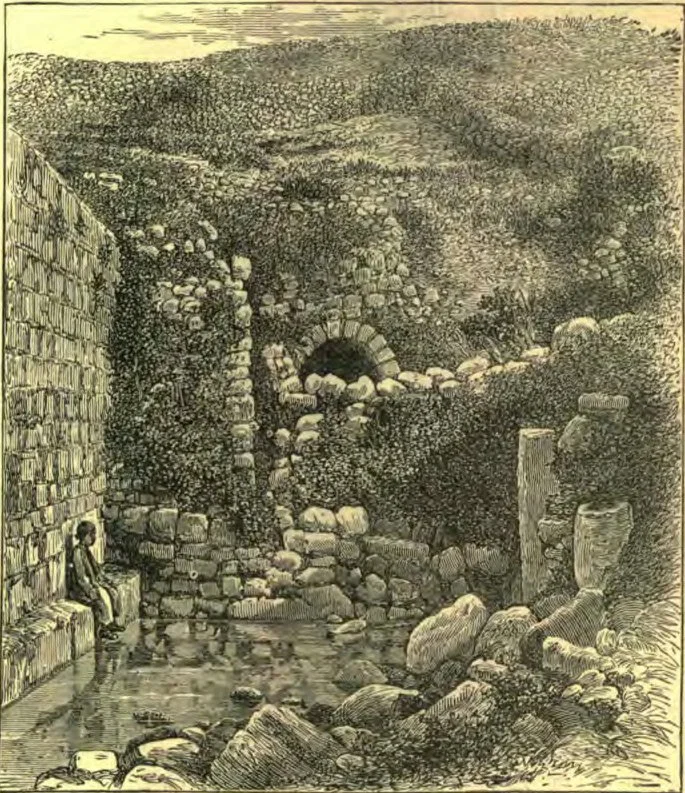
Many, many years ago a blind beggar sat by the gates of Jerusalem, asking alms. “And Jesus passed by, and he saw the man which was blind from his birth. . . . And he spat on the ground, and made clay, and he anointed the eyes of the blind man with the clay, and said unto him, Go wash in the pool of Siloam. . . . And he went his way therefore, and washed, and came seeing.”
The traveler, mindful of the miracle which Jesus performed, still visits the pool of Siloam with much interest. It lies outside of the Jerusalem walls, to the southeast, in the valley of Jehoshaphat, near its junction with the valley of Hinnom. Perhaps there comes to his mind these lines of familiar song,—
“By cool Siloam's shady rills, How fair the lily grows,” and he quickens his footsteps in expectation of finding Siloam a pleasant and poetical retreat.
But as he reaches the spot, how is he disappointed! Whatever Siloam may have been when the poet penned these lines, its rills are not now shady, nor bordered with lilies. “There is nothing picturesque about it, certainly,” says one traveler, “and the crumbling walls and fallen columns in and around it give the pool an air of neglect, unusual even for this city of ruins and forsaken sites. It is a parallelogram, about fifty-three feet long and eighteen feet wide, and in its perfect condition must have been nearly twenty feet deep.” This reservoir “is never filled at present, but the water may be retained to the height of three or four feet from the bottom, where it passes off through a duct, and soon reappears in a deep ditch under the perpendicular cliff of Ophel.” The people do not hesitate to bathe in its waters, to wash their clothes in it, nor after that to drink the water from it!
Siloam receives its waters from the Fountain of the Virgin, the only true spring known at present to exist in Jerusalem. The water is conducted to the pool through a rough-hewn passage cut in the rock. The supply is small and irregular, depending in large measure upon the rainfall. “Its taste is slightly salt and decidedly unpleasant, owing chiefly to the fact that the water has filtered through the mass of rubbish and filth on which the city stands. This peculiarity of taste is intensified at Siloam, as the water passes over a slimy deposit from two to three inches deep, which covers the bottom of the passage.” The fountain received its name from the tradition that the Virgin Mary drew water from the well, in which to wash the infant Saviour’s clothes.
All around Jerusalem may be found ruins of pools, cisterns, and aqueducts, which prove that there was a time when the water-supply of the city was in an excellent condition. Although Canaan was a land flowing with milk and honey, it was nevertheless dependent in part on a carefully-regulated water-supply. Rain fell only from November to March, and hence it was necessary to provide reservoirs in order to keep a supply of water. The aqueducts and cisterns which have been found show a skill in masonry and engineering which has not been surpassed at the present day.
But there is in Jerusalem now-a-days great neglect in sanitary matters; for the waters which collect in the cisterns filter in through masses of garbage, and the pools are put to use both for bathing and drinking purposes. So that where Jerusalem was once the most healthful city in the world, while it followed out sanitary laws given by the Lord himself, it has now come to be one of the most unhealthful, through neglect of those laws. W. L. K.

GOD'S UNSPEAKABLE LOVE.

A STORY is told us of the time of Luther, which shows how a little girl found out something about the love of God.
It happened when Luther was having his Bible printed in the speech of his beloved German people. A little girl, the daughter of one of his printers, had learned to spell out the words of the book which her father was printing, though largely ignorant of what it was. She had been reared in the Church of Rome, and her whole thought of God was that he was a great and dreadful Judge, into whose presence she must finally come to give an account for her sins. To her all religion consisted in a constant series of works, prayers, penances, and such like acts, by means of which his wrath might be measurably appeased, and his punishment somewhat mitigated. She knew nothing of the “love of God,” even if she had ever heard of it. One day she picked up a fragment of paper, on which she spelled out these words: “For God so loved the world that he gave—”
This was all. But it was a new revelation to her. She knew that it came from God’s book, which her father was printing, but it was a statement to which she was entirely a stranger. She pondered it long and well. Her sensitive little heart became quickly alive to its importance, and as she thought more and more upon it, the Spirit opened her mind and heart to take in the full import of it. With this word, now not only in her hands but in her heart, her fear and dread of God vanished as darkness before the rising sun. Her heart responded to the revelation, and soon began to sing for joy. She hid the little piece of paper containing the wonderful fragment of truth in her bosom, as she would have done an amulet, and feasted her heart on it from day to day. Noticing so great a change in her spirits, in that she had grown so cheerful and happy (for she had always been a serious child, and her dread of God had made her a sad one), and observing that she was often found singing some little song, as if to herself, her mother said to her one day:—
“Why, Gretchen, what aileth thee, child? Thou hast grown wondrously cheerful and happy of late. What is it that has come to thee?”
The child pulled forth her wondrous piece of paper, and said,—
“It is this that makes me so happy, mother.”
“And what is there in that scrap of paper to make thee happy, child?”
“Oh, it is because of what it says out of God’s book.”
“And what does it say, child? Read it to me;” for the mother could not read.
So the child read her wondrous word: “For God so loved the world that he gave—”
This did not seem very clear to the mother.
So she asked again,—
“Gave what, my child? I do not see why that should make thee so happy?”
“O mother,” said the child, with the light of heaven filling her whole face, and joy thrilling in her voice, “I do not know what he gave; but if he so loved the world that he gave anything, I will never be afraid of him again.”
Ah, dear child, thou hast the secret of secrets in thy heart, though thou didst not know the fullness of it! I cannot but think that if little Gretchen had known what we know, and what no doubt she came soon to know herself, that he gave his only begotten Son, his well beloved, in whom he was well pleased, and that to take our sins, and put them away in his own body upon the tree, and bring us back to himself, her little heart would have well-nigh burst for gladness.—Youth’s Evangelist.

Self-Centered Thinking Brings Misery

If you want to be miserable, think about yourself—about what you want, what you like, what respect people ought to pay you, and what others think about you.—C. Kingsley.

Prayer in the Heart and Daily Life

If we have it in our heart to pray a proper prayer to God, that is something to be grateful for. If we pray the proper prayer that is in our heart, that is still better. If we live in the direction of our proper prayer, that is best of all.—The Sunday-School Times.

THE ANGELS,

Are the angels never impatient That we are so weak and slow, So dull to their guiding touches, So deaf to their whispers low, With which, entreating and urging, They follow us as we go?
Ah, no! the pitiful angels Are clearer of sight than we, And they note not only the thing that we are, But the thing that we fain would be,— The hint of gold in the cumbering dross; Of fruit on the bare, cold tree.
And I think that at times the angels Must smile as mothers smile At the peevish babies on their knees, Loving them all the while, And cheating the little ones of their pain With sweet and motherly wile.
And if they're so patient, the angels, How tender far than they Must the mighty Lord of the angels be, Whom the heavenly hosts obey. Who speeds them forth on their errands, And cares for us more than they! —Susan Coolidge.

ROUND THE WORLD.—18.

NOTES ON OLD CALCUTTA.
THERE is no city in all the Orient more famous in the annals of history, or better known to East Indian commerce, than the modern Calcutta, so named after Kali, the Hindu goddess.
It is situated about one hundred miles from the head of the Bay of Bengal, on the banks of the Hooghly River, a branch of the sacred Ganges, and is equally reverenced by the followers of Brahma. It is the capital of the empire of India, and is the residence of the viceroy, or, as an Asiatic would express it, the “Burra Sahib,” meaning the “great man.”
The rulers of Calcutta have been many, but the city finally fell into the hands of the English in 1860, and the memorable spot where Job Charnock first hoisted the royal standard of Great Britain can still be seen on Clive Street.
Calcutta lies in the tropics. From the middle of November till early February, the weather, though very warm, is pleasant, but with the exception of these months, it is almost unbearable. From February to June the heat is intense; then the rainy season commences, lasting till the return of cold weather. During this period the water descends in sheets rather than in torrents, causing streams to flow, but paralyzing everything else.
A FAKIR.
A FAKIR.
To estimate the population is a difficult matter. Of English-speaking people there are between 14,000 and 15,000, but the number of natives is almost infinitesimal. There are probably about a million of them.
To the west of Dalhousie Square, the finest in the city, and just north of the magnificent post-office building lately erected, is a space eighteen feet each way, covered with stone flags. It marks the spot where once stood that fearful dungeon known as “the Black Hole of Calcutta.” It was in 1750 that Siraj-ud-Dowllah, the native viceroy of Bengal, with an army of 50,000 men, took possession of old Fort William. After the surrender had been made, on the evening of June 20, the entire garrison of one hundred and forty-six men were crammed into this wretched prison. It was one of the hottest nights of the most sultry season of the year, and the unhappy prisoners soon became frantic with suffocating heat and insufferable thirst. One by one they sank into the arms of death, and when the door was opened in the morning, only twenty-three came out alive.
This well exemplifies East Indian inhumanity. As a people, they are cruel to a degree, of mercy they know nothing, and it is stated that in the Bengalee language there is not a single word having the significance of “gratitude.”
The shrine of the goddess Kali, who may be regarded as the patron saint of the city, is at Kalighat, and has probably stood there for centuries, from the time when the Ganges itself, some miles in width, laved its walls, and when human blood streamed upon its altars. Under British rule, the Hindu can no longer appease the wrath of his gods by the sacrifice of his brethren; but in one of the temple courtyards are two guillotines, where perish kid and buffalo, and with their gore the sign of the cross is made on the forehead of the one who offered them.
On certain days, thousands of natives flock to Kalighat to make their “Poojah” to the goddess; all the daily worship is performed at home, or on the river bank at bathing time. Every morning the river is crowded with natives busily engaged in laving themselves in the sacred stream, although, to judge from the color and density of the water, its cleansing properties must be very scarce.
Next in point of antiquity is the Armenian Church, bearing date of 1724. It is partly surrounded by a courtyard, which is completely floored with slabs, inscribed to the dead, whose remains lie beneath. It is curious how this people have retained their religion for so long, without being influenced by the idolaters who have been so closely connected with them.
One of the most repulsive and yet characteristic sights of the city is the Nimtolla Ghat, or burning place. The Hindus never bury their dead, but resort to cremation. There is no funeral service. The bodies are carried thither on stretchers, faggots piled under and above them, and then fired. The relatives stand round without exhibiting the slightest sign of emotion or remorse, and when the embers have died out, return to their daily avocations.
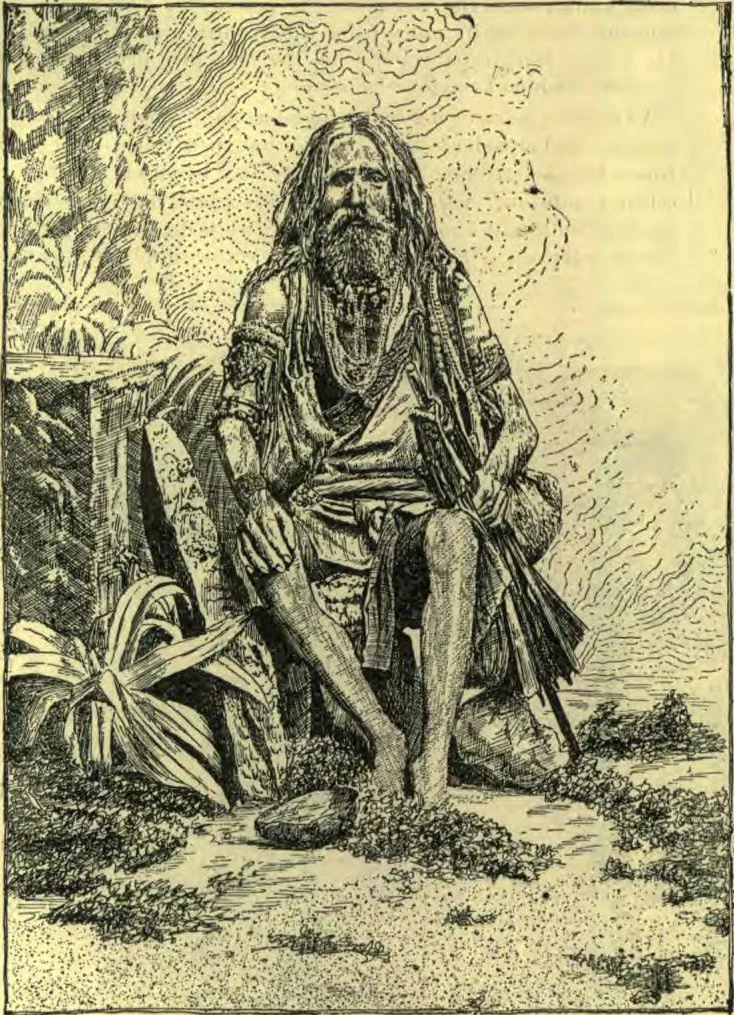
Round almost all these places linger the veritable “Fakirs,” and their constant cry for “backsheesh,” which means “a present,” greets all visitors. They are religious heathen fanatics, who spend their lives sitting on a stone in the open air, or lying on small nails, or torturing themselves in some way or other. They believe it will bring them to heaven; but if this were the only road, we should want to stay out.
F. T. M.

The Fruits of Courage.

The figure of a soldier is a favorite one in the New Testament writings. The true Christian is a true soldier. He carries a “sword,” a “shield,” a “helmet,” a “breastplate,”—all spiritual weapons. With these weapons he is to “war a good warfare,” and “fight the good fight of faith.” There are many ways in which the courage of the Christian soldier is tried. Here is a story that illustrates one way: A chaplain related an incident of a young soldier who on one occasion had consulted him upon a question of Christian duty.
“Last night,” said the young man, “in my barracks before going into bed, I knelt down, and prayed in a low voice, when suddenly my comrades began to throw their boots at me, and raised a great laugh.”
“Well,” replied the chaplain, “suppose you defer your prayer till you get into bed, and then silently lift your heart to God.”
A week or two afterwards, the young soldier called again.
“Well,” said the chaplain, “you took my advice, I suppose? How has it answered?”
“Sir,” he replied, “I did take your advice for one or two nights; but I began to think it looked rather like denying my Saviour, and I once more knelt at my bedside, and prayed in a low whisper as before.”
“And what followed, then?” asked the chaplain.
“Not one of them laughs now, sir. The whole fifteen kneel and pray too.”
“I felt ashamed,” added the chaplain, “of the advice I had given him. That young man was both wiser and bolder than myself.”
It is good for us if the contrary winds occasionally blow on us, for it is they that make us strong as we sail the voyage of life. If we wish to be crowned, we must fight manfully, and suffer patiently.—Selected.

LIFE IN BARBADOES.

This little island of the West Indies has but 106,000 acres of land, yet it supports a population of 172,000. As the traveler passes out of the town proper, he sees on every hand evidence of the teeming population the island carries. Every square foot of land not covered by sugar cane is possessed of a negro hut or cabin, and the black babies and children are scattered like so many great ants over the roads in every direction. All the people, great and small, are forever sucking the sweet sugar cane; while around them, and towering above them, waves the green growing cane, a sight to behold!
Although they are miserably poor, and herd together like animals, they are, in their way, happy and contented. With plenty of sunshine and sugar cane, the two things essential, life is not burdensome, although the whites abuse them shamefully. The cane, to the black, is what the potato is to the Irishman, and it grows everywhere. To obtain luxuries, the Barbadian must work, but in no case to any extent that would be at all injurious to him; so that poor as he is, his lot is never so hard as is that of the poor of our cities.
The white population is larger here than in any other of the English Caribbee Islands, yet singularly enough it has hardly increased beyond what it was in 1793. As in all tropical countries, the blacks increase, while the whites barely hold their own.
Barbadoes has strangely enough always enjoyed peace and prosperity. While neighboring islands have suffered from pillage, and the desolations of war, this island seems to have gone on peacefully progressing. It is the most English of all the British possessions among the islands. It raises a revenue of nearly $1,000,000 yearly, and has a debt of only $150,000. Its streets are busy marts of trade, and its open roadstead is filled with foreign ships. From here ply the small steamers to and fro between the other islands, connecting with the Royal Mail steamers from Jamaica to Southampton. This makes Barbadoes the center of life for the whites. The Governor's Mansion is located here, and as much of gaiety and frivolity is often witnessed as at a foreign capitol.
There are scarcely 16,000 whites on the island. The 156,000 blacks are, as a rule, honest and courageous. Many of the native chiefs often prefer to die rather than to violate a promise given. Most of the blacks are enrolled under chiefs to whom they owe allegiance, and whom they obey. Most of those who are not so associated in tribal relations are those who were brought to the island as slaves from Africa, and are regarded as the most worthless. The true Barbadian black has little else in common with the African except his color.
W. S. C.

THORNS OR ROSES.

A very discontented girl was Bessie Taylor. She was never pleased with anything; always looking out for what was disagreeable, and not for what was pleasant.
One day Bessie was going away from home, and her grandmother asked her if she would have a rose to stick in the bosom of her dress. So, being fond of flowers, she told her she would like one. Away went her grandmother, with her cane in her hand, into the little garden, and gathered the finest one there. There were two buds growing on the same stem with the rose, and the leaves were as fresh and green as the leaves of a rosebud could be. You may suppose that Bessie was not a little surprised when her grandmother snipped off the rose, the two buds, and the green leaves with her scissors, and offered Bessie Taylor the stem alone, all covered with thorns.
“O grandmother, this is not a rose! Do you think that I will stick that ugly stem in my dress, without a single flower or leaf upon it? No, that I never will! You do not deserve to have roses growing in your garden if you spoil them in this way.”
“Perhaps not,” mildly replied her grandmother, “but there are other people in the world besides me, who spoil their roses.”
“Then,” said Bessie, “they must be very silly people.”
“I think so too,” replied her grandmother. “And now I will tell you the name of one of them. It is Bessie Taylor!” Bessie reddened to her very ears, while her grandmother said: “It has pleased God, Bessie, to mark your life with many blessings, mingled with a few cares, and you are continually neglecting your blessings and remembering your cares. If, then, you thus willfully despise your comforts, and repine over your troubles, what is this but throwing away the flowers and green leaves of your life, and sticking the thorns in your bosom?”
Who is like Bessie Taylor?—Selected.

TEDDY AND HIS COCOON.

TEDDY'S nimble legs were carrying him home from school at full speed along the street one day in the fall. It was an uncommonly pretty city street; for it was lined on either side by maples and willows, which were even now beginning to shed their leafy summer suits.
But Teddy did not pay much attention to anything as he ran gaily along, swinging his books by the strap. Suddenly his sharp eyes saw a curious-looking brown thing on the sidewalk. He thought it was a butternut at first. He had been at his grandfather's the year before, and had gone “but-nutting” with some of the boys in the neighborhood, so he fancied himself well posted on butternuts. But this queer brown object was smaller than a butternut, and was entirely new to him. He decided to take it home, and see if his mother or Grandmother Grey could tell him about it.
“Mother! grandmother!” he called, as he rushed into the house, and, throwing his books on the dining table, ran up-stairs, “what's this? I found it right on the walk. Isn't it queer, though? What do you suppose is inside?” he asked, breathlessly.
“One question at a time, my boy,” said his mother, smiling. “I think,” she continued slowly, after looking at the dark roll in her hand, “I think it is the cocoon of some kind of moth.”
“Like a silk-worm's cocoon, mother?” Teddy asked.
“Not exactly like a silk-worm's, but yet similar,” answered Mrs. Grey. “Inside, there is a chrysalis, or pupa, as a naturalist would call it. By and by, when the chrysalis is changed into a moth, the cocoon will open here near the upper end, and the moth will come out. The cocoon is spun around by the worm as it enters the chrysalis state, to protect itself from birds, who would quickly see it and eat it up. The chrysalis is only a soft, pulpy mass, and, you see, this cocoon, or covering, is quite hard and shell-like. Besides, the cocoon keeps the chrysalis from being hurt in the changes of the weather.”
“But how did it come on the walk? Those are swept, you know, every day,” questioned Teddy.
“The chrysalis was probably fastened on a branch of one of the trees, and the wind, which has been strong to-day, shook it down. Out in the country, you would scarcely find a bush or a tree without cocoons of some sort on them. Often leaves are wrapped tightly around them by the tiny threads which the worms spin.”
“Tell him about the different stages the moth-egg goes through, before the moth is fully grown, Sarah,” interposed Grandmother Grey, who sat near by, holding the baby.
“Oh, yes, do, mother! I want to know all about it,” said Teddy, as he cautiously rolled the cocoon about in his hands, looking at it sharply.
“Well,” said Mrs. Grey, “I will tell you all I know. The mother-moth lays her eggs, little tiny white dots, on some tree or plant the leaves of which her babies will like to eat. The moth which destroys our clothes and carpets lays her eggs on some bits of wool for the same reason. From these eggs the young caterpillars are hatched, and then they begin to eat voraciously, and do great damage. You remember, don't you? how badly grandfather's potato-vines were eaten by the big, ugly, green potato-worms last year? Those worms were also hatched from eggs laid by a moth called the “Five-spotted Sphinx.”
Teddy nodded, and Mrs. Grey continued:—
“These caterpillars change their skin three, four, perhaps eight times,—this is called molting,—and finally instinct tells them it is time to become chrysalises, and then they roll themselves up and spin cocoons around them, or wrap themselves up in leaves.”
“The chrysalis sleeps a long while in its snug bed during the winter; and when it wakes up in the springtime, it comes out into the world with four delicate wings, a thick, downy body, two antennae, or feelers,—a long, thread-like organ which serves as a tongue,—and six slender legs. It flies about among the trees and flowers, chiefly at night, and lays its eggs as its mother did before it. It is doubtless a happy life, but it is a short one, and the poor moth soon dies.”
“That is very strange,” said the interested Teddy. “To think of being two or three kinds of things before it was full-grown, and then to die so soon! Couldn't I keep this cocoon in a box, and see what kind of moth will come out? It don't have to have anything to eat, does it?”
“No, it does not eat any more than you do when you are asleep, and you can easily keep it through the winter,” said his mother.
Teddy ran at once up to his room, and hastily rummaged in his bureau drawers and on his closet shelf for an empty box. A good-sized pasteboard box, highly scented from the soap it once held, suited him best, and he put the cocoon carefully into it. He placed the box in his top bureau drawer, with the cover on tightly; for he could not quite shake off the idea that the cocoon might crawl away.
For two or three weeks, Teddy peeped into the box every day or two, but, seeing no change in the cocoon, he was soon tired of watching anything “so slow.” Grandmother Grey hid the box from sight by putting some clothing over it, not knowing its contents, and this, with the gift of a new velocipede on his birthday, drove all remembrance of the brown cocoon quite out of Teddy's mind.
Spring came, with its bright, sunny days, but still Teddy did not think of his prisoner. His mind was too absorbed in the ball games and kite flying. The days were long and pleasant, but not long enough for Teddy, who could scarcely find time to eat, and grudged all the school hours which took him from his games.
But one day Grandmother Grey, who had found the hidden box, called him back into his room, and, taking off the cover, showed him a large and beautifully-colored moth. Teddy's eyes were big with surprise.
“My! I forgot about that chap! Did it really come out of that cocoon? Isn't it a beauty? And such a big one, too!” he exclaimed.
Every one in the house soon saw his treasure. It was a fine specimen, and measured almost five inches across its wings, and was quite as beautifully colored as a butterfly. Its wings were dark and light brown, each marked with a large spot of dark red, while the downy body was almost black, and striped with pale yellow and light brown.
Teddy's mother told him to notice the way its wings were folded down at its sides when not flying, instead of standing upright, like a butterfly's. Its feelers, too, were pointed, instead of club-like, at the ends.
It was taken down into the family sitting-room, and seemed to enjoy its new life very much, flying all around the room, and lighting on almost every object. Teddy thought he would like to take it to one of the large boys in school, who was making a collection of bugs and butterflies, and perhaps learn its name.
“But alas! he delayed too long. Neat Grandmother Grey found it was laying its eggs everywhere,—on the inkstand, the picture-frames, the chair-backs,—and, with good New England housewifely horror, declared she was not going to cultivate worms all over the house.
So she put the moth out on the window-ledge. Whether the indoor life had made it too weak to fly, or whether its own life was almost at an end, was not certain; but the next morning Teddy saw, to his dismay, the baby's pet kitten playing with the broken body of his poor moth, while pieces of the gay wings lay on the ground.—The Sunday-School Times.

A SUMMER MORNING.

SEE the birds together, In this splendid weather, Worship God—for he is God Of birds as well as men. And each feathered neighbor Enters on his labor,— Sparrow, robin, redpole, finch, The linnet, and the wren.
Ah, come and woo the spring; List to the birds that sing. Pluck the daisies, sing their praises, Come forth on this sweet day; Children, come forth to play. Worship the God of nature in your childhood. Worship him in the wildwood. Worship him at your tasks with best endeavor. Worship him in your sports. Worship him forever. —Selected.

DON'T HIDE IT.

“May I pick the flowers for the parlor this morning, mamma?”
“I am afraid you are too little, my dear.”
“O no, I am sure I could do it.”
“Well, I will let you try, as I am going away. Don’t spill any water, nor make any disorder in the room.”
“I’ll be careful, mamma.”
Jessie always enjoyed cutting flowers. Roses for one vase, scarlet geraniums for another, verbenas for the low bowl on the table, and heliotropes, with a few white flowers, for the matched vases on the mantel-piece.
“They look beautiful,” she said, gazing at them with great pleasure; “but I have these pretty pansies. Where shall I put them?”
One little vase stood on a bracket. Jessie knew that it was a rare one, that her mother thought a great deal of it, and that the children were never expected to touch it.
“But I must have a place for the pansies. It can’t be any harm for me to take it. Mamma won’t care when she sees I don’t break things.”
She carried it out, all the while feeling in the depths of her heart that she was doing wrong. Setting it on the stone step of the back porch, she soon had her pansies arranged, and went for water for them.
But O dear! How came that water running over the step? Raising the vase, Jessie saw the dreadful thing which had happened. She had set the delicate vase down too hard, and now a piece broken out of the bottom lay upon the stone.
What would Jessie have given just then if the vase were safe back in its place! How could she tell mamma? She knew very well, as all little girls and boys know, that the very first thing to do after a fault or an accident is to go at once and tell of it, but the foolish little girl could not make up her mind to do it.
She fitted the little piece back into the hole, and it stayed and looked exactly as it had before. Mamma was just coming in at the gate, and Jessie quickly threw away the pansies, ran in, and set the vase in its place.
She did not hurry to meet mamma and lead her to see her flowers. Can you guess why she felt like keeping out of her way?
The burden on Jessie’s heart grew heavier and heavier as the days went by. She was always resolving that she would tell of her fault the next day, but time passed, and it grew harder and harder to think of it.
Then her birthday was coming, and in the bustle of getting ready for the party, Jessie sometimes forgot her trouble.
One or two of her little friends had already come, when her Aunt Faith said:—
“I think the pet vase ought to be used on Jessie’s birthday.”
Jessie did not hear her, and did not notice when she brought a handful of honeysuckles and a small pitcher of water. Taking the vase in her hand, she arranged the flowers and poured in the water.
Then there was a start and a little scream. One of the small guests was sitting close to the mantel-piece and a stream of water poured over her head. It is no wonder that she gave a sudden jump, or that in doing so she knocked the dainty vase out of Aunt Faith’s hand. There came a little crash, and it lay in pieces on the floor, while poor little Annie stood looking very doleful in her wet ruffles.
“O mamma, it spoiled my whole party,” said Jessie that evening, as with tears she came to her with her sorrowful story. “If I only had told you before!”
“Yes, dear, if you had, the little vase given me so long ago would still have stood on the mantel-piece, as pretty as ever, with only the hole to remind my little girl that she should not touch what she is expected not to touch. You hid your fault from me, but you knew you could not hide it from God.”
“Of course I did, mamma, and it made me ten times more miserable. I shall never forget how dreadful it is to keep a wrong thing in my heart.”
“If you have learned that lesson well, dear child,” said her mother, “I shall never regret the loss of the vase.”—Sydney Dayre.
Continue reading: KEEP AT IT