Your ShelfYour Projects

Review and Herald, Vol. 81, No. 24.

KAATERSKILL FALLS
Earlier text: The English Church and Rome

Mission Work on the Gold Coast

J. M. HYATT
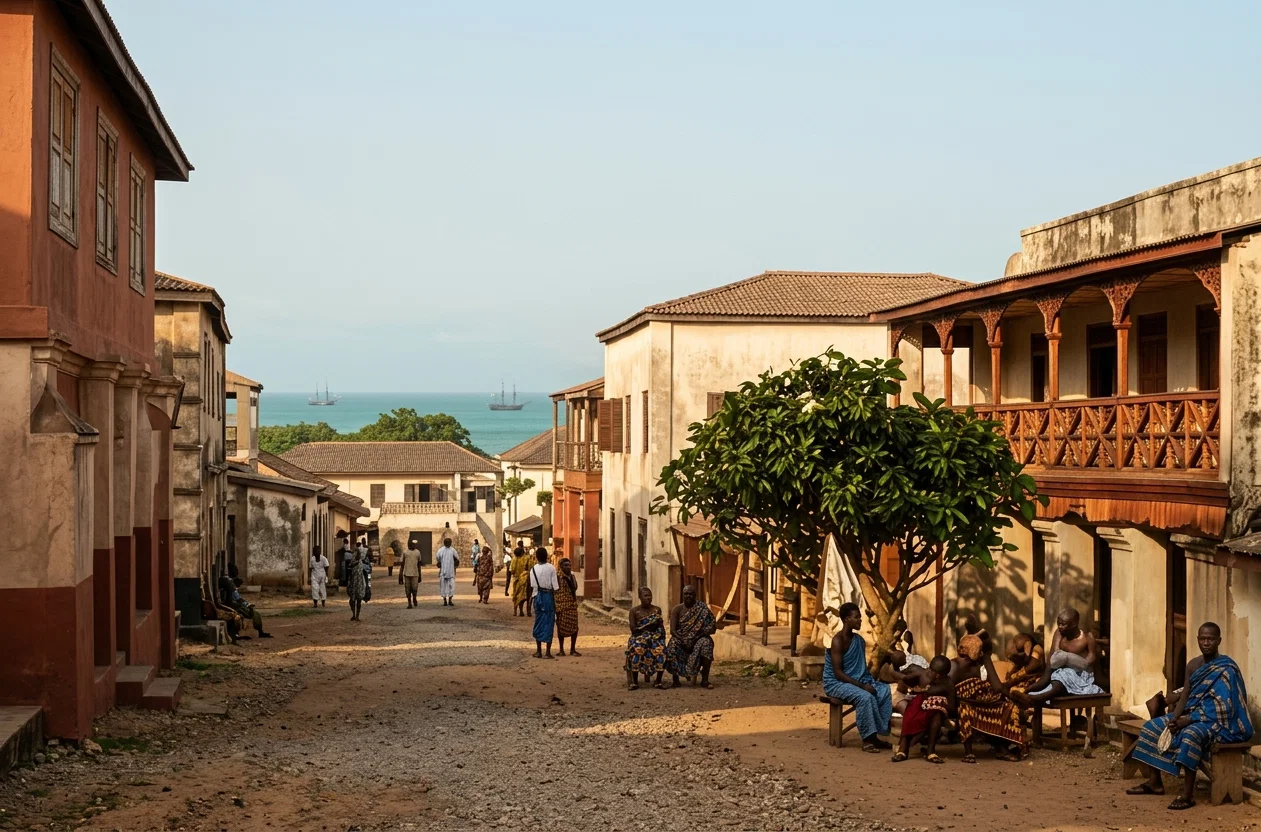
MISSION work on the Gold Coast, especially Cape Coast, dates from 1751. This first effort was made by the Church of England, who sent out the Rev. Thomas Thompson. He stayed four years at Cape Coast before returning, and taking some young men to England to train. In 1828 the Basel German Mission opened a station farther down the coast, at Accra.
STREET SCENE, CAPE COAST CASTLE, WEST AFRICA
It seems that from the very first, Cape Coast has been recognized as the strategic point of missionary work on the Gold Coast. It was in 1831 that a few young natives attending the government school formed a society for Bible study. One of their number applied to the captain of a merchant vessel for some copies of the New Testament. The captain was surprised to receive such a request from the native youth, and asked if he and his friends would not like the instruction of a missionary. Upon his return to England, he brought the matter before the Wesleyan Missionary Society, offering to carry out and bring back the missionary free of all cost.
In due time the missionary came. From this nucleus the Wesleyan church of the Gold Coast has grown to 111 churches, with 573 preaching places. There are said to be 6,350 day scholars and 7,677 full members, with a total congregation on Sunday of 32,371. The Basel German Mission claims a membership of 7,266, with 5,000 day scholars. The Roman Catholics claim a membership of 4,405, with 1,200 day scholars. Of this number 1,100 are said to belong to the Cape Coast church. This is their headquarters. All these societies have suffered the loss of many missionaries.
It can readily be seen that the Lord has prepared the way for a quick work to be done in giving the message to the two and three-quarter millions of the Gold Coast. There are thousands of scholars scattered in different parts of the country. Who knows but many of these will be used in giving the message when the earth is lightened with His glory?
Next to the need of the Bible is the need of knowing how to till the soil. This knowledge is greatly lacking. Many things would grow here, as the soil is very rich. A committee appointed by the government to look after agriculture said that not more than five per cent of the soil is under cultivation. The Basel Mission is the only society that has made an effort to teach the people to cultivate the soil. This effort seems to be confined mostly to their headquarters and surrounding country. I learn that the people are very industrious in this vicinity, raising cotton, cocoa, coffee, rubber-trees, and all kinds of garden produce. It is said that cocoa yields a large financial return for the labor put forth; hence much of it is raised. A strong effort is being made by the government to get cotton-growing well established.
Aburi, situated in the mountains, about twenty-five miles from Accra, is called the “Madeira of the West Coast.” This is the health resort of the foreigners operating on the coast. Here the Wesleyans have a house built especially to accommodate workers who come from the coast to recuperate their health. In connection with this is a girl's training-school. We should by all means have a building in these mountains, possibly in this village, that workers may go there when run down in health. In fact, these mountains would be an excellent place for our mission farm and training station, if the way should open for us. Many of the Europeans go to Aburi to rest, in preference to going to England. It is said to be a very healthful place. Here the government botanical garden is situated.
Our work is moving on fairly well. Our enemies are not asleep. The other churches have practically combined against us. While they do not agree among themselves, they can unite in fighting us. At present, our attendance is greatly affected; but I think it will be better after a while. We labor under great disadvantage because our work is not well established. The others encourage the belief among the people that we are not going to stay here long. There is nothing that the native fears so much as being laughed at because his mission is broken. Hence, this has much weight with some. They point to the lone missionary for the whole West Coast, and then compare him and his mission with the many churches and ministers of the other missions. When we once get established in one place, it will have a good effect on the whole coast. I am waiting to hear if any workers are coming soon. If they are not, I expect to start a school of some kind.
In visiting the better class of natives, I find that our papers are exerting a power for good. They talk long and earnestly about the matter. The foundation is being laid for a good work when we can get more help. Some young men, now clerks, have spoken to me about giving up their work and entering our training-school if we start one. They know that there will be little or no money in it, yet they say that they would rather do this. These have finished the schools here. The training that they most need is Bible study and manual labor.
The report of our work has been carried for miles up and down the coast—that is, about the “Saturday mission.” I have had several letters from those to whom I have sent papers. I learn that some have been keeping the Sabbath for years. The young man who went from here to the mine writes that he has given the papers to those who could read, and that some of the European miners were trying to keep the Sabbath. I send him a bundle of papers each week. He is waiting until the mission station is opened up, hoping to connect with it.
I notice that the general public is honoring Sunday more now than they did a few months ago. When the mail boat comes on that day, it comes as quietly as possible, while the steamer was formerly signaled three ports up coast. One of our young men has been flogged because he refused to work at the carpenter's trade on the Sabbath.
The other night I was out giving away copies of the REVIEW and other papers. The next day I met a man whose house I had passed, and he said that he stayed up the greater part of the night, reading the paper that I left with him. I see from this that there are many who have not had the chance yet of hearing the truth. We see no reason to be discouraged. We firmly believe the statement made by Sister White, that nothing can stop this message, and we are sure that the time is not far distant when God will do a mighty work for this dark country. It is certainly true that we can hear the sound of a 'going' in the top of the mulberry trees.

Pastor Oberlin and His Wonderful Work

Pastor Oberlin’s kingdom, like that of his Master’s, came without observation. The story is one of the most remarkable that has ever been written, though very little is known about it in the church at large.
Johann Friedrich Oberlin was born in 1740, and died in 1826, very nearly completing eighty-six full years. He was distinguished by active benevolence and wide usefulness. The special field of his labors was Waldbach, in the Ban de la Roche, or Steinthal, a wild, mountainous region of Alsace.
His work in this district began in 1766, and therefore covers a period of two-score years. We question whether any similar period has been passed in work more thoroughly apostolic in character, more unselfish in spirit, or more permanent in substantial results. Oberlin was a philanthropist in the very best sense, and has been called “The Apostle of Alsace.” Although it was a home field as to locality, it was, in all essential respects, virtually a foreign missionary work, for even the South Sea Islanders were scarcely more heathen or uncivilized than the inhabitants of that isolated district.
Though they were marked by some of the substantial characteristics of the Germans, and were not much given to crimes or violence, they had a reputation for a savage disposition, which kept others from intruding upon them. Their mountain fastnesses were like fortresses, into which there was little desire to attempt an entrance.
When Oberlin first went among them, they were already reverting to their original barbarism; they no longer built houses, or even tilled their fields. They lived on the wild products of the ground, and such wild animals or game as their forests supplied. Oberlin understood the character of the people, but applied for the position as pastor to five widely scattered villages of the district. He had lived all his life at Strasburg, where his father was a professor in the university. His own scholarly attainments might well have secured for him an exalted position there, but the destitute and neglected condition of the inhabitants of Waldbach appealed to him. His affianced bride, Salome Witter, encouraged his purpose, and could not be persuaded to let him go alone. She had a spirit like his own, and the misery, poverty, and wretchedness of this people rather attracted than repelled her.
Oberlin went to his chosen field of labor, and took up his abode in a half-ruined stone hut, which he undertook to make comfortable. The people looked with surprise at the labors of the new pastor; what more could a man desire than to have a roof over him with a hole by which to carry off the smoke! He secured doors and windows, built a chimney, separated the hut into four rude rooms, cleared a little space about it, and planted a garden. All this he did not only for his own comfort, but because he felt that these wild people needed an example of decency and order. Conversations upon spiritual themes were not comprehended by intellects dulled by neglect, but the presence of a well-regulated Christian home among them proved to be one of the first conditions of a gospel witness.
He undertook to persuade the people to till the ground and raise potatoes, and when he had raised a crop, their astonishment was unbounded. As the family of Oberlin and his wife grew, their children took part in their agricultural work, so that the whole family was a standing rebuke to the idleness and sluggishness of their neighbors.

The Coming of Louise Scheppler

Perhaps the most important event at this stage in Oberlin’s life was the taking into his family of a thirteen-year-old girl by the name of Louise Scheppler. At that time his wife was borne down by domestic burdens, so that help became necessary. There was no one in the district who was fitted to become an inmate of the pastor’s house. Their sympathy was, however, awakened on behalf of Louise, who was left an orphan by the death of her father. After much consultation and prayer, they took her into their family. The same care which had turned the wilderness into a garden was blessed in turning this little waif into a helper and friend. She was by nature patient and industrious, humble and gentle, and rapidly became not only a capable servant, but a faithful companion and wise counselor. After the death of Oberlin’s wife in 1786, she became like a second mother to the children, the youngest a mere infant. There were also the fields to till, cattle to tend, food to prepare, clothes to wash, and, in a sense, the whole parish to guide.
It is remarkable how God raises up servants and adapts them for the work he has for them to do. Louise Scheppler proved herself to be created in Christ Jesus for good works. For example, Oberlin had set up schools for boys and girls, and Louise became the teacher. She instructed the girls in useful domestic arts (sewing, ironing, and cooking), as well as reading and writing, while Oberlin sought to train the lads not only by books, but by nature studies. He established a book club and lending library, and set up a kind of branch Bible society. Having no little knowledge of herbs and simple drugs, he also put a dispensary into working order.

The Genesis of Industrial Exhibits

Other forms of useful public institutions were the fruits of Louise’s invention and observation. She noticed that the humble villagers were, like children, easily stimulated by praises and prizes, and it occurred to her to establish a little agricultural exhibit, where year after year they could show the progress in agricultural implements, and the improvement in vegetables and fruits produced. Prizes were given to stimulate competition. This idea, first evolved from the shrewd brain of a rude Alsatian peasant girl, was the starting-point of all the great international competitions and monster exhibitions in history.
At this time the population, which consisted of eighty households when Oberlin went to the district, had increased eightfold, and the industries of the people compared favorably with those of the best parts of France. They carried on cotton-spinning, weaving, and dyeing, straw plaiting, clock-making, etc., and in 1816 a ribbon-making plant was established. Louise Scheppler not only interested herself in all these various employments, but became an adept, that she might instruct others.
Another idea was now evolved from her active brain. It occurred to her to set up a public nursery, that the little children might be cared for while the mothers were engaged in necessary work. Here she took care of most of the little ones, who would otherwise have been neglected. It is remarkable that this young girl, taken from a half-savage family and community, should have become, in a sense, the originator of three of the great enterprises—the industrial expositions, the day nurseries, and the kindergarten.
When Pastor Oberlin died, his funeral was attended by not only his own flock, but by many dignitaries of church and state from other parts of France and elsewhere. He had obtained a world-wide reputation as pastor, reformer, counselor, philanthropist, and for unequaled self-denial.
At this time Louise Scheppler was past sixty, and in his will he left his children to her care, giving a noble tribute to her unselfish life of service. In his last legacy he informed his children that she had always refused to accept any wages, or even her own clothes, meeting her necessary expenses with the proceeds of her own toil. The family unanimously desired her to accept a daughter’s share of the property; this, however, she absolutely refused, asking only to be allowed to hold the position which for so many years she had kept as a sort of foster-mother in the family. To the day of her death she devoted herself to the public nursery, which she especially superintended.
This story shows the power of a well-regulated Christian home, the effect of personal industry on a sluggish and idle population. It suggests methods by which rude and barbarous people may not only be won, but may be led up into the higher paths of prosperity and Christian advancement. It is one of God’s great lessons to the church of all ages.—A. T. Pierson, in Missionary Review of the World.

China

HONGKONG.—I am now giving my time to the language almost exclusively. I have finished reading St. John's Gospel, and am reading St. Mark's. It seems so good to be able to talk a little to the natives. My teacher is much interested, and says he will help us teach after one more year. I am teaching a little boy in the afternoons. A few weeks ago when the time came for his class, I had fever above one hundred and four degrees. His father came into the room, and asked if he might pray for me. I told him yes. It touched me greatly to see him so earnest, and I sincerely pray that I may be able to help this family to see the Saviour as he is.
I spent a few hours as I was able last May, taking orders for fruits, nuts, and health foods, in connection with my studies and the school work. Mrs. Anderson came down from Canton, and in ten days' time we had the orders wrapped and nearly all delivered. As a result of less than one month's work, we realized a profit of more than one hundred and fifty dollars gold. Brother La Rue had his regular customers, so it requires but little time now to secure their orders.
There are many things one can do that brings him in contact with the people, and it seems a pity we have not more laborers here. I am bound to be a Chinese after a few months. It is a real pleasure to me to learn this strange language; and the more I study it, the better I like it.
I have just been interrupted in my writing by a poor woman whom I have known as a faithful working woman for several months. She came in, and sat down, and soon I heard her sobbing. I asked her why she was crying. She said she was the mother of three children. The father was dead, and she could not earn enough to feed and clothe her family. She had left two of the little ones in the country with relatives, and brought her eldest, a son of twelve years, with her to Hongkong, where she was working to put him in school. I gave her some clothes, and it was worth a great deal to see her countenance change. She gets ten dollars, a little less than half as much gold, a month, and from this must feed herself and children, besides buying clothing. It is a fair price for her services, but is very little for four, I am sure. I told her to send for her little girl to come and live with me while it was cold; I would keep her two months free. The poor soul was so rejoiced, and has gone to her room a happy woman.
It is surprising how little goes to waste in some of these homes. I saw one undercoat made of pieces I would have put into the rags at home. But the cloth was thick and warm, and so must not go to waste. It is enough to break one's heart sometimes to see how these poor people manage. Our first servant boy used to save the scrapings from our rice kettle, and give them to the poor people. He said they were real glad to get them.
We have one more Sabbath-keeper—a man from the British navy, formerly a Roman Catholic. He seems very earnest. One more in our little Sabbath-school is appreciated. We are very thankful that six were added to the company in Honan. I am sure, that China, so long neglected, will now receive help. How generous our people are! I am sure their hearts are in this work. The message will surely triumph, and that gloriously, and all who are true-hearted will triumph with it.
As we have studied the Sabbath-school lessons the past quarter, the work has seemed so sacred. We can see that God's purposes are not to be hindered by man's unfaithfulness, but finally the earth will be filled with a pure-hearted people, and Jesus will be the recognized King.
I often think of the statement that was made before we left America, that those who go to the foreign lands are not to be pitied, but those who remain at home and desire to go. I am sure I would feel very sad, indeed, to return home. Although it is lonely sometimes, I believe that before long there will be more laborers here. I wish that some young ladies who want to teach would join in the work in this place. I do not mean teach a regular school, but have a class, and go into the homes and teach the women and children. We have access to some very nice homes. It is not like giving Bible readings in America. These poor souls do not even know who God is. It is a perfect mist to them. After you think you have at last said something that they begin to comprehend, their next question is as apt to be, “Did you make that dress?” or, “How much did it cost?” as anything else. But there are some who have become Christians, and are sincere, so I know there is hopes for them. They are so childlike, after their confidence has once been gained, that one can but love them.
We pray daily for the success of the work at home, and feel sure we share in your petitions. IDA E. THOMPSON.

Chesapeake Conference

The fifth annual session of the Chesapeake Conference was held at Fords Store, Md., May 10-15, 1904. The various churches were well represented by delegates, and by a goodly number of other brethren and sisters. The attendance from the village was excellent, the church being filled each evening to more than its seating capacity.
In addition to the conference laborers, Professor Griggs, Brother F. E. Painter, and the writer were present, and assisted in the services. The time each evening was devoted to the plain presentation of the message of truth that has made us a distinct people, and the truth so simply presented, was listened to with interest by those in attendance.
The results that were achieved in the various business meetings of the session were manifest evidence of the presence of the Lord with us during the council. The different interests of the conference were considered, and to the extent of our knowledge, plans were laid for the furtherance of each to the best advantage, in connection with the force of workers which we have, and the financial strength of the conference to execute plans.
Elder O. O. Farnsworth was again elected president, and Brother H. S. Weaver was re-elected secretary and treasurer.
Business meetings connected with the Lord’s work may be conducted so that the services will be just as spiritual as prayer and praise services, and the will of the Lord will not be fully met until such meetings are spiritual in their nature.
At the close of the session, the delegates and workers left the place full of hope and courage to press the work forward in the name of the Lord, awaiting his time for the final triumph of the good, with the knowledge of his assurance that time will be swallowed up in eternity in this generation.
H. W. COTTRELL.

Minnesota Camp-Meeting

This meeting was held at Stillwater, adjoining Lake Lilly, May 26 to June 5. Besides the laborers of the conference there were present to assist in the ministerial work of the meeting, Elders A. G. Daniells, E. W. Farnsworth, S. Mortenson (who labored in the Scandinavian language), V. Leer (who labored for the Germans), and the writer. It had been eighteen years since I attended a camp-meeting in the State of Minnesota. I was at Mankato in 1886. Great changes have come to the conference in its laborers and the lay membership during these years. I was glad to find so many young men of promise, who were but boys at the time of the meeting I attended, developing into strong laborers. At Mankato, notwithstanding the continuous rains throughout the meeting, making the grounds unpleasant, a cheerful spirit pervaded the camp.
For a year or more an effort had been in progress to establish an industrial conference school. A farm in a central location had been secured, and steps taken looking toward the erection of a suitable school building, yet some delays in this enterprise, owing to the lack of funds to erect school buildings, had caused some discouragement as to the conference school. As the meetings progressed, this feeling entirely disappeared from the camp.
The business meetings were among the best meetings we held in bringing light and courage to the people. Sufficient funds were secured to purchase material for the erection of the principal school building. The work will go forward as rapidly as funds come in, and no debt will be incurred.
The keynote of the meeting was consecration to the work. The Lord has called this people to preach the everlasting gospel in its fulness to the ends of the earth. The conference pays about one third of all the funds it raises to assist the general and foreign work. This is done by weekly offerings, special offerings, the first and second tithe, and the support of two laborers in Africa. Owing to a lack of funds for the home work, the question was raised in a meeting among the laborers of the conference whether in the year to come they should continue to support from their conference tithe the two laborers in Africa. After the question had been considered, it was the unanimous vote of the laborers of the conference that the conference should do this, even if their own wages had to be cut down to make it possible.
Elder H. S. Shaw was elected president. The conference committee was enlarged to seven. Twenty-six dear souls were baptized Sabbath afternoon in Lake Lilly, a short distance from the camp, while a number will be baptized at their home churches on returning from the meeting. The brethren and sisters were glad to see Elder C. W. Flaiz at the meeting two of three days, although he was unable to enter into the labor of the meeting. The Northern Union Conference committees held an important council during the meeting. At the close of the meeting it was the general expression that this had been one of the best camp-meetings ever held in Minnesota.
R. A. UNDERWOOD.

Another Word From East Africa

Thus far we are all well and of good courage, and the work goes onward. The last two Sabbaths we had about one hundred and fifty or more natives at our service. Brother Ehlers talked to them most of the time, and also translated for me, the best he could. They have no written dialect, and the spoken dialect is very deficient. I enjoy my stay here very much. It gives me a new experience to be at the front in dark Africa.
Last Wednesday we called on the chief in the village about ten miles south. It is at the entrance of the mountains on the great caravan route. We asked him whether he would assist us in putting up a school there. He was greatly pleased with the idea, being an enterprising man.
GOVERNMENT FARM AND NATIVE HUTS, KWAI, USAMBARA
(This range of mountains is thirty miles east of our station)
GOVERNMENT FARM AND NATIVE HUTS, KWAI, USAMBARA (This range of mountains is thirty miles east of our station)
There are about two thousand people closely clustered together in eight villages; here they are more scattered.
We find plenty of building timber two to three miles from us, sufficient stone on the ground for the foundations, and clay and sand for sun-dried bricks. The main expense will be the labor, and for things we need to import, like window-glass, hinges, locks, etc. We are putting up a roomy stable, and have planned for the dwelling-house, kitchen, and schoolhouse. At present part of our party live in tents, the rest in a hut, and we have light banana huts for kitchen, stable, etc. We have had only two light showers thus far.
From Wednesday to Friday three of us with three carriers went down to our village, Kihuiro, to see about the school; then we went up the Sasseni valley, and next we reached the southern ridge at an altitude of eighteen hundred meters, where we had a glorious view north and south in the plains of British and German East Africa, and could see the distant mountain ranges. It gave us a good idea of the lay of our district.
I hope to go north yet this week about eight hours' march, to visit our neighbors of the Leipzig Mission. I expect to leave about April 26. I intend to make a short trip in Usambara with Brother Ehlers. Our post-office is at that place; also a number of mission stations are located there.
Thus far we have had but one misfortune. We lost our two Indian ponies, woodbugs getting into their ears, and then into their brains. The cattle must be very carefully guarded, and everything cleared up before they can roam about. Ants are numerous.
Our freight is still en route, and consequently we lack our beds, tools, etc. Banana leaves on the earth supply the place of the beds.
While the Lord is richly blessing in establishing the headquarters in Washington, do not forget dark Africa.
L. R. CONRADI.

A Noble Contribution to Mission Fields

At its annual session just held on the Colfax camp-ground, the Iowa Conference made a splendid gift to missions. The conference laborers had been together several days before the session opened, seeking the Lord for a new experience and re-consecrating themselves to him for service.
When Elder E. W. Farnsworth and the writer reached the ground Friday morning, June 3, we found a sweet, earnest atmosphere pervading the camp. From the very first, there was laid upon our hearts the burden to call all the people to earnest, devoted, self-sacrificing service for a lost world.
Sabbath morning Brother Farnsworth preached a practical, powerful sermon on leaving all to follow the Master. A deep impression was made upon the hearts of all present, and many publicly responded to the call to surrender all.
In the afternoon I was constrained to present the pressing needs of home and foreign mission fields. The day closed with a deep, solemn conviction that the hour had come for our bonds to be broken. It was felt that nothing short of unreserved surrender on our part would permit the Lord to lift us from our present dead level, and bring the new experience we needed.
This conviction found expression a few days later in a vote by the whole congregation to devote to the needy mission fields at home and in foreign lands one half of all the laborers of the Iowa Conference, and with them one half of the annual tithe of the conference. This action was taken advisedly. There was no excitement manifested. It was an expression of the clear, definite, deep conviction of the brethren and sisters present. The thought was not a new one to many present. The Iowa Conference has been working to this point for years. Thank God, the step has now been taken. This will make history for Iowa. It is a parting of the ways, and that conference has taken the right way. This action is designed to indicate the permanent policy of the conference for the future years.
By this vote not less than twenty good workers will soon leave Iowa for fields greatly needing their services. About the sum of ten thousand dollars tithe will each year be sent from that State to places where the workers are now struggling with the smallest pittance to build up the cause. The blessed fruits of this generous gift to destitute mission fields will not all be seen until our work is done, and we are all gathered home.
The brethren reasoned like this: Iowa has a population of only about two and one-half millions; the third angel's message has been preached in the State about half a century; there are now over three thousand believers living in the State to help give the message to those who have not heard it; when the conference has sent to other fields one half of its regular laborers and tithe, it will still have more to do with than many fields. In view of these facts, the brethren and sisters could give no good reason why Iowa should continue to devote such large resources of talent and means to the Iowa Conference, while fields with a much larger population should cripple along with the most meager facilities.
The camp was profoundly solemn when this proposal was being considered and the vote taken. The seal of God's approval was surely placed upon this act. It seemed as if we could hear the words of Jesus spoken to Zaccheus, 'This day is salvation come to this house.' These words, it will be remembered, were spoken in response to the declaration of Zaccheus that half of his goods he had given to the poor.
We are not afraid to await the tangible results of this clear, definite, positive gift to missions. The next step taken after this vote of the conference was a personal and definite consecration on the part of the laborers to mission fields. This was general and hearty. It is but just to say that the members of the conference committee led in reaching the decision to make this great change in the program of the Iowa Conference. Arrangements are being made for the immediate transfer of a large number of workers to other fields. A number of the old, tried workers of the conference will remain at the base of supplies, to advance the cause in the State, and to carry on recruiting work.
From an experience of fourteen years in a needy, yet promising mission field, I know something of the joy that will fill the hearts of our missionaries when they learn of this gift of the Iowa Conference to missions. Let us remember both the givers and the gift at the throne of grace.
A. G. DANIELLS.

Canvassers’ Institute in Brazil

THE leading brethren of our conference have for some time felt the necessity of a revival in our canvassing work. Accordingly a plan was formulated to hold a canvassers’ institute at the close of our school year. Our institute for canvassers was held in connection with a similar meeting for our church-school teachers, and in a part of the instruction both alike shared. Thus a number of our young people who have for some time past enjoyed the privileges of the mission school received a further training for work in the field. The institute began January 31 and continued until February 25.
When informed that the German edition of “The Coming King” had been exhausted, and that our order could not be filled, we were considerably disappointed, and were obliged to confine our efforts largely to “His Glorious Appearing.”
A few days before the close of the institute I left Brusque and came to Joinville, to see if I could get permission to work in this section. Often the officials have demanded a high license for the privilege of selling our books which contain the truth. Upon arriving in this place, I went to the municipal officers and stated to them the work we intend to do, and after a short consultation among themselves they gave us permission to work the district without paying any license.
Upon the arrival of the eight canvassers whom I expect to-morrow, we shall work the city and surrounding country, and thus prepare the way for our conference, which will be held in this city in about seven weeks. Times are growing more difficult, and in this field we shall have to meet much prejudice, because of some who, though never connected with our denomination, professed to be Sabbath-keepers, but whose inconsistent lives brought reproach upon all who defend the Sabbath, yet we trust the Lord for his blessing, believing that the presence of his Spirit with the workers will insure success even in spite of these difficulties. May it be even so!
F. W. SPIES.

Student Volunteers for Foreign Missions

Two hundred and nineteen student volunteers for foreign missions have sailed from this country since Jan. 1, 1903.

In the Mount Shasta Regions of California

I LEFT Oakland, Cal., Saturday night, April 9, on a canvassing trip in the Mount Shasta district. On a clear day this grand old mountain can be seen from Woodland, Cal., a distance of two hundred or two hundred and twenty-five miles. At Woodland, in a transparent atmosphere, a view can also be had of the Sierra Nevada Mountains, which are about two hundred and twenty-five or two hundred and fifty miles southeast.
At Delamar to-day the Lord gave me thirty orders for books, helps, etc., or from sixty to seventy dollars’ worth. I can only exalt, extol, and praise him for it all. All our victories, our triumphs, our successes, come from the Lord. It is wonderful how he opens the way for the sale of “Patriarchs and State Prophets,” “Christ’s Object Lessons,” “Steps to Christ,” and other books, helps, etc. I seek God much in prayer. He does hear and answer most graciously. “Hitherto hath the Lord helped us.” “It is the Lord’s doing; it is marvelous in our eyes.” “What hath God wrought?” I see many and marked tokens of God’s love and care, great and marvelous answers to our prayers. John 14:13, 14, also 15:7.
WALTER HARPER.
Continue reading: The Educational Work of the Lake Union Conference***