The Youth’s Instructor, Vol. 29, No. 9.

THE BLACK ROCK

The Youth’s Instructor

Mar 2, 1881

S. D. A. Publishing Association · Battle Creek, Mich. · Mar 2, 1881

THE BLACK ROCK.
IT was a pleasant afternoon in the middle of May; and the boys, who had just been dismissed from school for a half holiday, now stood in a group before the school-house, trying to decide how best to spend the afternoon.
The school-house stood on a hill about half a mile from the sea-coast, in one of our New England States; and the grand scenery with which it was surrounded, furnished many places of amusement for the boys. Just back of the school-house were the woods, full of wild-flowers and squirrels; and there was the brook over in Farmer Dawson’s meadow, full of trout, where they might go fishing; and then there was a large boat on the mill-pond in the field to the left of the school-house. But the boys could not decide where to go.
“I say, boys,” said Willie Morgan, “let’s go down on the green and play ball.”
“Oh, we can play ball enough at recesses, when there is school,” said George Brown. “Let’s go down to our barn and play hide-and-seek.”
“I guess your father would n’t thank us for tramping around on his hay-mow,” suggested Albert Dawson. “I would rather go to the woods to play.”
“I’ll tell you what,” said Paul Denton, the largest boy in the group, “I heard James Barton say there were some nice shells on the coast; let’s go down there; we can go out as far as the Black Rock, and get back before the tide comes in.”
“Agreed!” cried all the boys together, and away they started for the beach.
The Black Rock, as it was called, was a large, singular looking rock, lying quite a distance from the shore. When the tide was out, it was high and dry; but it was entirely covered with water when the tide was in. The boys used to go there to gather shells, and to get a peculiar kind of moss that grew on the top of the rock. This was quite dangerous, however, as the tide comes in very fast; and woe to the luckless wight who happened to be there then.
The tide was out when the boys arrived, and the Black Rock was plainly visible. “Come on, boys,” said Paul, “the best shells are out by the Rock.”
“I do n’t believe we’d better venture out so far,” said Willie, “we can’t tell how soon the tide will turn.”
“We can find enough shells here on the shore,” said Albert.
“Oh, there is no danger!” exclaimed Paul, “I can get back from the Rock after the tide begins to turn;” and away he ran, just as people often do, even after they have been warned of danger.
“O boys,” cried Paul from the Rock, “here are some splendid shells, come and get them.”
The boys all started for the Rock, while Paul went some distance beyond, to get some shells which had attracted his attention; but the boys did not get to the Rock, for a noise from the sea warned them to stop.
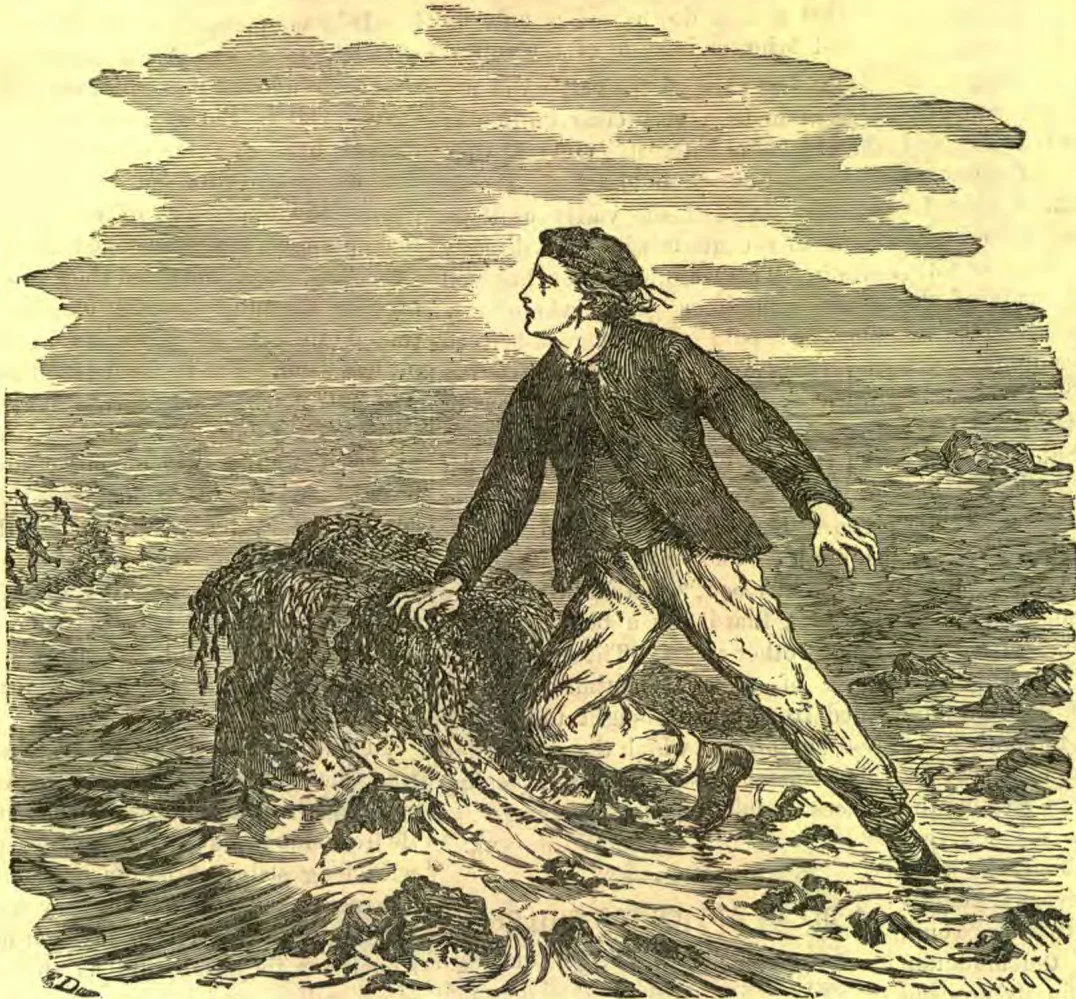
“The tide has turned! the tide has turned!” exclaimed the boys in a breath; and away they ran for the shore as fast as they could go. They all reached it in safety, but poor Paul was not so fortunate; he had heard the noise of the tide, and, running with all his might, he succeeded in reaching the Rock just as the tide overtook him. To gain the shore was now impossible, and he knew that the boys could not help him. The tide was rising rapidly, and as he looked around, the peril of his situation flashed upon him. He called to the boys on the shore, but the roar of the waters seemed to mock his words. He thought of his dead mother, and in this hour of peril the lessons which she had taught him came forcibly to his mind. He remembered that she had told him to pray to Jesus in time of trouble, and kneeling on the rock, only the top of which was now visible, he prayed earnestly.
His companions could not hear the words of his prayer, but they knew that he did not pass through the dark waters alone. EUGENE LELAND.

WE REAP WHAT WE SOW.

For pleasure or pain, for weal or for woe— 'Tis the law of our being—we reap what we sow. We may try to avoid them—may do what we will— But our acts, like our shadows, will follow us still.
The world is a wonderful chemist, be sure, And detects in a moment the base or the pure. We may boast of our claim to genius or birth, But the world takes a man for just what he's worth. We start in the race for fortune or fame, And then, when we fall, the world bears the blame; But nine times in ten, it is plain to be seen, There's a “screw somewhere loose” in the human machine.
Are you wearied and worn in this hard, earthly strife? Do you yearn for affection to sweeten your life? Remember, this great truth has often been proved; We must make ourselves lovable, would we be loved.
Though life may appear as a desolate track, Yet the bread that we cast on the waters comes back. This law was enacted by Nature above, That like attracts like, and love begets love.
We make ourselves heroes and martyrs for gold, Till health becomes broken, and youth becomes old; Ah! did we the same for a beautiful love, Our lives might be music for angels above!
We reap what we sow. Oh! wonderful truth!— A truth hard to learn in the days of our youth. But it shines out at last, “as the hand on the wall,” For the world has its “debit” and “credit” for all. —Selected.

Good Humor as the Clear Blue Sky of the Soul

Good Humor is the clear blue sky of the soul, on which every star of talent will shine more clearly, and the sun of genius encounter no vapor in his passage. ’Tis the most exquisite beauty of a fine face,—a redeeming grace in a homely one. It is like the green in the landscape, harmonizing with every color, mellowing the glories of the bright, and softening the hue of the dark; like a flute in a full concert of instruments, a sound, not at first discovered by the ear, yet filling up the breaks in the concord with its deep melody.

Watch Your Thoughts, and Your Words Will Follow

WATCH your thoughts, and your words will take care of themselves.

YOSEMITE VALLEY.

SAID a friend, “What! have you been to the Yosemite, and never said anything about it?” Yes, I have been to the Yosemite; but the person who can visit that valley, and then be satisfied with any description he can give of it, must be sadly lacking in appreciation of the grand and beautiful in nature.
The Yosemite (yo-sem'-i-te) valley lies among the Sierra Nevada mountains, in the eastern part of central California. While I cannot hope to present an adequate description, I will attempt to give the reader a partial idea of this celebrated spot, which affords some of the grandest scenery on the Pacific coast. With a friend who had a pony-team, I started from near Mount Diabolo, Contra Costa county, nearly east from Oakland. Almost every river, bay, valley, town, and street, named by the Spanish missionaries, is named from some saint. Everything is “San” or “Santa.” Why Mount Diabolo was made an exception, and named for the devil, I have never learned. It is quite a landmark, rising out of the plain to the height of 3000 feet. We went up the San Joaquin River, crossing it at Grayson, and then struck directly east to the mountains, striking the foot-hills near La Grange. Here considerable gold mining is done. Entering the foot-hills, we found the roughest roads of the whole journey before we reached Coulterville. This is a mining town, and shows that it has been a place of much business; some mining is still done in the canyons; but, like many other mining towns, Coulterville has seen its best days. It is over fifty miles from Yosemite valley.
Here we commenced our regular mountain travel. We soon struck “a grade,” which is the name of a steep road, or a road dug in the side of a mountain, to ascend it. As we wound around from one point to another, we could look up to a place far above us, where the road seemed to rest on the summit; but when we reached that point, it was only to find the road climbing up to newly revealed heights above. We concluded that this would bring us to the top of the mountain from which we would finally descend into the Yosemite valley. But, to our surprise, after a few miles traveling on the top of this range, we began to descend another grade, and we went down, down, into another valley, which seemed to be as low as that in which we left Coulterville.
“What have we gained by climbing up that grade?” queried my companion.
“We are so much farther toward Yosemite,” was my reply. And this we found to be only the beginning of a series of such up-and-down grades. We had some extensive views of the face of the country, which is composed of long ranges, with valleys between, running toward the Merced River, which flows through Yosemite. From some of these heights I saw more mountains than I ever saw before. With a clear sky, an unlimited view, with range after range spread out before us, the prospect was truly grand. Frequently we could look down into a smiling valley, where the farmers were gathering their hay. And such mountain valleys are the most beautiful spots in the world; their beauty, probably, being heightened by the contrast.
It was interesting to note the changing vegetation from the valleys below, to the heights where we stood. The busy scenes of summer work, with flowers in the valley; nearer toward us the “dogwoods” were in full bloom; and nearer still they were just opening; while around us the oak buds were just swelling.
We had a tent, and carried our provisions and camped out, which I think is the best way to visit the valley. We had no difficulty in finding good feed and water on the way. Far toward the valley we came to an up-grade, not generally so steep as some others, but about eight miles in length. Here we found the toll-gatherer. We asked him if this was the last grade. With a strong foreign accent, he told us that a mile down and a mile up would bring us in sight of the valley.
Our first view of the valley did not present to us a very clear outline of the objects of interest. Only El Capitan stood out in bold relief. Again we lost sight of the valley until we came to the grade which led directly into it. This was quite steep, but well made, sometimes going where only blasting could make a road-bed on the steep and solid rock. Starting down this, we came in full view of the canyon of the Merced River below the valley. For rocky ruggedness it exceeded anything which I had ever seen. The river raves and pitches through its rocky pathway—I will not say “rocky bed,” as that would give the idea that it has a bed similar to that of other rivers. The canyon is a mass of rocks, sometimes roughly piled from a great height to the very bottom, through which the river rushes in a constant foam, having no resting places or quiet pools.
J. H. WAGGONER.

The Carpet Weaver.

Old Ana lived away back in the country, not a house being in sight. And after you had left the highway, you had to cross a rustic bridge over a narrow stream. The house was a small brown one, hardly as fine as those warmly thatched bee-hives that were ranged along the sunny side of it. It was pleasanter outside than within, but it was Ana’s home, and the children loved it because she lived there. Out in the garden there were matted beds of yellow periwinkles, that almost crowded out the weaklier plants, and long rows of hollyhocks that purpled and crimsoned in the sun. Tall coxcombs lifted their heads high in air, and “Love-lies-bleeding” trailed its stained blossoms in the pitiless sand. But in the house there was not much beauty; Ana herself was far from fair; her hair had been bleached by the suns of many summers; and the tears of more than seventy years had sadly faded the blue of her eyes. She was a poor old woman, who was not very learned, and whose life had been one of constant toil, but I think her heart was still young, for she was fond of little children.
In one of her dingy rooms there was a heavy wooden loom, where Ana sat, day after day, throwing the shuttle from side to side, filling the “warp” with long strips of cotton or woolen “carpet rags.” Sometimes they were bright as the flowers in her garden, sometimes they were dull as the old stone wall around it; but the carpet, when it came from the loom, was often very gay, and fairly dazzling to the eyes of inquisitive children. Perhaps it looked brighter still when spread on her old floor for them to look at.
If some of you had seen the old carpet weaver as she labored hour after hour, the work would have seemed hard, and you would have thought the task unpleasant; but do you know that you are at work at a similar business every day, every hour, every moment of your lives? There is a “web” that God has given you to weave, and with it a “pattern” wonderfully varied, and more beautiful than human genius can design. At times the web is very white, at times it seems dipped in blood; one day the rainbow is not more brilliant, the next, the storm-cloud covers it with blackness. Now we have the gold of the setting sun, then the roseate hue of early dawn, or the purple of the distant hills—there is no shade or tint that may not shine or glisten here; there is no line or curve that may not decorate this web. By-and-by the Master’s hand shall cut the threads and gather up the web complete. Then shall it borrow priceless beauty from his glance, or crumble like dust beneath his touch. This web is the web of life; the pattern is Christ, and God slowly dyes it for us with carefulness and skill. Tears fade it, sorrow darkens it, sin mars it, but the smile of God brightens and restores.—E. B., in Little Christian.

“BLUE SKY SOMEWHERE.”

CHILDREN are eloquent teachers. Many a lesson which has done our heart good have we learned from their lisping lips. It was but the other day another took root in memory. We were going to a picnic, and of course the little ones had been in ecstasies for several days. But the appointed morning broke forth with no glad sunshine, no song of birds, no peals of mirth.
There was every prospect of rain—even Hope hid her face and wept.
“Shan’t we go, mother?” exclaimed a child of five, with passionate emphasis.
“If it clears off.”
“But when will it clear off?”
“Oh, look out for the blue sky!”
And so he did, poor little fellow, but never a bit of blue sky gladdened his eyes.
“Well, I do n't care, mother,” said he, when the tedious day had numbered all its hours, “if I have n't seen it, I know there is blue sky somewhere.”
The next morning there was blue sky, such as only greets us after a storm.
“There, mother, did n't I tell you so?” cried a joyous voice; “there is blue sky!” Then the little head bowed for a moment in silent thought.
“Mother,” exclaimed the child, when he again looked up, “there must have been blue sky all day yesterday, though I never saw a bit of it, ’cause you see, there ain't no place where it could have gone to. God only covered it up with clouds, did n't he?”—Sel.

NO HIDING.

No one can hide from the Judgment. A century ago an infidel German countess, dying, gave orders that her grave should be covered with a solid slab of granite; that around it should be placed square blocks of stone; and that the whole should be fastened together by strong iron clamps. On the stone, by her order, these words were cut: “This burial place, purchased to all eternity, must never be opened.” Thus she defied the Almighty. But a little seed sprouted under the cover, and the tiny shoot found its way through between two of the slabs, and grew there, slowly and surely, until it burst the clamps asunder, and lifted the immense blocks. No wonder the people of Hanover look at that opening grave as God’s answer to the terrible defiance of the young countess. Certain it is that no one can hide from that universal exposition.

A BIT OF ADVICE FOR CHILDREN.

Said Horace Mann, “You were made to be kind, generous and magnanimous. If there is a boy in the school who has a club foot, don’t let him know you ever saw it. If there is a poor boy with ragged clothes, don’t talk about rags when he is in hearing. If there is a lame boy, assign him some part of the game which does not require running. If there is a hungry one, give him a part of your dinner. If there is a dull one, help him to get his lessons. If there is a bright one, be not envious of him; for if one boy is proud of his talents, and another is envious of them, there are two great wrongs, and no more talents than before. If a larger or stronger boy has injured you, and is sorry for it, forgive him, and request the teacher not to punish him. All the school will show by their countenances how much better it is than to have a great fist.”

Good Manners Are Made Up of Petty Sacrifices

Good manners are made up of petty sacrifices.—Emerson.

DON'T GIVE UP.

If you've tried and have not won, Never stop for crying; All that's great and good is done Just by patient trying.
Though young birds in flying fall, Still their wings grow stronger; And the next time they can keep Up a little longer.
Though the sturdy oak has known Many a blast that bowed her, She has risen again, and grown Loftier and prouder.
If by easy work you beat, Who the more will prize you? Gaining victory from defeat, That's the test that tries you! —Phebe Cary.

SCENES IN THE LIFE OF CHRIST.

LESSON 6.—THE VISIT OF THE WISE MEN.

Not long after Jesus was presented at the temple, there came wise men from the East to Jerusalem, saying, “Where is he that is born king of the Jews; for we have seen his star in the East, and are come to worship him.” The cruel Herod was at this time reigning in Judea. He was so jealous of every one who could possibly become king in his room that, when he heard the errand of the wise men, “he was troubled, and all Jerusalem with him.”
So when he had gathered all the chief priests and scribes together, he asked them where Christ should be born. And they said unto him, “In Bethlehem of Judea; for thus it is written by the prophet.” Then Herod, calling the wise men apart, talked with them privately, questioning them very carefully about the time when the star first appeared to them. Then he sent them to Bethlehem, saying, “Go and search diligently for the young child, and when ye have found him, bring me word again, that I may come and worship him also.”
Now when the wise men had started on their way to Bethlehem, the star which they had seen in the East appeared to them again, and went before them, till it stood over the place where Jesus was. “And when they were come into the house, they saw the young child with Mary his mother, and fell down, and worshiped him; and when they had opened their treasures, they presented unto him gifts; gold, frankincense, and myrrh. And being warned of God in a dream that they should not return to Herod, they departed into their own country another way. And when they were departed, behold, the angel of the Lord appeareth to Joseph in a dream, saying, Arise and take the young child and his mother, and flee into Egypt, and be thou there until I bring thee word; for Herod will seek the young child to destroy him. When he arose, he took the young child and his mother by night, and departed into Egypt, and was there until the death of Herod.”
“Then Herod when he saw that he was mocked of the wise men, was exceeding wroth, and sent forth, and slew all the children that were in Bethlehem, and in all the coasts thereof, from two years old and under, according to the time that he had diligently inquired of the wise men.”
“But when Herod was dead, behold, an angel of the Lord appeareth in a dream to Joseph in Egypt, saying, Arise, and take the young child and his mother, and go into the land of Israel; for they are dead which sought the young child’s life. And he arose, and took the young child and his mother, and came into the land of Israel. But when he heard that Archelaus did reign in Judea in the room of his father Herod, he was afraid to go thither;” and “being warned of God in a dream, he turned aside into the parts of Galilee; and he came and dwelt in a city called Nazareth.”

QUESTIONS.

  1. What happened soon after Jesus was presented at the temple?
  2. What did these men say? Matt. 2:2.
  3. Who was reigning in Judea at this time?
  4. What was his disposition?
  5. What effect did the visit of the wise men have upon Herod and others in Jerusalem?
  6. What way did Herod take to answer the wise men?
  7. What answer did the priests and scribes give? Verse 5.
  8. Who were the scribes?—They were men who copied that part of the Bible which had then been given.
  9. Why was it necessary to copy the Bible with a pen?
  10. How could the priests and scribes tell where Christ was to be born?
  11. What did Herod then do?
  12. About what did he carefully question them?
  13. When he sent them to Bethlehem, what did he charge them to do?
  14. How were the wise men guided to the place where Christ was?
  15. What did they do when they had come into the presence of Jesus?
  16. What gifts did they present?
  17. What warning did God give them in a dream?
  18. What instruction did the Lord give Joseph?
  19. What reason did the Lord give for asking Joseph to take such a long journey?
  20. How far was it from Bethlehem to Egypt?—Not less than 200 miles.
  21. Describe the country through which they had to pass in going from Bethlehem to Egypt.—It was a rocky, barren country, with but few trees and streams, and not much grass.
  22. In what direction did they have to travel in going from Bethlehem to Egypt?
  23. How did people travel in those days?
  24. How long do you think it must have taken Joseph and Mary to make the journey?
  25. What great sea did they have on their right as they traveled?
  26. What sea lies south-east of Egypt?
  27. What great river runs through Egypt?
  28. Where does it empty?
  29. How did Joseph know when to return from Egypt?
  30. When he returned, where did he go to dwell?
  31. Why did he not return to Bethlehem?
  32. Where is Nazareth?—About seventy miles north of Bethlehem.
  33. How might you know where to place it if you were drawing a map?—It is just a little farther south than the lower end of the Sea of Galilee, and not quite half way from the River Jordan to the Mediterranean Sea.

LESSONS ON NEW-TESTAMENT HISTORY.

LESSON 19.—THE CALLING OF MATTHEW.

AGAIN Jesus went forth by the sea, and taught the people that resorted to him.
Now there was at Capernaum a Roman tax-gatherer by the name of Matthew Levi, and as Jesus passed by where this man sat receiving tribute, he said unto him, “Follow me.” “And he left all, rose up, and followed him,” are the simple words of the Sacred Record, implying that his faith was such that he obeyed the Master without hesitation. Matthew was greatly surprised, no doubt, at being called to follow Jesus; for the Jews were so unwilling to pay tribute to the Romans, that they despised and hated the publicans, who were employed to collect the taxes. This odium was in part deserved; for many of the publicans extorted from the people more than the government required.
Matthew was so anxious to show his gratitude that he made a great feast for Jesus and his disciples; and there were present a great company of publicans and others, who sat down to the feast. Now when the Pharisees who had followed Jesus saw this, they said unto his disciples, “Why eateth your Master with publicans and sinners?” But when he heard that, he said unto them, They that be whole need not a physician, but they that are sick. But go ye and learn what that meaneth, I will have mercy and not sacrifice; for I am not come to call the righteous, but sinners to repentance. Then came to him the disciples of John, saying, Why do we and the Pharisees fast oft, but thy disciples fast not? And Jesus said unto them, Can the children of the bridechamber mourn as long as the bridegroom is with them? but the days will come, when the bridegroom shall be taken from them, and then shall they fast.” “And he spake also a parable unto them: No man putteth a piece of a new garment upon an old; if otherwise, then both the new maketh a rent, and the piece that was taken out of the new agreeth not with the old. And no man putteth new wine into old bottles, else the new wine will burst the bottles, and be spilled, and the bottles shall perish. But new wine must be put into new bottles; and both are preserved. No man also having drunk old wine straightway desireth the new; for he saith, the old is better.”

QUESTIONS.

1. What practice did Jesus resume after returning to Capernaum? Mark 2:13.
2. As Jesus was passing along one day, whom did he notice?
3. What did Jesus say to him?
4. What was the effect of these words?
5. What must have been Matthew’s feelings at being called to follow Jesus?
6. What were the feelings of the Jews toward the publicans?
7. What causes were there for these feelings?
8. How did Matthew show his gratitude for the Lord’s kindness to him?
9. Who sat down to the feast with Jesus and his disciples? Matt. 9:10.
10. Who were among the number that had followed Jesus to the feast?
11. What did they say to the disciples?
12. When Jesus heard it, what reply did he make?
13. What scripture did he tell them to learn the meaning of? Verse 13.
14. Whom did he say he had come to call?
15. What question was asked by the disciples of John?
16. How did Jesus answer them?
17. What parable did Jesus speak concerning the mending of garments?
18. What concerning the putting of wine into bottles? Luke 5:37.
19. What concerning the drinking of wine?
NOTE.—The bottles most commonly used in the East and doubtless here referred to by Christ, were made, not of glass or earthen, but of the skins of animals, tanned and sewed together in their original shape. At first, these bottles are soft and pliable, but after being used some time, they grow hard and shriveled, and are liable to crack and become useless. So if new wine were put into these old bottles, when it began to ferment, they would not stretch, or “give,” like new bottles, but would be likely to burst, and so the wine be spilled.

EBAL AND GERIZIM.

ALTHOUGH these mountains have no immediate connection with the lessons of this week, they have been so frequently referred to in the past lessons and the accompanying articles, that some description of them may perhaps be interesting.
As formerly stated, these mountains stand on either side of the valley of Shechem, some thirty miles north of Jerusalem. Ebal rises almost in the face of Gerizim, the two mountains being of nearly equal height.
It will be remembered that these mountains were pointed out by Moses, while the children of Israel still stood on the plains of Moab, as the place to which they were to come after conquering the land of Canaan, and pronounce the blessings and curses. Mr. Prime, a traveler in the Holy Land, makes a statement in reference to this, which, if true, certainly furnishes an interesting coincidence. He says: “As we rode up the narrow pass between the mountains, we looked behind us; and there, right down the valley, which went sloping away thirty miles to the Jordan, lit in the red rays of the setting sun, were the mountains of Moab and the summit of Pisgah. It was evident that the very words of the great law giver were accompanied by a gesture of his hand pointing to Ebal and Gerizim, at the head of that valley. I could then understand how he came to describe their situation so minutely, and to speak of them so familiarly. (Deut. 11:29.)”
All this might easily be true, as it is a well-known fact that the atmosphere of Syria and Palestine is so peculiarly clear as to make it possible for one to see a long distance; and objects that are really many miles away often appear to be within an hour’s ride.
Be this as it may, it seems that these mountains were peculiarly fitted for the purpose to which they were set apart by Moses. Quoting again from Mr. Prime: “Mount Ebal was on our right and Gerizim on our left, and in the front of each, where the valley narrowed to the least width, was a platform, natural, indeed, but capable of holding a hundred thousand persons, as if arranged expressly for the scene of blessing and cursing which here took place.”
Says Dr. Fish: “Descending along the side of Gerizim, I saw just how the blessings and curses of old took place as described. Skeptics have asked, ‘How could the voices be heard from one mountain to the other?’ Easily enough. It was not on their tops, but on their sides, that the representatives of six tribes stood, on Gerizim to bless and those of the other six tribes on Ebal to curse, while the two millions of people below responded, Amen. Half-way down Gerizim, Ebal seemed in our very faces. To descend and go up to the spot opposite, would have been an hour’s hard work; but we could talk across from one mountain to the other, and be heard also in the valley, which is here only about six hundred feet across, while where the village (Nablous) stands, it is fifteen hundred feet.”
As before stated, a sort of natural amphitheatre exists at this point, where it is likely all the people, or their tribal representatives, were assembled. It is formed by a recess in Ebal exactly facing a similar recess in Gerizim. Travelers, both by measurement and by experiment, have found it to be admirably adapted to the assemblage of a large concourse of people.
“It is a myth that any special barrenness exists on Ebal, more than on Gerizim. There is some vegetable growth on both, yet they are alike naked, as a rule, until we approach the base, where they are remarkably fertile.”
The history of Ebal has nothing of special importance connected with it after the event referred to; but on Gerizim for many years stood the temple of the Samaritans, who worshiped here instead of at Jerusalem. These people were descendants of the heathen colonists sent thither by the king of Assyria to inhabit the country after the captivity of the Israelites. They accepted some points of the Jewish religion, as, for instance, adopting the Pentateuch, or five books of Moses; but as we are told in 2 Kings 17:33, “they feared the Lord, and served their own gods.” For this reason, the Jews, after their return from captivity, refused to let the Samaritans have any part with them in rebuilding the temple at Jerusalem. This led not only to the building of a rival temple on Mount Gerizim, but also to a bitterness of feeling between the two nations, which never passed away.
A mere handful of these Samaritans, something less than two hundred, are now found at Nablous; and they are still looking for the Messiah to come and establish his throne on Mount Gerizim, and so reign over them.
E. B.

MAKE YOUR TEACHER HAPPY.

If you only knew, scholars, how much even one studious pupil encourages the teacher, you would all try to be studious. If all in the class are so, it is more cheerful than you think. And if most are careless, then each one who does actually try to do well helps the teacher greatly. So you see there is an excellent chance for you to add to your teacher’s happiness.

CHILDREN'S SERMON.

[1 Sam. 3:10. And the Lord came and stood, and called as at other times, Samuel, Samuel. Then Samuel answered, Speak, for thy servant heareth.]
ROUND the ancient town of Shiloh Night has come, so still and dark; Round the sacred tabernacle And the golden-covered ark. Now the fathers, worn with labor, And the mothers, tired with cares, Find the rest, serene, refreshing, Which the blessed night prepares.
Now the bright-eyed Hebrew children, After active, noisy games, Hide-and-seek, or ball, or marbles, Rest their hardy, sun-browned frames. Eli sleeps, the priest, gray-headed, With his beard along his breast, Like a pictured saint so peaceful, And his dreams are with the blest.
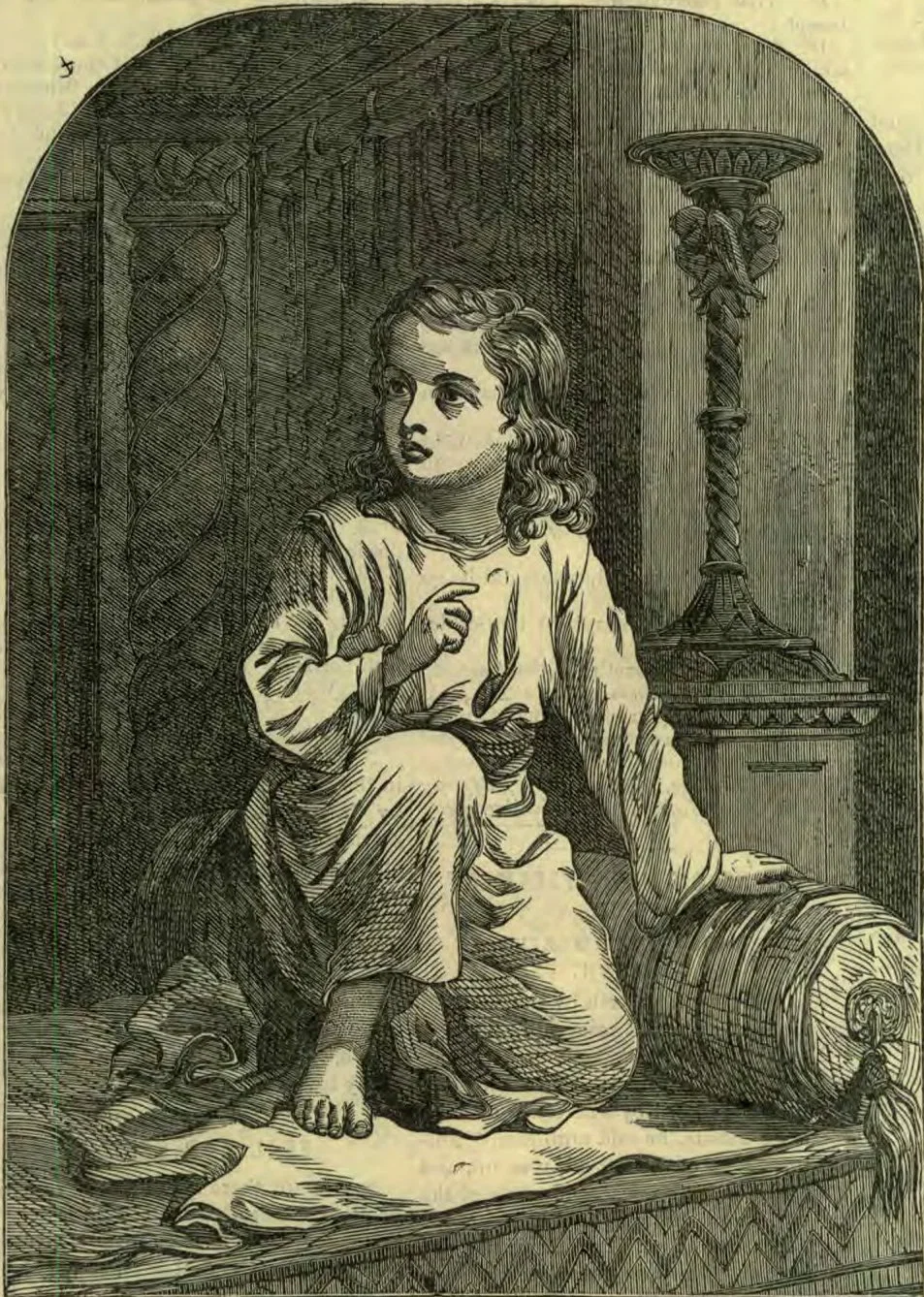
Deeper in the solemn shadow, Low upon his little bed, In the bloom of childish beauty, Samuel rests his curly head. So they sleep and wait the morrow, When new day to life shall call, And the sleepless God of Israel Watches, faithful, over all.
But the child starts in his slumber— Does he dream, or does he hear Voice that calls him in the darkness? Now again it fills his ear; Voice like that of ancient Eli, Tender, fatherly in tone, Thrice to Samuel clearly calling, As a father calls his own.
Through the silent tabernacle Cautious trip the little feet; Hand and spirit both are ready For obedience complete.
Never stops the child to question— Lingers not to frame reply— Straight he seeks his aged master, Softly saying, “Here am I.”
Yet his heart is full of wonder, And the question of surprise, Eager, earnestly appealing, Looks from his wide-opened eyes.
But ’tis not the voice of Eli; See; he sleeps; but wakes to say, “I called not, my son; thou dreamest; Lay thee down till coming day.”
Now again resounds the summons Through the tabernacle still, And the wondering childish sleeper,
Quick to wait on Eli’s will, Stands and waits to know his bidding; Till the priest, so simple, mild, Learns at length the truth momentous, That the Lord had called the child.
“Seek once more, my son, thy pillow; If the call shall come again, ‘Speak thou, Lord, thy servant heareth!’ This shall be thy answer then.” Calls again the voice majestic; And the child, with accents clear Answers bravely, “Speak, Jehovah! I, thy servant, now will hear.”
Do you think, my precious children, That the Lord called him alone? Are there, think you, no more Samuels Whom he loves—his very own? Did he only call the Hebrew In the midnight, long ago? Was that willing boy in Shiloh All the child that God can know?
Has the Lord one message only? Only work for one to do? In the service of his altar Is there left no place for you, Where quick hands may do his bidding, Where light feet may walk his ways, By whose lips be nobly spoken Pure, brave words of truth and grace?
O my children, let the story Teach you of your life to-day; Now to you Jehovah calleth: “Will ye love me and obey? Still my service, glad and holy, Makes the soul of childhood sweet; Still I ask the trust of children, And obedience complete.
“Will ye walk with me, your Father, Giving heart and life to me? Will ye follow and believe me Till my face and home ye see?” In the light and in the darkness Searching ever, voices call: “Will ye take Him now, ye children, Yours forever and for all?”
So within the tabernacle Of your Father you may bide; Safe in love, unfailing, tender, You may dwell unterrified. As he calls you, blooming children, Give him hands and hearts and ears, Spirits bowing low to answer, “Speak, O Lord, thy servant hears.”

LETTER BUDGET.

F. H. Richardson, of Ferndale, Cal., says: “I am eleven years old. I keep Sunday with my father and mother, brothers and sisters, but I have no chance to go to Sunday-school. My kind uncle sends me the INSTRUCTOR, for which I am very thankful. I like it much, and hope to receive benefit from its good teachings.”
Maudie Carler writes from Delta, Ohio: “I am eight years old. I have read in the Bible that the seventh day is the Sabbath. Mrs. McClure keeps it, and I am trying to keep it too. She takes the INSTRUCTOR, and lets me read it. I like it so well that I think I will try to take it for myself. I want the INSTRUCTOR family to pray for me.”
Erick Larson writes from Dickinson Co., Iowa. He says: “I am glad the INSTRUCTOR comes to my home every week. I am twelve years old. I live so far from any Sabbath-school that I cannot attend very often. I go to day-school, when there is one. I want to be a good boy, and keep all the commandments of God.”
Fannie Jones writes from Bedford, Iowa: “As my time was out for the INSTRUCTOR, I thought I could not do without it, so I picked up potatoes for pa and earned 49 cents, and herded cattle for 60 cents more. Ma says I ought to give a tenth of it to the Lord, so I will send you 85 cents, and you can send me the paper, and use the other 10 cents as you think best. I hope I will get it, so I will not lose one lesson. I am most ten years old; I keep the Sabbath with ma and grandma.”
Fannie will be likely to prize her paper, after working so hard to earn it. The ten cents we put into the fund to send the INSTRUCTOR to children too poor to pay for it themselves.
Continue reading: A LITTLE EVERY DAY