The Youth’s Instructor, Vol. 35, No. 25.

THE STREETS OF JERUSALEM

The Youth’s Instructor

Jun 22, 1887

S. D. A. Publishing Association · Battle Creek, Mich. · Jun 22, 1887

THE STREETS OF JERUSALEM.
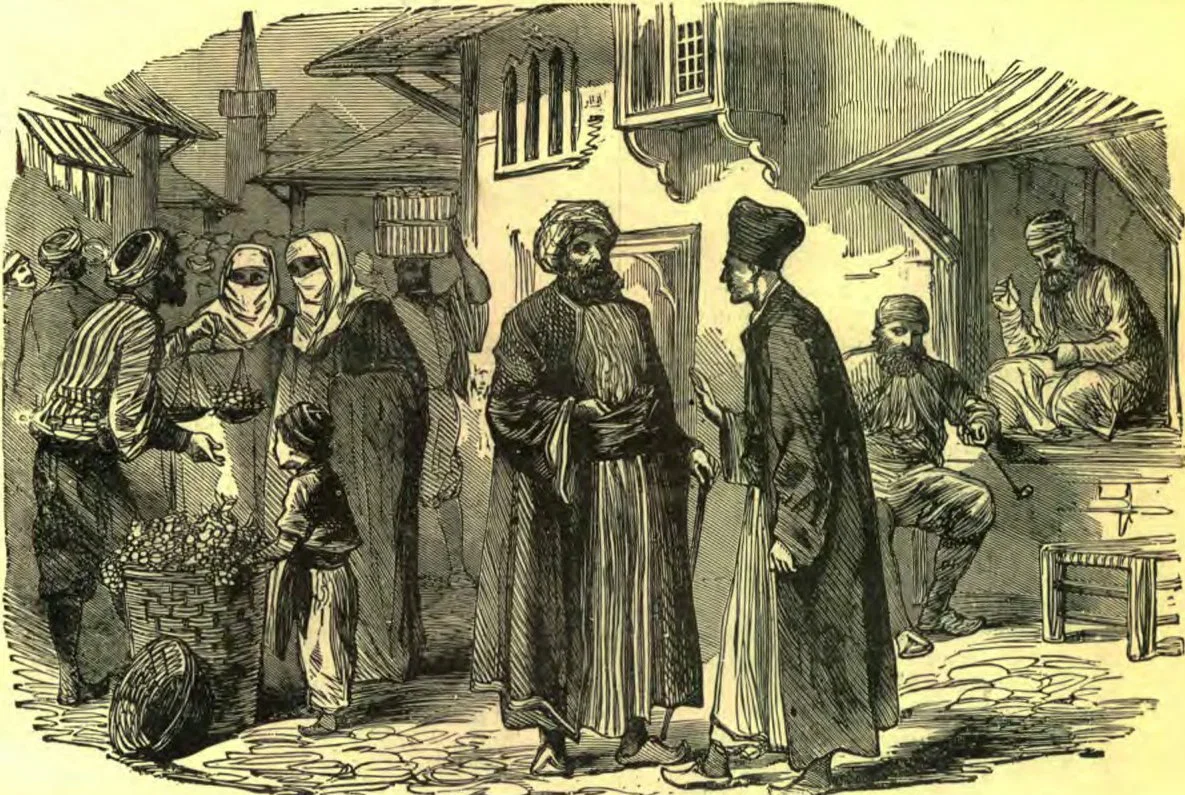
No more can the inhabitants of Jerusalem with pride exclaim, “Let us walk about Zion, and tell the towers thereof!” for the strength of the Holy City has departed; the joy of the whole earth is laid low. The temple no more glitters in the morning sun, with its clouds from the altar of burnt-offering and its fragrant incense ascending as a sweet savor to Heaven. The stately towers and bulwarks are crumbling to dust, and rubbish fills the streets.
“No rich local coloring,” says a traveler, “brightens the outward aspect of the Holy City. A ruddy gray stone is the material basis of wall and roof; for the upper rooms being vaulted and the covering flat, the housetops are composed of the same material as the upright shell. A gilt cross gleams from a church; a silver crescent sparkles on a mosque; a belt of white colonnades adorns the Temple hill; a parapet of red tiles surrounds some of the high roofs; here a patch of mosaic quickens into beauty a modest dome; and there a palm tree waves its elegant fans against the azure sky. But these specks of color on the prevailing ground only serve to set the landscape in a lower key. A sky of variable tone, Sicilian in its usual depth of blue, yet English in its occasional wealth of mist and cloud, hangs over this mass of limestone roof and wall.”
Though the general aspect of the city falls below the glowing colors with which, in spite of travelers’ descriptions, we still invest the Holy City, we shall find that the novel scene which greets us as we enter the city gate, in some measure compensates for the disappointment. Jerusalem is laid out with more regularity than many Eastern cities. Two long streets run through it, crossing each other at right angles, thus dividing it into four quarters occupied respectively by the Franks, the Armenians, the Jews, and the Mahometans.
As we enter the walls from the East through the Jaffa Gate, the one through which travelers generally go, a strange scene greets the eye. We find ourselves in the midst of the chief market-place. Says an eye witness: “Dusky women of Bethany and Siloam, in long blue or white gowns, with bright colored kerchiefs tied round their heads, bring large baskets full of cucumbers, tomatoes and onions, and other garden produce; while from more distant villages, especially Bethlehem and Artas, troops of donkeys come laden with enormous cauliflowers and turnips, guided by boys in white shirts girdled with broad red leather belts. The pleasant-looking Bethlehem women, wearing crimson and yellow striped or blue gowns with long white linen vails, carry on their heads baskets of grapes, figs, prickly pears, pomegranates, and apricots, or whatever fruit is in season. Sometimes this market-place is almost blocked up with piles of melons, or with oranges and lemons from Jaffa, and in this early summer time roses are sold here by weight to the makers of conserves and attar of roses. Hotel-keepers and servants from the various convents come here to make their bargains, and turbaned green-grocers and itinerant venders of fruit come to buy their stock for the day. Soon the place is crowded, and the bustle of buying and selling begins. No purchase is effected without a considerable amount of contention. The seller does not usually price the goods, but waits for an offer. The first offer is always absurdly low. The seller then names an exorbitantly high price. For instance, a dignified shop-keeper, wearing a white turban, will offer three piasters for a large basket full of tomatoes. The girl in charge answers indignantly,—
“‘I will carry my tomatoes back to Siloam rather than take less than fifteen!’
“‘O thou most greedy of the greedy, I will give no more than six!’
“‘O possessor of a tightly closed hand, I will not take less than twelve! How shall I buy the rice for my mother if I give away the fruits of her garden?’ Finally she obtains seven and a half piasters, and goes away perfectly satisfied, having argued with pertinacity for the half piaster.
“In an hour or two the market people disperse and only a few retail sellers of fruit or of rude pottery remain. As soon as the market is over, the crowds increase in the bazaars.”
“A turn eastward out of Christian Street leads through dirty crooked streets of stairs and arched passages, dark and dusty, to the most important of the bazaars and khans, which are in the center of the city. Here, under lofty arcades, the butchers’, fruiters’, oil, grain, and leather markets are held. The butchers call out loudly, ‘Oh, every one that hath money, let him come and buy!’ and ‘Oh, such a one, let him come and buy!’ The cry of the sellers of fruit appears to be more disinterested, for they often say to a passer-by, ‘Take of our fruit without money and without price!’ but immediately afterward they will ask him an exorbitant sum for it!”
The streets of Jerusalem, like those of other oriental cities, have no names, those by which they are known in books of travel being by common assent, given them by travelers merely for convenience in speaking of them afterward. The streets are execrably bad. They are narrow, and hemmed in on each side by grim, dark buildings. A gutter runs through the middle, and into it are cast all the filth and garbage of the town. The rounded stones with which they are paved adds to the general discomfort. Perhaps it were charity to draw a veil over these “foot-torturing, nose-offending streets,” which only serve to make the downfall of the Holy City more painfully apparent to the traveler.
W. E. L.

THE POWER OF LOVE.

I HAD a little heliotrope, 'Twas dry and scant and slender; I placed it in the window, In the dewy sunshine's splendor; I watered it, and loved it With a pitying love, and tender.
It seemed to know it was beloved. It suddenly was growing; The dry, poor limbs began to break, With dainty leaflets showing; And after while the fragrant flowers, My love's return, were blowing.
I saw a little saddened child, Her face was dull and dreary; She was not loved, and oft her eyes Looked wistful, sad, and teary; She was an uninviting child, And looked so worn and weary.
But one kind heart went out to her In sweet compassion tender, And softly folded her in love, The heart's own sunny splendor, The little child began to bloom, New life love seemed to lend her.
Her eyes grew bright with quickening thought, Her lips grew sweet with singing, Her awkward ways were changed to grace, Her steps grew light and springing; And one heart's love transfigured her, And set the joy bells ringing.
Oh! love is power. 'Tis bloom and grace 'Tis a reviving essence; A flower will bud, a heart will sing, Beneath its sunny presence; And God is love, and love makes kings And priests of humble peasants.
Oh! love is power. It operates, To make all things diviner; It is the beauty of our God; All graces are its minor; It pours like fire and dew through hearts And is the soul's refiner.
'Twas love that brought our Saviour here, To shed his heart's dew o'er us, That our poor, withered souls might bloom, And sing in Heaven's chorus. He loved all men, and we should walk The path he walked before us.
FANNIE BOLTON.

SEVENTY TIMES SEVEN.

“If thy brother trespass against thee seven times in a day,” read Daisy Ford from her little “Daily Food” before her on the bureau, as she brushed the snarls from her brown curls,—“If thy brother trespass against thee seven times in a day, and seven times in a day turn again to thee, saying, I repent, thou shalt forgive him.”
“Oh dear!” she exclaimed in dismay. “Must I forgive Tom seven times every day? I suppose if it says so in the Bible, I must; but he is so aggravating!” and Daisy put on her collar and blue ribbons with a sigh, and went down to breakfast.
Papa and mamma were not down. Tom was over in the bay-window trying to teach Rover a new trick.
“Hallo, sis!” he exclaimed, suspending operations at her entrance, “what’s the matter with you? Your face’s as long as the moral law with a postscript.—‘Guess we’ll have to ’liven her up a little, won’t we, Rover? Let’s go for her.”
Now, Rover was fresh from a long run in the grass, and it had rained in the night.
“Oh, Tom, don’t; you’ll soil my clean apron, and I’m all ready for school.”
But she was too late; the dainty white apron was soiled and rumpled past wearing, and there was nothing left to do but go in search of a fresh one.
“I’m sorry. I didn’t mean to do anything, only wake you up a little,” shouted Tom after her as she went upstairs.
“Oh,” was Daisy’s only reply, softly to herself.
Tom was vexatious enough at any time, but to-day he seemed possessed.
He carried her books to school for her, and in some way lost out her paper of examples, so she had those to work over. He tipped his inkstand over her copybook, which she was keeping so neatly for examination-day. He borrowed her knife that Aunt Sue gave her on her birthday, and lost it. He put a live toad in her lunch-basket. He broke the handle of her new umbrella, using it, in spite of her entreaties, as a bat.
“Can’t imagine how it happened,” said Tom; “hadn’t the remotest idea I was using it hard enough to break it.” But it was broken, for all that, and Daisy picked up the pieces, saying to herself as she did so, “This makes six times.”
Last but not least, when she came home from Mamie Granger’s at night, she found him chasing her pet kitten Snowball around the yard, with a tin pan tied to her tail.
“There!” said Daisy as she set the poor, frightened creature at liberty; “it’s been awful hard, but I’m through for one day, at any rate, for this makes seven times I’ve forgiven him.”
Half an hour later, when she sat in the sitting-room reading, Tom put his head in at the door:—
“I say, Daisy, I’m sorry, but Snowball ran under the shed, and I tried to catch her, and she’s in a fit. I shouldn’t wonder much if she was dying. Can you forgive a fellow?”
“No, I can’t, and won’t try to, either, for this is the eighth time to-day, and I almost hate you,” said Daisy as she brushed past him.
“Come here a moment, Daisy,” called mamma from her room, where she had overheard all. “What do you mean by ‘eight times’?”
“Why, mamma, you see my verse this morning said I must forgive my brother seven times a day; so I have, but this is the eighth time, and I needn’t, need I?”
“Run and get your Bible,” was mamma’s reply; and Daisy obeyed with sudden misgivings.
Could it be she had learned the verse wrong?
“Now, find Matthew 18:22,” said mamma, “and read it aloud.”
“Jesus said unto him, I say not unto thee, Until seven times: but, Until seventy times seven.” “Oh, mamma, I can’t do that.”
“How many times have you done wrong to-day?” asked mamma.
“I don’t know—a good many times, I guess,” Daisy replied wonderingly.
“More than ‘seven’ times?” continued mamma.
“I’m afraid so,” said Daisy slowly and reluctantly, as the light began to dawn upon her.
“Be ye kind to one another, tender-hearted, forgiving one another, even as God for Christ’s sake hath forgiven you,” whispered mamma softly, leaving her to think it out for herself.
“Oh dear! there’s no end to it if you begin,” she sighed: “‘Even as God for Christ’s sake hath forgiven you.’ I—suppose—God always has something to forgive, too.”
By and by, after a long time, Daisy got up and went slowly down stairs to the sitting-room door. At the threshold she paused irresolute for a few moments, then she went quietly in.
Somebody about Tom’s size was all curled up on the lounge, with his face buried in the pillows. Daisy went over to him: “I didn’t mean what I said, Tom. I will forgive you, and you know I don’t hate you.”
“You may go out and do anything you’ve a mind to, to Rover—choke him or drown him or anything,” said Tom in a shaky voice from the depths of the pillows.
Rover was Tom’s idol.
“But I don’t want to do anything at all to him,” replied Daisy, smiling through her tears. “I’ll forgive you without; only, Tom, won’t you try not to plague me quite so much?” And by this time Daisy’s voice shook, and her eyes overflowed as she thought of poor Snowball.
“You’re a good girl, Daisy!” said Tom, emerging from his retreat, “and I will try to treat you better. I say,” he added, diving once more into the pillows, “you might have Rover for your own, you know.”
“No, indeed, Tom; I won’t rob you of your pet,” responded Daisy promptly, and giving Tom’s hand at the same time a grateful little squeeze that told him she appreciated his offer, though she refused it.
“And you won’t do any more of that horrid counting, will you?” asked Tom presently.
“No,” replied Daisy gravely, “I won’t, because, you see, God don’t, so I ought not to. I didn’t think of that.”—Examiner and Chronicle.

THE SOCIAL POSITION OF CHINESE WOMEN

TCHOUNG-KOUO.—NO. 4.

THE SOCIAL POSITION OF CHINESE WOMEN.

There is one object, peculiar to China, which is to be met with on every hand, both in the cities and on the highways,—memorial, or rather, triumphal arches, erected to commemorate voluntary maidenhood or widowhood. When a girl refuses an offer of marriage that she may remain with her parents to take care of them in their old age, an arch is erected to her memory at her death. The same honor is accorded to a widow who refuses a second offer, out of respect to the memory of her deceased husband. When an event of this kind occurs, a subscription is taken up for the erection of such a monument, and it is obligatory upon every relative to give according to his means; and not unfrequently every one in the neighborhood contributes. Generally these monuments are composed of wood, yet they are sometimes made of stone, and are beautifully carved and richly molded. In front the lettering is generally an ode to maidenhood or widowhood, and on the sides a record of the virtues of the heroine in whose honor the arch was erected.
But do not imagine from this circumstance that women are equally honored in other things. Indeed, the social position of women in China is truly deplorable. The law does not recognize her except to bind the fetters of her servitude closer. Her husband may beat her, starve her, sell her, with impunity. The advent of a girl child into the family is cause for lamentation, but a boy is greeted with rejoicing. A girl's life is passed within doors, or rather, she is never allowed to appear on the street; yet to each house is a court, or inclosed place, where one may pass the time unperceived, since it is considered a crime in China for any one to attempt to look into the court-yard of his neighbor. A girl is allowed to occupy herself only with household affairs. To all the family, more practically to her brothers if she is unfortunate enough to have any, she is an object of abuse, from whom they have a right to demand the lowest and most degrading servitude.
To social pleasures she is an entire stranger. She is taught neither to read nor to write, but simply to cook food, make wine, and use the needle. Even in the matter of marriage she has no voice, except that she has a right to bind herself to remain with her parents, to care for them during their life. As a general thing, she does not know even the name of her future husband. In fact she is simply an article of traffic, sold to the highest bidder. Should she be chosen to fill the place of “little” or secondary wife, allowable in China, her position is one of pitiable hardship. She becomes the servant of the first wife, and the recipient of her abuse, coupled with that of all the other members of the family. Her children are taught, and compelled, to dishonor her, not even being allowed to call her mother, or to recognize her as such, the first wife filling that place.
A wife and mother has not the privilege of eating with her husband, or even with her own children, if they are boys. Her duty is to serve them at table, or at all other times, to stand by them in silence, help them to drink, and fill their pipes. She cannot use the food provided by the rest of the family, but must take the coarse and scanty fare allowed her, and with it retire to some out-of-the-way corner and eat it. She would not dare to touch even a scrap of food left by her own sons.
Many of the Chinese women believe that, as their present lives are so pitiable, there must be another and future one in which they will be treated more humanely. Such ones are associated in bands resembling secret societies, being bound by oaths to do, and not to do, certain things; among the latter being to eat no living thing, but to subsist wholly upon fruits and vegetables. They believe that, if faithful to their vows, they will, after death, enter into other animate forms, finally becoming men. The hope of some day becoming men is a wonderful support to them in their daily life, and makes them rigid abstainers, trusting that eventually their perseverance will be rewarded, and they be able to return to life, and wreak vengeance on their persecutors. Groups of these devotees can frequently be met with on their way to certain pagodas, hobbling along, leaning on sticks, performing their long pilgrimage to worship at shrines of favorite gods supposed to be propitious to their aims.
W. S. C.

INDUSTRY WINS.

EVERYBODY knows how many difficulties stand in the way of a young man who is in search of employment. There are thousands of young fellows who are complaining how hard it is to obtain a position.
And yet the business man who has a vacancy in his office finds it hard to fill it satisfactorily. Many good places to-day are waiting for the right men to enter and develop them.
There are too many young men who have not the industry and fidelity to command success by deserving it. They are looking out for short hours, easy occupation, and a good salary. When they work, their chief object seems to be to get through as quickly as possible, and go away for what they call a good time.
This is not the way to become business men, or to accomplish anything in the world. It is not young fellows of this kind who control railroads, manage newspapers, and build up great enterprises.
Fortunately there are some boys of a different stamp; who are not afraid of work; who can stand long hours; who are not always thinking of a good time; who are ready to “lend a hand.” There is room for them, and work for them to do.
Such boys grow into men like those who have raised their country to its present pitch of greatness and prosperity.—Golden Argosy.

“REALLY IN EARNEST.”

THERE was a little girl in Vermont, who had been taught to have faith that God would answer her prayers. One night, when her sister was sick and not expected to live, she went to her room, and prayed long and earnestly that God would spare her and make her well. Then she came out, and asked her mother if her sister was better.
“No, dear,” replied her mother, “she is no better, but worse.”
“Then,” said the little girl, “I guess the Lord wants to know if I am really in earnest.”
So she went back and prayed till midnight, when a change came, and her sister began to recover. The Lord heard her prayer because she was really in earnest.
When we ask God for anything, we must be in earnest. He rewards only those who “diligently seek him.” Elijah was in earnest when he prayed seven times for rain, and God heard him. I Kings 18:41-45. The blind men were in earnest when they wanted their eyes opened, and Jesus heard and answered their prayers. Dear young friends, the Lord is just as willing to hear your prayers when you ask him to help you to overcome your wicked ways, to forgive your sins, and help you to do right. Only you must be really in earnest. H. W. PIERCE.

A GOOD CONSCIENCE.

A RAILWAY gate-keeper who, one cold night, requested every passenger to show his ticket before passing through to the train, and was rewarded with considerable grumbling and protesting, was told by Major Whittle, “You are a very unpopular man to-night.”
“I only care to be popular with one man,” was the reply, “and that is the superintendent.”
He might have pleased the passengers, disobeyed orders, and lost his position. He was too wise for that; his business was to please one man—the man who hired him, gave him his orders, and rewarded him for faithfulness, and who would discharge him for disobedience. Your business is to please one,—a good conscience.

SACRIFICE

LESSON 2.—THE CHARACTER OF THOSE WHO BRING ACCEPTABLE SACRIFICES.

1. Who were the first to honor Christ’s birth with offerings? Matt. 2:1, 11.
2. Who were these wise men? See note.
3. Of what did these offerings consist, and for what were they used? Matt. 2:11, last clause.
4. Why was not the honor of sustaining the infant Saviour given to the Jews who were making daily offerings in the temple?—Because of their darkness and unbelief.
5. What was the occasion of the angel’s visit to Cornelius? Acts 10:2, 4.
6. What was the result of this visit?—It opened a door for the gospel to go to the Gentiles.
7. How does God measure the offerings presented to him? Luke 21:3, 4.
8. If offerings are to be acceptable to God, what must be their character, and with what spirit must they be offered? Lev. 22:21; Phil. 14.
9. Of whom does God accept sacrifices? Ex. 25:2.
10. With what kind of offerings was the tabernacle built? Ex. 35:21, 22.
11. Was it necessary to urge the people to make these offerings? Ex. 36:5, 6.
12. What wonderful manifestations showed that God accepted this tabernacle? Ex. 40:34, 35.
13. When it gave place to the more permanent building erected by Solomon, what characterized the offerings then made? 1 Chron. 29:6.
14. What did this spirit lead the people to do? Verse 8.
15. What effect did this willingness to make offerings have upon the people? Verse 9.
16. What continual offerings in addition to special offerings, as in the building of the temple, were required of God’s people anciently?—Sin offering, wave offering, meat offering, drink offering, incense and first-fruits, besides free-will offering, gifts for jealousy and personal redemption, and also the tithe. See note.
17. If these offerings were withheld, of what were the people guilty? Mal. 3:8.

NOTES.

“These men [the wise men] were not Jews; but they had been waiting for the predicted Messiah. They had studied prophecy and knew that the time was at hand when Christ would come; and they were anxiously watching for some sign of this great event, that they might be among the first to welcome this great heavenly King, and worship him. These wise men were philosophers, and had studied the works of God in nature. In the wonders of the heavens, in the glories of the sun, moon, and stars, they traced the finger of God. They were not idolaters. They lived up to the dim light which shone upon them. These men were regarded by the Jews as heathen; but they were more pure in the sight of God than the Jews who had been privileged with great light, and who made exalted professions, yet did not live up to the light God had given them.”—Great Controversy.
“The epithet by which Matthew describes to us these Eastern strangers is not so vague and indefinite as it seems in our translation. He calls them Magi from the East. The birthplace and natural home of the magian worship was in Persia. And there the Magi had a place and power such as the Chaldeans had in Babylon, the Hierophants in Egypt, the Druids in Gaul, and the Brahmins still have in India. They formed a tribe or caste, priestly in office, princely in rank. They were the depositories of nearly all the knowledge or science existing in the country where they lived. . . . As originally applied to this priest-caste, the term Magi was one of dignity and honour. Afterwards . . . as these astrologers and diviners sunk in character, and had recourse to all kinds of mean imposture, the term of magian or magician was turned into one of dishonor and reproach.”—Hanna.
“He provided for the necessities of their journey, and for their sojourn in Egypt, by moving upon the wise men of the East to go in search of the infant Saviour, and to bear to him valuable offerings as a token of honor. . . . The earthly parents of Jesus were poor. The gifts brought by the wise men sustained them in the land of strangers.”—Great Controversy.
“They open their treasures and present to him their gifts: the gold, the frankincense, and the myrrh, the rarest products of the East; an offering such as any monarch might have had presented to him by the ambassadors from any foreign prince. When we take the whole course of these wise men’s conduct into account; when we remember that they had none of the advantages of a Jewish birth or education, of an early acquaintance with the Jewish Scriptures; when we think of their starting on their long and perilous journey with no other object than the making of this single obeisance to the infant Redeemer of mankind; when we look at them standing unmoved, amid all the discouragements of the Jewish metropolis; when we attend them on their solitary way to Bethlehem, when we stand by their side, as beneath that lowly roof they silently worship, and spread out their costly gifts,—we cannot but regard their faith as in many of its features unparalleled in the gospel narrative: we cannot but place them in the front rank of that goodly company in whose acts the power and the triumph of a simple faith shine forth.”—Hanna.
“The wise men of the East understood more definitely his true position, and the honor due him, than his own followers, who had received his instruction and beheld his mighty miracles. They brought precious gifts to the Saviour, and bent in homage before him, while he was but a babe, and cradled in a manger.”
“Though Cornelius was a Roman, he had become acquainted with the true God, and had renounced idolatry. He was obedient to the will of God, and worshiped him with a true heart. He had not connected himself with the Jews, but was acquainted with, and obedient to, the moral law. He had not been circumcised, nor did he take part in the sacrificial offerings; he was therefore accounted by the Jews as unclean. He, however, sustained the Jewish cause by liberal donations, and was known far and near for his deeds of charity and benevolence. His righteous life made him of good repute, among both Jews and Gentiles.”—Great Controversy.

A DISTILLING INSECT.

Men of learning nowadays give so much attention to the study of entomology, or the science of insects, that it is interesting to watch their new disclosures. Classed with those who took pleasure in this study is the great African explorer, Dr. Livingstone. It is stated that he spent many happy hours in studying nature in that far-away country. Among the wonderful things he discovered was a distilling insect, on the fig-trees of Africa. The following description of it was given in a late S. S. Advocate:—
“Dr. Livingstone says: ‘Seven or eight of these insects cluster round a spot on one of the smaller branches, and these keep up a constant distillation of clear, fluid-like water, which, dropping to the ground, forms a little puddle. If a vessel is placed under them in the evening, it contains two or three pints of fluid in the morning.’ When the natives are asked whence this fluid is derived, they reply that the insects suck it out of the trees, and naturalists give the same answer. But Livingstone, after watching closely, could never find any wounds on the bark, or any proof whatever that the insect pierced it.
“The common English frog-hopper, which before it gets its wings is called ‘Cuckoo-spit,’ and lives on many plants in a frothy, spittle-like fluid, is said to be like the African insect, but is much smaller.
“Livingstone is of the opinion that the distilling insects derive much of their fluid by absorbing it from the air. He found some of the insects on a castor-plant, and he cut away about twenty inches of the bark between the insect and the tree, and destroyed all the vegetable tissue which carried the sap from the tree to the place where the insects were distilling. The distillation was then going on at the rate of one drop in every sixty-seven seconds, or about five and a half tablespoonfuls every twenty-four hours. The next morning, although the supplies of sap were stopped, supposing them to come up from the ground, the fluid was increased to one drop every five seconds, or one pint in every twenty-four hours. He then cut the branch so much it broke, but they still went on at the rate of a drop every five seconds, while another colony of the insects on a branch of the same tree gave a drop every seventeen seconds.
“We should be tempted to call this a singular freak of nature, were it not for the assurance that a divine Hand has formed every living creature, great and small, and placed them on this earth for some wise purpose, each one to carry out the peculiarities of its own nature, and thus balance and counter-balance one another by feeding upon those best adapted to them, and so keep up sufficient active life among themselves to carry out the Creator’s design.”

A LOST RACE.

A CORRESPONDENT of the N. Y. World, in making mention of the discovery in West Virginia of some relics of an extinct people, says:—
“On the banks of the Guyandotte River, towards its head, is a large farm owned by a gentleman named Leitz. On this farm are scattered a number of mounds, or tumuli, erected ages ago by a people long since extinct. In each tumulus on a level with the surrounding country and in the center of the mound, is a large crypt which contains the bones of men and women. When discovered a short time since, the skeletons were found in great numbers, many of them well preserved from the corroding tooth of time. Some of the bones were of unusual size and of great thickness. In the same crypts by the side of the skeletons were many stone hatchets, flint arrows and spear heads, and other indications of a primal, warlike race. Fragments of pottery of peculiar shape were found lying around. These tumuli had undoubtedly been the burying place of prominent members of the lost race, chiefs, princes, or savage potentates. But strange as was the findings within the mounds, a stranger one lay within a scope of territory surrounding them. Within the space of several acres—say ten or twelve—in the shape of an octagon, the ploughshare had uncovered evidences of a fortification. The outer line had evidently at one time been thrown up by these extinct people as a means of defense from attack by other races of people. Within these walls innumerable pieces of bone, fragments of the skeletons of hundreds of people, were found in all attitudes; among and around them spearheads, arrow-heads, stone hatchets and other implements were scattered, covered with fragments of a conglomerate stone of a highly silicious character which has enabled them to resist degradation and removal by water and leveling powers of atmospheric agencies, otherwise the corroding influence of time would have removed all traces of these people. Outside in either direction lines and piles of bones and instruments of war were found, showing that at one time a fierce battle for existence had occurred—a war of extermination—in which the strange people confined within the stone and earthen battlements had suffered defeat, and that men, women, and children had been mercilessly slaughtered.”

CHINESE VINEGAR.

In the Yellow Sea, along the coast of Leao-tong, there is found a species of polypi called Tsou-no-dze. This curious animal is the Chinaman’s vinegar factory. In the water one would suppose that this creature was simply an ugly, even horrible, mass of shapeless dead matter; but when touched, it recoils, and shrinks, and assumes various forms. It is easily propagated by detaching one of its numerous limbs, which vegetates and grows to maturity, having all the properties of its parent. The polypi is placed in a large vessel filled with water, to which a few glasses of alcohol are added. In less than a month the liquid is transformed into a clear and very strong vinegar, and from that time onward nothing more is necessary than to add fresh water, as the vinegar is consumed, the supply being practically inexhaustible.
W. S. C.

THE TRUE GENTLEMAN.

The following sketch is called the portrait of a true gentleman. It was found in an old manor-house in Gloucestershire, written and framed, and hung over the mantelpiece of a tapestried sitting-room:—
“The true gentleman is God’s servant, the world’s master, and his own man; virtue is his business, study his recreation, contentment his rest, and happiness his reward; God is his father, Jesus Christ is his Saviour, the saints his brethren, and all that need him his friends; devotion is his chaplain, chastity his chamberlain, sobriety his butler, temperance his cook, hospitality his housekeeper, providence his steward, charity his treasurer, piety his mistress of the house, and discretion his porter to let in or out as most fit. Thus is his whole family made up of virtues, and he is the true master of the house. He is necessitated to take the world on his way to heaven, but he walks through it as fast as he can, and all his business by the way is to make himself and others happy. Take him in two words—a man and a Christian.”—S. S. Classmate.

SWISS FAMILY REGISTERS.

A SINGULAR kind of family register is kept in some parts of Switzerland. Wherever those big round cheeses are made, it is the custom for the friends and relatives of a newly married couple to join in presenting them with an extra specimen of their dairy produce, which is not intended to be eaten, but serves as a family register, on which the family events, such as births, deaths, and weddings, are marked by crosses cut perpendicularly into the cheese. This custom dates back as far as the seventeenth century, and a good many cheeses two centuries old are said to be extant.—Selected.

Ancient Egyptian Women's Wooden-Soled Shoes

In the tombs of ancient Egypt, women's shoes have been found having soles of wood, to which are affixed four round props—a sort of footstool fixed to the feet, and raising the wearer about a foot in height. The shoes were laced in front.

Letter Budget.

ALLIE GIBSON, of Todd Co., Ky., says: “It has been some time since I wrote a letter to the Budget, so I thought I would write again. First, I want to tell you what Santa Claus brought me for Christmas. It was a beautiful wax doll with golden hair and brown eyes. He brought me many nice things besides. I hope all the little boys and girls got something nice and pretty. It made them as happy as it did me. We had quite a hail storm yesterday. It was the first hail I ever saw, and was so pretty, round, and white, I could not keep still. I think Bessie B. Nicola writes a very pretty letter. I love my paper, and all the little folks, and I hope that, with me, they will try to be good. I read my Bible every day. My little cousin Herschel died a few weeks ago. I loved him very much. I want to meet him in heaven. I remain your little friend.”
Well, Allie, we suspect but few of the INSTRUCTOR boys and girls received any Christmas gifts last December, because they chose to show their love for the Saviour by sacrificing for him; that is, they chose to go without presents, that the Christmas-gift money might help in the mission work. And they seemed very happy in doing so. May be you did not know their plan; but we suppose you brought gifts to Jesus?
MARY E. BAYLISS, writing from Johnson Co., Texas, says: “As I love to hear the letters read in the Budget, I thought I would write a few lines. I am glad to learn that the children in Australia love the INSTRUCTOR family. I have pieced four quilts. I want to give one to the mission when I have a chance. I have three chickens, and when I sell them, I want to put a part of the money into the cause. We have Sabbath-school at home, as we live some distance from any other Sabbath-keepers. I study in Book No. 1, with my two little sisters. Papa has a pretty colt that I claim. Her name is Maggie. I love the INSTRUCTOR family, and I want to meet them all in the new earth. Papa copied my letter for me. I hope soon to be able to write all for myself.”
Your donations will be very acceptable, Mary.
TRUELOVE LIVINGSTON sends a letter from Lancaster Co., Neb. It reads: “I have seen so many letters that were written by the little boys and girls that I thought I would write. I go to Sabbath-school every Sabbath, and study in Book No. 2. I am nine years old. I have three brothers and two sisters. I go down and read to Mrs. Pearls. She is a poor blind woman. I love to read the ‘Letter Budget.’ My baby brother is sick with the measles, and that made it a pretty dull New Year’s to us.”
Reading for the blind is good work for dull days. We hope baby is well now.
CLARA MAY BYRD writes from Cass Co., Ia. She says: “I go to Sabbath-school and day school. I like my Sabbath-school real well. It is new, and small, but all are anxious to go. We have about thirty-five members. I am twelve years old, and my little sister is eight. She has been to Sabbath-school twice, and is going all the time next summer. We began last fall, and I have only lost two Sabbaths since, although we have to go two miles and a half. I love to read the Budget.”
We believe you do love your Sabbath-school, if you can attend so regularly at such a distance from home. We pray that you may there be taught to walk always in the paths of the Lord.
Continue reading: THE BIRD'S HOUSEKEEPING