The Youth’s Instructor, Vol. 27, No. 18.

SOWING TIME

The Youth’s Instructor

May 7, 1879

S. D. A. Publishing Association · Battle Creek, Mich. · May 7, 1879

SOWING TIME.

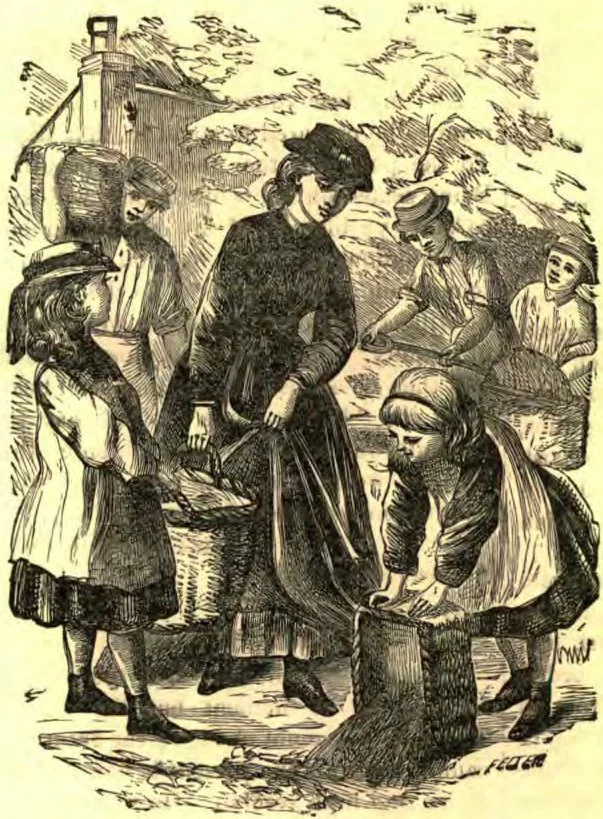
In many parts of our country this is the time for making gardens. In the distant South they did this long ago, and are now eating some of the vegetables which have quickly grown under the warmth of the Southern sun. But in this part of the country we are compelled to wait until sun and soil are ready for us. So now we find the farmers at work, plowing, and harrowing, and planting, and getting ready for the great crops which they hope to gather during the summer and fall.
The children help in this work. They can put seeds of flowers or of vegetables into the earth; and right glad are they that the cold winter is, at last, over; that spring has come with blossoms, buds, and flowers. In a few weeks they will be dropping corn, and then will welcome the time in the summer when the green ears can be gathered and roasted or boiled.
In some families in the country, all the children have little garden spots of their own, in which they dig and sow seed. They watch the sprouting plants, and water them, and care for them, and rejoice when the flowers appear, or the vegetables can be gathered for the table. It is very pleasant to eat what one has raised for himself. It seems to have a sweeter taste, and one feels paid for the labor given to it.
Do our readers think of the fact that this young life is to them a sowing time? The habits you are now forming will very likely cling to you through life, for it is very hard to change habits as we grow older. The Bible says, “Whatsoever a man soweth, that shall he also reap.” We expect this in our gardens. You would be very much surprised if, when you plant corn, potatoes should grow from the seed. Such a thing never happened, and never can happen. So the bad habits which some children and young people form will, sooner or later, show bad results. Remember, then, that this is your sowing time. Be sure you have the right kind of seed. Form the very best habits you can, and then, as good seed brings a harvest like itself, you will find these good habits bringing to you happiness. Study hard now, and by and by you will become learned; avoid all low, vulgar language, and your speech in after life will be pure; be industrious, and when you grow up, you will not find it a hardship to work; above all, pray daily, and you will receive the grace from God which will keep you ever in the right way.—S. S. Advocate.

WORDS TO BOYS.

I would keep “better hours” if I were a boy again; that is, I would go to bed earlier than most boys do. Nothing gives more mental and bodily vigor than sound rest when properly applied. Sleep is our great replenisher, and if we neglect to take it regularly in childhood, all the worse for us when we grow up. If we go to bed early, we ripen; if we sit up late, we decay; and sooner or later we contract a disease called insomnia; and allowing this to be permanently fixed upon us, we begin to decay, even in youth. Late hours are shadows from the grave.
If I were a boy again, I would practice perseverance oftener, and never give up a thing because it was hard or inconvenient to do. If we want light, we must conquer darkness. When I think of mathematics, I blush at the recollection of how often I “gave in” years ago. There is no trait more valuable than a determination to persevere when the right thing is to be accomplished. We are inclined to give up too easily in trying or unpleasant situations, and the point I would establish with myself, if the choice was again within my grasp, would be never to relinquish my hold on a possible success, if moral strength or brains in my case were adequate to the occasion.
That was a capital lesson which a learned professor taught one of his students in the lecture-room after some chemical experiment. The lights had been put out in the hall, and by accident some small article dropped on the floor from the professor’s hand. The professor lingered behind, endeavoring to pick it up. “Never mind,” said the student, “it is of no consequence, sir, whether we find it to-night or not.” “That is true,” said the professor; “but it is of grave consequence to me, as a principle, that I am not foiled in my determination to find it.” Perseverance can sometimes equal genius in its results. “There are only two creatures,” says the Eastern proverb, “who can surmount the pyramids—the eagle and the snail.”—James T. Fields.

MY VOICE SHALT THOU HEAR IN THE MORNING.

My voice shalt Thou hear this morning, For the shades have passed away, And out from the dark, like a joyous lark, My heart soars up with the day; And its burden all is blessing, And its accents all are song; For Thou hast refreshed its slumbers, And Thy strength hath made it strong.
My voice shalt Thou hear this morning, For the day is all unknown; And I am afraid, without Thine aid, To travel its hours alone. Give me Thy light to lead me, Give me Thy hand to guide, Give me Thy living presence To journey side by side.
Star of eternal morning, Sun that can ne’er decline, Day that is bright with unfading light, Ever above me shine. For the night shall all be noontide, And the clouds shall vanish far, When my path of life is gilded By the Bright and Morning Star.
—George Matheson.

THE PRESENT MOMENT.

THERE is no moment like the present, for there is no moment but the present. The past we cannot change; the future we cannot control; the present is our time for action and high resolve. He who will not act on the fresh impulse of a present resolution, will find his purposes lost in the hurry of the future, or sunk in the slough of indolent delay. The present is our hour of strength. Our feet stand on reality to-day. If we miss this footing, we may be swept away by the current, and never gain another.
Experience, inspiration, and wisdom counsel us to seize the present hour. It flies like an arrow; it passes like a shadow. Once gone, and in its stead may come only fruitless endeavors and vain regrets. God calls us now. His time is the present moment. “To-day if ye will hear his voice, harden not your heart.” “Whatsoever thy hand findeth to do, do it with thy might; for there is no work, nor device, nor wisdom, nor knowledge, in the grave whither thou goest.” MINNIE J. CURRIE.

“HE THAT WORKETH, RECEIVETH WAGES.”

LABOR was wisely ordained for mankind, and we believe those are happiest who have a certain amount to perform each day. But none of us like to toil for naught; we expect some benefit will accrue from our labors, either to ourselves or others. From whom do the INSTRUCTOR family receive recompense for their services? Perhaps you respond, “We don’t do much;” or, “We don’t work for wages.”
Well, it is true that you don’t do much compared with what your parents and others do for you; and if they do not give you a fixed sum of money for the little offices you perform, you are daily receiving many more benefits from them than your little hands could provide were you dependent upon your own efforts.
It is in another sense, however, that we meant the question, Who pays you for your labor? Whether you are aware of it or not, you are all engaged in service which will bring wages; for the Book of books says, “He that worketh, receiveth wages;” also, “the wages of sin is death; but the gift of God is eternal life through Jesus Christ our Lord.”
If you are Christ’s faithful servant, your wages will be eternal life through him; but if you are in the service of Satan, and thus remain, your wages will be the second death.
When we work for man, we are at liberty to refuse wages if we wish; but it will avail us nothing to refuse the wages of sin. If these are the wages we have earned, they will be forced upon us.
Dear reader, Satan is a hard master, and for our services will leave us to suffer the second death. Why not be wise, and quit his service? The service of Christ gives joy and peace in this life, and the reward of an abundant entrance into the everlasting kingdom of God. Who does not rather choose Christ, and live? M. J. C.

FACTS ABOUT VARNISH.

I presume our little folks have often exclaimed, as they have seen a new carriage pass swiftly by, “Look! how the wheels of that carriage glitter in the sun! I wonder how the painter made them so bright!”
We answer, By the use of varnish. Listen, and we will tell you something about it.
The “earth is Nature’s great storehouse,” from which she produces many wonderful things. Varnish is made from gums which are nearly all found by mining, though they are not so deep down in the earth as are gold and coal. Now you will probably be astonished when I tell you that all the varnish gums are supposed to be the hardened sap of the copal tree, found in Africa and Australia; and you will wonder how it can be obtained by mining if it is the sap of a tree.
It is a curious fact that these gums are found in deserts, where there is not a vestige of a tree now in existence. It is supposed that the forests which formerly grew where these gum beds exist, were destroyed by a great fire, and that the sap which was tried out by the excessive heat run over the ground and settled in hollows and gullies, which, in the course of time, became hardened by the rays of a torrid sun, and then were gradually covered with sand which the wind blew over it.
There are several varieties of gums from which varnish is made. Zanzibar, amber, angola, Benguela, Northcoast Kauri, and Manilla gums belong to the copal order. Zanzibar is procured and shipped from an island by the same name in Africa.
It is supposed that the earth has contained these gums for ages. They are found at the depth of from a few inches to that of three feet or more, and are mined by the natives, as the climate proves in many cases fatal to the white man.
The natives simply dig a trench, and if successful in striking a vein, it is followed, the gums are collected, and sometimes brought direct to market by the finders, who “tote” it on their heads or backs. But a greater quantity is conveyed by Arabian traders, who organize large caravans for the purpose of conveying various articles of produce, such as ivory, rubber, and gums from the interior.
We will tell you more about this wonderful product soon. C. N. STUTTLE.

POWERS OF THE AIR.

THERE are many wonderful things concerning the air that I shall be unable to notice in this series of articles. Strange birds and curious insects flit to and fro in the vast expanse above. The ancients believed that fairies and sylphs inhabited the upper regions. We read in the Bible about the “powers of the air,” which no doubt means evil spirits. These spirits are ever on the watch to tempt us to do evil, but we can drive them from us with prayer. If we earnestly ask God’s assistance, he will send shining angels to strengthen us and keep us from unhallowed influences. It is a beautiful thought that groups of white-winged angels may be hovering around us when, “low in prayer we bow the knee.”
Dear children, the earnest desire of your friend is, that the “powers of the air” may never harm you, nor lead you to do evil. Angels have often been seen in the air by “holy men of old,” but soon every eye will see a more glorious sight than the shepherds saw when the birth of Christ was announced. That same Jesus will appear in the clouds of heaven. Thousands of seraphs will surround him, and ten thousand times ten thousand angels will sing his praise. The whole expanse of heaven will be lighted up with the beauty of those shining ones, and the nations of earth will tremble before the glory of that coming King.
Ah! my dear young friends, do you not want to be prepared to stand in that day? To the pure and the good, the beautiful Being seated on the white cloud, will say, “Come, ye blessed of my Father, inherit the kingdom prepared for you from the foundation of the world.” To the wicked, he will say, “Depart from me, ye workers of iniquity.” The transient glory of earth will then be eclipsed by the immortal beauty of the “life to come.” Oh! may the INSTRUCTOR family, one and all, enter that “bright world afar,” and in everlasting habitations evermore find rest.
ELIZA H. MORTON.
Allen’s Corner, Me.

THE PLAIN PATH.

’Tis a narrow, rugged pathway That leads to the heavenly hill; But it winds through fresh green pastures, By waters cool and still.
There are other paths, just lying On either side the way, Where the feet of the unwary Ofttimes are led astray.
So smooth are they, so pleasing, The narrow way in sight,— Beware! those paths end only In rayless, hopeless night.
Only the “plain path” choosing, We may pass life’s dangers by, And enter the “many mansions” Of our Father’s house on high.
M. A. D.

REPORT OF GENERAL SABBATH-SCHOOL CONVENTION.

A GENERAL Sabbath-school Convention was held at Battle Creek, April 21, 22. Elders Haskell, Butler, Canright, Andrews, Whitney, Hutchins, Lamson, Lane, Jones, Decker, and other leading brethren were present.
The zeal and interest manifested were truly encouraging to all lovers of the Sabbath-school work.
The exercises consisted in reports, remarks, discussions, questions, passing resolutions, etc.
It was recommended,—
1. That in view of the necessary expenses for blank reports, circulars, stamps, stationery, etc., each school donate to the State Association one-tenth of all contributions received, and that each State Association donate to the General Association one-tenth of all its receipts.
2. That in view of the rapidly growing and continually changing wants of the cause, it would be better to defer the publication of the Manual recommended at the last meeting of the General Association, and issue in its place a Quarterly Supplement to the INSTRUCTOR, containing such suggestions to officers and teachers as may be especially demanded at the time.
3. That there be held in connection with each State Quarterly Tract and Missionary Meeting a Sabbath-school Convention, in which all present may take part, important questions may be discussed, resolutions passed, etc.; but that all such action be subject to the approval of the regular Annual Meeting of the Sabbath-school Association, at which the officers shall be elected, and all legal business transacted.
4. That wherever practicable, a fit man should be chosen in each State, who shall spend his time in visiting and organizing Sabbath-schools, instructing Sabbath-school officers, holding conventions, and in promoting the interests of the schools in such other ways as circumstances and experience may suggest.
The subject of local conventions was discussed, but for want of time no definite conclusion was reached. G. H. BELL, Rec. Sec.
“What shall I do,” said a teacher the other day, “to catch and hold the attention of my class?” “Be in earnest,” was the answer. Earnestness always arrests attention and holds it. The man who cries “fire” or “murder,” with the earnestness of conviction, does not fail to rouse every one that hears the cry. Let us utter the great truths of the Bible as though we believed in their reality, and no one then will be listless or indifferent.
JOHN NEWTON'S favorite expression to his friends was, “I am not what I ought to be; I am not what I wish to be; I am not what I hope to be; but, by the grace of God, I am not what I was.”

BIBLE LESSONS FOR YOUTH.

LESSON XLIV.—HAZEROTH; THE SPIES.

  1. To WHAT place did the people journey after leaving Kibroth-hattaavah? Num. 12.
  2. What grievous sin was committed by Miriam and Aaron at this place?
  3. What was the cause of their complaint?
  4. What did they say?
  1. What is said of the character of Moses at this time?
  2. How were Miriam and Aaron suddenly interrupted in their course?
  3. Where did the Lord meet them and Moses?
  4. What did God say to Miriam and Aaron?
  5. What question did he ask them?
  6. How was Miriam punished?
  7. How was she healed?
  8. How long did she have to remain without the camp, while all the host of Israel waited?
  9. Where did the people next encamp?
  10. What command did the Lord give Moses in regard to searching the land of Canaan? Num. 13.
  11. What instruction did Moses give the spies?
  12. How many days did they search the land?
  13. What did they bring back with them?
  14. What description did they give of the land?
  15. What, of the people and the cities in which they lived?
  16. What did most of these men think in regard to the possibility of their taking possession of the land?
  17. What did Caleb and Joshua say about it?
  18. What reply did the others make?
  19. What did they say about the giants of the land?
  20. What did they seem to have forgotten?
  21. What did they doubt?
  22. Why does it seem strange that they should take such a course?

SYNOPSIS.

“And the people journeyed from Kibroth-hattaavah unto Hazeroth, and abode at Hazeroth.” Here Miriam and Aaron murmured against Moses because of the Ethiopian woman that he had married. “And they said, Hath the Lord indeed spoken only by Moses? hath he not spoken also by us? And the Lord heard.” Now this was very unkind; for the record says that the man Moses was meek above all men that dwelt on the earth.
And the Lord called suddenly unto Miriam, Aaron, and Moses, and bade them come out unto the tabernacle of the congregation. And God spake unto Miriam and Aaron from out the pillar of the cloud. He told them that he would speak to his prophets in visions and dreams, but with Moses he had spoken mouth to mouth, as a man speaks with his friend, thus exalting him above an ordinary prophet. He said to them, “Wherefore then were ye not afraid to speak against my servant Moses?”
“And the anger of the Lord was kindled against them; and he departed.” And Miriam became leprous, white as snow; and Aaron besought Moses that he would not lay the sin to their charge, wherein they had done foolishly and sinned. He prayed that Miriam might not be as one dead; and Moses cried unto the Lord for her, and she was healed. She was, however, shut without the camp seven days, and they journeyed not until she was brought in again.
“And afterward the people removed from Hazeroth, and pitched in the wilderness of Paran. And the Lord spake unto Moses, saying, Send thou men, that they may search the land of Canaan, which I give unto the children of Israel: of every tribe of their fathers shall ye send a man, every one a ruler among them.” So Moses did as the Lord had said, and sent up twelve men to search the land of Canaan. He told them to go and see the land, what it was, and the people that dwelt therein, whether they were strong or weak, few or many, and what the land was that they dwelt in, whether it were good or bad.
“And they returned from searching the land after forty days.” It was in the time of ripe grapes, and they brought a cluster of grapes so large that it was carried between two men. They all brought back the report that it was an exceeding good land,—a land flowing with milk and honey; but they said that the people that dwelt in the land were strong, and the cities were walled and very great, and that it was useless for them to think of possessing the land.
There were, however, two men, Caleb the son of Jephunneh, and Joshua the son of Nun, who gave a different report. They agreed that it was indeed a good land, and said, “Let us go up at once and possess it; for we are well able to overcome it.” But the others who went up with them cried out, “We be not able to go up against the people; for they are stronger than we.” They said also that they had seen the sons of Anak, giants, in whose sight they were as grasshoppers. They seemed to forget the great things which God had already done for them, and now doubted his power to deliver them from their enemies. It would seem strange that they had not learned from all their past experiences to trust in God for what he had promised. G. H. BELL.

LESSONS FOR CHILDREN.

LESSON XVIII.—GIDEON'S ARMY.

And the Spirit of the Lord came upon Gideon, and he blew a trumpet, and sent messengers throughout the land to gather the people to war.
Before going to battle, he asked the Lord to give him a sign that Israel would be delivered by his hand. Gideon said, “Behold, I will put a fleece of wool in the floor; and if the dew be on the fleece only, and it be dry upon all the earth besides, then shall I know that thou wilt save Israel by mine hand, as thou hast said. And it was so: for he rose up early on the morrow, and thrust the fleece together, and wringed the dew out of the fleece, a bowl full of water.” Then Gideon asked that the next night the fleece might be dry and the ground wet, and in the morning he found it so.
Then God told Gideon that his army was too large, for they would think that they had gained the victory by their own might. Then Gideon said, “Whosoever is fearful and afraid, let him return;” and there returned twenty-two thousand, while but ten thousand remained. “And the Lord said unto Gideon, The people are yet too many; bring them down unto the water, and I will try them for thee there; and it shall be, that of whom I say unto thee, This shall go with thee, the same shall go with thee; and of whomsoever I say unto thee, This shall not go with thee, the same shall not go.
“So he brought down the people unto the water: and the Lord said unto Gideon, Every one that lappeth of the water with his tongue, as a dog lappeth, him shalt thou set by himself; likewise every one that boweth down upon his knees to drink.
“And the number of them that lapped, putting their hand to their mouth, were three hundred men: but all the rest of the people bowed down upon their knees to drink water. And the Lord said unto Gideon, By the three hundred men that lapped will I save you, and deliver the Midianites into thine hand: and let all the other people go every man unto his place.”

QUESTIONS.

  1. How was Gideon at this time especially prepared for the work of delivering his people? Judges 6:34.
  2. What did he then do?
  3. Before going out against his enemies, what did Gideon ask of God?
  4. What sign did he require?
  5. How was his wish granted?
  6. How did he wish to have the sign varied the next night?
  7. How did the Lord fulfill this desire?
  8. What did he tell Gideon about his army? Judges 7:2.
  9. What harm could come from having the army so large?
  10. What did Gideon then say to his men?
  11. How many of them returned?
  12. What did the Lord then say about the number?
  13. What did he tell Gideon to do?
  14. What was he to observe when they came down to the water to drink?
  15. How many of them lapped the water when they drank?
  16. How did the others drink?
  17. What did the Lord then say to Gideon?

CHILDREN'S CORNER.

SPRING.
SPRING.

SPRING.

How beautiful the spring doth seem! The air is soft and mild, The grass comes creeping up the hills, And o'er the woodland wild.
The trees put forth their pretty buds, The daffodil appears, The crocus raiseth up her head Amid the April tears.
The blue-bell with its soft green leaves Looks out upon the sky; The violet in her shady nook Opens her soft blue eye; The birds are busy with their nests, And happy sing away; The little lambs seem very glad, They skip about and play.
And happy children run and shout, And say that summer's come; And very hard it is to keep The little ones at home.
Oh, let us bless the glorious God, Who maketh all things fair, Who sends us sunshine bright, and flowers, And this soft, fragrant air; Who formed us in his tender love, That we might happy be; Who watcheth o'er us night and day, And guards us carefully.
Bless God for all his perfect gifts, And trust him for his love, Prepare on earth to do his will, That you may dwell above.
—Sel.

SIGNAL LIGHTS.

Once I knew a sweet little girl called Mary, and I am going to tell you how she showed old Jim the signal lights that guide us to our Father’s kingdom.
Her papa was the captain of a big ship, and sometimes she went with him to sea; and it was on one of these trips that what I am going to tell you happened.
One day she sat on a coil of rope, watching old Jim clean the signal lamps.
“What are you doing?” she asked.
“I am trimming the signal lamps, Miss,” said old Jim. “They are to keep other ships from running into us, Miss; if we did not hang out our lights, we might be wrecked.”
Mary watched him for some time, and then she ran away and seemed to forget all about the signal lights; but she did not, as was afterwards shown.
The next day she came to watch old Jim trim the lamps, and after he had helped her onto the coil of rope, he turned to do his work. Just then the wind carried away one of his cloths, and old Jim began to swear awfully.
Mary slipped from her place and ran into the cabin; but she soon came back and put a folded paper into his hand.
Old Jim opened it, and there, printed in large letters—for Mary was too young to write—were these words, “Thou shalt not take the name of the Lord thy God in vain; for the Lord will not hold him guiltless that taketh his name in vain.”
The old man looked into her face, and asked, “What is this, Miss Mary?”
“It is a signal light, please. I saw that a bad ship was running against you because you did not have your signal hung out, so I thought you had forgotten it,” said Mary.
Old Jim bowed his head and wept like a little child. At last he said:—
“You are right, Miss, I had forgotten it. My mother taught me that very commandment when I was no bigger than you; and for the future I will hang out my signal lights, for I might be quite wrecked by that bad ship, as you call those oaths.”
Old Jim has a large Bible now, and on the cover he has printed, “Signal lights for souls bound for Heaven.”—Child’s Paper.

ABOUT WATCHES.

WATCH is from a Saxon word, signifying to wake. At first the watch was as large as a saucer; it had weights, and was known as a “pocket clock.” The earliest known use of the modern name occurs in a record of 1552, which mentions that Edward VI. had “one alarm or watch of iron, the case being likewise of iron, gilt, with two plummets of lead.” The first great improvement was the substitution of the spring for weights. The earliest springs were not coiled, but only straight pieces of steel.
Early watches had only one hand, and required winding twice a day. The dials were of silver and brass; the cases had no crystals, but opened at the back and front, and were four or five inches in diameter. A plain watch cost the equivalent of $1600 in our currency, and after one was ordered it took a year to make it.
There is a watch in a Swiss museum only three-sixteenths of an inch in diameter, inserted in the top of a pencil case. Its little dial indicates not only hours, minutes and seconds, but the days of the month. It is a relic of old times, when watches were inserted in saddles, snuff-boxes, shirt studs, breast pins, bracelets, and finger rings. Some were fantastical—oval, octangular, cruciform, or in the shape of pears, melons, tulips, and coffins.—Sel.

A WONDERFUL WALKING-STICK.

We have received (says Nature) from Messrs. Eberstein, of Dresden, a specimen of an interesting “walking-stick for naturalists or tourists.” The stick is a perfect multum in parvo, and contains quite a museum of scientific instruments. The handle alone contains a compass, a double magnifying glass or pocket microscope, and a whistle. Below it there is a thermometer on one side of the stick, and a sand-glass on the other. The body of the stick is partly hollow, and its interior holds a small bottle, which is intended to contain chloroform or ether for killing insects. Along the outside of the body there is a half-meter measure, showing decimeters and centimeters. Near the end of the stick a knife blade may be opened, which serves for cutting off objects which cannot be reached by hand. At the extreme end a screw may hold in turn a spade (for botanists), a hammer (for geologists), a hatchet, or a strong spike, which would be of great use on glaciers. The whole is neatly finished in black polished wood.

IN THE STREETS.

A GENTLEMAN visited an unhappy man in jail awaiting his trial. “Sir,” said the prisoner, “I had a good home education. My street education ruined me. I used to slip out of the house and go off with the boys in the street. In the street I learned to lounge; in the street I learned to swear; in the street I learned to smoke; in the street I learned to gamble; in the street I learned to pilfer and do all evil. O sir! it is in the street that the devil lurks to work the ruin of the young.”—Presbyterian.

PROFANE WORDS.

As polished steel receives a stain From drops at random flung, So does the child, when words profane Drop from a parent's tongue. The rust eats in, and oft we find, That naught which we can do To cleanse the metal or the mind, The brightness will renew.

LETTER BUDGET.

WOODLAND, CAL.
Dear Editors: I am a little boy twelve years old. I go to church, and keep the Sabbath with my parents. I like the Instructor better now because it is printed every week. I love to read the papers very much. As soon as I read them I give them away. Pray for me.
Jackson L. Martin.
Continue reading: GRUNDY CO., IOWA