Your ShelfYour Projects

Review and Herald, Vol. 87, No. 35.

A Psalm of the Helpers
Earlier text: A Psalm of the Helpers

The Way to Health

The Drug Clerk a Poor Doctor

An intelligent mother recently brought her five-year-old boy to my office, saying that she wanted me to do something for his malaria. The druggist had given her some quinin tablets, but they didn’t seem to be doing any good.
“How do you know that the boy has malaria?” I asked.
“Why, his bones ache, and he just feels bad all over.”
“But every ache isn’t malaria. How did it start?”
“He has been playing in the wet grass, caught cold, and it developed into malaria.”
“The only known thing that develops into malaria is the bite of an infected mosquito,” I answered. Then I began to examine the boy.
I found that all the joints of his hands and his feet were stiff and sore. Then I looked at his tonsils, and the diagnosis was plain.
“Your boy has acute rheumatism of the membranes that cover the joints,” I remarked. “Now let me examine his heart.”
The stethoscope revealed what I anticipated—an inflammation of the delicate membranes that line the heart and its valves.
“But how can rheumatism in the joints affect the heart?” the mother asked.
“Have you ever noticed the rounded end of a soup-bone, how glossy and satiny it looks?”
“Yes.”
“Well, that is what we call ‘the synovial membrane,’ and it covers the end of every bone that enters into the formation of a joint. When it becomes inflamed, the surfaces no longer glide over each other smoothly, and the friction results in heat and pain—in other words, rheumatism.”
“But there are no bones in the heart, surely?”
“No, but the inside and the outside linings of the heart and valves are made of the same shiny membrane. The infection probably began in his tonsils, and is gradually spreading to every part of the body that is supplied with that particular membrane.”
“Is the heart trouble serious?”
“Very serious. When the valves become inflamed and swollen, they do not close properly, and the heart leaks at every pulsation. You might have continued giving him quinin until he became deaf, and it would not have given him the slightest relief. The most important thing now is to check that inflammation of the heart. It kills a great many people, and those who pull through are generally left with damaged hearts.”
It had never occurred to this woman nor to the drug clerk that the boy might have rheumatism, and he might have died of heart failure if it had been neglected a few days longer. The drug clerk had no business to prescribe at all; it is his business to know the chemistry of drugs, not the symptoms of disease. Even if he had by chance recognized the rheumatism, he would doubtless have given him one of the rheumatic “cures” containing opium and salicylic acid. This would probably have affected his stomach, and thrown extra work on a heart that was already crippled. In the story of this boy you have one of the real reasons why the drug clerk is a poor substitute for the family physician.
The druggist who hands out a medicine that somebody a thousand miles away has put up for rheumatism overlooks the fact that there are several kinds of rheumatism, located in different kinds of tissue, and that what might be helpful in one variety is not the thing for another.
If the clerk had jumped at the conclusion that the pain was due to neuralgia the boy would probably have been dosed with one of the coal-tar preparations, without any effort being made to find out whether he had a heart-murmur.
I remember a big, husky merchant, the picture of health, who came to me to be examined for life insurance. When I examined his heart, I was surprised at what I heard, and then he told me the story. He used to be a frequent sufferer from neuralgia, and a druggist had given him a certain coal-tar remedy. One night he took five doses, became blue in the face, and it took the doctors three or four days to get him out of danger. The experience left him with a dilated heart, and he has never been able to get a cent’s worth of life insurance, because he is liable to drop off at any moment.
One of the commonest habits of people is to run to the drug-store for cough remedies. They tell the clerk that their throats are sore from coughing, or that the baby keeps them awake all night, and that they want relief. The clerk, without knowing anything about the condition of throat, temperature, or bowels, hands out a “remedy.” Most of these cough remedies contain some preparation of morphin, chloroform, or belladonna—drugs which blunt sensibility and thereby mechanically interrupt the cough. The important fact that every cough is an indication of an irritation in the air-passages, and is nature’s effort to get rid of the cause, is ignored. The druggist furnishes a mixture that paralyzes the coughing muscles, and the patient drives complacently past the red flag of warning.
I was once called hurriedly to see a baby seven months old, one that had always been a strong, healthy infant. The mother said that it had been feeling bad for several days, and coughing a good deal. She had been giving it a certain cough mixture. I found the little fellow with blue lips and fingers, breathing three times as rapidly as usual, and it required but a moment to recognize a double-pneumonia of the worst type. I hastily ordered oxygen, and sat up all night with him; but the appeal from the drug clerk’s judgment had come too late.
People are altogether too quick to try any remedy that a friend may suggest—and intelligent people are about as bad as others. Just the other day a prominent man came to me, and said that he had sharp pains in his back; he thought that he had wrenched himself, but I told him that a jagged kidney-stone was traveling down a very sensitive tube, and causing all his suffering. I gave him some simple directions, and he left the office. On his way down the street he met a friend and told him his trouble; the friend then told him about a wonderful “German tea”—and the advice of the friend who knew nothing about the ailment overruled the judgment of the doctor. Now if I had been a lawyer and had given this man legal advice about the title to his home, and that same friend had met him on the street with different advice, my client would not
have done more than listen to him respectfully.
The alimentary canal has always been a great thoroughfare leading from the stomach to the drug-store. The clerk is supposed to be a person competent to minister to any form of diarrhea, regardless of its cause, and the bottles on his shelves have been filled perhaps by a manufacturer in a distant city. Here again the symptom is treated as if it were a disease, whereas diarrhea is simply nature’s effort to get rid of an irritation somewhere in the intestines. The obvious thing to do is to flush out the canal, get rid of the irritating substance, and then check the superabundance of secretion. The cordials which the drug-clerk supplies, however, usually contain opium, tannic acid, camphor, and capsicum—and the effect of these is to lock up the bowels with the irritating material still inside. Since typhoid fever often attracts attention to itself first by a diarrhea, it will be apparent to every one that there is real danger in carelessly locking up a bowel that contains an infection that is rapidly multiplying.
The pill-eating habit—for the opposite condition—is another sin that is laid at the door of the stomach, when it is really a sin of the intelligence. The bowel is a creature of habit, and it is just as easy for it to acquire the pill-habit as it is for a man to become addicted to smoking or to taking morphin. Many of these preparations are drastic cathartics, and an alimentary tract which gets in the habit of requiring their use, sooner or later loses much of the elasticity of its walls. By and by the patient hunts up his doctor, and expects him quickly to restore the function of an organ that is like a piece of rubber that has been on the stretch too long. Our problem then is the same as would be that of a tailor who is asked to restore the elasticity to a pair of old suspenders.
When I speak of remedies that are sold broadcast, I know what I am talking about; for I was for many years a druggist myself. Moreover, I have been guilty of making some of them myself; for anybody can put up a preparation, and call it anything that he likes. For instance, since I have been a physician, I once wrote a prescription for calomel combined with certain other drugs which were intended to meet a specific need of the patient’s condition. Some time afterward a druggist called me up, and asked if I wanted everybody to have my calomel prescription, and explained that several people had come to him and asked for “the calomel that Dr. Johnson prescribes.” Later still, I happened into a drug-store, and discovered a case containing five thousand of “Dr. Johnson’s Calomel Tablets.” During the period when I was a druggist, I was often called upon to make patent medicines for other people—and if those who have the habit of buying these remedies knew as much as I do about what they cost, there would be less confidence in their supposed virtues. For example, a customer once gave me a sample of a suppository,
and asked me to find out what was in it, and to see if I could duplicate it. It took me two years to solve the problem completely, which was that of making it out of a substance which would not melt in any climate, but which would dissolve at the temperature of the body. This preparation sold for $1, and the cost, as I remember it, was about seven eighths of a cent.
Some people justify their too-frequent use of ready-to-take remedies on the ground that physicians themselves often prescribe them. They think that any preparation with a pharmacist’s name on the label is a “patent” medicine—but that which the physician sometimes orders is a “proprietary” medicine. The difference is very great. A patent medicine is a secret nostrum whose exact composition may be known only to the manufacturer, and whose label is protected by copyright. A proprietary medicine, on the other hand, is a preparation compounded by a manufacturing pharmacist, in conformity with the United States Pharmacopeia, and whose exact formula is supplied to the physician.—Eugene Yates Johnson, M. D., in World’s Work for July.

The Bible Work

ARTHUR L. MANOUS
To the Ephesian brethren Paul wrote: “I kept back nothing that was profitable unto you, but have showed you, and have taught you publicly, and from house to house,” etc. Acts 20:20. This house-to-house work was good in the apostle’s day, and why not to-day? We believe it is, and hope that many of the young people in our schools will turn their attention to it.
The following extracts from “Gospel Workers” ought to help some of our people to see the importance of the Bible work. Please read the context of these quotations, and then let us encourage our young people to enter upon this noble ministry. Many of our people ought to be engaged in this kind of missionary labor:—
“Preach less, and educate more by holding Bible readings, and by praying with families and little companies.”—“Gospel Workers,” page 340.
“The opening of the Scriptures by means of Bible readings is an essential part of the work connected with these [city] missions; but persons can not take hold of this work successfully until they are prepared for it.”—Id., page 291.
“The plan of holding Bible readings was a heaven-born idea. There are many, both men and women, who can engage in this branch of missionary labor. Workers may thus be developed who will become mighty men of God.”—Id., page 339.
“The most effectual way to find access to those whom we wish to educate in the truth, is to have them bring their Bibles, and point them to the chapter and verse, that they may see for themselves that these things are so.”—Id., page 410. See also pages 101, 284, 290, and 464.
Cartersville, Ga.

The Healing Power of Laughter

“Do you know, my dear,” says Mrs. Holden, writing to a young mother, “that there is nothing that will help you to bear the ills of life so well as a good laugh? Laugh all you can, and the small imps in blue who love to preempt their quarters in a human heart will scatter away like owls before the music of flutes. There are few of the minor difficulties and annoyances that will not dissipate at the charge of merry laughter. If the clothes-line breaks; if the cat tips over the milk, and the dog elopes with the roast; if the children fall into the mud simultaneously with the advent of clean aprons; if the new girl quits in the middle of house cleaning, and though you search the earth with candles, you find none to take her place; if the neighbor you have trusted goes back on you; if the chariot wheels of the uninvited guest draw near when you are out of provender, and the gaping of your empty purse is like the unfilled mouth of a young robin,—take courage if you have enough sunshine in your heart to keep the laugh on your lips. Before good nature, half the cares of daily living will fly away like midges before the wind. Try it.”

Three Things I’ve Learned

“THREE things I’ve learned—three things of precious worth— To guide and help me down the western slope: I have learned how to pray, and toil, and save,— To pray for courage to receive what comes, Knowing what comes to be divinely sent; To toil for universal good, since thus And only thus, can true good come to me; To save, by giving whatsoe’er I have To those who have not. This alone is gain.”

East Caribbean Mission

H. C. J. WALLEKER
DURING the past four months I have visited most of the islands in this mission, where there are believers in the message, and have found the work advancing. Calls are coming from different islands for us to come and preach the truth. Another has united with the church here at St. Thomas. The school has nearly outgrown its seating capacity, and next fall we expect additional pupils. This school is exerting a good influence.
THE NEW ST. THOMAS MOTOR LAUNCH
Elder J. H. Matthews baptized several at St. Croix not long ago. Recently I went over there in our new motor boat, and remained over Sabbath. It is very encouraging to note the progress our brethren are making, and to witness their earnestness and zeal in the message. They are all very poor, as most of the people here are; but they are faithful with the little they have, although in most cases it is but a few cents a day. Most of our foodstuffs come from America, so you can know what must be the cost to the poor people here, when freight and duty are added. Bread is a great luxury. Yet with all this they pay a faithful tithe.
I have visited St. John, and met our brethren there. I found them of good courage, although they have had but little help for a long time. From a human standpoint, things are very discouraging at present, as we have had no rain to speak of for more than four months, with a burning tropical sun scorching everything. When you realize that we are entirely dependent on rain for water, you can know what this means to us. We now have only six inches of water in our cistern, and this is very dirty. But we hope the Lord will soon give us rain.
The last few days I have had fever, but am feeling better now. While we have many difficulties to meet, we thank the Lord for a place in the message, and are anxious to do all we can to hasten it on to a glorious consummation.
Danish West Indies.

Garhwal Industrial School

L. J. BURGESS
IT was about four years ago that the people of this district in the Himalayas sent us a petition for a school. It has taken some time to get to the place where we were able to answer this call. A year ago we were granted some land by the government, and began building a small mission bungalow. The work on this was somewhat delayed, so that the house was not ready for occupancy until the first of June. At that time we moved into our quarters in one room of the bungalow, reserving the other two rooms for the school. We also erected two buildings twenty-four feet long and eight feet wide, built of bamboo and grass, to serve as dormitories for the boys.
On the first of June over forty boys put in their appearance; this number has since grown to fifty-eight, ranging in age from twelve to twenty-four years. The students bring their food from home, which they cook for themselves with wood gathered from the jungle. They also wash their own clothes at a mountain spring not far distant.
From half-past eight to half-past ten we have industrial work. We are now teaching simple manual training, which consists in this case of digging dirt to level the yard. After this we hope to teach stone masonry, carpentry, and agriculture. Before we opened our school, we were told that these boys would not take to the industrial work; and some did wish to pay fees instead of working. But we held strictly to the industrial plan, which we believe to be the better, and the experience thus far indicates that there will be no difficulty in this matter. I have never seen boys work with a better will. One of our teachers, Moti Singh, is especially helpful in encouraging the boys.
The school hours, from eleven to three, are spent in study. It would be hard to find more studious, earnest boys. Most of them are Hindus, who had never heard of the gospel of salvation, and their interest in the Bible studies is very encouraging.
We are also trying to teach music; but as the boys are entirely unacquainted with what we consider melody and harmony, it will take some time to educate the ear and voice. However, we hope to develop some singers from among them.
Will the reader kindly remember this work in prayer?
India.

The First General Meeting in Siberia

MRS. J. T. BOETTCHER
Early Monday morning, June 13, we left the city of Moscow en route for Siberia. The weather was very hot and dusty; but as we succeeded in obtaining, without extra expense, a small compartment alone, we found ourselves very pleasantly situated for our long inland journey. We enjoyed the privilege of having with us for four days Elder E. Gnedjen, who was on his way from Caucasia to Manchuria.
When night came, we could make up our beds and rest as comfortably as in a sleeper. We had a little table which we arranged for our books and papers, and for our meals. We could read and hold our worship undisturbed, and as we could lock ourselves in, we were not obliged to lie awake at night to watch our baggage. All travelers going long distances in Russia provide themselves with teakettles, as all the larger stations furnish the passengers with hot water free of charge. The water is clean and boiling hot, so that it is easy to make a good cup of cereal, or any other kind of drink, right on the train. Thus we were always provided with wholesome drinks on our journey, and thought it a great improvement over the ice-water tank and common drinking-cup found in our American trains. At most of the smaller stations hot milk in bottles can be bought for two cents and a half a quart. In fact, the Siberian trains are among the most comfortable in the world. They are very clean and well kept.
<|DELIM_1e3|>[[FIGURE]]<|DELIM_1e3|>
We passed through many great cities, and through innumerable towns, villages, and hamlets; over broad rivers and by quiet lakes. Valleys, plains, and high mountains succeeded one another in rapid succession. But our hearts were made sad to realize that in all this long journey we were not passing one church or group from which the light of present truth is shining. Yet God has caused this great railroad to be built that the third angel’s message may be carried to these nations sitting in darkness. We saw church buildings enough everywhere, both Orthodox and Mohammedan, many of them grand and imposing; but they do not teach how Christ can set the burdened sinner free. While in Moscow, we visited some of the churches there,—vast treasure-houses, where the wealth of the earth is stored, gold and silver, precious stones and jewels, pictures and relics. Truly she sits a queen, and is no widow!
A church sexton took us into a chapel where the ancient relics are most carefully preserved in costly cases. We were shown a long row of such cases, closed except for a little round hole in the top of each, through which one can see a bit of bone or cloth, or a piece of wood, or a nail. Each case is carefully labeled, describing the contents,—a bone from the body of St. John, one from St. Luke, and also one from St. Stephen; here a bit of Mary’s dress, and there a piece from the Saviour’s cloak; one of the nails which pierced his hand, and also a piece of the cross. We found one case containing, it was claimed, a bone from the prophet Daniel (evidently the Orthodox church does not dispute the fact that such a man as Daniel existed). Whole beds, covered with most costly draperies, are to be seen, whose only occupant is a small piece of skull from some great saint, put in a case and laid among the pillows, to be kissed by the believers. Often one sees a mother lifting her child up so it can kiss these bones.
Then there are the holy pictures, which are said to work miracles. We asked, “What miracles?” and were told that the blind had been restored to sight. Yet just outside the church door we had given money to a blind beggar. The people are most enthusiastic in their worship, bowing their faces clear down to the ground many times, and kissing every picture and relic with great reverence. This seems to be the whole of their worship. O, how great is the darkness!
And as in the Orthodox church, so also in the Mohammedan mosque, the worship consists of dead works, which can never create a new and clean heart.
Of late the liberties of our people in the Russian Union have been greatly restricted, and so it was decided not to hold the Siberian general meetings in the cities, but far out in the country. Consequently, Friday morning, about six o’clock, we left our comfortable train at a small Tartar station called Mamlutke. The conductor did not want to let us off at such a place, as he felt sure there must be some mistake. But we were following the directions of Brother H. K. Loebsack, and he had written that a brother would meet us with a team at this station.
As we stepped out upon the platform, we found the air piercing cold, and we were thinly dressed. The brother who was to meet us was not yet there, so we went into the depot, and ate our breakfast. Before we had finished, our brother arrived, and we started for the place of meeting, which he said was about twelve miles distant. It was a cold ride indeed,—as we could not unpack our warm clothing,—but a very interesting one, passing, as we did, first through a Tartar and then a Russian village. The Tartar houses are made of mud or clay, with flat roofs. These houses are very low, but they have windows, and in many of those we saw there were house plants in bloom.
Leaving the villages behind, we rode over the prairie and through the woods, until we came to a small settlement consisting of nine families, most of them Seventh-day Adventists. The houses are built close together, and the location is pleasant, with a small lake on one side and woods on the other. We received a most hearty welcome. Elder Loebsack had arrived the day before, and other brethren and sisters were beginning to come.
(Concluded next week)
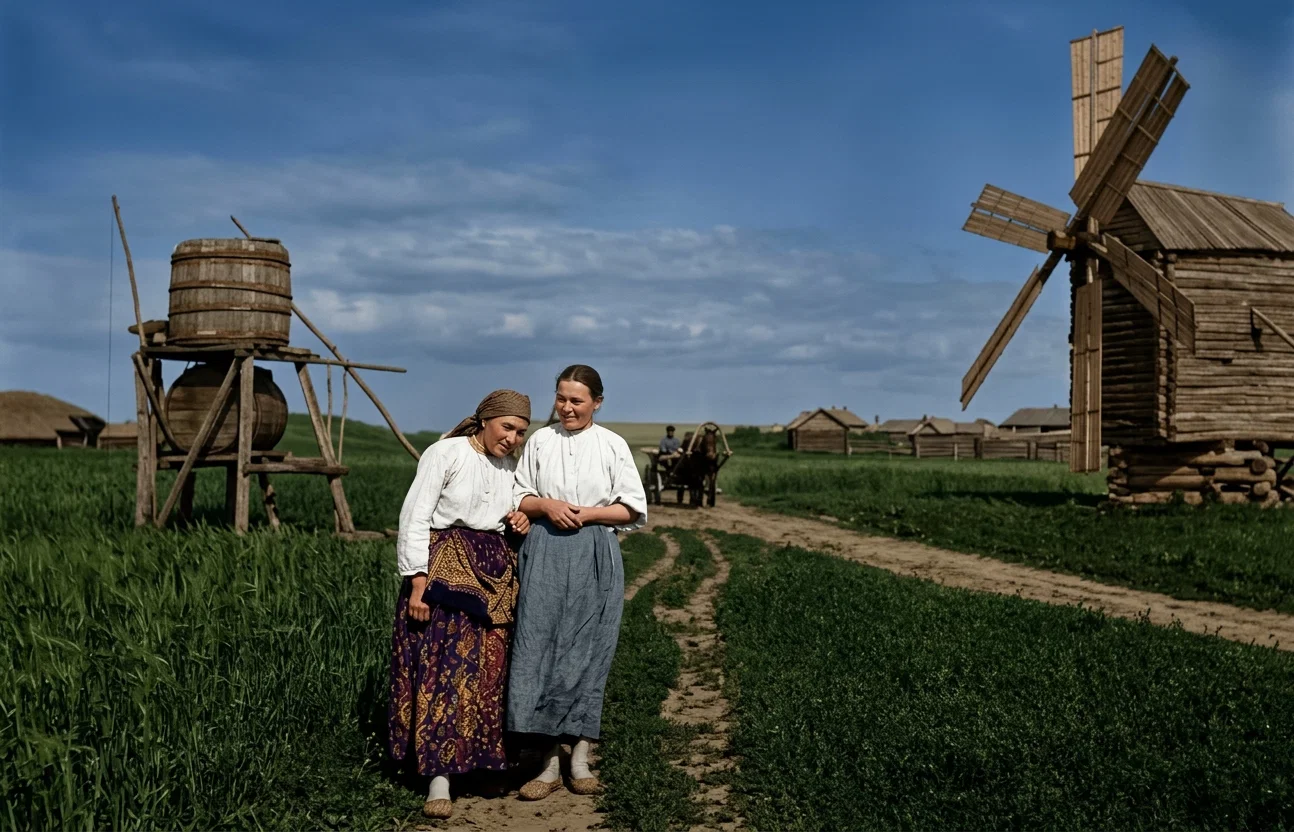
A RUSSIAN WINDMILL
A RUSSIAN WINDMILL

Wai-Chow-Fu, Kwangtung, China

J. N. ANDERSON
WAI-CHOW is a city of the first rank,—a “fu” city,—situated directly east of Canton, about one hundred fifty miles on the lower reach of the East River. Just next to Wai-chow, but separated from it by a small stream and the respective walls of the two cities, is another city, a district city called Kwaishin (a district city corresponds to a county-seat in the States). The union of the two cities makes that point a large and important center, as it is the head of a large section of country. It is the gateway of all the country up the East River, very accessible from the outside, especially during the time of high water, when launches run daily between there and Canton.
The language spoken is prevailingly Hakka, and hence it is a center for work among that class. It was from the Hakkas that some of our first converts came, and additions have steadily been made from time to time, so that now there is a considerable constituency with which to inaugurate an independent work among the Hakka people, who are scattered over large sections of this province, and are said to number no fewer than ten millions. Some of them are also to be found in the province of Fukien.
A small building site just outside the city of Kwaishin has been purchased (about two thirds of an acre) for one hundred seventy-five dollars. At the present time there is much trouble in all parts of China to get deeds stamped by Chinese officials when the transfer is to missionary societies. For this reason we were compelled to buy in the name of our Chinese evangelist, who, in turn, will transfer the title of the land to our mission. This necessitates two transfers, and so calls for the stamping of the deed twice; but on the whole it will be the shortest way to the possession of the land. In any case we were driven to this course, since the owner absolutely refused to sell directly to us. His refusal to sell to us foreigners may have been due to superstitious fear, or what is more likely, it may have been due to a fear that his own people would make him serious trouble for thus aiding the foreigner. There have been cases where Chinese have been dealt with very severely for the offense (?) of selling land to a foreign missionary society. Missionary societies are allowed to purchase land under treaty rights.
For some time it has been our settled purpose to erect a house for foreign residence at Wai-chow. We were driven to this resolution by the fact that it is impossible to find native houses that can be made suitable for our workers to live in without exposing them to conditions that endanger their lives. As the land has been secured, we are now prepared to build just as soon as the necessary funds are in hand; and this we confidently expect will be very soon.
At our meeting held in Shanghai last January, it was voted to send Brother and Sister S. A. Nagel to Wai-chow to connect with Brother J. P. Anderson, who is our sole worker among the Hakkas. The coming of another family, which is an absolute necessity, calls for the erection of a house that will accommodate the new workers as well as the old ones. In view of this we are planning to put up a double house on the site mentioned above. In the meantime Brother Anderson is living in a very bad part of the city, and in a house that is in every way unfit for a foreigner. Brother and Sister Nagel are compelled to remain in Canton temporarily, until a suitable house can be erected. They are studying the Hakka language; but since they are entirely out of the Hakka element, being among Cantonese all this time, they are working at no little disadvantage. They should be among their own people from the very first; and, furthermore, since the work has been begun there, they are needed from the very first. The chapel and school work at the local station in Wai-chow require a man's close and constant attention. On the other hand the several out-stations at some considerable distance in the country, together with the canvassing work, fully occupy the time and strength of the other man. Moreover, there is need of two workers being together, so they can, in accordance with the plan of our Lord, counsel and work together to lead souls into the truth, and build them up into strong churches, which shall, in turn, be lights in this dark land. During the last year and more J. P. Anderson and his Chinese assistants have been very active in the distribution of our literature in that part of the Hakka territory, and in this way our work has come to be known quite extensively in that part of the field. When our workers are once permanently located at Wai-chow, in suitable quarters, the work for the Hakkas will by that very fact be placed on a good footing.
The money for the erection of the house at Wai-chow, we are told, is to come out of the first instalment of the $300,000 Fund. This is very much appreciated by the workers who are enlisted in that difficult but promising field. For this generous aid financially, and the constant faith and prayers of the believers in the home land on our behalf, we all thank God.

How Piao-m Learned to Read

T. E. BOWEN
THE following incident, published in the Bible in All the World for August, should be a great encouragement to our workers in China, helping them to be patient and painstaking in their efforts to teach the message to native believers, with a view to their becoming workers for God. Such efforts will be greatly blessed by the Lord, and will no doubt result in leading many poor wanderers to the Light of Life. One worker patiently teaching a few honest souls will be putting out the Lord’s talents where they will increase manyfold.
Pastor W. D. Rudland, who has labored in inland China, translating the Scriptures into the Taichow dialect, relates the following experience:—
“An old Chinese lady, Piao-m by name, not long after her conversion expressed a wish to give herself to the Lord’s work. But as she could not read, and was well advanced in years, besides being far from bright in intelligence, it did not look as if she were likely to be of much use as a Bible woman. However, my wife undertook to do her best to teach her to read. For several months, day by day, Piao-m had a lesson, lasting for one or two hours. After learning the primer she went on the Taichow colloquial version of the New Testament, printed in Roman characters. For some time she made very slight progress; and even after she began to read a little, she seemed to have made up her mind that it would be impossible for her ever to understand what she read.
“I confess that I was quite in despair about Piao-m. After six months’ steady toil, each sentence being explained to her, there seemed hardly any hope that she would succeed.
“But one day, as she was reading, she suddenly found that she grasped the meaning of the passage; and from that moment she made rapid progress. I shall never forget the look on her face when she came and told me that she was beginning to understand what she was reading in the Testament. And how my wife rejoiced to see at last the fruit of her labors!
“Finding that she could understand what the words conveyed, Piao-m spent a large part of each day reading her book, going to her teacher for the explanation of words and passages which she could not make out. By this means before very long she had made certain portions of the book her own.
“But she could not be satisfied with just reading the Testament for herself; she began to read it to other women, and soon taught some of them to read, too.
“It was not long before she was sent to some of our out-stations to teach the women there; and wherever she went, women were converted to Christ. She is so humble and so self-sacrificing that the people believe in her. Her life is quite as powerful as her words, and she knows how to use the words of the Testament with great effect.
“One day she met with the widow of a small Chinese official, and began to tell her about the Saviour from sin. This was something quite new to the widow, who listened attentively. The result was that eventually she was converted and baptized. She in her turn is now a valued worker, giving her time to the teaching of the female patients in Dr. Anderson’s hospital, and also speaking to the out-patients who come to the dispensary. No doubt many of these will carry the message away to their homes in isolated villages, where no preacher of the gospel has ever penetrated.
“Although nearly seventy years old, Piao-m is still working in one of the China Inland Mission out-stations, beloved wherever she goes. She carries her New Testament with her, and some simple tracts; and while she is ever ready to read to the women from the Book, her strong point is to teach them to read it for themselves. How many she has taught to read the Word of God for themselves I do not know, but it must be a great many.
“In the Taichow district scarcely one woman in a thousand can read the Chinese character so as to be able to understand it: it takes years of study to master. But a few months’ time is sufficient to enable men and women to read and understand the Taichow colloquial version of the New Testament, printed in Roman characters.”
Truly we know not which shall prosper, either this or that; but one thing is noticeable,—God often chooses instruments whom men would pass by as very unpromising, but who, in his hand, lead many souls to Jesus.
Takoma Park, D. C.

He Lives to Save

A LADY missionary traveling in the hills near Mussoorie, in northern India, stopped to speak with a gang of coolie women working on the road. Among them was a woman of considerable intelligence, who spoke Urdu fairly well. Her husband was a Tibetan, who had in some way obtained a Gospel in the Tibetan language. The woman was familiar with the story of our Lord, but she refused to mention his crucifixion and death. “It was too awful,” she said; “I can not bring myself to read it.” The lady asked, “Did you think his death was the end of all? Did you not see that he died for your sins and mine, and then arose from the dead and ascended to heaven, where he now lives to intercede for us?” A wave of delight swept over her face, as she replied: “I am so glad you have told me. I see it all. It must be true. He lives to save.”—Selected.

Supporting Missionaries Through Small Gifts

“FORTY boys or girls, giving only five cents each week, will support a native preacher on the foreign field. One hundred persons giving twenty-five cents each a week, will support a missionary on the mission field at home or abroad.”
Continue reading: Editorial