The Youth’s Instructor, Vol. 27, No. 46.

MILAN CATHEDRAL

The Youth’s Instructor

Nov 19, 1879

S. D. A. Publishing Association · Battle Creek, Mich. · Nov 19, 1879

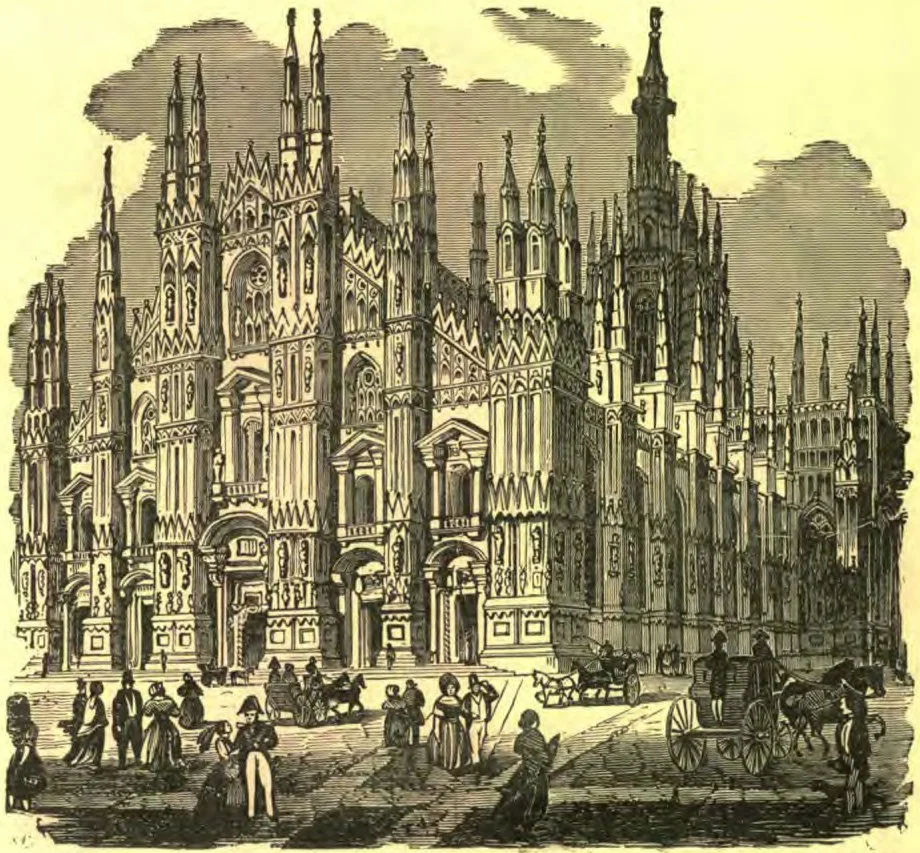
MILAN CATHEDRAL.

THE Duomo, or Great Cathedral of Milan, is said to be the finest work of Gothic architecture in the world. Its foundation was laid in 1386, four hundred and ninety-three years ago; and it is still unfinished.
It is built entirely of marble, which, under an Italian sky, has preserved its whiteness; and its appearance is exceedingly beautiful. It is adorned with more than one hundred pinnacles or spires, upon the tops of which are statues; these, as they gleam in the last rays of sunset, or under the full moon, seem like angelic sentinels ranged along the heavenly battlements, for the pinnacles are more than three hundred feet in height. The arches of the roof are supported by fifty-two pillars, each fifteen feet in diameter. Around the roof and sides of the cathedral are no less than four thousand six hundred niches, of which about four thousand are already occupied by statues, as perfectly executed as if made for an art gallery.
While the exterior dazzles and astonishes the beholder by the brilliancy of the marble, the Gothic ornaments, and the statues, he is not less strongly impressed by the interior. The beauties of the outside draw away the eye from the vastness of the building as a whole, so that not until he enters within does its immensity burst upon the visitor. The eye dazzles in looking up to the vaulted roof, and is almost overpowered by the number of grand and beautiful objects which claim attention. The building is crowded with monuments of prelates and princes; the floor is of marble of different colors, formed in various figures; paintings by the most celebrated masters adorn the walls; and the groups of figures sketched on the stained-glass windows are of great size and beauty.
The height of this wonderful church is 265 feet, the length 485 feet, the breadth 191 feet, and the transept 287 feet. The height of the spire in the center of the church is 355 feet, or 130 feet higher than Bunker-hill Monument.
But there is another church in Milan, which, though smaller in size, and much less beautiful than the Duomo, is of greater interest to Christians. It is that of St. Ambrose, which was founded by the good bishop of this name in A. D. 387, and in which he eloquently and faithfully preached the gospel. His most famous convert was Augustine, who became the greatest of the church fathers, and at whose baptism it is believed was first sung the majestic anthem of St. Ambrose, “We praise thee, O God; we acknowledge thee to be the Lord,” which glorious song will continue to be sung in earthly temples, till it is caught up by voices around the throne of God.
Com.

GOD'S BUILDING.

’Tis said that the temple so stately, That crowned Moriah’s hill, Was built without sound of hammer, The toilers working so still. Far off from the grand foundation Was all the noise and strain Of fitting one stone to another, From base to turret’s fane.
And when all were brought together, The stones of every size, The columns, so strong and graceful, Each in its place to rise, They formed so grand a temple As never before was seen; So true in its great proportions, So bright in its glittering sheen.
Yet there is a greater temple, And God is he who plans; Now gath’ring his stones together For his “house not made with hands.” And each ransomed soul will be there, Which evermore, day by day, He’s fitting for this great temple, Which will last forever and aye.
Our pains, temptations, and perils, Our sufferings, sighs, and tears, Are God’s chisels, tools, and hammers, Before “the angel appears.” Let no one shrink from the process, Let none of the Lord complain; But wait with a meek submission; ’T will not be long or in vain.
Away from the noise of the furnace, Away from the toil and sin, Will he carry each of his children, The beautiful gates within; Where each in appointed stations He will fashion, one by one, And Christ will complete the temple, Himself for the corner-stone.

From Sea to Sea: Battle Creek to Detroit

FROM SEA TO SEA.—NO. 18.

PARTING with our friends in Battle Creek we are again on our way toward the broad Atlantic. Among the first points of interest that attract our attention are the coal mines of Michigan, a little west of Jackson. As we look at these, we call to mind a statement made by a scientific gentleman who passed through the State some twenty-five years ago, setting forth his “infallible science of geology,” as positive proof against the Bible records. In elucidating his subject he gave reasons why, “according to geology,” coal would never be found in Michigan. In less than three months after he left the State large beds of coal were discovered in Jackson County. Thus his geology was proved to be not “infallible.”
But on we speed, passing fertile fields, luxuriant orchards yielding their golden store, and sear-leaved forests which show that Jack Frost has returned and begun his work. Now we have reached the river Raisin, one of the most crooked streams I ever saw. The railroad crosses this river thirteen times in three miles.
Our train makes a few minutes’ halt at Dearborn, the great military station of the State. When Michigan was a country of savages this was a very important point, but now only a few soldiers are stationed here, to hold the forts bordering on the British possessions. Soon after leaving Dearborn we arrive at Detroit, on the west bank of the Detroit River. Immediately opposite, on the east side of the river, is Windsor, in Canada. The Detroit River is between one-half and two-thirds of a mile wide. It is the great outlet of lakes Michigan, Superior, Huron, and St. Clair, through which their waters empty into Lake Erie.
At Detroit we reach the terminus of the Michigan Central Railroad, one hundred and twenty miles from Battle Creek. This is one of the most complete and best conducted roads in the United States, being one of the great links in the line of travel from ocean to ocean. The Detroit River formerly made a serious break in this line. All passengers were obliged to leave the cars and cross the river in a ferry-boat, and then take the cars again at Windsor, on the Canada side. Now we find the cars of the “Great Western” (Canada) Railroad in the Detroit depot. We change cars, and are backed on to a huge ferry-boat, which takes the whole train over the river. On the Canada side another engine draws the train off the boat, and soon we pass on our way.
The Great Western Railway runs the whole length of the north side of Lake Erie, through what was once called “Upper Canada,” afterward known as “Canada West,” but now named “The Province of Ontario.” This road is two hundred and thirty miles in length, and extends from Detroit River, the inlet of Lake Erie, to the Niagara River, the outlet of that lake.
Near the line of this railroad is found the oil region of Canada, where no inconsiderable amount of petroleum has been obtained from the oil wells. Among the cities and villages which we pass on this line is the beautiful city of London, so named after London in England.
On this road we see much less of that spirit of hurry and bustle that is so characteristic of railroad operating in the United States. Great care is taken to guard against loss of life. The stops at the depots are longer, and the trains in starting move off more slowly. As our passage over this road is mostly in the night we must close our observations and seek rest in sleep, “Nature’s sweet restorer,” preparatory to an early view of the Niagara Falls and the great Suspension Bridge, which are at the terminus of this road.
J. N. L.

OUR DAILY CUP.

Every morning, as it dawns upon our eyes, is like a messenger from Heaven, bearing a crystal goblet for us to drink from. It is ours. We cannot transfer it to our neighbor or companion. We must empty it, whether its contents be bitter or sweet. At night the cup will be broken; but the morning will bring another, filled to the brim. Thus we may liken the events which daily come to us, unsought. We call them our “circumstances”—our “lot;” and we have little power to alter or control them. Sometimes they are pleasing, sometimes painful; mostly of a mingled character, and always to some extent unforeseen by us. How can we drink the cup, under such varying conditions, and yet be peaceful, contented, and happy? Only by receiving it as from our Father’s hands.
There is a story of Alexander the Great somewhat to this effect: He was attacked by a tedious sickness, and consulted a tried and valued physician, calling for a powerful remedy, that the effect might be speedy. The physician asked for three days to procure the drugs. In the meantime the king was warned that this man had been bribed to poison him. When the medicine was brought, Alexander handed the letter to the physician and drank the liquid at a draught. In three days he was restored to health.
Here was unwavering faith in a servant; can we not trust our best Friend with like confidence? It is easy—only too easy—to be discontented; but that day will always be happy in which we are enabled to receive all as from God.—Groser.

WHEN THE WOODS TURN BROWN.

How will it be when the roses fade Out of the garden and out of the glade? When the fresh pink bloom of the sweet-brier wild, That leans from the dell like the cheek of a child, Is changed for dry hips on a thorny bush?— Then, scarlet and carmine, the groves will flush.
How will it be when the autumn flowers Wither away from their leafless bowers; When sunflower and starflower and golden-rod Glimmer no more from the frosted sod, And the hillside nooks are empty and cold? Then the forest tops will be gay with gold.
How will it be when the woods turn brown, Their gold and their crimson all dropped down, And crumbled to dust!— Oh, then, as we lay Our ear to Earth's lips, we shall hear her say, “In the dark I am seeking new gems for my crown”!:— We will dream of green leaves when the woods turn brown.
—Lucy Larcom.

THE SAVIOUR'S INVITATION.

There is usually something pleasing in “an invitation,”—in being invited guests to participate in the hospitalities of friends, and to join them in seasons of healthful recreation. Pleasures of this nature form no small portion of the sum of human happiness. On the contrary, a large per cent of human unhappiness results from slights and neglect on the part of those who, instead of following the scriptural injunction to share their blessings with those less fortunate than themselves, suffer pride and selfishness to influence them in their choice of guests.
But it is the Saviour's invitation to which we wish to call your attention. He invites us to become heirs with him in glory. What is the value of his invitation?—heirs with Jesus Christ in the glory he has with the Father. No partiality is shown by him, but he invites the whole world, without money and without price, to accept the hospitalities of his heavenly inheritance.
Dear readers, what an invitation is this! and how it is slighted by the great majority of mankind! We wish you to acquaint yourselves with its inestimable worth, that you may know how highly to prize it, and make haste to accept it. Study the word of God diligently, for it reveals the glory and the happiness in store for those who accept.
But keep ever in mind that although all are his invited guests, all are not accepted ones. The wedding garment,—the spotless robe of righteousness,—is the passport for admittance through the pearly gates.
This bountiful Benefactor not only invites, but he provides a fountain in which to whiten our robes and make them acceptable in his presence. To us the fountain is open to-day; how will it be to-morrow? Will you “plunge beneath that flood, and lose your guilty stains”? or will you refuse the gracious invitation, and be driven with the multitude to take up the sad lamentation, “The harvest is past, the summer is ended, and we are not saved”?
“Delay not, delay not; O sinner, draw near; The waters of life are now flowing for thee; No price is demanded, the Saviour is here, Redemption is purchased, salvation is free.
“Delay not, delay not; the Spirit of grace, Long grieved and resisted, may take its sad flight, And leave thee in darkness to finish thy race,— To sink in the gloom of eternity's night.”
M. J. C.

LESSONS FOR CHILDREN.

LESSON XLVI.—ABSALOM'S DEATH.

When Ahithophel found that his counsel was rejected, he went home, and hung himself. As soon as the council was over, the sons of the priests were sent to tell David what had been said. They were waiting, a little way out of the city, and a woman went out to tell them, so that Absalom might not know what was done. But a lad saw them, and ran and told Absalom. The young men knew that Absalom would send some one to take them; so they went quickly to Bahurim, and hid themselves in a well. A woman who saw them go down into the well put a covering over the well's mouth, and spread ground corn upon it. When Absalom's servants had searched in vain for the young men, they returned. Then the woman took the covering from the mouth of the well, and the messengers went on their errand. When they came to David, they told him not to lodge in the plains of the wilderness that night. Then David and all the people that were with him arose, and went on. By daylight, the next morning, they were all on the other side of Jordan.
Then Absalom followed on with an army, and crossed the Jordan also. David divided his army into three parts, and put one part under the command of Joab, one under Abishai, and one under Ittai. The king wanted to go forth to battle himself, but his men would not allow him to do so, fearing that he would be killed, or taken prisoner. So David remained in the city, but as the men went out to battle, he stood by the gate, and said, “Deal gently for my sake with the young man, even with Absalom.”
The battle was in the wood of Ephraim, and was scattered over a large extent of country. The servants of David gained the victory. Absalom, who was riding on a mule, was caught by the head in a tree, and left hanging there; for the mule went out from under him. When Joab knew this, he went to the place, and thrust Absalom through with three darts. “And they took Absalom, and cast him into a great pit in the wood, and laid a very great heap of stones upon him; and all Israel fled every one to his tent.”

QUESTIONS.

  1. What did Ahithophel do when he knew that his counsel was rejected? 2 Sam. 17:23.
  2. Who were sent to tell David what had been said? Verse 17.
  3. Where were the young men waiting?
  4. Who went out to give them their message?
  5. Why was this done?
  6. How did Absalom find out what was going on?
  7. How did the sons of the priests escape from the men who were sent to take them?
  8. When they came to David, what did they say to him?
  9. What did David and his men then do?
  10. Where were they by daylight the next morning?
  11. What course did Absalom pursue?
  12. How did David prepare for battle? Chap. 18:1, 2.
  13. Why would not his men allow him to go forth with them?
  14. What charge did he give the men as they went out to battle?
  15. Where was the battle fought?
  16. Who gained the victory?
  17. What was the fate of Absalom?
  18. What was done with his body?

BIBLE LESSONS FOR YOUTH.

LESSON LXXII.—THE KINGDOM DIVIDED.

  1. WHY was the Lord displeased with Solomon? 1 Kings 11:9-11.
  2. What did he threaten to do?
  3. Why was this evil deferred until after Solomon’s death?
  4. What promise was made in regard to Solomon’s son?
  5. What enemies did the Lord stir up against Solomon?
  6. What did Ahijah the prophet reveal to Jeroboam?
  7. When Solomon heard what the prophet had said to Jeroboam, what did he attempt to do?
  8. How did Jeroboam escape?
  9. How long did Solomon reign?
  10. Who succeeded him?
  11. Who assembled at Shechem? Chap. 12:1.
  12. For what purpose?
  13. Who had been called from Egypt as soon as Solomon died?
  14. What did Jeroboam and all the congregation say to Rehoboam?
  15. What reply did Rehoboam make?
  16. With whom did he consult?
  17. What counsel did the old men give him?
  18. Was he content to follow their counsel?
  19. What did the young men advise him to do?
  20. What answer did he give the people when they came to him the third day?
  21. What did the people say in return?
  22. Over whom did Rehoboam still reign?

SYNOPSIS.

The Lord was greatly displeased with Solomon for going after other gods, and told him that the kingdom should be taken from him, or rather from his son; for, because of the respect which he had for David, this evil was to be deferred until after Solomon’s death. The Lord also promised that Solomon’s son should sit on his father’s throne in Jerusalem, and reign over the tribes of Judah and Benjamin.
And the Lord stirred up powerful enemies against Solomon,—Hadad, the Edomite; Rezon, who reigned over Syria; and Jeroboam the son of Nebat, who was plainly told by the prophet Ahijah that after the death of Solomon he should reign over ten of the tribes of Israel. “Solomon sought therefore to kill Jeroboam. And Jeroboam arose, and fled into Egypt, unto Shishak king of Egypt, and was in Egypt until the death of Solomon. . . . And the time that Solomon reigned in Jerusalem over all Israel, was forty years. And Solomon slept with his fathers, and was buried in the city of David his father; and Rehoboam his son reigned in his stead.”
“And Rehoboam went to Shechem; for all Israel were come to Shechem to make him king.” On the death of Solomon the people had called Jeroboam from Egypt. “And Jeroboam and all the congregation of Israel came and spake unto Rehoboam, saying, Thy father made our yoke grievous; now, therefore, make thou the grievous service of thy father, and his heavy yoke which he put upon us, lighter, and we will serve thee. And he said unto them, Depart yet for three days, then come again to me. And the people departed.”
“And King Rehoboam consulted with the old men that stood before Solomon his father while he yet lived, and said, How do ye advise that I may answer this people? And they spake unto him, saying, If thou wilt be a servant unto this people this day, and wilt serve them, and answer them, and speak good words to them, then they will be thy servants forever.”
“But he forsook the counsel of the old men, which they had given him, and consulted with the young men that were grown up with him.” And the young men spake unto him, saying, “Thus shalt thou say unto them, My little finger shall be thicker than my father’s loins. And now, whereas my father did lade you with a heavy yoke, I will add to your yoke: my father hath chastised you with whips, but I will chastise you with scorpions.”
“So Jeroboam and all the people came to Rehoboam the third day, as the king had appointed.” “And the king answered the people roughly, and forsook the old men’s counsel that they gave him; and spake to them after the counsel of the young men, saying, My father made your yoke heavy, and I will add to your yoke; my father also chastised you with whips, but I will chastise you with scorpions.”
“So when all Israel saw that the king hearkened not unto them, the people answered the king, saying, What portion have we in David? neither have we inheritance in the son of Jesse: to your tents, O Israel: now see to thine own house, David. So Israel departed unto their tents. But as for the children of Israel which dwelt in the cities of Judah, Rehoboam reigned over them.” G. H. BELL.

ANNUAL REPORT OF THE MICHIGAN S. S. ASSOCIATION FOR 1879.
The following report was read before the annual meeting held in connection with the camp-meeting at Lyons, Sept. 25-30:—
Since the annual meeting of the Michigan S. S. Association, held Oct. 7, 1878, there have been three quarterly reports.
At the end of the first quarter, 43 schools reported; at the end of the second quarter, 57; at the end of the third quarter, 80; showing an increase of 37 schools.
The number of classes at the end of the first quarter was 190; at the end of the second, 240; at the end of the third, 351; showing an increase of 161 classes.
The report for the first quarter showed a membership of 1753; for the second quarter, 2211; for the third quarter, 2907,—an increase of 1154 members. The first quarter showed the attendance to be 70 per cent of the membership; the second, 69 per cent; the third, 68 per cent,—a decrease of 2 per cent.
Amount contributed reported for the first quarter, 67 cents; for the second, $75.48; for the third, $161.77.
Number of INSTRUCTORS taken during the first quarter, 183; during the second, 701; during the third, 976,—an increase of 793 copies.
One year ago, but very few schools used the “Class Records” or the “Secretary’s Records”; now, they are used in nearly all. The “Song Anchor,” published a year ago, is now almost exclusively used as a book of songs.
During the past year, a lively correspondence has been kept up with the schools. There have been 160 letters and 30 postal cards written. Printed circular letters have also been sent to all the schools. Many of the reports from the schools were accompanied by questions and interesting remarks.
The officers of the Association have visited the schools at Jasper, Ransom, Jefferson, Hillsdale, Spring Arbor, Marshall, Newton, Burlington, Hickory Corners, and Potterville. Three S. S. meetings or conventions were held in the State during the summer, viz., at Spring Arbor, Bushnell, and Potterville. These meetings were well attended, and have been, it is believed, the source of much encouragement to the schools in the vicinity of those places.
At each camp-meeting a general Sabbath-school has been held, important subjects have been considered, interesting questions discussed, and officers and teachers interviewed in private as well as in public. Earnest efforts have been made to learn the condition and wants of the schools and to give such assistance as could be afforded. Many seemed anxious to learn all they could in regard to the best methods of carrying on the work.
There seems to have been a marked improvement, not only in organization and methods, but also in the interest and thoroughness with which the Bible is studied. Courage and hopefulness prevail, and the outlook gives promise of better days for the Sabbath-schools of Michigan. We must remember, however, that the work is but just begun, and that much remains yet to be accomplished. W. C. WHITE, Pres. LETTIE MARVIN, Sec.

Trust in Mother.

LITTLE darlings, full of glee, Bright and bonny, fair and free, Trust in mother; You will never find another Like this one so good and true, And so faithful unto you.
Tell her all your childish woes, For a precious balm she knows, Sweet and healing; And her kiss is warm with feeling; Blessed kiss that never cloys— Tell her all your childish joys.
Maiden daughters, blooming fair, With your opening charms so rare, Trust in mother; She’ll advise you like no other; Lock no secret in your breast, Share with her who loves you best.
Girls and boys, where’er you stand, Scattered through our glorious land, Trust in mother; She’ll advise you like no other; Loving heart does she possess, Full of thoughtful tenderness.
—M. A. Kidder.

ANTS AS DAIRYMEN.

You have heard, little readers, many things about the wise and industrious ants, but perhaps you have never been told of their dairies.
Yes, it is true; they have herds of tiny cattle, which they guard carefully, and which, in turn, supply the ants with food.
The yellow ants, it is said, collect a drove of these cattle near their homes, and there protect and even caress them. Sometimes they build for them a room around a thistle stalk, on which their cattle feed, so that the ants have only to crawl up the stalk to enter the fold.
And most carefully do they watch them there. Should an ant attempt to milk the cattle belonging to the ants of a neighboring hill, he is instantly caught and punished by the trusty herdsmen.
What are these cattle? and how can the ants obtain the milk?
They are aphides, very small insects which live on the juices of vegetables, and yield through two little tubes a sweet liquid. This liquid the ant obtains by rapidly passing its antennae, or feelers, first on one side and then on the other of these tubes, going from one insect to another until it is no longer hungry.
But the ants don’t keep any milk to make butter.—Children’s Friend.

SCRIPTURE PUZZLE.

A BUREAU.
THE top horizontal row of eight stars represents the name of a son of Ahimelech; the second horizontal row of eight, one of the cities destroyed by Ben-hadad at the instigation of Asa, king of Judah; the third horizontal row of eight, a sea in the north central part of Palestine—Capernaum is near this sea; the fourth horizontal row of eight, one of the four disciples who acted as amanuenses when Paul wrote the First Epistle to the Corinthians; the left vertical row of seven stars, one of the seven chamberlains who served in the presence of King Ahasuerus; the right vertical of seven, a treasure city belonging to Pharaoh, also the name of that part of the land of Egypt where Joseph gave his father and brothers a possession; the two knobs in the upper drawer, the name of a king of Bashan; the two knobs on the second drawer, a king of Egypt to whom Hoshea, king of Israel, sent presents; the two knobs on the lowest drawer, the son of Peleth, and one who was of the company of Korah.—Sel.

Early History of European Banking

The first regular bank was established at Venice in 1157. The bank of Genoa was established in 1247; that of England, 1674.

KINDNESS

God has placed us here together That we may be good and kind; He is ever watching whether We are one in heart and mind. Who is stronger than the other? Let him be the weak one's friend; Who's more playthings than his brother? He should like to give or lend.

LETTER BUDGET.

FREMONT CENTER, MICH.
DEAR EDITORS: I try to keep the Sabbath with my mother and two sisters, and we attend Sabbath-school regularly every Sabbath,—the school which Mr. and Mrs. Lane organized, within four miles of this place. There are quite a number of scholars, I do not know just how many. There are five teachers. I love my teacher very much, and try to have my lessons perfect.
MILO E. YERGIN.

Letter from Batavia, Michigan Reader

Batavia, Mich.
Dear Editors: I have just begun to read your paper, and I like it very much, especially the Letter Budget. I first became acquainted with the Instructor by seeing a notice of it in another paper.
I attend Sunday-school every Sunday. I am not staying at home, as my father does not live here. I work for a man in this place.
I hope to meet the readers of the Instructor in the better land.
W. J. W. Westerman.

PANORA, IOWA

Dear Editors: I am seven years old. I have been to school only four days, but read in the third reader. I have two brothers and one sister. Arthur is five years, Annie two years, and Frankie six months old. I like the INSTRUCTOR very much, although I do not take it, but my kind Aunt Annie, of Marshalltown, has sent me a great many, and I also received a roll with the name Willie Shinkle on them. I do not know him, nor where he lives. He was very kind, and I am thankful to him for them. Ma reads them all to me, and I will be glad when I can take them and get one every week. I learn some of the lessons in them, and ma teaches me all she has time from the Bible. I am learning the ten commandments. Ma has kept the Sabbath of the Lord over two years, through reading of tracts sent her by Aunt Annie.
Ma tries to teach us to love and keep the Sabbath, but has not books and papers to keep us busy as she would like to have, and I do not keep it as I ought, sometimes, but am sorry. Pa does not keep the Sabbath, but we pray that he may some day.
Ma has written this letter for me, but I intend to go to school this winter, and hope to be able to write for myself next time. I want to be good and to meet all of God's people when Jesus comes. Good-bye.
HERBERT E. CULVER.

TELL YOUR MOTHER.

PARTY of school-girls were whispering together in one corner of the school-room, and as another of their number came in they exclaimed, “O Jennie, do come here! We have a secret to tell you; but you must promise not to tell anybody for the world.”
“Well,” said Jennie, “then I cannot hear it, for I never listen to anything that I cannot tell my mother.”
What a noble girl! and how much happier she must be than those who hide things which they would blush to have known.
Girls, how many of you do as Jennie did?
I heard of a good man once, who said, “I never did anything that I was ashamed to tell my mother.” It is a great thing to be able to say that, and I am afraid there are few boys now-a-days who can say it. Can you, my young reader? If you cannot, will you not make up your mind so to live after this that you can say it, if you are so happy as to have a mother still living?
Tell your mother everything, children; never do or say anything that you would be ashamed to have her know.

You have reached the end of this edition.

The Youth’s Instructor · Nov 19, 1879