The Youth’s Instructor, Vol. XLIX, No. 36

SUMMER BIRDS

The Youth’s Instructor

Sep 12, 1901

Review and Herald Publishing Company · Battle Creek, Mich. · Sep 12, 1901

SUMMER BIRDS

RESPLENDENT in the summer choir, The redbird folds its wings of fire, And sings; and how the oriole’s note Translates his gold of breast and throat!
Deep in the holy woods the thrush Breaks with ecstatic praise the hush; And o’er wide meadows bathed in sun The bluebird’s dialogue is spun.
White-chaliced daisies lean to drink The cascades of the bobolink, And cheerful robin from the wall Sings mellow matins for them all.
O God! how artless and sincere Thy little feathered hymnists here! So true the song, and feeling fit! No bird was e’er a hypocrite.
Out of my heart, I pray, may rise Tribute as earnest to the skies. Unless my words be heart-true words, I lack the faith of summer birds.
—James Buckham.

THE WRENS

THERE are a number of different wrens in the United States. The bird is so small, and the different species so nearly resemble one another, that some care is needed to distinguish individuals.
In the Northern States in summer, the House Wren is most common. But west of the Alleghanies, and south of the fortieth degree of latitude,—this line runs nearly through the middle of Illinois from west to east,—the Bewick Wren is quite common. Its appearance, song, nest, and habits are very much like those of the House Wren; but they may be distinguished by several definite markings. The House Wren has no white line over the eye, while Bewick’s Wren has. As has been intimated, the location will also give one something of a clue. In Michigan, Wisconsin, etc., or on the Eastern coast, if the wren you have discovered lives about a home, or a farmyard, it is probably the House Wren; but in southern Illinois, and farther west and south, Bewick’s Wren is more common than the other.
In the winter, another wren visits us, while the House Wren goes farther south. This little bird is the Winter Wren. His tail is much shorter than that of the House Wren, and is held up much higher over his back. Then there is the Long-billed Marsh Wren, which has a white line over the eye, a black patch on the back, a very long bill, and is found in marshes.
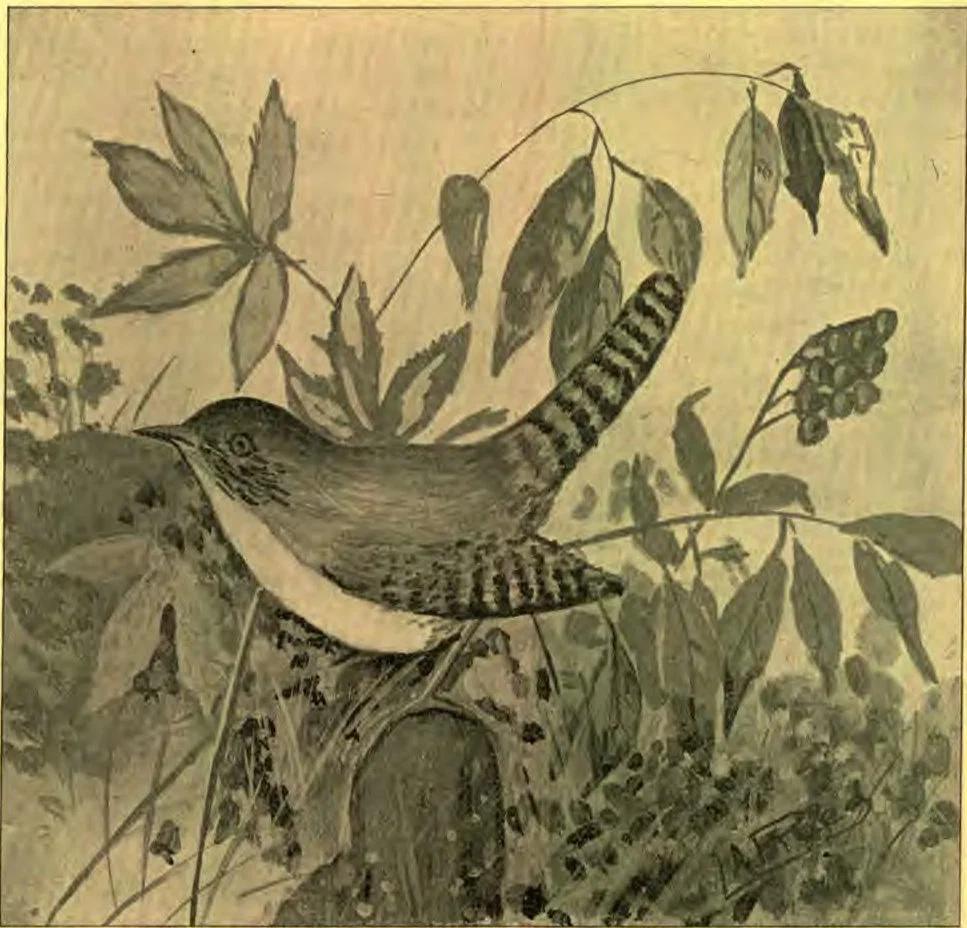
In the picture we have tried to represent a House Wren. This bird is a tame little creature, and an excellent singer, although Bewick’s Wren can outrival him.
When a House Wren once selects a place for a nest, it becomes greatly attached to it, and will return to the same place year after year. The birds will nest in a bird-box if the opening is not larger than a silver quarter. A larger opening will let in the English sparrow, which is apt to drive out the wrens.
At my old home in Wisconsin, a pair of wrens built a nest in the boxing of our picket fence. It was the post at the gate, and it seems strange that they would build so close to where persons were so often passing. They were never molested, however, and we grew very fond of them, and each summer looked for their return. I do not know how many years they nested in the old post, but it was for a number of seasons.
Here in Jacksonville, Ill., two wrens have a nest in a dead limb of an old apple-tree. They have either dug out enough of the rotten wood to make room for the nest, or else this was done for them by some other birds. They seem very happy, and one or the other is singing most of the time.
THE HOUSE WREN
THE HOUSE WREN
One writer has said that the House Wren is given to perpetual motion. He surely is a lively little creature. You may as well expect to catch a weasel asleep as to find a wren at rest.
“He is ever hopping, flitting, bobbing, or bowing, pausing only long enough to give voice to his feelings in fidgety, scolding notes, or an effervescing, musical trill, with the force of which his small body trembles. It is a wonderful outburst of song, and the diminutive singer’s enthusiasm and endurance are even more remarkable. The song occupies about three seconds, and I have heard a wren, in response to a rival, sing at the rate of ten songs a minute for two hours at a time.”
The House Wren sometimes uses about half a bushel of twigs in making a nest. In the center of this mass are placed dried grasses. The eggs number from six to eight, and are minutely speckled with pinkish-brown. The House Wren leaves us for the South about October; but before it leaves, the Winter Wren comes from the North. It remains with us until April; and at about the time the House Wren returns, the Winter Wren leaves us again for the North.
L. A. REED.

TWO LITTLE WRENS

Very small birds inspire a peculiar kind of affection. Perhaps it is because they seem peculiarly helpless. A hawk can take care of himself. We are glad to see him, we admire the strength and grace of his flight; but as for loving him, the idea never occurs to us.
For another thing, many small birds are very confiding, and, if a creature confides in you, you can hardly help feeling your heart warm toward him. A man said in my hearing, not long ago, “I like a dog that likes me.” And I say now, as I have said before, that I am interested in all birds, but I love especially those that treat me as if I could be trusted.
Only this forenoon I offered a bird something to eat. She was sitting on her eggs (a friend had invited me to come to see her), and might reasonably enough have told me to mind my own business. Well, I could not quite reach her from the place where I stood; but I held up my finger with a dead ant on it, putting it as near her bill as I could get it, and she stepped at once out of the nest to a twig a few inches below, and took the morsel from my finger as innocently and frankly as a child would have taken an orange. Perhaps I did not love that bird!—that vireo, whose mate was at that moment singing to her in the next apple-tree.
I am saying all this by way of introduction to a very brief talk about two kinds of small birds, one of which generally builds its nest in the immediate neighborhood of human beings, while the other quite as generally does exactly the opposite, setting up its abode in some very wild and out-of-the-way place. In short, although the two look most confusingly alike, one is habitually a door-yard bird, the other a bird of the unbroken forest.
Number one is the house wren,—a chubby, short-tailed, brown creature, with a slender, sharply pointed bill, very common and well known in many localities, but seldom or never seen in others that seem quite as well suited to its needs.
This season a pair have built a nest in the yard of one of my neighbors. I pass the spot almost daily, and four times out of five, even though I go directly past, I hear the male singing his short, hurried, gurgling tune from one of the trees directly before the door. One day a friend expressed a desire to hear the song, and we went to the place together. The fellow sang, and then—what was unusual—flew to the other side of the road. “I should like really to see him,” said my friend, and we crossed the road in pursuit. We were standing motionless on the sidewalk, when suddenly the tiny thing hopped into sight from under the picket fence. In and out he went between the slats, every slat bringing him nearer, till all at once he found himself within a foot or two of my companion’s boot. He stopped, looked at the strange shiny object, dodged back between the pickets, and we lost him. Thirty seconds passed, or possibly sixty, and, behold! he was singing again from his old perch.
The incident was characteristic, for both the wrens of which I am writing are a good deal like mice in their habit of dodging about in brush-heaps, stone walls, wood-piles, and other tangles, now visible for an instant, now lost to sight, and anon reappearing in some least expected quarter. Hide-and-seek is their game. For aught that I know, they may have been the inventors of it.
The house wren’s nest is built in a bird-box, in the hollow of a tree or branch, or in any similar opening that happens to strike the builder’s fancy. He is an excellent neighbor, worthy of all encouragement, especially in these days when the multitudinous English sparrow so often gets early possession of all such building-sites as the wren would naturally choose to settle in.
Our second bird is known as the winter wren. You may find him in summer in all the wilder parts of northern New England, but will be little likely to do so unless you are on the lookout for him, or have with you some better-informed companion to call your attention to his music. This is highly peculiar and highly pleasing,—a rapid, tinkling, life-like tune, pretty well prolonged, in a very fine, thin voice, which, for all its thinness, is not wiry, in any bad sense of that word, but decidedly musical. Thousands of tourists hear it without minding it, and thousands more without suspecting the name of its author.
If you hear such a song,—anywhere in the White Mountains or the Adirondacks, for example,—you may need only a few bits of patience to discover the singer; but you will find him the more easily if you keep in mind that he is the merest midget of a plainly colored bird, with the shortest kind of a tipped-up tail, and is never far from the ground,—as well as never, or next to never, on a leafy branch,—but is to be caught sight of as he flits about the dead roots of an overturned tree, the mazes of a brush-heap, or other such close piece of cover. If you see him, he will most likely have seen you first, and will be bowing to you in a comically nervous manner, while he utters at intervals a brief tut-tut, which sounds like anything but a compliment or an address of welcome. He is an oddity, but one of the very best of our wilderness songsters.—Bradford Torrey, in S. S. Times.

DIVISION I—CONCLUSION OF CHAPTER II

The Week of Creation

§ 24. “And God said, Let us make man in our image, after our likeness. . . . So God created man in his own image, in the image of God created he him.” Gen. 1:26, 27. Nowhere do we read that man, the crowning work of all God’s creation, was evolved from the lower forms of life. This theory of evolution was first promulgated in the year 1734 by Emanuel Swedenborg; and though taught in the name of religion, has become the foundation rock of all infidel science, and is to-day the stone upon which many an unsuspecting mind has stumbled in regard to the true science of God’s creation.
§ 25. What if there are graduations and classifications plainly found in the field of animate creation? What if there is a gradually ascending scale from the simple cell of the protoplasm up to man, the most complex of earth’s creatures? Could God possibly have created so vast a number of animate creatures, covering so wide and diversified a field as he did, without bringing the species so closely together as to make the above-mentioned classification possible?—Certainly not. From the minute amoeba, large numbers of which move about with the greatest freedom in a tiny drop of stagnant water, to the mighty mammoth, there must of necessity be a wide field to fill with living creatures. One river alone, the Amazon, contains no fewer than two thousand separate species of fish, to say nothing of myriad other forms of life.
§ 26. Shall we cast aside as untrue the plain statement that God created the varied forms of life, and believe the man-made theory that all these different species, during the lapse of ages past, have developed from a single cell? Shall we believe that man evolved from the chimpanzee, the chimpanzee from the orang-utan, the orang-utan from the monkey, he from the dog, and so on back through the fishes to the mollusks, and finally to the single cell of protoplasmic life? This would, forsooth, put God a long way off, and so perhaps suit the feelings of many; but when it has been done, it might well be asked, Who, in those dim and distant ages, created that first cell, which, as we are so vividly told, lived upon a lone rock until it finally evolved itself into two cells, and has, since then, according to the “law of the survival of the fittest,” evolved into unnumbered forms?—The reverent answer must ever be, “God.”
§ 27. But why do we not, in this enlightened age, like to retain God, who is the only true source of light and knowledge, in our reckoning?—Simply because Satan is leading this present generation over exactly the same ground over which he anciently led the now heathen nations. “Because that, when they knew God, they glorified him not as God, neither were thankful; but became vain in their imaginations, and their foolish heart was darkened. Professing themselves to be wise, they became fools, . . . wherefore God gave them up to uncleanness through the lusts of their own hearts.” Rom. 1:21–24.
§ 28. It is also argued that because all animals, fishes, and reptiles are composed of cells, therefore all must have evolved from one original cell; but this is not a necessary conclusion. That God saw fit to build his creatures out of one foundation material, is no argument that the higher orders had to pass through the different stages of progression. To illustrate: Here stands a house, yonder a stable, there a hen-house, and near it a dog-kennel, all built of brick; does this prove that before the house became a house, it had first to pass through all the stages of being a stable, a coop, and a kennel? Is the hen-house in the transitory stage between the kennel and the barn, simply because we find them all composed of the same foundation material?—Not at all. They may have all been built at the same time and designed by the same architect; but no rational mind offers the theory of evolution as a means of explaining the sameness of the material used in their construction.
§ 29. It is true that man has evolved, but in the downward direction. “Lo, this only have I found, that God made man upright [in the image of God], but they have sought out many inventions,” or excuses, as one translation reads. Eccl. 7:29. By indulgence in sin, man has become so degraded and so like the beasts that, as an excuse for this debased condition, he accepts the revolting theory that he has actually descended from the monkey, in place of having been created in the image of God. This condition has come about because mankind “changed the truth of God into a lie, and worshiped and served the creature rather [margin] than the Creator. . . . And even as they did not like to retain [“acknowledge,” margin] God in their knowledge, God gave them over to a mind void of judgment [margin], to do those things which are not convenient.” Rom. 1:25, 28.

QUESTIONS

Do the fossil remains disprove the Bible record? How many different species of fish are found in one river alone? What phase of evolution is based upon there being so great a number of different species? Do we at present see animals changing from one species into another? What claims are made concerning the cell structure of all animate creation? Illustrate the fallacy of this theory. Explain the origin of the heathen nations, as told in Romans 1. In what year and by whom was the theory of evolution first taught? Is it an inspiring, uplifting thought to believe that man has developed from the monkey? In whose image and likeness was man made? Dr. O. C. Godsmark.
NOTE.—These lessons, comprising a brief study of Geology, Philosophy, Meteorology, and Astronomy have been prepared in response to the many calls that have come for a simple treatise on these subjects, that shall be free from the many infidel theories and deductions that are unscriptural and untrue. They have been written with special reference to the fireside, and the home- and church-school. The author would be pleased to receive, by correspondence, any criticisms or suggestions that will help to make them better adapted to this field of usefulness.

IN WAYS THAT COUNT

“I THINK through the nib of my pen,” wrote the genial Dr. P. S. Henson.
“I will send my prayers in my wagon,” answered a farmer who was asked to pray for a poor widow.
“It is time my sympathies oozed out through my finger tips,” thought a young girl who had been feeling sorry for an overworked mother.
“I must spell my pity with my purse,” decided a man whose heart had been touched at the need of the heathen.
“My sociability needs to be mounted on shoe leather,” concluded a well-meaning but home-tied church-member, as she thought of her duties toward some newcomers.
“I will try to coax my heart into the palm of my hand,” the usher whispered to himself, as he was about to reach out for a perfunctory handshake with a stranger.
“O Love, come sit on my lips while I speak to that careless one,” invoked one whose good intentions had a fashion of hiding in the heart.
—The Christian Endeavor World.

—Marianne Farningham

Alas! for the trees that have only leaves For the Master's piercing gaze, Who have lived and flourished and bloomed in vain After these many days. What if the Master should say to them, “Never shall fruit be seen On the trees that cumber the useful ground, And have nothing to show but green?” Patient Master, be patient still; Smite not the trees to-day With the blighting word or a stern rebuke, Bringing the swift decay. Let them linger a season yet, If perchance there soon may be Not leaves alone for thy searching glance, But ripened fruit for thee.

—Marianne Farningham

THE HEALING OF THE LEPERS

Leprosy was one of the most distressing maladies of Bible times. Its subjects are none the less pitiful to-day. Then it was considered so great a calamity as to be worthy of special mention, apart from disease in general. For instance, when the Saviour commissioned the seventy to go forth and herald the advent of the kingdom of God, he said: “Heal the sick, cleanse the lepers,” as if to be afflicted with leprosy was something different from being merely “sick.”
There was good reason for this. Sickness in ordinary forms was curable after some manner of treatment; but leprosy, when once in the system, refused to be eliminated by any known process. Instead, when it first appeared, however mild its form, its victim gave up all hope of recovery, and yielded himself up to the inevitable. The next thing was to be separated from dearest friends, lest they, too, might become infected by the terrible malady. The leper was therefore doomed to drag out a miserable existence, in unfrequented places, until relieved from his ever-increasing suffering by the hand of death.
The story of Naaman and his leprosy doubtless comes to mind at this juncture. It will be remembered that through the intercession of a little girl, whose faith in the power of God was strong, this general of Syria’s hosts was induced to seek recovery from his leprosy, at the hands of Elisha, a prophet of God. Having followed the simple prescription given him, he came forth a new man physically, his flesh having become as fresh and clear as that of a little child.
Not only was he thus convinced of the power of God to heal leprosy, but he was ready, in his joyous frame of mind, to make a thank-offering in return. Elisha refused to take anything for the service he had rendered, so Naaman departed toward his own country. But Gehazi, Elisha’s servant, seeing, from the circumstances, an opportunity to obtain something for himself, followed after, and secured a large sum of money from the grateful man. Returning to Elisha, and that prophet learning of his servant’s course, there was pronounced upon him the curse which had been lifted from the Syrian soldier. These are the words of the prophet to Gehazi: “The leprosy of Naaman shall cleave unto thee, and unto thy seed forever. And he went out from his presence a leper as white as snow.”
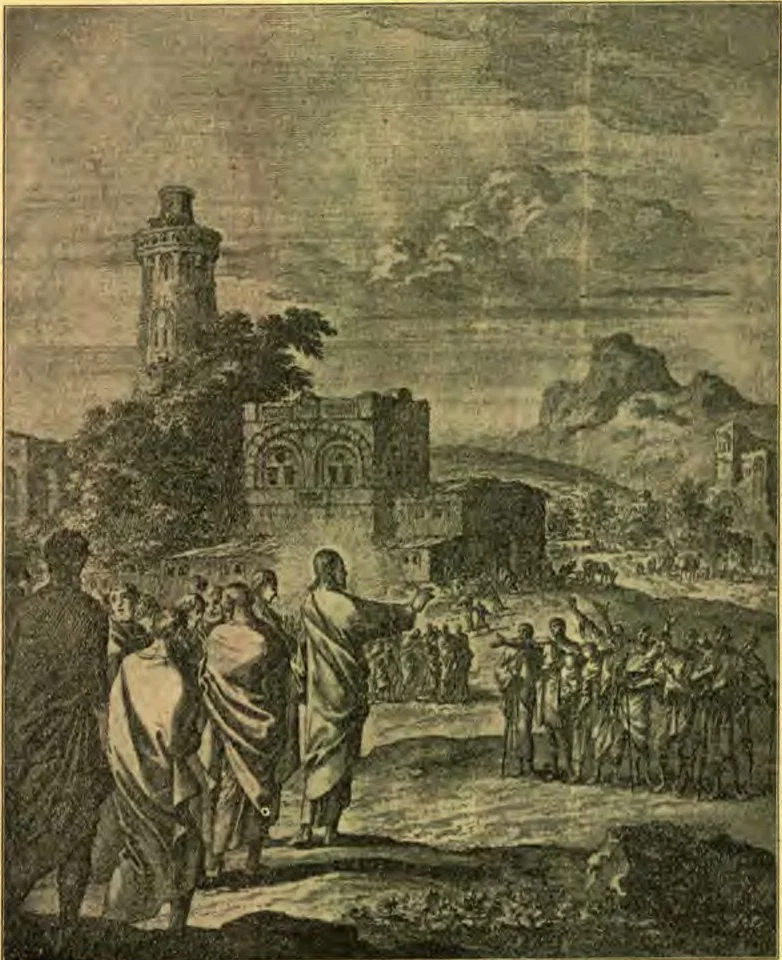
This was a terrible return for the servant’s exhibition of covetousness. But while the Lord does not want men to accept, for their own benefit, the thank-offerings of those who have had special blessings from heaven, he does desire that all shall acknowledge heavenly benefits received by them. When Jesus was here in the flesh, he healed lepers as freely as those afflicted with other forms of disease. One notable case is that shown in the accompanying picture.
In a certain out-of-the-way village the Saviour came suddenly upon ten of these unfortunates, in one company. Standing afar off in beseeching attitude, they cried out, as with one voice: “Jesus, Master, have mercy on us.” The Saviour’s great heart was touched at the sight, yet he could not well lay his hands on them then and there, because of certain circumstances. But that which he could do without detriment or hindrance to his work, he immediately did. His response to the united, earnest appeal of these unhappy men was: “Go show yourselves unto the priests.”
They quickly started, but soon realized that the secret power of the Lord had freed them from their bondage of loathsome disease. They were doubtless all glad beyond measure for the change, and were anxious to make known to dear friends their cleansed condition. So all but one of them kept moving onward, probably in the direction of home and family. This one, however, returned, loudly praising God all the way, and upon meeting the Saviour, fell down before him in thankfulness, thus acknowledging his obligation to be the Lord’s servant.
The strange part of this incident was that all those who failed to return and acknowledge the Lord’s hand in their restoration, were those who formerly professed the worship of Jehovah, while the only one who did go back to thank the Lord for his mercy bestowed was, before that event, a stranger to God, being a partial heathen. There is danger, even to-day, of this figure being acted over in our own lives, unless we constantly cultivate thanksgiving for daily blessings.
J. O. COLLISS.

“GOD WILL PROVIDE HIMSELF A LAMB”

The pathos of Abraham’s great trial of faith makes a nearer approach to that of Heaven’s great sacrifice for a lost world than any other circumstance in earthly history. Every feature of the narrative is deeply laden with spiritual meaning, and lies close to the experience of every one who comes into the family of faith.
Abraham was now an old man. Long he had waited for the child of promise, in whom the great purposes of God concerning himself were centered. At last Isaac was born, and his growth had been watched with eager joy.
Abraham now saw a clear way to the fulfillment of the promises. He could see the Christ, “the seed,” and through him the family of the blessed without number, and he was content. He could now rest the remainder of his days in assurance and peace. How like a thunderclap from a clear sky came the awful command of God, “Take now thy son, thine only son Isaac, whom thou lovest, . . . and offer him . . . for a burnt-offering.” But the grand old hero, “staggered not at the promise of God through unbelief; but was strong in faith, giving glory to God.” He did not reveal the fearful mission to any one; but on the morning following the order, he started out by faith.
As he and his boy walked up the mountain-side, the lad exclaimed, very naturally, “My father, . . . behold the fire and the wood: but where is the lamb for a burnt-offering?” And Abraham said, “My son, God will provide himself a lamb for a burnt-offering.” And “so they went both of them together.”
Very soon it flashed upon Isaac’s consciousness that he was to be the lamb. God called for the sacrifice of himself. We can almost hear the father tremblingly unfolding the plan to his son, and encouraging him to have faith in God, and be willing to follow his word, even to an awful death. With a faith akin to that which Jesus exercised in his Father, Isaac yielded himself fully into the hands of God. He was bound and laid upon the altar. The knife was uplifted, but,— Hold! It is enough! Then appeared the sacrifice which God had prepared.
God calls upon us all to place all we have, even father, mother, son, or daughter, in his hands, fully and implicitly. Not that he means to deprive us of them, but he would have us feel that they are his own; and that no object should come between us and himself. Many youth to-day march willingly up to the place of sacrifice. “Here are the fire and the wood,” they say; “but where is the sacrifice?” Some one else must furnish the lamb. They will give strength, talents, education, and all those things; but “where is the lamb?” O, God has provided the lamb: “My son, give me thine heart.” “Whosoever will save his life shall lose it: and whosoever shall lose his life for my sake shall find it.”
“JESUS, MASTER, HAVE MERCY ON US”
It must have been a dreadful moment to Isaac when he made the supreme sacrifice. But it was no sooner made than the substitute appeared. So with us. When we pass the critical moment, and accept the crucial test, we shall see standing there, with pierced hands and side, Jesus, the loving Saviour, our substitute upon the consuming altar.
How glad Abraham and Isaac must have been the rest of their days that they had withheld nothing from the Lord. The best thing that any youth can do is to give himself wholly to God. All our acquirements are like the wood and fire which Isaac carried: they do not make an acceptable sacrifice without the lamb. And before God will substitute his Son for us, we must give ourselves to him.
G. C. TENNEY.

WHAT TO DO WITH DOUBT

Read “Steps to Christ,” Pages 133-145
  • (September 15-21)*
The language of doubt. John 20:25; Ps. 14:1.
Doubt results in—
  1. Destruction to the individual. Matt. 14:29-31; 2 Peter 3:16.
  2. Failure in God's work. Matt. 17:19-21.
A divine warning against doubt. Heb. 3:12.
The language of faith. 1 John 5:14, 15; 2 Tim. 1:12; Mark 9:24, last part.
God has given faith to all. Rom. 12:3; Acts 17:31, margin.
Effect of faith. Rom. 15:13; Acts 15:9.
Faith of the Christian grows. 2 Thess. 1:3.
Results in salvation. 1 Peter 1:9.

SUGGESTIONS

1. Doubt casts its black shadow over the spiritual life of many a young Christian; and it may some day be your privilege to speak the words that shall lead such a one out into the bright sunlight of an “unfeigned faith.” As you study this subject, therefore, note especially those thoughts that are helpful to you, finding answers, also, to such expressions as the following:—
“How can I really know the right way?”
“I can believe nothing without evidence.”
“There are so many things that I can not explain nor understand.”
“There are discrepancies in the Scriptures.”
“Anything can be proved from the Bible.”
2. Notice also what is said about—
The mysteries of the natural world.
The result if men could fully comprehend God and his works.
The exercise of the reasoning faculties.
The reading of the Bible.
The real cause of doubt.
The evidence offered to all.

DAILY PRAYER

As sure as comes my daily need, And comes my daily care, My humbled, willing soul must feed In daily prayer.
It brings me light when all is dark, When fierce temptations lie Beneath the clouds, when not a spark Is in the sky.
When conflicts rage with thrusting sword, In battles terrible, I kneel before my listening Lord, And him I tell.
A Friend, a Helper, in my need— ’Tis that he is to me; Daily upon his love I feed; My Fortress, he.
Sure as the sun its glory spreads When birds in carols call, At daily prayer his love he sheds, Illuming all.
B. F. M. Sours.

WHAT CAN OUR YOUNG PEOPLE DO?

THEY can heed the following most tender and earnest appeal, taken from “Testimonies for the Church,” Vol. I, pages 511–513:—
“I saw that Satan is a vigilant foe, intent upon his purpose of leading the youth to a course of action entirely contrary to that which God would approve. He well knows that there is no other class that can do as much good as young men and young women who are consecrated to God. The youth, if right, could sway a mighty influence. Preachers, or laymen advanced in years, can not have one half the influence upon the young that the youth, devoted to God, can have upon their associates. They ought to feel that a responsibility rests upon them to do all they can to save their fellow mortals, even at a sacrifice of their pleasure and natural desires.
“The young should inquire, ‘Lord, what wilt thou have me to do? How can I honor and glorify thy name upon the earth?’ Souls are perishing all around us, and yet what burden do the youth bear to win souls to Christ? Those who attend school could have an influence for the Saviour; but who name the name of Christ? and who are seen pleading with tender earnestness with their companions to forsake the ways of sin, and choose the path of holiness?
“I was shown that this is the course which the believing young should take, but they do not; it is more congenial to their feelings to unite with the sinner in sport and pleasure. The young have a wide sphere of usefulness, but they see it not. O, that they would exert their powers of mind in seeking ways to approach perishing sinners, that they might make known to them the path of holiness, and by prayer and entreaty win even one soul to Christ! What a noble enterprise! One soul to praise God through eternity! One soul to enjoy happiness and everlasting life! One gem in their crown to shine as a star forever and ever! But even more than one can be brought to turn from error to truth, from sin to holiness. Says the Lord by the prophet, ‘And they that turn many to righteousness shall shine as the stars forever and ever.’ Then those who engage with Christ and angels in the work of saving perishing souls, are richly rewarded in the kingdom of heaven.
“I saw that many souls might be saved if the young were where they ought to be, devoted to God and to the truth; but they generally occupy a position where constant labor must be bestowed upon them, or they will become of the world themselves. They are a source of constant anxiety and heartache. Tears flow on their account, and agonizing prayers are wrung from the hearts of parents in their behalf. Yet they move on, reckless of the pain which their course of action causes. They plant thorns in the breasts of those who would die to save them, and have them become what God designed they should. . .
“Young men and young women, I saw that God has a work for you to do; take up your cross and follow Christ, or you are unworthy of him. While you remain in listless indifference, how can you tell what is the will of God concerning you? and how do you expect to be saved, unless as faithful servants you do your Lord’s will? Those who possess eternal life will have done well. The King of glory will exalt them to his right hand, while he says to them, ‘Well done, good and faithful servants.’ How can you tell how many souls you might save from ruin, if instead of studying your own pleasure, you were seeking what work you could do in the vineyard of your Master? How many souls have these gatherings for conversation and the practice of music been the means of saving? If you can not point to one soul thus saved, turn, oh! turn to a new course of action. Begin to pray for souls; come near to Christ, close to his bleeding side. Let a meek and quiet spirit adorn your lives, and let your earnest, broken, humble petitions ascend to him for wisdom that you may have success in saving not only your own soul, but the souls of others. Pray more than you sing. Do you not stand in greater need of prayer than of singing? Young men and women, God calls upon you to work, work for him. Make an entire change in your course of action. You can do a work that those who minister in word and doctrine can not do. You can reach a class whom the minister can not affect.”

Young People's Work Organized in Denver Church

FROM DENVER, COLORADO

THE young people’s work in Denver, Colo., has been divided into departments, in what seems to be a very desirable way. The Mercy and Help Department engages in a very practical form of Christian work, as its name indicates. Another much-needed line of work in a city church has been assigned to a Reception Committee; namely, the reception of strangers or visitors at the church services or at the young people’s meetings. The Department of Good Literature is devoted to the work of making the young people intelligent Christians, as well as saving them from the pernicious influence of bad literature. It also includes the arrangements for the Reading Circle studies and other special studies, all of which will connect in some way with the past history or present work of God in the earth. The Committee of Counsel, which has the general oversight of the whole, includes church and Sabbath-school officers and persons of experience.
We are glad to know that the work for the young people is receiving attention in this church. Doubtless the arrangements here spoken of will be suggestive to other churches similarly situated.

CHRISTIAN AXIOMS

1. THE best commentary on the Bible is the Bible itself.
2. The best teacher in things spiritual is the Holy Spirit.
3. Unless a man believes the Bible to be the word of God, containing the truth and nothing but the truth, he can not understand it in its parts. Unless he believes that Jesus Christ not only has come, but also will yet come again, he can not understand the Bible as a whole.
4. Unless a man loves the Lord Jesus as a living person, he alone being his hope, a man can not walk in the full light of Christ.—Selected.

IS THERE A REASONABLE BASIS FOR FAITH?

THERE is scarcely a word in the English language that has been so warped from its true meaning as the word “faith.” Instead of being some peculiar tension or emotion of the mind, true faith is simply a recognition of things as they actually are. The individual who becomes best acquainted with God will necessarily manifest most faith in him. He will learn the consistent manner in which God deals with his children. This will preserve him from asking unreasonable things, which is presumption.
Much of the so-called faith of to-day is, in reality, nothing short of presumption; consequently, God can only ignore it.
God is the author of all the good sense there is in existence; and the highest and purest form of faith will be founded upon well-known principles, which are unfolded both in his word and in nature; for God himself invites us: “Come now, and let us reason together.” Isa. 7:18.
Although we find much that we are unable to understand, this is no proof that it is unreasonable, but is rather an evidence of the limited capacity of our reasoning ability. As our ability to understand God’s ways increases, we shall see more and more reasonableness in all that he does; but even in the fullest human development, there will undoubtedly be much that will not seem absolutely clear to our minds until they are illuminated with the light that will by and by fall from the throne of God. We may rejoice that all that has perplexed us in the providences of God will then be made plain; things hard to be understood will then find an explanation; and where our finite minds discovered only confusion and broken purposes, we shall see the most perfect and beautiful harmony. “Now we see through a glass, darkly; but then, face to face: now I know in part; but then shall I know even as also I am known.”
DAVID PAULSON, M. D.
Continue reading: LESSONS FROM THE BEES