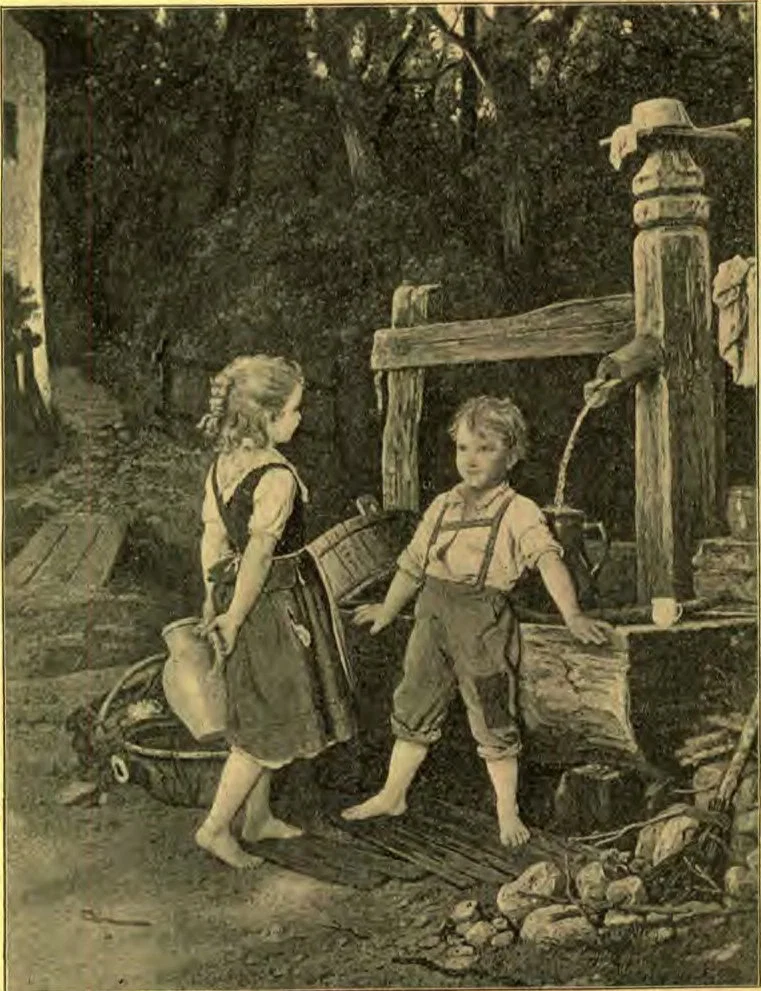
Now the bees are busy gathering honey while the sun shines, and the flowers bloom. God has spread a rich feast for them in more beautiful dishes and cups than were ever made by the hands of the most skillful workmen to adorn the king’s table.
“God might have made the earth
bring forth,
Without a flower at all.”
He might have fed the bees without the lovely colors and scents which give us so much pleasure, and which must surely add sweetness to their feast and their work. Like all the rest of God’s creatures,—
“That thou givest them, they gather;
Thou openest thine hand; they are
satisfied with good.”
God does not put the honey in their mouths or in their hives, but he teaches them where to find it, how to gather it from the flowers, and how to make the perfect little six-sided cells of the comb in which to store it for winter.
Watch the bees at work, and notice the flowers that they visit,—the sweet-scented and gay-colored ones. Suppose that in a beautiful, sweet-smelling flower, the bee should find no honey, but poison instead. Then that flower would be bearing “false witness,”—showing fair colors to lure living creatures to their destruction.
There is a plant called the “pitcher plant,” which does something very much like this. It has a long, pitcher-shaped cup, which it fills with a sweet, intoxicating fluid. This is a snare to the insects, which crowd into it, and drink until they are too dazed to escape. Then the plant closes over them, and sucks their life blood.
That plant is a false witness. Its fair form, and the attractive liquid within it, invite the insects to come in and feast and get new life; but they find death instead.
Sometimes people flatter others in the hope of gaining something from them. Sometimes they speak fair words, but mischief is in their heart. These are false witnesses, seeking their own welfare at the expense of others, instead of, like the sweet flowers, attracting others by their loveliness, so that they may feed them and do them good.
There are some insects that feed on carrion—decaying matter. These flies are attracted by the most unpleasant smells, to the place where they will find what they most like. For them some pale flowers give forth sickly odors to draw them.
But these the bee passes by. It loves purity and sweetness, and the most pleasant odors attract it to the place where these are to be found. Little children should be like the bee, attracted to those things that are pure and lovely, abstaining from all appearance of evil.
What teaches the bee where to find honey, so that it does not make a mistake and draw deadly poison instead from some plants which contain it?—It is the same thing that teaches the birds to fly south in the winter, and brings them home again in the spring; the same thing that teaches the flowers to put forth their lovely petals, that inspires their balmy odors, and fills them with honey,—the Spirit of God, which is the life and inspiration of all things that live and move. He guides the bee to the flower, just as he directs the bird in its flight over the pathless ocean.
It is the Spirit of God alone that can guide you in the right way, keep you from evil, and lead you into all truth. The Bible speaks of those who “approve the things that are more excellent,” because they are “instructed out of the law.”
The life of God is the law of the bee and the flower, and instructs each to grow and to go in the way that he would have it. And this same law will keep you also in his way, if you will let him guide you. EDITH E. ADAMS.
GARDENERS ALL
“Burdocks and stick-tights are pretty thick in your clover meadow, aren’t they, grandpa?” said Jack, as he leaned on the pasture bars, and looked over into the field where the red blossoms were nodding in the breeze.
“Yes, and I shouldn’t be at all surprised if a boy about your size helped to plant them,” replied grandpa.
“I? Why, I wouldn’t even think of doing such a thing as spoiling that lovely meadow!”
“Aha!” said grandpa. “And it’s just when people aren’t thinking, that they do a great many things they do not intend to do. But I know you can not tell how you planted such ugly weeds in my meadow, and as you are not the only one who did it, I’ll have to explain.
“You see in the farther corner of the pasture, and along the sides of the cow-path leading up the hill, there are a lot of burdocks and stick-tights growing. Well, how many times do you think you have played on that path without getting those little seeds fastened into your stockings and clothes?”
“When the seeds are ripe, I would be willing to say that you couldn’t pass them once without carrying some of them along with you. Then, on your way to the house, you often take the short cut through the meadow, and sometimes perhaps you have stopped to pull them off because they pricked you; and if you haven’t done that, the tall grass and clover have pulled them off for you, as you went through; and there have those seeds been planted, as neatly as you please, among the roots of the meadow-grass.
“Now you see how you have helped to raise that good-for-nothing crop. But Towser is just as good, or as bad, a planter as you, and his shaggy hair has carried many a seed to be brushed off in my clover meadow.
“The cows, too, get their sides, legs, and tails caught by the little hands and fingers of those naughty seeds that are not content to stay at home; and when milking time comes, and Bess, Blossom, and Betty come down to the bars, and give a rub against the rails to brush off the biting flies, down fall the seeds through the fence, and in the springtime up comes a border of burdocks and stick-tights on the meadow side as well as on the pasture side of the fence.”
“How strange, grandpa! I never thought seeds were such travelers before. How came the thistles here?”
“They flew,” said grandpa. “I have often heard you say you liked to see the thistles sailing in the air, but you did not know that each one was carrying a little brown seed to drop into somebody’s field, perhaps. The dandelions carry their seeds in the same way, and so do the milk-weeds and a few other weeds.
“There are some weeds whose seed-pods pop when ripe, and scatter the seeds over a wide space; then birds carry many seeds, and let them fall while eating; and heavy winds blow pretty large ones sometimes a long way. You see there are many gardeners at work that we do not always stop to think about.”
“Well,” said Jack, “I’m glad that you told me about them, for I did not know there were so286many planters in the world. I can not keep the winds or the birds from bringing you those bad seeds, but I will not go through the meadow again with stick-tights or burdocks on my clothes; and in the morning, if you will let me take the corn-knife, I will cut down the big weeds that the cows and Towser and I didn’t mean to plant.” — Selected.
COUNTRY JOYS
By Elizabeth Rosser
What do the country children do
From New-years till December?
What tasks have they the whole year through?
What pleasures to remember?
They visit early maple woods
With pails of sap o’erflowing;
They gather pussy-willow boughs;
They see the green things growing.
The squirrels are their acrobats;
The bees and ants their teachers;
Their playmates, birds and butterflies
And gentle farmyard creatures.
The fields of clover blush and bloom,
While days grow hot and hotter;
The children to the mowers bring
Jugs brimming o’er with water.
They search the haymows’ fragrant depths,
With little city cousins,
And, finding slyly hidden nests,
They gather eggs by dozens.
The berries and the grapes are theirs;
The apple-boughs low-bending;
The yellow pumpkins in the corn,
To crown the rich year’s ending.
Who would not be a country lad
Or lass, for simple pleasure,
And gather up the country joys,
A lifelong store of treasure?
ELIZABETH ROSSER.
THE WEIRD OF THE MORROW
By Margaret E. Sangster
You'll be sorry to-morrow, sorry
For the harsh words said to-day.
You will wish you had waited a little,
Till the ill mood passed away.
You will grieve for the friend you wounded,
But you'll grieve till your heart is sore
For the strife and sin that entered in
When anger set wide the door.
You'll be sorry to-morrow, sorry
That an old face quivered and broke,
As if a blow had struck it,
At the hasty words you spoke.
You'll be low in your mind to-morrow,
That a little child with dread
At the glance of your eye went hurrying by,
With downcast, drooping head.
You'll be sorry to-morrow, sorry
That you played the cowardly part,
That you hid in a mask of silence
And the hypocrite's hateful art;
For silence is sometimes shameful,
And born of the mean degree,
And it creeps away at the end of the day,
To lurk where the mean things be.
Sorry to-morrow? Truly
'Twere better to be content,
And have no guilt to atone for,
No willful sins to repent.
The word, the look, the action,
By the help of God may wear
That light of heaven, forever given
In the hush of the answered prayer.
— Margaret E. Sangster.
CONQUERING TEMPTATION
By Ellen G. White
“Let the peace of God rule in your hearts, . . . and be ye thankful. Let the word of Christ dwell in you richly in all wisdom; teaching and admonishing one another in psalms and hymns and spiritual songs, singing with grace in your hearts to the Lord.”
This was Christ’s practice. He was often assailed by temptation, but in place of yielding or being provoked, he sang God’s praises. With spiritual songs he stopped the fluent speech of those whom Satan was using to create strife. He sang with fervency and melody.
When those who love God are tempted, let them sing the praises of their Creator rather than speak words of accusing or faultfinding. The Lord will bless those who thus try to make peace. Trust in God. Be careful not to give the enemy any advantage by your unguarded words. Keep looking to Jesus. He is your strength. By steadfastly beholding him, you will be changed into the same likeness.
When the enemy tempts you to become discouraged, remember that Christ has said, “Let him take hold of my strength, that he may make peace with me; and he shall make peace with me.” Draw nigh to God, and he will draw nigh to you. Then when the enemy comes in like a flood, the Spirit of the Lord will lift up for you a standard against him. Your part is to take hold of the strength that is as firm as the throne of God. Believe in God. Although you have trials, lose not your faith. Remember that Christ was tempted in all points like as you are. Remember that nothing in this world is so dear to God as his church. The Lord knows and loves those who are his.
“Stand therefore, having your loins girt about with truth, and having on the breastplate of righteousness; and your feet shod with the preparation of the gospel of peace; above all, taking the shield of faith, wherewith ye shall be able to quench all the fiery darts of the wicked. And take the helmet of salvation, and the sword of the Spirit, which is the word of God.”
We must put on every piece of the armor, and then stand firm. The Lord has honored us by choosing us as his soldiers. Let us fight bravely for him, maintaining the right in every transaction. Rectitude in all things is essential to the welfare of the soul. As you strive for the victory over your own inclinations, he will help you by his Holy Spirit to be circumspect in every action, that you may give no occasion for the enemy to speak evil of the truth. Put on as your breastplate that divinely protected righteousness which it is the privilege of all to wear. This will protect your spiritual life.
Be so considerate, so tender, so compassionate, that the atmosphere surrounding you will be fragrant with heaven’s blessing. Do not discourage yourself and others by talking of defects of character. Talk of the light of which heaven is full. Look away from the imperfections of others to the perfection of Christ. Praise wherever you can. Love God and those around you. Forget yourself.
Improve is the word I have for all. Use to a purpose the capabilities God has given you. Let the love of Christ lead you to strive for victory. You can, if you will do his will, reach the ideal which he has set before you. Let joy and love and the grace of Christ perfect your character. Let a willingness to obey make your path bright. Believe, and receive to impart. Without a murmur or complaint lift the cross. In the act of lifting it, you will find that it lifts you. You will find it alive with mercy, compassion, and pitying love. MRS. E. G. WHITE.
A MOTHER OF EIGHT HUNDRED CHILDREN
By M. H. Melik Vartan
THE children and teachers of Haskell Home were delighted to listen to Mrs. Steele, who has a large home for colored orphans in the South, one Sabbath not long ago.
Mrs. Steele looks very active in spite of her gray hair, and is a pleasant speaker. She does not stop to think what she shall say,—the words flow easily from her lips. She told the children that she is mother to a larger family than they have ever seen, as she has over eight hundred orphans to take care of.
Some of them are so sweet and affectionate that any one would love them; but others are restless, naughty, and disobedient, so that she has to go to the Lord many times a day, in order to learn from him how to love them. One boy especially was very bad. He would steal clothes, sell them, and then ride in the cars for miles. He was arrested once, and put in jail for thirty days; but Mrs. Steele took him again into her home. Before she took him in, her assistant asked, “Are you going to take him back again?”
“Yes,” she replied.
“Are you really?”
“Yes, I am.”
“I think it is a shame,” said the assistant, “to have that boy here; he is like a specked apple,—he will spoil all the others. He ought to be in chains.”
But Mrs. Steele, full of a mother’s love, took him in, hoping he would be bound by the golden chains of love to his home. She gave him a five-dollar bill, telling him to use it in case he should run off again, and find himself in need. It was not very long before he did run off, this time going to Chicago. There he washed dishes in a hotel; and the first thing he did was to send Mrs. Steele her five dollars with two dollars besides, telling her he would come home soon.
Within two weeks Mrs. Steele received a note from a jailer in Chicago, saying that her boy was in jail, and that she could have him released by paying forty dollars. She paid the fine, and again brought him home. But as he was so in the habit of running away, Mrs. Steele asked him to let her know the next time he intended to leave. One day he came in, saying that he was going.
“Where are you going?” asked Mrs. Steele.
“Oh, I am just going off,” he said.
“Why are you going off?”
“Oh, I have a traveling mind.”
Then she took a sash from the wall, and tied one end of it to his arm, and the other end to her own, telling him that she was going with him. And taking her sunshade and hat, she said, “I am ready.”
“I don’t want to go with you,” he said.
“Well, if you are going, I am going.”
“If you are going, I am not going,” he answered; and that was the last of his “traveling mind.” Never again did he run away. Before he was twenty-four years old, he was a noble Christian, and a great help to Mrs. Steele.
M. H. MELIK VARTAN.
HEALING OF PETER'S WIFE'S MOTHER
By W. S. Sadler
INTRODUCTORY
Preceding Events.—This miracle was performed during the afternoon immediately following the healing of the demoniac in the synagogue.
The Bible Story of the Miracle.—“And he rose up out of the synagogue; and forthwith, when they were come out of the synagogue, they entered into the house of Simon and Andrew, with James and John. Now Simon’s wife’s mother was holden with a great fever, and lay sick, and straightway they tell him of her, and besought him for her, and he came and stood over her, and took her by the hand, and raised her up; and rebuked the fever; and the fever left her; and immediately she rose up and ministered unto them.” (The foregoing is an interwoven story of the miracle, gathered from Mark 1: 29-31, Luke 4: 38, 39, and Matt. 8: 14, 15, but told in the exact language of the Bible.)
Place.—Capernaum.
Circumstances.—This miracle was performed on Sabbath afternoon, sometime between the synagogue service during which Jesus cast the unclean spirit out of the demoniac, and the remarkable sunset scene mentioned in Mark 1: 32. From the narrative we would rather suppose that Jesus went directly from the synagogue to the house of Simon and Andrew. James and John were with him, and on the way they undoubtedly told Jesus of the sick one at home. Upon coming to the house, without request and without word, Jesus took the hand of the fever-stricken patient, and instantly restored her to health.
Great Lesson.—The one great lesson to be learned from this remarkable miracle is that Christ is our harvest-sharer. He has taken our sicknesses upon himself; he has borne all our griefs and afflictions; he is the great healer of mind, soul, and body. Matt. 8: 17. Every time a fever patient recovers, it is due to the fact that Jesus has worked a miracle. It requires the same power to raise up a fever patient in six weeks that it does to raise one up instantly. The element of time in no sense lessens the miracle. Peter’s287mother-in-law, in her remarkable healing, passed through a great experience; but the ordinary process of recovery from fever may enable the patient to become familiar with great truths concerning diet, the use of water, and the care of the body in general, and so be to him a truly great experience.
STUDY OF THE MIRACLE
Entered into the House of Simon and Andrew.—Peter lived at Bethsaida. He was probably temporarily in Capernaum, owing to the fact that that city had become the headquarters of Christ. In this Peter gives us an example of arranging his residence with a view to enjoying religious privileges and accomplishing the greatest amount of good. Peter’s residence was probably a humble cottage; for he was a poor man in this world’s goods. Probably Andrew lived with him. Jesus graced this humble dwelling with his presence; and as the result of what he did while an honored guest in this household, the whole city was stirred. Ere the sun went down on this Sabbath day, multitudes had gathered about its doors, seeking for healing of soul and body; for it had gone forth that afternoon throughout the city that the Great Healer tarried at the home of Peter the fisherman. Dear reader, what a blessing if the Master could work with such power in your home that throughout the whole neighborhood, village, or city, your house might be known as a place where God had wrought, and there might be gathered around the hearthstone scores of earnest souls seeking light and truth, and deliverance from physical and spiritual bondage. By a faithful practice and study of health principles, your home might become extensively known as a center for obtaining healing truth for soul and body. Perhaps Peter’s house was near the seashore; the land may have been low, and it may have been due to the breathing of the poisonous miasma there found that Peter’s wife’s mother was suffering with a fever. There is at least a spiritual lesson in this thought. We should seek to dwell on the moral uplands, to take up our residence as far as possible from the lowlands of sin, that the health of the soul be not imperiled by its miasma.
W. S. Sadler.
(Concluded next week.)
THE COMING OF CHRIST—ITS RESULTS TO THE RIGHTEOUS AND THE WICKED
3. What will occur immediately after this wonderful shaking of the heavens? Matt. 24: 30; note 2.
4. What promise concerning his appearing has the Lord given to those who love his truth? Isa. 66: 5.
5. What will the righteous say as they see Jesus coming? Isa. 25: 9.
6. In their shame and confusion, what will the wicked exclaim? Rev. 6: 15–17.
7. For what purpose did Jesus say he would come again? John 14: 3.
8. In what way will he fulfill this promise at his appearing? 1 Thess. 4: 16, 17.
9. To what place are the people of God taken? Rev. 20: 4; note 3.
10. As Jesus invites them into the New Jerusalem, what blessed words will come from his lips? Matt. 25: 34.
11. While the righteous are thus blessed, what will come to the wicked at Jesus’ appearing? Isa. 11: 4, last part; 2 Thess. 1: 7–10.
12. What will the Lord do to Satan at this time? Rev. 20: 1–3; note 4.
13. In what condition will the earth be while Satan is confined here? Jer. 4: 23–27.
NOTES
1. When the voice of God, like the sound of many waters, proclaims, “It is done,” there is a mighty shaking of the heavens and the earth. He has told us of this in his word. He says, “Yet once more I shake not the earth only, but also heaven.” Heb. 12: 25, 26. The great earthquake which takes place opens the graves of many who sleep in Jesus, and also many of the wicked. This will fulfill the words of Dan. 12: 2. All those who have kept the Sabbath since 1844 will come up out of their graves at this time, to hear God speak the words of blessing upon his waiting ones. There will also be raised some of the very wicked; for, when Jesus actually appears, not only the wicked living upon the earth, but they also which pierced him, will see him come. Rev. 1: 7.
2. “Soon there appears in the east a small black cloud, about half the size of a man’s hand. It is the cloud which surrounds the Saviour, and which seems in the distance to be shrouded in darkness. The people of God know this to be the sign of the Son of man. In solemn silence they gaze upon it as it draws nearer the earth, becoming lighter and more glorious, until it is a great white cloud, its base a glory like consuming fire, and above it the rainbow of the covenant. Jesus rides forth as a mighty conqueror.”—“Great Controversy,” pages 640, 641.
3. The people of God live and reign with Christ a thousand years. Their home during this time is in heaven, in the New Jerusalem. At the close of the one thousand years they will be brought to earth, where they will dwell in peace forever.
4. Satan and his angels will be bound for a thousand years in the “bottomless pit.” The expression “bottomless pit” refers to the earth as it will be when broken down by the wrath of God. Here Satan and his evil angels will be confined. They will not be permitted to go to other worlds, to tempt and annoy those who have been true to God, and on the earth there are none left alive. They have none but themselves to trouble. In this way they are bound till the thousand years are ended. This binding of Satan is the antitype, or real experience, of leading the scapegoat away into the wilderness. Satan, while bound, will bear the sins of all God’s people; for they will be placed upon him when Jesus leaves the sanctuary; and he will bear them until he is miserably destroyed in the lake of fire.
OUT IN THE FIELDS
THE little cares that fretted me,
I lost them yesterday.
Among the fields above the sea,
Among the winds at play,
Among the lowing of the herds,
The rustling of the trees,
Among the singing of the birds,
The humming of the bees.
The foolish fears of what might pass,—
I cast them all away
Among the clover-scented grass,
Among the new-mown hay,
Among the hushing of the corn,
Where drowsy poppies nod,
Where ill thoughts die, and good are born—.
Out in the fields with God!
— Selected.
Devotion Must Lead to Active Service
By Miller
DEVOTION is not all. Peter wished to stay on the mount of transfiguration, to go back no more to the cold, sin-stricken world below: but no; down at the mountain’s base, human suffering and sorrow were waiting for the coming of the Healer, and the Master and his disciples must leave the rapture of heavenly communion, and hasten down to carry healing and comfort. It is always so. While we enjoy the blessedness of fellowship with God in the closet, there come in at our closed doors, and break upon our ears, the cries of human need and sorrow outside. The truest religious life is one whose devotion gives food and strength for service. The way to spiritual health lies in the paths of consecrated activity.—Miller.
THE LAST SIGN
That Jesus gave in the long line of prophecies in Matthew 24, by which we are to know that the end is near, “even at the door,” is the sign of the falling stars, fulfilled Nov. 13, 1833.
A beautiful art luxotype picture, 22 x 29 inches, has been made, representing this last sign, as seen at Niagara Falls, where history states the display was grand beyond all description. The most wonderful thing that the Lord placed on earth is here united with the most marvelous thing he ever put in the heavens, and it is done so artistically that the world must stop and look, if the picture is hung up in our homes and in the waiting-rooms all over the land; and, looking, they will become as familiar with the last sign of Christ’s coming as they are with the sight of the great Falls of Niagara.
To show conclusively the place of this sign in the chain of fulfilled prophecies of Matthew 24, a sixteen-page booklet is also being prepared, containing over thirty half-tone engravings, and on the face of each the very words of our Saviour predicting what the picture shows fulfilled. This booklet, in a rack beside the picture, in the public waiting-rooms of the world, and in our homes, will convince thousands of the truth for this time on this point.
The price was advertised in the REVIEW at sixty-five cents, postpaid, in strong mailing-tube, with ten copies of the illustrated booklet; but the orders are coming in so that the price has been dropped to only thirty-nine cents, including the ten booklets. This is done in order to encourage the widest possible circulation. Those who have sent sixty-five cents will receive a second picture, mailed free.
Address the designer and publisher, F. E. Belden, Battle Creek, Mich.
The Test of Our Religious Life
“The test of our religious life is not our highest hours, but our every-day minutes.”
A Baby’s First Wardrobe
By Mrs. F. M. Kellogg
Is the most trying proposition a young mother can meet. Often everything she makes is wrong. For 30 cents in stamps you can get twenty-two guaranteed patterns drawn on anatomical and hygienic lines, with full instructions for making. Also an illustrated booklet on care of the body—free. All in plain envelope. Everything essential to know. For information on garments for other ages, send stamp.
MRS. F. M. KELLOGG,
207 Hubbard St., - - Battle Creek, Mich.
GRAND TRUNK R'y. SYSTEM.
By W. C. Cunliffe
Taking Effect June 2, 1901.
Trains leave Battle Creek.
WEST-BOUND.
No. 9, Mail and Express, to Chicago — 12.15 P. M.
No. 7, Limited Express, to Chicago — 7.00 A. M.
No. 1, Chicago Express, to Chicago — 9.23 A. M.
No. 3, Lehigh Valley Express, to Chicago — 3.50 P. M.
No. 5, International Express — 2.17 A. M.
No. 75, Mixed, to South Bend — 7.30 A. M.
Nos. 9 and 75, daily, except Sunday.
Nos. 1, 3, 5, and 7, daily.
EAST-BOUND.
No. 10, Mail and Express, East and Detroit — 3.45 P. M.
No. 8, Limited Express, East and Detroit — 4.50 P. M.
No. 4, Lehigh Express, East and Canada — 8.22 P. M.
No. 6, Atlantic Express, East and Detroit — 9.10 A. M.
No. 2, Express, East and Detroit — 7.00 A. M.
No. 74, Mixed (starts from Nichols yard) — 7.15 A. M.
Nos. 10 and 74, daily, except Sunday.
Nos. 4, 6, 8, and 2, daily.