The Youth’s Instructor, Vol. 36, No. 13.

ASHAMED OF FATHER

The Youth’s Instructor

Mar 28, 1888

S. D. A. Publishing Association · Battle Creek, Mich. · Mar 28, 1888

ASHAMED OF FATHER.

WITH a weary face and tired manner, an old man entered a store on Broadway, and looking around in a wistful way, said to the first person he met: “I’ve stopped for my little girl. I thought she wouldn’t want to walk home alone, and it’s about time to close, a’n’t it?”
“Yes, it’s time to close,” replied the floor-walker, “but who is your little girl, and where is she?”
“My little girl is Sally—Sally Denham, and she’s here somewhere; can’t you please tell me where? I’m a little near-sighted, or I could find her easy enough.”
“There’s no such girl in our employ,” said the floor-walker, decidedly; “you must be laboring under a mistake, sir.”
“This is Rathbone’s, a’n’t it?” the old man asked.
“Certainly.”
“Then she’s here.”
“I am quite sure, as I told you before, sir, that there’s no girl by that name in our employ.”
“Is there another store kept by a man named Rathbone?” he asked, wearily.
“Yes, I believe there is,” without much interest, “three blocks further down, I think.”
The old man went out, and a young girl, who had heard the conversation between him and the floor-walker, breathed a sigh of relief. She was a new clerk, and her name had been registered with other new ones, but not as Sally Denham (although it was Sally); it read Maude Elliott. No one in the store knew her, she reasoned, so why should she not call herself Maude, if she wanted to, instead of that plebeian Sally? And to think her father should come after her! Her face flushed hotly as she wondered what those proud girl clerks all around her would say if they should find out that the shabbily-dressed old man was her father. The girls were starting for their homes; she put on her cap and jacket and went out.
“I will give father a piece of my mind,” she said to herself, undutifully. “I shall ask him never to stop for me again. I’m quite old enough to go home alone, I think.”
She took a roundabout way home. It was a pleasure to walk along the street now, for she was dressed in a very neat and becoming suit, the hard-earned gift of the dear, loving old father of whom she was ashamed.
But what was the matter at home?
She was startled as she reached her door, and heard the commotion within.
“Your father’s killed, Sally,” was the abrupt explanation of a small boy outside; “he was a looking of you up, an’ couldn’t find you.”
The frightened girl darted past him into the house, where she found her mother nearly wild with grief.
“Mother,” she sobbed, “it isn’t true, is it, that father is dead?”
“Yes, he was killed—was knocked over by runaway horses while looking for you. He died just after reaching home. His last words were: ‘Tell my little Sally father tried to find her;’ tell her to find her Father in heaven. He’ll watch over her, even unto the end.’ Where were you, Sally?”
But Sally did not answer; she simply could not.
She was down on her knees beside her father’s dead body, sobbing out her agony of grief and remorse.
“It’s my fault, all mine,” her tortured soul moaned. “He wouldn’t be lying here cold and still if I hadn’t been ashamed of him.”
A year has passed since then, and Sally Denham is still a clerk at Rathbone’s. But there has never been an evening since her father’s sad death that, as the time for closing the store arrived, she has not heard a voice say: “I’ve stopped for my little girl. I thought she wouldn’t want to walk home alone.”—Good Words.

The Story of Pitcairn Island: Removal to Norfolk Island

THE STORY OF PITCAIRN ISLAND.—NO. 11.

Norfolk Island lies to the west of Pitcairn about 3,000 miles. This was a long distance for many of the Pitcairn people to think of removing, especially as the conclusion forced itself upon them that they would probably never again see the island of their birth. One who spoke echoed the feelings of many others, when he said he preferred to remain where he was, that when his end should come, he might “die on his native isle, and be buried in the grave of his father.”
It was a trying reason to most of them. But their own little spot was becoming much too small for the rapidly increasing population. Something must be done.
Accordingly they accepted the offer of the English Government, whose subjects they were, to transport them free to their new home in the West; yet they expressed a wish to be allowed to live on Norfolk Island in the same seclusion from the rest of the world, as they had formerly lived on Pitcairn. Happy people! They were satisfied to give up the world for the sake of peace in Christ, judging by their experience at Tahiti eighteen years before, and also by the influence brought to them from those who sometimes landed at their island, that it was better to dwell in solitude with the Lord than to enjoy the unhallowed associations of the world.
The ship Morayshire was sent to make the removal, and arrived at Pitcairn April 22, 1856. From that time forward until May 3 (the time of their departure), all was bustle and anxiety. Some, however, seemed depressed at the thought of leaving. But when all preparations were completed, the faint-hearted gathered courage to embark with the others; and in a few hours all had been carried safely through the breakers, and comfortably quartered on board the ship.
As the vessel weighed anchor to depart, the entire company of one hundred and ninety-four persons gathered on deck to take a last, lingering, tearful look at the spot more dear to them than any other land could ever be on earth. The evening twilight fell, and its gloom shut out from view the deserted island. Most of the voyagers gave up to melancholy and seasickness. Their hearts were sad, and their miseries great. They were truly to be pitied; but things were made just as pleasant for them as could be, and none permanently suffered.
The passage occupied thirty-one days. On coming near Norfolk Island, many expressed disappointment at its appearance. They contrasted with the picturesque abode they had so recently left, the low hillocks and shallow ravines, covered with short, brown grass, and the scarcity of trees, which now appeared before them, and longed for the rocky peaks of Pitcairn. As they came nearer, however, and took a closer view of the harbor, with its pretty buildings in the background, they were inclined to be more resigned and cheerful. On landing, they were not slow to acknowledge the Hand that had evidently regulated their destiny; and immediately assembling in a large room in the military barracks, they offered solemn thanks to God for his goodness in bringing them safely to their new home.
They were not long in accustoming themselves to their changed circumstances. Some things, indeed, looked strange to them. The size of the houses, their construction, and the great height of the rooms; the great number of cattle quietly feeding about, and the oxen yoked to the carts—all these things astonished them at first. One thing at which they seemed most delighted was their first sight of the horses. They were not long in learning their use. In almost childish joy, they took turns in wildly riding the overseer’s horse about the place, till the poor creature was nearly exhausted.
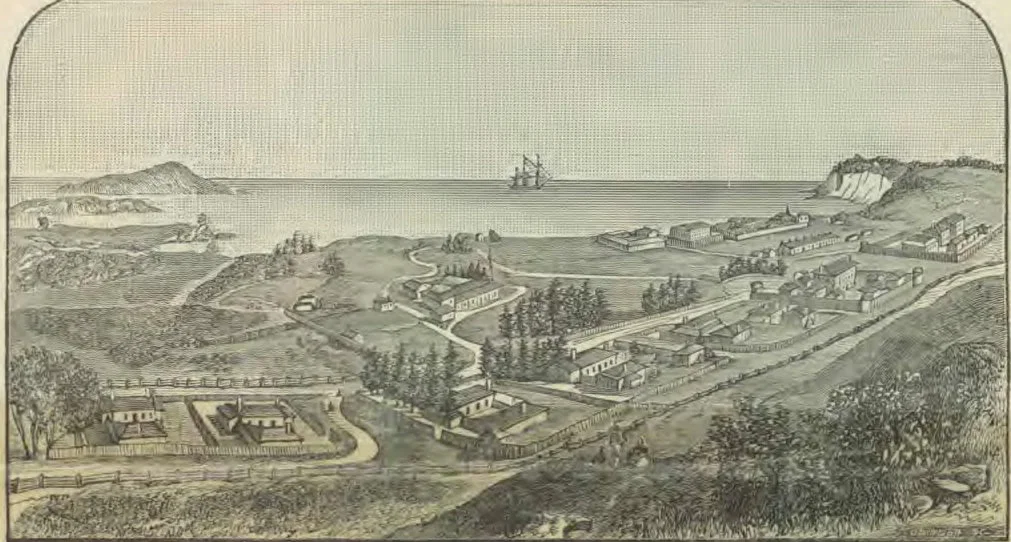
In the engraving is shown the south-east corner of the island, where the settlement is located; this is as it appeared just after the landing there of the Pitcairners. The village has only eighteen or twenty houses, besides the barracks and chapel, the last of which may be seen near the water, at the right hand of the picture. The other dwellings are scattered throughout the island.
The island had been used by the English Government as a place of banishment for some of its worst criminals. These were, however, removed to give place to the Pitcairn people. But the convicts, during their occupation of the place, had brought under cultivation eight hundred acres of land, and fenced it. Excellent roads traversed the island, and eighty-one substantial buildings had been erected, including dwellings, mills, workshops, a school-room, hospital, barracks, and a chapel capable of seating one thousand persons. Added to these, the houses were quite well fitted up with furniture, the workshops with tools, and the farms well stocked with two thousand sheep, and three hundred cattle, besides horses, pigs, and poultry.
The generous gift of all these things removed the hardships that otherwise might have attended the removal of the islanders. They also found the borders of their new home much more extensive than in their old one, Norfolk Island being about twenty miles in circumference, and having an average breadth of five or six miles. Its valleys are very fertile, producing in abundance all tropical fruits, such as cocoa-nuts, pine-apples, figs, lemons, oranges, guavas, pomegranates, Cape gooseberries, and bananas. The fruits of higher latitudes, such as grapes, peaches, strawberries, apples, quinces, etc., are also raised there. On the higher lands are grown wheat, barley, rye, corn, and the various kinds of vegetables.
Swarms of birds of most beautiful plumage flit about everywhere, and no venomous reptiles are found in the place. Many kinds of fish abound in the waters surrounding the island, as well as in the streams that intersect it. In fact, so far as the necessaries, and even luxuries, of life are concerned, no choicer spot can be found for the permanent habitation of man. But notwithstanding this, some of the Pitcairners were discontented, and longed for their old home, although Pitcairn had been stripped of all its belongings. It seems strange that this should be so, since they were in such an excellent place, and among their relatives. But so it was; and perhaps the providence of God was in it, that a portion of that people might still be isolated from the rest of the world, and he thus be enabled to work out his purpose through them. It is hard to account for their feelings in any other way.
J. O. C.

TO THE BIRDS.

SING on, thou glad birds, to the beautiful weather, Thy songs are so light and so happy and free; The breezes that float through the tree-tops together, They stop for a moment to listen to thee.
Oh, the earth's full of music, the earth's full of beauty, The earth's full of songs, and of joy, and delight; Then sing, thou glad ones, to the listening flowers, As the dew-sparkled morning dethrones the fair night.
Oh teach me thy songs, so trustful and happy, So full of the gladness thou knowest so well; I would that the music were mine, and the gladness; But no! 'tis a secret thou never canst tell.
So all I can do is to list with the flowers In silence and wonder, O birdlings so fair; And well may we wonder, thy songs are not earth-born, For thou soarest to heaven, thou learnest them there.
—Constant Hartz.

AN ANNUAL CEREMONY IN THE UNITED STATES MINT.

THE great United States Mint, in Philadelphia, makes all the dies used in the other mints as well as for its own use, and at the end of the year it destroys them all. This is the only sure way of preventing the counterfeiter from making spurious coin; and so, within a week after the close of each calendar year, every die bearing the date of the old year is collected at the Philadelphia mint, and given over to four brawny blacksmiths, who act as executioners. This includes every stamp, from double-eagles to dollars in gold; from dollars to ten-cent pieces in silver; and down to the humble nickel and still more humble cent. Each die is a little round chunk of the finest steel, about three inches long, sloping off at the top, something like a milkman's can in miniature, but without handles. On the top of it is cut the face of the coin it manufactures, with the date of the year.
In this connection, it is something to know that the die of the humble cent costs the government just as much as the die that makes the lordly twenty-dollar gold-piece.
The chief coiner at the mint receives the condemned dies, and the superintendent looks on at the execution. The smithy's fire is made roaring hot, and the gold-piece dies are flung into the flames. There they lie until the steel grows red, and then they are taken out with tongs, placed right end up on an anvil, and struck a terrific blow with a sledge-hammer. Two blows do the business, and the die is a shapeless mass of good-for-nothing metal, instead of a costly and artistic die. The silver dies then follow, and so on until all are smashed.
It is slow work, and the dies are many; but the blacksmiths are strong, and the superintendent is patient. By nightfall the last of the old dies has disappeared forever, and the dies of the new year are alone in their glory.—Exchange.

WHAT FLORENCE LEARNED WASHING DISHES.

“I’ve scrubbed and scrubbed and I can’t get this off.”
Florence did not enjoy “doing dishes,” and there were so many this morning that her patience had nearly given out.
“Try a little longer,” I replied. “There must be quite an attraction between the pan and the dough.”
“Is this cohesion, mamma?” she asked eagerly.
“What is cohesion?” I returned. “I think you learned the meaning.”
“It’s what makes two things that are just alike stay together.”
“Think a moment, Florence, and see if you cannot tell me a little more about cohesion.”
“Why, mamma, you said that a piece of iron, and everything else, was made of lots of little tiny particles, and cohesion kept them all together, so as to make one piece of the iron.”
“Then is this cohesion, dear?” I asked.
“Why, the particles of dough and tin are not just alike, and you said that attraction was not cohesion if they were not. But I should like to know what you do call this attraction,” was Florence’s perplexed reply.
“This attraction is called adhesion,” I explained.
“Well, I wish there were no such thing as adhesion. I’ve not got this dough off yet.”
“I don’t know what we would do without it,” was my answer to this impatient retort. “Do not you ever want two bodies of different kinds to adhere to each other, or stick together, as you say?”
“Yes; I put some butter on the tins a minute ago, and I should not have wanted it to come off,” Florence answered.
“And I’ve been writing,” I said, “and if there had been no adhesion between my pencil and the paper, what I’ve written could not have been read.”
Then Florence thought of her scrapbook, and said that adhesion helped her in making that.
By this time the dishes were done, and I told her that I would make some blacking adhere to the stove, and she might go and play. But before she went, she told me that adhesion is the attraction that exists between the particles of bodies of different kinds.— The Pansy.

NEW ORLEANS CEMETERIES.

There are several very large and beautiful cemeteries within the limits of the city of New Orleans. Among the finest are the Metairie, Greenwood, the French, the Odd Fellows’ Rest, and the Hebrew. A description of one of the finest will perhaps answer for the rest, and show how the city buries her dead.
About three miles west of the central part of the city is a large, level tract of land, the resting place of a quarter of a million of the dead. Upon this plot are three of the finest cemeteries of the South. They are separated by railways and public highways, and interspersed with beautiful walks, shaded by the massive live oaks of the sunny South.
The finest of these cemeteries is the Metairie. Passing around near the outer tombs is a circular driveway, paved with shells, and bordered on either side with a row of orange trees laden with golden fruit. It is a beautiful, quiet place. Scarce a sound is heard save the echo of the tomb builder’s chisel and the rich song of the mocking bird and robin, as they pour forth their sweetest notes of melody from the topmost bough of the orange or oak. In the middle of the day the visitor is occasionally roused from his revery by the crunching of carriage wheels on the driveway, but he is soon left alone again with the dead. It is said that this cemetery contains some of the most elaborately decorated and costly tombs to be found in the South.
The water lies so near the surface of the earth in New Orleans that the dead are rarely buried beneath the ground. Air-tight vaults, inclosed by solid walls of masonry or marble, form the usual receptacle for the dead. Some of the tombs are built out of the finest imported marble, highly polished, and are very costly. Some of the very finest vaults were built by such societies as the Young Men’s Benevolent Association, the Fireman’s Department, the Soldiers of the Confederacy, etc. These various associations, and the wealthy friends of the deceased, have spared no pains to make the resting place of the dead beautiful.
One vault that especially attracts the visitor’s attention was built by the Young Men’s Benevolent Association. It is a large white marble building, supported by round pillars of polished gray marble. It has four archway entrances from the cardinal points of the compass. Its floor is of the same material as the sides, and underneath is a row of sepulchers. Its sides form columns of air-tight vaults, many of which contain the remains of the dead.
Another interesting sight, especially to the Federal visitor, is the Washington Artillery Monument, marking the resting place of twenty-nine Confederate soldiers, who were either killed in battle, or died in service. The monument stands upon a circular elevation of earth, whose summit is reached by fine walks and stone steps, while a beautiful walk surrounds the base. On its top stands a marble statue of a soldier, with his musket by his side. Under the mound, in marble vaults, rest the heroes of the lost cause. They had fallen on the fields of Bull Run, Shiloh, Mission-ridge, Perryville, Seven Pines, etc. At each corner of the base is a marble cannon and ball, emblematic of carnage and death.
There are many fine and costly monuments among the family tombs. Men of wealth are apparently as anxious to make a display in building these houses for their final resting place as any in which they may live during their lifetime. Nearly all superintend the building of their own tombs. Among the finest of these family tombs is that belonging to the Howards. It is about fourteen feet square, and is built of marble. In the center of the room sits, in his old arm chair, the carved statue of a pensive old man, who is evidently trying to solve the problem of death. The sunlight falls through the many tinted panes of glass in rainbow colors on the marble floor.
Every year, on All Saint’s Day, these tombs are decorated from base to top with floral harps, crowns, and crosses, and present a most beautiful sight.
As we passed among the tombs in this beautiful resting place for the dead, we could not help calling to mind the time when the archangel’s voice and the trump of God will awaken the silent slumberers, some, perhaps, to everlasting life, and some to shame, contempt, and everlasting death; for the wages of sin is death. May God help us to avoid the contaminating influence of sinful associates, and by earnest prayer and the faithful study of God’s word, be found at last among the pure and good. “Abhor that which is evil; cleave to that which is good.”
E. Hilleary.

NO TIME.

THOSE who have the most time usually have the least. Those who have nothing to do are the longest about it, and are oftenest late and hurried at the end.
An early start and a steady pace, take the slowest through the race. The tortoise out-traveled the fox, for he kept on, while the fox slept by the roadside.
Saved pence make men rich; saved minutes make them wise. Half the time spent in dreading a job is sufficient to do it, and half the time spent in dreading a lesson will be ample to learn it, if we go about it.
Never whine, repine, nor grumble. Be up and about your business. You say you have no time; you have all the time there is. “Redeem the time, because the days are evil.”—Sel.

A STRANGE MISSIONARY.

The Emperor of China has just ordered a magic lantern for the Imperial Palace at Pekin, with scriptural scenes such as the missionaries there are exhibiting, for the instruction of his household. Miss Gordon Cumming tells us about it, and says that this, in connection with the fact “that one of the officers of the palace has recently become a zealous Christian (the first known convert within the imperial city), may possibly prove the thin edge of the wedge whereby a ray of light may even reach the little emperor himself, on whom as yet no European has been privileged even to look. Another of these very suggestive magic lanterns has been ordered by a Mongolian prince to help in whiling away the long, dark winter nights.”—S. S. Advocate.

QUESTIONS AND LESSON TEXT.

1. How old was Isaac when he was married?
And Isaac was forty years old when he took Rebekah to wife, the daughter of Bethuel the Syrian of Padan-aram, the sister to Laban the Syrian. Gen. 25:20.
2. How old was he when his two sons were born?—Three-score years. Verse 26.
3. What were their names?—Esau and Jacob.
4. What difference was there between them?
And the boys grew: and Esau was a cunning hunter, a man of the field; and Jacob was a plain man, dwelling in tents. Verse 27.
5. How did their parents regard them?
And Isaac loved Esau, because he did eat of his venison; but Rebekah loved Jacob. Verse 28.
6. What did Jacob have as Esau came in one day from a hunting trip?
And Jacob sod pottage; and Esau came from the field, and he was faint. Verse 29.
7. What did Esau say to Jacob?
And Esau said to Jacob, Feed me, I pray thee, with that same red pottage; for I am faint; therefore was his name called Edom. Verse 30.
8. What did Jacob reply?
And Jacob said, Sell me this day thy birthright. Verse 31.
9. How did Esau reason concerning his birthright?
And Esau said, Behold, I am at the point to die; and what profit shall this birthright do to me? Verse 32.
10. What transaction was thus made by the two brothers?
And Jacob said, Swear to me this day; and he sware unto him; and he sold his birthright unto Jacob. Then Jacob gave Esau bread and pottage of lentiles; and he did eat and drink, and rose up, and went his way. Thus Esau despised his birthright. Verses 33, 34.
11. What was the birthright, and what was its importance to any one?
12. How did Esau regard his birthright? Gen. 25:34, last clause.
13. How highly did he value it?—He considered it worth no more than a meal of victuals, to satisfy present necessity.
14. What language is used concerning Esau for this proceeding?
Lest there be any fornicator, or profane person, as Esau, who for one morsel of meat sold his birthright. Heb. 12:16.
15. How did he afterward feel concerning the blessings of his birthright?
For ye know how that afterward, when he would have inherited the blessing, he was rejected; for he found no place of repentance, though he sought it carefully with tears. Verse 17.
16. Relate, in brief, the circumstances. Gen. 27:1–40.
17. Was he able to get back the birthright? Heb. 12:17.
18. Why not?—Because he had deliberately sold it, and could not alter the trade.
19. What is the exhortation given to us in this connection?
Follow peace with all men, and holiness, without which no man shall see the Lord; looking diligently lest any man fail of the grace of God; lest any root of bitterness springing up trouble you, and thereby many be defiled. Lest there be any fornicator, or profane person, as Esau, who for one morsel of meat sold his birthright. For ye know how that afterward, when he would have inherited the blessing, he was rejected; for he found no place of repentance, though he sought it carefully with tears. Heb. 12:14–17.
20. If we are children of Abraham, what is our birthright?
For the promise, that he should be the heir of the world, was not to Abraham, or to his seed, through the law, but through the righteousness of faith. Rom. 4:13.
Giving thanks unto the Father which hath made us meet to be partakers of the inheritance of the saints in light. Col. 1:12.
Behold, what manner of love the Father hath bestowed upon us, that we should be called the sons of God: therefore the world knoweth us not, because it knew him not. Beloved, now are we the sons of God, and it doth not yet appear what we shall be: but we know that, when he shall appear, we shall be like him; for we shall see him as he is. 1 John 3:1, 2.
21. Through what are we made heirs of this inheritance?
Who hath delivered us from the power of darkness, and hath translated us into the kingdom of his dear Son; in whom we have redemption through his blood, even the forgiveness of sins. Col. 1:13, 14.
22. What does the Spirit through Paul say of one who despises his heavenly birthright?
He that despised Moses’ law died without mercy under two or three witnesses: Of how much sorer punishment, suppose ye, shall he be thought worthy, who hath trodden under foot the Son of God, and hath counted the blood of the covenant, wherewith he was sanctified, an unholy thing, and hath done despite unto the Spirit of grace? Heb. 10:28, 29.
23. How may we do this?
For Demas hath forsaken me, having loved this present world, and is departed unto Thessalonica; Crescens to Galatia, Titus unto Dalmatia. 2 Tim. 4:10.
24. What can you say of the condition of one who deliberately barters his interest in the blood of Christ, and his hope of eternal life, for a little present enjoyment?
Of how much sorer punishment, suppose ye, shall he be thought worthy, who hath trodden under foot the Son of God, and hath counted the blood of the covenant, wherewith he was sanctified, an unholy thing, and hath done despite unto the Spirit of grace? For we know him that hath said, Vengeance belongeth unto me, I will recompense, saith the Lord. And again, The Lord shall judge his people. It is a fearful thing to fall into the hands of the living God. Heb. 10:29–31.

OLD TESTAMENT HISTORY.

LESSON 15,—DESPISING THE BIRTHRIGHT.

PRACTICAL THEMES:— The value of an heirship to a heavenly inheritance, and the sin of parting with the same for a paltry consideration.
INTRODUCTION.—About fifteen years after the remarkable trial of faith recorded in the last lesson, Isaac took Rebekah, the daughter of Bethuel the Syrian, for wife. He continued to reside with his father Abraham, Rebekah taking, in the household, the place of Sarah, Abraham’s wife, who now was dead. Nineteen years later occurred the birth of Esau and Jacob, the account of which we find in this lesson. When these brothers were about thirty-three years old, Esau made the foolish transaction which constitutes the main theme of this lesson; viz., that of selling his birthright to his brother Jacob for a mere gratification of his appetite. Application is made of this event to the Christian who may also in a similar manner despise or reject his birthright to the heavenly inheritance. The two brothers aptly illustrate two classes of people in the world—one caring only for the pleasures and selfish gratifications of the present life, the other having regard for the future, and seeking the better part in the life to come.
In connection with this lesson, read “Great Controversy,” Vol. 1, first part of Chapter 12.

ANALYSIS.

I. Introductory.
1. Isaac’s Age— a. At his marriage. b. At birth of his two sons. 2. Isaac’s Sons. a. Names. b. Character and occupation of each. c. How regarded by the parents.
II. Esau’s Birthright.
  1. Its significance and importance.
  2. How regarded by Esau.
  3. Sold for what.
  4. Validity of the transaction.
  5. Esau’s subsequent feelings.
  6. Character attributed to him because of such transaction.
  7. Exhortation founded on Esau’s course.
III. The Christian’s Birthright.
  1. What.
  2. How obtained.
  3. Its rejection.
a. How accomplished. b. Results of. c. Consequent condition of the rejecter.

WHAT DYNAMITE IS LIKE.

Those who have never seen the much-talked-of dynamite explosive, will be interested to know that it looks very much like moist brown sugar. Nitro-glycerine, which is formed by the action of nitric acid upon glycerine, at a low temperature, is the active agent in dynamite, but is mixed with some absorbent substance to render it safer to handle than the liquid glycerine. The absorbent material thus used is a silicious earth—a fine white powder composed of the remains of infusoria, and resembling powdered chalk. This takes up two or three times its weight of the nitro-glycerine without becoming pasty, and the ingredients are easily mixed, leaden vessels and wooden spoons being used to avoid dangerous friction. When fire is applied to this mass, it burns with a strong flame, without any explosion; but when ignited by a detonating fuse, or even by a sudden blow, its explosive force is tremendous.—Golden Days.

MUSICAL SHOES.

A son of the Rev. Richard Armstrong, one of the early missionaries to the Sandwich Islands, gives this interesting picture of a Hawaiian church where his father used to preach to a congregation of twenty-five hundred people:—
“Outside was like an encampment; inside it was a sea of dusky faces. On one side was the king’s pew, with scarlet hangings. The royal family always distinguished themselves by coming in very late with the loudest of squeaking shoes. The more shoes squeaked the better was the wearer pleased, and often a man, after walking noisily in, would sit down and pass his shoes through the window for his wife to wear in, thus doubling the family glory. Non-musical shoes were hardly salable.”—Well-Spring.

PRACTICAL NOTES.

Regarding the esteem in which Isaac and Rebekah held their sons respectively, Dr. Adam Clarke says: “This is an early proof of unwarrantable parental attachment to one child in preference to another; and in consequence of this the interests of the family were divided, and the house set in opposition to itself. The fruits of this unreasonable and foolish attachment were afterwards seen in a long catalogue of both natural and moral evils among the descendants of both families.
“It is egregious folly to part with our interest in God, and Christ, and heaven, for the riches, honors, and pleasures of this world; as bad a bargain as his that sold a birthright for a dish of broth.”—Comprehensive Commentary.
“Though living embosomed in an economy of light and love, yet what numbers are there who manifest the same indifference about spiritual blessings, and the same insatiate thirst after sensual indulgence, as did Esau! . . . They do not acknowledge and bewail their sin and folly. They do not repent and pray for pardon. They do not resort to the means which God in mercy has provided for the forgiveness of offenders. Alas! what a fearfully close resemblance in all this to the mad career of their prototype! We can only earnestly beseech all such to reflect deeply on their folly and danger, and to contemplate that moment when they shall ‘be at the point to die.’ Let them think what judgment they will then form of earthly and eternal things. Will they then say contemptuously, ‘What profit will this birthright be to me?’ Will it then appear a trifling matter to have an interest in the Saviour, and a title to heaven?”—Bush’s Notes.

EXPLANATORY NOTES.

Gen. 25:28: And Isaac loved Esau . . . but Rebekah loved Jacob. “Outwardly regarded, Jacob on the whole resembled more the father,—Esau the mother. This, however, seems to be the very reason why Isaac preferred Esau, and Rebekah Jacob.”—Schaff.
Verse 29: And Jacob sod pottage. To “sod” is to boil. “Beans, lentiles, kidney beans, and garvancos are the chiefest of their pulse kind; beans, when boiled or stewed with garlic, are the principal food of persons of all distinctions; lentiles are dressed in the same manner with beans, dissolving easily into a mass, and making a pottage of a chocolate color. This, we find, was the red pottage which Esau, from thence called Edom, exchanged for his birthright.”—Shaw’s Travels.
Verse 31: Sell me this day thy birthright. The term “birthright” denotes the special privileges belonging to the first-born. Among these were, that he should have a double portion of the inheritance, and that he should succeed to whatever position was held by his father. Among the Jews the first-born was considered as especially devoted to God; and since the Jewish people were the chosen people of God, and the Jewish nation was the church of that time, it may justly be concluded that special spiritual blessings were considered as part of the birthright.
“Jacob had learned from his mother what God had taught her, that the elder should serve the younger, and his youthful reasoning led him to conclude that this promise could not be fulfilled while Esau had the privileges which were conferred on the first-born. And when Esau came in from the field, faint with hunger, Jacob improved the opportunity to turn Esau’s necessity to his own advantage, and proposed to feed him with pottage if he would renounce all claim to his birthright; and Esau sold his birthright to Jacob.”—Great Controversy, Vol. 1.
Verse 33: And Esau said, Behold I am at the point to die; and what profit shall this birthright do to me? “It cannot be conceived that Esau was literally dying of hunger, nor would the transaction have been so severely condemned had this been so. He had, indeed, continued in the field till he was faint for want of refreshment; but doubtless other food might have been obtained in Isaac’s family, had he not inordinately craved Jacob’s pottage, which he probably saw as soon as he entered the house, and determined at any rate to obtain. The words signify ‘I am going towards death,’ and he seems to have meant, ‘I shall never live to inherit Canaan, or any of these future supposed blessings; and what signifies it who has them when I am dead?’ This was the language of profaneness, for which the apostle condemns him; and implied great contempt of the birthright, which the historian notes with decided censure.”—Scott.

MARCH

He puffs in my face, and tangles my hair. And laughs at me In his saucy glee, As he looks to see if I seem to care; He steals behind me, and jerks my hat While I am at play, And flirts it away,— Perhaps he thinks there is fun in that. He reddens my cheeks, and even tries To fling the sand in my very eyes, And out of my ruffles he takes the starch,— An impudent fellow is he—that March!
But I can forgive him everything, For, hark!—do you hear A silvery, clear, Little chirping note On the air afloat?— He's teaching the earliest birds to sing, And then he will send them on the wing To tell the little ones, far and near, To be on the watch for the tiny flowers, That he has waiting for April showers. Crocuses, violets, Come, little dainty pets, Tell, when your pretty wee buds peep out, To see what the stirring is all about, That March, with all his bluster and roar, Is only hurrying on before, The sweetest message of all to bring,— She's coming—coming—beautiful spring! —Sydney Dayre.
Continue reading: THE CROSSING-SWEEP