S. D. A. Publishing Association · Battle Creek, Mich. · Mar 24, 1886
ÖREBRO
By John Gottlieb Matteson
IN the central part of Sweden lies Örebro, one of the oldest cities in this country. It is surrounded by a fruitful valley, while in the distant west the blue mountains appear. It is connected by lakes and canals with Stockholm and Göteberg, and by railroads with all the large cities in Sweden. The population is at present 12,570.
Örebro has probably been a city for about 1,000 years. In the beginning of the middle ages it was no mean city. It had a fine church, a strongly fortified castle, and a mint. The common houses in those days were very simple—merely wooden buildings, thatched with sod, and with the windows in the roof. As late as the 17th century the windows were made of horn, parchment, or white cloth. The furniture was exceedingly simple, consisting of a bedstead fastened to the wall, a table, and some benches.
Among the noted men who have lived in Örebro, Olaus Petri deserves to be mentioned. He was born here in 1497. His father was a blacksmith. With his brother, two years younger, he studied in Örebro cloister, and afterwards in Wittenberg, where both were favored with the instructions of Luther and Melanchthon. They took great interest in the Reformation, and labored diligently to introduce it into Sweden.
However, they did not begin their labors before the year 1521, when their father died. He was a good Catholic, and desired peace for his soul. To obtain this, he willed his field east of the city to the Carmelites, that they might read mass for him, and thus help his soul out of purgatory. His sons objected to the claims of these monks, and insisted that the soul could not be saved by reading mass. Then they commenced publicly to preach against the papal errors, and in this they were favored and powerfully assisted by the king. Two years later, Olaus Petri was made city secretary of Stockholm, and in 1531 the king’s chancellor. His brother Laurentius became professor of theology at the university of Upsala, and in the thirty-third year of his life he became the first Lutheran archbishop of Sweden. These men, however, did not continue in favor with the king. Their success brought them enemies, who charged them with disloyalty to the king; but Olaus afterward obtained favor with him.
There now stands in Örebro a monument, or an obelisk, raised over fifty years ago as a memorial of these two remarkable men, and bearing the inscription: “In memory of Olaus and Laurentius Petri, the first preachers of the Lutheran doctrine in Sweden, born in Örebro. Dan. 12:3.”
The Reformation, here, as in other countries, met with opposition on the part of the clergy; but the reformers at last gained the upper hand, and growing tyrannical as they gained power, were as oppressive as their enemies had been. This is well illustrated by a religious law which was passed in the year 1617, and read thus:—
“If any one, in whatever station, at this time or after this day, falls-away from the true Christian faith and doctrine of the gospel, which now through the grace of God shines in our dear native country, to the papal doctrine, he shall never have either house or home or any inheritance or right within the boundaries of Sweden; but he shall be considered and held in all inheritance and other rights, like one dead, and be considered a heretic all over Sweden. But if any one comes into the kingdom and secretly tries to deceive and lead astray the youth by false Jesuitical or papal doctrine, he shall be duly punished as a seceder and rebel.”46
The punishment inflicted, in those days, for transgressing the law, was very severe. A murderer was broken on the wheel, a female murderer was burned. Witchcraft was punished in the same way. Thieves were hanged when they had stolen much. If they had stolen a few dollars’ worth, they should lose both ears; and if they had stolen only a few cents’ worth, they should lose one ear. In either case they should be banished from the city; and if they returned and were found within the city limits, they should forfeit life. If a woman was sentenced to death, she should be buried alive. Thus said the State law in Sweden in 1700.
It is said that the inhabitants of this place, about a century ago, were very hospitable, and not much given to extravagance or surfeiting; yet the historian complains that, like the rest of the nation, they were too much given to coffee-drinking. He says: “Even the beggar in his rags may be seen with a beggar-staff in one hand and a coffee cup in the other, giving his last penny for a dainty draught.”
The first railroad for steam cars in Sweden, started from Örebro, March 5, 1856, and the first train went from Örebro to Nora.
The prison of Örebro is not without interest. Last fall I went in with a friend to see this prison. The present structure is large and spacious, built in modern style. In the center there is an open space the whole length of the building, extending clear to the roof. From each of the upper stories, galleries lead out to this court; and the floor is covered with large quantities of match-boxes, which are manufactured by the prisoners in their cells. We looked at the cells, and at the prisoners’ clothes, which were very coarse. The officials were polite to us, and willing to answer our inquiries; but we realized, however, that we were in a prison, for as soon as we had entered, the heavy doors were locked after us, and the key taken care of by the keeper.
When old things have passed away, and God shall make all things new, we shall have no more need of prison-houses. J. G. MATTESON.
Copenhagen, Denmark.
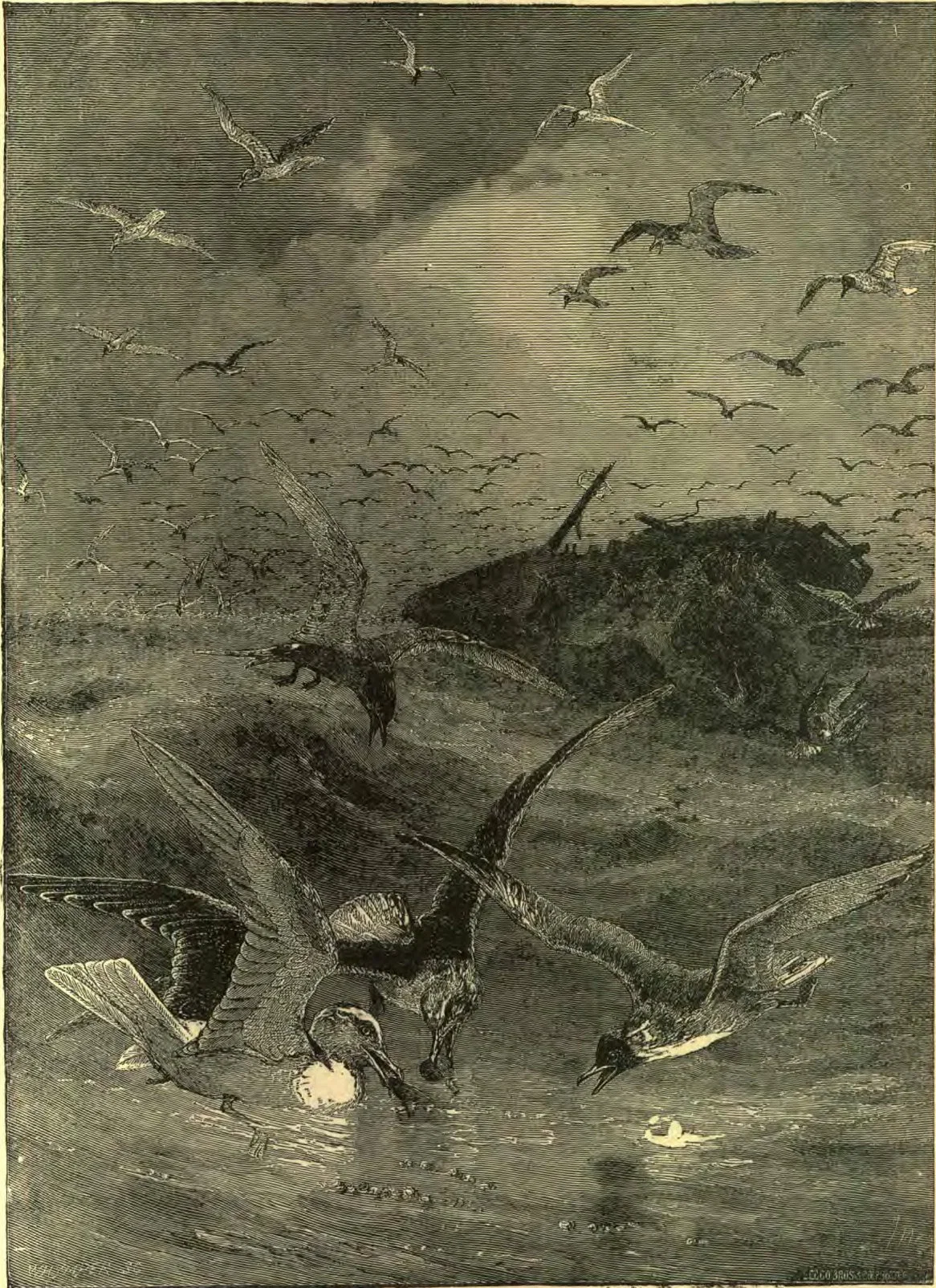
THE STORMY PETREL.
THIS is the bird that sweeps o'er the sea— Fearless, and rapid, and strong is he; He never forsakes the billowy roar To dwell in calm on the tranquil shore, Save when his mate, from the tempest's shocks, Protects her young in the splintered rocks.
Up and down! up and down! From the base of the wave to the billow's crown, And amidst the flashing and feathery foam, The stormy petrel finds a home— A home, if such a place may be, For her who lives on the wide, wide sea, On the craggy ice, in the frozen air, And only seeketh her rocky lair To warm her young, and teach them to spring At once o'er the waves on their stormy wing! All over the ocean, far from land, Where the storm-king rises, dark and grand, The mariner sees the petrel meet The fathomless waves with steady feet, And a tireless wing, and a dauntless breast, Without a home or a hope of rest.
O'er the deep! o'er the deep! Where the whale, and the shark, and the sword-fish sleep: Outflying the blast and the driving rain; The petrel telleth her tale—in vain; For the mariner curseth the warning bird, Which bringeth him news of the storm unheard! Ah! thus does the prophet of good or ill Meet hate from the creatures he serveth still; Yet he never falters: so, petrel, spring Once more o'er the waves on thy stormy wing!
So, 'mid the contest and toil of life, My soul, when the billows of rage and strife Are tossing high, and the heavenly blue Is shrouded by vapors of somber hue, Like the petrel, wheeling o'er foam and spray, Onward and upward pursue thy way!
UNCOVER THE FAULTS.
“Uncle, what are you doing?” inquired Reginald, with a perplexed face.
“I am getting rid of these offensive vegetables,” replied Uncle Prescott, as he pinned two great snowy sheets of paper together and reached for the third. “I see Dugald has neglected matters since I have been ill, and left this poisonous heap upon the barn floor.”
“But what is the paper for, Uncle?”
“To cover it up, to be sure,” replied Uncle Prescott, rapidly pinning away, until the thick white paper began to stand like a great cone over the offensive heap upon the floor.
Reginald did not quite know what to say, and Uncle Prescott having completed the cone, glanced back at it as though with satisfaction, and left the barn, with Reginald walking quietly at his side, deep in thought as to what Uncle Prescott’s idea could possibly be.
“I am glad that uncomfortable object is out of sight,” said Uncle Prescott at length; “I wonder Dugald never thought to cover it up.”
“Uncle, what is the use of covering it up?” inquired Reginald; “it is just as offensive.”
“It is surely better covered up than exposed to the eye. It is best, is it not, always to cover up any such object?”
“But, Uncle, it is there all the same.”
“So it is; but if nobody sees it, the fact of its being there cannot amount to anything, can it?”
“Yes, sir,” replied Reginald, a little uneasily; “we know it is there just as if it were not covered.”
“We know, of course, but other people do not, and we will not be likely to tell them.”
Reginald glanced a little shyly toward Uncle Prescott, but did not seem inclined to give up the subject.
“It poisons the air just the same, does it not, Uncle? I have heard you talk a great deal about all such things being unwholesome to have around.”
“What is the difference, so that people do not find it out? You see nobody would suspect anything impure under that snow-white paper.”
“But, Uncle,” exclaimed Reginald, in perplexity, “what is the use of having it there; why not uncover it, and clear it out, and be done with it?”
“Why do you ask such unreasonable questions, Reginald? Your words and your actions do not agree.”
Reginald thought, although he did not dare to say so, that Uncle Prescott’s present action and past words did not agree, but he simply asked: “Why, Uncle?”
“I cannot tell why they do not agree, unless it is because it is better always to cover up our real motives and manner of doing things when we know they are not quite as they should be.”
Reginald’s face flushed, and Uncle Prescott continued: “Why is it that you do not approve of my covering up the poisonous matter, and of making all pure to the eye? You know, boy, you work every day to pin white paper over a place of poison.”
Reginald looked up in dismay.
They had reached the house, and Uncle Prescott sat down on the long settee in the hall, and drew Reginald close to his side.
“Reginald,” he said, in a low and tender voice, “I am more sorry for you than you can guess. Your heart is not a pure, true heart; it sends out poisonous thoughts. Why do you cover them up and keep them; why do you try to seem white while underneath is the hidden trouble?”
Reginald’s eyes sought the floor; he could not look in his uncle’s face now. He knew his heart was not pure and true, that it only appeared to be so, but he had thought that his uncle believed in him.
“When you broke the rose-bush, why did you make it appear that your baby cousin had pushed the box over and damaged the bush? When you dropped the hatchet into the cistern, why did you cast the blame on your little friend? When you broke my choicest grapes from the vine, why did you arrange that Dugald should be suspected of the act? Had you acknowledged the wrong deeds, you would have been endeavoring to lay bare the poison in your heart, and to take the first step toward getting rid of it; but, though you know it is there, and is dangerous, and degrading, you keep it, and cover it, and work to hold on to it, and want nobody to know about it, and try to appear white and clean, when, in fact, under your pleasing face and manners is a corrupt heart.”
Had Uncle Prescott struck Reginald a blow, he would have been man enough, in his own way, to have borne it; but those words were worse than blows. He had a certain amount of pride which made him wish to be respected, and thought well of. He did not care so much about being honorable, but he liked to be thought so. He had imagined that Uncle Prescott believed all he said, and thought him a fair, square boy.
His pride was wounded; his good opinion of himself was humbled; he looked so utterly wretched that Uncle Prescott took his hand and drew him close to his knee.
“Reginald,” he said kindly, “I am only pulling some of the white paper off, and looking at the impurity underneath. Tell me truly, do you think you have a corrupt heart?”
Reginald quailed under the question. To be asked to own having such a possession was a staggering requirement; yet he knew his uncle’s charge was true, and he could do nothing but acknowledge its truth.
“You cannot easily be rid of the impurity, my boy,” said Uncle Prescott; “you have hidden it, and kept it, and fed it until it has overgrown the good in you. You have made it your sole object to try to appear good and pure; do you wish to go on feeding and hiding the poison, while it grows more and more powerful and impure?”
Reginald was too heartily ashamed of himself to have much to say, and while declaring that he did not wish to continue doing as in the past, was much concerned to know how much of his deception, and how many of his tricks, perpetrated during the past few weeks spent in his new home, had been discovered by Uncle Prescott.
“If you do not wish to continue hiding and keeping this poison, let us begin now to pull the pure, white paper off of it,” said Uncle Prescott; “what did you cover up yesterday? I must have the secrets of each day since the time you came to share my home. Tell me frankly, what did you cover up yesterday?”
Reginald glanced at his uncle and then at the floor. He was not all bad; he did think it would be more comfortable to be true and honorable. He did feel a longing to be rid of his present inner life; he saw himself as he had never seen himself before; he felt a loathing for the acts he had only thought clever and smart.
“Uncle, you would hate me!” he exclaimed, passionately; “I never can tell you the half.”
“Suppose I do hate you; suppose I never do and never can forgive or forget it; suppose you lose me as your friend; what can that matter in comparison to losing your soul, your self-respect, the respect of the whole world who may ever happen to hear of you, losing your own heart of honor? Uncover the poison, Reginald, and let me help you get it out of you, no matter how it hurts, or where it hits, or what becomes of you and of me afterward. You can afford to lose me if you can get rid of the dishonor which is destroying all the good that ever was in you.”
Reginald was looking in his uncle’s face; he was true with a sudden honor. He recounted trick after trick, accidents and deceptions, and Uncle Prescott could have been angry enough had he not been in soul-earnestness helping Reginald fight a fight never to be forgotten.
Reginald, having confessed every fault he could think of, waited to hear the words which would banish him from his new home; but his uncle took his hand kindly, saying: “I believe you have faithfully torn off the covering, and tried to take the first step toward removing the impurity underneath; do you promise me at this moment, which is a solemn one, my boy, that you will faithfully, honorably bring the faults of every day to me and uncover them, no matter what their nature, rather than hide them to turn to poison in your heart?”
Reginald’s promise was not a promise meant to be broken; and if in after-time he was tempted and failed and began again, are you not very sure that his heart of dishonor gradually shrunk away, as it was kept uncovered and brought to the light, while the owner grew to be happy, honorable, and true?—N. Y. Observer.
UNDER THE SNOW.
By The Well-Spring
On the early spring time of the year,
Under leaves and branches brown and sere,
Clinging closely to the ground,
There the sweet May-buds are found,
Fresh and fair.
Do you ask why thus they're growing?
Is there not enough in knowing
They are there?
So in work and study something lies,
Which, when once you find it, is a prize.
If at first you can subdue
All hard things that come to you
Day by day,
Even so all tedious duty
To a sweet and glowing beauty
Shall give way.
—The Well-Spring.
BOYS. DON'T SWEAR.
By Dudley Marvin Canright
I should be very sorry to think that any of the boys who love and read the INSTRUCTOR ever swore. They may associate at the day school or somewhere else with boys who are profane; and they may, by such examples, sometimes be tempted to use bad language. So I want to warn them against it while their minds are pure.
Let us now consider why it is wrong to swear. First, one of God's commandments plainly forbids us to do it. Thus it reads: “Thou shalt not take the name of the Lord thy God in vain; for the Lord will not hold him guiltless that taketh his name in vain.” This forbids us even to speak God's name in vain, that is, in a jesting manner, in anger, or in any other than the most reverent way. And it is specially wicked to use his holy name in cursing and swearing.
See in what a solemn manner the Lord gave that commandment. The great Jehovah himself came down upon Mount Sinai in the most terrible majesty, with thunders and lightnings, while the earth shook and trembled. The mountain was covered with a thick cloud, while lightnings flashed and thunders rolled, and fire burned up toward the heavens. All the people stood around the mountain. Then God spoke, and his voice shook the earth. He told them they must not take his name in vain. The people were terribly afraid, as well they might be. I think they must have remembered the commandment a long while.
But in order that they might not forget it, God himself wrote these words with his own finger upon a table of stone, and had it put in the most holy place in the sanctuary. By this you can see that he wished them to understand that it is a terrible thing to profane his name.
Now think who this God is whom some men blaspheme so readily. He created the whole earth, the land and the water, the hills and the mountains, the beasts and men; and he also made the sun, moon, and stars, and every thing in heaven, even the angels. Around his throne stand thousands of holy angels, all bright and glorious. They sing his praise; they bow down before him, and cry, “Holy, holy, holy, Lord God Almighty.” Now think of a little boy down here on the earth cursing and profaning the name of so great and terrible a Being!
Very soon all these boys will have to stand right in the presence of this holy God, right before his face at the Judgment, and give an account of every word they have spoken. How will they feel, then, when they hear read to them, right before the face of God, the oaths which they have uttered? It will not sound as smart and manly then as they now think it does. Better beware, boys, before you begin such terrible work.
What is the use of swearing? It does not do any good to any one. If a person steals, he gets something which he can use; but when a person swears, it does him no good, nor any one else. It is the most foolish thing a person can do. It only insults God without benefiting anybody.
Swearing is only an evil habit which persons allow themselves to fall into. They imagine it adds force to what they say; but no one believes them any more because they swear. Indeed, a swearer is not believed as soon as a person who does not swear. We generally think that a boy who is not afraid to swear is not afraid to lie. Thieves, robbers, drunkards, and murderers are nearly always swearers. Just think of that list, boys. Do you want to be classed with them? If you don't mean to, then don't learn to swear, for that generally goes with the others.
No real gentleman will ever swear. No boy who has good manners will use an oath. The moment we hear him swear, we mark him as ill-mannered and vulgar, as well as wicked. It lowers his character, and detracts from his refinement. So, boys, we say, don't begin, don't allow yourself to do it even once. Not only should you not curse and swear by God's name, but you should not swear by anything. Some use by-words, and swear by them. This is wrong too. Jesus plainly says, “Swear not at all.” Matt. 5:34. He says you shall not swear by heaven, nor by your head, nor by anything. Say what you have to say, and leave all the oaths out. By doing this you will please God, and have one mark of a gentleman and a Christian. D. M. CANRIGHT.
WHAT MAKES A LADY?
A SHABBILY dressed woman accidentally ran against a superb-looking woman whose dress and manner indicated the perfect lady.
“I beg your pardon, madam,” said the poor woman in the most humble manner.
“You clumsy thing!” angrily retorted the elegantly clad woman.
Which was the lady?
THE INDESTRUCTIBILITY OF GOLD.
The Sacred Record says, “And the street of the city was pure gold, as it were transparent glass.” If, as Sir Henry Vivian observes, gold may be considered an “everlasting, indestructible metal,” how appropriate that it should be the one chosen for the streets of the New Jerusalem. We need have no fears but that “noble” metal which withstands all the tests that are now brought to bear upon it for its destruction will be enduring in the new earth, which will remain forever. As proof of its indestructible nature, this gentleman says:—
“The pure acids have no effect upon it. Air and water are alike prohibited from working its destruction. While to baser metals they are decay, to gold they are innocuous.”
“Bury it through long ages, and when the rude tool of the excavator again brings it to light, while everything around it and originally associated with it has returned to dust from whence it sprang; while the delicate form which it adorned has become a powder so impalpable as to be inappreciable; while the strong bone of the mighty warrior crumbles as you gaze upon it; while his trusty sword lies a mass of shapeless rust, the delicate tracery in gold which adorned it, or the finely-wrought tiara which encircled the lofty brow of the fair damsel there in its pristine beauty, perfect as when it left the workman’s hands, and became the joy of her fleeting moments.”
“Yes; days, years, centuries upon centuries, have rolled by; mighty empires have risen and fallen; dynasties that dreamed their power was to be everlasting have passed away; armies have marched, conquered, and become nerveless with decrepit old age; cities teeming with population and commerce have become the dwelling-place of the owl and the bat; the very pyramids themselves, raised in the pride of power, and destined to be forever, are crumbling; and yet that thin filament of gold has stood unchanged through all these mighty changes. It has withstood triumphantly the destroying hand of time. It is to-day what it was three thousand years ago.”
THE TEACHER IN THE HOMES OF HIS SCHOLARS.
VISITING is much neglected, and where practiced, is more often than not undertaken on a wrong principle. The teachers who visit, generally go to find fault—to report that Tom has not been at school for so many Sabbaths, that James has been behaving very badly, that Charles ran away from church, or to make many similar complaints.
The teacher should not visit in order to complain. Let him complain when he is there if it is necessary, but in nine cases out of ten the mother will do the complaining, and the teacher may show the more amiable side of his character in sympathy with and interest in his boys; and in earnest anxiety for their welfare, and happy is the teacher who can make a special visit to the home of any of his boys with the view of giving a report of specially good or praiseworthy conduct.
Let the teacher visit regularly and systematically, not for the purpose of finding fault, and not in sudden spurts only, but specially in order that he may show his boys and their parents that he is their friend, and that he does think of them, and love and care for them and also for himself, that by gaining a knowledge of the home life of his lads, he may the better adapt his teaching to their needs, their difficulties, trials, or special circumstances. The teacher who does this will find that a house-going teacher makes a school-going class.—S. S. Magazine.
IMPORTANT BIBLE SUBJECTS.
LESSON 14.—THE SANCTUARY AND ITS CLEANSING.
(Review.)
[NOTE TO THE STUDENT.—Do not consider the lesson learned until you can give at least the substance of every text, with the correct reference for each. The references in black letters indicate those texts that should be committed to memory. A little diligent application each day will enable you to learn them, although this need not be considered a test of scholarship.]
1. After ascending from the earth, what position did our Saviour take? Heb. 4:14; 8:1.
12. Why was so much importance attached to the blood?—Because it represented the life of the victim.Lev. 17:11.
13. What was signified by the sprinkling of the blood upon the mercy-seat?—That the law beneath the mercy-seat demanded the life of the one who had transgressed it.
14. What were all these ceremonies meant to impress upon the minds of men?—That by disobeying God, they had forfeited all right to eternal life; and their only hope of salvation was in the promised Redeemer, who would make an atonement for them.Eze. 18:4; 1 John 3:5; 2 Cor. 5:21.
15. Who bears the sins of penitent believers? 1 Pet. 2:24.
16. How long will he continue to bear them?—Till they are blotted from the books of record, and laid upon the head of Satan.
17. In what two ways, then, do the sins of penitent believers find their way into the heavenly sanctuary?—Christ bears them there, and they are recorded in the books.
18. How was it in the worldly sanctuary?—The priest bare them in figure till the cleansing of the sanctuary, and it would seem that the blood which stained the altar recorded them.
20. What must constitute a part of the cleansing of the sanctuary?—The blotting out of the sins recorded there.
21. What must take place before they can be blotted out?—They must first serve their purpose in the Judgment.
22. What follows from this?—That the cleansing of the sanctuary must include an examination of the books, to see who of those that have once entered the service of God are entitled to have their sins blotted out.
23. Whose names will be retained in the book of life? Rev. 3:5.
25. What will constitute the complete cleansing of the sanctuary?—The blotting out of sins, and the laying of them upon the head of Satan, the antitypical scapegoat.
26. What will be done with the sin records that are not blotted out?—They will be reserved to be examined during the judgment of the thousand years, that sentence may be rendered accordingly, and will confront the sinner when his day of perdition and execution comes.2 Pet. 3:7; Rev. 20:12-15.
OFFICERS, ATTENTION.
By Editor
The Sabbath-School Worker has now entered well upon its second year. Its future publication is an assured fact. Will you give it a liberal support? The discussion of subjects of special interest will commence with the April number, and we hope none will lose the benefit of it.
A full report of the Convention now in progress at the Battle Creek College will begin with this issue, giving plan of organization, methods of conducting, and topics considered. As all the addresses are stenographically reported, a synopsis, at least, of each one will appear, the whole report probably continuing through two or more numbers. One design of the Convention is to prepare something definite that can be useful to others in similar gatherings. The report will appear in no other paper.
The wonderful avenue for successful work which the Sunday-schools are presenting to our people, and the best plans for organizing and conducting them will also be discussed in the April number. It is hoped that a more general interest will be taken in this paper, and that none will lose the valuable instruction just commencing in its columns. We trust that special efforts will be made by all the officers, to see that the teachers all receive the paper.
PUBLISHERS S. S. WORKER.
HOUSEKEEPING IN JAPAN.
If our readers will bring to mind Mrs. Leonowens’ trials at housekeeping in India, printed in No. 7, of present volume, they will observe a marked difference in contrast with Japanese housekeeping. A lady writing from the latter place says:—
“Housekeeping here has no trials. The worn and vexed spirits of American châtelaines ought to rest in Japan after death. Capable and faithful servants are plenty and cheap. Our establishment boasts five, and for these we pay about what two would cost in New York. I do not visit my kitchen once a month, never give an order outside of a spoken wish, yet the domestic machinery moves with an ease and perfection unattainable at home by almost any effort on the part of the mistress. The manners of the servants are amusing, not to say startling, to an American accustomed to the cheerful familiarity of her native help. Every night at bed-time our five retainers appear, prostrate themselves in succession to the earth, and retire. This is to wish me good-night, and to renew their testimony of profound respect and pleasure over the privilege of serving me. It was difficult at first to preserve the necessary dignity for the ceremony, but now I am as majestically gracious as any other potentate. The other day, on one of my rare visits to the kitchen, a hair-pin became loosened and dropped without my notice. I had been seated in my own room only a few moments when my houseman entered, bearing a small salver, which he presented to me with many genuflections. Fancy my surprise to see a little hair-pin upon it, and to learn from my proud but embarrassed servitor that it had fallen to the kitchen floor from my head. Afterward I found there had been a discussion as to who should pick it up, and almost a quarrel as to whom belonged the inestimable honor of bearing it to its owner!”
ABOUT OPALS.
The mineral called opal is composed of silex combined with from 5 to 13 per cent of water. There are many varieties of this stone. The most valuable are the precious opal, exhibiting a peculiar play of delicate, rainbow-like tints, which makes it valuable as a gem, and the fire opal, which is less transparent, and of the color of flame. The ancients ranked the precious opal among the most valuable gems; and Pliny speaks of it as presenting a variety of brilliant tints in succession, first one color, and then another. It is used much for jewelry and other ornaments; but the fire opal is too rare to be employed thus.
Opals are sometimes rated at very high prices. Two belonging to the crown-jewels of France cost 75,000 francs. One from Hungary, at the great exhibition of 1851, was valued at £4,000.
The St. Louis Globe Democrat says of opals:—
“The mineralogists and geologists have offered many very clever theories to account for the splendor of the opal, but no one has completely satisfied everybody, and perhaps never will. It is conjectured that it is due either to the presence of water in its composition or to the disintegration of the laminæ or layers of stone; but even this is not certainly known. The Turks believe that the gem is of celestial origin, and thus escape all difficulties at once. The ancient opal mines have never been discovered, but there were no doubt deposits of the precious stones in Arabia, Syria, and perhaps other parts of Asia, from which the ancients obtained their gems.”
“Central America and Mexico abound in opal-bearing districts, which are much more abundant than might be supposed. But perhaps the finest opals of the present day are obtained in Hungary. The fire opal is found in the greatest perfection in the porphyrite rocks near Zimapan, in Mexico; but while this variety is the most beautiful of opals, it is also the most sensitive, and is frequently ruined beyond the hope of repair by damp or exposure, or even by a sudden change in the weather. There is probably no gem, however, which is more subject to injury than the opal. Exposure to the light injures it very materially, though there is not one thing strange about this, the fact being true also of the amethyst, the garnet, and almost all other precious colored stones.”
“As stated, the finest opals are now found in Hungarian mines. When first extracted from their matrix, the gems are soft, friable, tender, and easily broken. The first thing to be done is to expose them to the air and light for a few days, until they have become hard, and then their colors begin to appear. At the same time this change takes place in the gem, it becomes also reduced in size from the evaporation of the quarry water contained in its veins. Great care must be exercised in drying the stone, or it will split and crack in a thousand directions, and become utterly worthless. It is also liable to another calamity if exposed to a high temperature—that is, of losing iridescence; and when this once happens, the stone is absolutely worthless.”
A SUBSTITUTE FOR SOAP.
The espinosilla, or thorn plant, is one of those beautiful wild plants which adorn the plains of Mexico, and is found particularly in cold, dry spots. It has been thus christened because on touching it a sensation is felt similar to that which a plant covered with thorns would produce. The Aztecs lacking soap, so necessary to their health and happiness, found its substitute in the espinosilla. They agitated a bough in the water and it produced a lather with which they washed, using the plant as a scrub-brush. Even to-day it is used by women as a hair-preservative, having extraordinary powers in that direction. But its most useful application is a medicinal to fight fevers, as it is an excellent diaphoretic. Its ancient name is beautiful—Hoititzilxochoti, a compound word, hoitzitzil, humming-bird, and xochoti, a flower; thus translated, meaning “flower of the humming-bird.” The Spaniards called it huitchichile, signifying sparrow, a name given it on account of the resemblance between the color of the flower and that of a sparrow’s head plumes.—Two Republics, Mexico.
THE CANDLE-FISH.
Most all of you have heard of the candle-fish, which in some places is used as a light-giver. A writer in St. Nicholas says:—
“This fish is so very oily that all you have to do is to fasten it by its tail between two pieces of wood, touch a match to its head, and a pale flame will arise from its mouth, that lasts until, like a candle, the fish is slowly consumed.”
This writer says further:—
“The candle-fish is a very important one to persons living on the north-western coast of North America. At certain seasons they swarm the bays and rivers in vast numbers, and every native man, woman, and child is engaged in capturing them. To do this they actually comb them in. The boats drive them in shore, where each native, armed with a gigantic weapon with teeth eight inches long, sweeps or combs them up by the hundred.
“When the boats are loaded full, the fish are carried ashore, where women and children take charge of them. After being dried and smoked, they are ready for candles. They are also used as food, and in that case the oil is tried out and put away for winter use.
“But what is very curious, these natives find also in the sea the bottles in which to stow away the oil. Far down at the bottom of the Pacific grows a great weed with a hollow stem. This the natives in some way manage to obtain; they then cut it into lengths of about three feet each, and stop up the ends with fish skin. And so they obtain light, food, and bottles from that excellent provider, Old Ocean.”
THE DEEPEST MINE.
The deepest mine in the world of which we can find any authentic record is situated at Wieliczka, a small town of Austrian Galicia. This town is literally undermined by excavations, which extend 9,600 feet from east to west, 3,600 feet from north to south, and 1,800 feet in depth. The mine produces about 62,000 tons of salt a year. It is divided into four stories, one above the other, in the second of which a salt lake is situated. In one of the chambers the miners have scooped out a Gothic chapel, and skillfully carved a number of statues and obelisks from the solid rock-salt.—Golden Days.